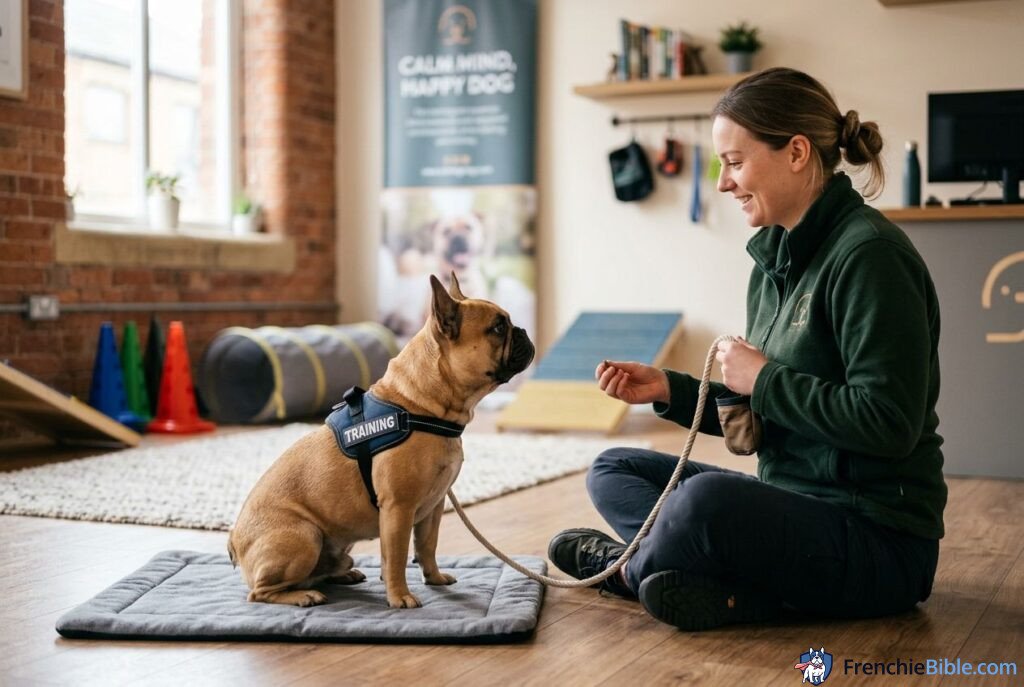
Welcome to the wonderful world of French Bulldog training! If you are a novice or intermediate Frenchie owner looking to strengthen your bond with your furry best friend while providing them with essential mental stimulation, you have come to the right place. As a passionate French Bulldog breeder with over 10 years of hands-on experience, I have dedicated a significant portion of my life to understanding the unique genetics, behavioral psychology, and daily care routines of this incredible breed. Today, I am going to share my proven, super simple step-by-step methodology for teaching your French Bulldog how to give a “Paw” (shake hands) and eventually transition that skill into a crowd-pleasing “High Five.”
Training a French Bulldog is an incredibly rewarding experience, but it requires a deep understanding of their specific temperament. Frenchies are notoriously comical, affectionate, and sometimes incredibly stubborn. They are not the Golden Retrievers of the dog world; they require a different approach—one that leverages their love for food and their desire to please their owners, all while keeping the sessions short, engaging, and positive. In this comprehensive guide, we will break down the exact steps you need to follow, explore the psychology behind how Frenchies learn, troubleshoot common problems, and answer your most frequently asked questions.
Related Reading: Health & Diet | Frenchie Puppy Guide
Let us dive right into the ultimate guide to teaching your French Bulldog to shake paws and high five!
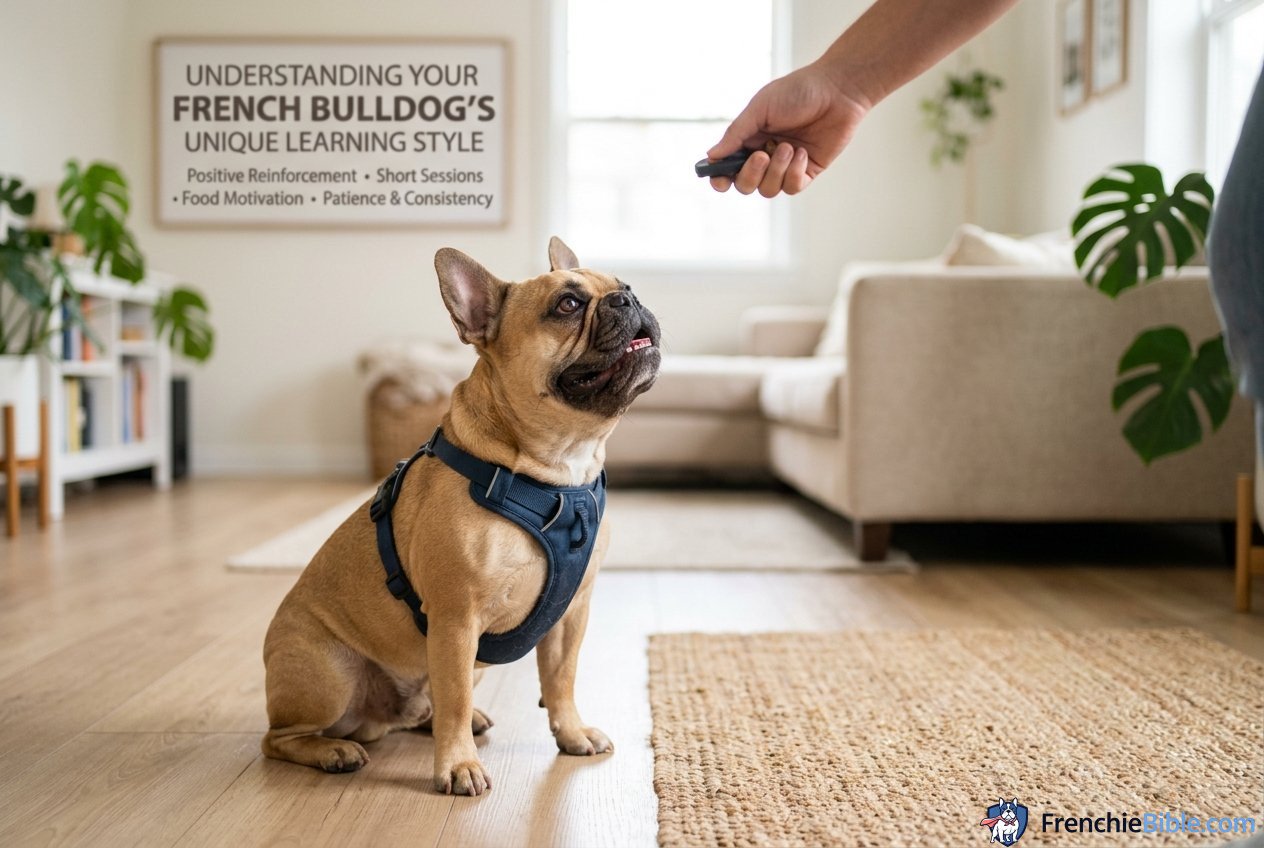
Understanding Your French Bulldog’s Unique Learning Style
Before we even grab a bag of treats and start asking your dog for their paw, it is absolutely crucial to understand how the French Bulldog brain works. With over a decade of breeding and observing these dogs, I can tell you that their learning style is distinct.
The “Stubborn” Myth and Frenchie Intelligence
Many people mistakenly label French Bulldogs as “stubborn” or even “unintelligent.” This couldn’t be further from the truth. Frenchies are highly intelligent, but they are also independent thinkers. Unlike working breeds that were bred to blindly follow human commands all day long, Frenchies were bred to be companions. They will often weigh the pros and cons of listening to you. If the reward isn’t high enough, or if they are simply not in the mood, they might pretend they didn’t hear you.
This means that as an owner and trainer, your job is to make training more exciting than whatever else is happening in the room. You have to convince your Frenchie that giving you their paw is the absolute best, most rewarding thing they could be doing at that moment.
The Power of Positive Reinforcement
In my ten years of raising French Bulldogs, the single most important lesson I have learned is that positive reinforcement is the only way to train this breed. Frenchies are incredibly sensitive to their owner’s emotions. If you become frustrated, raise your voice, or use punitive training methods, a Frenchie will simply shut down. They will refuse to cooperate and may even develop anxiety around training sessions.
Positive reinforcement means rewarding the behaviors we want to see (in this case, lifting the paw) and ignoring the behaviors we don’t want. When your Frenchie successfully gives you their paw, it should be met with immediate praise, enthusiasm, and a high-value treat.
The Importance of Timing in Dog Training
Timing is everything when it comes to dog training. When your French Bulldog lifts their paw and touches your hand, you have a window of about one to two seconds to deliver the reward so that they associate the action with the prize. If you wait five seconds to give them the treat, they might think they are being rewarded for sitting, looking away, or just breathing.
To help with timing, many trainers use a “marker word” like “Yes!” or a mechanical clicker. The moment the paw touches your hand, you say “Yes!” (or click) and then immediately give the treat.
Preparation: Setting the Stage for Success
Proper preparation is half the battle. You cannot expect your Frenchie to learn a new trick in a chaotic environment. Here is how you need to prepare before starting our step-by-step guide.
1. Choosing the Ultimate High-Value Treats
French Bulldogs are famously food-motivated, which is a massive advantage for us. However, standard dry kibble usually won’t cut it when you are teaching a brand-new behavior. You need “high-value” treats. These are treats that your dog rarely gets and absolutely goes crazy for.
Great options include:
– Small pieces of boiled plain chicken breast
– Tiny cubes of low-fat cheese
– Freeze-dried liver treats
– Small dabs of dog-safe peanut butter (xylitol-free!)
Breeder’s Nutrition Tip: Because Frenchies are prone to weight gain and have sensitive digestive tracts, make sure the treats are very small—about the size of a pea. You want them to taste the reward without getting full quickly or upsetting their stomach.
2. Finding a Distraction-Free Environment
For the first few training sessions, you need to be in a quiet room with zero distractions. No other pets running around, no loud televisions, and no kids playing with toys nearby. A quiet living room or bedroom is perfect. Once your Frenchie has mastered the “Paw” command in a quiet room, you can gradually introduce distractions, but initially, you want their 100% undivided attention.
3. Keeping Sessions Short and Sweet
French Bulldogs have relatively short attention spans when it comes to repetitive tasks. They get bored easily. Therefore, your training sessions should never exceed 5 to 10 minutes at a time. It is far better to have three 5-minute sessions spread throughout the day than one frustrating 15-minute session. End every session on a positive note, even if it means asking them for a simple “Sit” that they already know, just so you can reward them and throw a mini-party.
The Step-by-Step Guide to Teaching “Paw” (Shake Hands)
Now that you understand the psychology and have your high-value treats ready, it is time to get to the fun part. Teaching “Paw” is one of the easiest tricks because it relies on a natural instinct: dogs naturally use their paws to investigate things they want.
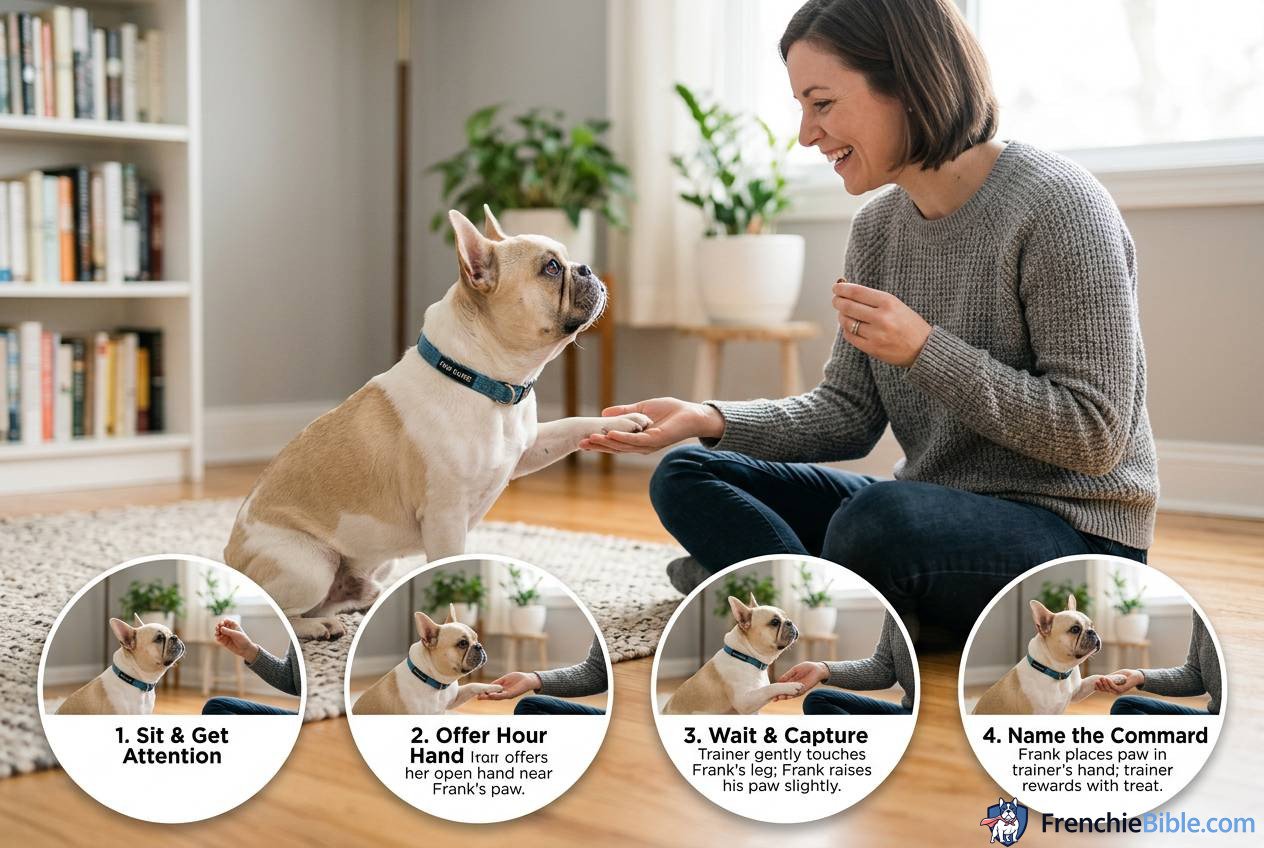
Step 1: The “Treat in the Fist” Method
- Have your dog sit: Start with your Frenchie in a sitting position facing you. If they don’t know “Sit” yet, you will need to teach that fundamental command first.
- Hide the treat: Take a high-value treat and enclose it completely in your fist so your dog cannot see it, but can definitely smell it.
- Present your fist: Hold your closed fist out directly in front of your Frenchie’s nose, just slightly off to the side of the paw you want them to lift. Keep your hand at chest level for them.
- Wait for the paw: Your Frenchie will likely sniff your hand, lick it, or gently nibble at it trying to get the treat. Do nothing. Just patiently wait. Eventually, out of frustration or natural instinct to dig at a puzzle, they will lift their paw and scratch or tap your closed fist.
- Mark and Reward: The exact millisecond their paw touches your hand, say your marker word (“Yes!” or “Good!”) enthusiastically, immediately open your fist, and let them eat the treat.
Repeat this step 5 to 10 times until your dog consistently taps your fist with their paw as soon as you present it.
Step 2: Delaying the Reward
Once your dog is reliably whacking your closed fist, it is time to refine the movement.
1. Present your closed fist with the treat inside.
2. When they tap your fist, do not open it immediately. Let their paw rest on your hand for a fraction of a second longer.
3. Say “Yes!” and open your hand.
This teaches them that the goal is not just to hit your hand, but to place their paw in it.
Step 3: Introducing the Verbal Cue (“Paw” or “Shake”)
Up until this point, we haven’t used any command words. Dogs learn visual and physical cues much faster than verbal ones. Now that the behavior is predictable, we add the word.
- As you present your closed fist, clearly say your chosen cue word: “Paw” (or “Shake”). Choose one word and stick to it; consistency is key.
- As soon as they place their paw on your fist, say “Yes!” and reward them.
- Practice this for another 5 to 10 repetitions. Your Frenchie is now associating the word “Paw” with the physical action of lifting their foot.
Step 4: Fading the Lure (The Empty Hand)
This is the critical step where we remove the “bribe.”
- Hold out an empty fist in front of your dog, but keep the treats accessible in your other hand behind your back or in a treat pouch.
- Say the command “Paw.”
- Because they have built muscle memory, they should still lift their paw and place it on your empty fist.
- The moment they do, say “Yes!”, open your empty fist to show them there is no treat there, but immediately use your other hand to deliver a treat to their mouth.
If your dog just stares at your empty fist and does nothing, they aren’t ready for Step 4. Go back to Step 1 for a few more sessions to reinforce the behavior.
Step 5: Opening Your Hand
The final step for the classic “Shake Hands” trick is to present an open palm instead of a closed fist.
- Ask your Frenchie to sit.
- Present your hand flat, palm facing up, exactly where your fist used to be.
- Say “Paw.”
- When they place their paw in your open hand, say “Yes!”, gently grasp their paw for a second (don’t squeeze!), and deliver the treat from your other hand.
Congratulations! Your French Bulldog now knows how to shake paws.
Leveling Up: Transitioning from “Paw” to “High Five”
Once your French Bulldog has mastered “Paw,” teaching them “High Five” is incredibly easy. A High Five is essentially the exact same behavior as a Paw, just with your hand in a different physical orientation.
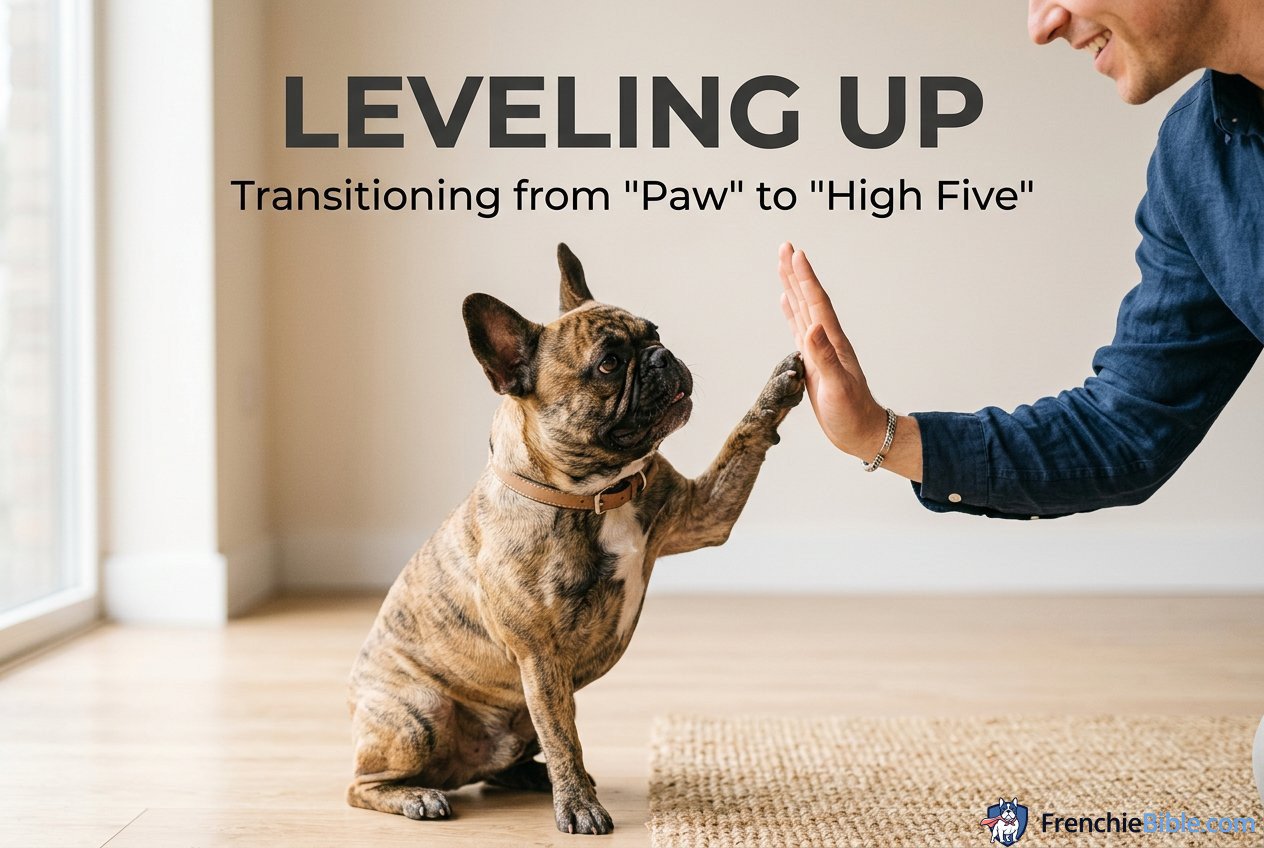
Step 1: Modifying the Hand Target
Start by asking for a regular “Paw” with your open hand palm up. Reward them. Do this twice just to warm up their brain.
Now, instead of holding your hand flat with the palm facing the ceiling, hold your hand vertically, with your palm facing your dog (like a stop sign), but keep it very low to the ground—at the exact same height you were asking for the “Paw.”
Step 2: Using the New Cue Word
Say your new command word clearly and enthusiastically: “High Five!” (or just “Five!”).
Because your hand is in the same general area, your dog will naturally lift their paw to hit your hand, even though it’s sideways. When their paw hits your vertical palm, say “Yes!” and give them a jackpot reward (two or three tiny treats instead of one).
Step 3: Gradually Raising the Height
The key to a great High Five is getting the dog to reach up. Right now, they are doing a low-five.
Over the next few training sessions, gradually raise your vertical hand an inch higher each time you ask for a “High Five.” If you raise it too high too fast, your Frenchie might get confused and just stare at you or try to jump up.
If they fail, simply lower your hand back to the last successful height and try again. French Bulldogs have a unique, top-heavy physical structure, so don’t expect them to reach incredibly high without losing their balance. Keep the height comfortable for their specific body type.
Troubleshooting Common Training Issues
Over my 10 years of experience breeding and raising Frenchies, I have seen every training roadblock imaginable. If your Frenchie isn’t picking up the trick, do not worry. Here are the most common issues and exactly how to solve them.
Problem 1: My Frenchie is Using Their Mouth Instead of Their Paw
When you present a closed fist full of treats, many food-motivated Frenchies will default to licking, nibbling, or even gently mouthing your hand to pry it open.
The Solution: Patience and strict boundaries. Do not pull your hand away, as this can turn into a game of tug. Keep your fist completely still and ignore the mouthing. The second they realize their mouth isn’t working, they will try something else—usually their paw. The instant the paw touches, reward heavily. They will quickly learn that “Paw gets the treat; teeth get nothing.”
Problem 2: My Frenchie Just Stares at Me Blankly
You hold out your fist, and your Frenchie just sits there, staring at you like you have two heads.
The Solution: First, check your treats. Are they high-value enough? If your dog isn’t motivated, they won’t work. Second, your dog might just be confused. Try wiggling your fist slightly to encourage them to investigate it. Alternatively, you can try “capturing” the behavior. Gently reach down, physically lift their paw, place it on your hand, say “Paw,” and treat them. Do this a few times to jump-start their brain, then go back to waiting for them to do it independently.
Problem 3: My Frenchie is Scratching Too Hard
Frenchies have surprisingly strong little legs. Sometimes, in their excitement, they will smack your hand hard, leaving scratches from their nails.
The Solution: This is an opportunity to teach impulse control. If they hit your hand too hard, pull your hand away, say “Too hard,” and withhold the treat. Wait five seconds, and try again. Only reward gentle taps. Furthermore, hard scratching is a great reminder from a breeder’s perspective: keep those nails trimmed! Long nails not only hurt you during training but can cause serious joint and structural issues for your Frenchie over time.
Problem 4: My Frenchie Gets Frustrated and Barks or Walks Away
If your dog is vocalizing out of frustration or simply abandoning the training session, you have either pushed them too far, the session has gone on too long, or the steps are too complicated.
The Solution: Lower your criteria. Go back to a step they were highly successful at. End the session with an easy win (like a simple “Sit”), give them a treat, and try again later. Remember, training must always be fun.
The Broader Benefits of Trick Training for French Bulldogs
Teaching your French Bulldog to give a Paw or a High Five is a neat party trick to show your friends, but as a breeder, I advocate for trick training for much deeper, more important reasons.
1. Superior Mental Stimulation
French Bulldogs might not need miles of running every day, but they desperately need mental exercise to stay happy and balanced. Mental fatigue is just as tiring for a dog as physical fatigue. Ten minutes of intensive trick training, where your dog has to use their brain to solve the puzzle of “how do I get that treat,” will exhaust them in the best way possible. This prevents destructive behaviors rooted in boredom, like chewing furniture or excessive barking.
2. Building an Unbreakable Bond
Training is a shared language. When you take the time to teach your Frenchie a trick using positive reinforcement, you are building trust. They learn to look to you for guidance, and they realize that working together with you is highly rewarding. This strengthens the human-animal bond far more than just cuddling on the couch.
3. Preparation for Grooming and Handling
Teaching the “Paw” command is incredibly practical. French Bulldogs are notorious for hating having their paws touched or their nails clipped. By teaching “Paw,” you are desensitizing them to foot handling. They learn that having their paw held by a human results in positive things (treats). This makes future nail trimming sessions, paw inspections after walks, and wiping muddy feet significantly easier and less stressful for both of you.
Frequently Asked Questions (FAQ)
Q1: At what age can I start teaching my French Bulldog puppy to shake paws?
A: You can start as early as 8 weeks old! Puppies are like little sponges. Keep the sessions to just 2 or 3 minutes and use extremely soft puppy-safe treats. Early training builds a foundation of learning and obedience that will last a lifetime.
Q2: My Frenchie will only give their paw if they see I have a treat in my hand. How do I stop this?
A: You are stuck in the “luring” phase. You need to heavily practice Step 4 (Fading the Lure). Use an empty hand to signal the trick, and produce the treat from behind your back or a pocket after they perform the trick. You must teach them that obedience brings the reward, not the other way around.
Q3: Can I teach my Frenchie to give the left paw and right paw specifically?
A: Absolutely! Once they master the basic “Paw,” you can teach differentiation. Offer your right hand and say “Right Paw.” If they give the left, ignore it. When they give the right, reward heavily. Then switch. It takes time, but Frenchies are definitely smart enough to learn right from left.
Q4: How often should I practice this trick with my French Bulldog?
A: Consistency is better than duration. Practicing for 5 minutes a day, every single day, will yield far better results than practicing for an hour once a week. Once they know the trick perfectly, ask for it randomly throughout the day—before putting their leash on, before setting down their food bowl, or just for fun.
Q5: Are French Bulldogs generally easy to train compared to other breeds?
A: “Easy” is subjective. They are not as eager to please as a Border Collie, so they won’t do tricks just for the sake of working. They require motivation (food or high-value toys) and a positive approach. If you make training a fun, rewarding game, they are extremely fast learners. If you try to force them, they become very “stubborn.”
Disclaimer: I am a breeder with over 10 years of experience, not a veterinarian. I do not hold any medical qualifications. The information provided in this article is based entirely on my personal experience in breeding, raising, and training French Bulldogs. This content is intended for educational and informational purposes only regarding daily care and training, and it absolutely cannot and should not replace professional medical advice, diagnosis, or treatment. Always consult with a licensed, qualified veterinarian for any questions or concerns regarding your dog’s health, diet, or medical conditions.