Welcome, fellow French Bulldog enthusiasts! If you have ever been dragged down the street by a muscular, compact, and surprisingly strong little Frenchie, you are not alone. As a French Bulldog breeding expert and enthusiast with over a decade of hands-on experience, I have seen my fair share of leash-pulling, stubborn behavior, and downright chaotic walks. But fear not—teaching your French Bulldog to “heel” and walk calmly by your side is entirely possible.
In this comprehensive guide, we will dive deep into the psychology, mechanics, and step-by-step process of heel training your French Bulldog. Whether you are a novice owner trying to establish basic manners or an experienced handler looking to refine your Frenchie’s obedience, this article will equip you with the secrets to transforming your stressful walks into peaceful, enjoyable strolls.
Related Reading: Health & Diet | Frenchie Puppy Guide
Understanding the French Bulldog Temperament and Leash Behavior
Before we embark on the journey of heel training, it is crucial to understand the unique mindset of a French Bulldog. Frenchies are known for their affectionate, playful, and sometimes remarkably stubborn personalities. They are intelligent dogs, but they are also independent thinkers. When a French Bulldog pulls on the leash, it is rarely out of dominance or malice; rather, it is usually a combination of excitement, curiosity, and a lack of proper impulse control.
The Physiology of the Pull
French Bulldogs have a low center of gravity, a sturdy build, and a surprisingly powerful chest and shoulder area. When they decide to pull, they engage their entire body weight, making them feel much heavier and stronger than their compact size suggests. Furthermore, as a brachycephalic (flat-faced) breed, pulling on a collar can put immense pressure on their delicate airways, leading to respiratory distress, coughing, and potential long-term damage to their trachea. This physiological reality makes heel training not just a matter of convenience, but a critical component of your Frenchie’s health and safety. The unique anatomical structure of the French Bulldog means we must be incredibly mindful of how we handle them on leash. Their short snouts mean they already have to work harder to breathe, especially in warm weather or during exertion. A collar pressing against their windpipe restricts this airflow even further. Over time, constant pulling on a collar can lead to tracheal collapse, a serious and progressive condition that causes chronic coughing and breathing difficulty. Therefore, controlling their movement and teaching them to walk without tension is a vital preventative health measure.
The Psychology of the Walk
To a French Bulldog, a walk is an overwhelming sensory experience. There are new smells to investigate, squirrels to chase, and other dogs to greet. The world is an exciting place, and their natural instinct is to rush forward to explore it. If they learn that pulling on the leash successfully gets them to their desired destination (a bush, a fire hydrant, or another dog), the behavior is reinforced. Your goal in heel training is to change this equation: to teach them that walking calmly by your side is the most rewarding choice, and that pulling gets them nowhere. Dogs are opportunistic creatures. They repeat behaviors that bring them rewards and abandon behaviors that do not. When a dog pulls and you follow, you are inadvertently rewarding the pulling. You are teaching them that pulling is the mechanism by which forward progress is achieved. To change the behavior, we must change the consequence. Pulling must result in forward momentum stopping completely, while a loose leash and attention to the handler result in moving forward and access to all the wonderful smells of the neighborhood.
The Importance of Mental Stimulation
Heel training is not just physical exercise; it is intense mental exercise for your French Bulldog. Walking on a loose leash and paying attention to your cues requires focus, impulse control, and continuous decision-making on the dog’s part. Ten minutes of focused heel training can tire a dog out more than a thirty-minute chaotic, pulling walk. This mental fatigue is excellent for reducing overall anxiety, hyperactivity, and destructive behaviors at home. A dog that is thinking and working alongside you is a happy, balanced dog.
Essential Equipment for Heel Training Success
Setting yourself and your Frenchie up for success begins with using the right equipment. Using the wrong gear can make training frustrating and, as mentioned earlier, even dangerous for your dog’s health.
1. The Right Harness
Due to their brachycephalic anatomy, French Bulldogs should never be walked on a flat collar, especially during the training phase when pulling is likely. A collar puts direct pressure on their fragile windpipe. Instead, invest in a high-quality, well-fitting harness.
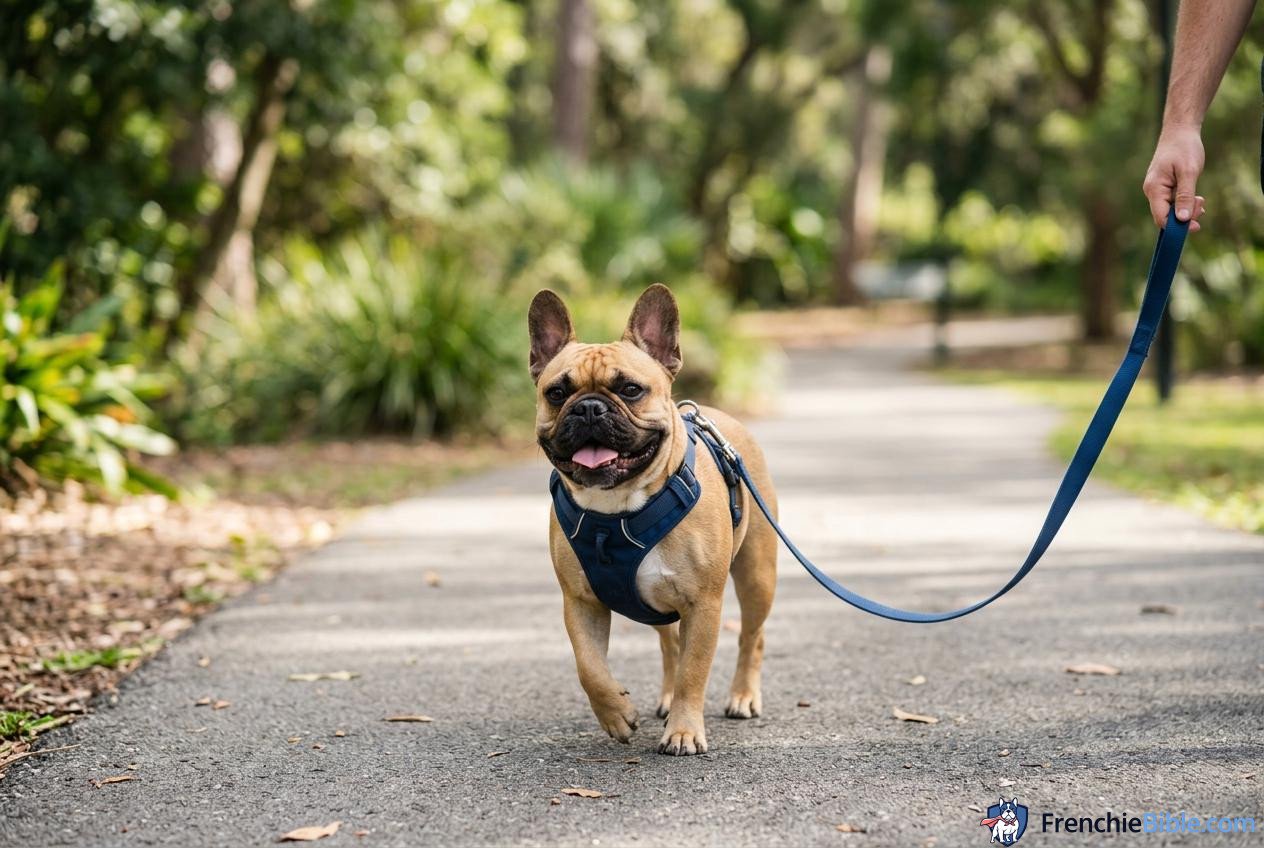
– Front-Clip Harness: For dogs that are strong pullers, a front-clip harness can be a game-changer. The leash attachment point is on the dog’s chest. If the dog pulls forward, the tension on the leash naturally redirects their momentum sideways and back towards you, making pulling physically counterproductive. It acts as a sort of power steering for your dog, allowing you to easily redirect their attention and body.
– Y-Shaped Harness: Ensure the harness is Y-shaped across the chest rather than a straight band across the shoulders. A straight band can restrict the dog’s natural shoulder movement and alter their gait over time. The Y-shape allows for full range of motion while safely distributing any pressure across the robust chest muscles rather than the delicate neck.
– Proper Fit: A harness that is too loose can cause chafing or allow the dog to back out and escape. A harness that is too tight can restrict breathing and movement. You should be able to comfortably slip two fingers under any strap of the harness. Check the fit regularly, as Frenchies can gain or lose weight, and young dogs will grow quickly.
2. The Leash
A standard 4 to 6-foot nylon or leather leash is ideal for heel training. Avoid retractable leashes at all costs. Retractable leashes teach dogs that pulling extends their freedom, which is the exact opposite of what you are trying to achieve. Furthermore, they offer terrible control in emergency situations and can cause severe friction burns to both you and the dog if they wrap around a leg. A standard, fixed-length leash allows you to communicate clearly with your dog through gentle tension and release. It gives you immediate feedback on whether the leash is loose or tight, and allows you to quickly gather the leash if you need to pull your dog close in a hazardous situation.
3. High-Value Treats
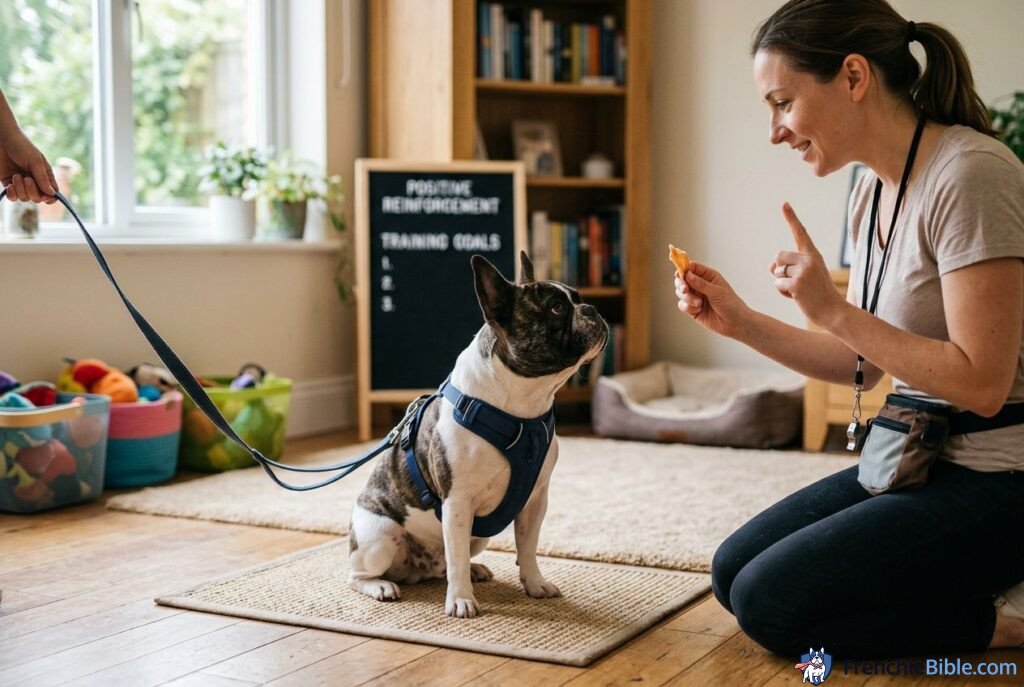
French Bulldogs are typically highly food-motivated, which works to your advantage. During heel training, especially in the beginning stages or in distracting environments, standard kibble might not cut it. You need “high-value” treats—small, soft, strong-smelling, and highly desirable rewards. Think boiled chicken, small pieces of cheese, freeze-dried liver, hot dogs, or specialized training treats. The treats should be small enough (pea-sized) that the dog can eat them quickly without breaking their stride or stopping to chew for an extended period. If the treat takes too long to eat, the flow of the training session is interrupted.
4. A Treat Pouch
Timing is everything in dog training. Fumbling in your pockets or a plastic bag for a treat will delay the reward, confusing the dog about what behavior they are being praised for. Dogs associate the reward with whatever they were doing exactly at the moment the reward is delivered, or at the moment the marker word is spoken. A treat pouch worn on your waist allows for rapid, precise reward delivery. It also keeps your hands free to manage the leash and use hand signals.
5. A Clicker (Optional but Highly Recommended)
Clicker training is a highly effective method for clear, precise communication. The sharp, distinct “click” sound precisely marks the exact moment the dog performs the desired behavior, bridging the gap between the action and the delivery of the treat. Because the click is a unique sound that the dog only hears during training, it stands out clearly from the background noise of our constant chatter. If you choose not to use a clicker, you must use a consistent verbal marker word like “Yes!” or “Good!” with the same exact precision, delivering it the millisecond the correct behavior occurs.
The Foundation: Establishing Focus and Engagement
Before you even step out the front door, you must establish a solid foundation of focus and engagement. If your French Bulldog is completely ignoring you inside the quiet, familiar environment of your house, they will certainly ignore you when faced with the immense distractions of the outside world.
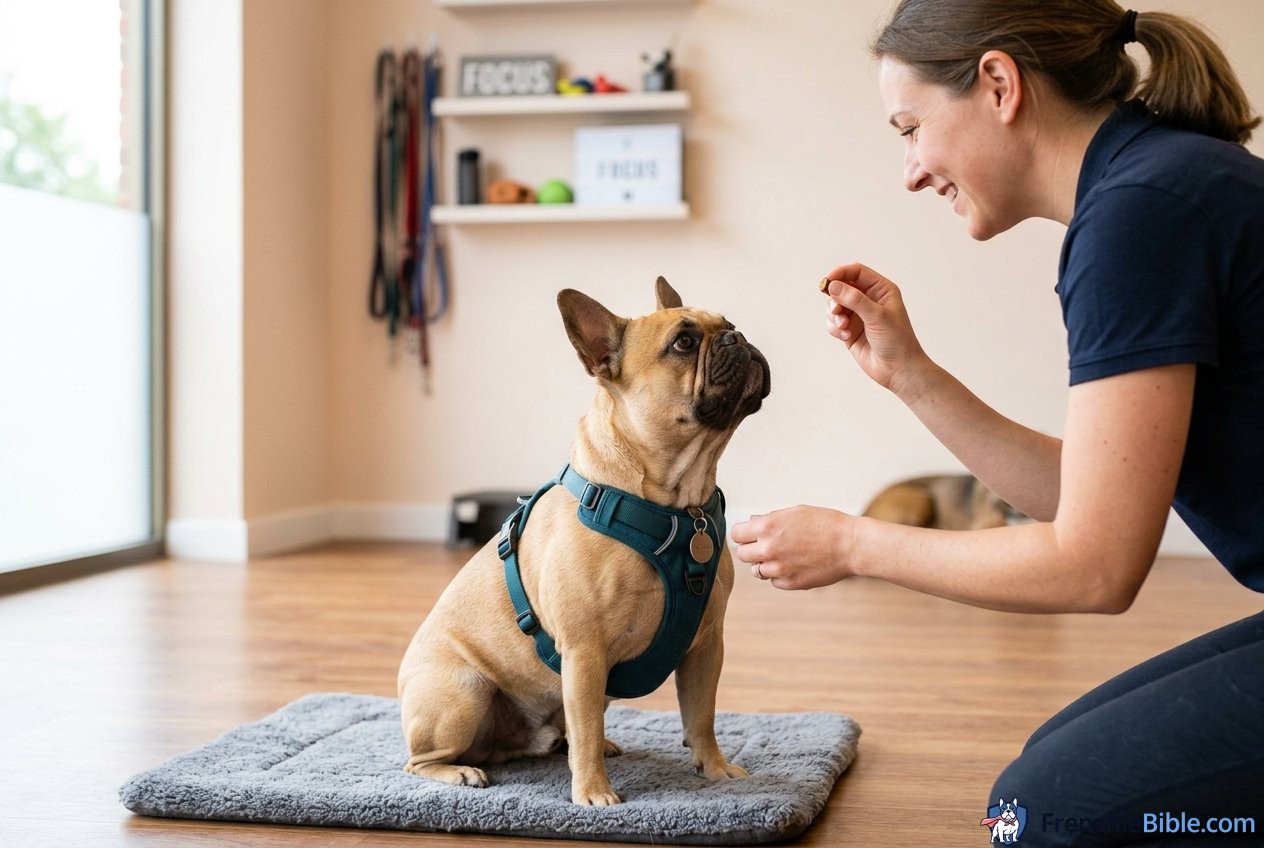
The “Look” or “Watch Me” Command
The first step is teaching your dog that paying attention to you is highly rewarding. This command is the prerequisite for all other obedience training.
1. The Setup: Stand or sit in a quiet room with your Frenchie and a pouch full of high-value treats. Ensure there are no toys, other pets, or loud noises to distract them.
2. The Action: Wait silently for your dog to look at your face. You can make a small kissing sound, click your tongue, or say their name once to encourage them, but do not repeatedly chant their name.
3. The Mark and Reward: The instant they make eye contact, click your clicker (or say a sharp, enthusiastic “Yes!”) and immediately deliver a treat to their mouth.
4. Repetition: Repeat this multiple times. You will notice that the dog starts looking at you more frequently and holding the eye contact longer, anticipating the reward.
5. Adding the Cue: Once the behavior is reliable and the dog is eagerly staring up at you, add the verbal cue “Look” or “Watch me” right before you anticipate them looking at you. This pairs the word with the action.
6. Adding Distractions (Proofing): Gradually practice this in more distracting environments. Move from the living room to the hallway, then to the backyard, then the front porch, and eventually on walks. If your dog cannot give you eye contact when asked, the environment is too distracting. You need to take a step back to a less distracting environment and build their focus there first.
The “Magnet Hand” Technique
This technique teaches the dog the physical position of “heel”—that staying close to your leg is incredibly rewarding. It builds muscle memory for walking parallel to you.
1. Load the hand on the side you want your dog to walk on (traditionally the left hand, but choose whatever is comfortable and stick with it) with several high-value treats.
2. Lure your Frenchie to your side so their shoulder is aligned with your leg. Their body should be parallel to yours, facing the same direction.
3. Keep your hand right at their nose level, acting as a “magnet.” Let them smell the treats but not eat them yet.
4. Take one slow step forward. As long as the dog stays glued to your hand, let them nibble on the treats as you move.
5. If they surge forward ahead of your hand, or pull away to the side, close your hand tightly so they cannot get the treats, and stop moving completely.
6. Wait for them to return to the correct position by your side before reopening your hand and resuming movement. This teaches them that leaving the “sweet spot” next to your leg causes the rewards to vanish and the walk to stop.
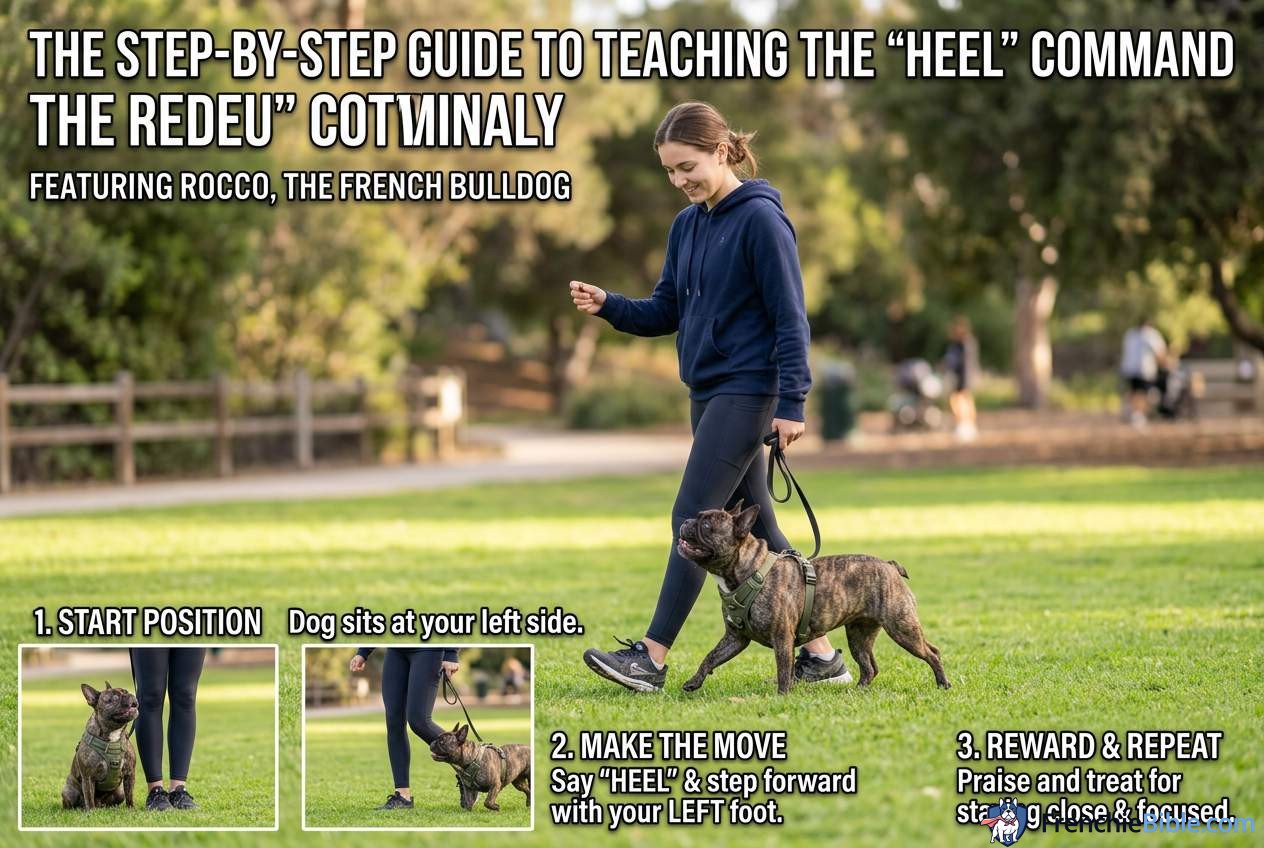
The Step-by-Step Guide to Teaching the “Heel” Command
Now that your Frenchie understands that focus and proximity to you equal rewards, it is time to formally introduce the “Heel” command and start moving together. The ultimate goal of “Heel” is for the dog to walk parallel to you, with their shoulder roughly aligned with your leg, maintaining a loose leash, and adjusting their pace to match yours, regardless of distractions.
Phase 1: Indoor Practice (Zero Distractions)
Do not rush this phase. The habits built indoors will be the foundation for your outdoor walks.
Step 1: The Starting Position
Choose which side your dog will heel on and be perfectly consistent. Lure your dog into a sitting position next to your leg, facing forward. This is the starting “Heel” position. Reward them simply for being in this spot and remaining calm.
Step 2: The First Steps
Say the command “Heel” clearly, cheerfully, and confidently. Immediately take a single step forward, leading with the leg closest to the dog. This visual cue helps the dog anticipate your movement. Your dog should naturally follow your movement.
Step 3: Mark and Reward Immediately
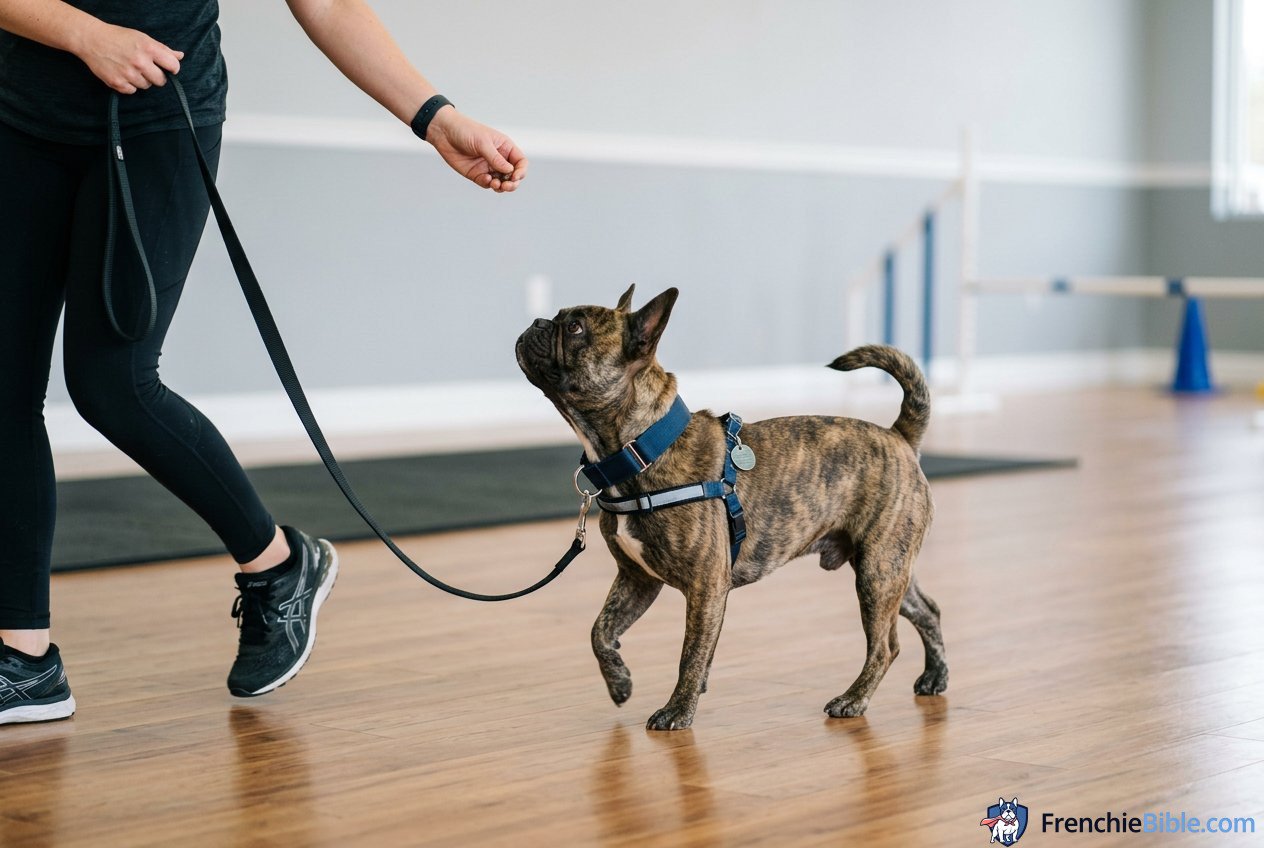
The moment your dog takes that step and remains in the correct position by your side, click (or say “Yes!”) and give them a treat right by your pant seam. It is crucial to deliver the treat exactly where you want the dog to be. If you reach across your body or hold the treat out in front of you, the dog will step forward or sideways to get it, breaking the heel position.
Step 4: Gradually Increase Distance and Duration
Continue this process, systematically increasing the number of steps you take before rewarding. Go from one step to two steps, then three, then five. If the dog breaks the position, forges ahead, or lags behind, stop immediately. Do not correct them; simply lure them back to the starting position and try again. On the next repetition, reward them sooner to set them up for success and rebuild their confidence.
Step 5: Incorporate Stops and Starts
Heeling is a dynamic exercise; it involves stopping when you stop. As you are walking indoors, simply stop moving your feet. The goal is for your Frenchie to notice your body language changing and automatically stop and sit by your side without being told. At first, you may need to gently lure them into a sit with a treat when you stop. Reward heavily when they successfully stop and sit in the heel position. This creates a highly attentive dog.
Phase 2: The Backyard (Low Distractions)
Once your Frenchie is heeling beautifully up and down your hallway, navigating around furniture, and stopping automatically when you stop, it is time to move to the backyard. The introduction of grass, outdoor smells, wind, and open space will instantly increase the difficulty level significantly.
Step 1: Restart from the Basics
Do not expect your dog to maintain their indoor proficiency outside immediately. Dogs are terrible generalizers. To them, “Heel in the living room” is a completely different command than “Heel in the grass.” Drop your criteria. Go back to rewarding every single step or two steps to remind them that the rules and the rewards still apply in this new environment.
Step 2: The “Be a Tree” Method for Pulling
Inevitably, your dog will get distracted by a scent or a sound and pull forward, causing the leash to go tight. When this happens, immediately stop moving and plant your feet firmly like a deeply rooted tree. Do not yank the leash, do not yell “No!”, do not pull them back; just become an immovable object.
Wait patiently. The moment your dog realizes they are not making any forward progress, they will eventually turn their head to look at you, or take a step back towards you. This action will put slack into the leash. The absolute instant the leash has slack, click (or say “Yes!”), reward them from your pouch, and briskly resume walking forward. They must learn an unshakeable rule: a tight leash means the walk stops dead, and a loose leash means the walk continues and rewards happen.
Step 3: Changing Directions Unpredictably
If you walk in long, straight lines, the dog will zone out and forge ahead. To keep your Frenchie engaged and focused intensely on you, change directions frequently and unpredictably.
– The U-Turn: If your dog starts to drift ahead and you feel the leash about to tighten, abruptly turn 180 degrees and walk briskly in the opposite direction. Say “Let’s go!” in a cheerful, engaging voice as you turn to encourage them to follow. When the dog scrambles to catch up and reaches the correct position by your leg, click and reward them. This exercise teaches them that they must pay constant attention to your body language because you might change direction at any moment, and they don’t want to be left behind.
– Figure Eights and Sharp Turns: Practice walking in figure-eight patterns around cones or lawn chairs. Make sharp 90-degree left and right turns. Every time the dog adjusts their body to stay with you through a turn, reward them.
Phase 3: The Real World (High Distractions)
Taking your heel training to the public sidewalk, the park, or a busy pet store is the ultimate test. It will require immense patience, unwavering consistency, a high rate of reinforcement, and a good sense of humor.
Step 1: Set Realistic Expectations
Understand that a 30-minute training walk in a new environment might only cover one block. You will be stopping constantly. Your dog will make mistakes. That is perfectly fine and completely normal. The goal during these sessions is training and proofing the behavior, not physical exhaustion or getting from point A to point B quickly. If you are in a rush, do not attempt a training walk; you will only get frustrated.
Step 2: Manage the Environment Proactively
If you see a massive distraction approaching—like another dog walking towards you, a noisy garbage truck, or a group of children—do not wait for your dog to react, lunge, and pull. Be proactive.
Increase the distance between you and the distraction if possible (cross the street or step into a driveway). Use your “Look” command to get their attention before they lock onto the distraction. Pull out your highest-value, smelliest treats, and do rapid-fire rewards (feeding them continuously) for maintaining eye contact and staying by your side as the distraction passes. You are teaching them that ignoring massive distractions and focusing on you is the most rewarding choice they can make.
Step 3: The “Sniffari” vs. The “Heel” Walk
It is critically important to understand that dogs experience the world primarily through their noses. Sniffing is not just a hobby; it is incredibly mentally enriching and essential for their well-being. Expecting a dog to maintain a rigid, military-style “Heel” with unwavering eye contact for an entire 45-minute walk is mentally exhausting, unfair, and counterproductive to a happy dog.
Instead, clearly differentiate between a structured “Heel” walk and a relaxed “Free/Sniff” walk.
– The “Heel”: Use the “Heel” command when you genuinely need them close and under strict control—for example, when crossing a busy intersection, navigating a crowded farmer’s market, or passing a reactive dog on a narrow sidewalk. During this time, the criteria are strict: stay by my leg, focus on me.
– The “Release”: When you reach a safe, open area like a park path or a quiet residential street, release them from the heel with a specific, consistent cue like “Go sniff,” “Break,” or “Free.” This tells the dog they are off duty. They can drop their head, explore the grass, and walk ahead of you. Crucially, they still are not allowed to pull and tighten the leash. But they have the freedom to be a dog and explore. Alternating between structured heeling and relaxed sniffing keeps the walk enjoyable for both of you and prevents the dog from becoming frustrated.
Common Mistakes to Avoid During Heel Training
Even the most well-intentioned and dedicated owners can fall into common traps that severely hinder their Frenchie’s progress. Be highly mindful of these pitfalls:
1. Inconsistency (The Silent Killer of Training)
This is unequivocally the number one reason heel training fails. Dogs learn through clear, consistent patterns. If you enforce the “no pulling” rule during your dedicated 15-minute training sessions, but allow the dog to drag you to the park later that evening because you are tired and just want to get there, you are destroying your training. You are teaching the dog that sometimes pulling doesn’t work, but sometimes it does work brilliantly. This creates a gambler’s mindset in the dog—they will always try pulling just in case this is one of the times it pays off. The rule must be absolute, black and white: pulling never, ever, under any circumstances, results in forward movement. If you do not have the time, patience, or energy to enforce the training rules on a particular walk, do not take them for a walk. Exercise them in the yard or play indoor games instead of undoing weeks of hard work.
2. Rewarding in the Wrong Position
This is a mechanical error that creates a crooked heel. If you treat your dog by reaching your hand forward in front of your body, or reaching across your body to the opposite side, you are inadvertently luring the dog out of the correct heel position to get the reward. They will quickly learn to walk ahead of you or wrap around your legs to anticipate the treat. The treat must always be delivered precisely where you want the dog’s head to remain—right down by the seam of your pants on the side they are heeling on. Bring the treat to the dog; do not make the dog move to the treat.
3. Yanking, Leash Corrections, and Punishment
Jerking the leash, yelling “No!”, “Ah-ah!”, or using harsh physical corrections is highly counterproductive, especially with a sensitive and physically robust breed like a French Bulldog.
Firstly, it damages the bond of trust between you and your dog. The walk should be a fun team activity, not a battleground. Secondly, it drastically increases their stress, anxiety, and arousal levels, which often makes pulling worse, not better. Thirdly, yanking on the neck of a brachycephalic breed is dangerous and can cause severe medical issues.
Heel training must be based on positive reinforcement—rewarding the desired behavior heavily, and simply preventing the undesired behavior (pulling) from being successful. If your dog is constantly making mistakes and pulling, it is not because they are stubborn or dominant; it is because you have increased the criteria (the distractions or the distance) too quickly. You need to take a step back, simplify the exercise, and set them up to succeed.
4. Holding the Leash Too Tight (The “Death Grip”)
Many owners instinctively wrap the leash tightly around their hand, maintaining constant, tight tension to physically force the dog to stay close. This completely backfires. Dogs possess a natural “opposition reflex.” If they feel steady pressure pulling them backward, their instinctive physical response is to lean and push forward against that pressure. By keeping the leash tight, you are actually encouraging them to pull.
You must give them enough slack in the leash to actually make the conscious choice to stay by your side. The leash should hang in a relaxed, loose “J” shape between your hand and their harness. The dog needs to feel the difference between the comfortable slack leash (which means they are doing it right) and the sudden tight leash (which means they made a mistake and the walk stops). If the leash is always tight, they have no information to work with.
5. Moving Too Fast Through Distractions
Patience is vital. Do not expect a dog who just successfully learned to heel in your quiet living room to be able to heel perfectly past a flock of ducks at the local park the very next day. Proofing a behavior against real-world distractions takes significant time and methodical practice. Systematically introduce low-level distractions (a quiet street) before tackling high-level ones (a busy cafe patio). Always be prepared to decrease your expectations and drastically increase your rate of reinforcement when the environment gets tougher.
Advanced Heel Training Techniques for Frenchies
Once your French Bulldog has mastered the basics of a loose-leash walk and a reliable, attentive “Heel” in moderately distracting environments, you can introduce advanced techniques. These exercises sharpen their skills, improve their physical coordination, and provide fantastic mental stimulation, keeping their intelligent minds fully engaged.
1. The Automatic Sit
The ultimate goal of the automatic sit is for your dog to immediately drop their bottom to the ground and sit whenever you stop walking, without you ever having to utter the “Sit” command. It looks incredibly impressive and keeps the dog highly focused on your movement.
– How to train it: While heeling briskly, abruptly stop walking. Stand perfectly still and remain silent. Do not say “sit.” Wait. If your dog doesn’t sit within 3 to 5 seconds, gently use a treat to lure them backward into a sit, and reward them. Repeat this. After several repetitions, stop and wait. Give them time to think. The moment you see their back legs bend and their bottom hit the ground on their own volition, throw a massive “jackpot” reward (give them 3 or 4 treats in a row) and praise profusely. Through repetition, the physical act of your feet stopping becomes the specific cue for them to sit.
2. Precision Pivots and Turns
Teaching sharp, precise turns keeps your dog paying microscopic attention to your leg movements and body positioning.
– Inside Turns: This is when you turn into the dog’s path (e.g., executing a sharp left turn if the dog is heeling on your left side). Gently guide the dog around your leg with a treat, ensuring they don’t get stepped on, and reward them for maintaining the tight position through the turn without lagging behind.
– Outside Turns: This is when you turn away from the dog (e.g., executing a sharp right turn if the dog is on your left). The dog suddenly has to speed up their pace significantly to navigate the much larger outer arc and stay aligned with your leg. Use an enthusiastic voice to encourage them to hurry up, and reward them heavily for keeping up and maintaining the parallel position.
3. Change of Pace Exercises
Varying your walking speed teaches the dog to actively monitor your pace and adjust their own stride accordingly, rather than just cruising at their own preferred speed.
– The Slow Pace: Exaggerate a very slow, deliberate, almost creeping walk. Command “Steady” or “Slow.” Reward the dog constantly for holding back, matching your creeping pace, and resisting the urge to forge ahead. This requires immense impulse control from the dog.
– The Fast Pace: Break into a light jog or a brisk, energetic power walk. Command “Quickly” or “Hurry.” Reward the dog for speeding up, trotting happily by your side, without breaking into a wild, uncontrolled run or pulling ahead of you.
Transition suddenly and unpredictably between normal, slow, and fast paces to keep the dog entirely focused on your movement.
4. Heeling Off-Leash (In Safe, Enclosed Environments Only)
The absolute pinnacle of heel training is the off-leash heel. Crucial Safety Disclaimer: French Bulldogs should NEVER be walked off-leash in unsecured, public areas, near traffic, or in open parks. They have high prey drives, can be stubborn, and lack road awareness. A sudden squirrel can cause them to bolt into danger. However, in a securely fenced backyard, an empty tennis court, or an indoor training facility, practicing off-leash heeling builds an incredible bond and unparalleled focus.
– How to transition: Start by letting the leash drag on the ground while you practice your standard heeling routine. The dog must realize that the behavioral rules still apply strictly, even if you aren’t physically holding the handle of the leash. If they break position or wander off, calmly step on the trailing leash to stop them, reset them into the heel position, and try again. Gradually transition to completely removing the leash for short periods, relying entirely on your engagement, your voice, and your rewards to keep them by your side.
Troubleshooting Common Heel Training Challenges
Even with dedication and consistent effort, you will likely encounter specific challenges that are unique to your Frenchie’s distinct personality. Here is how to expertly troubleshoot the most common issues:
The “Anchor” Frenchie (Refusing to Move Forward)
Sometimes, French Bulldogs don’t exhibit the typical pulling behavior; instead, they slam on the brakes, plant their feet firmly, drop their weight, and refuse to move an inch. This is affectionately (and frustratingly) known as the “Frenchie stand-off.”
– The Solution: Do not, under any circumstances, pull or drag them. Dragging them immediately engages their opposition reflex, making them dig in their heels even harder, and it can damage their neck.
First, do a quick welfare check. Are they tired? Is the pavement too hot? Are they in pain? Frenchies overheat very easily, so an “anchor” dog might simply be exhausted or struggling to breathe. If you suspect any physical distress, end the walk immediately and carry them.
If they are physically fine and just being stubborn, change the dynamic. Use a high, silly, excited voice. Pat your leg enthusiastically. Turn around and jog backwards a few steps to encourage them to chase you. Toss a high-value treat a few feet ahead of them on the ground to get their feet moving again. Your goal is to make moving forward seem incredibly fun, engaging, and rewarding, breaking their stubborn fixation.
The “Sniffing Obsessive”
Some Frenchies are so entirely obsessed with the olfactory world on the ground that they completely tune you out, burying their nose in the grass and yanking you from bush to fire hydrant to tree.
– The Solution: Utilize the “Premack Principle”—a psychological concept that states you can use a high-probability behavior (something the dog desperately wants to do, like sniffing a bush) to reinforce a low-probability behavior (something you want them to do, like heeling).
Tell the dog to “Heel.” Walk nicely towards a bush they clearly want to investigate. If they maintain a nice heel and a loose leash for five or ten steps approaching the bush, excitedly say “Go sniff!” and release them to investigate it. Access to the bush is the reward for the nice heeling. They quickly learn that performing obedience is the magical key that unlocks access to the environment they want to explore. If they pull toward the bush, stop dead. They don’t get to sniff it until the leash is loose.
The “Frantic Greeter” (Pulling Towards Other Dogs or People)
French Bulldogs are famously social, affectionate clowns. They often want to vigorously greet every single living creature they see, resulting in frantic pulling, panting, and lunging on the leash.
– The Solution: Distance is your most valuable tool here. You must figure out your dog’s “threshold”—the precise distance at which they notice the trigger (the other dog or person) but are not yet reacting frantically and can still respond to your voice and eat a treat.
If they lose their mind when a dog is 20 feet away, you must work at 30 feet or 40 feet away. At that safe distance, when they spot the other dog, immediately ask for a “Look” or a “Heel” and feed them a steady, continuous stream of amazing treats (like hot dog pieces) the entire time the other dog is visible and passing by. The moment the other dog is gone, the treats stop.
You are performing classical counter-conditioning. You are changing their emotional response from “OMG ANOTHER DOG I MUST GO SAY HI NOW!” to “Oh, there’s another dog over there. That means my human is about to feed me amazing chicken!” Over weeks of consistent practice, you can gradually, foot by foot, decrease the distance to the trigger.
The “Bribed” Dog (Only Heels When They See the Food)
If your Frenchie heels perfectly with laser focus when you are visibly holding a piece of cheese in your hand, but completely ignores you and pulls the moment your hands are empty, you have successfully bribed them, rather than trained them. They are following the food, not the command.
– The Solution: You must fade the physical lure. The treats must remain hidden in your treat pouch, not visibly held in your hand.
Ask for the “Heel” command with empty hands. Walk a few steps. If they comply and stay in position, click (or say “Yes!”), and only then reach into your pouch to produce the treat. The dog must perform the behavior before they see the payment.
Once they understand this, you must gradually make the rewards more intermittent and unpredictable. Do not reward every single step. Reward every third step, then every fifth step, then maybe the tenth step, then back to the second step. Keep them guessing when the payout will happen. Furthermore, begin swapping out food rewards for “life rewards”—permission to go sniff a tree, a quick game of tug-of-war with a toy, or exuberant verbal praise and physical petting. The dog must learn that obedience is required regardless of whether food is visible.
Conclusion
Teaching your French Bulldog to heel is a rewarding journey that requires patience, unwavering consistency, and a deep, empathetic understanding of their unique breed characteristics and physical limitations. It is emphatically not an overnight fix. There will be walks that feel like major setbacks, where your dog seems to have forgotten everything. This is part of the process.
However, the effort and time you invest in heel training pay monumental dividends for the rest of your dog’s life. A Frenchie that walks calmly by your side on a loose leash is not just a pleasure to walk; they are a significantly safer, less stressed, and more emotionally balanced companion. By utilizing modern positive reinforcement techniques, proactively managing the environment, strictly avoiding harsh physical corrections, and understanding the vital physiology of your brachycephalic dog, you can transform chaotic, frustrating, shoulder-dislocating outings into harmonious, peaceful strolls.
Remember, every single time you clip the leash onto their harness, it is a training opportunity. Stay incredibly consistent, keep your sense of humor accessible (you will absolutely need it with a Frenchie’s clownish antics!), and be sure to celebrate the small victories along the way. Your bond, trust, and communication with your French Bulldog will grow exponentially stronger with every peaceful, in-sync step you take together.
Frequently Asked Questions (FAQ)
1. At what age should I start heel training my French Bulldog puppy?
You can and should start the very basic foundation of heel training the moment you bring your puppy home, which is usually around 8 to 10 weeks old. Start with simple engagement exercises like the “Look” command and the “Magnet Hand” technique indoors in a distraction-free room. The earlier you establish the concept that staying near you is highly rewarding, the easier formal leash training will be when they are older and stronger. However, keep sessions incredibly short—just 1 to 2 minutes at a time—and keep it purely positive and game-like.
2. How long does it typically take to teach a French Bulldog to heel reliably?
There is no set timeline, as it depends entirely on the dog’s age, their previous rehearsal of bad habits, their individual temperament, and most importantly, your consistency as a handler. A young puppy learning from scratch might grasp the concept beautifully in a few weeks of daily practice. An adult Frenchie with three years of heavily reinforced pulling behavior might take many months of diligent retraining to become reliable. Focus on incremental daily progress rather than an arbitrary deadline.
3. My French Bulldog gets too hot, pants heavily, and seems tired during our training walks. What should I do?
French Bulldogs are brachycephalic (flat-faced) and are highly susceptible to heat exhaustion and heatstroke. Their compromised airways make it difficult for them to cool themselves efficiently through panting. Never train or walk them during the hottest parts of the day; stick to early mornings or late evenings. Keep training sessions very short (5-10 minutes maximum), bring plenty of cool water, and seek shade frequently. If your dog starts panting excessively, their tongue becomes very wide or dark, they slow down significantly, or they refuse to move, stop immediately. Pick them up, carry them home, or find an air-conditioned space to let them recover. Health and safety always supersede training.
4. Is a head halter (like a Gentle Leader) a good training tool for a pulling Frenchie?
Generally, no. Head halters are designed for dogs with a pronounced, standard-length muzzle. Because French Bulldogs have extremely short snouts and virtually no bridge of the nose, head halters rarely fit correctly or securely. They can easily ride up into their large, prominent eyes causing injury, or slip off completely. More importantly, if a Frenchie lunges while wearing a head halter, the sudden twist can cause severe whiplash or injury to their delicate cervical spine. A well-fitted, Y-shaped front-clip harness is a significantly safer and more effective tool for managing pulling in this specific breed.
5. I have tried everything—high-value treats, stopping when they pull, front-clip harnesses—and my French Bulldog still pulls like a freight train. What is the next step?
If you have been genuinely consistent with positive reinforcement techniques, using extremely high-value rewards, and utilizing the proper equipment for several weeks without seeing any improvement, it is highly recommended to seek the assistance of a certified professional dog trainer or a veterinary behaviorist. A professional can observe your mechanical handling skills, accurately assess the dog’s body language and behavior in real-time, identify any subtle triggers you might be missing, and provide a customized, hands-on training plan. Often, a very subtle change in the handler’s timing, treat delivery, or leash mechanics can make all the difference in the world.
Disclaimer: The information provided in this article is based on over a decade of personal experience in breeding, handling, and training French Bulldogs. I am a breed enthusiast and expert, but I am not a licensed veterinarian. This content is intended for educational and informational purposes only and should not be considered a substitute for professional veterinary advice, diagnosis, or medical treatment. Always consult with a qualified veterinarian regarding the health, physical capabilities, and appropriate exercise regimens for your specific dog, especially given the unique respiratory and structural health considerations of the brachycephalic French Bulldog breed.