Bringing a French Bulldog puppy into your home is an incredibly exciting journey, filled with playful moments, endless cuddles, and the joy of watching a tiny creature grow into a robust companion. As a breeder with over a decade of hands-on experience specializing in French Bulldogs, one of the most frequent and intriguing questions I receive from new and prospective owners is: “Will my French Bulldog’s coat color change as they get older?”
The short and definitive answer is yes. It is entirely normal and expected for a Frenchie’s coat to undergo significant transformations from the time they are a tiny, wrinkly eight-week-old puppy to when they mature into a fully grown, muscular adult. Just as humans experience profound changes in hair color, texture, and density as they transition from infancy to adulthood, French Bulldogs go through a fascinating biological process of shedding their initial puppy coat. This transition often results in fading, darkening, clearing of “smut,” or the sudden emergence of new, striking patterns that were previously hidden.
Related Reading: Training & Behavior | Frenchie Puppy Guide | Best Food for Frenchies
In this comprehensive, deep-dive guide, we will explore the fascinating world of French Bulldog coat genetics. We will explain the biological reasons why puppy fading occurs, provide detailed breakdowns of how different colors—such as classic fawn, intricate brindle, rare blue, and striking merle—transition over time. Furthermore, we will equip you with the knowledge to understand when you can realistically expect your Frenchie’s permanent adult color to finally set in stone, and how to maintain that coat’s vibrant health throughout their life.
The Science Behind French Bulldog Coat Colors
Before we can accurately comprehend why a French Bulldog’s coat changes color as they age, we must first establish a foundational understanding of the basic mechanics of canine coat color determination. Ultimately, it all comes down to the complex and beautiful science of genetics.
Genetics and DNA Basics: The Blueprint of Color
Every single French Bulldog inherits a specific, unique set of genes from their sire (father) and dam (mother). These inherited genes serve as a biological blueprint, dictating not just their physical structure, bone density, and behavioral temperament, but also the exact pigments that will be expressed in their fur, the pigmentation of their skin (nose, paw pads, eye rims), and even the color of their eyes.
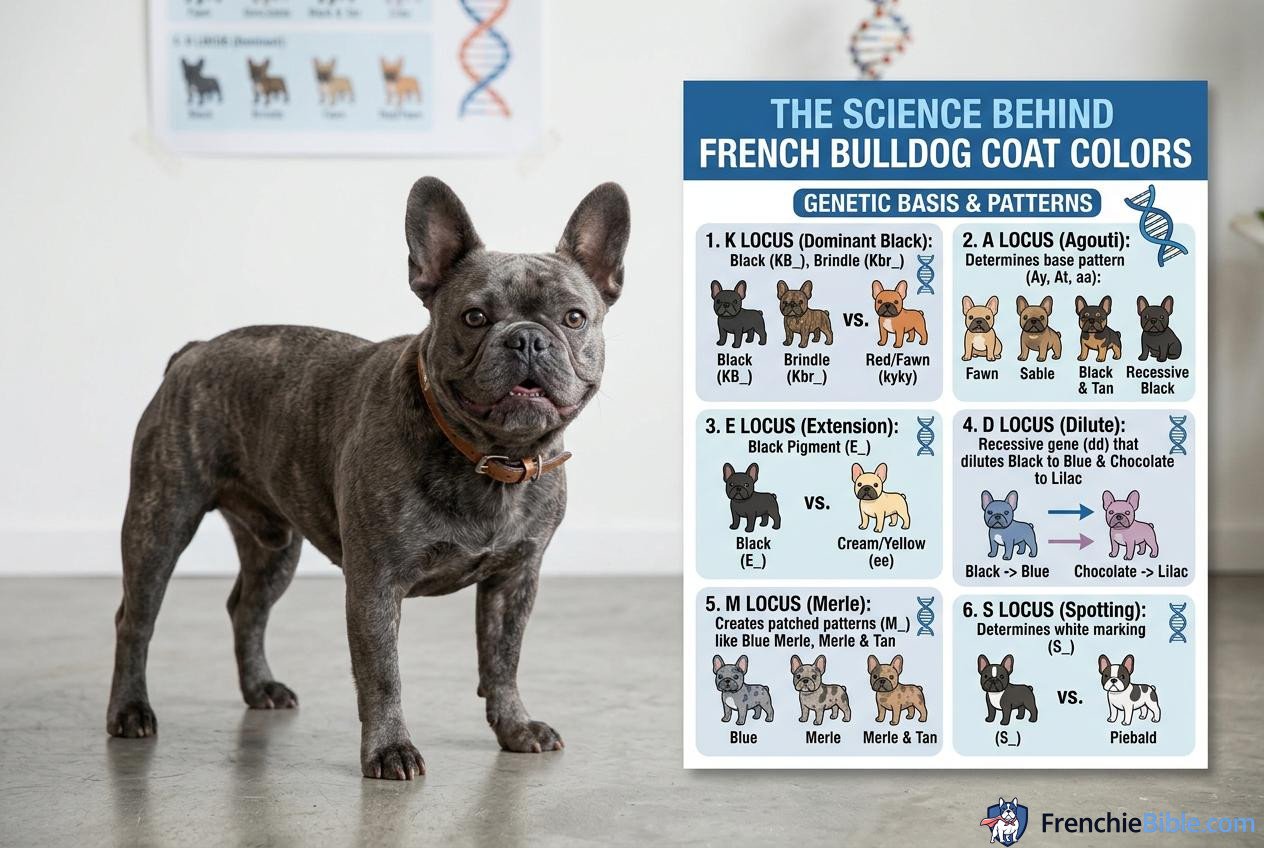
As a dedicated breeder, I spend countless hours studying complex DNA panels and pedigree charts to understand exactly what colors my dogs carry both visibly and recessively, allowing me to predict what they might pass on to their future offspring. Canine coat color genetics operate on various specific “loci” (plural for locus, which refers to a specific, fixed position on a chromosome).
To give you a simplified overview of how these loci impact the French Bulldog breed:
- The K-Locus (Dominant Black/Brindle): This locus determines whether a dog will have a brindle pattern, be solid black, or allow other colors to express themselves.
- The A-Locus (Agouti): This locus heavily influences fawn, sable, and solid patterns. It dictates the distribution of pigment along individual hair shafts.
- The D-Locus (Dilution): This is the crucial locus that controls the dilution of black pigment into blue (slate gray). A dog must inherit two copies of the dilute gene (d/d) to appear visually blue.
- The E-Locus (Extension): This locus controls the presence of a black mask on the face and can also result in a completely yellow/cream coat if the recessive “e/e” genes are present, essentially masking all black pigment on the body.
While a puppy is born with this genetic code permanently locked in from the moment of conception, the way these specific genes express themselves visually can and will shift as the dog grows, matures, and experiences hormonal changes.
The Role of Eumelanin and Phaeomelanin
At a microscopic, cellular level, all French Bulldog coat colors—regardless of how varied or exotic they appear—are created by the interplay of just two foundational base pigments:
- Eumelanin (Black Pigment): In its default state, eumelanin produces black hair, a black nose, and dark brown eyes. However, the genetic modifiers we mentioned earlier can alter eumelanin’s structure, causing it to appear brown (often referred to as chocolate or cocoa), blue (a dilution of black), or lilac (a complex combination of dilute and brown genes).
- Phaeomelanin (Red/Yellow Pigment): This is the pigment responsible for all the red, yellow, and golden hues. It can range in intensity from a deep, rich mahogany red to a pale, milky cream or light yellow. Fawn Frenchies, which are incredibly popular, are primarily colored by the expression of phaeomelanin.
It is also important to note that “white” in a French Bulldog’s coat is not actually a pigment itself. Rather, white hair represents a total absence of pigment in those specific hair follicles. When the melanocyte cells fail to produce either eumelanin or phaeomelanin in certain localized areas, the hair grows in completely white. This is most commonly controlled by the S-Locus (Spotting locus), which causes the beloved pied pattern.
As a puppy grows rapidly during its first year, the bodily production, density, and distribution of these eumelanin and phaeomelanin pigments can fluctuate naturally, directly leading to the visual color changes we observe in their coat over the first twelve to eighteen months of life.
Puppy Coat vs. Adult Coat: What You Need to Know
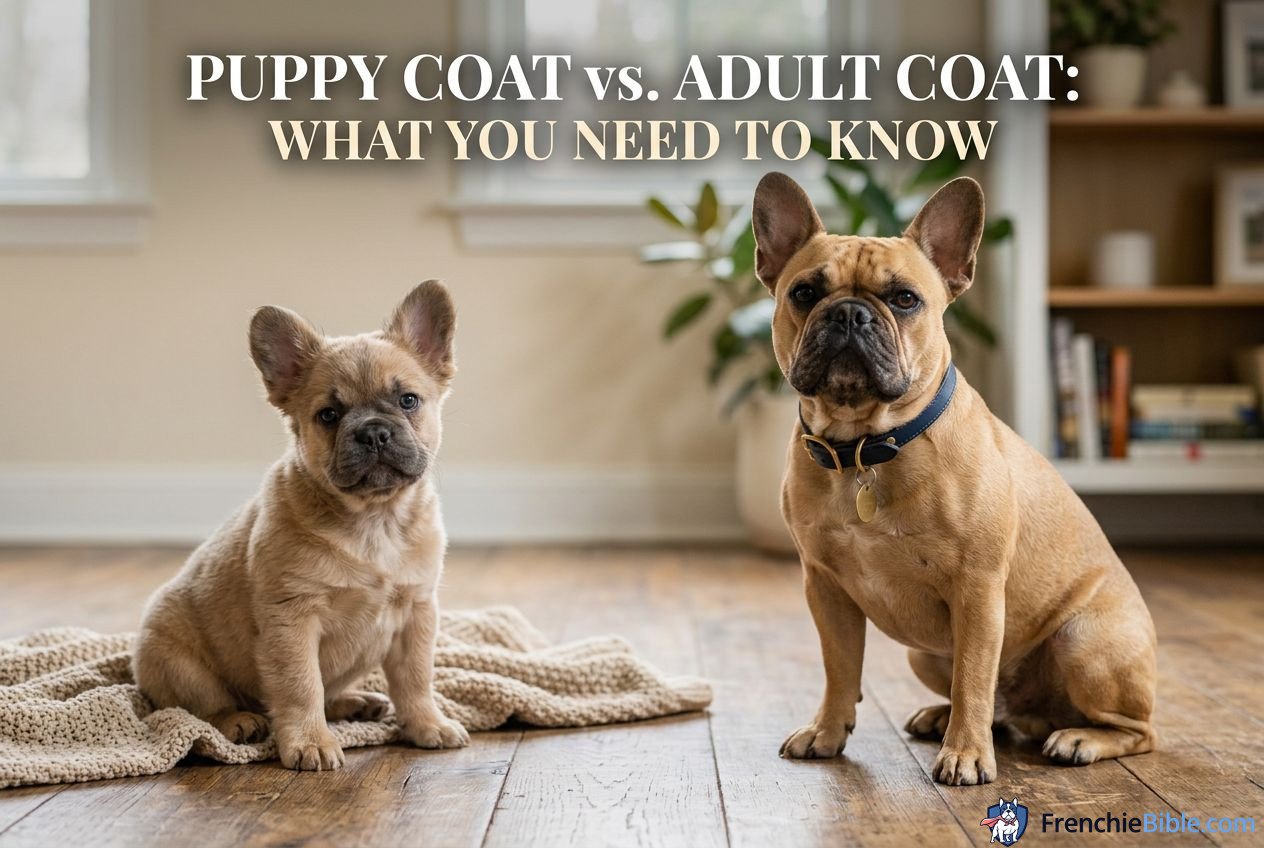
When you pick up your new French Bulldog puppy at eight weeks old and hold them for the first time, the incredibly soft fur you are touching is their temporary “puppy coat.” This specialized coat is typically much softer, noticeably fluffier, and sometimes appears duller, “smuttier,” or more muted in color than the sleek, dense coat they will sport as a mature adult.
The “Fading” Phase: Why Do Frenchie Puppies Change Color?
Puppy fading or transitioning is a completely natural, unavoidable physiological process. The delicate hairs that make up a puppy’s initial coat are strictly temporary, designed to keep them warm and protected during their most vulnerable early weeks. As the dog goes through its rapid growth phases, its body naturally begins to produce the coarser, thicker, and more weather-resistant hairs that will ultimately constitute the adult coat.
During this massive transitional phase, you might notice that your puppy looks a bit patchy, uneven, or that their once vibrant, solid color is looking a little washed out or dusty. Many puppies are born with what breeders commonly refer to as “smutty” coats. Smut refers to darker, usually black, hairs heavily mixed in with their lighter base color.
For example, a fawn puppy might be born looking almost entirely brown or heavily shaded with a dark overlay down its back and shoulders. As they begin to shed the puppy coat, this “smut” often fades away entirely, revealing a remarkably clear, bright, and stunning fawn color underneath. This transformation can be quite dramatic, turning a dark, muddy-looking puppy into a bright golden adult.
When do french bulldogs shed Their Puppy Coat?
The transition from the fluffy puppy coat to the sleek adult coat does not happen overnight. It is a slow, gradual, and sometimes messy process that usually begins in earnest when the Frenchie is around 4 to 6 months old.
You will likely notice significantly increased shedding during this specific timeframe. The soft, cotton-like fluff is steadily replaced by the smoother, denser, and shinier hairs of the adult coat. By the time your French Bulldog reaches 10 to 12 months of age, they will have usually shed their entire puppy coat. At this one-year mark, their primary adult color and coat texture will be firmly established.
However, it is crucial to understand that minor, subtle shifts in shade, tone, and depth can still occur up until the dog is about 18 months to 2 years old. This is especially true as their physical body fills out, they gain muscle mass, and their internal hormones fully stabilize after puberty.
Common Color Changes in French Bulldogs as They Grow
The specific way a French Bulldog’s color changes and evolves depends almost entirely on their unique genetic makeup. Let’s break down exactly what you can realistically expect from the most common and popular Frenchie colors as they age from puppyhood to adulthood.
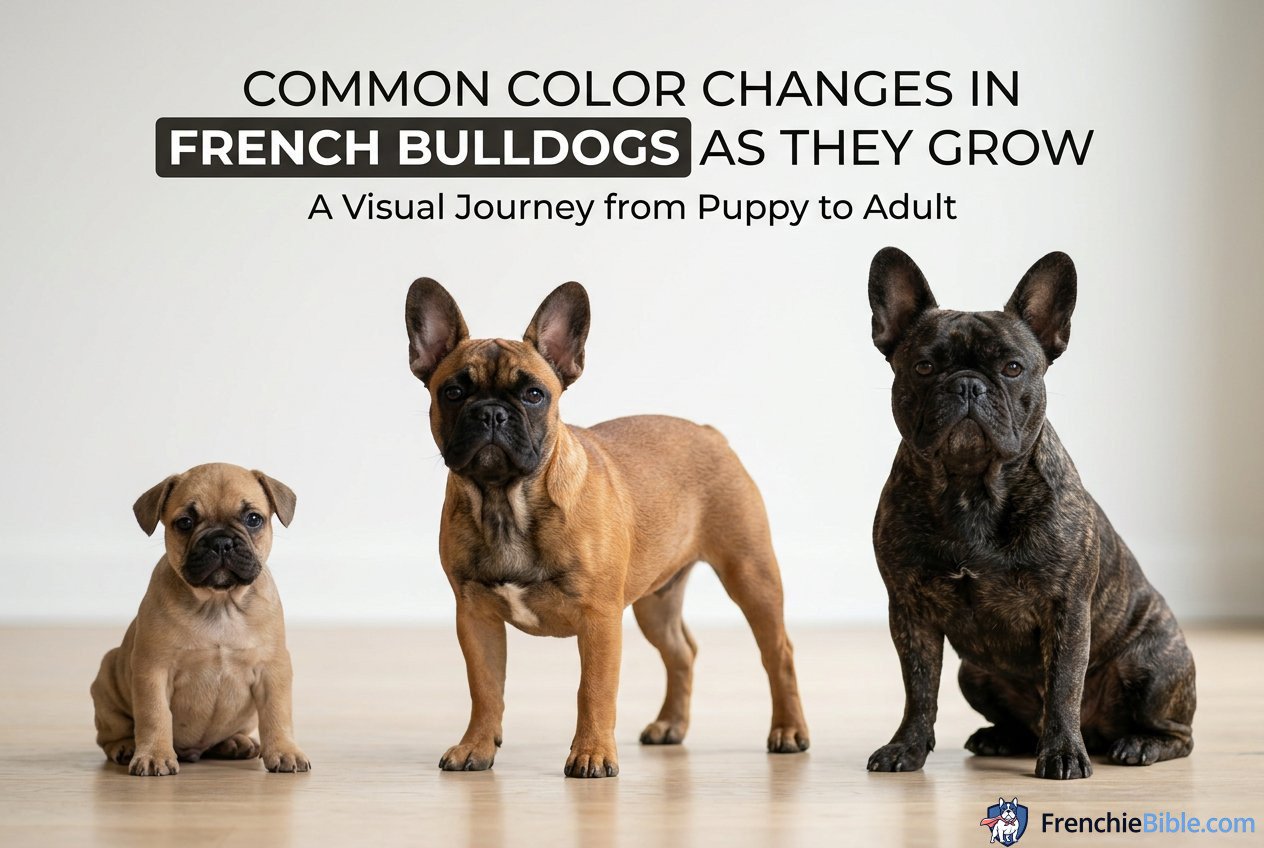
fawn french bulldogs: From Smutty to Clear
Fawn is arguably the most classic, traditional, and universally beloved of all French Bulldog colors. Interestingly, fawn puppies are also the ones that frequently go through the most dramatic and noticeable color changes.
Many fawn puppies are born with black hairs heavily sprinkled throughout their entire coat, particularly concentrated down the ridge of their back, on their shoulders, and over their head. They might also feature a very dark, pronounced, and extensive black mask covering their face.
As the fawn puppy reaches that critical 4 to 6 months of age mark, these dark “smutty” hairs usually begin to fall out rapidly and are permanently replaced by clear, solid fawn-colored hairs. A puppy that looked quite dark and muddy at 8 weeks old can blossom into a remarkably bright, golden, or deep red fawn by the time they celebrate their first birthday.
The black mask on their face may also shrink slightly in proportion or become much more sharply defined as the skull grows and the adult facial fur comes in. Conversely, some cream puppies (which are genetically a very light, diluted shade of fawn or e/e) might develop a slightly darker, more apricot or champagne tint down their spine and ears as they mature and spend more time exposed to natural sunlight.
brindle french bulldogs: The Tiger Stripes Emerge
Brindle is a stunning, complex pattern consisting of a lighter fawn base coat adorned with darker black (or in dilute dogs, blue or chocolate) stripes running through it, somewhat resembling tiger stripes.
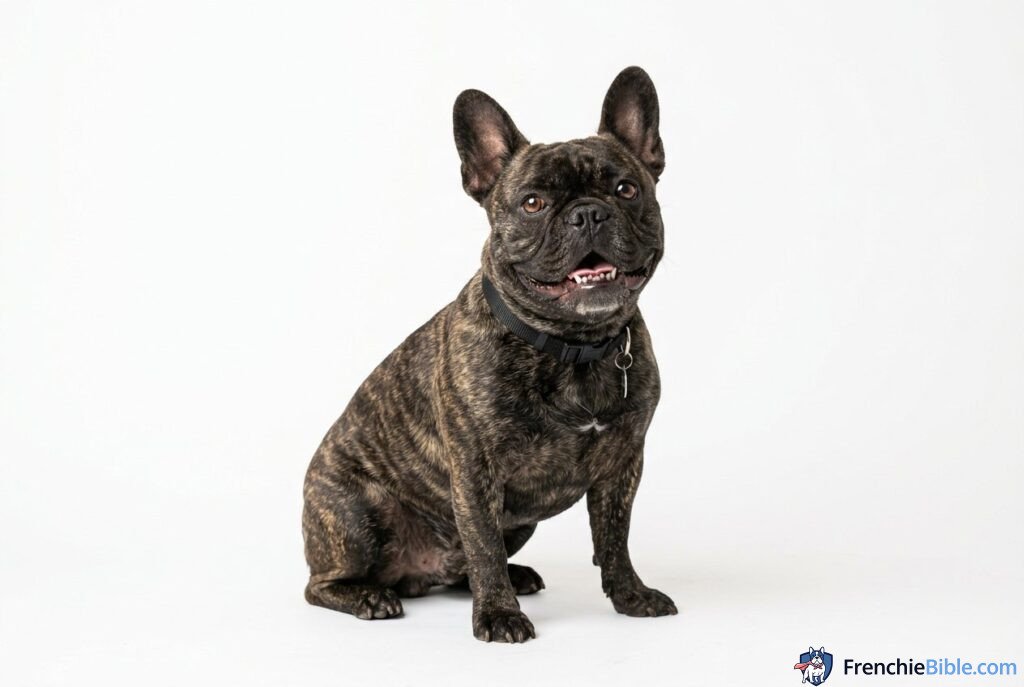
When brindle puppies are first born, they very often appear almost completely solid black to the untrained eye. The lighter brindle striping can be incredibly faint, narrow, and exceedingly difficult to see under indoor lighting. As a breeder, I routinely have to take newborn brindle puppies outside into bright, direct sunlight just to spot the subtle, shimmering hints of fawn starting to push through the dark overlay.
As the brindle puppy rapidly grows and sheds its initial puppy coat, the lighter fawn base color begins to “break through” the dark eumelanin overlay much more prominently. The stripes become significantly wider, much more pronounced, and highly distinct. A dog that looked like a solid black puppy at birth can mature into a beautifully striking, heavily “tiger-striped” brindle adult.
The “reverse brindle” pattern—a variation where the lighter fawn base is so heavily and densely striped with black that the dog appears almost entirely black with only a few sparse fawn hairs showing through—will also become much more clearly defined as the dog ages and the adult coat sets.
merle french bulldogs: Pattern Blending and Fading
The merle gene is a fascinating genetic modifier that creates a mottled, blotchy, or marbled pattern by randomly diluting sections of the coat while leaving other patches fully pigmented. Merle French Bulldogs are incredibly unique, highly sought after, and absolutely no two merles will ever look exactly alike.
Merle puppies typically possess very distinct, high-contrast patches of color when they are young. The difference between the dark, solid spots and the lighter, diluted background is stark. However, as they age, grow, and their thicker adult coat fully comes in, the sharp contrast between the dark patches and the diluted background can sometimes soften or blend slightly. The lighter base color might darken a shade, making the merle spots appear somewhat less stark than they were during the puppy stage.
Additionally, if a merle Frenchie also carries the genetic “ticking” gene (a gene that causes small flecks or freckles of color to appear in areas of white fur), you might very well see more small spots and speckles develop on their legs, chest, and muzzle as they get older, adding even more complexity to their pattern.
pied french bulldogs: Spot Development and Ticking
Pied French Bulldogs feature a beautiful, classic pattern characterized by a base coat of stark white with distinct, large patches of another solid color, such as brindle, fawn, blue, or lilac.
A pied puppy’s major, primary colored patches (like a patch over the eye or a large spot on the back) are permanently set at birth. These large patches will not migrate, move, or significantly change their overall shape. However, as the dog’s body stretches and grows, the edges of these patches might become slightly sharper, more defined, or subtly more jagged.
The most noticeable and common change in pied Frenchies as they age relates to the “ticking” or “roaning” effect. Many pied puppies are born with bodies that appear to be pure, pristine white. But as they age, they may begin to develop numerous small freckles, spots, or flecks of color throughout the previously white areas. These ticking spots usually start to become visible around 3 to 4 months of age and can continue to develop, darken, and multiply until the dog is well over a year old.
Blue and Lilac French Bulldogs: Dilution Changes over Time
Blue and lilac are highly coveted “dilute” colors. Blue is caused by the recessive D-Locus (d/d), which dilutes black pigment to a slate gray. Lilac is a further dilution, requiring both the blue dilution (d/d) and a chocolate/brown dilution (often the ‘coco’ gene), resulting in a silvery-purple or champagne hue.
Blue Frenchies are typically born with a very distinct, vibrant silvery-gray or light slate-blue coat. Over time, as the dog matures, this specific color tone can shift. Many blue puppies will gradually develop a slightly darker, deeper, more charcoal or gunmetal hue as their thicker, denser adult coat comes in. Others might experience a slight “browning” or “rusting” effect, taking on a warmer tone, especially if they spend a considerable amount of time outdoors in the sun (a phenomenon we will discuss in detail below).
Lilac Frenchies, which frequently appear almost silver, icy white, or light champagne as young puppies, can also deepen in color saturation. Their adult coat might ultimately take on a warmer, slightly more dusty-purple, mocha, or brownish-gray tone compared to the icy-cool, bright coat they had as a neonate.
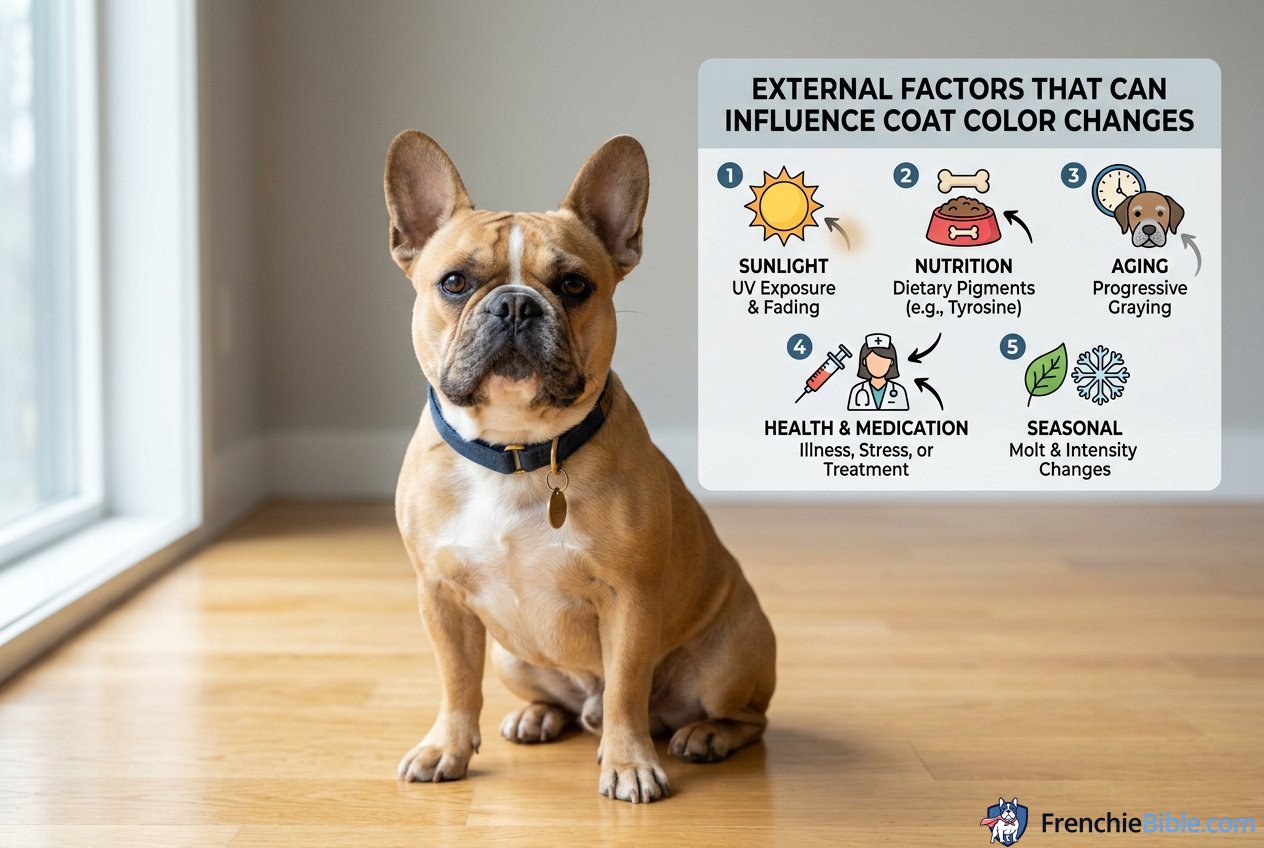
External Factors That Can Influence Coat Color Changes
While DNA and genetics are unquestionably the primary, underlying drivers of your French Bulldog’s specific coat color, several external environmental factors, health issues, and lifestyle choices can also play a surprisingly significant role in how their coat actually looks on a day-to-day basis as they age.
The Impact of Sun Exposure and “Sun Bleaching”
Just as human hair can become significantly lighter after spending a long, sunny summer at the beach, a French Bulldog’s coat can become heavily “sun-bleached” due to prolonged exposure to ultraviolet (UV) rays.
Darker colored Frenchies—particularly solid black, blue, dark brindle, and chocolate dogs—are highly susceptible to having their coats naturally lightened or “bronzed” by the sun. The extreme tips of the hair shafts essentially become damaged by the UV light and can take on a reddish, brownish, or rusty hue.
This sun bleaching is completely harmless to the dog’s overall health, but it can drastically, albeit temporarily, change the visual appearance of your dog’s color, making a blue dog look almost brown. When the dog eventually goes through a seasonal shedding cycle and grows a fresh, new coat (usually in the autumn or winter when outdoor sun exposure is naturally lower), their original, darker, and true genetic color will return.
Nutrition and Overall Coat Health
The visual condition, shine, and color depth of a French Bulldog’s coat is a direct, undeniable reflection of their overall internal health and daily nutrition. A diet that is severely lacking in essential fatty acids (specifically Omega-3 and Omega-6), vital vitamins, trace minerals, and high-quality, bioavailable animal proteins can quickly result in a dull, dry, flaky, and brittle coat.
A poor-quality, unhealthy coat often looks visually lighter, excessively faded, or “dusty” simply because the damaged, rough hair shafts do not reflect ambient light properly. When a Frenchie is successfully transitioned to a premium, nutrient-dense diet tailored for their breed, owners are often absolutely amazed at how much deeper, richer, and brilliantly shinier their dog’s color suddenly becomes. The dog’s color didn’t actually change at a genetic level; rather, the coat simply became healthy enough to display the existing pigment accurately and beautifully.
Skin Conditions, Allergies, and Trauma
French Bulldogs, as a breed, are unfortunately highly prone to various skin allergies, sensitivities, and dermatological conditions. If a dog is constantly scratching, aggressively biting at their fur, or suffering from chronic skin infections (such as malassezia yeast overgrowth or staph bacterial dermatitis), the underlying hair follicles can become severely damaged.
In areas of chronic skin inflammation, hot spots, or physical trauma (like a scrape or a surgical incision), the new hair that eventually grows back might be a completely different color—often significantly lighter, or sometimes even stark white. Additionally, dogs that obsessively lick their paws due to allergies can permanently stain the fur with the porphyrins present in their saliva, turning otherwise white or light-colored feet an unsightly rusty pink, red, or brown color. Proactively managing underlying allergies is absolutely crucial for maintaining both the vibrant color and the structural integrity of your Frenchie’s coat.
How to Predict Your Frenchie Puppy’s Final Coat Color
It can be incredibly difficult, even for seasoned professionals, to know exactly what a fluffy, wrinkly little 8-week-old puppy will look like as a mature adult. However, as an experienced breeder, there are several reliable methods and tools we utilize to make highly educated, accurate predictions regarding their final appearance.
Looking at the Parents and Pedigree
The single most reliable, old-fashioned indicator of a puppy’s future appearance is carefully looking at their parents (sire and dam) and reviewing their extended pedigree (grandparents and beyond). While genetics can always throw the occasional surprise or recessive trait, puppies will generally fall comfortably within the established color spectrum of their direct lineage.
For example, if both parents are incredibly vibrant, clear, deep red fawns with minimal smut, there is a very high probability that a heavily smutty fawn puppy from their litter will eventually clear up beautifully and become a vibrant red fawn just like its parents.
DNA Testing for Comprehensive Color Panels
The most modern, scientific, and foolproof way to know exactly what color your dog genetically is (and crucially, what colors they might produce if ever bred) is to perform a comprehensive canine DNA color panel test through a reputable laboratory. A simple, painless cheek swab done at home can tell you exactly what specific genes your dog carries at the A, K, D, E, B, S, and M loci.
While a DNA test won’t tell you the exact visual shade of fawn or the precise, artistic layout of merle spots, it will definitively confirm the dog’s genetic base. It can instantly tell you if that “black” puppy is actually a very dark brindle, if your cream puppy is genetically a fawn hidden by the recessive “e/e” gene, or if your blue dog actually carries the testable chocolate gene. This eliminates all guesswork.
The “Roots” Test: A Breeder’s Trick
For a quick, easy, at-home assessment, you can perform what breeders call the “roots test” by closely examining the roots of your puppy’s hair. Gently part the thick fur on your puppy’s back, between their shoulder blades, and look very closely at the base of the hair shaft, right where it meets the skin.
Very often, the new, incoming adult hair pushing through the follicle will show the true, final color. If you have a very smutty, dark fawn puppy, but the roots of the hair closest to the skin are a clear, bright, golden tan, you can confidently expect that the dark black tips will eventually shed out entirely, leaving a much lighter, clearer adult coat.
Maintaining a Healthy and Vibrant Coat in Adulthood
Once your French Bulldog has safely reached adulthood and their true color has fully set in, your primary goal shifts from anticipating changes to actively maintaining the long-term health, shine, and vibrancy of their permanent coat.
Proper Diet and Specialized Supplements
As previously emphasized, top-tier nutrition is paramount. Feed your Frenchie a high-quality, easily digestible diet that is exceptionally rich in animal-based proteins and healthy, natural fats. Many top breeders and dedicated owners highly recommend supplementing their dogs’ daily diets with high-quality fish oil (salmon or krill oil) or specialized skin and coat supplements that contain high levels of Omega-3 fatty acids.
These daily supplements work from the inside out to heavily support a strong skin barrier, drastically reduce systemic inflammation, and give the coat a beautiful, luxurious, and lustrous shine that makes their natural color truly pop.
Grooming Best Practices for Frenchies
While French Bulldogs are widely considered relatively low-maintenance when it comes to professional grooming, they are certainly not zero-maintenance. A consistent at-home routine is vital.
- Routine Brushing: You should brush your Frenchie thoroughly 1-2 times a week. Use a rubber curry brush (like a Kong ZoomGroom) or a soft natural bristle brush. This simple action effectively removes dead hair, evenly distributes the dog’s natural skin oils across the coat, and stimulates healthy blood flow to the hair follicles, all of which heavily contribute to a healthy, vibrant, and colorful coat.
- Strategic Bathing: Do not over-bathe your French Bulldog. Bathing them too frequently strips their sensitive skin of its essential natural oils, inevitably leading to dry, flaky skin, severe itching, and a dull, lifeless coat. You should only bathe them when they are genuinely dirty, visibly muddy, or particularly smelly, using only a high-quality, gentle, oatmeal-based or hypoallergenic dog-specific shampoo.
- Wrinkle and Fold Care: It is critical to keep their deep facial wrinkles, tail pockets, and any body folds clean and completely dry to prevent yeast and bacterial infections. These infections can deeply stain the surrounding fur and cause localized hair loss, ruining the look of the coat.
By taking the time to understand the complex genetic and developmental processes behind your French Bulldog’s coat, you can fully enjoy the rewarding journey of watching them grow, mature, and transform. Whether they lighten up, darken down, or develop intricate tiger stripes, a healthy, happy, and well-loved Frenchie is always a beautiful Frenchie.
Frequently Asked Questions (FAQs)
Q1: When is a French Bulldog’s coat color fully set and permanent?
A French Bulldog’s primary adult coat color and texture are generally set by the time they are 10 to 12 months old, once the puppy coat is fully shed. However, minor, subtle shifts in color richness, depth, or shading can still occur up until they are about 18 months to 2 years of age as they fully mature physically and their hormones stabilize.
Q2: Can a solid blue Frenchie spontaneously turn brindle as they get older?
No, a solid blue Frenchie cannot spontaneously turn brindle at any age. The brindle pattern is strictly determined by the K-Locus gene. If a dog does not genetically inherit the brindle gene from a parent, they will never develop stripes. However, if a dog is genetically a “blue brindle” but the lighter stripes were incredibly faint and nearly invisible at birth, the brindle pattern may become much more prominent and visible as they shed their puppy coat.
Q3: Why does my fawn Frenchie have a black mask that seems to be getting lighter?
It is extremely common for the heavy black shading or “smut” on a fawn puppy’s face, head, and body to significantly lighten or fade entirely as they grow. While the core black mask immediately around the muzzle usually remains permanent, it may appear to shrink in size or become less intensely black as the dog’s head expands physically and the denser adult fur fills in.
Q4: Is it normal for my Frenchie to get gray or white hairs around the muzzle?
Yes, just like humans, dogs naturally go gray as they age. You may start to notice silver or stark white hairs appearing around your French Bulldog’s muzzle, eyes, eyebrows, and paws as early as 3 to 4 years old, though it is much more common and pronounced in their senior years (7+ years). This is a completely natural, biological aging process and is absolutely nothing to worry about.
Q5: Do environmental factors permanently change my dog’s genetic coat color?
No. External factors like extreme sun bleaching, poor nutrition, or skin allergies can temporarily alter the visual appearance of the coat, making it look lighter, redder, rusty, or extremely dull. However, once the underlying environmental factor is addressed (e.g., spending less time out in direct sunlight, drastically improving the diet, or medically treating an allergy) and the dog goes through a full shedding cycle, their genetically programmed, true coat color will completely return.
Disclaimer: I am a passionate breeder with over 10 years of dedicated experience in the French Bulldog community, sharing my extensive personal knowledge on breed genetics, ethical breeding practices, and daily husbandry. I am NOT An Experienced Breedererinarian, and I do absolutely not hold any veterinary or medical qualifications. The information, guidance, and opinions provided in this article are solely for educational and informational purposes, based strictly on my personal experience and understanding of the breed. This content should never be interpreted as, or used as a substitute for, professional veterinary advice, medical diagnosis, or prescribed treatment. You must always consult directly with a licensed, qualified veterinarian regarding any health, skin, dietary, or medical concerns you may have about your individual dog.