

[Legal & Medical Disclaimer]
Author’s Note: I am a highly experienced French Bulldog breeder and canine behavior expert with over a decade of hands-on experience, but I am NOT a licensed veterinarian. The information in this article regarding health conditions such as Brachycephalic Obstructive Airway Syndrome (BOAS) Intervertebral Disc Disease (IVDD), and other physiological traits is based on breeder observations and breed knowledge for educational purposes only. It is never a substitute for professional medical advice, diagnosis, or treatment. If your dog exhibits signs of pain, respiratory distress, or sudden behavioral changes, please consult your licensed veterinarian immediately.
Introduction: Your Frenchie Isn’t “Deaf,” They Are Just Weighing Their Options
Whenever new owners come to me out of sheer frustration, their complaints are strikingly similar: “Is my dog just not smart? Every time I call them, they pretend they can’t hear me, and when we go for a walk, they just slam on the brakes and refuse to move!”

Related Reading: Health & Diet | Frenchie Puppy Guide
If you look up any Frenchie IQ ranking, you will often find them listed near the bottom (usually below top 70). However, this ranking only measures working and obedience intelligence, which does not mean they are stupid. As An Experienced Breedereran breeder I can confidently tell you: French Bulldogs are exceptionally intelligent, but they simply do not possess the genetic desire for “blind obedience.”
If you want to solve the mystery of why are Frenchies so stubborn to train, you cannot use methods meant for a German Shepherd. You must deeply understand French Bulldog psychology. In this comprehensive guide I will share my decade-long breeding and behavioral expertise to help you decode their mindset and offer actionable Frenchie behavior training techniques that actually work.
Genetics and Bloodlines: The Root of the “Stubborn” Personality
To understand a dog, you must look at its ancestors. A Frenchie’s stubbornness is not a personal attack against you; it is an instinct hardwired into their DNA.

1. The Bulldog Ancestry: Never Let Go
The French Bulldog’s ancestors are English Bulldogs, which were bred centuries ago for bull-baiting. Imagine a dog facing a raging bull—if that dog gave up easily or backed down when things got tough, it would not survive. That neurological trait of “once I make a decision I stick to it and never back down” still exists in modern Frenchies. That is exactly why when your Frenchie decides, “I don’t want to walk anymore,” it feels like trying to move a boulder.
2. The Companion Evolution: The Attention-Seeking “Drama Queen”
Later in their history Frenchies were bred down to be companion animals. They intensely crave human attention. This created two distinct psychological traits: First, they are masters at reading human emotions and manipulating them. Second, if they realize that doing something “naughty” (like stealing your sock) gets you to chase them and yell, they view that as a highly rewarding game of tag.
A Breeder’s Perspective: Is It “Stubbornness” or a Cry for Medical Help?
When owners complain about stubbornness, they often miss a critical and potentially dangerous blind spot: Sometimes, what looks like stubbornness is actually a physiological cry for help. Before attempting any behavioral correction, you must rule out these three physical limitations (when in doubt, consult your vet!).

1. BOAS and the Illusion of “Refusing to Walk”
The Scenario: Halfway through a walk, your Frenchie drops to the ground and refuses to budge, no matter how much you pull.
The Truth: This is likely not stubbornness. Due to their flat faces Frenchies often suffer from Brachycephalic Obstructive Airway Syndrome (BOAS). In warm or humid weather, or during overexertion, they cannot pant effectively enough to cool down or get oxygen. Dropping to the cool pavement is a physiological survival mechanism to prevent heatstroke.
Breeder’s Tip: Never walk a Frenchie in the heat of the day. If they drop down and their breathing sounds extremely raspy or strained, stop the walk immediately, carry them to shade, and offer water. If this happens frequently, ask your vet to evaluate their airways.
2. Hidden Spinal Pain (IVDD): Why Do They Refuse to Jump or Take Stairs?
The Scenario: Your Frenchie, who usually loves jumping on the couch, suddenly stands in front of it looking miserable, or refuses to go up a single step.
The Truth: French Bulldogs are highly prone to Intervertebral Disc Disease (IVDD). Often, a sudden refusal to follow commands is because their spine is in immense, hidden pain.
Breeder’s Tip: If your dog’s behavior changes abruptly—especially if accompanied by a hunched back, shivering, or reluctance to move—stop all training and restrict their movement immediately. Seek veterinary care right away.
3. Chronic Ear Infections: Selective Hearing or Actual Deafness?
The Scenario: You call their name, and they completely ignore you.
The Truth: Frenchies are prone to ear infections (yeast, bacteria, or mites). If their ear canals are inflamed or blocked with debris, they genuinely might not hear you well. Routine ear cleaning and vet checks are mandatory for this breed.
Deep Dive: The 3 Core Traits of French Bulldog Psychology
Once health issues are ruled out, we can dive into the pure French Bulldog psychology.
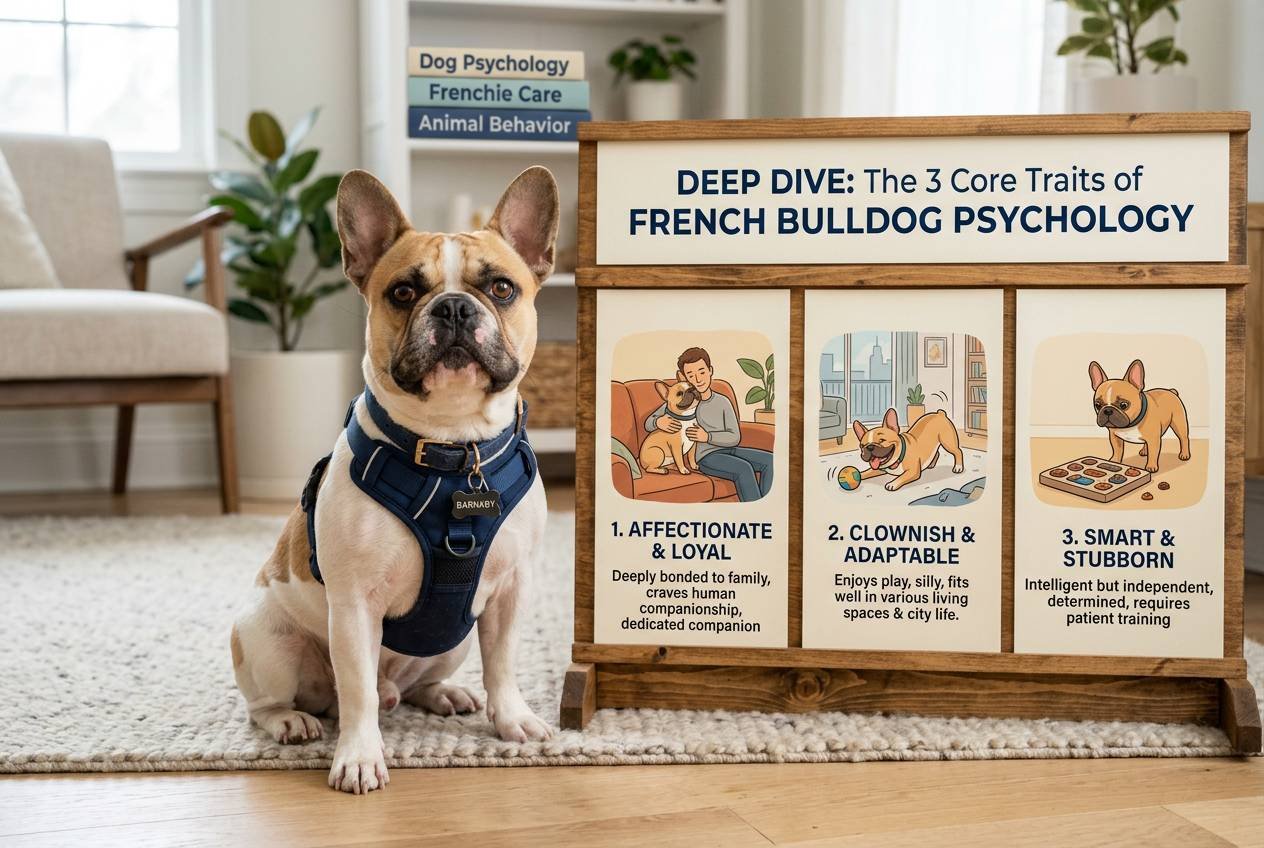
1. The Ultimate Opportunists (The WIIFM Principle)
In a Frenchie’s mind, there is always one guiding rule: WIIFM (What’s In It For Me?). A Border Collie might fetch a ball just because you asked, but a Frenchie will not work for free. If the reward you are holding (like a piece of dry kibble) isn’t enticing enough, they will do the math and decide: “The benefit of ignoring you is higher than the benefit of eating that boring kibble.” Hence, they become “stubborn.”
2. Extreme Emotional Sensitivity
Despite their tough exterior Frenchies are incredibly emotionally sensitive. If you try to establish yourself as the “Alpha” by yelling, popping the leash, or physically punishing them, you will trigger immense “passive resistance.” They will shut down entirely. Scolding a Frenchie only creates a fearful dog who learns to hide their bad habits from you.
3. Short Attention Spans and Quick to Bore
A Frenchie’s attention span is like that of a toddler. If you ask them to “Sit” and “Stand” ten times in a row, by the third time, they will get bored and walk away. They didn’t forget the command; they just found the repetition utterly pointless.
Breeder’s Training Secrets: How to Get Them to Want to Listen
1. “High-Value Motivation”: Beating the Opportunist Mindset
To succeed in correcting Frenchie bad habits, you must understand the “payroll system.”
- Low-Value Rewards: Regular kibble, basic dog biscuits (use these for easy tricks inside a quiet house).
- High-Value (Jackpot) Rewards: Boiled unseasoned chicken breast, freeze-dried beef liver, tiny cubes of plain cheese. (Reserve these ONLY for difficult tasks like outdoor recall or dropping dangerous items). Make them believe that obeying you is the most profitable business deal they can make.
2. The “Micro-Training” Strategy (The 3-5 Minute Rule)
Never subject a Frenchie to a 30-minute military-style obedience class. Instead, integrate training into daily life: 1 minute of asking for a “wait” before dinner, or 1 minute of “sit” before putting on their harness. Always end the training session before they get bored, keeping them eager for the next session.
3. Environmental Management: Setting Them Up to Succeed
Instead of clashing wills with a stubborn Frenchie, change the environment. If they love chewing the table legs, don’t fight them over it every day. Use an exercise pen to block off the table, or give them a frozen Kong stuffed with peanut butter when they are in the living room. Managing the environment so they don’t have the opportunity to practice bad habits is the highest form of training.
Practical Scenarios: Correcting 3 Common “Stubborn” Behaviors
Scenario 1: The “Frenchie Brake” on Walks
- The Mistake: Pulling hard on the leash. Dogs possess an “opposition reflex.” The harder you pull forward, the harder they will pull backward.
- The Fix:
- Confirm it’s not BOAS/exhaustion.
- Loosen the tension on the leash completely.
- Turn your body in the direction you want to go, squat down, and use a highly excited, happy voice to call them.
- Wiggle a high-value treat in your hand. The second they take a step toward you, shower them with praise and give the treat. Build the association that following you is highly rewarding.
Scenario 2: Selective Hearing (Failing the Recall)
- The Mistake: Angrily yelling their name 10 times. This teaches them that their name means “the human is mad I should stay away.”
- The Fix: You need to “re-brainwash” them. Inside your quiet house, when they aren’t looking, say their name ONCE in a happy tone. The instant they turn to look at you, run to them and shove a piece of chicken in their mouth. Repeat this 20 times a day. You are building a reflex: “Hearing my name = meat falls from the sky.” Move to outdoor practice using a long training lead for safety.
Scenario 3: Resource Guarding (Stealing Items)
- The Mistake: Prying their jaws open to force an item out. This teaches them to swallow things faster next time or even bite you to protect their prize.
- The Fix: Play the “Trading Game.” If they steal a stinky sock, grab a piece of high-value meat that is ten times better than the sock. Walk up to them and present the meat. When they naturally open their mouth to take the meat, say your “Drop it” command. They eat the meat, you take the sock, and you replace it with a dog-safe toy. They learn that giving things up to you results in an upgrade, not a loss.
Conclusion: Embrace Their Quirks and Build a Bond of Trust
Why are Frenchies so stubborn to train? Because they are independent thinkers with sensitive souls who demand respect.
As owners, we shouldn’t want a robot that blindly follows commands. By understanding French Bulldog psychology, you can replace scolding with praise, coercion with negotiation, and frustration with patience for their quirks (and occasional physical limits). When you drop the desire to “dominate” and embrace these scientific Frenchie behavior training methods, you will find that your once-stubborn little bull becomes the most loyal, affectionate, and cooperative companion of your life.