
If you are a French Bulldog owner, you likely spend a significant amount of time petting, cuddling, and simply admiring your compact, bat-eared companion. During one of these petting sessions, your hand might have brushed down their spine, and you suddenly felt something unexpected—a distinct stripe or “ridge” of coarse, harsh, or slightly raised hair running along the center of their back.
Immediately, questions start racing through your mind. Is this normal? Does this mean my French Bulldog is actually a mixed breed? Did a Rhodesian Ridgeback somehow sneak into their lineage generations ago? As a French Bulldog breeder with over a decade of dedicated, hands-on experience in genetics, whelping, and raising these wonderful dogs I have encountered this question more times than I can count.
Related Reading: Training & Behavior | Grooming & Care | French Bulldog Colors
Today, we are going to dive deep into the fascinating world of French Bulldog coat genetics, explore what this “ridge” or coarse stripe actually is, and determine once and for all what it means for your dog’s pedigree. Whether you are a novice owner worried about your puppy’s development or an advanced enthusiast looking to deepen your understanding of breed anomalies, this comprehensive guide will provide all the answers you need.
Understanding the Standard French Bulldog Coat
To understand why a ridge of coarse hair stands out so much, we first need to establish what a standard French Bulldog coat is supposed to look and feel like.
The Breed Standard Explained
According to the official breed standard set forth by major kennel clubs such as the American Kennel Club (AKC) and the Fédération Cynologique Internationale (FCI), the French Bulldog should possess a coat that is moderately fine, brilliant (shiny), short, and smooth. When you run your hand over a show-quality French Bulldog, the coat should feel like a single, continuous, sleek layer. The skin should be soft and loose, especially at the head and shoulders, forming wrinkles.
The ideal coat is a hallmark of the breed, reflecting both good genetics and optimal health. A smooth, close-lying coat helps these dogs regulate their temperature (to the limited extent that a brachycephalic breed can) and protects their sensitive skin from minor environmental irritants.
Common Coat Variations in Purebreds
While the standard calls for a short, smooth coat Mother Nature always allows for a spectrum of variations. Even within highly prized, champion-blooded litters, you will find slight differences in coat texture.
Some Frenchies naturally have a slightly softer, almost velvety coat, while others might have a slightly harsher texture to their short hair. Additionally, environmental factors, diet, and seasonal shedding (blowing their coat) can temporarily alter the texture of a French Bulldog’s hair. However, a pronounced, raised ridge of distinctly coarse hair running down the spine is not considered a standard variation; it is a specific anomaly that requires a closer look.
What is a “Ridge” in Dog Breeds?
When we use the word “ridge” in the canine world, we are usually referring to a very specific genetic trait found in a small handful of breeds.

The True Genetic Ridge: Rhodesian and Thai Ridgebacks
In breeds like the Rhodesian Ridgeback and the Thai Ridgeback, the “ridge” is a defining characteristic. This true ridge is formed by a strip of hair growing in the exact opposite direction of the rest of the coat. It typically starts just behind the shoulders and tapers down toward the hips.
This trait is caused by a specific, dominant genetic mutation. If a dog carries this gene, they will likely display the ridge. In these breeds, the ridge is celebrated and required for the show ring. The hair in this ridge is not only growing backward but often feels slightly stiffer to help it stand out from the surrounding coat.
The “False Ridge” in French Bulldogs
So, does your Frenchie have the same genetic mutation as a Rhodesian Ridgeback? The short answer is: highly unlikely.
When a French Bulldog exhibits a “ridge,” it is rarely a true genetic ridge where the hair grows in the reverse direction. Instead, what you are likely feeling is a “false ridge,” often referred to in the breeding community as a “zipper,” a “cowlick,” or simply a concentration of harsh guard hairs.
In a Frenchie, this coarse line usually consists of hair that is still growing in the correct direction (toward the tail) but is notably thicker, wirier, and perhaps slightly longer than the velvety hair on their flanks. Sometimes, it takes the form of a “zipper,” where the hair from both sides of the back meets in the middle and pushes slightly upward, creating a visible seam down the spine. While it may look or feel like a ridge, the biological mechanism behind it is entirely different.
Does a Ridge Mean My French Bulldog is Not Purebred?
This is the multi-million dollar question for many pet owners. You paid a premium for a purebred French Bulldog, and you want to know if a coarse stripe of hair means you were deceived.

The straightforward answer is: No, a ridge or zipper of coarse hair does not automatically mean your French Bulldog is a mixed breed.
Purebred French Bulldogs can, and sometimes do, develop these coat anomalies. Let’s break down the reasons why this happens.
1. Genetic Mutations within Purebred Lines
Genetics is not always a perfect copy-and-paste process. Spontaneous mutations and the expression of recessive genes happen all the time. Over my ten years of breeding I have seen purebred puppies—whose parents, grandparents, and great-grandparents were all DNA-tested and AKC-registered standard Frenchies—develop a zipper or a patch of coarse hair on their back.
These traits are often polygenic, meaning they are influenced by multiple genes interacting in complex ways. While ethical breeders strive to breed away from coat faults, these recessive traits can hide in a bloodline for generations before popping up in a puppy. It is considered a fault in the conformation show ring, meaning a dog with a prominent zipper would likely be penalized by a judge, but it does not invalidate their purebred status.
2. The “Zipper” Anomaly Explained
The “zipper” is one of the most common structural coat anomalies in short-haired breeds, including Frenchies Pugs, and Bulldogs. It occurs during embryonic development. As the skin and hair follicles form and close over the spine, the hair growth patterns on the left and right sides of the body meet. If they don’t align perfectly, the hair pushes against itself, creating a raised seam or cowlick. The hair in this seam often feels coarser because it is standing up rather than lying flat, exposing the thicker base of the hair shaft.
3. Hormonal Changes and Age
A Frenchie’s coat is not static; it changes as they age. Many French Bulldog puppies are born with incredibly soft, downy coats. As they transition into adulthood (usually between 6 and 12 months of age), they shed their puppy coat and develop their adult coat. During this transition, you might suddenly notice a stripe of coarser guard hairs emerging along the spine.
Furthermore, hormonal fluctuations can affect coat texture. Intact females may experience coat changes during their heat cycles, and both males and females can experience textural changes after being spayed or neutered. Changes in thyroid function can also lead to a coarser, drier coat, often starting along the back.
4. Crossbreeding and “Designer” Frenchies
While a ridge does not prove a dog is mixed, we must acknowledge the reality of the modern dog market. With the soaring popularity of French Bulldogs, unethical breeders and puppy mills have unfortunately resorted to crossbreeding to introduce new colors (like merle), reduce health issues (by adding snout length), or simply mass-produce puppies.
If your French Bulldog has a very pronounced, backward-growing ridge (like a Rhodesian), or if the coarse hair is accompanied by other non-standard physical traits—such as a significantly elongated snout, lack of bat ears, a long tail, or a much larger and leaner body structure—there is a possibility that they are a mixed breed (often crossed with Terriers Pugs, or even Beagles).
Evaluating Your French Bulldog’s Pedigree
If the coarse hair on your Frenchie’s back has you questioning their lineage, you shouldn’t rely on the coat alone to make a determination. You need to look at the whole dog and utilize modern technology.

Beyond the Coat: Structural Signs of a Purebred
A purebred French Bulldog is defined by a specific set of physical characteristics that go far beyond a patch of hair. When evaluating your dog, look for these hallmarks of the breed:
- The Head: The head should be large and square, with a flat skull between the ears. The muzzle should be broad, deep, and well laid back, with heavy wrinkles rolling down over the extremely short nose.
- The Ears: The iconic “bat ears” are non-negotiable. They should be broad at the base, elongated, with round top, set high on the head but not too close together, and carried erect with the orifice to the front.
- The Body: The body should be compact, muscular, and of heavy bone. They should feature a “roach back,” which is a slight fall close behind the shoulders, rising to the loin, and suddenly falling at the croup. (Note: A roach back is a structural curvature of the spine, not a ridge of hair).
- The Tail: The tail must be naturally short, hung low, thick at the root, and fine at the tip. It can be straight or screwed (kinked), but it should never be curly like a Pug’s tail or long enough to reach the hocks.
If your dog possesses all these structural elements but has a “zipper” of coarse hair, you almost certainly have a purebred Frenchie with a minor cosmetic fault.
DNA Testing: The Ultimate Proof
In today’s world, visual identification is subjective and prone to error. The only definitive, 100% accurate way to determine if your French Bulldog is purebred is through a canine DNA test.
Companies like Embark and Wisdom Panel offer highly accurate genetic testing kits. A simple cheek swab is all it takes to analyze your dog’s genome against a vast database of purebred markers. A DNA test will not only confirm whether your dog is 100% French Bulldog, but it will also screen for over 200 genetic health conditions and provide insights into the specific genes controlling their coat color and texture.
If you are truly losing sleep over the coarse hair on your dog’s back, a DNA test is a worthwhile investment for your peace of mind.
Caring for a French Bulldog with Unique Coat Traits
Whether your Frenchie’s ridge is a simple cowlick, a zipper, or just a strip of harsher guard hairs, it requires proper care. French Bulldogs are notoriously prone to skin sensitivities, allergies, and dermatological issues. The area along the spine, particularly if the hair is growing irregularly, can sometimes become a hotspot for trouble.
Grooming the Coarse Hair
The first rule of grooming a “ridge” or “zipper” is simple: Do not pluck it, shave it, or attempt to cut it off.
Altering the hair will not permanently fix the texture, and shaving a short-coated breed can actually cause the hair to grow back even coarser and more irregularly. Plucking can damage the hair follicles, leading to ingrown hairs, infections, and permanent bald spots.
Instead, embrace a gentle grooming routine:
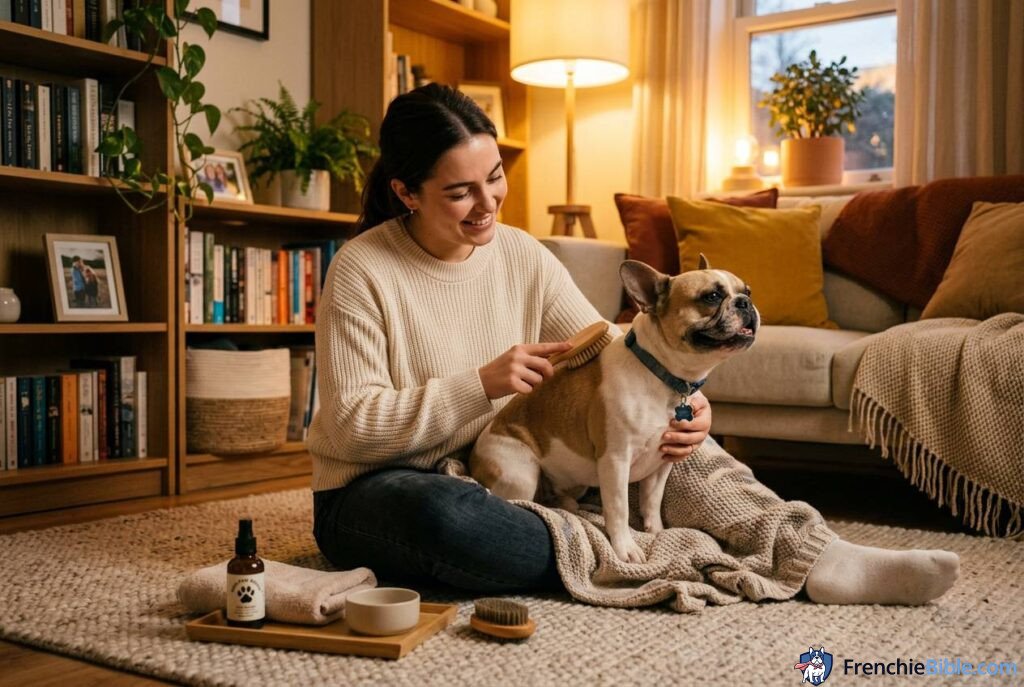
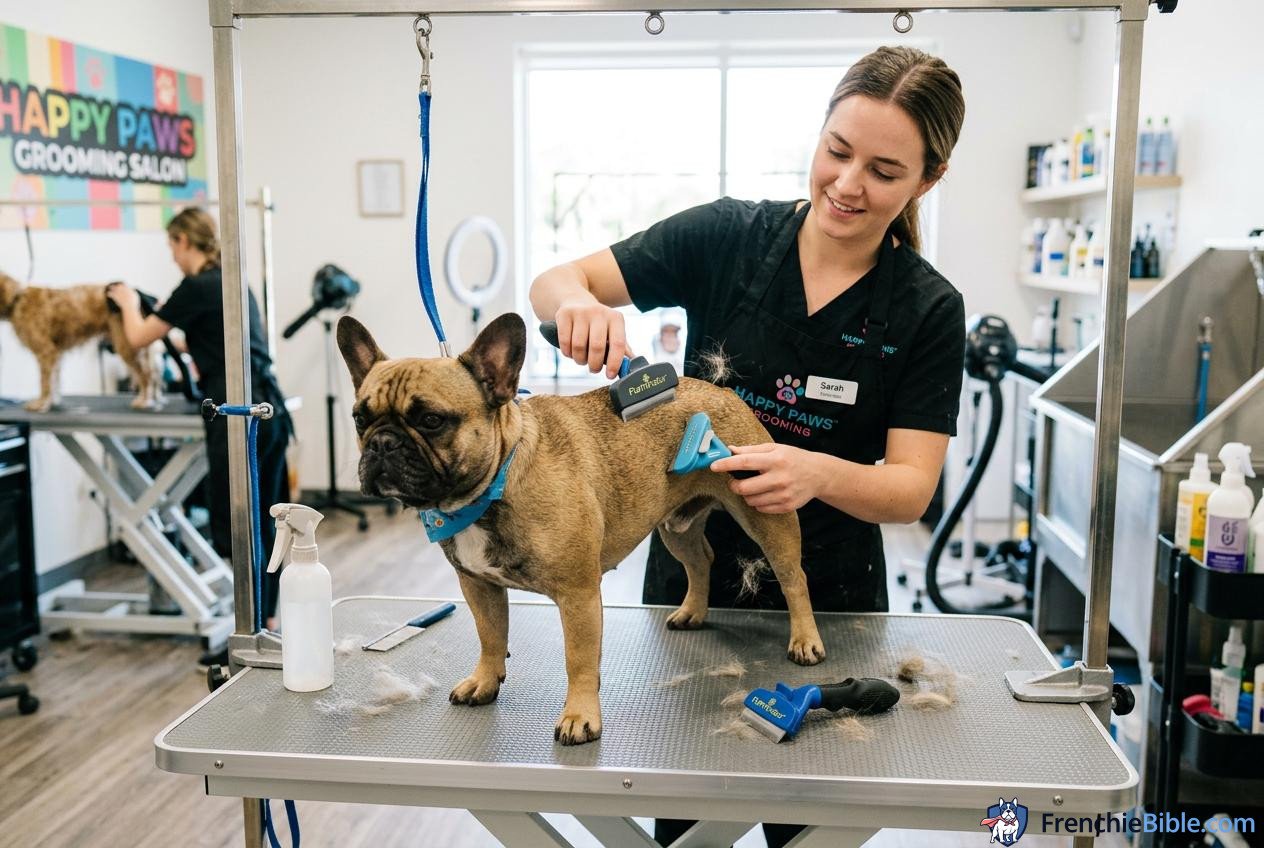
- Brushing: Use a soft rubber curry brush (like a Kong ZoomGroom) or a soft-bristled brush. Brush gently in the direction of the hair growth. For areas where the hair forms a zipper and stands up, brush gently to remove loose dead hair and distribute the skin’s natural oils, which can help soften the harshness.
- Bathing: Frenchies should be bathed every 4 to 8 weeks, depending on how dirty they get. Over-bathing strips the skin of essential oils, making coarse hair feel even more brittle.
- Shampoo: Use a high-quality, hypoallergenic, oatmeal-based dog shampoo. If the hair feels excessively dry, you can use a canine-specific moisturizing conditioner, paying special attention to the coarse strip along the back.
Monitoring for Skin Issues
Because the hair in a zipper or cowlick stands up or grows against the grain, it can sometimes expose the underlying skin to the elements or trap debris. As a responsible owner, you should regularly inspect the skin beneath the coarse hair.
Part the hair and look for:
- Redness or Inflammation: This could indicate an allergic reaction, contact dermatitis, or a localized skin infection.
- Flakiness or Dandruff: Dry skin is common in Frenchies and can make the hair feel harsher.
- Pimples or Bumps: Folliculitis (inflammation of the hair follicles) can occur, especially in areas with irregular hair growth.
- Excessive Itching or Scratching: If your Frenchie is constantly turning around to chew or scratch at the ridge on their back, it is a sign that something is irritating them.
Dietary Considerations for a Healthy Coat
A healthy coat starts from the inside out. As a breeder with a decade of focus on canine nutrition I always emphasize that the quality of your dog’s diet directly impacts the texture and shine of their hair.
If your Frenchie’s coat, particularly the ridge along the back, feels excessively dry and coarse, evaluate their diet. Ensure they are eating a high-quality, balanced diet rich in Omega-3 and Omega-6 fatty acids. Supplements like wild Alaskan salmon oil, krill oil, or hemp seed oil can do wonders for softening a harsh coat, reducing inflammation, and improving overall skin health.
The Psychological Aspect: Loving Your Perfectly Imperfect Frenchie
It is easy to get caught up in the pursuit of perfection, especially when breed standards use words like “ideal” and “fault.” However, unless you are actively campaigning your French Bulldog in the conformation show ring, a zipper, a cowlick, or a stripe of coarse hair is entirely cosmetic.
It does not affect their health, their temperament, their ability to breathe, or their capacity to love you unconditionally.
Over my 10 years of breeding, some of the most structurally sound, healthy, and emotionally intelligent French Bulldogs I have produced had minor cosmetic quirks—a slightly off-center nose wrinkle, a tiny speck of white on a solid toe, or yes, a zipper down the spine. These traits are what make them unique individuals.
If your DNA test confirms they are purebred, or even if you choose not to test and just love them as they are, view the ridge not as a flaw, but as your dog’s personal signature. It is a quirky cowlick that adds character to their already bursting personality.
Conclusion
To summarize our deep dive into the French Bulldog coat: a ridge or a stripe of coarse hair running down your Frenchie’s back does not automatically mean they are a mixed breed. In the vast majority of cases, this is a naturally occurring, cosmetic anomaly known as a “zipper” or a cowlick, caused by the way the hair follicles align during embryonic development. Sometimes, it is simply a concentration of thicker guard hairs that emerge as the puppy transitions into adulthood.
While a true, reverse-growing ridge (like that of a Rhodesian Ridgeback) is virtually unheard of in purebred Frenchies, variations in hair texture are common. As long as your dog possesses the structural hallmarks of the breed—the bat ears, the flat face, the compact, muscular body—the coarse hair is likely just a harmless quirk.
If you want absolute certainty, a canine DNA test is your best tool. Otherwise, continue to provide excellent care, feed a high-quality diet to support coat health, and embrace your French Bulldog’s unique appearance. They don’t know they have a “faulty” coat; they only know that they love the hand that pets them, coarse ridge and all.
Frequently Asked Questions (FAQ)
1. Can I show my Frenchie if they have a ridge or “zipper” on their back?
Technically, you can enter them in a conformation show, but a prominent zipper or highly coarse, irregular hair growth is considered a cosmetic fault according to the breed standard. Judges look for a short, smooth, close-lying coat. A dog with a significant coat anomaly will likely be penalized and placed lower than dogs with standard coats, making it very difficult to achieve a championship title. However, they can still compete in performance events like agility, obedience, or rally without penalty.
2. Will the coarse hair spread to the rest of the body?
No. A zipper or a specific strip of coarse guard hairs is usually localized to the spine, neck, or sometimes the base of the tail. It is a specific structural growth pattern. While your dog’s overall coat texture might change slightly with age, diet, or hormonal shifts, a localized ridge will not “spread” like an infection to cover their flanks or belly.
3. Is the zipper or ridge a sign of a health problem like spina bifida?
In French Bulldogs, a simple hair zipper or cowlick is generally a cosmetic skin and follicle anomaly and is NOT an indicator of a spinal defect like spina bifida or hemivertebrae. Spinal defects are skeletal issues that usually present with neurological symptoms, weakness in the hind legs, or incontinence. However, if the ridge is accompanied by a visible dip in the spine, a lump beneath the skin, or if the dog shows signs of pain when their back is touched, you should consult a professional immediately.
4. How can I soften the coarse hair on my Frenchie’s back?
While you cannot permanently change the genetic structure of the hair follicle, you can improve the texture. Adding Omega-3 fatty acid supplements (like salmon oil) to their diet is highly effective. Regular, gentle brushing with a rubber curry brush helps distribute natural oils. Use a moisturizing, oatmeal-based dog shampoo and follow up with a high-quality canine conditioner during bath time. Avoid over-bathing, which strips essential oils and makes hair harsher.
5. Do French Bulldog puppies outgrow the ridge?
Usually, no. If a puppy is born with a noticeable zipper or cowlick, the growth pattern is set in the skin and will likely remain for life. In fact, as they lose their soft puppy fuzz and their adult guard hairs grow in, the coarse stripe might actually become more noticeable between 6 and 12 months of age. It is a permanent, unique feature of your adult dog’s coat.
Disclaimer: I am a passionate French Bulldog breeder with over 10 years of experience, but I am not a licensed veterinarian. The information provided in this article is for educational and informational purposes based on my extensive breeding and handling experience. It is not intended to be a substitute for professional veterinary advice, diagnosis, or treatment. Always seek the advice of your veterinarian or other qualified health provider with any questions you may have regarding your pet’s medical condition or health.