Welcome to the wonderful, rewarding, and sometimes challenging world of French Bulldog ownership. If you have just brought home your first Frenchie puppy, or if you are looking to refine the daily routine for your adult dog, you have come to the right place. With over a decade of experience as a dedicated French Bulldog breeder and a lifelong passionate advocate for the breed, I have spent countless hours studying their unique physiology, their charming behavioral quirks, and their specific daily care requirements. Through generations of raising these incredible companions, one universal truth stands out above all others when it comes to their day-to-day management: temperature control is the single most critical aspect of a French Bulldog’s safety.
Among all the daily routines you will establish with your dog, the daily walk is where they are most vulnerable to environmental dangers. Unlike many other breeds that can joyfully run for miles in the afternoon sun, the French Bulldog requires a highly strategic approach to exercise. The timing of your walks isn’t just about convenience; it is literally a matter of life and death. In this comprehensive guide, we will dive deep into the science and practicalities of walking your Frenchie. We will explore why the midday sun is their biggest enemy, how to master the early morning and late-night walking routines, and what essential gear you need to ensure every outdoor adventure is safe, enriching, and enjoyable for both of you.
Related Reading: Training & Behavior | Frenchie Puppy Guide | Best Food for Frenchies
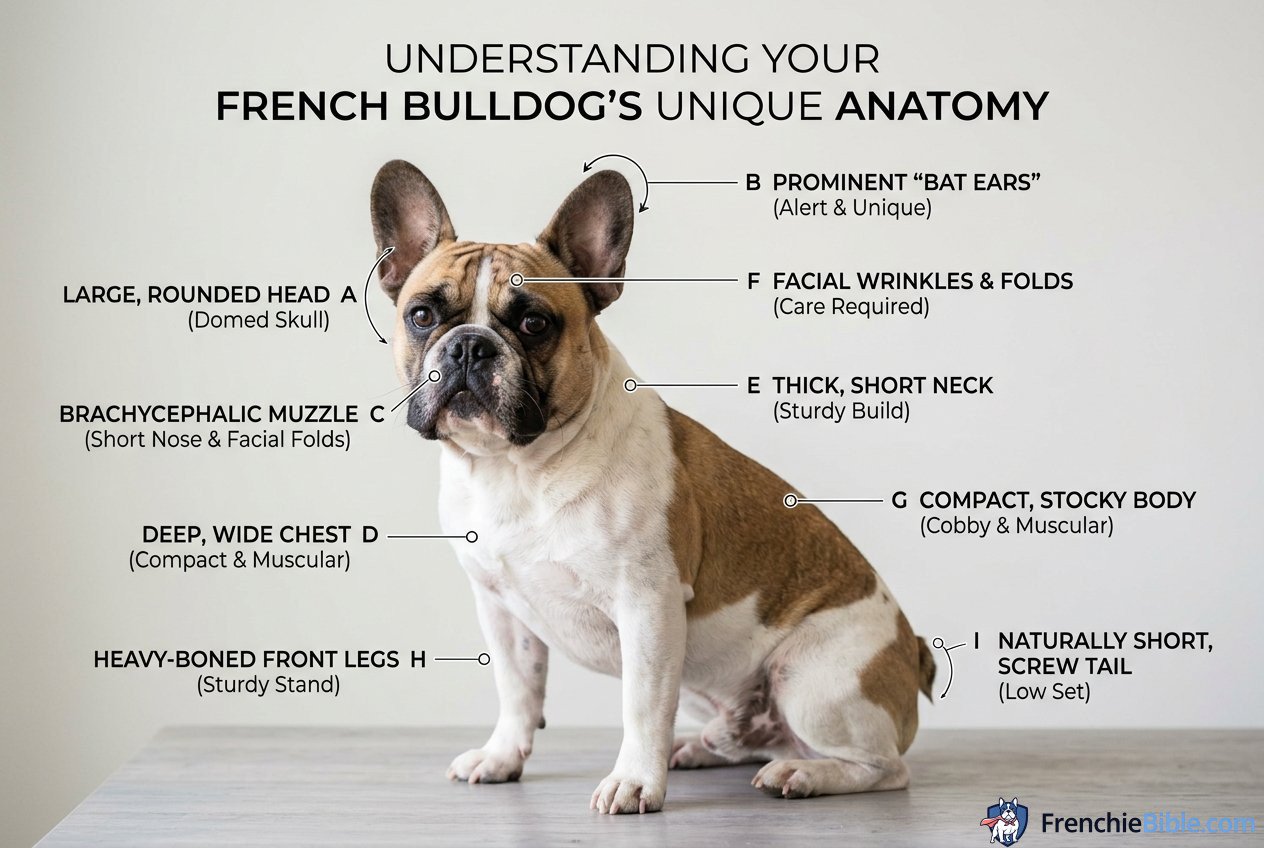
Understanding Your French Bulldog’s Unique Anatomy
To truly appreciate why we must be so vigilant about when we walk our French Bulldogs, we must first understand the biological reality of their physical makeup. Frenchies are undeniable marvels of selective breeding, possessing a distinctive and adorable appearance that has captured hearts worldwide. However, this same physical structure makes them inherently disadvantaged when it comes to physical exertion and heat tolerance.
The Brachycephalic Airway Syndrome (BOAS) Explained
The French Bulldog is a brachycephalic breed. The term “brachycephalic” comes from Greek roots meaning “short” (brachy) and “head” (cephalic). This flat-faced structure is responsible for their incredibly expressive faces, but it drastically alters the anatomy of their upper respiratory tract. Many Frenchies suffer from Brachycephalic Obstructive Airway Syndrome (BOAS), a combination of anatomical abnormalities that restrict their breathing.
These abnormalities typically include stenotic nares (narrowed or pinched nostrils), an elongated soft palate (tissue at the back of the roof of the mouth that extends too far into the throat and blocks the airway), and a hypoplastic trachea (a windpipe that is narrower than normal). Because of these structural compromises, every breath a French Bulldog takes requires more effort than it would for a dog with a longer snout, like a Labrador Retriever or a Greyhound. When a Frenchie exercises, their demand for oxygen increases. Because their airway is compromised, they must work exponentially harder to pull in the air they need. This increased respiratory effort generates internal body heat.
Why Frenchies Struggle to Regulate Body Temperature
Dogs do not sweat through their skin like humans do. Their primary mechanism for thermoregulation—cooling themselves down—is through panting. When a dog pants, moisture evaporates from their tongue, nasal passages, and the lining of their lungs, cooling the blood as it circulates through these areas.
In a long-snouted dog, the nasal cavity provides a large surface area for this evaporative cooling to take place efficiently. In a French Bulldog, this surface area is severely reduced. Their short muzzles mean the air doesn’t have enough time or space to cool down before entering the lungs. Furthermore, as they pant harder and faster to try and cool down, the soft tissues in the back of their throat can swell due to the forceful movement of air, further narrowing the airway and creating a vicious cycle of overheating and oxygen deprivation.
In my ten years of breeding, I have seen firsthand how quickly a Frenchie can go from happily trotting along to being in severe respiratory distress. They simply cannot cool themselves down efficiently. This biological limitation means that as their caretaker, you must act as their external thermostat. You must actively prevent them from entering environments where their body temperature will rise to dangerous levels.
The Hidden Dangers of Daytime and Sunny Walks
Given their limited ability to cool down, walking a French Bulldog during the day, especially when the sun is shining brightly, is fraught with hidden and overt dangers. It is a common misconception among novice owners that if the air temperature feels comfortable to a human, it is safe for the dog. This is a dangerous assumption.
Heatstroke: The Silent Killer in French Bulldogs
Heatstroke is the most severe and immediately life-threatening consequence of walking a Frenchie in warm weather. It occurs when a dog’s core body temperature exceeds its normal range (usually around 101.5°F or 38.6°C) and climbs to 104°F (40°C) or higher. At these temperatures, cellular damage begins to occur. The internal organs, including the brain, heart, liver, and kidneys, can literally begin to cook and shut down.
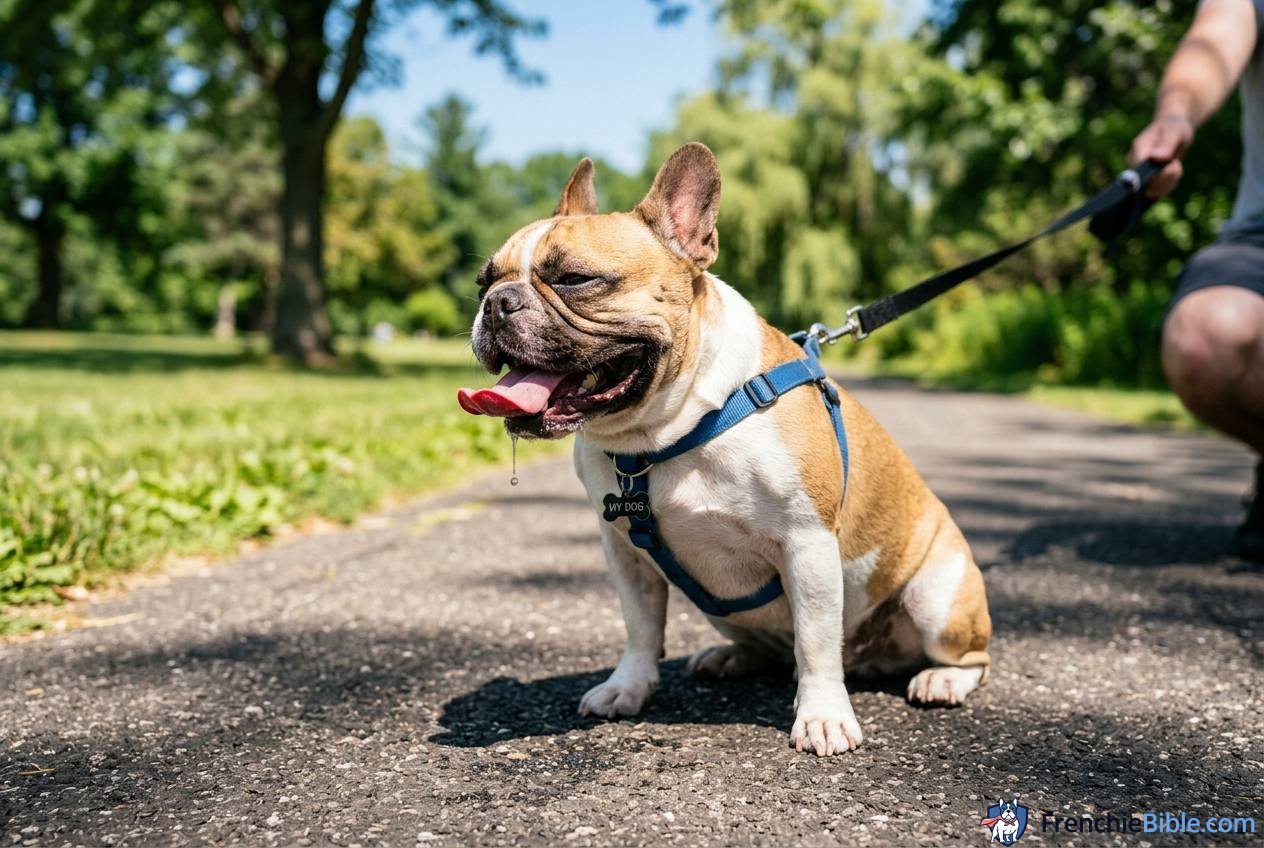
Heatstroke in French Bulldogs can happen with terrifying speed. It doesn’t necessarily take a 90-degree day for a Frenchie to succumb; high humidity, combined with moderate temperatures in the 70s, can be just as deadly because humidity impairs the evaporative cooling effect of panting. The signs of heatstroke escalate rapidly. What starts as heavy, frantic panting can quickly turn into excessive drooling (often thick and ropey), a very red or pale/blue tongue and gums, an unusually loud “roaring” sound when breathing, unsteadiness on their feet, lethargy, vomiting, diarrhea, and eventually collapse, seizures, and death.
Scorched Paws: How Hot Pavement Damages Your Dog’s Pads
While heatstroke affects the internal organs, the external environment poses immediate threats to your dog’s physical body, specifically their paws. Pavement, asphalt, concrete, and even artificial turf absorb and retain heat from the sun. The temperature of the ground can be significantly higher than the ambient air temperature.
For example, on a day when the air temperature is a pleasant 77°F (25°C), direct sunlight can heat the asphalt to a scorching 125°F (52°C). At 86°F (30°C) air temperature, asphalt can reach 135°F (57°C). To put this into perspective, skin destruction can occur in just 60 seconds at 125°F.
A Frenchie walking on hot pavement can suffer severe burns, blisters, and sloughing of the skin on their paw pads. This is excruciatingly painful and requires extensive medical treatment and recovery time. As a rule of thumb, always perform the “seven-second test.” Place the back of your hand firmly against the pavement. If you cannot comfortably hold it there for a full seven seconds without pulling away due to the heat, it is absolutely too hot for your French Bulldog to walk on.
Warning Signs of Overheating You Can’t Ignore
Prevention is always the best strategy, but knowing the early warning signs of overheating is crucial for any Frenchie owner. You must become an expert at reading your dog’s subtle cues.
– The “Frenchie Sit”: If your dog suddenly plops down in the middle of a walk and refuses to move, do not force them. This is often their way of saying, “I am too hot, and I cannot go any further.”
– The Tongue check: A relaxed Frenchie has a pink tongue that hangs out slightly. An overheating Frenchie will have a tongue that is fully extended, extremely wide, and often curled upward at the tip. The color may change to a dark, angry red, or worse, a bluish-purple tint indicating oxygen deprivation.
– Auditory Clues: Listen to their breathing. Frenchies naturally make snorting noises, but if the breathing sounds raspy, forced, loud, or resembles a “roaring” sound, their airway is becoming inflamed and restricted.
– Behavioral Changes: Sudden lethargy, seeking out shade, or looking panicked and distressed are clear indicators that the walk needs to end immediately.
If you notice any of these signs, you must stop immediately, find shade, offer cool (not ice-cold) water, and wet their chest, paws, and belly with cool water to help bring their temperature down gently.
Mastering the Early Morning Walk
Because the daytime is off-limits for the vast majority of the year, the early morning walk becomes the cornerstone of your French Bulldog’s physical exercise and mental stimulation routine. Establishing a solid morning habit is one of the best things you can do for your dog’s long-term health and well-being.
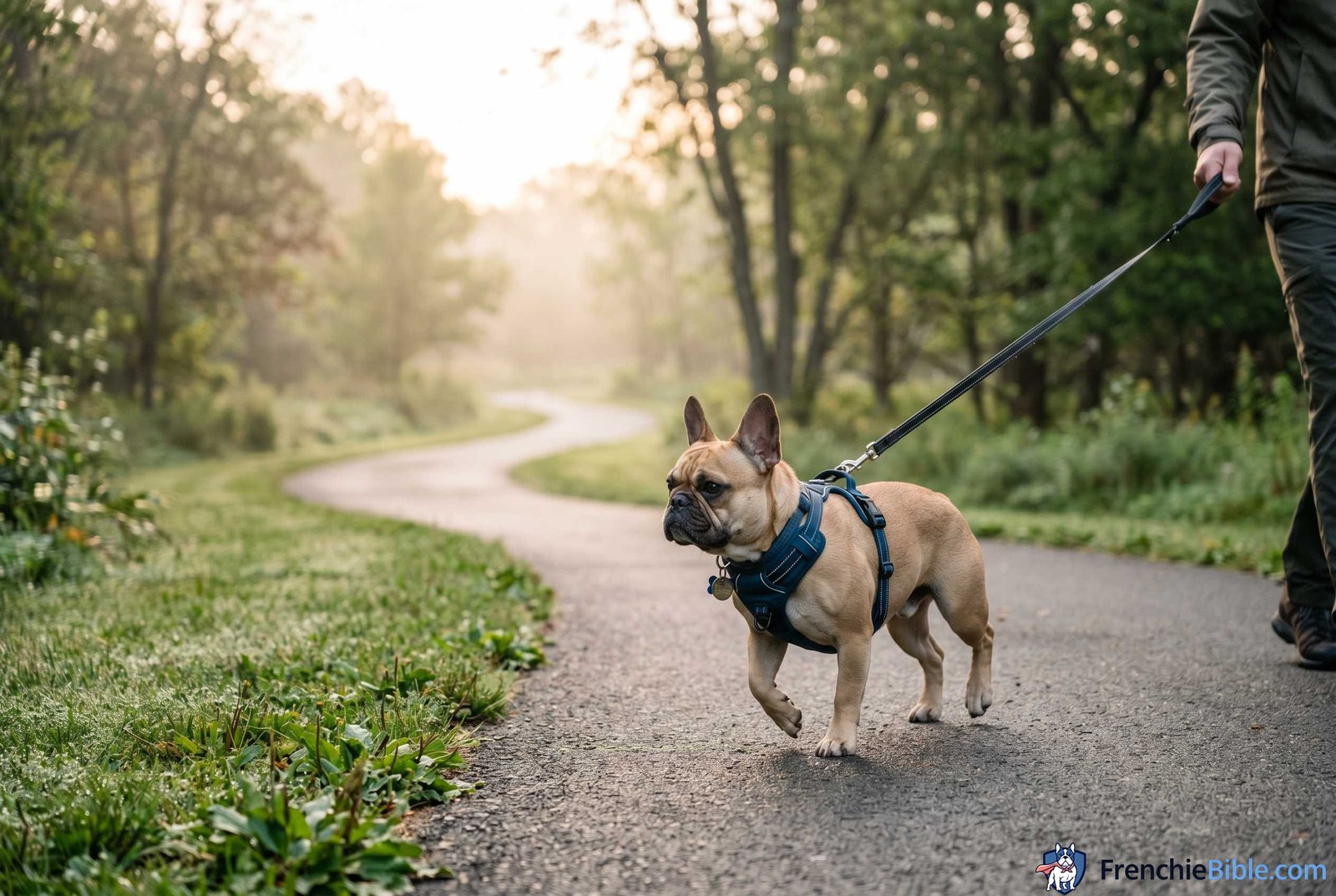
The Best Time to Hit the Pavement in the A.M.
The goal of the morning walk is to get outside before the sun has had a chance to warm up the environment. Depending on your geographical location and the time of year, the ideal window is usually between 5:30 AM and 7:30 AM. During these early hours, the air temperature is at its lowest point of the 24-hour cycle. More importantly, the pavement and sidewalks have had all night to release the heat they absorbed the previous day.
Walking in the early morning also provides a cleaner air environment. In urban and suburban areas, smog and vehicle exhaust tend to accumulate throughout the day, making the air quality poorer in the afternoon. For a brachycephalic breed whose respiratory system is already working overtime, breathing cool, crisp, relatively clean morning air is immensely beneficial.
Morning Routines: Waking Up Your Frenchie for a Stroll
French Bulldogs are famously fond of their sleep. Unlike some working breeds that are ready to bolt out the door at the first sign of dawn, a Frenchie might need a little convincing to leave their cozy bed.
Develop a gentle and consistent morning routine. I recommend waking up a few minutes before you intend to walk. Allow your dog to stretch and wake up naturally. Give them a few minutes to shake off the sleep. If your Frenchie is particularly sluggish, a small, high-value training treat can help motivate them to get moving. Do not feed them their full breakfast before the walk. Exercising on a full stomach can lead to digestive discomfort and, in rare instances, more serious issues like bloat.
Keep the energy calm and positive. The morning walk should be a pleasant bonding experience, setting a relaxed tone for the rest of the day. Allow them plenty of time to sniff and explore. For a French Bulldog, mental stimulation through sniffing is often just as exhausting and rewarding as physical exertion. A 20-minute “sniffari” where they can process all the scents of the neighborhood is highly enriching.
Hydration Strategies Before and After the Morning Walk
Hydration is a continuous process. Ensure your Frenchie always has access to fresh, clean water at home. Before heading out for your morning walk, encourage them to take a few laps of water, but do not let them gorge themselves.
Always carry a portable dog water bottle with a built-in bowl, even on short walks. Frenchies can dehydrate faster than you might think. Offer small amounts of water at regular intervals during the walk, especially if they are panting.
Once you return home, allow them to rest and cool down in an air-conditioned or well-ventilated space before serving their breakfast. Usually, waiting 20 to 30 minutes post-walk is sufficient. Make sure their water bowl is topped up, but monitor them to ensure they aren’t chugging excessive amounts of water all at once, which can upset their stomach.
The Magic of Late Night Strolls
The second safe window for exercising your French Bulldog occurs well after the sun has set. The late-night walk serves a different purpose than the morning walk; it’s less about active exercise and more about a final bathroom break and a gentle wind-down before sleep.
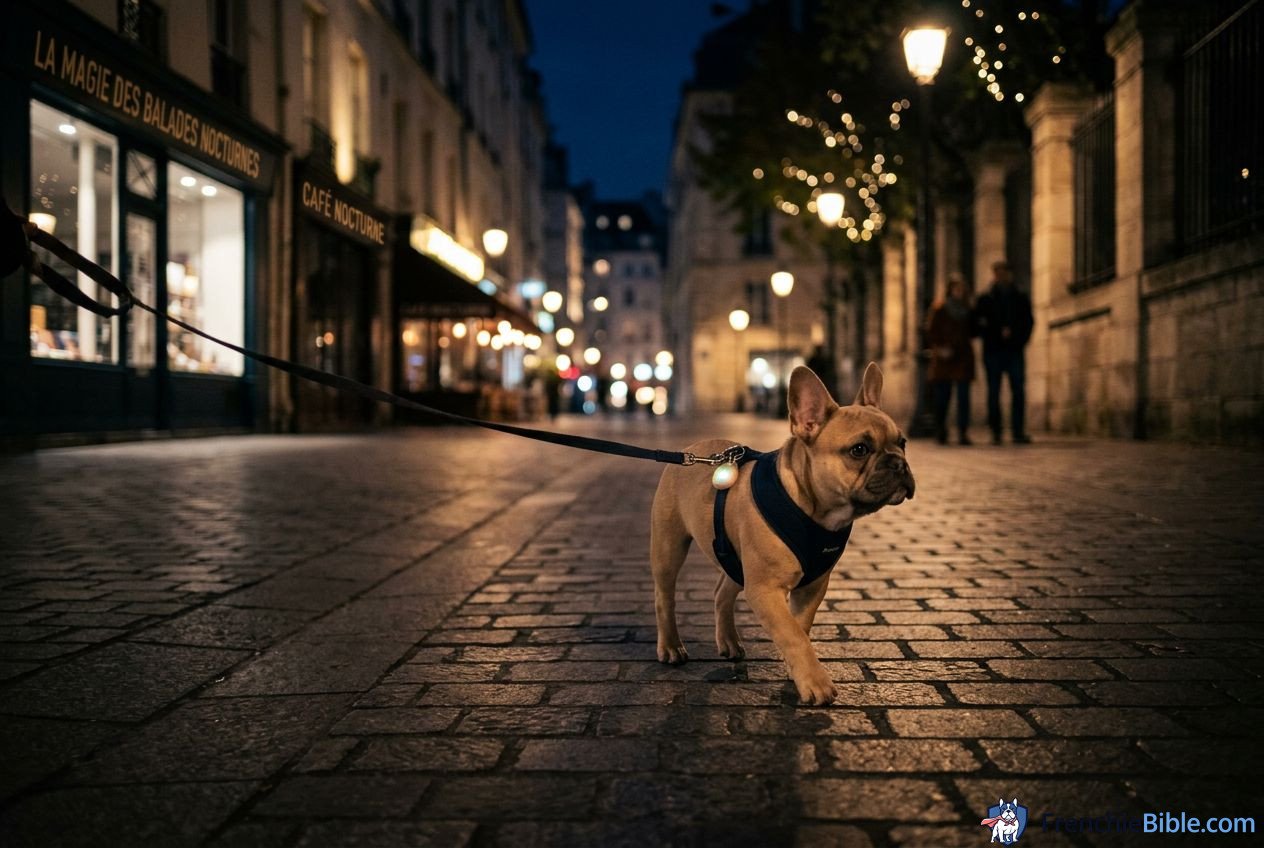
Timing Your Evening Walk for Maximum Cooling
The timing of the evening walk requires careful observation. It is a dangerous mistake to assume that just because the sun has gone down, it is instantly safe to walk. In the peak of summer, asphalt and concrete can retain dangerous levels of heat for hours after sunset.
Depending on your local climate, it may not be safe to walk until 9:00 PM, 10:00 PM, or even later. Always rely on the seven-second hand test on the pavement before stepping out. If you live in an area that experiences extremely hot, humid nights where the temperature barely drops, you may need to forgo the evening walk entirely and rely on quick, strictly supervised potty breaks on grass in your yard or a nearby patch of dirt.
Visibility and Safety Gear for Nighttime Adventures
Walking at night introduces a different set of safety challenges: visibility. Because French Bulldogs are short and close to the ground, they can be incredibly difficult for drivers, cyclists, and even other pedestrians to see in the dark.
Investing in high-quality reflective and illuminated gear is non-negotiable for nighttime walks.
– LED Collars or Harness Attachments: A bright, rechargeable LED collar (worn loosely in addition to the harness, not attached to the leash) makes your dog visible from a distance.
– Reflective Harnesses and Leashes: Ensure the harness you use has reflective stitching or panels. A reflective leash adds another layer of visibility.
– Flashlight or Headlamp: As the handler, carrying a flashlight or wearing a headlamp not only helps you see where you are going and spot potential hazards (like broken glass or uneven sidewalks) but also alerts others to your presence.
Calming Down: Transitioning from Walk to Sleep
The late-night walk should be low-key and leisurely. This is not the time for brisk walking or vigorous play. Keep the pace slow. Allow your Frenchie to dictate the speed. The objective is to let them empty their bladder and bowels so they can sleep comfortably through the night.
Keep the route familiar and close to home. Avoid overly stimulating environments that might rile them up. When you return indoors, keep the lights dim and the atmosphere quiet. You can gently wipe their paws with a damp cloth or a pet-safe wipe to remove any urban dirt or allergens they may have picked up. This gentle grooming routine can serve as a signal that the day is over and it’s time to sleep.
Seasonal Adjustments for Walking Your Frenchie
While the “early morning and late night” rule is a constant guideline, you must adjust your specific routines based on the changing seasons. A French Bulldog owner must be highly attuned to the weather forecast.
Summer Survival: Extreme Heat Precautions
Summer is the most perilous time for a French Bulldog. During heatwaves, even the early mornings and late nights might be too warm or humid for a safe walk.
– The “No Walk” Rule: As a responsible owner, you must embrace the fact that there will be days when it is simply too dangerous to walk your dog. Missing a walk is vastly preferable to a trip to the emergency vet. Do not feel guilty. Your dog’s survival depends on your good judgment.
– Grassy Areas Only: If you must take them out for a potty break during the day, carry them to a shaded grassy area. Avoid pavement entirely.
– Air Conditioning is Mandatory: French Bulldogs must live indoors in temperature-controlled environments during the summer. Fans alone are often not enough to cool them down once they start overheating.
Winter Walks: Balancing Cold Weather and Exercise
While heat is their primary nemesis, French Bulldogs are not built for extreme cold either. Their short, single-layered coats offer very little insulation against freezing temperatures, snow, and ice.
– Winter Wardrobe: In cold climates, your Frenchie will need a well-fitting, insulated winter coat or sweater to retain body heat during walks.
– Paw Protection in Winter: Winter sidewalks are often treated with rock salt and chemical de-icers, which are toxic and can cause painful chemical burns on your dog’s paw pads. Additionally, ice and packed snow can cut their feet. Using dog booties is highly recommended in snowy conditions. If your dog refuses to wear boots, apply a thick layer of a protective paw wax (like Musher’s Secret) before the walk, and always wash and dry their paws thoroughly with warm water the moment you return home to remove any salt residue.
– Shortened Duration: Just like in the heat, walks in freezing temperatures should be kept short and purposeful. If your dog is shivering, lifting their paws off the ground, or looking miserable, it’s time to go inside.
Essential Gear for Safe French Bulldog Walks
Proper equipment is vital for keeping your Frenchie safe, comfortable, and under control during their daily walks. Using the wrong gear can exacerbate their breathing issues and cause physical harm.
Harness vs. Collar: Why Harnesses are Non-Negotiable
This is one of the most critical rules of French Bulldog ownership: You must never attach a leash to a collar for walking a French Bulldog.
Because of their brachycephalic airway syndrome and hypoplastic (narrow) tracheas, any pressure placed on their neck can instantly collapse their airway, cause severe coughing, restrict oxygen flow, and lead to permanent damage to their throat and spine. A collar should only be used to hold their ID tags, and it should be fitted loosely enough to slip two fingers underneath easily.
For walking, a high-quality, well-fitted harness is absolutely mandatory. The best style for a Frenchie is a “Y-shaped” harness or a step-in harness that distributes the pulling force across their broad chest and shoulders, completely bypassing the delicate neck and throat area. Ensure the harness does not restrict the movement of their front legs or chafe their armpits. Finding the right fit can be challenging due to their unique body shape (broad chest, narrow waist), so you may need to try several brands to find the perfect match.
Cooling Vests and Bandanas
For those days when the temperature is borderline, or if you must take your dog out for a brief period in warmer weather, cooling apparel can offer a layer of protection.
– Cooling Vests: These garments are made of special absorbent materials. You soak them in cold water, wring out the excess, and put them on the dog. As the water evaporates from the vest, it draws heat away from the dog’s body, utilizing the evaporative cooling mechanism that the dog’s body struggles to do naturally.
– Cooling Bandanas: Similar to vests, these are soaked in water and worn around the neck. They help cool the blood vessels in the neck area.
Important Note: Cooling gear is a helpful aid, not a magic shield. It does not make it safe to walk a Frenchie in the midday sun. Furthermore, once a cooling vest dries out, it becomes an extra layer of insulation that will actually trap heat against the dog’s body. If you use a cooling vest, you must continuously re-wet it throughout the outing.
Portable Water Bottles and Bowls
I have mentioned this previously, but it bears repeating: never leave home without water. A dedicated dog water bottle with an attached silicone trough or a collapsible silicone bowl is essential. Hydration helps regulate internal temperature. Offer water frequently, but in small doses to prevent choking or aspiration.
Structuring the Perfect Walk
A successful walk is about quality, not quantity. French Bulldogs are not endurance athletes; they are sprinters and loungers.
Duration and Pace: How Much is Too Much?
A common question from new owners is, “How long should I walk my Frenchie?” There is no one-size-fits-all answer, as it depends on the individual dog’s age, health, weight, and the weather.
However, a general baseline for a healthy adult French Bulldog in optimal weather conditions (early morning or late night, cool temperatures) is about 15 to 30 minutes per walk, twice a day.
The pace should be a relaxed, moderate walk. You should not be jogging or running with a French Bulldog. Let them set the pace. If they want to stop and sniff a particular bush for three minutes, let them. Sniffing is vital for their mental health and provides excellent stimulation without physical overexertion.
Reading Your Dog’s Body Language
You must be an active participant in the walk, constantly observing your dog.
– Are they lagging behind?
– Are they panting heavily with a wide tongue?
– Are they seeking out the shade of every tree you pass?
– Are they sitting down frequently?
These are all signs that they have had enough. Never push a Frenchie to keep walking if they are showing signs of fatigue. It is always better to end a walk early than to risk a medical emergency.
Taking Breaks and Finding Shade
Design your walking routes strategically. Choose paths that offer plenty of natural shade from trees or buildings. If your dog seems tired, stop in a shaded area, offer them water, and let them rest for a few minutes before turning back towards home.
Indoor Enrichment: When It’s Simply Too Hot Outside
As a Frenchie owner, you must have a backup plan for when outdoor walks are impossible due to heat, humidity, or extreme cold. A bored Frenchie can become destructive or develop behavioral issues. Fortunately, you can tire them out effectively indoors.
- Scent Work and Snuffle Mats: Dogs “see” the world through their noses. Hide high-value treats around the living room or use a snuffle mat (a fabric mat with lots of folds and crevices) for them to forage through. 15 minutes of intense sniffing can be as exhausting as a 30-minute walk.
- Interactive Puzzle Toys: Invest in durable puzzle toys where they have to slide compartments or roll objects to dispense kibble. This engages their brain and provides a rewarding challenge.
- Training Sessions: Short, 5-10 minute positive reinforcement training sessions are a fantastic way to bond and tire out their minds. Teach them a new trick, practice their obedience commands (sit, stay, leave it), or work on loose-leash walking indoors.
- Gentle Play: A game of tug-of-war or very low-to-the-ground fetch down a carpeted hallway can burn off excess energy. Avoid activities that involve jumping or sharp twists, as Frenchies are prone to spinal issues like Intervertebral Disc Disease (IVDD).
By prioritizing early morning and late night walks, investing in the right safety gear, and always remaining highly observant of your dog’s physical condition, you can ensure that your French Bulldog enjoys a safe, active, and fulfilling life. Remember, when it comes to a Frenchie and the heat, caution must always override convenience.
Frequently Asked Questions (FAQ)
Q1: How long should I walk my French Bulldog?
For a healthy adult Frenchie in safe, cool weather conditions, a walk of 15 to 30 minutes, twice a day (early morning and late evening), is generally sufficient. Puppies and senior dogs require much shorter, gentler walks. Always let your dog dictate the pace and stop if they show signs of fatigue.
Q2: What temperature is too hot to walk a Frenchie?
As a general rule, if the air temperature is over 75°F (24°C), you should exercise extreme caution, especially if it is humid. Humidity severely impairs their ability to cool down. Furthermore, always check the pavement temperature. If you cannot hold the back of your hand against the pavement for seven seconds, it will burn your dog’s paws, and it is too hot to walk.
Q3: Can my French Bulldog go to the beach in the summer?
Taking a Frenchie to the beach in the middle of a summer day is highly dangerous and strongly discouraged. The sand gets incredibly hot, there is often no shade, and the physical exertion of walking in sand generates massive amounts of body heat. If you must go, go very early in the morning, bring an umbrella or tent for deep shade, provide constant access to cool water, and invest in a canine life jacket, as French Bulldogs are notoriously poor swimmers due to their top-heavy build.
Q4: My Frenchie sits down and refuses to walk, what should I do?
First, assess the situation. Is it too hot? Is the pavement warm? Are they panting heavily? If the answer to any of these is yes, pick them up and carry them home, or find immediate shade and cool them down. If the weather is perfectly cool and they simply are being stubborn (a common Frenchie trait), try using high-value treats to lure them forward, or make the walk more exciting with a happy, upbeat voice. Never drag a Frenchie by their harness.
Q5: Do French Bulldogs need vigorous exercise?
No. French Bulldogs are a low-energy companion breed. They do not require—and cannot physically handle—vigorous exercise like running, hiking long distances, or intense agility training. Short, leisurely walks and interactive play sessions are all they need to stay physically healthy and mentally stimulated.
Disclaimer: The information provided in this article is based on over a decade of personal experience in breeding, raising, and caring for French Bulldogs. I am not An Experienced Breedererinarian, and I do not hold any veterinary or medical qualifications. The content discussed here is for informational and educational purposes only and is meant to share best practices for daily care and husbandry. It is not intended to be a substitute for professional veterinary advice, diagnosis, or treatment. Always seek the advice of your veterinarian or other qualified animal health provider with any questions you may have regarding a medical condition or the health and welfare of your pet.