
Introduction to the Fascinating World of French Bulldog Genetics
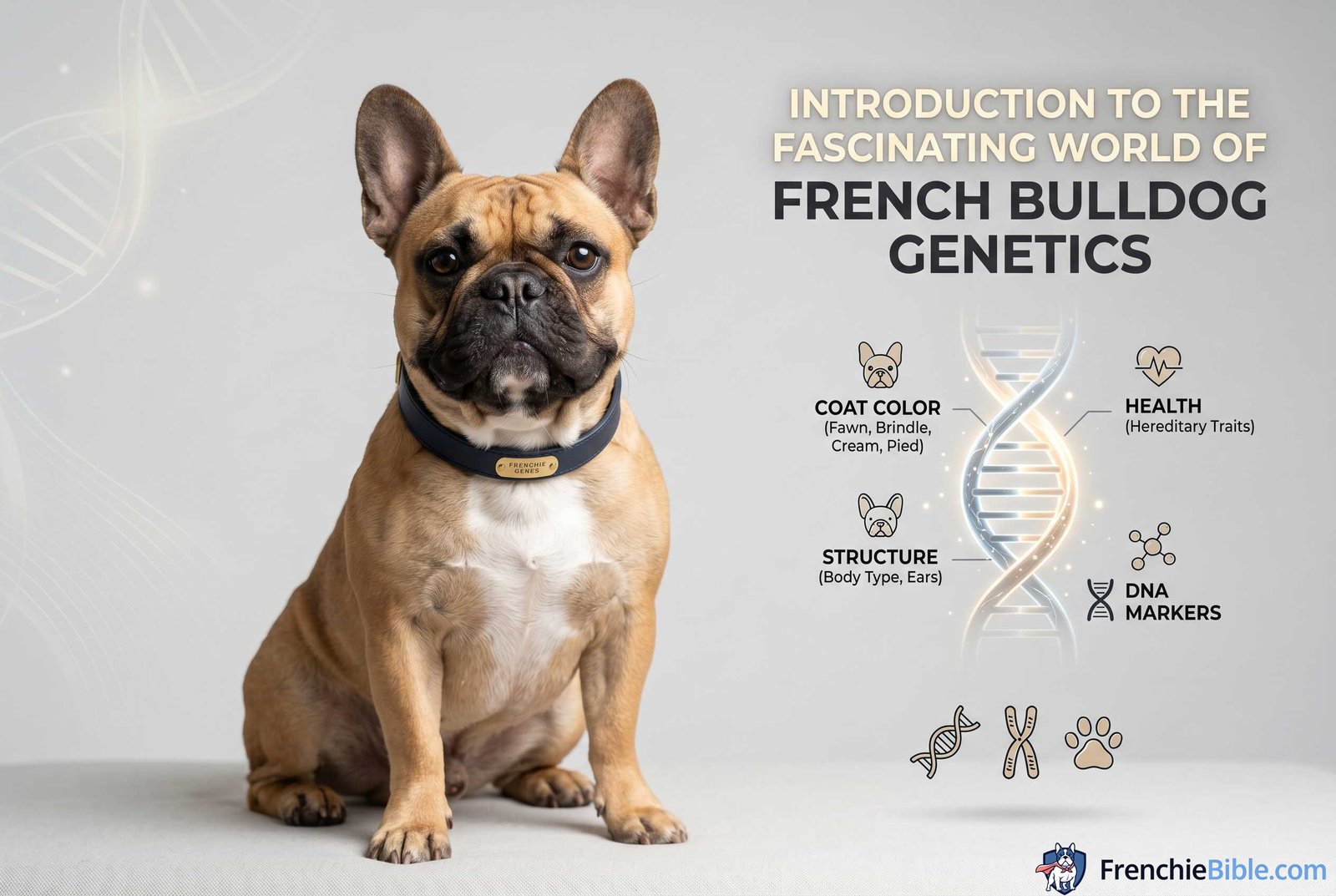
as a French Bulldog expert and breeder and a seasoned breeding expert, I often encounter breeders and enthusiasts who are deeply fascinated by the sheer variety of coat colors and patterns this incredible breed has to offer. The French Bulldog is a marvel of canine genetics, presenting a canvas where dominant and recessive genes interact to create stunning visual expressions. Among the most discussed, highly sought-after, and occasionally misunderstood coat patterns are the Solid Black and the Pied (specifically, the Black Pied).
Understanding the identification, pigmentation mechanics, and patch distribution rules of Black and pied french bulldogs requires more than a passing glance. It demands an intricate knowledge of canine color genetics—specifically the interplay of the A Locus, K Locus, and S Locus. Whether you are a prospective owner trying to verify the coat color of a puppy, an ethical breeder aiming to predict your next litter’s phenotype, or an enthusiast studying the breed standard, mastering the identification of these patterns is essential.
Related Reading: Training & Behavior | Frenchie Puppy Guide | Best Food for Frenchies
In this comprehensive guide, we will delve deeply into the genetic blueprint of the true Black and the complex Pied French Bulldog. We will explore how pigmentation migrates during embryonic development, what dictates the distribution of patches on a Pied dog, and how to unequivocally identify these traits visually and genetically.
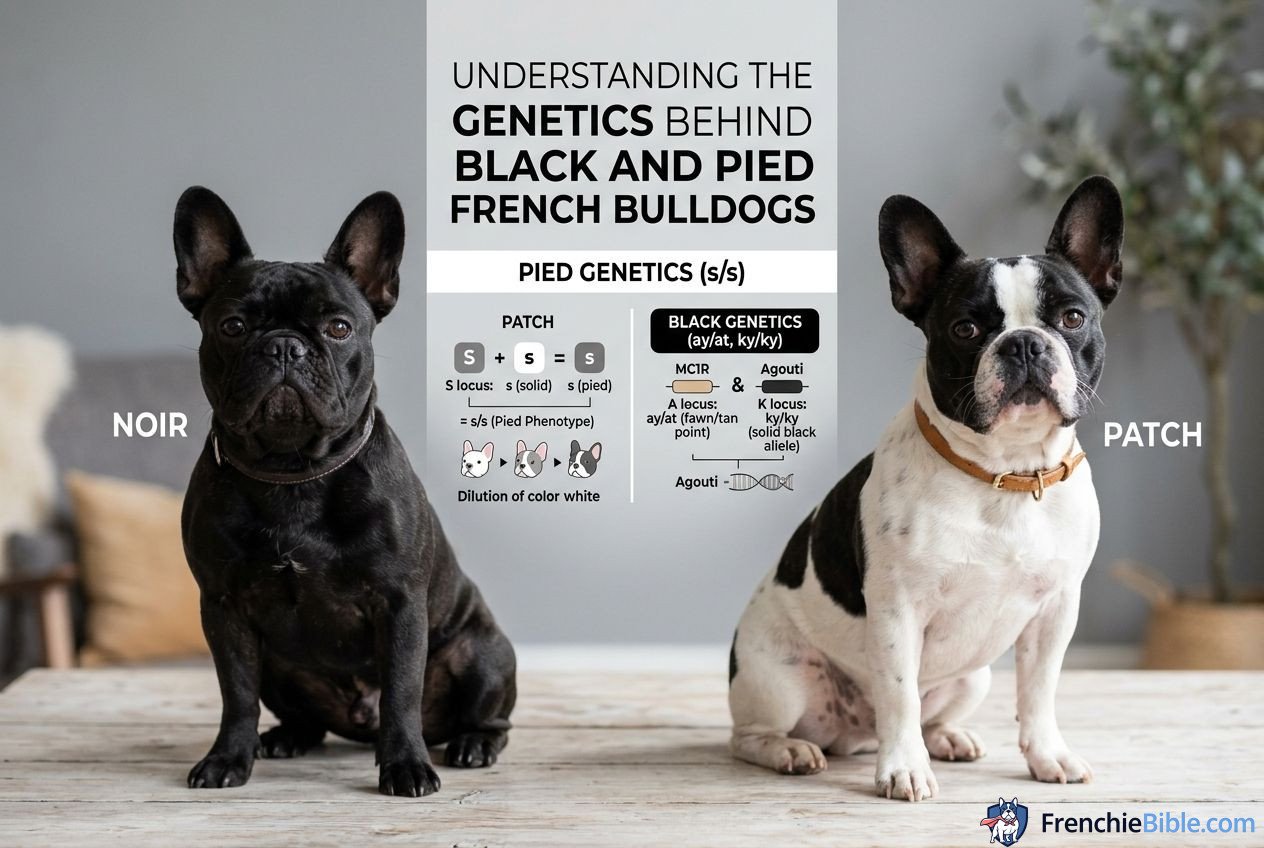
Understanding the Genetics Behind Black and Pied French Bulldogs
To accurately identify a Black or Pied French Bulldog, one must first grasp the foundational genetics that govern canine coat color. A dog’s coat color is determined by a combination of genetic loci, each acting like an on/off switch or a volume dial for different pigments. Dogs produce only two basic pigments: eumelanin (black pigment) and phaeomelanin (red/yellow pigment). Every coat color we see in a French Bulldog is a variation, dilution, or restriction of these two pigments.
The K Locus: Dominant Black and Brindle
The K Locus (Defensin Beta 103 gene) plays a pivotal role in determining whether a French Bulldog will be solid black, brindle, or fawn.
1. K^B (Dominant Black): This allele dictates that the dog will produce solid eumelanin (black pigment) across its entire coat, masking the effects of the A Locus (which controls fawn and agouti). A dog with one or two copies of K^B will appear solid black (unless modified by other dilution genes).
2. k^br (Brindle): This allele allows both eumelanin and phaeomelanin to express in a striped pattern. It is recessive to K^B but dominant to k^y.
3. k^y (Recessive Non-Black): This allele allows the A Locus to express fully. A dog must be k^y/k^y for pure fawn or solid tan points to show.
For a true solid black french bulldog to exist, it usually must carry at least one K^B allele. However, true dominant black is rare in standard Frenchies, meaning many “black” Frenchies are actually very dark brindles (seal) or recessive blacks (a/a at the A Locus).
The A Locus: Agouti, Solid Black, and Fawn
The A Locus (Agouti Signaling Protein gene) determines how and where phaeomelanin and eumelanin are distributed on the hair shaft and the body.
1. A^y (Fawn/Sable): The most common allele in French Bulldogs, producing a fawn coat.
2. a^t (Tan Points): Produces a black dog with tan markings on the eyebrows, cheeks, chest, and legs.
3. a (Recessive Black): A very rare allele in Frenchies. A dog with a/a genotype will be solid black, regardless of the K Locus.
The S Locus: Spotting and the Pied Gene (sp)
The S Locus (MITF gene) is the master controller of the Pied pattern. It determines whether a dog will have a solid coat or white spotting. The “white” on a Pied Frenchie is not a pigment; rather, it is the absence of pigment. The MITF gene dictates how melanocytes (pigment-producing cells) spread across the embryo’s skin during development.
1. S (Solid): The dog has no white spotting (though minor white on the chest/toes can occur from other factors).
2. s^p (Piebald/Pied): This recessive allele restricts pigment migration. A dog must inherit two copies (s^p/s^p) to express the classic Pied pattern—a predominantly white body with distinct patches of color.
Identifying the True Black French Bulldog
Identifying a true Black French Bulldog can be surprisingly tricky. Many dogs that appear black to the naked eye are actually hiding brindle hairs or are genetically “seal.” Let’s break down the identification markers.
What Makes a French Bulldog “True Black”?
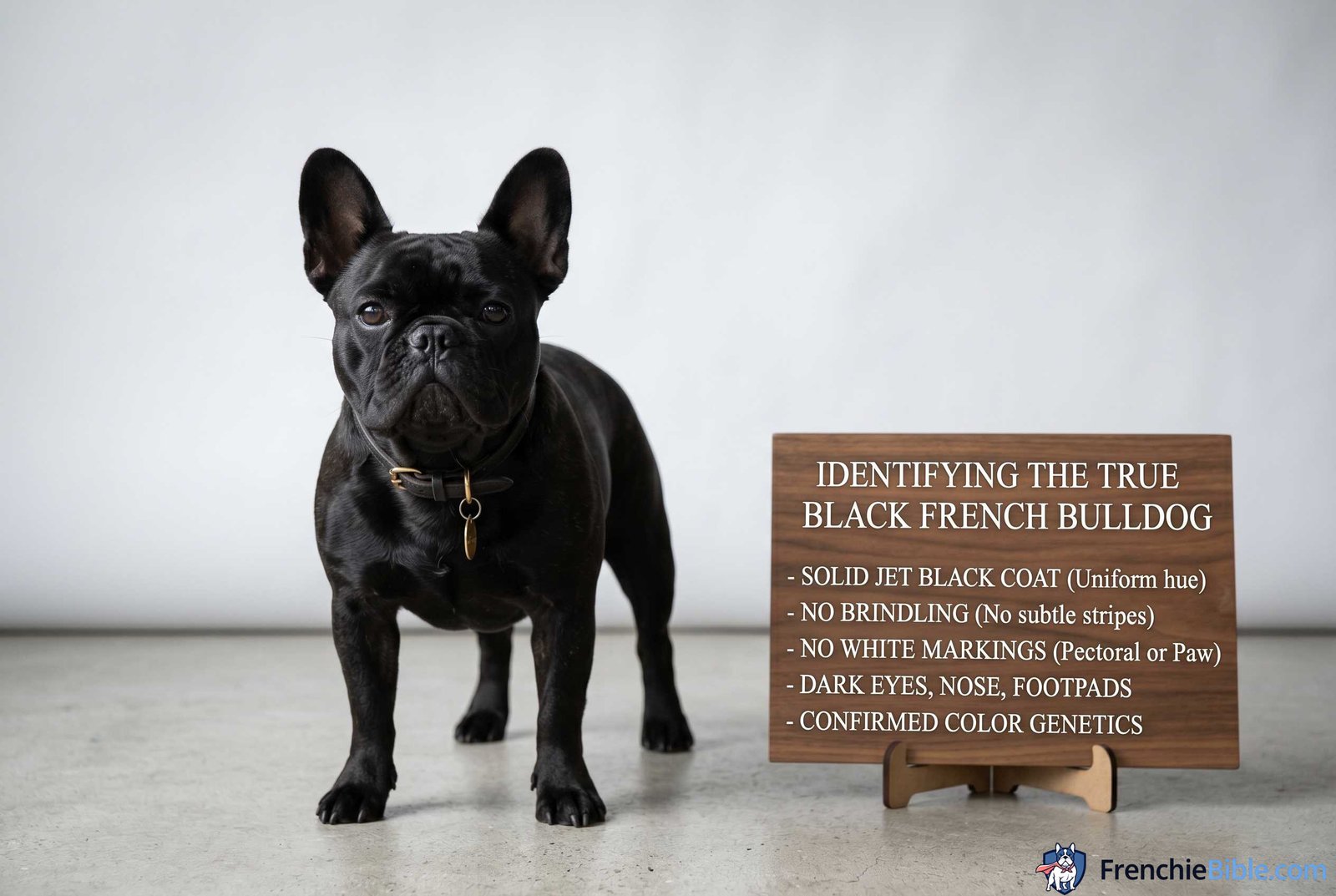
A true Black French Bulldog possesses a coat completely devoid of brindle (tiger striping) and fawn hairs. The coat is a deep, jet black. Genetically, this dog is either dominant black (K^B/_) or recessive black (a/a). Because the AKC breed standard lists solid black without a trace of brindle as a disqualification, true black is considered a “fad” or “rare” color, though it is highly popular among pet owners.
Distinguishing Black from Seal and Dark Brindle
- Dark Brindle (Black Brindle): These dogs appear black but, upon closer inspection (especially in bright sunlight), display faint reddish or fawn stripes. Even a single fawn hair classifies the dog as a brindle, not a solid black.
- Seal: A seal Frenchie appears black indoors but takes on a brownish, reddish, or “cast” appearance in the sun. The coat often looks like dark chocolate or mahogany. Seal is caused by an incomplete dominance interaction, usually in dogs that are K^B/k^y or k^br/k^y. A true black will remain jet black even in direct, bright sunlight.
Pigmentation Markers: Nose, Lips, and Paws
In a true Black French Bulldog, the pigmentation on the skin points must match the coat’s eumelanin.
– Nose: The nose must be completely black. There should be no pink (Dudley) or brown liver tones.
– Lips and Eye Rims: The margins of the lips and the eyeliner (eye rims) must be solid black.
– Paw Pads: The paw pads should be solid black.
– Nails: The nails should ideally be black, although a white mark on the toe can lead to a white nail.
Eye Color and Its Relationship to Coat Pigment
A true Black French Bulldog without any dilution genes (like the blue/d locus or cocoa/co locus) will have dark brown eyes. The intensity of the black coat is often reflected in deeply pigmented, almost black-looking eyes. If a “black” dog has light brown, yellow, or green eyes, it likely carries a hidden dilution gene affecting the melanin in the iris.
The Intricacies of the Pied (Piebald) French Bulldog
The Pied pattern is one of the most striking and historically recognized patterns in the French Bulldog breed. Unlike solid black, Pied is widely accepted by breed standards (such as the AKC), provided the patches are of standard colors (brindle or fawn).
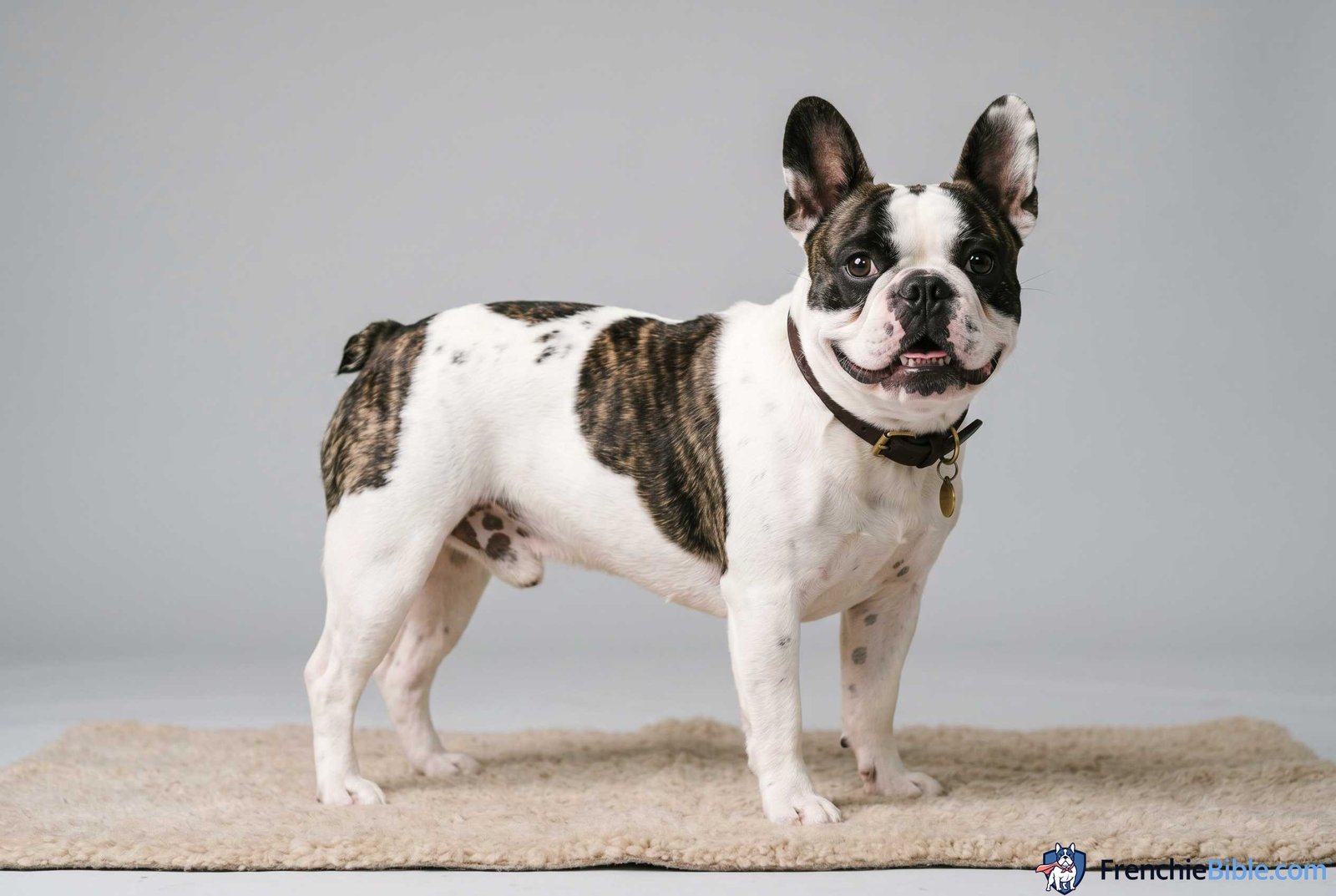
What is a Pied French Bulldog?
A Pied Frenchie is a dog with a coat that is more than 50% white, accompanied by distinct, well-defined patches of color (brindle, fawn, black, blue, etc.). As mentioned earlier, this is governed by the s^p/s^p genotype. The white areas are regions where melanocytes failed to migrate during embryonic development.
Types of Pied Patterns: Irish Spotting, Extreme Pied, and Standard Pied
While the genetic cause is the same, the expression of the Pied gene varies wildly:
1. Irish Spotting (Not true Pied): This refers to white markings on the chest, collar, muzzle, and toes (the “trim” areas). These dogs are typically S/s^p (carriers of Pied).
2. Standard Pied: The dog is roughly 50-80% white. They have colored patches on the head, body, and tail base.
3. Extreme Pied (Extreme White): The dog is 90-100% white. They may have a small patch of color over an ear or near the tail base, or they may appear completely white.
The Role of the S Locus in Melanin Migration
During embryonic development, melanocytes originate at the neural crest (along the spine) and migrate downwards towards the belly, legs, and extremities. The S Locus gene (MITF) controls the speed and success of this migration. In a solid dog, the cells cover the entire body. In a Pied dog (s^p/s^p), the migration is halted prematurely. This is why the “furthest” points from the spine—the chest, toes, tail tip, and muzzle—are the first to lose pigment and turn white, while areas near the spine—the head, back (saddle), and tail base—are the most likely to retain colored patches.
Health Considerations Linked to the Extreme White/Pied Gene
as a French Bulldog expert and breeder, I must highlight a crucial aspect of the Pied gene: its link to congenital deafness. Melanocytes are not just responsible for coat pigment; they play a vital role in the inner ear (the stria vascularis in the cochlea). If melanocytes fail to migrate to the inner ear, the sensory hair cells die, resulting in sensorineural deafness. Extreme Pied dogs, or dogs with completely white heads and no pigment around the ears, are at a significantly higher risk for unilateral (one ear) or bilateral (both ears) deafness. BAER (Brainstem Auditory Evoked Response) testing is highly recommended for all predominantly white Pied Frenchies.
Pigmentation Rules and Patch Distribution in Pied Frenchies
The distribution of patches on a Pied French Bulldog is not entirely random. It follows the physiological rules of embryonic cell migration. Understanding these rules helps in predicting patterns and assessing the genetic quality of the dog.
Symmetrical vs. Asymmetrical Patch Distribution
While true perfect symmetry is rare in nature, high-quality Pied French Bulldogs often exhibit bilateral symmetry, especially on the face. A highly prized pattern is the “Mantle” or the classic face mask, where color covers both ears and eyes evenly, leaving a white blaze up the center of the face. Asymmetrical patches (e.g., color over one eye and ear, while the other side is white) are very common and perfectly healthy, though sometimes considered less desirable in strict show rings.
Facial Masks and Eye Patches (Mantle vs. Splash)
- The Hood/Mantle: Pigment covers the entire top of the head, both ears, and around both eyes, often connecting at the back of the neck.
- The Splash: Broken, irregular patches on the face. Sometimes referred to as a “pirate” patch when only one eye is covered.
It is biologically critical that a Pied dog has pigment around at least one ear to reduce the risk of deafness.
Body Patches: Saddle, Spots, and the Tail Base
Because pigment drops from the spine down, the most common areas to find colored patches on the body are:
– The Saddle: A large patch spanning across the middle of the back.
– The Tail Base: A patch surrounding the root of the tail. This is one of the last places to lose pigment.
– Body Spots: Smaller, distinct coin-sized or palm-sized spots scattered across the torso.
Breeders generally prefer well-defined, crisp patches rather than heavily mottled or broken spots.
The “Ticking” Phenomenon in Pied Coats
Some Pied Frenchies are born with stark white coats, but as they age (usually around 4-8 weeks), tiny speckles of color begin to appear in the white areas. This is known as “ticking” or “freckling.” Ticking is controlled by a separate gene locus (the T Locus).
– T/T or T/t: The dog will develop ticking in the white regions.
– t/t: The white areas will remain crisp and clear.
In French Bulldogs, heavy ticking is often viewed as a flaw in standard show dogs, as it muddies the crisp contrast of the Pied pattern, but it is purely an aesthetic trait with no health implications.
Why Pigment Doesn’t Reach Certain Areas
As explained, the melanocytes run out of “energy” or are chemically blocked from migrating to the extremities. Therefore, the chest, lower legs, muzzle, and the underside of the belly are almost universally white in a true s^p/s^p Pied French Bulldog.
Black Pied French Bulldogs: A Unique Convergence
A Black Pied French Bulldog represents the genetic convergence of the Pied pattern (s^p/s^p) and the solid black coat genetics (either K^B dominant black or a/a recessive black).
Defining the Black Pied Pattern
A Black Pied Frenchie has a pristine, stark white base coat with vividly contrasting, solid jet-black patches. There is absolutely no brindle (striping) within the black patches, nor is there any fawn hair. The contrast is spectacular, resembling a small Dalmatian or a Holstein cow.
Examining the Contrast: Jet Black on Pure White
The beauty of the Black Pied lies in the starkness of the contrast. To verify a Black Pied visually:
1. Isolate the patches in natural sunlight.
2. Part the hair to the skin within the black patch.
3. Look for any red, fawn, or lighter brown hairs. If the hairs are pure black to the root, and there is zero striping, the dog is a true Black Pied.
Common Misidentifications: Black Pied vs. Brindle Pied
The most common mistake made by novice breeders and pet owners is confusing a Dark Brindle Pied with a True Black Pied.
– A Brindle Pied will have patches that look black from a distance, but upon closer inspection, you will see fawn stripes within those dark patches. Because the brindle allele (k^br) is dominant over fawn, most standard “black-and-white” Frenchies seen in the show ring are actually Brindle Pieds, as true solid black is a disqualifying color.
– A Black Pied will have patches that remain an impenetrable, solid black, regardless of the lighting.
The Breeder’s Guide to Color Testing and Prediction
Relying solely on visual identification can lead to breeding surprises. To truly understand a dog’s genetic makeup and predict litter outcomes, DNA testing is mandatory.
Why Visual Identification Isn’t Enough
as a French Bulldog expert and breeder, I frequently see “black” dogs that produce fawn offspring because they were actually very dark seals carrying a recessive fawn gene. Similarly, a dog that appears to have an “Irish Collar” of white might actually be a Pied carrier (S/s^p) that can produce full Pied puppies if mated with another carrier.
Recommended DNA Tests for Coat Color
To definitively identify a Black Pied or Solid Black French Bulldog, breeders should test via a reputable canine genetics laboratory (such as UC Davis or Animal Genetics). The essential panel must include:
– K Locus (Dominant Black)
– A Locus (Agouti/Fawn/Tan Points/Recessive Black)
– S Locus (White Spotting/Piebald)
– B Locus (Brown/Chocolate/Testable)
– D Locus (Dilute/Blue)
Interpreting DNA Results: K, A, and S Alleles
If you want to produce a true Black Pied French Bulldog, you must aim for specific genotypic combinations.
Example Genotype for a Black Pied:
– K^B/k^y or K^B/K^B (Produces solid black pigment)
– a^y/a^y or any A-Locus combination (A Locus is hidden by the dominant K^B)
– s^p/s^p (Produces the Pied pattern)
Example Genotype for a Recessive Black Pied:
– k^y/k^y (Allows A Locus to express)
– a/a (Solid recessive black)
– s^p/s^p (Pied pattern)
Ethical Breeding Practices for Black and Pied
Ethical breeding must prioritize health over coat color. When breeding for Black or Pied:
1. Never breed two Extreme Pieds together: This heavily increases the risk of bilateral deafness.
2. Prioritize Pigmented Heads: When selecting Pied breeding stock, favor dogs with fully pigmented ears and eye patches to ensure melanocytes are present near the inner ear.
3. Avoid the “Fad Color” Health Trap: While Black and Black Pied are beautiful, ensure the dogs are fully health tested for French Bulldog hereditary diseases (e.g., JHC, CMR1, HUU, IVDD) before focusing on color genetics.
Caring for Black and Pied French Bulldogs
From An Experienced Breedererinary standpoint, owning a Pied Frenchie comes with specific dermatological and environmental considerations due to the lack of pigment in the white areas.
Skin Sensitivity in White/Pied Areas
The white fur on a Pied French Bulldog covers unpigmented pink skin. This pink skin lacks the protective barrier of melanin, making it highly sensitive to environmental allergens, contact dermatitis (from grass or synthetic carpets), and topical irritants. Pied dogs are statistically more prone to showing visible signs of allergies, such as red, inflamed paws and a pink, irritated belly.
Sunburn and UV Protection
Melanin acts as a natural sunscreen. Therefore, the white areas of a Pied Frenchie are incredibly susceptible to sunburn (solar dermatitis) and, over time, skin cancers like squamous cell carcinoma.
– Avoid walking your Pied Frenchie during peak UV hours (10 AM to 4 PM).
– Apply dog-safe sunscreen to the pink skin on their nose, ear tips, and belly if they are sunbathing.
– Consider UV-protective clothing for dogs with Extreme Pied coats.
Deafness and the White Gene: What Owners Must Know
As mentioned earlier, if you own a Pied French Bulldog—especially one with a largely white head—you should have their hearing tested early. If a dog is deaf in one ear (unilateral), they will live a completely normal life but may have trouble determining the direction of a sound. If they are completely deaf, they require specialized training using hand signals, vibration collars (not shock collars), and must be kept on a leash in un-fenced areas, as they cannot hear approaching dangers like cars.
Grooming Needs Specific to These Coat Types
- Tear Stains: Pied dogs with white faces are highly prone to visible tear stains. The porphyrins in their tears will stain the white fur a reddish-brown. Daily wiping with An Experienced Breedererinary-approved canine eye wipe is essential.
- Bathing: Use a hypoallergenic, soothing oatmeal shampoo to protect their sensitive unpigmented skin. Avoid harsh whitening shampoos containing bleach or peroxide, as these can severely irritate the skin.
Conclusion
The Black and Pied French Bulldog is a stunning example of canine genetic artistry. The stark contrast of jet black against a pristine white canvas—governed by the delicate dance of the K, A, and S loci—makes them a visually striking companion. However, accurate identification goes far beyond visual aesthetics; it requires a deep understanding of pigmentation rules, patch distribution, and the biological mechanics of melanin migration.
Whether you are a breeder striving for perfection or an owner marveling at your pet’s unique spots, understanding these genetic principles elevates your appreciation for the breed. Always remember that beneath the beautiful coat—be it solid black, heavily patched, or predominantly white—lies a dog that requires robust health testing, ethical breeding, and dedicated veterinary care.
Frequently Asked Questions (FAQ)
1. How can I tell if my French Bulldog is a true Black Pied or just a Dark Brindle Pied?
To differentiate, take your dog out into bright, natural sunlight. Closely examine the dark patches on their coat, parting the fur to the skin. If you see even a single hair of red, fawn, or brown striping mixed into the black patch, your dog is genetically a Brindle Pied. A true Black Pied will have solid, unbroken jet-black hairs throughout the patch.
2. Why are solid black French Bulldogs considered a “fad” color?
According to the official breed standards set by major kennel clubs like the AKC (American Kennel Club), solid black without a trace of brindle is listed as a disqualification. Standard colors must include brindle, fawn, white, or standard pied combinations. Solid black was historically bred out to maintain the brindle trait, making pure black a “non-standard” or “fad” color today, despite its popularity.
3. Will a Pied Frenchie puppy’s spots change as they grow?
The actual patches of pigment on a Pied Frenchie are set before birth and will simply grow in proportion to the dog’s body. They will not move or change shape. However, if the dog carries the ticking gene (T Locus), small speckles or freckles of color may begin to appear in the white areas as the puppy ages, usually becoming visible between 4 and 8 weeks of age.
4. Are Pied French Bulldogs more prone to health issues?
Pied French Bulldogs have the same structural health risks as any Frenchie (like Brachycephalic Airway Syndrome or spinal issues). However, the specific lack of pigment in the S Locus mutation does carry two unique risks: a higher susceptibility to sunburn and skin cancers on the pink skin, and an increased risk of congenital deafness, particularly in Extreme Pieds with unpigmented ears.
5. Can two solid-colored French Bulldogs produce a Pied puppy?
Yes, absolutely. If both solid-colored parents are carriers of the recessive Pied gene (genotype S/s^p), they have a 25% chance of producing a Pied puppy (s^p/s^p) in their litter. This is why DNA testing is crucial for breeders to predict litter outcomes accurately.
6. What is the difference between an Extreme Pied and a Standard Pied?
A Standard Pied Frenchie is typically 50% to 80% white, with distinct, well-distributed patches of color on the head, saddle, and tail base. An Extreme Pied is 90% to 100% white, often with no body patches and only minimal coloring, if any, over an ear or the tail base. Extreme Pieds carry a higher risk of deafness.
Disclaimer: We are not veterinarians and do not hold veterinary medical licenses. The information provided in this article is based on years of breeding and daily care experience and is for educational purposes only. It should not replace professional veterinary advice. Always consult with a licensed veterinarian if you have concerns about your French Bulldog’s health or before starting any new treatment.