If there is one phrase I hear in my veterinary clinic on a daily basis, it’s this: “Doc, my Frenchie just won’t stop scratching his ear.”
French Bulldogs are magnificent, loving, and hilarious companions, but let’s be honest—they are a genetic melting pot of predisposed health conditions. While we talk endlessly about Brachycephalic Obstructive Airway Syndrome (BOAS) and spinal issues (IVDD), the quiet, relentless tormentor of the French Bulldog breed is chronic otitis externa: outer ear infections.
Related Reading: Training & Behavior | Frenchie Puppy Guide | Best Food for Frenchies
Those adorable, oversized bat ears act like giant satellite dishes, collecting pollen, dust, dirt, and moisture. Combined with the breed’s notorious susceptibility to environmental and food allergies, the Frenchie ear canal often becomes a humid, inflamed breeding ground for yeast and bacteria. as a French Bulldog expert and breeder and breeder I’ve seen ear infections escalate from a mild itch to severe neurological damage and deafness simply because owners missed the early warning signs.
You must learn to read the signals your dog is sending you. In this guide I will walk you through the clinical realities of french bulldog ear infections, the anatomy behind why they happen, and the three major, undeniable warning signs that mean it’s time to stop Googling and start driving to the vet clinic.
The Anatomy of the Frenchie Ear: Why They Suffer
To understand the warning signs, you need to understand the battlefield. The canine ear is fundamentally different from ours. Human ear canals are relatively short and horizontal. The canine ear canal is shaped like a steep letter “L.”
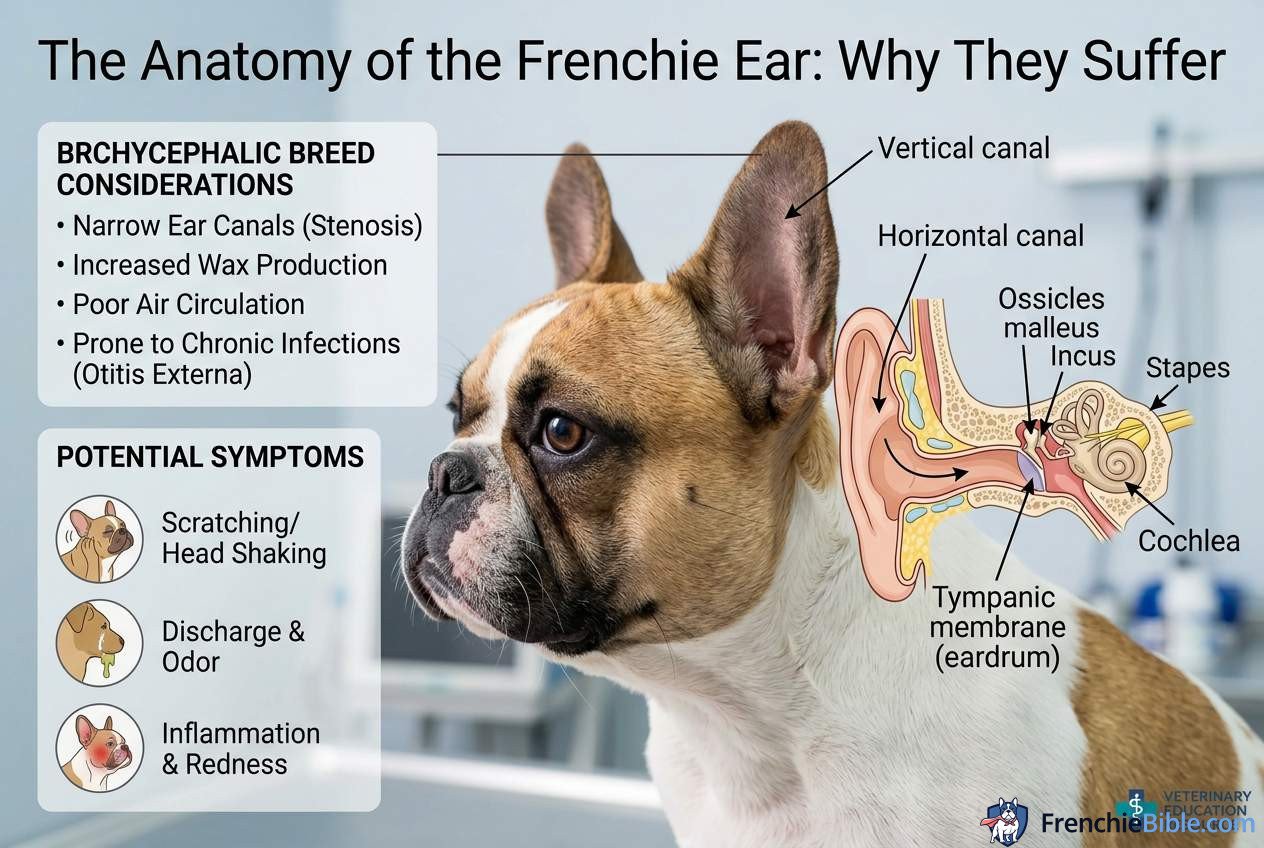
The canal travels vertically downward toward the jaw, then makes a sharp 90-degree turn horizontally toward the eardrum. Because of this structure, gravity works against the dog. Any water from a bath, sweat, excess wax, or debris falls to the bottom of the “L” and gets trapped. Furthermore French Bulldogs often suffer from allergies. An allergic reaction causes the tissue lining the ear canal to swell and become inflamed. When the tissue swells, the already narrow canal closes up, trapping the heat and moisture inside. This creates the ultimate incubator for normal skin yeast (Malassezia) and bacteria (Staphylococcus) to mutate into a raging infection.
The 3 Major Warning Signs of a Frenchie Ear Infection
Dogs are stoic creatures. By the time they are showing obvious signs of distress, the infection has likely been brewing for days or weeks. If you observe any of the following three major warning signs, your Frenchie is suffering from an ear infection.
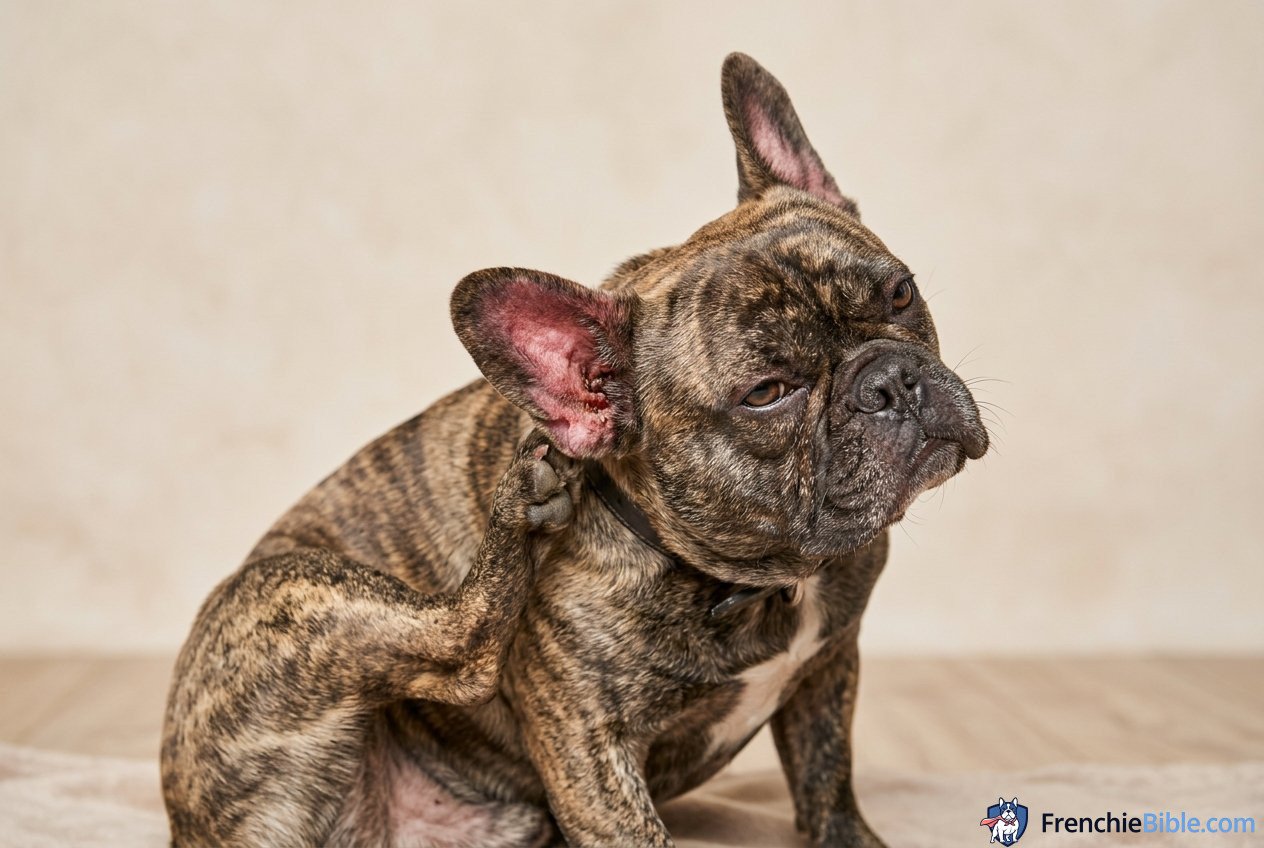
1. The Frantic Head Shake and Persistent Scratching
This is usually the first clinical sign an owner notices.
The Scratching:
Your Frenchie will violently and repeatedly scratch at the base of their ear with their hind leg, often groaning or whining while doing so. You might hear the hollow “thump-thump-thump” of their foot against the floor all night long. They may also rub the side of their head aggressively against the carpet, the couch, or your leg in a desperate attempt to relieve the deep, unreachable itch.
The Head Shake:
Because the infection and debris are trapped deep at the bottom of the L-shaped canal, the dog feels a heavy, uncomfortable sensation of fullness inside their head. To try and dislodge it, they will violently shake their head from side to side.
Vet Warning: If a Frenchie shakes their head too violently and too often, the fragile blood vessels inside the ear flap (pinna) can burst. This causes the ear flap to fill with blood, swelling up like a warm, painful balloon. This is called an Aural Hematoma, and it requires surgical intervention to fix. A simple ear infection just turned into a costly surgery.
2. The Foul Odor (The “Fritos” or “Swamp” Smell)
Healthy dog ears do not smell. They might have a faint, neutral scent of dog skin, but they should never be offensive. If you lean in to kiss your Frenchie’s head and are hit by a wall of foul odor, an infection is actively multiplying.
The type of smell actually tells me, as a French Bulldog expert and breeder, what kind of infection we are likely dealing with before I even look in the microscope:
– The Yeast Infection (Malassezia): This is the most common in Frenchies. It smells distinctly sweet, pungent, and remarkably like corn chips (Fritos), old socks, or fermenting bread dough.
– The Bacterial Infection (Staph or Pseudomonas): This odor is far more aggressive and putrid. It smells necrotic, sour, or like rotting meat or a stagnant swamp. Pseudomonas bacteria, in particular, are highly resistant to antibiotics and create a very sharp, sickening smell.
If your dog’s ear smells bad, do not try to mask it by pouring perfumed cleaners inside. You are just adding liquid to an active biohazard site.
3. Abnormal Discharge and Redness (The “Coffee Grounds” or Pus)
When you lift your French Bulldog’s ear flap, the skin inside should be a pale, healthy pink, and the canal should look clean with perhaps a tiny smear of pale yellow wax. If you see the following, you have an infection.
The Redness and Heat:
Inflammation brings blood flow. The ear flap and the entrance to the canal will appear bright red, swollen, and will feel significantly hotter to the touch than the rest of the dog’s body. The skin may look thickened, bumpy, or “cobblestone-like,” which is a sign of chronic, long-term inflammation.
The Discharge:
The color and texture of the gunk in the ear are diagnostic goldmines:
– Dark Brown/Black and Waxy: Usually indicates a severe yeast infection.
– Dry Crumbly Black “Coffee Grounds”: This is the classic signature of Ear Mites (Otodectes cynotis). While more common in puppies, adults can catch them too. The “coffee grounds” are actually dried blood and mite feces.
– Yellow or Green Liquid/Pus: Indicates a severe, purulent bacterial infection. This is a red-alert medical emergency, as pus means the infection is aggressively attacking the tissue and could easily rupture the eardrum.
What to Do If You Spot the Signs (And What NOT to Do)
If your Frenchie exhibits the head shaking, the smell, or the discharge, you must act correctly to prevent permanent damage.
DO NOT: Use Q-Tips
I have banned Q-tips in my breeding program. When an owner uses a Q-tip, they invariably push the infected wax and debris deeper into the horizontal canal, packing it tightly against the eardrum. This causes immense pain and traps the infection deep in the skull.
DO NOT: Use Over-the-Counter “Remedies”
Do not pour vinegar, hydrogen peroxide, rubbing alcohol, or essential oils into an infected ear. Infected skin is raw, ulcerated, and hypersensitive. Pouring acid or alcohol onto raw tissue is excruciatingly painful and will traumatize your dog, making them aggressive for future treatments.
DO NOT: Pour Ear Cleaner into an Actively Infected Ear
If the eardrum has been ruptured by the infection (which you cannot see without veterinary otoscope), pouring standard liquid ear cleaner into the canal will allow the liquid to flood the middle and inner ear. This can cause permanent deafness, vestibular disease (loss of balance, severe dizziness), and facial nerve paralysis.
DO: Go to the Veterinarian for a Cytology Test
The only correct action is An Experienced Breeder visit. When you bring your Frenchie to my breeding program I do two things immediately:
1. Otoscopic Exam: I look down the canal with a specialized light to ensure the eardrum is intact and check for foreign bodies (like grass seeds).
2. Ear Cytology: I take a swab of the gunk, smear it on a glass slide, stain it, and look at it under a microscope.
I must know exactly what the enemy is. Is it Yeast? Cocci bacteria? Rod bacteria? Mites? Without knowing the specific microscopic pathogen, we cannot prescribe the correct medication. Using antibacterial drops on a yeast infection will do absolutely nothing, and vice versa.
Preventing the Nightmare
Once the vet cures the active infection, your job as an owner is prevention. French Bulldogs are maintenance-heavy dogs, and their ears require diligent care.
- Routine Cleaning: Flush the ears every 2-4 weeks with veterinary-approved, drying ear cleanser (like Epi-Otic) using the “flood and massage” technique.
- Address the Root Cause: Ear infections are rarely standalone issues; they are almost always a secondary symptom of underlying allergies. If your Frenchie gets repeated ear infections, you must work with your vet to identify the allergen. Is it a chicken allergy? Environmental pollen? Dust mites? Until you treat the allergy, the ear infections will keep coming back.
- Keep Them Dry: After every bath or walk in the rain, thoroughly dry the ear flaps and flush the canals with a drying agent to prevent moisture buildup.
Conclusion
Your French Bulldog’s ears are their radar, their defining feature, and unfortunately, their Achilles’ heel. By staying vigilant and monitoring for the three major warning signs—head shaking, foul odors, and dark discharge—you can catch otitis externa before it ravages the ear canal. Never ignore an ear issue hoping it will resolve on its own; it won’t. Partner with your veterinarian, establish a strict cleaning routine, and address underlying allergies to keep those beautiful bat ears healthy, pain-free, and listening for the sound of the treat bag opening.
Frequently Asked Questions (FAQs)
1. Can I use human ear infection drops for my French Bulldog?
Absolutely not. Human ear drops are formulated for human ear physiology and specific human pathogens. They are often the wrong pH, contain incorrect active ingredients, and lack the anti-inflammatory steroids needed to open a swollen canine ear canal. Using them can worsen the infection and cause chemical burns to the eardrum.
2. Why does my Frenchie pull away and cry when I try to touch their ear?
If your dog is exhibiting pain responses—crying, pulling away, or snapping—when you touch the base of their ear, they have a severe, deep ear infection. The canal is highly inflamed and ulcerated. Stop touching it immediately and take them to an emergency or primary care veterinarian.
3. Are some French Bulldog colors more prone to ear infections?
Yes. While any Frenchie can get an ear infection, “fad colors” like Blue Lilac, and Merle often carry genes linked to weaker immune systems and a higher prevalence of skin conditions, including severe allergies. Because allergies are the primary driver of ear infections, these dilute-colored dogs frequently suffer from chronic, lifelong otitis.
4. How long does it take for a French Bulldog’s ear infection to heal?
With proper veterinary diagnosis (cytology) and the correct prescription medication, a standard outer ear infection usually resolves in 10 to 14 days. However, you must finish the entire course of medication even if the ear looks better after 3 days. Stopping early leads to antibiotic-resistant superbugs.
5. Is surgery ever required for French Bulldog ear infections?
Yes, in severe, neglected cases. If chronic infections cause the ear canal tissue to calcify (turn to bone) and permanently swell shut, medical treatment is no longer possible. A radical and expensive surgery called a Total Ear Canal Ablation (TECA) is required, where the entire ear canal is surgically removed, leaving the dog permanently deaf in that ear but free from pain.
Disclaimer: We are not veterinarians and do not hold veterinary medical licenses. The information provided in this article is based on years of breeding and daily care experience and is for educational purposes only. It should not replace professional veterinary advice. Always consult with a licensed veterinarian if you have concerns about your French Bulldog’s health or before starting any new treatment.