

As a French Bulldog breeder with over a decade of experience, I’ve seen countless new owners fall into the same trap. You bring home this incredibly squishy, adorable, bat-eared little potato, and the first thing you want to do is snuggle them on the couch or let them sleep in your bed. It’s natural. Frenchies are bred to be companion animals; they thrive on human contact. However, the decision of whether to allow your French Bulldog puppy on furniture is not just about preference or keeping your sheets clean. It touches on critical aspects of their behavioral development, pack dynamics, and, most importantly, their physical health.
Setting boundaries from day one is one of the most loving things you can do for your French Bulldog. In this comprehensive guide, we are going to dive deep into the pros, cons, and the exact strategies I use and recommend for setting healthy boundaries regarding furniture. We will explore Frenchie psychology, the very real physical risks (like IVDD), and how to strike the perfect balance between cuddling your best friend and raising a well-adjusted, safe, and respectful adult dog.
Related Reading: Health & Diet | Frenchie Puppy Guide
Understanding French Bulldog Puppy Psychology and Pack Dynamics
Before we talk about the how, we need to understand the why. French Bulldogs are smart, stubborn, and highly attuned to the hierarchy within their household. While we don’t need to subscribe to outdated, aggressive “alpha” training methods, we do need to recognize that dogs find comfort in structure.

How Frenchies View Furniture and Space
To a French Bulldog puppy, the couch or the bed isn’t just a soft place to sleep. It is a high-value resource. In the canine world, elevation often correlates with status. When you invite your puppy onto the highest, most comfortable resting spots in the house—especially the spots that smell the most like you—you are sharing your most valuable resources.
If your puppy is confident, well-adjusted, and respects your leadership in other areas of life (like feeding, walking, and basic obedience), sharing the couch might never become an issue. However, if your puppy is naturally pushy, anxious, or prone to resource guarding, giving them free access to furniture can blur the lines of leadership. They may start to view the couch as their territory, leading to behaviors like growling when you try to move them or refusing to let other family members sit down.
The Concept of “Earned Privilege” vs. “Inherent Right”
In my breeding program and when advising new families, I always emphasize the concept of “earned privilege.” Access to the human bed or the couch should not be an inherent right that the puppy has from the moment they walk through the door. It should be a privilege that is granted when the puppy is calm, invited up, and knows they must get off when asked.
When a puppy learns that they only get the good things in life (like couch snuggles) when they are polite and follow the rules, you are actively building a foundation of respect and impulse control.
The Pros of Letting Your Frenchie Puppy on Furniture
Let’s be realistic: we get French Bulldogs because we want a snuggle bug. There are undeniable benefits to sharing your resting spaces with your dog.

1. Enhanced Bonding and Affection
Physical touch is a primary way dogs and humans bond. Having your Frenchie curled up next to you while you watch TV or read a book releases oxytocin in both of you. It strengthens the human-animal bond and builds deep emotional security for the puppy.
2. Warmth and Comfort
French Bulldogs have a single coat and can get chilly easily, depending on your climate. They naturally seek out warmth, and what’s warmer than a human body under a blanket? For many owners, the feeling of a warm, softly snoring Frenchie is the ultimate relaxation.
3. Ease of Monitoring (Sometimes)
During the very early days, some owners prefer having the puppy in bed with them to monitor their breathing, body temperature, or to know exactly when they wake up needing a potty break. (Though, as we’ll discuss, a crate right next to the bed is usually a safer and better long-term solution).
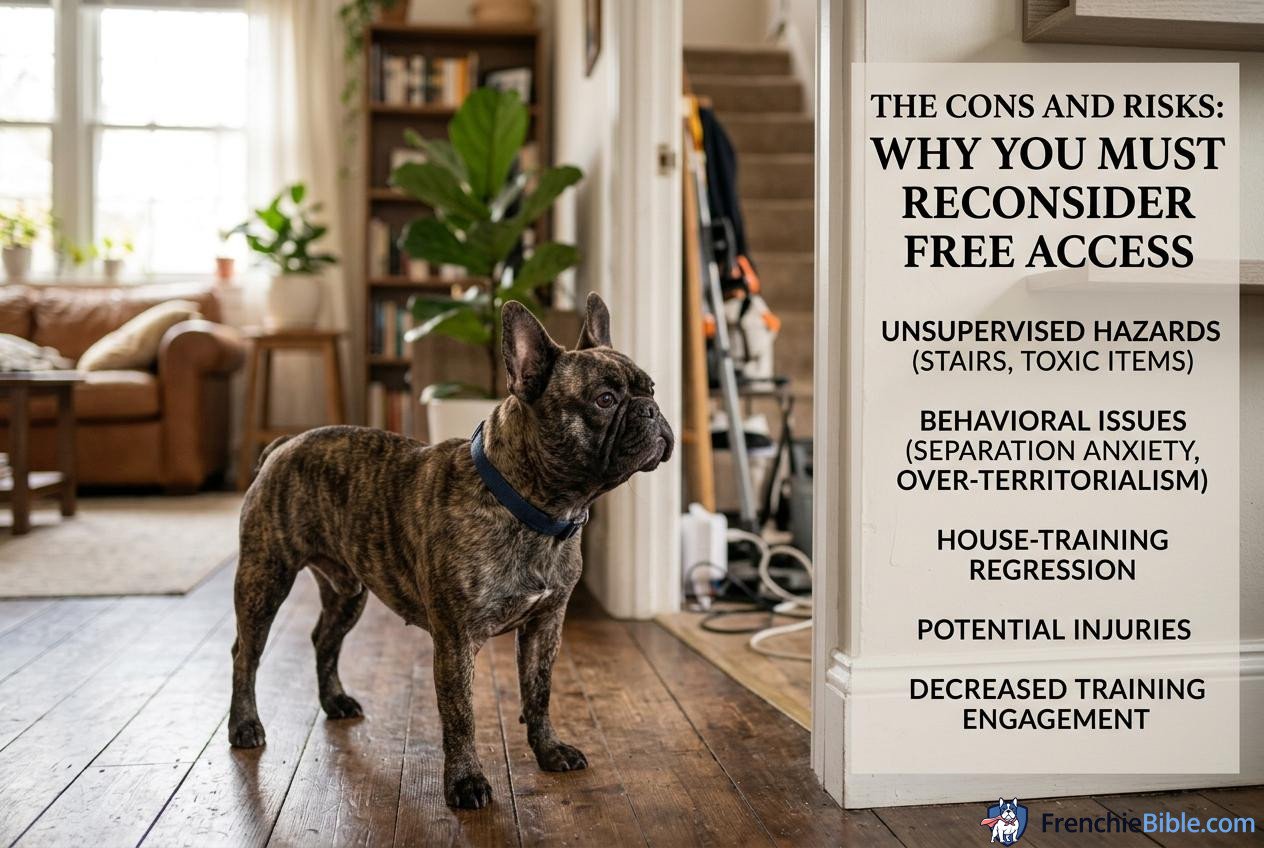
The Cons and Risks: Why You Must Reconsider Free Access
While the pros are emotionally appealing, the cons are significant and, in some cases, life-altering for the dog. Here is why you need to think twice before lifting that puppy onto the bed.
1. The Looming Threat of IVDD (Intervertebral Disc Disease)
This is, without a doubt, the most critical point in this entire article. French Bulldogs are a chondrodystrophic breed. This means they are genetically predisposed to having shortened limbs and a longer back, which inherently puts stress on their spine. They are highly susceptible to Intervertebral Disc Disease (IVDD), a condition where the cushioning discs between the vertebrae bulge or burst into the spinal cord space.
Jumping off a couch or a bed is one of the leading triggers for acute IVDD episodes in French Bulldogs.
When a Frenchie jumps down from a height, the impact of landing on their front legs sends a massive shockwave directly up their spine. Repeated jumping, or even just one awkward landing, can cause a disc to rupture. This can lead to excruciating pain, loss of bowel/bladder control, and even permanent paralysis of the hind legs.
As a breeder, it breaks my heart to hear from owners whose young dogs require $10,000 emergency spinal surgeries because they jumped off the bed. If you take nothing else away from this article, let it be this: Your French Bulldog should never be allowed to jump off furniture. If they are allowed up, you must have a foolproof plan for how they get down safely.
2. Joint Stress and Hip Dysplasia
Beyond the spine, jumping up and down puts immense stress on growing puppy joints. Frenchies are also prone to hip dysplasia and luxating patellas (slipping kneecaps). The repetitive impact of jumping on and off furniture during their crucial developmental months (from 8 weeks to 18 months) can exacerbate or trigger these orthopedic issues.
3. Behavioral Issues: Resource Guarding
As mentioned earlier, the couch or bed is a high-value resource. Some Frenchies will develop “resource guarding” behavior. This looks like:
– Growling or snapping when you try to move them.
– Refusing to let your spouse or children onto the bed.
– Becoming stiff and giving “whale eye” (showing the whites of their eyes) when approached while resting.
If a dog begins to guard the furniture, they must immediately lose the privilege of being on it until the behavior is completely resolved through training.
4. Sleep Disruption
Frenchies are notorious snorers. They also dream, twitch, and sometimes suffer from flatulence. If you are a light sleeper, having a Frenchie in your bed might severely disrupt your own rest. A well-rested owner is a more patient owner, which is vital when raising a stubborn breed.
5. House Training Setbacks
Puppies have small bladders. If they sleep in your bed, they might not want to wake you up to go outside, leading to accidents on your mattress. A crate is a much more effective tool for house training, as dogs naturally do not want to soil their immediate sleeping area.
Setting the Boundaries: A Step-by-Step Guide for Frenchie Puppies
If you decide that your Frenchie will not be allowed on the furniture, or if you decide they will only be allowed on it under strict conditions, you must start implementing these rules the moment they come home.
Step 1: Total Consistency Among All Family Members
This is where most families fail. If you don’t want the dog on the couch, but your partner lets them up when you aren’t looking, the puppy will become confused and frustrated. Frenchies are smart; they will quickly learn who the “soft touch” is in the family. Sit down with everyone in your household and agree on the rules before the puppy arrives.
Step 2: Management and Limiting Access
You cannot train a puppy when you aren’t actively supervising them. When you are cooking dinner or watching TV, the puppy might try to sneak onto the couch. Use management tools:
– Playpens (X-Pens): Keep the puppy in a safe, enclosed area when you cannot watch them with 100% attention.
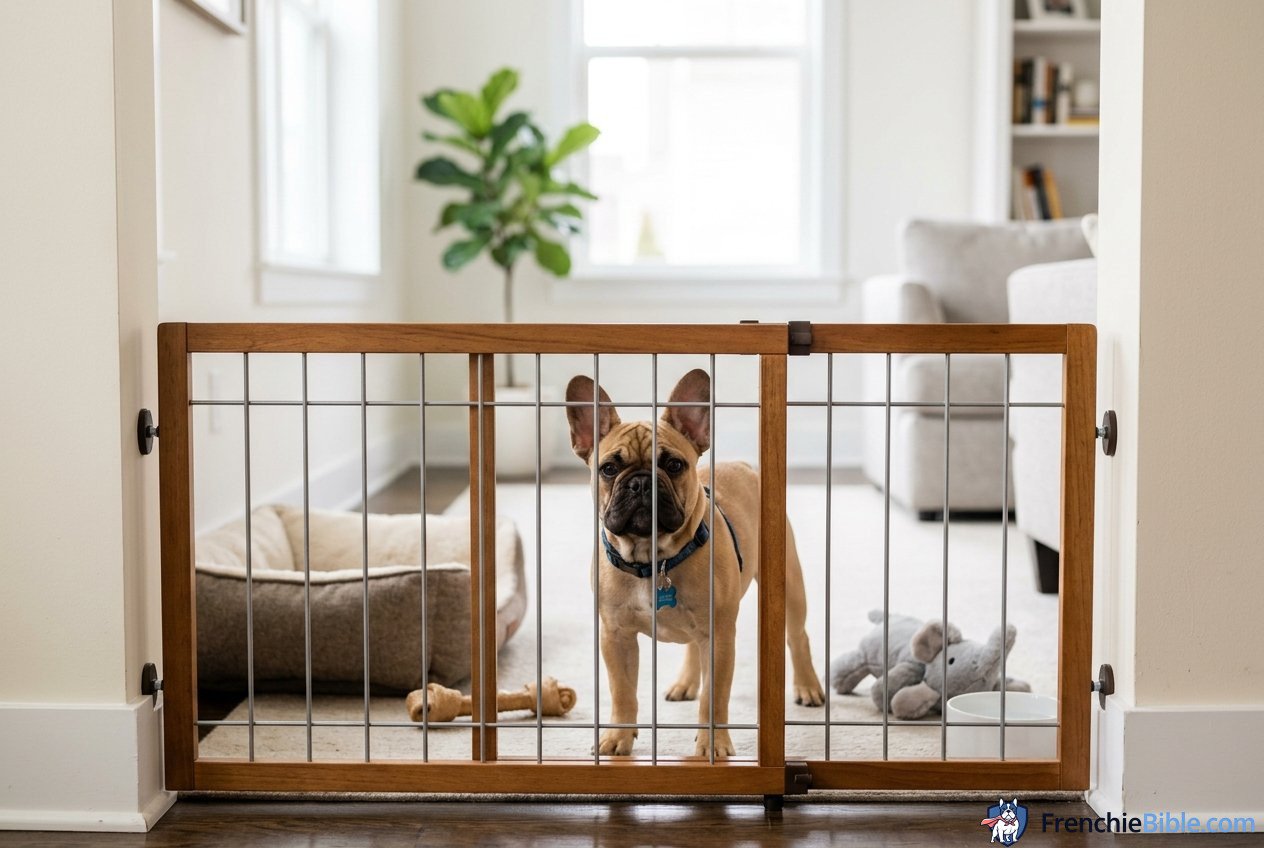
– Baby Gates: Block off access to bedrooms or living rooms where tempting furniture lives.
– Leashes indoors: Keep a light drag leash on the puppy (only when supervised) so you can gently guide them away from the couch without having to chase them or grab them roughly.
Step 3: Teaching the “Off” Command
You must teach your puppy what to do when they inevitably try to climb up.
1. When your puppy puts their front paws on the couch, calmly but firmly say “Off.”
2. Gently use your body or the drag leash to guide them back to all four paws on the floor. Do not push them aggressively, as some Frenchies see this as a wrestling game and will jump back up harder.
3. The absolute second all four paws hit the floor, praise them enthusiastically and offer a high-value treat.
4. Repeat this consistently. They need to learn that the floor is where the rewards happen, not the couch.
Step 4: Teaching the “Place” or “Bed” Command
You cannot just tell a dog what not to do; you must give them an alternative behavior. Invest in a high-quality, incredibly comfortable orthopedic dog bed.
1. Lure the puppy onto their bed with a treat.
2. Say the command “Place” or “Bed.”
3. When they are on the bed, give them the treat and praise them.
4. To build duration, give them a long-lasting chew (like a bully stick or a stuffed Kong) only when they are on their bed.
If you make their floor-level bed the most rewarding, comfortable, and treat-filled spot in the room, the couch will suddenly seem much less appealing.
The Compromise: Allowing Access Safely (Using Ramps and Stairs)
If you absolutely cannot resist snuggling your Frenchie on the couch or bed, you must implement safety measures to protect their spine and joints from IVDD. You cannot rely on lifting them up and down every single time; eventually, the doorbell will ring, they will get excited, and they will launch themselves off the sofa before you can stop them.
Investing in Pet Stairs or Ramps
You need to provide a safe, low-impact way for your Frenchie to get up and down.
– Stairs: Best for couches. Ensure the stairs have a gentle incline, are made of high-density foam (so they don’t hurt if the dog bumps into them), and have a non-slip surface. Hard plastic stairs can be scary and slippery for puppies.
– Ramps: Best for higher beds. Ramps provide a continuous, impact-free surface. They take up more room but are the safest option for a dog’s back.
Training Your Frenchie to Use Stairs/Ramps
Do not just place the stairs next to the bed and expect your puppy to know what to do. You must train them.
- Desensitization: Let the puppy sniff and explore the ramp/stairs while it’s flat on the floor or near a low step. Reward them for interacting with it.
- Luring Up: Place the ramp against the couch. Use a high-value treat (like a tiny piece of boiled chicken) right in front of their nose. Slowly move the treat up the ramp, encouraging them to follow. Reward them heavily when they reach the top.
- Luring Down: This is the most crucial part. When it’s time to get off, do not let them jump. Block the edge of the couch with your body if necessary. Use a treat to lure them slowly down the ramp.
- The “Wait” Command: Teach them to wait at the top of the ramp until you give the release word (like “Okay” or “Free”) to walk down. This prevents them from rushing and tumbling.
- Consistency: If they jump instead of using the ramp, immediately calmly put them on the floor and ignore them for a minute. They learn that jumping means the fun and attention stop. Using the ramp means praise and treats.
Dealing with a Rebellious Frenchie: When They Won’t Stay Off
French Bulldogs are famously stubborn. If they have decided the couch is theirs, they will test your boundaries daily.
If you find your puppy constantly sneaking onto the furniture:
– Re-evaluate your management. Are you leaving them unsupervised in the living room? Use the playpen more.
– Make the furniture unappealing. When you are not sitting there, place laundry baskets, upside-down chairs, or crinkly aluminum foil on the couch cushions. This breaks the habit of jumping up when you aren’t looking.
– Check your own behavior. Are you accidentally rewarding them when they jump up by petting them or giving them attention before telling them “Off”? Any attention, even negative attention (like yelling), can be rewarding to a bored puppy. Be calm, silent, and physically guide them off.
Red Flags: Dealing with Resource Guarding
If your puppy is allowed on the furniture and begins showing signs of resource guarding (growling, stiffening, lip lifting, or snapping when you approach them or try to move them), this is a serious behavioral red flag that must be addressed immediately.
- Revoke the Privilege: The puppy immediately loses all access to furniture. Period. This is non-negotiable until the behavior is fixed.
- Do Not Meet Aggression with Aggression: Do not yell, hit, or violently drag the dog off the bed. This will only validate their belief that they need to defend their spot, and it can escalate to a severe bite.
- Use the “Trade” Game: If they are on the couch and guarding it, get a treat that is of incredibly high value (hot dog, cheese). Toss the treat onto the floor away from the couch. When the dog jumps down to eat it, calmly block their access to the couch.
- Consult a Professional: Resource guarding can escalate quickly. If you see these signs, it is highly recommended to work with a certified, positive-reinforcement dog trainer or a canine behaviorist.
What to Do If You’ve Already Started Bad Habits
Maybe you are reading this and realizing you’ve been letting your 6-month-old Frenchie jump on and off the bed for months. Is it too late?
Absolutely not. Dogs are incredible learners and can adapt to new rules at any age. However, retraining an established habit takes more time and patience than preventing it in the first place.
- Expect an Extinction Burst: When you suddenly change the rules and stop allowing them on the bed, their behavior will likely get worse before it gets better. They will try harder to get up, whine, bark, and act frustrated. This is called an extinction burst. You must hold your ground. If you give in during this phase, you teach them that whining and barking loudly will eventually get them what they want.
- Go Back to Basics: Treat them like an 8-week-old puppy again. Use leashes indoors, manage their environment with gates, and heavily reward them for settling on their own floor bed.
Creating the Ultimate “Frenchie Safe Zone” as an Alternative
To make the transition easier, ensure their designated sleeping area is a paradise.
– Use orthopedic foam beds that support their joints.
– Frenchies love to burrow; consider a “cave bed” or provide plenty of soft fleece blankets for them to root around in.
– Place their bed in a socially significant area—like right next to the couch or next to your side of the human bed. They still want to be near you; they just need to learn that their designated spot is on the floor.
– Utilize a heated pet mat (specifically designed for pets, with chew-proof cords) during colder months to replicate the warmth of your bed.
Final Thoughts from a Breeder
Raising a French Bulldog is a joy, but it comes with specific responsibilities. Setting boundaries regarding furniture isn’t about being mean or overly strict; it’s about ensuring their long-term spinal health, preventing behavioral issues, and establishing a relationship built on mutual respect. Whether you choose a strict “no furniture” rule or invest the time to train them to safely use ramps, consistency is your best tool. Your Frenchie will ultimately be happier, safer, and more relaxed when they clearly understand the rules of the house.
Frequently Asked Questions (FAQ)
1. At what age can my French Bulldog puppy start using pet stairs?
You can introduce pet stairs or ramps as early as 8-10 weeks old. The earlier you introduce them, the more natural it will feel to the puppy. Start with ramps laid flat on the ground for them to walk over before angling them up to furniture.
2. My Frenchie cries at night if they aren’t in my bed. What should I do?
This is common separation anxiety and FOMO (fear of missing out). Ensure they have a comfortable crate or bed right next to your bed so they can see and smell you. You can let your hand hang down to comfort them. Do not give in and put them in the bed, or you will reinforce the crying behavior.
3. Is it okay to lift my Frenchie onto the couch if I also lift them down?
While lifting them prevents jumping, the reality is that you cannot be there 100% of the time to lift them down. If they get startled by a noise outside, they may bolt off the couch before you can catch them. If they are allowed up, they should be trained to use a ramp or stairs independently for safety.
4. My partner lets the dog on the couch, but I don’t want them to. Will this ruin the training?
Yes, inconsistency is highly detrimental to dog training. Frenchies will quickly learn who enforces the rules and who doesn’t. This can lead to frustration and confusion for the dog. The entire household must agree on and enforce the same boundaries.
5. How do I stop my Frenchie from jumping on the couch when I leave the house?
If you are not home to enforce the rules, you must manage the environment. Confine your Frenchie to a dog-safe room, use an appropriately sized crate, or put up baby gates to block access to rooms with tempting furniture.
Disclaimer: We are not veterinarians and do not hold veterinary medical licenses. The information provided in this article is based on years of breeding and daily care experience and is for educational purposes only. It should not replace professional veterinary advice. Always consult with a licensed veterinarian if you have concerns about your French Bulldog’s health or before starting any new treatment.