
Disclaimer: The information provided in this comprehensive guide is intended for educational and informational purposes only. It does not replace professional veterinary advice, diagnosis, or treatment, nor does it substitute for hands-on guidance from a certified canine behaviorist or professional dog trainer. With my background in French Bulldog breeding and breeder specializing in brachycephalic breeds, I strongly advise that any sudden behavioral changes in your French Bulldog should be thoroughly evaluated by your primary care veterinarian to rule out underlying physiological health issues, such as partial hearing loss, ear infections, cognitive dysfunction, or neurological conditions. Always utilize positive reinforcement training techniques that are carefully tailored to your individual dog’s physical limitations, breathing capabilities, and health status.
Introduction: The Great Frenchie Escape
As a practicing veterinarian specializing in brachycephalic (flat-faced) breeds and a dedicated French Bulldog breeder with decades of hands-on experience, I hear variations of the same frustrating story almost daily in my clinic. An exasperated owner sits in the exam room, looking exhausted, while their Frenchie snores peacefully on the table. “Doc,” they sigh, “my Frenchie is an angel indoors. But the second we step outside, it’s like I don’t exist. They are completely deaf to my voice. They just won’t come when called!”

Related Reading: Health & Diet | Frenchie Puppy Guide
If you share your life with a French Bulldog, you are undoubtedly intimately familiar with the infamous “Frenchie Stare.” It is that uniquely comical yet maddening look they give you when you issue a command—a slow blink, a slight head tilt, and a facial expression that clearly suggests they are internally calculating a complex cost-benefit analysis. They are weighing whether the reward you are offering is genuinely worth the physical effort of moving, before they inevitably turn their back and return to sniffing a particularly fascinating patch of dirt.
Teaching a reliable recall—the precise act of your dog turning away from distractions and returning to you immediately upon hearing a specific command—is unequivocally the most critical, life-saving skill you will ever impart to your French Bulldog. It is not merely a matter of convenience for you; it is a profound matter of safety and survival for them. A rock-solid recall serves as an invisible leash that can instantly stop your Frenchie from darting into a busy intersection, prevent them from approaching a highly reactive or aggressive dog, or call them away from ingesting something toxic on the sidewalk.
Yet, despite its monumental importance, achieving a reliable, fast, and enthusiastic recall—especially in high-distraction environments like public parks or busy city streets—feels akin to an impossible, mythological feat for the vast majority of French Bulldog owners.
Why do French Bulldogs, in particular, struggle so immensely with this specific command compared to other breeds? Is it merely a manifestation of their legendary, meme-worthy stubbornness? Or is there a complex web of psychology, evolutionary history, and unique physical traits operating beneath that adorable, bat-eared exterior?
In this exhaustive, masterclass-level guide, we will dive profoundly deep into the intricate psychology, physiological realities, and distinctive behavioral quirks of the French Bulldog. We will systematically deconstruct the root causes behind their notorious “selective hearing.” Most importantly, I will provide you with a veterinarian-endorsed, behaviorist-approved, meticulously detailed step-by-step methodology to build an unbreakable, high-distraction recall. Whether your Frenchie is a blank-slate puppy just beginning their training journey or an adult dog with a deeply ingrained history of actively ignoring your pleas, this guide will equip you with the advanced tools, scientific understanding, and practical strategies required to achieve lifelong success.
Understanding the French Bulldog Mind: Why Recall is a Monumental Struggle
To successfully communicate with and train a French Bulldog, you must first commit to genuinely understanding how their minds operate. You must discard the training paradigms designed for easily biddable breeds. Frenchies are not Golden Retrievers, German Shepherds, or Border Collies—breeds that have been genetically hardwired over centuries to seek human direction, thrive on cooperative work, and experience intrinsic joy in pleasing their handlers. French Bulldogs possess a vastly different genetic tapestry and historical background, which heavily and undeniably dictates their unique learning style and worldview.

The Independent Streak: Breed History and Original Purpose
To understand the modern Frenchie, we must look to their past. Unlike working breeds that were meticulously bred for complex tasks like herding flocks across harsh terrains, retrieving downed waterfowl, or guarding estates, French Bulldogs were bred with a singular, vastly different purpose: companionship.
Originally derived from the smaller, toy-sized Bulldogs of 19th-century England, they became the highly favored companions of Nottingham lace makers. When the Industrial Revolution displaced these workers, they migrated to France, taking their beloved little dogs with them. In the cafes, brothels, and society homes of Paris, their primary “job” was simply to be charming, affectionate, and entertaining lap warmers.
Crucially, they were never selectively bred for high trainability, quick reflexes, or blind obedience to human commands. This genetic history has cultivated a profound, deeply ingrained independent streak. A French Bulldog does not inherently feel a biological imperative to look to their human for the next set of instructions or permission to act. They are perfectly content, and indeed programmed, to make their own unilateral decisions. More often than not, those decisions revolve around investigating an interesting scent, demanding attention from a stranger, or finding the most comfortable sunbeam for a nap. When you call a Frenchie, their immediate internal reaction is rarely, “My master commands, I must obey!” Instead, their cognitive process is much closer to a negotiation: “What exactly is in it for me, and is that offering demonstrably superior to what I am currently enjoying?”
Stubbornness vs. Selective Hearing: A Clinical Distinction
French Bulldogs are universally labeled as “stubborn,” a term owners use with a mix of endearment and utter frustration. However, from a clinical animal behavior perspective, “stubbornness” is an unhelpful anthromorphic label. What humans perceive as stubborn defiance is almost always a combination of low motivation, unclear communication from the handler, and competing environmental reinforcements.
The phenomenon of “selective hearing” in Frenchies is, in reality, a highly evolved, intelligent skill. They are incredibly observant, analytical animals who quickly learn to categorize commands. They figure out rapidly which commands are strictly enforced (and highly rewarding) and which ones are entirely optional.
If you have historically fallen into the trap of calling your Frenchie multiple times without enforcing the command, or if the reward you offer for returning is consistently less exciting than the squirrel they are currently chasing, they will simply, logically tune you out. It is very rarely the case that they cannot hear you or do not comprehend the word you are saying. It is simply that you have failed to successfully market the act of returning to you as the absolute best available option in that specific moment.
Physical Limitations, Brachycephalic Anatomy, and Distractions
With my background in French Bulldog breeding, I must fiercely advocate for acknowledging the physiological realities of the breed, as anatomy profoundly impacts behavior. French Bulldogs are a brachycephalic breed, characterized by their shortened skulls, flat faces, elongated soft palates, and narrow nostrils (stenotic nares).
This unique anatomy significantly impacts their respiratory efficiency, thermoregulation, and overall physical stamina. In highly stimulating environments—such as a dog park or a busy street—a Frenchie can rapidly become over-aroused. As their heart rate increases and they begin panting heavily to regulate excitement or temperature, they can experience mild oxygen deprivation. When an animal is physically struggling to breathe efficiently, their cognitive processing power plummets. It becomes neurologically much harder for them to focus, filter out background noise, and process your verbal commands.
Furthermore, consider their physical stature. Their low-to-the-ground build means they experience the world at the exact level where the highest concentration of fascinating olfactory data resides. Their world is dictated by smell far more than ours. When you are attempting to recall your dog, you are not just competing with what they see; you are competing against an incredibly rich, invisible tapestry of scents—the lingering smell of a fox, a discarded piece of fast food, or the pheromones of fifty other dogs. You are fighting a monumental battle against nature, and unless your reinforcement is astronomically high, nature will win.
The Behavioral Science Behind High-Distraction Recall Failures
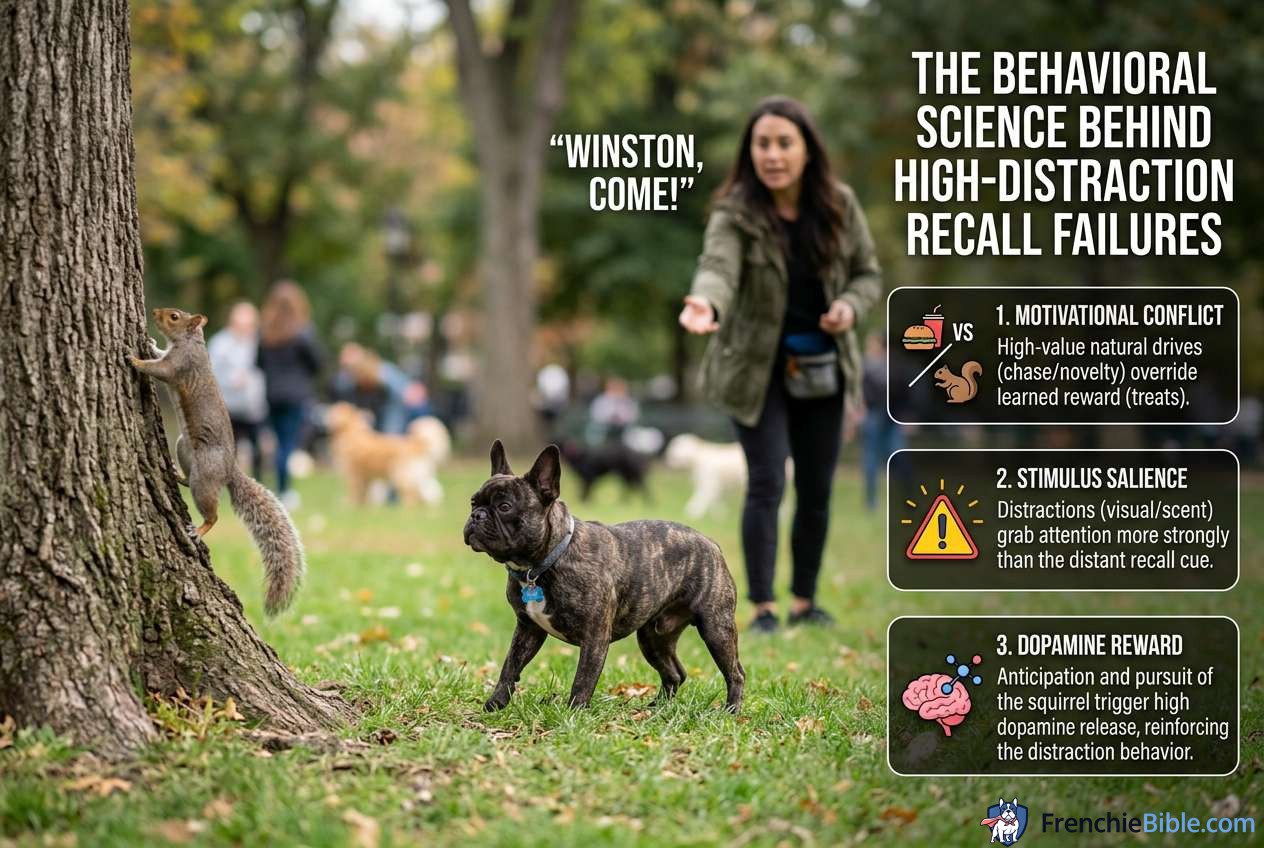
Why does your French Bulldog execute a flawless, military-precision recall in the sterile environment of your living room, yet act like they have never met you when you unleash them at the local dog park? The answer lies not in their malice, but in the rigorous, unyielding science of animal learning, specifically the concepts of “competing motivators,” “environmental conditioning,” and “poisoned cues.”
The Environment vs. You: The Economics of Attention
In applied behavioral science, we rely heavily on the concept of the “value of reinforcement.” Imagine attention as a currency. In a low-distraction environment, such as your kitchen or living room, a single piece of standard dry kibble or a quick scratch behind the ears might be an adequately high-value reward. Why? Because the environmental competition is practically zero. There is nothing else happening; you are inherently the most interesting, dynamic thing in the room.
However, the moment you step out your front door, the economic landscape shifts violently. The environment instantly transforms into an all-you-can-eat sensory buffet. The intrinsic value of your dry biscuit completely plummets when compared to the intoxicating thrill of a fleeing rabbit, the erratic movement of a skateboarder, or the opportunity to wrestle with a canine best friend.
If the reward you are holding does not dramatically outweigh the environmental distraction they are currently engaging with, the recall will fail 100% of the time. This is not disobedience; it is basic economics. To achieve a high-distraction recall, you must relentlessly scale the value of your reward to exceed the perceived value of the distraction.
The Deep Danger of “Poisoning” the Recall Cue
One of the most insidious and common reasons French Bulldogs actively stop coming when called is the psychological phenomenon known as a “poisoned cue.” A poisoned cue occurs when a dog slowly, over time, associates a specific verbal command (like “Come!” or “Here!”) with a negative, unpleasant, or “end-of-fun” consequence.
Consider your daily routine. If the only time you use the recall command is to put their leash back on to leave the park, to drag them to the bathtub, to administer unpleasant medication, to trim their nails, or to scold them for chewing a shoe, what is the dog actually learning? Dogs are unparalleled masters of associative learning. If the word “Come” is a reliable predictor that their freedom is about to end or discomfort is about to begin, they will intelligently and actively avoid you when they hear that word. You have inadvertently taught them that running away is the only logical response to the cue.
Fear, Frustration, and Negative Associations with Returning
In severe cases, a dog may refuse to return because they have been actively punished upon returning in the past. This is a heartbreaking but common cycle.
Imagine this scenario: Your Frenchie slips their collar and runs off. You spend 30 terrifying, infuriating minutes chasing them through the neighborhood. When you finally corner them or they eventually trot back to you, your natural, adrenaline-fueled human instinct might be to yell, scold, or roughly grab them by the harness.
You must view this interaction strictly from the dog’s perspective. In their mind, they just returned to their owner, and they were instantly met with anger, loud noises, and physical roughness. They do not possess the complex cognitive ability to connect your anger to the act of running away 30 minutes ago. They only connect the punishment to the immediate preceding action: the act of coming back to you. This single interaction can create a deep-seated, lasting fear of returning to you, practically guaranteeing that the next time they get loose, they will actively run away from you to avoid punishment, making them infinitely harder to catch.
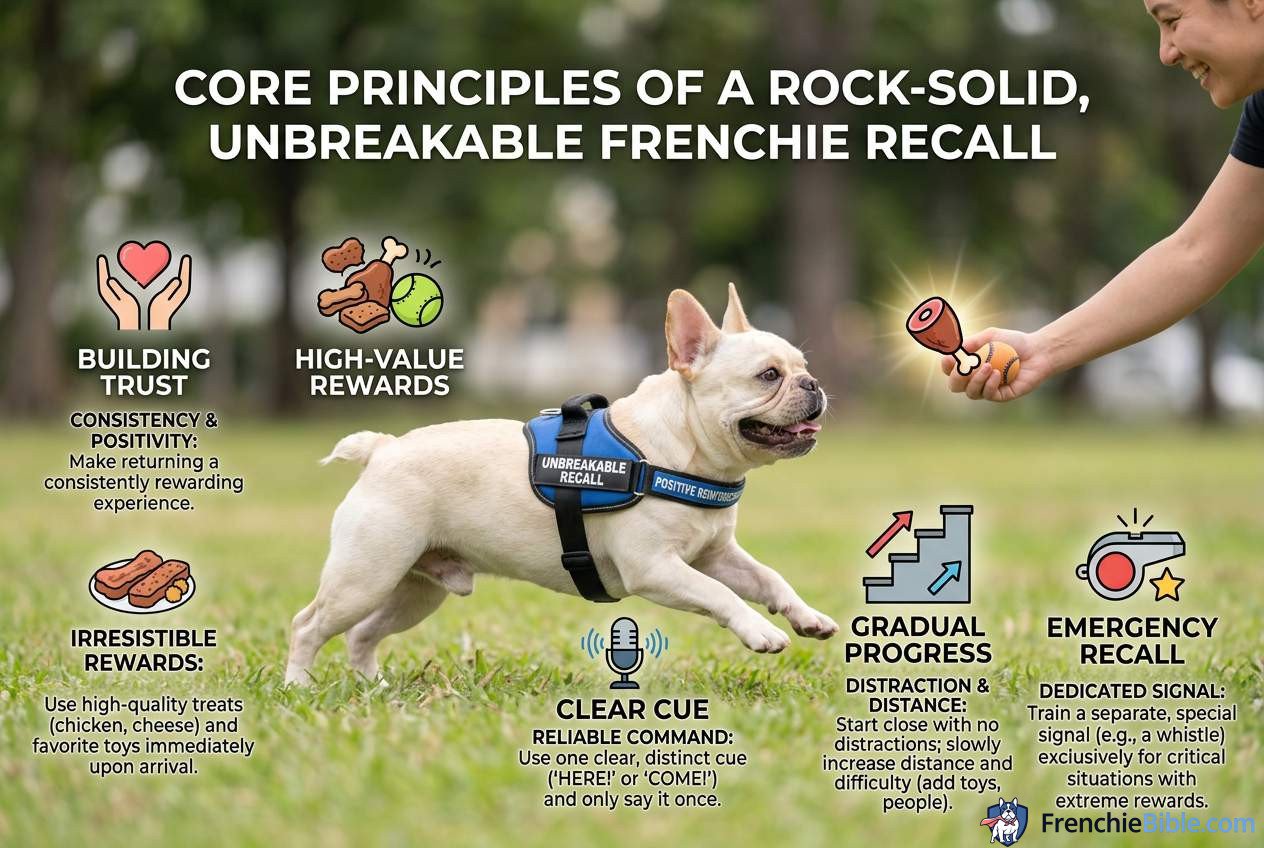
Core Principles of a Rock-Solid, Unbreakable Frenchie Recall
Before we even begin to discuss the mechanical, step-by-step training process, you must fundamentally shift your mindset and adopt these non-negotiable core principles. These are the foundational pillars that must govern every single recall interaction you have with your French Bulldog for the rest of their life.
Principle 1: The “Paycheck” Must Exceed the Job Requirements (High-Value Rewards)
Consider this human analogy: If your employer suddenly demanded you work triple shifts, over weekends, in a highly stressful environment, but offered no increase in your standard salary, you would undoubtedly refuse. Your Frenchie operates on the exact same pragmatic principle.
Coming to you from the sofa to the kitchen is a low-effort, low-distraction job; standard currency (kibble) is acceptable. Turning away from a wrestling match with another dog at a chaotic park and sprinting back to you is a massive, high-stress, high-effort job. It absolutely requires a monumental, life-altering paycheck.
When training and maintaining a high-distraction recall, you are obligated to use “jackpot” rewards. These are exquisite, rare treats that your Frenchie literally never experiences under any other circumstances. Exceptional examples include freshly boiled chicken breast, freeze-dried beef liver, tiny cubes of smelly Swiss cheese, roasted salmon, or small slices of hot dogs. The treat must be highly aromatic, visually appealing, and texturally irresistible.
Clinical Note from the Vet: French Bulldogs are highly prone to obesity, which exacerbates their brachycephalic airway syndrome and places immense strain on their joints (predisposing them to IVDD – Intervertebral Disc Disease). When utilizing these high-calorie jackpot rewards for training, you must rigorously calculate these calories and appropriately reduce their daily kibble allowance to maintain a lean, healthy body condition score.
Principle 2: Setting Them Up for Inevitable Success (The Micro-Step Approach)
The single biggest mistake amateur trainers make is attempting to jump to the final, hardest step before laying a solid foundation. They try calling their dog away from a squirrel before they have successfully taught the dog to come away from a boring toy in the living room.
You must set your dog up for inevitable success by systematically breaking the training process down into microscopic, easily achievable steps. If you call your dog and they fail to recall, you must immediately internalize this truth: It is not the dog’s fault. The failure simply means you, the trainer, increased the difficulty (distance, duration, or distraction level) too quickly. You must check your ego, take a step back, reduce the environmental distractions, decrease the distance, and practice at that easier level until they are 100% reliable before ever attempting to move forward again.
Principle 3: The Emotional Connection: Becoming the Ultimate Destination
While pungent, high-value treats are the mechanical currency of training, your ultimate, long-term goal is to make yourself the most exciting, fulfilling, and safe entity in your dog’s universe. Your recall should not merely be a sterile auditory cue; it should be an emotional event.
When you issue the recall command, your tone of voice must be enthusiastically high-pitched, welcoming, and irresistibly inviting. Do not use a deep, booming, authoritative voice—that sounds like a reprimand. Crouch down low to their level, open your arms wide, tap your legs, and act like the most exciting cheerleader in the world. When they finally arrive at your feet, it should literally be a party. Shower them with genuine verbal praise, lavish physical affection, their favorite toys, and, of course, the jackpot treats. You are striving to program their brain to instinctively think, “No matter what amazing thing I am doing right now, going back to my human is always a thousand times better!”
The Masterclass: Step-by-Step Guide to High-Distraction Recall Training
Building an unbreakable, high-distraction recall is a deeply systematic, progressive process. It requires immense patience and consistency. Do not rush through these stages. Your French Bulldog must master one stage with absolute, 100% reliability before you even consider moving to the next.
Stage 1: Building the Foundation (Zero Distraction Environment)
This stage takes place entirely inside your home, in a quiet, boring room (like a hallway or spare bedroom), with no other people, children, or pets present. You want the environment to be as uninteresting as possible.
- The Name Recognition Game: Before a dog can come to you, they must know that their name means “Look at my human for instruction.” Say your Frenchie’s name in a bright tone. The exact millisecond they make eye contact with you, mark the behavior clearly (using a training clicker or a sharp, consistent verbal marker like “Yes!”), and immediately toss them a high-value treat. Repeat this rapid-fire 15-20 times per session, twice a day. You want to build a reflexive muscle memory where hearing their name causes their head to whip around toward you instantly.
- Selecting a Virgin Recall Word: If your current recall word (e.g., “Come”) has been ignored for months, it is formally poisoned. Discard it permanently. Pick a brand new, virgin word that has no prior negative associations. Good options include “Here!”, “Touch!”, “Vite!” (French for fast), or even a specific, unique whistle pattern. This provides you and your dog with a clean psychological slate.
- The Lure, Mark, and Reward Protocol: Stand just two feet away from your dog. Say your new recall word enthusiastically. If they don’t immediately move toward you, do not repeat the word. Instead, show them the jackpot treat, let them smell it, and slowly back away, luring them toward you. As they take steps toward you, praise them profusely (“Good boy!”). The second they reach you, say “Yes!” and deliver the treat directly to their mouth.
- The Critical “Collar Grab” Conditioning: Frenchies are notoriously clever. Many will quickly learn to sprint up to you, snatch the treat from your hand like a drive-by thief, and immediately dart back out of reach before you can secure their leash. To prevent this dangerous habit, you must condition them to accept handling upon return. As they arrive and are actively eating the treat from your right hand, use your left hand to gently touch, stroke, and eventually hold their collar or harness. Do this every single time. This desensitizes them to the physical sensation of being grabbed, teaching them that a hand reaching for their collar means treats are arriving, not that their freedom is ending.
Stage 2: Introducing Mild, Controlled Distractions (Inside the Home)
Once your Frenchie reliably and enthusiastically sprints to you from across an empty room 10 times out of 10, it is time to incrementally increase the distance and introduce mild, controlled distractions.
- The Room-to-Room Challenge: Enlist a family member or friend. Have them gently hold the dog in the living room while you walk into the kitchen (out of sight). Call out your recall word once, loudly and happily. When they come tearing around the corner and find you, deliver a massive jackpot reward and throw a mini-party.
- The “Hide and Seek” Engagement Game: When your dog isn’t looking, quietly hide behind a door, behind a sofa, or behind a long curtain. Call them once. Frenchies are naturally curious and often deeply attached to their owners; this game taps into those traits. Let them use their nose and ears to find you. When they discover your hiding spot, explode with praise and treats. This teaches them that finding you is an incredibly fun, rewarding game.
- Proofing Against Mild Distractions: Wait until your dog is engaged in a low-level activity—perhaps sniffing a boring toy, staring out the window at nothing in particular, or waking up from a nap. Issue your recall command. If they ignore you, do not repeat the command. Walk over to them calmly, place the high-value treat right in front of their nose to break their concentration, lure them away from the distraction, and once they follow you a few steps, reward them. Next time, try it from a slightly shorter distance.
Stage 3: The Long Line Strategy (Backyards and Quiet Outdoor Spaces)
Now, we transition to the great outdoors. This is where most owners fail because they jump from the living room to the off-leash dog park. The transition must be bridged using a “Long Line.” The ideal environment is a securely fenced backyard or a very quiet, empty public park at an off-peak hour (e.g., 6:00 AM on a Sunday).
Crucial Safety Rule: Never, under any circumstances, practice off-leash training in an unenclosed, public area until the recall is 100% reliable on a long line for several months.
- Equipment Setup: Purchase a dedicated 15-to-30-foot training lead (a long line). Veterinary Warning: Never attach a long line to a neck collar, especially on a brachycephalic breed. If the dog hits the end of the line at a sprint, the sudden deceleration force on their neck can cause severe tracheal collapse, cervical spine injuries, or asphyxiation. Always, always attach a long line to a well-fitting, sturdy, back-clipping body harness.
- Controlled Wandering: Take your dog to the quiet outdoor area. Allow them to drag the long line or hold the end of it loosely. Let them wander, sniff, and become mildly engaged with the outdoor environment.
- Executing the Long Line Recall: Wait for a moment when they are slightly distracted but not hyper-focused. Say their name, followed immediately by your enthusiastic recall word.
- Scenario A (Success): If they turn and run to you, celebrate wildly! Deliver the jackpot reward, perform the gentle collar grab, and then—this is the most important part—release them immediately with a cue like “Go Play!” Let them go back to sniffing. This teaches them a profound lesson: coming to you does not mean the fun ends; it just means a brief interruption for a delicious snack before the fun resumes.
- Scenario B (Failure/Ignoring): If they completely ignore your command, do not yell, and do not repeat the word. Calmly and silently plant your feet. Gently and steadily reel them in using the long line, hand over hand, like you are reeling in a fish. Do not yank, jerk, or drag them aggressively. Just apply consistent, inescapable pressure. As soon as they yield to the pressure and take even one step toward you on their own, immediately praise them (“Good boy!”). When they finally reach you, offer a moderate reward (less exciting than the jackpot). This teaches them a vital concept: ignoring the command is physically impossible. They will end up by your side regardless, but choosing to come willingly on the first call is vastly more pleasant and rewarding.
Stage 4: High-Distraction Proofing (Real-World Scenarios)
This is the ultimate, most difficult stage, and realistically, it takes months of dedicated effort. You are now systematically preparing them to choose you over the most exciting elements of the real world.
- The Art of Gradual Exposure (Desensitization): Take your dog, securely attached to the long line and harness, to a moderately busy environment, like a park where other dogs are playing in the distance. Do not walk right into the middle of the chaos. Start at the extreme far edge of the park. You want to find the “threshold”—the exact distance where your dog notices the other dogs but is not completely overwhelmed by them and can still eat a treat.
- The “Look at That” (LAT) Game: Sit with your dog at this safe distance. When your dog looks at the distraction (the other dogs playing), say their name or use your clicker. If they break their gaze from the other dogs and look back at you, deliver a massive jackpot reward. You are actively building incredible value in the act of paying attention to you in the presence of massive triggers.
- Recall Away from Triggers: As they get better at LAT, wait until they are looking at the distraction, then issue your full recall command and run a few steps backward (away from the distraction). Running away triggers their prey/chase drive, making you more enticing to follow. If they chase you and catch you, jackpot reward.
- The Ultimate Test and Retreat: Over weeks and months, gradually decrease the distance between you and the high distractions (moving closer to the center of the park). If your dog fails at any point and ignores you, do not get angry. It is simply diagnostic feedback. It means you pushed them over their threshold too fast. Calmly reel them in, pack up, back away 30 feet, and try again at an easier distance the next day.
Advanced Tactical Interventions for the Truly Stubborn Frenchie
If you have a profoundly strong-willed Frenchie who still views your commands as merely polite suggestions despite mastering the basics, you must deploy advanced behavioral strategies to bridge the gap and establish undeniable relevance in their life.
The “Emergency Recall” Command (The Nuclear Option)
This is a specialized, distinct command that means, “Drop absolutely everything you are doing, turn around, and sprint to me right this second, and I will literally give you a piece of prime rib.” It must be a completely different word or sound from your daily recall word. Highly effective options include yelling “Jackpot!”, “Bingo!”, or using a specialized, loud shepherd’s whistle.
The Rules of the Emergency Recall:
- Never, ever use this command for mundane, daily tasks (like calling them for dinner or to go inside).
- Only practice it 1 to 2 times a week maximum to keep the novelty incredibly high.
- The reward must be absurdly high—an entire handful of shredded chicken, a whole slice of cheese, or opening a brand new can of wet food.
- Condition this word in zero-distraction environments for months before you ever attempt to use it in a real-life emergency (like a dropped leash near a road). The association must be so deeply ingrained that it bypasses their thinking brain and triggers a purely reflexive sprint toward you.
Mastering the Premack Principle in Daily Life
The Premack Principle (often colloquially referred to as “Grandma’s Law”—you must eat your vegetables before you get dessert) is a cornerstone of advanced dog training. It states that a highly probable, highly desired behavior (what the dog wants to do) can be used as the ultimate reinforcement for a less probable behavior (what you want the dog to do).
Put simply: your dog must perform a task for you before the environment yields what they want. You become the gateway to all joy.
- The Doorway: Does your Frenchie want to rush out the front door for a walk? The door does not open until they offer a voluntary “Sit” and look you directly in the eye.
- Dinner Time: Do they want their bowl of food? They must go to their designated “Place” (a bed or mat) and hold a “Wait” command until you release them.
- Social Greetings: Do they want to go greet that friendly dog across the street? They must first execute a flawless recall to your side and sit patiently. Only then do you say “Go say hi,” using the other dog as the reward for obeying you.
By ruthlessly incorporating the Premack Principle into every aspect of daily life, you fundamentally shift your Frenchie’s worldview. They realize that ignoring you gets them nowhere, while paying attention to you and following your rules is the magical key that unlocks every wonderful thing in their environment.
The “Silent Hide and Seek” Game for Building Relentless Engagement
Many Frenchies become “environmentally focused”—they walk at the end of the leash, staring ahead, completely ignoring the human on the other end, assuming you will blindly follow them wherever they go. To fix this, you must teach them that they are responsible for keeping track of you.
On a walk in a safe, fully enclosed area (or on a long line), if your Frenchie is ignoring you and forging ahead, silently stop walking. Wait for them to notice. If they don’t, silently turn around and walk briskly in the exact opposite direction. Or, if safe, silently step behind a large tree or a parked car and hide.
When your Frenchie finally turns around and realizes you have vanished, they will experience a mild, healthy moment of panic. They will start frantically searching for you. The moment they find you, drop to your knees and explode with praise and treats. You are teaching them a profound lesson: “My human is unpredictable and might disappear if I don’t pay attention. I need to keep one eye on them at all times.” This builds massive natural engagement and makes them hypersensitive to your location and movements, drastically improving their responsiveness to a verbal recall.
Common, Sabotaging Mistakes Owners Make (And How to Avoid Them)
As a behaviorist, I watch well-meaning owners inadvertently sabotage their own training efforts daily. Avoid these critical errors at all costs.
The “Broken Record” Syndrome (Repeating the Command)
“Come! … Buster, come! … Come here! … BUSTER! GET OVER HERE RIGHT NOW!”
Every single time you utter the command and the dog does not immediately comply, and you fail to enforce it, you are actively degrading the power of that word. You are teaching your Frenchie that the word “Come” is merely optional background noise, no more meaningful than the wind blowing.
The Rule: Say the command exactly once. If they do not respond within two seconds, you must physically make it happen (by reeling them in gently on the long line) or you must walk over to them, lure them, and remove them from the situation. Never issue a recall command in a situation where you are not physically capable of enforcing it (e.g., when they are completely off-leash and ignoring you 50 feet away).
The Ultimate Betrayal: Punishing the Dog When They Finally Return
I must reiterate this point because it is the most damaging mistake an owner can make: Never, under any conceivable circumstances, punish, scold, or physically reprimand your dog when they arrive at your side.
It does not matter if it took them 45 agonizing minutes to return. It does not matter if they rolled in a dead animal while they were gone. It does not matter if they terrified the neighborhood cat and embarrassed you deeply.
If you yell at them, hit them, or aggressively leash them the moment they return, you have just guaranteed that they will not come back the next time. They must inherently, unshakeably believe that arriving at your feet is the safest, happiest, most rewarding place on planet Earth. You must swallow your human frustration, plaster a fake smile on your face, and reward the return. Deal with the behavioral fallout (like the dead animal smell) later, but never associate punishment with the act of coming to you.
The “End of Fun” Trap
If you only ever call your dog to you when it’s time to clip the leash on and leave the glorious dog park, go inside the boring house, or endure a miserable bath, your recall command becomes a harbinger of doom. Dogs are smart; they won’t comply with a command that consistently ends their joy.
The Golden Rule of 9 to 1: For every one time you recall your dog to permanently end their fun (e.g., leaving the park), you must execute nine “mock recalls.” A mock recall is calling them to you, throwing a massive party with jackpot treats, giving them a scratch, and immediately releasing them back to play (“Go play!”). This ensures that 90% of the time, the recall is just a quick, incredibly rewarding pit stop before the fun continues. It keeps the command positive, unpredictable, and highly desirable.
FAQ: The Veterinarian & Behaviorist Answers Your French Bulldog Recall Questions
As a specialist in this breed, my inbox is constantly flooded with specific, nuanced questions regarding training. Here are the most critical, frequently asked questions regarding French Bulldog recall.
Q: At what exact age should I start recall training with my new French Bulldog puppy?
A: You should begin the very day you bring your 8-week-old puppy home. Very young puppies have a deeply ingrained biological instinct (the “following response”) to stay close to their perceived parental figure for safety. Capitalize on this early window. Play the “Name Game” and “Hide and Seek” indoors immediately. Building strong neurological pathways for recall is infinitely easier than trying to overwrite established bad habits in an adolescent dog. However, if you have adopted a 5-year-old Frenchie with a terrible history of running away, do not despair. Adult dogs are highly neuroplastic and capable of learning; it simply requires more patience, stricter management (always using a long line), and pristine consistency from you.
Q: My Frenchie is incredibly food-motivated indoors, but completely ignores my highest-value treats when we are outside. What should I do?
A: This is incredibly common and indicates one clear diagnostic fact: the environmental distractions you are currently competing against hold a higher intrinsic value to your dog than your food. You must tackle this from two angles simultaneously. First, upgrade the treats. If you are using cheese, upgrade to pungent, warm, boiled liver or hot dogs. Second, and more importantly, you must drastically manage the environment. You are asking for too much, too soon. You must retreat to a significantly less distracting environment—perhaps your boring driveway, an empty tennis court, or an industrial park on a Sunday. Practice there, build their focus, and only slowly re-introduce higher-distraction environments over weeks.
Q: With my background in French Bulldog breeding, what is your professional stance on using electronic collars (e-collars/shock collars) for off-leash recall training with French Bulldogs?
A: As a medical professional specializing in brachycephalic breeds, I fiercely advise against the use of e-collars for French Bulldogs. Beyond the ethical debates surrounding aversive training, there are severe medical contraindications. Frenchies are physically delicate. They are prone to rapid stress escalation, anxiety, and, most critically, Brachycephalic Airway Obstruction Syndrome (BAOS). The sudden shock, vibration, or even the loud beep from an e-collar can easily induce a state of panic. Panic leads to heavy panting, which can rapidly trigger severe respiratory distress, tracheal inflammation, and even life-threatening collapse in a flat-faced breed. Furthermore, modern behavioral science conclusively proves that positive reinforcement builds a more reliable, resilient behavior based on trust, whereas aversive tools build behaviors based on fear and avoidance. You want a dog that runs to you because they love you, not because they are terrified of being shocked.
Q: Realistically, how long does it take to train a genuinely reliable, bomb-proof recall in a stubborn Frenchie?
A: A truly reliable, high-distraction recall is not a trick you teach in a weekend seminar; it is a lifestyle. It is the culmination of months, sometimes years, of consistent, daily effort. You will likely see significant, encouraging improvement within 3 to 4 weeks in low-distraction environments (like your house or yard). However, genuinely “proofing” the recall against explosive, real-world triggers—like a fleeing squirrel, a loud siren, or a pack of playing dogs—typically requires 6 to 12 months of dedicated, strategic practice using long lines and controlled exposure. Furthermore, recall is a perishable skill. Even a fully trained dog needs regular “tune-ups” and jackpot rewards periodically throughout their life to maintain the behavior. Training is a lifelong journey of communication, not a final destination.
Q: From a nutritional standpoint, what are the safest, highest-value training treats for Frenchies that won’t upset their notoriously sensitive stomachs?
A: French Bulldogs are infamous for their sensitive gastrointestinal tracts and propensity for food allergies (particularly to common proteins like beef or chicken, though every dog varies). For high-value, “jackpot” training, I recommend finding a novel, highly aromatic protein that your specific dog tolerates perfectly. Excellent, vet-approved options include:
- Boiled, plain, skinless turkey breast (shredded microscopically small).
- Freeze-dried single-ingredient treats (like 100% lamb lung or wild-caught salmon).
- Tiny, pea-sized cubes of low-fat mozzarella cheese (if they tolerate dairy).
- A specialized squeeze tube (like a silicone travel shampoo bottle) filled with plain, unsweetened Greek yogurt or a dog-safe meat pate. Squeeze tubes are phenomenal because the dog only gets a tiny lick, keeping calories low while providing a long-lasting, high-value experience.
- Crucial Warning: If you use peanut butter, you must compulsively check the ingredient label to ensure it does NOT contain Xylitol (or Birch Sugar), an artificial sweetener that is rapidly fatal to dogs, even in microscopic doses.
Always remember, for training purposes, the treat size should be no larger than half a pea. You want them to taste it, swallow it instantly, and look back to you for more, not stand there chewing for ten seconds.
Conclusion: The Lifelong Bond of a Reliable Recall
Training a reliable, high-distraction recall in a French Bulldog is undeniably challenging. It requires immense patience, a deep, empathetic understanding of their unique breed characteristics and physical limitations, and an unwavering commitment to positive, reward-based behavioral science.
They may be independent, they may be easily distracted by the rich olfactory world, and they will almost certainly test your patience and resolve. However, by strictly adhering to the core principles outlined in this guide—never poisoning the cue, utilizing jackpot rewards, mastering the long line, and setting them up for incremental success—you can absolutely build a recall that defies their “stubborn” stereotype.
Achieving this milestone does more than just make your daily walks more pleasant. It grants your Frenchie the ultimate gift: safe freedom. More importantly, it fundamentally transforms your relationship. When your Frenchie turns away from a compelling distraction and sprints back to you with joy in their eyes, it is the ultimate expression of trust. It proves that in a chaotic, fascinating world, you are their favorite destination. Happy training, and stay patient!
Disclaimer: I am a French Bulldog breeding expert with over a decade of hands-on experience with this breed. I am not a veterinarian. The information in this article is for educational purposes only. Always consult your veterinarian regarding your dog’s specific health needs and care.