

Disclaimer: The information provided in this article is for educational and informational purposes only. While I am an experienced breeder and veterinary professional, this content should not replace professional veterinary advice, diagnosis, or treatment. Always consult with a licensed veterinarian regarding your dog’s specific health needs.
If you were to ask someone on the street to describe a French Bulldog, the very first characteristic they would likely mention is those massive, adorable, upright ears. The iconic “Bat Ear” is the undeniable hallmark of the French Bulldog breed today. However, as a veterinary professional and a long-time enthusiast of canine genetics and history, I find it endlessly fascinating that these signature ears were almost bred out of existence entirely.
Related Reading: Training & Behavior | Frenchie Puppy Guide | Best Food for Frenchies
In the late 19th century, a fierce debate raged across continents between dog breeders, aristocrats, and kennel clubs. The battleground? The shape of the French Bulldog’s ears. The “Bat Ear” versus the “Rose Ear” debate shaped the modern Frenchie we know and love today. Let’s take a deep dive into the historical evolution of the French Bulldog breed standard, the anatomy behind their unique ears, and how American breeders saved the Bat Ear from extinction.
The Origins of the Frenchie: A Tale of Two Countries
To understand the ear debate, we must first look at where the French Bulldog actually came from. Ironically, the French Bulldog’s roots begin in England. During the Industrial Revolution in the mid-1800s, lace-makers in Nottingham, England, began selectively breeding standard English Bulldogs to be smaller, creating a “Toy Bulldog.” These miniature bulldogs served as lap warmers and ratters in the lace factories.

When the lace industry mechanized, many of these workers lost their jobs and immigrated to Northern France, bringing their Toy Bulldogs with them. In France, these little dogs became wildly popular among the Parisian working class, bohemians, and even the high-society “ladies of the night.”
In France, these English Toy Bulldogs were crossed with local ratters and possibly Terriers or Pugs. This crossbreeding in the streets of Paris introduced a new, dominant genetic mutation: large, upright ears that were wide at the base and rounded at the top. The French dubbed them Bouledogue Français, and the “Bat Ear” was born.
The Great Ear Debate: Rose Ears vs. Bat Ears
While the French were falling in love with the upright Bat Ears, the English and other European breeders were appalled.
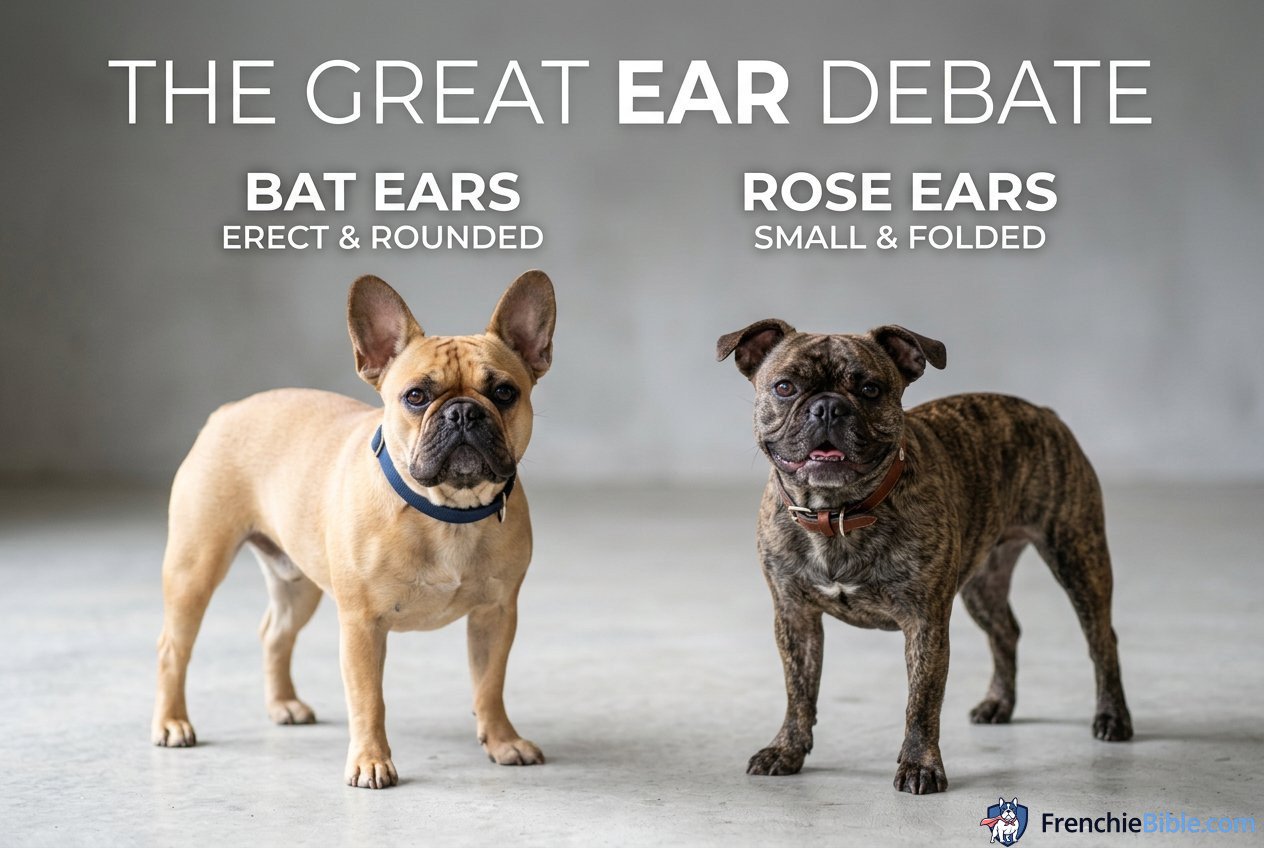
The Rose Ear Standard
To traditional English breeders, a bulldog—no matter how small—should have a “Rose Ear.” A Rose Ear is an ear that folds inward at its back lower edge, exposing the burr (the inside of the ear), and laying back against the side of the head. This is the ear type you see on modern English Bulldogs and Greyhounds.
English dog show judges considered the upright Bat Ear to be a severe fault, a grotesque mutation that made the dog look too much like a terrier or a bat. In Europe, dogs with Rose Ears were heavily favored, and the Bat Ear was on the verge of being selectively bred out of the gene pool to conform to traditional bulldog aesthetics.
The American Intervention
This is where American dog fanciers enter the story and completely change the trajectory of the breed. In the late 1800s, wealthy Americans visiting Paris fell in love with the quirky little dogs with the massive upright ears. They began importing Bat-Eared Frenchies back to the United States.
In 1897, the Westminster Kennel Club Dog Show in New York featured a class for French Bulldogs. However, the English judges at the show placed Rose-Eared dogs as the winners, dismissing the Bat-Eared dogs entirely.
The American breeders were furious. They passionately believed that the Bat Ear was the defining characteristic that separated the French Bulldog from simply being a shrunken English Bulldog. In protest, a group of prominent American breeders organized the French Bull Dog Club of America (FBDCA) in 1897.
They did something unprecedented: they drafted their own breed standard for the French Bulldog. In this newly penned standard, it was explicitly declared that the only acceptable ear shape for a French Bulldog was the Bat Ear. Any dog with a Rose Ear was immediately disqualified from the show ring.
Their influence, wealth, and dedication to the Bat Ear eventually forced the international dog community to capitulate. By the early 20th century, the Bat Ear was universally recognized as the official standard for the breed. The American breeders had saved the Frenchie’s iconic look.
Anatomy and Veterinary Perspective on Bat Ears
As a veterinary professional, I look at the French Bulldog’s ears not just as a historical triumph, but as an anatomical marvel that requires specific care.
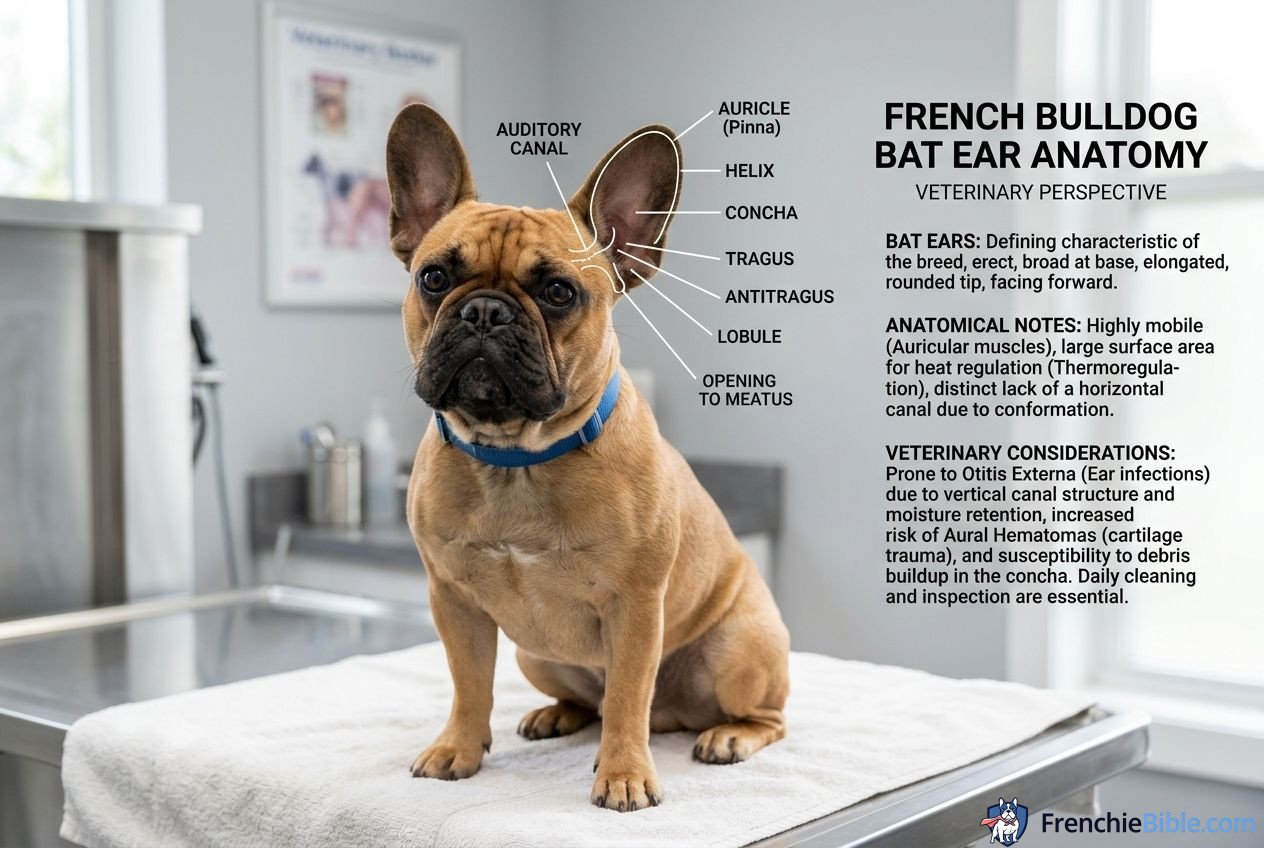
The Genetics of the Bat Ear
The Bat Ear is a fascinating genetic trait. French Bulldog puppies are not born with their ears standing up. Like most dogs, their ears are floppy at birth. It isn’t until they are between 5 and 15 weeks old that the cartilage in the base of the ear begins to harden and strengthen, allowing the massive ear flap (the pinna) to stand erect.
The process is heavily dependent on genetics, but also on calcium and teething. During the teething phase (around 3 to 5 months of age), the body redirects calcium to the developing adult teeth. It is incredibly common for a Frenchie puppy’s ears to go “wonky”—one ear might flop down, or they might tilt inward—during teething. Once teething is finished, the cartilage usually solidifies, and the ears stand proud.
Veterinary Care for Bat Ears
While aesthetically pleasing, these massive, open ears act like radar dishes, collecting dust, debris, allergens, and moisture. This makes French Bulldogs highly susceptible to ear infections (otitis externa).
- Regular Cleaning is Mandatory: Because the ear canal is wide open to the elements, owners must clean their Frenchie’s ears weekly using a vet-approved, pH-balanced ear cleanser.
- Allergy Indicators: The ears are often the first place environmental or food allergies manifest in a French Bulldog. If the inside of the ear flap is bright red, inflamed, or hot to the touch, it is usually an allergic response, not just dirty ears.
- Yeast Infections: The deep crevices at the base of the Bat Ear are prone to holding moisture, creating a perfect breeding ground for yeast (Malassezia). A dark, coffee-ground-like discharge with a strong, musty odor requires immediate veterinary treatment.
Conclusion: A Legacy Preserved
When you look at your French Bulldog sleeping on the couch, those massive, rounded ears are a testament to a fascinating piece of canine history. They represent a rebellion against traditional European standards and a victory for the eccentric, unique aesthetic championed by American dog lovers over a century ago.

The Bat Ear is what makes a Frenchie a Frenchie. It gives them their clownish expression, their alert curiosity, and their undeniable charm. As breeders and owners, it is our responsibility to maintain the health and cleanliness of these iconic features, ensuring that the legacy of the Bat Ear continues for generations to come.
Frequently Asked Questions (FAQs)
1. My French Bulldog puppy is 4 months old and his ears are still floppy. Is this normal?
Yes! The teething phase (between 3 and 6 months) often causes the ears to droop or behave erratically because the body is utilizing calcium for adult teeth development. Do not panic. However, if the ears are still completely flat by 7-8 months, they may never stand up due to genetic cartilage weakness.
2. Should I tape my Frenchie puppy’s ears to make them stand up?
As a veterinary professional, I strongly advise against amateur ear taping. Taping incorrectly can permanently damage the fragile cartilage, cause severe skin infections, or cut off blood circulation to the ear tip, leading to necrosis. If you are concerned, consult your vet or an experienced preservation breeder for guidance.
3. Do French Bulldogs with Rose Ears still exist?
It is incredibly rare to see a purebred French Bulldog with true Rose Ears today, as the trait has been aggressively bred out of the gene pool for over 100 years. If a dog has Rose Ears, it is highly likely it is a mixed breed (perhaps mixed with an English Bulldog or Boston Terrier) or a severe genetic anomaly.
4. Why do my Frenchie’s ears smell like corn chips?
The “Fritos” or “corn chip” smell is a classic sign of a yeast overgrowth (Malassezia) in the ear canal or paws. Because Frenchie ears are wide and trap moisture at the base, yeast thrives there. You need a medicated veterinary ear drop to clear the infection; over-the-counter cleaners will not resolve it.
5. Can French Bulldogs hear better because their ears are so big?
Yes and no. The large, upright pinna acts as an acoustic funnel, making them highly sensitive to catching sound waves (which is why they always hear a cheese wrapper opening from three rooms away). However, they are also prone to congenital deafness, particularly in all-white or heavily pied dogs, due to a lack of pigment cells in the inner ear. Always have a BAER hearing test done on white puppies.