
Disclaimer: The information provided in this article is for educational and informational purposes only. While I am an experienced breeder and veterinary professional, this content should not replace professional veterinary advice, diagnosis, or treatment. Always consult with a licensed veterinarian regarding your dog’s specific health needs.
If I had a dollar for every time someone pointed at a French Bulldog and confidently shouted, “Look, a Boston Terrier!” (or vice versa), I could retire my veterinary stethoscope today.
Related Reading: Training & Behavior | Frenchie Puppy Guide | Best Food for Frenchies
As a veterinary professional and canine genetics enthusiast, I completely understand the confusion. Both the French Bulldog and the Boston Terrier are small, flat-faced (brachycephalic) dogs with massive, upright “bat ears,” big round eyes, and virtually no tail. They look like they could be siblings.
However, beneath their superficial similarities lie two entirely different breeds, originating on different continents, with distinct body structures, temperaments, and health profiles. If you are trying to decide which of these tuxedo-wearing or bat-eared comedians is right for your family, or if you simply want to win your next dog-park trivia debate, this ultimate guide will break down exactly how to tell the French Bulldog and the Boston Terrier apart.
A Tale of Two Continents: Breed Origins
To understand why they look similar but act differently, you have to look at where they came from.

The French Bulldog: The Parisian Companion
As the name suggests, the French Bulldog’s history is deeply rooted in Europe. In the 1800s, English lace-makers brought toy-sized English Bulldogs to France. There, they were crossed with local ratters and terriers, resulting in a compact, heavy-boned dog with iconic “Bat Ears.” They were bred purely as lap dogs and companions for the Parisian elite and working class alike.
The Boston Terrier: The All-American Gentleman
The Boston Terrier is one of the few breeds truly “Made in the USA.” In the late 1800s in Boston, Massachusetts, breeders crossed the English Bulldog with the now-extinct White English Terrier. Originally bred for pit fighting (a horrific past they have long left behind), they were eventually downsized and refined into the ultimate companion dog. Their polite demeanor and distinct tuxedo-like coat earned them the nickname “The American Gentleman.”
The Physical Differences: How to Spot Them Instantly
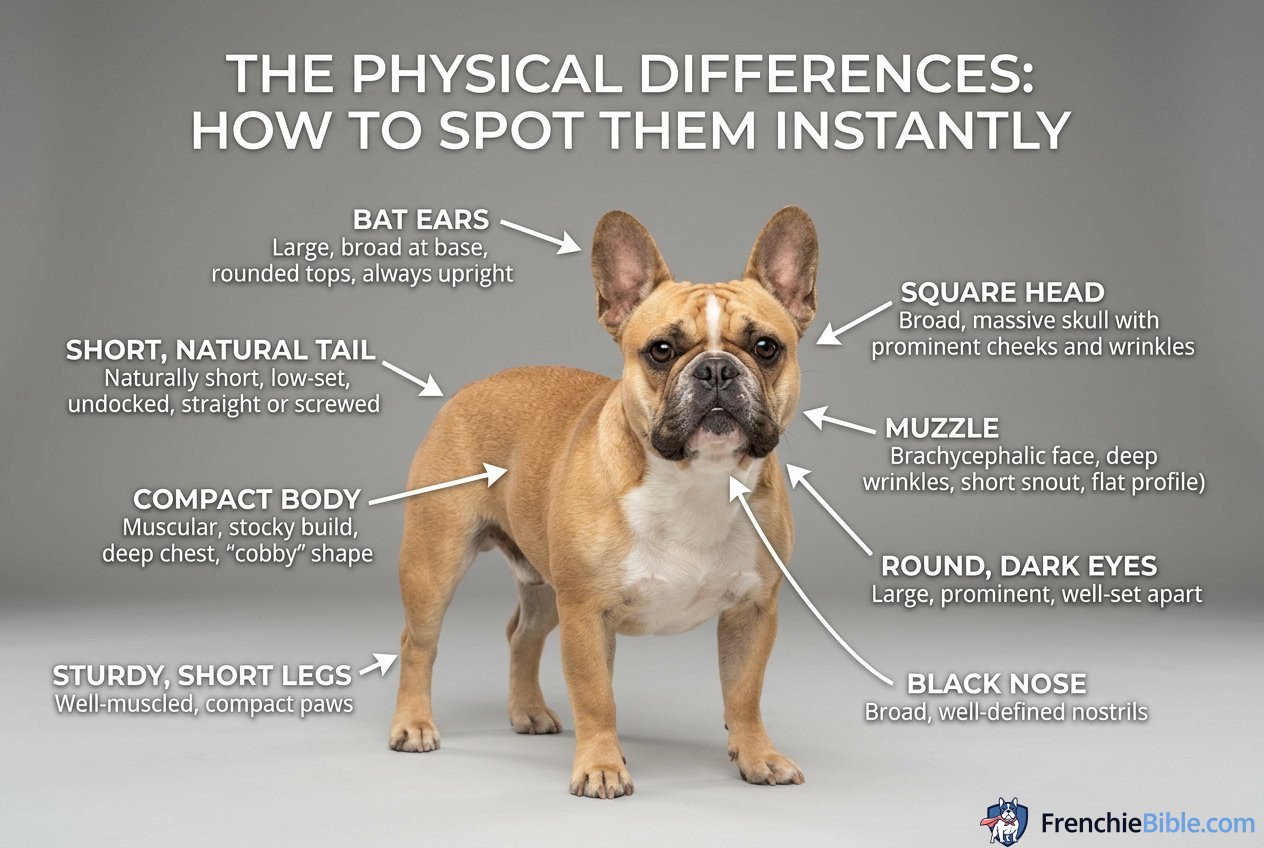
Once you know what to look for, you will never confuse these two breeds again. Here is the physical cheat sheet:
1. Ear Shape
- French Bulldog: Their ears are large, stand perfectly straight up, and are rounded at the top (the classic Bat Ear).
- Boston Terrier: Their ears also stand upright, but they are pointed at the tips, resembling a traditional terrier ear.
2. Body Shape and Bone Structure
This is the most significant physical difference.
- French Bulldog: Think of a bowling ball. Frenchies are incredibly dense, heavy-boned, low to the ground, and muscular. They have wide, barrel-shaped chests and a low center of gravity. They weigh between 20 to 28 pounds, but feel like solid lead when you pick them up.
- Boston Terrier: Think of a gymnast. Bostons are much more refined, leggy, and elegantly built. They have longer legs, a slimmer waist, and a lighter bone structure. They weigh between 12 to 25 pounds and look much more athletic.
3. Coat Colors and Patterns
- Boston Terrier: Bostons are famous for their strict color standard. They must have a “tuxedo” pattern—meaning they have a white chest, white blaze between the eyes, and a white muzzle. The base color can be Black, Brindle, or Seal (black with a red cast in the sunlight).
- French Bulldog: Frenchies come in a much wider variety of standard colors, including solid Cream, Fawn, Brindle, and Pied (mostly white with patches of color). You will rarely see a Frenchie with a perfect tuxedo pattern.
4. Facial Features
- French Bulldog: They have a square head, heavy wrinkles on the face, and prominent jowls. Their muzzle is extremely short.
- Boston Terrier: Their head is rounder, unwrinkled, and their skin is tight to their skull. Their muzzle is slightly longer and more refined than the Frenchie’s.
Temperament and Energy Levels
If the physical traits don’t give it away, their behavior absolutely will.

The Boston Terrier: The Agile Athlete
Because of their terrier heritage, Boston Terriers are highly energetic, alert, and athletic. They are fast runners, excellent jumpers, and excel in dog sports like agility or flyball. A Boston Terrier will happily hike a short trail with you, play a vigorous game of fetch, and bounce around the living room. They are intelligent, highly trainable, and eager to please, making them easier to train than a Frenchie.
The French Bulldog: The Comical Couch Potato
French Bulldogs are the ultimate chill companions. While they have bursts of zoomies and love to play, they lack the stamina and athleticism of the Boston Terrier. A Frenchie’s idea of a perfect afternoon is a 15-minute walk followed by a 4-hour nap on your lap. They are famously stubborn; if a Frenchie doesn’t want to do something, they simply will plant their feet and refuse to move.
The Verdict: If you are an active individual who wants a dog to play fetch, go for walks, and easily learn tricks, choose the Boston Terrier. If you want a hilariously stubborn, low-energy cuddle bug, choose the French Bulldog.
Health Profile: A Veterinary Perspective
As a veterinary professional, I see both breeds frequently for similar issues, as both are brachycephalic (flat-faced). However, their specific vulnerabilities differ.

Shared Health Risks
Both breeds are highly susceptible to:
- Brachycephalic Obstructive Airway Syndrome (BOAS): Difficulty breathing, overheating, and snorting.
- Corneal Ulcers: Their bulging eyes are easily scratched.
French Bulldog Specific Risks
Because of their heavy, dwarf-like build, Frenchies are plagued by Intervertebral Disc Disease (IVDD). Their spines are incredibly fragile, and jumping off a couch can result in sudden paralysis. They are also highly prone to severe skin allergies and require C-sections to give birth, which drives up their purchase price significantly.
Boston Terrier Specific Risks
Boston Terriers have much healthier spines and hips due to their athletic build. However, they are prone to specific eye issues, including Juvenile Cataracts and Glaucoma. They are also prone to Patellar Luxation (slip knee) due to their long, slender back legs.
The Verdict: The Boston Terrier is generally considered a healthier, hardier, and longer-lived breed than the French Bulldog. Bostons average 11 to 15 years, while Frenchies average 10 to 12 years.
Conclusion
Choosing between a French Bulldog and a Boston Terrier comes down to your lifestyle. The Boston Terrier is the “American Gentleman”—polite, energetic, athletic, and relatively healthy, making them a fantastic family pet for active households. The French Bulldog is the “Parisian Clown”—heavy, stubborn, incredibly affectionate, and low-energy, perfect for apartment dwellers who want a loyal shadow.
Whichever you choose, you are bringing a deeply loving, incredibly entertaining companion into your home. Just be sure to purchase pet insurance on day one to protect those beautiful, big-eyed faces!
Frequently Asked Questions (FAQs)
1. Which breed is more expensive to purchase?
The French Bulldog is significantly more expensive. A well-bred Frenchie ranges from $3,500 to $6,000, primarily because they require artificial insemination and C-sections to breed. Boston Terriers can often breed and whelp naturally, making their purchase price lower, typically between $1,500 and $2,500.
2. I live in a hot climate. Which breed handles heat better?
Neither breed handles heat well due to their flat faces. Both are highly susceptible to heatstroke and must live in air-conditioned homes. However, because the Boston Terrier is slightly less heavy and has a slightly longer muzzle, they are marginally better at regulating their temperature than the dense, heavy-breathing Frenchie.
3. Do they both shed a lot?
Yes, but the French Bulldog sheds significantly more. While both have short, fine coats, Frenchies are notorious for leaving small, coarse hairs all over furniture and clothing. Boston Terriers shed minimally and require less grooming.
4. Are Boston Terriers and French Bulldogs good swimmers?
No! French Bulldogs are notoriously bad swimmers; their heavy, dense bodies and large heads cause them to sink like stones. They must wear life jackets near water. Boston Terriers, being lighter and longer-legged, can doggy-paddle better than Frenchies, but they still tire very quickly and should never be left unsupervised near a pool.
5. Which breed is more vocal or barks more?
Both breeds are generally quiet and make excellent apartment dogs. French Bulldogs rarely bark; instead, they communicate through a hilarious range of yodels, gargles, and grunts. Boston Terriers may bark to alert you when someone is at the door, but they are not considered a “yappy” breed.