

1. Introduction: The Allure and The Reality of the Pure white french bulldog
The French Bulldog is a breed that has captured the hearts of dog lovers across the globe, consistently ranking as one of the most popular breeds in the world. With their compact, muscular bodies, distinctive “bat” ears, and endearing, flat-faced expressions, they are undeniable charmers. Among the myriad of coat colors and patterns available in the breed, the pure white French Bulldog stands out as a striking and highly coveted aesthetic. Their pristine, snowy coats and contrasting dark eyes (or sometimes piercing blue eyes) give them an almost ethereal appearance, driving significant demand in the pet market and commanding premium prices.

However, as a French Bulldog expert and breeder and a dedicated breeding expert, I am acutely aware of the hidden realities that accompany this beautiful coat. The breeding of pure white or extreme piebald French Bulldogs is not merely a matter of selecting for a pretty color; it is a complex genetic endeavor fraught with significant health implications. Beneath the surface of that magnificent white coat lies a genetic architecture that intricately links pigmentation to neurological and sensory development.
Related Reading: Training & Behavior | Frenchie Puppy Guide | Best Food for Frenchies
The most profound and life-altering consequence of this genetic linkage is congenital sensorineural deafness. The same genes that strip the pigment from the dog’s hair follicles can also strip vital pigment cells from the inner ear, leading to irreversible hearing loss. in my breeding experience, I have witnessed the heartbreak of owners who discover their seemingly perfect white puppy is entirely deaf, and the frustration of breeders dealing with the fallout of untested breeding stock.
In this exhaustive guide, we will delve deep into the science behind the pure white French Bulldog coat. We will unpack the complex genetics of the S locus, explore the precise anatomical and physiological reasons why a lack of pigment destroys hearing, and comprehensively cover the gold standard of hearing assessment: the Brainstem Auditory Evoked Response (BAER) test. Whether you are a prospective owner captivated by a white Frenchie, a breeder striving for ethical excellence, or simply an enthusiast of canine genetics, this article will serve as your ultimate resource for understanding and navigating the deafness gene.
2. The Deep Science: Genetics Behind the Pure White Coat
To truly grasp why a white French Bulldog is prone to deafness, we must first abandon the notion that coat color is merely “paint” on a dog. Coat color is the visible manifestation of a highly complex genetic code that regulates the migration, distribution, and chemical function of cells throughout the body during embryonic development.

2.1 The Canine Genome and Color Loci
The canine genome dictates coat color through various “loci” (specific positions on a chromosome). The most prominent loci include:
– The Agouti (A) Locus: Determines the distribution of dark and light pigment on individual hairs.
– The Extension (E) Locus: Controls the production of black (eumelanin) versus red/yellow (phaeomelanin) pigment. Frenchies with the “e/e” genotype are often cream or fawn.
– The Dilute (D) Locus: Modifies black pigment to blue (slate grey) and liver to isabella.
– The Spotting (S) Locus: This is the critical locus for white French Bulldogs. It dictates the presence, absence, and distribution of white spotting across the body.
2.2 The S Locus Masterclass (MITF Gene)
The S locus is governed by the Microphthalmia-associated transcription factor (MITF) gene. This gene is the master regulator of melanocyte development. Melanocytes are the cells responsible for producing melanin, the pigment that gives color to skin, hair, and eyes.
In French Bulldogs, the S locus primarily has two recognized alleles:
– S (Solid): The dominant allele. A dog with S/S will have a solid coat with minimal to no white spotting (perhaps just a small patch on the chest).
– s^p (Piebald): The recessive allele. When a dog inherits two copies (s^p/s^p), they exhibit the piebald pattern—large, random patches of white interspersed with colored spots.
The pure white French Bulldog is typically an “extreme piebald.” Through the interaction of the s^p/s^p genotype and various unmapped modifier genes, the white spotting is pushed to its absolute maximum, clearing virtually all color from the coat.
2.3 The Cellular Journey: Neural Crest and Melanocytes
The story of the white coat begins in the womb, specifically between days 20 and 30 of embryonic development. During this critical window, a temporary structure called the “neural crest” forms along the embryo’s developing spinal cord.
Cells from the neural crest embark on an incredible journey, migrating outward in complex pathways to colonize various parts of the developing fetus. Some of these neural crest cells are destined to become melanoblasts (the precursors to melanocytes). They must migrate from the top of the spinal cord down the flanks, ultimately reaching the skin, hair follicles, eyes, and inner ears.
In a dog with the extreme piebald genetics, the MITF gene sends a faulty signal that prematurely halts or disrupts this migration. The melanoblasts simply run out of steam before they reach their destinations. Because the migration starts at the spine and moves outward, the extremities (paws, tail tip, chest, and face) are the furthest points and are usually the first to lose pigment. In an extreme white Frenchie, the migration fails almost entirely across the body skin.
2.4 Albinism vs. Leucism in French Bulldogs
It is a common misconception that pure white French Bulldogs are albino. They are not.
– Albinism is a condition (often linked to the C locus, specifically the tyrosinase gene) where melanocytes are present everywhere they should be, but a chemical defect prevents them from actually synthesizing melanin. True albino dogs have pure white coats, pink skin, pink noses, and red or pale blue eyes because there is zero pigment anywhere.
– Leucism (which extreme piebaldism falls under) is a condition where the melanocytes are physically missing from the skin and hair follicles due to the migration failure described above. However, the melanocytes that did manage to migrate to the eyes and the nose leather often function normally. This is why a pure white Frenchie usually has a black or dark nose, dark eyeliner, and brown eyes.
3. The Neurological Connection: How Pigmentation Dictates Hearing
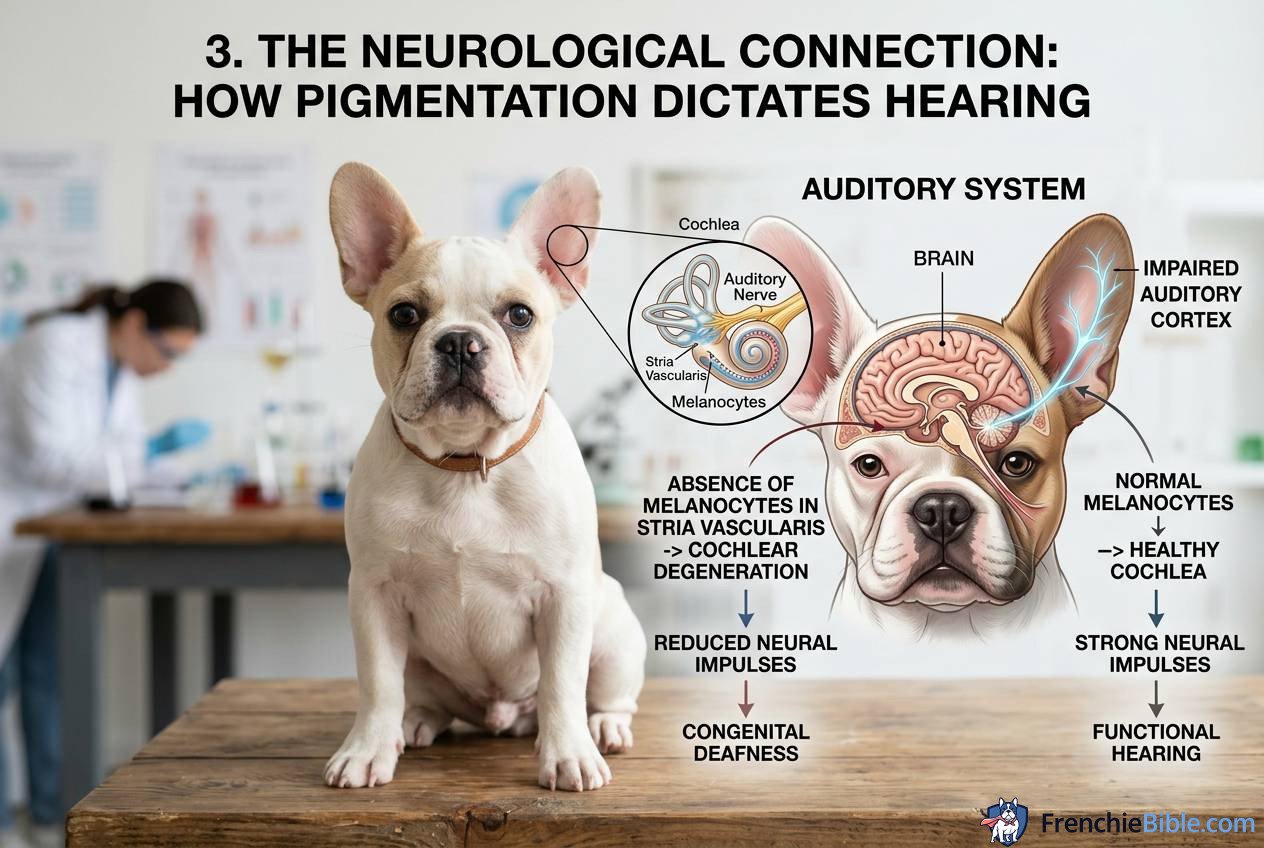
Understanding the genetic failure of melanocyte migration is the key to unlocking the mystery of white-coat deafness. Why does missing pigment in the fur result in a non-functioning ear? The answer lies in the microscopic anatomy of the inner ear.
3.1 Anatomy of the Canine Ear: A Microscopic View
The canine ear is divided into three sections:
1. The Outer Ear: The visible pinna (the bat ear) and the ear canal down to the eardrum.
2. The Middle Ear: An air-filled chamber containing three tiny bones (ossicles) that transmit vibrations from the eardrum.
3. The Inner Ear: Deep within the skull, this contains the vestibular system (for balance) and the cochlea (for hearing).
The cochlea is a snail-shell-shaped, fluid-filled organ. Inside the cochlea sits the Organ of Corti, which houses thousands of microscopic sensory “hair cells.” When sound vibrations enter the cochlea, the fluid moves, bending the hair cells. This bending triggers an electrical signal that travels up the auditory nerve to the brain.
3.2 The Stria Vascularis: The Battery of the Ear
For the hair cells to fire that electrical signal, they require a highly specific chemical environment. The fluid bathing the tops of the hair cells is called endolymph, and it is exceptionally rich in potassium. This high potassium concentration creates an “endocochlear potential”—essentially an electrical battery charge of about +80 millivolts.
This battery is constantly maintained and recharged by a specialized strip of tissue on the outer wall of the cochlear duct called the stria vascularis.
3.3 The Crucial Role of Melanocytes in the Cochlea
Here is the critical link: The stria vascularis is densely populated with melanocytes.
In the inner ear, melanocytes are not there to provide color. They play an absolutely vital structural and physiological role. They are integral to the potassium-recycling mechanism that pumps potassium back into the endolymph to maintain the +80mV battery charge. Without melanocytes, the stria vascularis cannot function.
3.4 The Pathogenesis of Congenital Sensorineural Deafness
When a French Bulldog inherits the extreme piebald genetic makeup, the migration of neural crest cells is severely impaired. Just as the melanocytes fail to reach the skin of the torso, they also frequently fail to reach the stria vascularis deep inside the skull.
If a puppy is born without melanocytes in the inner ear, a catastrophic chain of events unfolds:
1. Birth to 2 weeks: The puppy is born deaf (as all puppies are, since ear canals are closed), but the cochlea is technically still intact.
2. 2 to 3 weeks: Without melanocytes, the stria vascularis fails to generate the endolymphatic potential. It quickly begins to atrophy and shrink.
3. 3 to 4 weeks: Because the “battery” is dead, the delicate sensory hair cells in the Organ of Corti are deprived of their essential chemical environment. They undergo apoptosis (programmed cell death).
4. 4 weeks and beyond: The hair cells are completely destroyed. Because mammals cannot regenerate inner ear hair cells, the puppy is now permanently, irreversibly deaf.
This is known as congenital sensorineural deafness. It is a direct, physiological consequence of breeding for extreme lack of pigment.
4. Recognizing Congenital Sensorineural Deafness in Frenchies
Deafness in a tiny, squirming litter of French Bulldog puppies is notoriously difficult to identify through casual observation. as a French Bulldog expert and breeder, I rely on specific clinical timelines and detailed breeder histories to flag potential issues.
4.1 Unilateral vs. Bilateral Deafness Explained
Because the migration of melanocytes is a somewhat random, chaotic process in extreme piebalds, the ears can be affected independently.
– Bilateral Deafness: Melanocytes failed to reach both the left and right inner ears. The dog is completely deaf.
– Unilateral Deafness: Melanocytes successfully reached one ear, but failed to reach the other. The dog is completely deaf in one ear, but has normal hearing in the other.
Unilateral deafness is the hidden assassin in breeding programs. A unilaterally deaf dog behaves almost exactly like a fully hearing dog. They respond to commands, wake up to sounds, and live entirely normal lives. Their only deficit is directional hearing—they may have trouble locating exactly where a sound is coming from. Because they appear perfectly normal, breeders often unknowingly breed them, thereby passing the strong genetic propensity for deafness to the next generation.
4.2 The Timeline of Hearing Loss
French Bulldog puppies are born altricial, meaning they are highly undeveloped. Their ear canals are sealed shut at birth and do not begin to open until 10 to 14 days of age. True hearing (neurological processing of sound) develops around 3 to 4 weeks of age.
Therefore, a puppy with the extreme piebald deafness gene actually possesses normal cochlear structures at birth. The destruction of the hair cells occurs precisely around the time the ear canals are opening. By 4 to 5 weeks of age, the deafness is permanent and absolute.
4.3 Clinical Signs and Symptoms in Puppies
While bilateral deafness is obvious to a professional, breeders and new owners might miss the subtle signs. Symptoms to watch for include:
– Deep Sleeping: The puppy does not wake up when littermates start crying, when the breeder drops a metal bowl, or when the vacuum is running nearby. They only wake up when physically touched or jostled by a sibling.
– Aggressive Play/Biting: Puppies learn bite inhibition by hearing their littermates yelp when bitten too hard. A deaf puppy cannot hear the yelps and may routinely bite siblings hard enough to draw blood.
– Visual Dependency: The deaf puppy becomes hyper-vigilant with its eyes. It watches the littermates to know when the mother is returning to nurse or when it is time to play. If the litter runs to the door, the deaf puppy follows the pack, not the sound.
– Vocalization Anomalies: Deaf puppies often have louder, sharper, or more bizarre-sounding barks and whines because they cannot hear themselves to regulate their volume.
– The Startle Reflex: When touched from behind while awake, the puppy may flinch dramatically, as they had no auditory warning of your approach.
5. The Gold Standard: Brainstem Auditory Evoked Response (BAER) Testing
Given the impossibility of visually diagnosing unilateral deafness, and the unreliability of home testing for bilateral deafness, the veterinary community relies on a highly sophisticated neurological exam: the BAER test.
5.1 What Exactly is a BAER Test?
The Brainstem Auditory Evoked Response (BAER) test—sometimes called Brainstem Auditory Evoked Potential (BAEP)—is an electrodiagnostic test. It is fundamentally similar to an electrocardiogram (EKG) for the heart or an electroencephalogram (EEG) for the brain, but it specifically measures the electrical activity within the auditory pathways of the brain.
When a sound enters a healthy ear, it triggers an electrical impulse that travels from the cochlea, up the auditory nerve, and through various relay stations in the brainstem before reaching the auditory cortex. The BAER test uses computer software and highly sensitive electrodes to detect, amplify, and record this microscopic electrical journey in real-time.
5.2 Why Behavioral Testing is Inadequate
I frequently hear from breeders: “I clapped my hands behind his head and he turned around, so he can hear!”
This is a dangerous assumption. Behavioral testing is fundamentally flawed for several reasons:
1. Vibration: Clapping hands, stomping feet, or dropping keys creates sound waves that physically move the air and vibrate the floor. A deaf Frenchie has highly attuned tactile senses and will feel the air pressure change or the floor vibrate, turning their head in response.
2. Visual Cues: Dogs possess incredible peripheral vision. A shadow or a slight movement in the corner of their eye will cause them to turn.
3. Unilateral Masking: If you clap behind a unilaterally deaf dog, their one good ear hears it perfectly. You will never know the other ear is completely dead.
Only a BAER test can isolate each ear individually and bypass the dog’s behavioral reactions entirely, measuring the raw physiological data.
5.3 The Ideal Age for BAER Testing
Because the degeneration of the inner ear is complete by 4 weeks of age, puppies can technically be tested any time after that. However, the optimal window for testing a French Bulldog litter is between 6 and 8 weeks of age.
– At this age, the ear canals are fully open, and the neurological pathways are mature enough to yield clear, undeniable waveforms.
– Crucially, this timeline allows breeders to test the entire litter before the puppies are dispersed to their new homes, ensuring that buyers are fully informed of the puppy’s hearing status.
5.4 Finding a Certified Tester
BAER testing requires specialized, expensive equipment (often costing upwards of $15,000) and specific training to administer and interpret. It is not typically found in a standard primary care veterinary clinic.
To find a tester, owners and breeders must seek out experienced neurologists, university veterinary teaching hospitals, or specialized mobile BAER clinics. The Orthopedic Foundation for Animals (OFA) maintains a directory of certified BAER testing facilities across the country.
6. A Step-by-Step Guide: What to Expect During the BAER Appointment
For a first-time owner or breeder, taking a puppy in for neurological testing can sound intimidating. as a French Bulldog expert and breeder who has overseen countless tests, I can assure you that the process is quick, entirely safe, and virtually painless for the dog.
6.1 Pre-Appointment Preparation
Very little preparation is required. The puppies do not need to be fasted unless the neurologist anticipates the need for heavy sedation (which is rare). In fact, I recommend keeping the puppies active and playing prior to the appointment so that they are naturally sleepy when it is time to test. A sleeping puppy produces the cleanest, most artifact-free BAER tracings.
6.2 The Testing Environment and Equipment
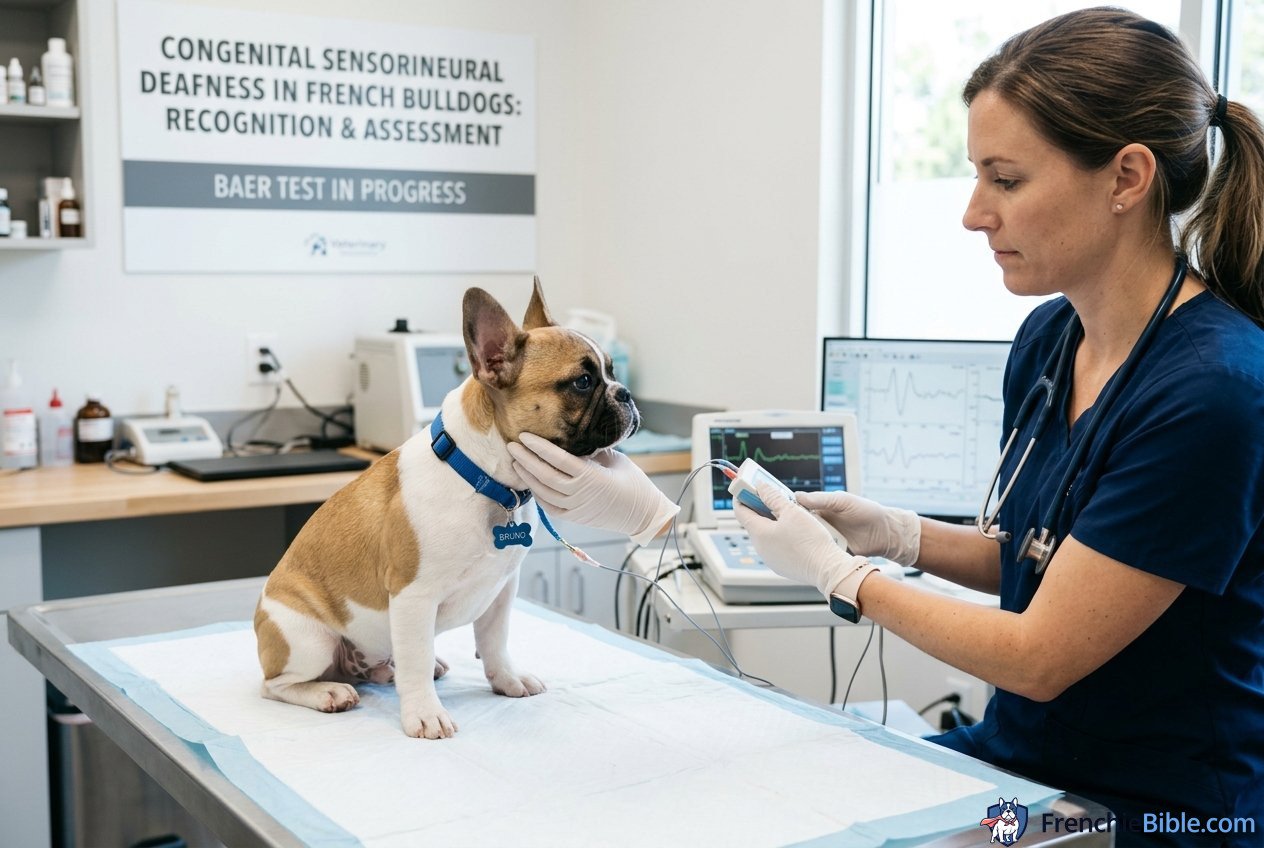
The test is usually conducted in a quiet room within the clinic. The equipment consists of a specialized computer interface, an amplifier box, tiny needle electrodes connected to thin wires, and a set of foam insert earphones (similar to earplugs).
6.3 The Procedure: From Start to Finish
- Positioning: The puppy is usually held gently in the owner’s lap or placed on a padded, warmed table. For young, tired puppies, no sedation is needed. If an adult Frenchie is being tested and is highly anxious or panting heavily (muscle movement creates electrical “noise” that obscures the brainwaves), a mild, reversible, short-acting sedative may be administered.
- Electrode Placement: The veterinarian inserts three to four extremely fine, sterile, stainless-steel needle electrodes just under the skin.
- One is placed at the vertex (the very top center of the head).
- One is placed just in front of or behind the left ear.
- One is placed just in front of or behind the right ear.
- A ground electrode is placed on the neck or between the shoulder blades.
Note: These needles are akin to acupuncture needles. Most puppies barely register their insertion and often sleep right through it. - Earphone Insertion: A small foam earphone is gently placed into one ear canal.
- The Stimulus: The computer generates a series of sharp “click” sounds. The clicks are broad-frequency and usually delivered at an intensity of 70 to 105 decibels. To ensure the untested ear isn’t accidentally picking up the sound via bone conduction through the skull, a “masking noise” (static) is sometimes played in the opposite ear.
- Recording: The machine delivers hundreds of clicks in a matter of seconds. The computer averages the brain’s electrical responses to these clicks, filtering out random brain activity to reveal the specific auditory pathway signal.
- Repeat: The process is repeated for the other ear. The entire test takes less than 10-15 minutes per puppy.
6.4 Post-Test Care and Recovery
Once the tracings are recorded, the needle electrodes and earphones are removed. There is no bleeding, no pain, and no recovery time required unless a sedative was used. The puppy is immediately ready to return to playing or sleeping.
7. Decoding the Results: Interpreting the BAER Tracing
The results of a BAER test are immediate. The software generates a graph with time (in milliseconds) on the horizontal axis and electrical amplitude (in microvolts) on the vertical axis.
7.1 The Anatomy of a Normal Waveform
A healthy, hearing ear will produce a tracing that looks like a miniature mountain range. In dogs, a normal BAER tracing displays five distinct, repeatable positive peaks occurring within the first 6 to 8 milliseconds after the click.
These peaks represent the sound signal traveling through specific anatomical waypoints:
– Wave I: Generated by the cochlear nerve (the very beginning of the journey).
– Wave II: Generated by the cochlear nucleus in the lower brainstem.
– Wave III: Generated by the superior olivary complex.
– Wave IV: Generated by the lateral lemniscus.
– Wave V: Generated by the inferior colliculus in the midbrain.
If the veterinarian sees these clear, reproducible waves at the correct latencies, the ear has normal hearing.
7.2 Identifying a Deaf Tracing
The tracing for a deaf ear is devastatingly unmistakable. Instead of a series of peaks, the graph shows a relatively flat line. There are no distinct waves because the cochlea is dead; no electrical signal is being generated or sent to the brain.
Occasionally, there may be tiny, random undulations on the line, but these are electrical artifacts (from muscle twitches or heartbeats), not the synchronized firing of auditory neurons. The absence of Wave I confirms that the sensorineural apparatus is non-functional.
7.3 Unilateral Results: The Hidden Carrier
When viewing the printout for a unilaterally deaf French Bulldog, you will see two starkly different graphs. The left ear tracing may show the beautiful, five-peaked mountain range, while the right ear tracing is a completely flat line. This confirms the dog is perfectly deaf in the right ear and perfectly hearing in the left. This objective data is exactly why the BAER test is indispensable.
8. Ethical Breeding: The Vet and Breeder Perspective
as a French Bulldog expert and breeder, I view the breeding of pure white and extreme piebald French Bulldogs as a practice that demands the highest level of ethical scrutiny. The link between the S locus and deafness is not a hypothesis; it is an established biological fact.
8.1 The Moral Imperative of Testing
It is my professional stance that every single white, extreme piebald, or heavily white-marked French Bulldog must be BAER tested before being placed in a home or used in a breeding program. Ignorance is no longer an excuse. Breeding untested dogs with high-white phenotypes is reckless and compromises the genetic integrity of the breed.
8.2 Managing a Breeding Program with Extreme Piebalds
If a breeder chooses to work with piebald genetics, they must implement strict protocols:
– Never breed two extreme piebalds together. Mating a white Frenchie to another white Frenchie virtually guarantees a high incidence of deafness in the litter.
– Utilize Solid Outcrosses. An extreme piebald should ideally be bred to a solid dog (S/S) with little to no white. The resulting puppies will carry the piebald gene (S/s^p) but will typically be solid-colored or have minimal white (Irish spotting), drastically reducing the risk of melanocyte migration failure to the inner ear.
– Spay and Neuter Unilaterally Deaf Dogs. While a unilaterally deaf Frenchie makes an outstanding, completely functional family pet, their genetic makeup is deeply flawed regarding pigmentation. Breeding a unilaterally deaf dog significantly increases the statistical probability of producing bilaterally deaf offspring. They must be removed from the gene pool.
8.3 The OFA Database and Transparency
Responsible breeders do not hide health results; they champion them. Once a Frenchie has been BAER tested, the results should be submitted to the Orthopedic Foundation for Animals (OFA). The OFA issues a certificate and registers the dog in a public, searchable health database.
– A “Normal” rating means bilateral hearing.
– A “Unilateral” or “Bilateral Deafness” rating is permanently recorded.
Buyers should always demand to see the OFA BAER certificates for both the sire and the dam before purchasing a white French Bulldog puppy.
8.4 The Dilemma: What to do with a Deaf Puppy?
If a breeder produces a bilaterally deaf puppy, ethical decisions must be made. Deaf puppies absolutely deserve life and love. They should never be euthanized simply for being deaf. However, they require homes that are educated and prepared for the unique challenges of raising a deaf dog. These puppies are usually sold on strict spay/neuter contracts at a reduced price, or placed through specialized breed rescues.
9. Comprehensive Care and Training for a Deaf French Bulldog
Receiving a diagnosis of bilateral deafness for your beloved white Frenchie can feel overwhelming. Many owners immediately panic, assuming their dog will be impossible to train, aggressive, or miserable.
Let me assure you as a French Bulldog expert and breeder: Deaf dogs do not know they are deaf. They do not mourn the loss of music or the sound of your voice. They experience the world profoundly through their noses, their eyes, and their sense of touch. With the right training approach, a deaf Frenchie can achieve advanced obedience, participate in agility, and be a flawless companion.
9.1 Shifting the Communication Paradigm
Training a deaf dog requires the owner to completely abandon verbal communication. Yelling “Sit” louder will not work. You must transition entirely to visual and tactile cues.
9.2 Hand Signals and Visual Markers
Dogs are inherently masters of reading body language. Deaf dogs, in particular, become intensely focused on their owners’ hands and faces.
– Standardizing Signals: You can use standard American Sign Language (ASL) or invent your own clear, distinct hand signals. You will need signs for “Watch Me,” “Sit,” “Down,” “Stay,” “Come,” “No,” and “Good.”
– The Visual Clicker: In traditional training, a “clicker” marks the exact moment a dog does the right behavior. For a deaf dog, substitute the click with a sharp visual marker. A rapid “thumbs up,” a distinct flash of an open hand, or a quick flick of a small flashlight can serve as the “Yes!” marker, immediately followed by a high-value treat.
9.3 Tactile Training and Vibration Collars
How do you get your dog’s attention when they are looking away?
– Floor Vibrations: Stomping heavily on a hardwood floor sends vibrations they can easily feel.
– The Vibration Collar: This is a crucial tool, but it must be used correctly. A vibration-only collar (absolutely NEVER a shock collar) is placed on the dog. You condition the dog to understand that a gentle buzz on the neck means “Look at Mom/Dad for a treat.” It becomes a long-distance tap on the shoulder. This is essential for off-leash recall in secure areas.
9.4 Environmental Management and Safety
The greatest threat to a deaf Frenchie is the environment. They cannot hear a speeding car, a growling stray dog, or a bicyclist coming up behind them.
– The Leash Rule: A deaf dog must never be allowed off-leash in an unfenced, public area. Period.
– Visual Warning Gear: Outfit the dog with a harness, leash, or bandana that clearly says “DEAF DOG.” This alerts strangers not to approach from behind or let their dogs rush up unannounced.
– Bells: Put a small bell on your deaf Frenchie’s collar. Since you can’t call them to find them in the house or yard, the bell allows you to track their movements.
9.5 Desensitization to Startle Reflexes
Because they cannot hear you approaching, touching a sleeping deaf dog can trigger a massive startle reflex, which in a state of panic, can result in a bite.
– The Wake-Up Game: From puppyhood, practice waking the dog gently. Place a smelly treat right under their nose so they wake up to a positive scent. Alternatively, gently tap the cushion they are sleeping on so they feel the vibration before you touch their body. Over time, condition them that being woken up is a positive experience.
9.6 Quality of Life and Psychological Well-being
Deaf Frenchies thrive on structure and engagement. Because they lack auditory input, they benefit massively from olfactory and visual enrichment. Use snuffle mats, puzzle toys, and hide-and-seek games to exhaust their minds. A mentally enriched deaf dog is a tired, happy dog.
10. Beyond Hearing: Other Health Considerations for White Frenchies
While deafness is the primary concern tied to the extreme piebald gene, a lack of pigment can affect the body in other ways that owners must actively manage.
10.1 Dermatological Sensitivities
Melanin acts as a natural sunscreen. Pure white French Bulldogs often have pink skin underneath their white fur, particularly on the belly, nose, and the tips of the ears.
– Sunburn and Skin Cancer: White Frenchies are highly susceptible to solar dermatitis (sunburn) and squamous cell carcinoma (skin cancer). Owners must apply pet-safe sunscreen to the nose and ear tips when the dog is outdoors during peak UV hours, or use UV-protective sun shirts.
10.2 Ocular Abnormalities
While most extreme piebald Frenchies have dark eyes, some may present with blue eyes or “wall eyes” (one blue, one brown). A lack of pigment in the iris can make the dog photophobic (sensitive to bright light), causing them to squint heavily in the sun. In rare cases, the genetic defect causing the white coat can also cause microphthalmia (abnormally small eyes) and associated vision deficits.
10.3 Allergies and Immune Responses
There is widespread anecdotal belief in the veterinary community that white dogs (of many breeds, including Frenchies, Bull Terriers, and Boxers) are more prone to atopic dermatitis (environmental allergies) and food allergies. While the exact genetic linkage is still being researched, owners of white French Bulldogs should be hyper-vigilant regarding their dog’s diet and skin health, addressing itching, redness, or paw-licking immediately with their veterinarian.
11. Frequently Asked Questions (FAQ)
Can a white Frenchie’s hearing improve or worsen over time?
No. Congenital sensorineural deafness caused by pigment lack is absolute and permanent by 4 weeks of age. The hair cells in the cochlea are dead and cannot regenerate. A dog that is BAER tested deaf at 8 weeks will be deaf for its entire life. Conversely, a dog that tests with normal hearing at 8 weeks will not lose its hearing later in life due to this specific genetic cause (though they can lose hearing in old age due to standard geriatric nerve degeneration).
How much does a BAER test cost?
The cost varies depending on your geographical location and the specific veterinary neurologist. Generally, a single BAER test costs between $75 and $200. Many clinics offer significantly discounted “litter rates” (e.g., $40-$60 per puppy) to encourage breeders to test the entire litter at once.
Are only pure white French Bulldogs prone to deafness?
No. While pure white and extreme piebalds are at the highest risk, any French Bulldog with a significant amount of white on the head and ears is at risk. If the white spotting happens to cover the ears, the melanocytes may have failed to migrate to the inner ear as well. Additionally, the “Merle” pattern (which is highly controversial and not a recognized standard color in the breed) causes pigment dilution through a entirely different genetic mechanism but carries an equally high, if not higher, risk of deafness and blindness, especially in “double merles.”
How can I tell if my white Frenchie is unilaterally deaf at home?
You almost certainly cannot. Unilaterally deaf dogs compensate incredibly well. The only subtle sign might be a difficulty in sound localization; if you call them from across a park, they might spin in a circle looking for you before finally locking onto your visual location, because they cannot triangulate the sound source with only one ear. The BAER test is the only definitive diagnostic tool.
Will a deaf French Bulldog be aggressive?
Deafness is a sensory deficit, not a personality trait. A deaf Frenchie is not inherently aggressive. However, if a deaf dog is constantly startled, stepped on, or aggressively woken up, they can develop fear-based reactivity. Proper socialization, the “wake-up game,” and using positive reinforcement training are critical to raising a confident, friendly deaf dog.
Is the BAER test painful for my puppy?
Not at all. The needle electrodes are incredibly thin (subdermal needles), and most puppies sleep right through their insertion. The click sounds are loud but brief, and the entire test is over in minutes. It is a highly humane, low-stress diagnostic procedure.
Can a unilaterally deaf dog live a normal life?
Absolutely. Unilaterally deaf dogs make phenomenal pets. They require virtually zero lifestyle modifications compared to a fully hearing dog. However, as previously stressed, they must never be bred.
Do deaf dogs bark?
Yes, they do! Barking is an instinctual behavior, not a learned one. However, because they cannot hear their own voices, deaf dogs often have barks that sound a bit unusual—they may be louder, more monotone, or have a strange pitch compared to hearing dogs.
12. Conclusion: Embracing the White Frenchie with Open Eyes
The pure white French Bulldog is a masterpiece of canine aesthetics, commanding attention and admiration wherever it goes. However, as we have thoroughly explored, the beauty of that pristine coat is inextricably tied to a fragile genetic and neurological balance. The failure of melanocytes to migrate during embryonic development is not just a mechanism for creating white fur; it is a direct pathway to irreversible sensorineural deafness.
as a French Bulldog expert and breeder and breeding advocate, my goal is not to discourage the love for white French Bulldogs, but to elevate the standards by which they are bred and raised. Ignorance of the S locus and its consequences is no longer acceptable in the modern breeding community. The BAER test provides us with a clear, objective, and painless window into the neurological health of these animals. It is the definitive tool that separates ethical, health-focused breeding from reckless aesthetic production.
For breeders, mandatory BAER testing and transparent OFA reporting must become the unyielding standard. For prospective owners, demanding to see BAER certificates before purchasing a white puppy is your right and your responsibility.
If you do find yourself sharing your life with a deaf French Bulldog, embrace the journey. While it requires you to adapt your communication and heighten your vigilance, the reward is a bond built on profound trust, visual connection, and tactile affection. A deaf Frenchie may not hear your voice, but with education, patience, and love, they will undoubtedly feel every ounce of your devotion.
Disclaimer: We are not veterinarians and do not hold veterinary medical licenses. The information provided in this article is based on years of breeding and daily care experience and is for educational purposes only. It should not replace professional veterinary advice. Always consult with a licensed veterinarian if you have concerns about your French Bulldog’s health or before starting any new treatment.