Disclaimer: The information, guidance, and training techniques provided in this article are for educational and informational purposes only. They are not intended as a substitute for professional veterinary advice, diagnosis, or behavioral treatment. Every dog is unique, and French Bulldogs have specific anatomical and health considerations. Always seek the advice of your veterinarian, a certified canine behaviorist, or a professional dog trainer with any questions you may have regarding your French Bulldog’s health, physical capabilities, or training regimen.
Introduction: The Unique Challenge of the French Bulldog
Teaching a dog the “Down” command is often considered one of the fundamental pillars of basic obedience. For many breeds, it is a natural progression from the “Sit” command. However, if you are the proud parent of a French Bulldog, you may have quickly realized that standard training manual instructions do not always apply. As An Experienced Breedererinary specialist and seasoned breeder dedicated to the French Bulldog breed, I often hear from frustrated owners who feel like their Frenchie is either being stubbornly defiant or simply lacks the comprehension to perform the “Down” command.
Related Reading: Health & Diet | Frenchie Puppy Guide
The truth is far more complex and fundamentally rooted in the breed’s unique physical anatomy and psychological profile. French Bulldogs are chondrodystrophic dogs, meaning they have a specific type of dwarfism that results in short limbs compared to their body size. Coupled with their heavy, broad chests, compact spines, and brachycephalic (flat-faced) skull structure, the simple mechanical act of lying down on command is physically different and sometimes more challenging for them than it is for a long-legged breed like a Golden Retriever or a Border Collie.
In this comprehensive guide, we will delve deep into the biomechanics of the French Bulldog, exploring why the traditional “lure and drop” method often fails. More importantly, we will outline highly specialized, positive-reinforcement-based techniques tailored specifically for short-legged, front-heavy breeds. By understanding their physical limitations and leveraging their distinct motivations, you can successfully teach your Frenchie this crucial command, ensuring their safety, enhancing your bond, and building a foundation for advanced obedience and behavioral management.
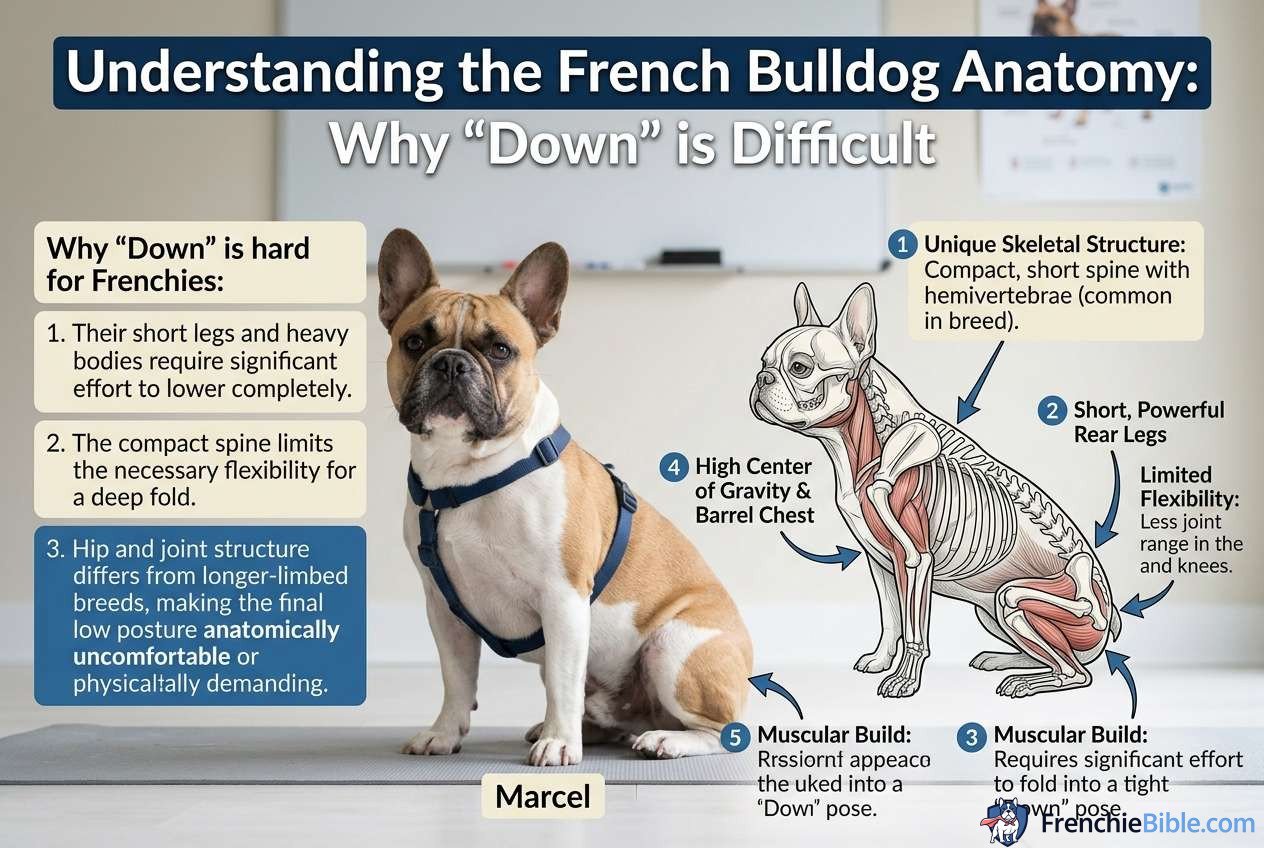
Understanding the French Bulldog Anatomy: Why “Down” is Difficult
Before we can effectively train a French Bulldog, we must look at the world—and the training process—through the lens of their unique physiology. The French Bulldog’s body is a marvel of compact engineering, but it comes with distinct biomechanical limitations that directly impact how they move and learn.
The Front-Heavy Physique and Center of Gravity
Unlike moderately proportioned dogs, French Bulldogs carry a disproportionate amount of their weight in their front chest, shoulders, and head. This front-heavy build significantly alters their center of gravity. When a standard breed is lured into a “down” position from a “sit,” they naturally slide their front paws forward while their hindquarters remain stationary, smoothly lowering their center of mass.
For a Frenchie, extending those short front legs forward while bearing the massive weight of their chest requires considerable effort and balance. They often feel unstable when asked to stretch forward. As a result, when you use a traditional training lure (moving a treat from their nose down to the floor and pulling it outward), a Frenchie will often just pop their rear end up into a standing position to reach the treat, rather than lowering their chest. It is not defiance; it is basic physics. To them, standing up and leaning over is anatomically easier than sliding their short, heavily-loaded front legs outward.
Spinal Health and Joint Considerations
With my background in French Bulldog breeding, I must emphasize the critical importance of spinal health in French Bulldogs. They are predisposed to Intervertebral Disc Disease (IVDD) and may have congenital spinal anomalies like hemivertebrae (butterfly vertebrae). The mechanics of going into a “down” position involve spinal flexion and extension. If a Frenchie has underlying back discomfort, the act of stretching into a down might be uncomfortable or even painful.
Furthermore, their short, sometimes bowed front legs and the potential for patellar luxation (slipping kneecaps) in the rear legs mean that the joints are working under different stressors. A training method that forces unnatural pressure on these joints will be met with resistance. It is paramount that any training technique we use encourages a natural, comfortable transition into the lying position without putting undue stress on the spine or joints.
Brachycephalic Airway Syndrome (BAS)
French Bulldogs are brachycephalic, meaning they have shortened muzzles and flattened faces. This anatomical trait often leads to Brachycephalic Airway Syndrome, which affects their breathing efficiency. When a Frenchie is forced into a highly active, repetitive training session, they can easily become oxygen-deprived or overheated. The “down” position itself, if the dog is panting heavily, might compress the chest slightly depending on how they lie. Training sessions must be kept short, highly positive, and conducted in a cool, well-ventilated environment to ensure the dog is not experiencing respiratory distress, which would immediately derail any learning process.
The Psychological Profile of the French Bulldog
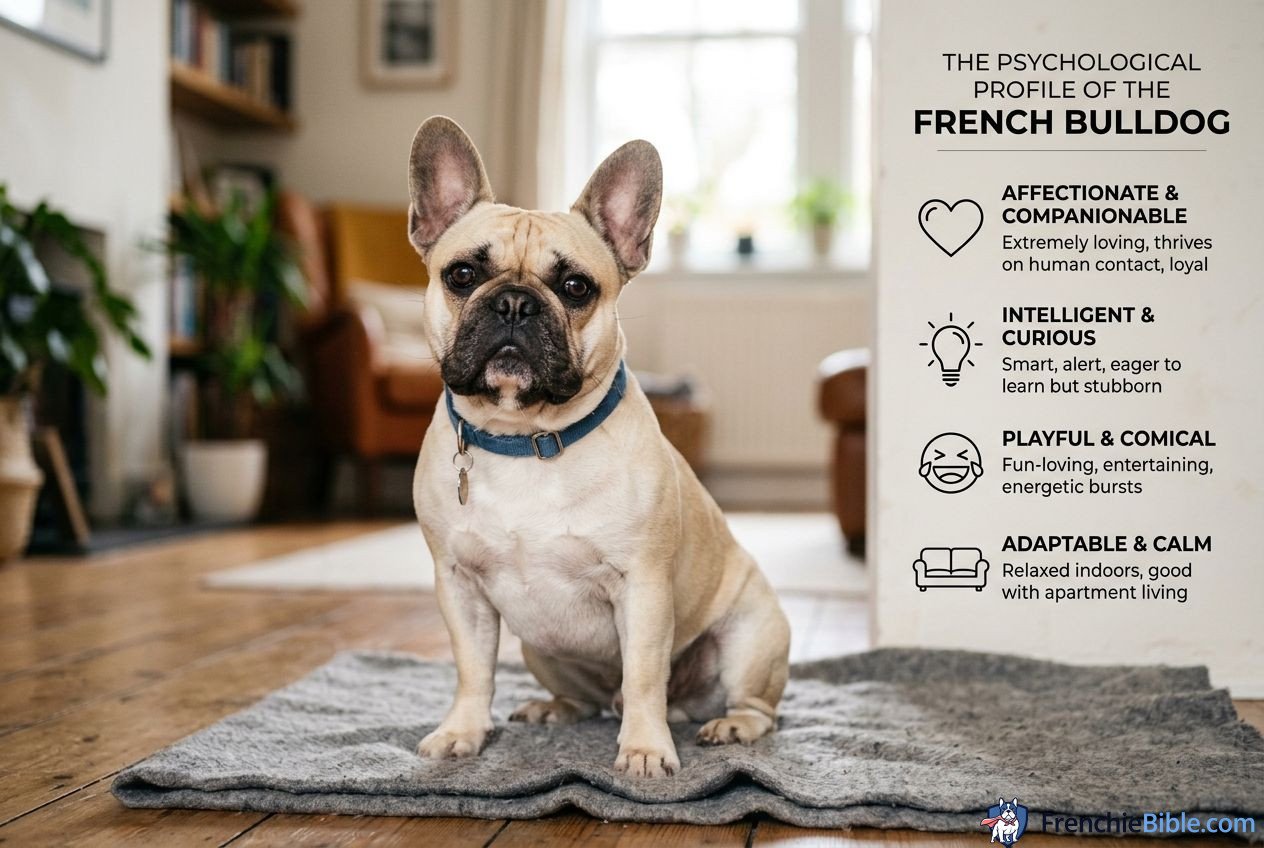
Beyond their physical structure, understanding the Frenchie mindset is crucial for training success. They are widely beloved for their affectionate, comical, and highly adaptable personalities, but they are also infamous for their stubborn streaks.
The “What’s In It For Me?” Mentality
French Bulldogs are incredibly intelligent, but their intelligence does not always manifest as eager-to-please obedience (unlike working breeds such as the German Shepherd). They are independent thinkers. When presented with a command, a Frenchie often evaluates the situation to determine if the reward is worth the effort—especially if the effort involves a physically awkward movement like lying down.
Therefore, standard kibble might not cut it. To overcome their physical reluctance, the motivational currency must be extraordinarily high. We need to use high-value, highly aromatic treats that make the physical effort of moving into a “down” position overwhelmingly worthwhile.
Sensitivity to Pressure
Despite their robust, muscular appearance, Frenchies are emotionally sensitive dogs. They do not respond well to harsh corrections, physical manipulation (such as pushing on their hindquarters to force a sit or down), or signs of frustration from their owner. If a Frenchie feels pressured or senses your irritation, they are highly likely to shut down, disengage, and refuse to participate. Training must remain a fun, positive, and low-pressure game.
Preparation: Setting the Stage for Success
Before initiating the first training session, proper preparation is essential. Setting the environment, timing, and tools correctly will drastically reduce the time it takes for your short-legged companion to master the “Down” command.

1. Choosing the Right Environment
Start in a quiet, familiar room with absolutely zero distractions. No other pets, no children running around, no loud televisions, and no outdoor stimuli. Because the command requires concentration and physical maneuvering, you want your dog’s undivided attention.
Crucially, the surface you train on matters immensely. Never train a Frenchie to “down” on a slippery floor like hardwood, tile, or linoleum. Their short legs offer little traction, and slipping will make them feel insecure and unwilling to lower themselves. Always use a carpeted room, a large yoga mat, or a non-slip rug. The surface must provide grip and a soft landing pad for their heavy chests.
2. High-Value Reinforcement
As mentioned, the standard treats won’t work for a behavior they find physically taxing. You need “jackpot” treats. These should be soft, highly aromatic, and cut into pea-sized pieces to prevent overfeeding and choking. Excellent options include:
- Boiled, unseasoned chicken breast.
- Small cubes of low-fat cheese (if your dog tolerates dairy).
- Freeze-dried liver or salmon.
- A smear of dog-safe peanut butter (xylitol-free) on a long spoon.
Have a large quantity ready, as the initial stages of training require a high rate of reinforcement.
3. Timing and Session Length
French Bulldogs tire easily, both physically and mentally. Keep training sessions incredibly short—no more than 3 to 5 minutes at a time. Aim for three to four of these micro-sessions per day rather than one long 20-minute marathon.
Train before meals when the dog is slightly hungry and highly motivated by food. Never train immediately after a heavy meal or during the hottest parts of the day, as brachycephalic dogs are highly susceptible to heat exhaustion.
4. Establishing a Marker
Before teaching “Down,” your dog should understand a “marker.” This can be a mechanical clicker or a consistent verbal marker like “Yes!” or “Good!”. The marker serves to pinpoint the exact millisecond the dog performs the correct behavior, bridging the gap between the action and the delivery of the food reward.
Step-by-Step Training Methods for French Bulldogs
Because the traditional “Sit, then Lure Down” method frequently fails with short-legged, front-heavy breeds, we must employ alternative, specialized techniques. Here are the three most effective methods for teaching a French Bulldog to lie down.
Method 1: The “Under the Bridge” Technique (Highly Recommended for Short Legs)
This is unequivocally the most successful method for breeds like French Bulldogs, Corgis, and Dachshunds. It physically prevents the dog from popping up into a stand and naturally encourages their body mechanics to slide into a down position.
The Setup:
You will need to create a “bridge” that is just low enough that the Frenchie must lower their body to pass under it, but high enough that they don’t feel trapped. The easiest bridge is your own leg.
1. Sit on the floor (on your non-slip surface) with your knees bent and your feet flat on the floor, creating an arch or “bridge” with your legs.
2. Have your Frenchie on one side of your legs and your high-value treats on the other side.
The Execution:
1. The Lure: Hold a highly aromatic treat right in front of your Frenchie’s nose. Let them sniff it and get engaged.
2. The Guide: Slowly move your hand containing the treat under your bent leg (the bridge). Keep your hand low to the ground.
3. The Movement: Encourage your dog to follow the treat under your leg. Because the “roof” of the bridge prevents them from simply standing up to reach the treat, they will have to lower their head, drop their shoulders, and eventually drop their elbows and belly to the floor to crawl under and get the food.
4. The Mark and Reward: The precise millisecond your dog’s elbows and chest touch the floor, confidently say your marker word (“Yes!”) and immediately release the treat to them.
5. The Reset: Toss another treat a few feet away to “reset” the dog, getting them to stand up and come back for another repetition.
Refining the Bridge Method:
As your dog gets comfortable dropping into the down position under your leg, you need to begin fading the bridge.
- Phase 1: Lower your leg slightly so they have to commit more fully to the down.
- Phase 2: Instead of your leg, use your arm hovering above the ground.
- Phase 3: Remove the physical barrier entirely. Simply use your hand to lure them straight down to the floor in the same motion you used when leading them under the bridge.
Veterinary Note: Ensure the “bridge” is not too tight. If the dog has any spinal issues, forcing them to squirm tightly under a low object can cause pain. The bridge should act as a gentle physical boundary, not a tight squeeze.
Method 2: Capturing the Natural Behavior
If your Frenchie is highly sensitive to luring or tends to get frustrated quickly, “capturing” is a brilliant, entirely pressure-free method. It requires patience and keen observation but yields a very strong, organically learned behavior.
The Concept:
Dogs naturally lie down multiple times a day. By capturing this natural behavior, you are simply putting a name to an action the dog has already chosen to do on their own.
The Execution:
1. The Stakeout: Arm yourself with a pocket full of high-value treats and your clicker (or verbal marker). Go about your business in the house while keeping a subtle eye on your Frenchie.
2. The Wait: Wait for your dog to naturally decide to lie down. This might happen when they are bored, preparing to nap, or just relaxing near you.
3. The Mark: The absolute second their elbows and chest hit the floor, mark it enthusiastically (“Yes!” or click).
4. The Jackpot: Immediately toss a high-value treat to them. It is important to toss the treat slightly away from them so they have to stand up to get it. This “resets” their position, allowing them the opportunity to perform the behavior again.
5. The Repetition: Wait for them to lie down again. Repeat the mark and reward process. Dogs are incredibly associative learners. Within a few repetitions, you will see the “lightbulb” moment. Your Frenchie will realize, “Wait, every time my belly touches the floor, a piece of chicken falls from the sky!”
6. Adding the Cue: Once the dog is actively offering the “down” position repeatedly in hopes of triggering the reward, you can add the verbal cue. Right as they begin the downward motion, say the word “Down.” Over time, the word becomes associated with the action.
Breeder Insight: Capturing is exceptionally effective for Frenchies because it empowers them. It caters to their independent nature by allowing them to “trick” you into giving them a treat, making them much more enthusiastic participants in the training process.
Method 3: The Modified Lure and Fold (The “L-Shape” Drop)
If you must try a traditional lure from a seated position, you have to modify the trajectory of the lure to accommodate the Frenchie’s short limbs and heavy front. Pulling the treat straight out away from them will usually result in them standing up.
The Execution:
1. The Sit: Ask your Frenchie to sit on a non-slip surface.
2. The Lure: Hold the high-value treat directly in front of their nose.
3. The Drop: Move your hand straight down from their nose toward the floor, between their front paws. Do not pull outward yet. Keep the treat right between their toes. Their nose will follow the treat straight down.
4. The Fold: Once their nose is touching the floor between their paws, slowly slide the treat horizontally along the floor directly towards their chest (inward, under their chin), not outward.
5. The Mechanics: By pushing the treat slightly back towards their chest, you encourage their heavy front end to fold backwards and down, causing the elbows to drop to the floor. If you pull the treat away, they will step forward to follow it. Pushing it slightly in and down creates an anatomical necessity to drop the chest.
6. Mark and Reward: As soon as the elbows hit the floor, mark (“Yes!”) and release the treat.
Troubleshooting Common Frenchie “Down” Problems
Even with specialized techniques, French Bulldogs can present unique troubleshooting scenarios. Here is how to handle the most common roadblocks.
Problem 1: The “Sphinx” Pose vs. The “Relaxed Down”
Often, a Frenchie will drop their front elbows to the floor but keep their rear end elevated in the air, resembling the Sphinx. This is technically not a full “down,” and it’s a common physical evasion for dogs with short backs or tight hips.
Solution: Do not reward the Sphinx pose. If they freeze in this position, gently take the treat and slowly lure it slightly toward one of their shoulders. This slight sideways movement forces the dog to shift their weight, which almost always results in their hindquarters collapsing to the floor in a “frog leg” or relaxed side-down position. Once the rear drops, instantly mark and reward.
Problem 2: The “Pop-Up”
You lure the dog down, but the moment their elbows touch, they instantly spring back up like a jack-in-the-box to eat the treat, never truly settling into the position.
Solution: This is a rate-of-reinforcement issue. The dog believes the action is complete the millisecond they touch the ground. To fix this, you need to reward duration. Lure the dog down. Mark when they hit the floor, give them a treat, but keep your hand (with more treats) pinned to the floor between their paws. As long as they stay down, feed them a second treat, then a third, then a fourth, in rapid succession. Feed them multiple times for staying down. Finally, say “Okay!” or “Free!” and toss a treat away to release them. This teaches them that the “down” position is a continuous state of reward, not a momentary touch-and-go.
Problem 3: Biting or Snapping at the Lure Hand
Because Frenchies are highly food-motivated, they may get overly excited and try to bite at your fingers to get the treat, rather than following the lure smoothly.
Solution: Use a closed fist. Enclose the treat entirely in your hand so they can smell it but cannot see or bite it. Let them nibble and lick your fist. As they follow your closed fist downward and eventually hit the floor, open your hand flat to deliver the reward. Alternatively, use a long wooden spoon with a smear of peanut butter or cream cheese; this keeps teeth away from fingers and provides a continuous, slow-release lickable reward as you guide them downward.
Problem 4: Complete Refusal or Disinterest
Your Frenchie just stares at you, ignores the treat, or walks away.
Solution: Assess the situation immediately.
- Is the floor too slippery? (Move to a rug).
- Is the treat not valuable enough? (Switch from kibble to hot dogs or cheese).
- Is the dog exhausted, too hot, or having trouble breathing? (End the session immediately and let them rest).
- Have you repeated it too many times? (Keep sessions to 3 minutes max).
Never force the issue. If the dog is disengaged, take a break and evaluate your setup and motivation.
Fading the Lure and Introducing the Verbal Command
Once your French Bulldog is smoothly and consistently dropping into the “down” position using the food lure or the bridge technique, it is time to transition away from the food magnet and establish the verbal command and hand signal.
Step 1: The Empty Hand Lure
Begin by performing the exact same luring motion with your hand, but without a treat in it. Have the treats readily available in your pocket or a bait bag, but not in your luring hand.
1. Present your empty hand (fingers pinched as if holding a treat).
2. Move it to the floor just as you did before.
3. When your Frenchie follows the empty hand and lies down, enthusiastically say “Yes!” and immediately produce a high-value treat from your pocket to reward them.
This teaches the dog that they must perform the action based on the hand movement alone, and the reward will follow.
Step 2: Adding the Verbal Cue
Up until this point, we have primarily relied on body language. Now, we introduce the word.
1. Stand or sit in front of your dog.
2. Say the word clearly and calmly: “Down.”
3. Pause for exactly one second.
4. Then, give the empty-hand lure signal toward the floor.
5. When the dog lies down, mark (“Yes!”) and reward.
Crucial concept: The sequence must be Word -> Pause -> Physical Signal. Do not do them at the same time. The dog needs to hear the word, process it, and then see the signal. Over many repetitions, the dog will anticipate the hand signal after hearing the word and will simply drop into the down position upon hearing “Down” to get the reward faster.
Step 3: Formalizing the Hand Signal
The standard obedience hand signal for “Down” is a flat palm, facing downward, moving in a sweeping motion from chest height toward the floor.
Gradually modify your “empty hand lure” from a pinched finger gesture pointing at the floor to a flat palm pressing downward. As your dog begins to understand the verbal cue, you will no longer need to bend all the way to the floor; a simple downward sweep of the hand from a standing position will suffice.
Proofing the “Down”: Duration, Distance, and Distractions
A “Down” command is only truly useful if it works in real-world scenarios, not just in your quiet living room with a piece of cheese. We must “proof” the behavior against the three D’s: Duration, Distance, and Distraction.
1. Duration (The Down-Stay)
Once your Frenchie reliably lies down on command, you need to extend the time they remain there.
- Give the “Down” command.
- Instead of immediately marking and releasing, wait 2 seconds. Mark and reward while they are still down.
- Wait 5 seconds, mark, and reward.
- Wait 10 seconds.
- If they break the position and stand up, simply say “Ah-ah,” withhold the reward, and ask for the “Down” again. Make it easier the next time so they succeed.
- Always use a release word (like “Free!” or “Okay!”) to let them know when the exercise is over and they are allowed to get up.
2. Distance
Start asking for the “Down” command when you are not standing directly over them.
- Put the dog in a sit. Take half a step backward. Give the “Down” command.
- If they succeed, walk back to them to deliver the reward (do not make them come to you, or you will break the position).
- Gradually increase the distance: one step, two steps, across the room. Because Frenchies are prone to running toward you, distance training requires immense patience and very incremental steps.
3. Distractions
This is the most critical phase. A Frenchie might know “Down” perfectly in the kitchen, but completely ignore it when a squirrel runs past the window.
- Start with mild distractions: Have a family member walk quietly across the room while you ask for the “Down.” Reward heavily for compliance.
- Increase the distraction level: Bounce a ball lightly, turn on the television, or drop a piece of kibble on the floor.
- Take the training outside: Move to the backyard, then the front yard, then a quiet park. The environment is the biggest distraction. You must lower your expectations in a new environment and go back to basics (perhaps even reintroducing the lure temporarily) until they understand that “Down” means “Down” regardless of where they are.
Advanced Variations and Real-World Applications
Once your French Bulldog has mastered the foundational “Down,” you can utilize this command for advanced behavioral management, ensuring their safety and your peace of mind.
The “Go to Place” and Down
This is an invaluable skill for Frenchie owners. It teaches the dog to go to a specific mat or bed and lie down, keeping them out from underfoot during dinner or when guests arrive.
1. Place a distinct bed or mat on the floor.
2. Lure the dog onto the mat.
3. Ask for the “Down” command.
4. Reward heavily.
5. Gradually add a cue like “Place” or “Bed.” Eventually, you can point to the bed from across the room, say “Place,” and the dog will walk over and lie down automatically.
The Emergency Down (Distance Down)
Because French Bulldogs are not built for long-distance running or extreme physical exertion, an “Emergency Down” can save their life if they slip their leash near a busy road. If you yell “Come,” they might run toward you into danger. An Emergency Down freezes them in place.
This requires extensive proofing. You must practice the “Down” command while the dog is walking away from you, playing, or moderately distracted, ensuring their immediate response is to drop to the floor wherever they are.
Calming the Arousal Cycle
French Bulldogs can go from zero to one hundred in seconds—getting the “zoomies” or becoming overly excited by visitors. The “Down” command is physically incompatible with frantic pacing or jumping. By practicing the “Down” command in highly exciting situations, you teach your dog emotional regulation. Lying down lowers their heart rate and requires focus, helping to break the cycle of over-arousal.
Conclusion
Teaching a French Bulldog the “Down” command requires a profound departure from traditional dog training mentalities. It demands a deep respect for their unique anatomical limitations, their specific health risks, and their highly intelligent, slightly stubborn psychological makeup.
By abandoning the standard pulling lure and adopting tailored techniques like the “Under the Bridge” method or behavioral capturing, you remove the physical friction and frustration from the equation. Remember to keep sessions incredibly short, utilize jackpot-level high-value rewards, and maintain a positive, pressure-free environment.
Patience is not just a virtue in Frenchie training; it is an absolute necessity. With consistency, empathy for their physical structure, and a deep pocket of high-quality treats, you can successfully teach your short-legged companion this vital command, fostering a deeper bond and a lifetime of good behavior.
Frequently Asked Questions (FAQ)
1. Why does my Frenchie just stare at me and refuse to lie down, even when I have a great treat?
This is often a sign of confusion or a physical barrier. First, check your floor surface; if it is slippery, they will not lie down. Second, consider if you are using a traditional lure (pulling away from them), which physically prompts them to stand up rather than drop down. Try the “Under the Bridge” method instead. If they still stare, the training session may have gone on too long, or they may be too hot or tired. End the session on a positive note and try again later.
2. Is it safe to push my Frenchie’s back or hips down to teach the command?
Absolutely not. As An Experienced Breedererinary professional, I cannot stress this enough. French Bulldogs are prone to severe spinal issues, including IVDD and hemivertebrae. Applying physical downward pressure to their spine, hips, or hindquarters can cause acute pain, exacerbate existing spinal conditions, and create a deep fear of the training process. Training must always be hands-off and based on luring or capturing.
3. My Frenchie does a perfect “Down,” but only if I have food in my hand. How do I fix this?
Your dog has learned that the sight of the food is the actual command, not your voice. You need to “fade the lure.” Use an empty hand to make the luring motion, and only produce the food from your pocket after the dog has completed the behavior. Gradually phase out the hand motion until the dog relies solely on the verbal cue.
4. How old should my French Bulldog puppy be to start learning “Down”?
You can begin teaching the foundations of “Down” as early as 8 weeks old using positive reinforcement and capturing. In fact, puppies are often easier to train because they haven’t developed ingrained habits. Keep sessions to 1-2 minutes and use very soft, puppy-safe treats.
5. My Frenchie breathes very heavily when we train. Should I be worried?
Yes. Due to Brachycephalic Airway Syndrome, Frenchies cannot tolerate extended exertion. If your dog is panting excessively, has a wide mouth, or their breathing sounds unusually raspy or labored, stop training immediately. Move them to a cool environment, provide water, and let them rest. Training sessions should be micro-sessions (3 minutes) specifically to avoid this respiratory stress.
6. Can I teach “Down” from a standing position rather than a “Sit”?
Yes! In fact, for some Frenchies with tight hips or specific spinal conformation, going directly from a “Stand” into a “Down” is actually physically easier than transitioning through the “Sit” phase. You can use the exact same luring techniques (straight down between the front paws and slightly back toward the chest) starting from a standing position.
7. What should I do if my French Bulldog tries to roll over instead of just lying down?
Rolling over is a common appeasement behavior or simply a result of the dog shifting their weight too far to one side. If they start to roll, do not reward the behavior. Simply say “Oops,” withhold the treat, reset them into a sit or stand, and try again, ensuring your lure hand stays low and perfectly centered between their front paws to prevent weight shifting.
Disclaimer: I am a French Bulldog breeding expert with over a decade of hands-on experience with this breed. I am not An Experienced Breedererinarian. The information in this article is for educational purposes only. Always consult your veterinarian regarding your dog’s specific health needs and care.
Disclaimer: I am a French Bulldog breeding expert with over a decade of hands-on experience with this breed. I am not a veterinarian. The information in this article is for educational purposes only. Always consult your veterinarian regarding your dog’s specific health needs and care.