
Disclaimer: The information provided in this article is for educational and informational purposes only. While I draw upon years of experience as a French Bulldog breeder and canine specialist, I am not a practicing licensed veterinarian. The content herein is not intended to be a substitute for professional veterinary advice, diagnosis, or treatment. Always seek the advice of your veterinarian with any questions you may have regarding your dog’s medical condition or dietary needs.
As a French Bulldog specialist and someone who has dedicated over a decade to the health, breeding, and nutritional science of this magnificent breed, I get asked one question more than almost any other: “When is the exact right time to transition my Frenchie puppy to adult dog food?”
Related Reading: Training & Behavior | Frenchie Puppy Guide | Best Food for Frenchies
It sounds like a simple question, right? But with French Bulldogs, nothing is ever just “simple.” Due to their unique anatomy—specifically their propensity for Brachycephalic Obstructive Airway Syndrome (BOAS), their notorious sensitive stomachs, and their genetic predisposition to Intervertebral Disc Disease (IVDD)—getting their nutrition right during this critical growth phase is paramount. Feed them puppy food for too long, and you risk rapid growth that strains their joints and spine. Switch them too early, and you deprive them of the essential building blocks for their musculoskeletal system.
In this comprehensive guide, I am going to walk you through the exact timeline for transitioning your French Bulldog from puppy kibble to an adult diet. More importantly, I will share the precise 7-Day Smooth Transition Method we use in our breeding program to avoid the dreaded Frenchie diarrhea, flatulence, and upset stomachs.
1. Understanding the French Bulldog Growth Cycle
Before we can discuss when to switch foods, we must first understand how a French Bulldog grows. Frenchies are considered a small-to-medium breed. Unlike large breeds (like Great Danes or Mastiffs) that can take up to two years to reach full maturity, French Bulldogs do most of their growing in the first 9 to 12 months.
The Rapid Growth Phase (0 to 6 Months)
During the first six months, your Frenchie is a growing machine. Their body requires a massive amount of calories, high-quality protein, calcium, and phosphorus. Puppy formulations are specifically designed to meet these intense metabolic demands.
The Plateau Phase (6 to 12 Months)
Around the 6-month mark, their upward growth begins to slow down. They will still “fill out” (developing that iconic muscular chest and thick neck), but their skeletal growth plates are preparing to close. It is during this plateau phase that the dietary needs shift. Continuing a high-calorie puppy diet when the growth rate has slowed is the number one cause of early-onset obesity in French Bulldogs. And obesity, my friends, is the absolute worst enemy of a dog prone to BOAS and IVDD.
2. When is the Exact Right Time to Switch?
So, when is the magic moment? For the vast majority of French Bulldogs, the optimal time to switch from puppy food to adult food is between 10 and 12 months of age.
However, as a breeder, I never rely solely on a calendar. Every Frenchie is an individual. Here are the clinical and behavioral signs I look for to determine if a dog is ready for the transition:
Sign 1: Reaching Adult Height and Weight
If your Frenchie has maintained a stable weight for 3 to 4 weeks (usually around 20-28 pounds, depending on their sex and specific genetics) and their height at the withers hasn’t changed, their skeletal growth is likely complete.
Sign 2: Leaving Food in the Bowl
Puppies are notorious vacuum cleaners. If your 9-month-old Frenchie, who previously devoured their meals in seconds, suddenly starts leaving kibble behind or seems less enthusiastic at mealtime, it may be a sign that their metabolic rate has slowed. Their body is telling them they no longer need the high calorie density of puppy food.
Sign 3: Unwanted Weight Gain
If you can no longer easily feel your Frenchie’s ribs without pressing hard, or if they have lost their defined “waist” when viewed from above, they are putting on fat, not muscle. This is a massive red flag. Extra weight puts severe strain on their spine and makes breathing significantly harder. If this happens around the 8 to 10-month mark, an immediate transition to a lower-calorie adult formula is warranted.
3. Why the “Cold Turkey” Switch is a Recipe for Disaster
If you take only one piece of advice from this article, let it be this: Never, under any circumstances, switch your French Bulldog’s food abruptly.
French Bulldogs have notoriously sensitive gastrointestinal tracts. Their gut microbiome becomes accustomed to breaking down a specific matrix of proteins, fats, and carbohydrates. If you suddenly introduce a completely new formula, the gut bacteria cannot process it efficiently.
What happens next? The undigested food ferments in the colon. For you, the owner, this translates to room-clearing, eye-watering Frenchie flatulence, followed almost inevitably by explosive diarrhea. Not only is this miserable for you to clean up, but it can also lead to dehydration and severe discomfort for your dog.
4. The 7-Day Smooth Transition Method: A Step-by-Step Guide
To avoid the gastrointestinal nightmare described above, we use a strict 7-day transition protocol. This gives the gut flora ample time to adjust to the new ingredients, new protein sources, and new fiber ratios.
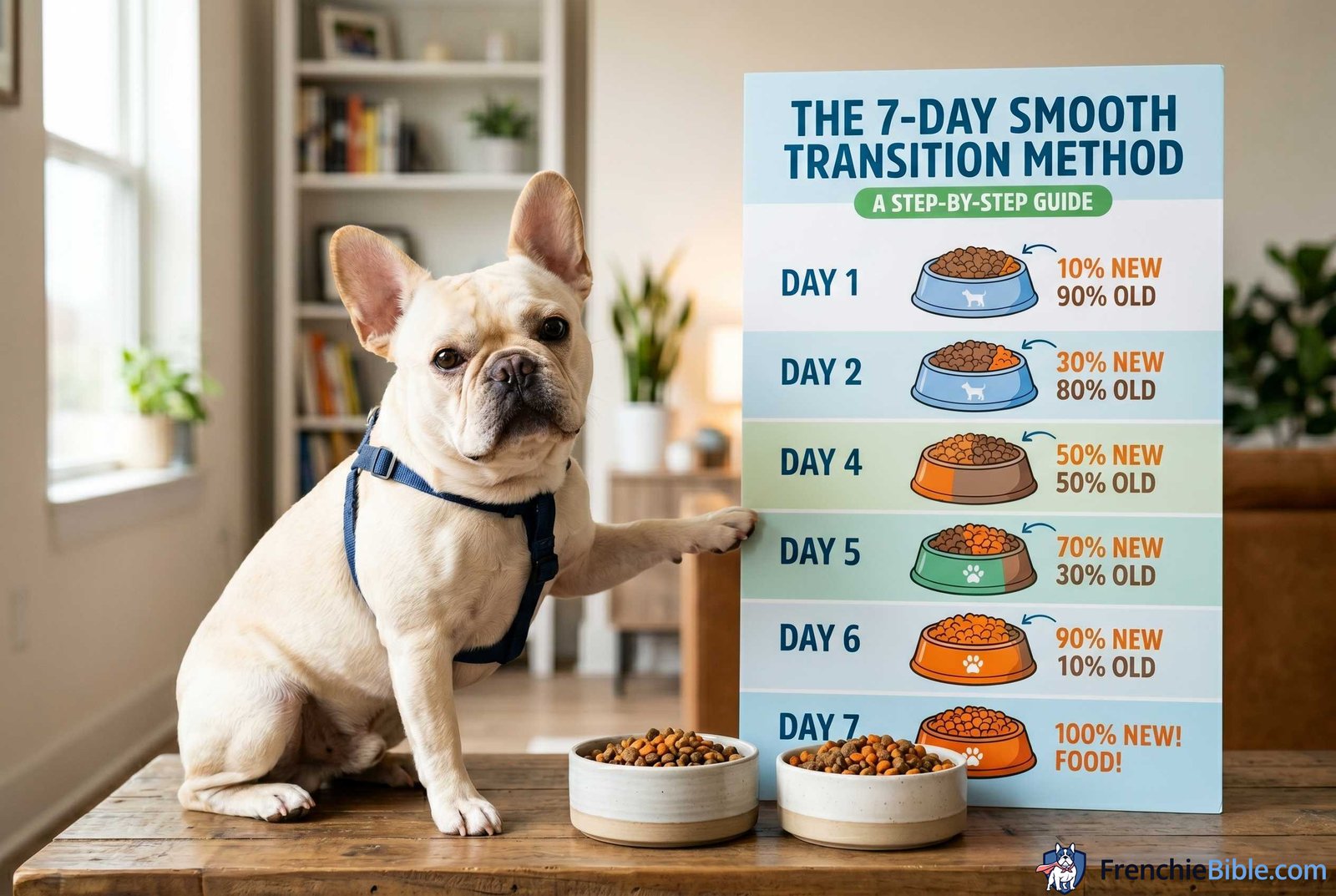
Here is the exact schedule you should follow. Note: Measure the food precisely using a digital kitchen scale or a standard measuring cup.
Days 1 and 2: The Introduction (75% / 25%)
- Puppy Food: 75% of the total meal volume
- Adult Food: 25% of the total meal volume
- What to watch for: During these first two days, monitor their stool closely. You want to see well-formed, firm logs. A slight softening is acceptable, but liquid diarrhea means you need to slow down.
Days 3 and 4: The Tipping Point (50% / 50%)
- Puppy Food: 50% of the total meal volume
- Adult Food: 50% of the total meal volume
- What to watch for: This is usually where sensitive stomachs might protest. If you notice an increase in gas or very loose stools, do not progress to the next step. Stay at the 50/50 ratio for an extra 2 to 3 days until their gut stabilizes.
Days 5 and 6: The Takeover (25% / 75%)
- Puppy Food: 25% of the total meal volume
- Adult Food: 75% of the total meal volume
- What to watch for: By now, their digestive system should be producing the enzymes necessary to break down the adult formula efficiently. Energy levels should be normal, and stools should be firm.
Day 7: The Finish Line (0% / 100%)
- Puppy Food: 0%
- Adult Food: 100% of the total meal volume
- What to watch for: Congratulations! You have successfully transitioned your Frenchie. Keep monitoring their weight over the next month to ensure the portion sizes of the new adult food are correct.
5. Pro Tips for a Successful Transition
Over the years, I’ve picked up a few tricks that make this transition even smoother for sensitive French Bulldogs.
Introduce a Probiotic
Three days before you begin the 7-day transition, start adding a canine-specific probiotic powder or chew to their current meals. Probiotics fortify the gut with beneficial bacteria, making it much more resilient against the stress of a dietary change. Continue the probiotic throughout the transition and for a week afterward.
Add Canned Pumpkin
If you notice the stool getting a bit soft during the transition, add one tablespoon of 100% pure canned pumpkin puree (NOT pumpkin pie filling) to their bowl. Pumpkin is rich in soluble fiber, which acts like a sponge in the colon, absorbing excess water and firming up the stool beautifully.
Keep the Protein Source Similar
If your Frenchie has been thriving on a chicken-based puppy kibble, try to find an adult formula from the same brand that also uses chicken as the primary protein. Switching from a chicken puppy food to a salmon or lamb adult food introduces two major changes at once (new macro ratios + new novel protein), which increases the risk of an upset stomach.
Hydration is Key
Adult kibble can sometimes have a different moisture content than puppy kibble. Ensure your Frenchie always has access to fresh, clean water. For dogs that don’t drink enough, you can add a splash of low-sodium bone broth to the mixed kibble during the transition week.
6. How to Choose the Right Adult Food for a French Bulldog
Not all adult dog foods are created equal, and Frenchies have very specific needs. When selecting your dog’s forever food, look for the following criteria:
- Moderate Calories: To prevent obesity and protect their spine (IVDD prevention) and airways (BOAS management).
- High-Quality, Digestible Protein: Look for whole meats (like deboned turkey, chicken, or salmon) as the first ingredient.
- Omega-3 Fatty Acids: Frenchies are prone to environmental allergies and Atopic Dermatitis. A diet rich in Omega-3s (from fish oil or flaxseed) helps maintain a strong skin barrier and a shiny coat.
- Appropriate Kibble Shape: Because of their flat faces (brachycephalic structure), Frenchies sometimes struggle to pick up and chew standard kibble. Look for brands that offer specialized kibble shapes designed for flat-faced breeds, or smaller, triangular kibbles that are easier to grasp.
- Joint Support: Ingredients like Glucosamine and Chondroitin are excellent additions to support their heavily loaded joints.
Conclusion
Transitioning your French Bulldog from puppy to adult food is a major milestone in their life. By waiting until the 10 to 12-month mark, paying close attention to their physical development, and adhering strictly to the 7-Day Smooth Transition Method, you are setting the foundation for a long, healthy, and comfortable life. Remember, a healthy gut means a happy Frenchie—and a happy owner who doesn’t have to deal with clearing the room every time the dog passes gas!
Frequently Asked Questions (FAQs)
Q1: My Frenchie is 8 months old but looks huge. Should I switch to adult food now?
A: Not necessarily. While they may look fully grown, their internal skeletal structure and joints may still be developing. Switching too early can deprive them of the calcium and phosphorus needed for optimal bone density. Consult your vet to assess their body condition score before making an early switch.
Q2: I messed up and switched cold turkey, and now my Frenchie has diarrhea. What do I do?
A: Stop the new food immediately. Fast your dog for 12 to 24 hours (ensure they have water) to let their gut rest. Then, introduce a bland diet of boiled white chicken breast and plain white rice. Feed this for 2-3 days until the stool is firm. Once stable, re-introduce the new food using a highly diluted version of the 7-day method (e.g., start with a 10-day or 14-day transition).
Q3: Should I switch to a grain-free adult food?
A: Unless your veterinarian has specifically diagnosed your French Bulldog with a grain allergy (which is quite rare; most allergies are to proteins like chicken or beef), there is generally no need for a grain-free diet. In fact, the FDA is currently investigating a potential link between certain grain-free diets and Dilated Cardiomyopathy (DCM) in dogs. Wholesome grains like oatmeal and brown rice provide excellent fiber for their sensitive digestion.
Q4: My Frenchie refuses to eat the adult food when I mix it in. Any advice?
A: Frenchies can be stubborn! Try adding a small “high-value” topper to the mixture, such as a spoonful of plain, unsweetened yogurt, a splash of unsalted bone broth, or a tiny sprinkle of freeze-dried liver dust. The enticing smell usually convinces them to eat the entire bowl.
Q5: Is it normal for my Frenchie to poop less often on adult food?
A: Yes, this is completely normal. High-quality adult foods are often more digestible and have less “filler” than some puppy formulations. Because their body is absorbing more of the nutrients, there is less waste produced. As long as the stool is firm and they aren’t straining to go, a reduction in frequency is a good sign.