As a dedicated French Bulldog breeder with over a decade of hands-on experience, I have witnessed the immense joy these charming, bat-eared companions bring to families. Through my years of guiding new and experienced owners, I have also encountered many misconceptions about Frenchie care—none more terrifying or potentially fatal than the assumption that “all dogs know how to swim.” Let me be unequivocally clear from the start: French Bulldogs are not natural swimmers. In fact, their unique physical traits make them incredibly vulnerable around water.
If you are a Frenchie owner—or are planning to bring one of these wonderful dogs into your home—and you have a backyard pool, live near a lake, or frequently visit areas with deep water, you must treat water safety with the same urgency as you would for a human toddler. This comprehensive guide, born from ten years of breeding, observing, and caring for French Bulldogs, will deeply explore the anatomical reasons why Frenchies sink like rocks, the hidden dangers of unsecured swimming pools, and the absolute necessities of pool covers and canine life jackets.
Related Reading: Training & Behavior | Frenchie Puppy Guide | Best Food for Frenchies
By the end of this extensive guide, you will be equipped with the knowledge and practical strategies needed to keep your beloved Frenchie safe around water, allowing you to enjoy the summer months without the constant dread of a water-related tragedy.
Understanding French Bulldog Anatomy: Why They Cannot Swim
To truly grasp the importance of pool safety for French Bulldogs, we must first look at their anatomy. Over my ten years as a breeder, I have studied the physical structure of the Frenchie extensively. They are a marvel of specialized breeding, designed for companionship and affection, not for athleticism or aquatic survival. Their bodies are essentially the opposite of what is required for buoyancy and efficient swimming.
The Brachycephalic Airway Syndrome
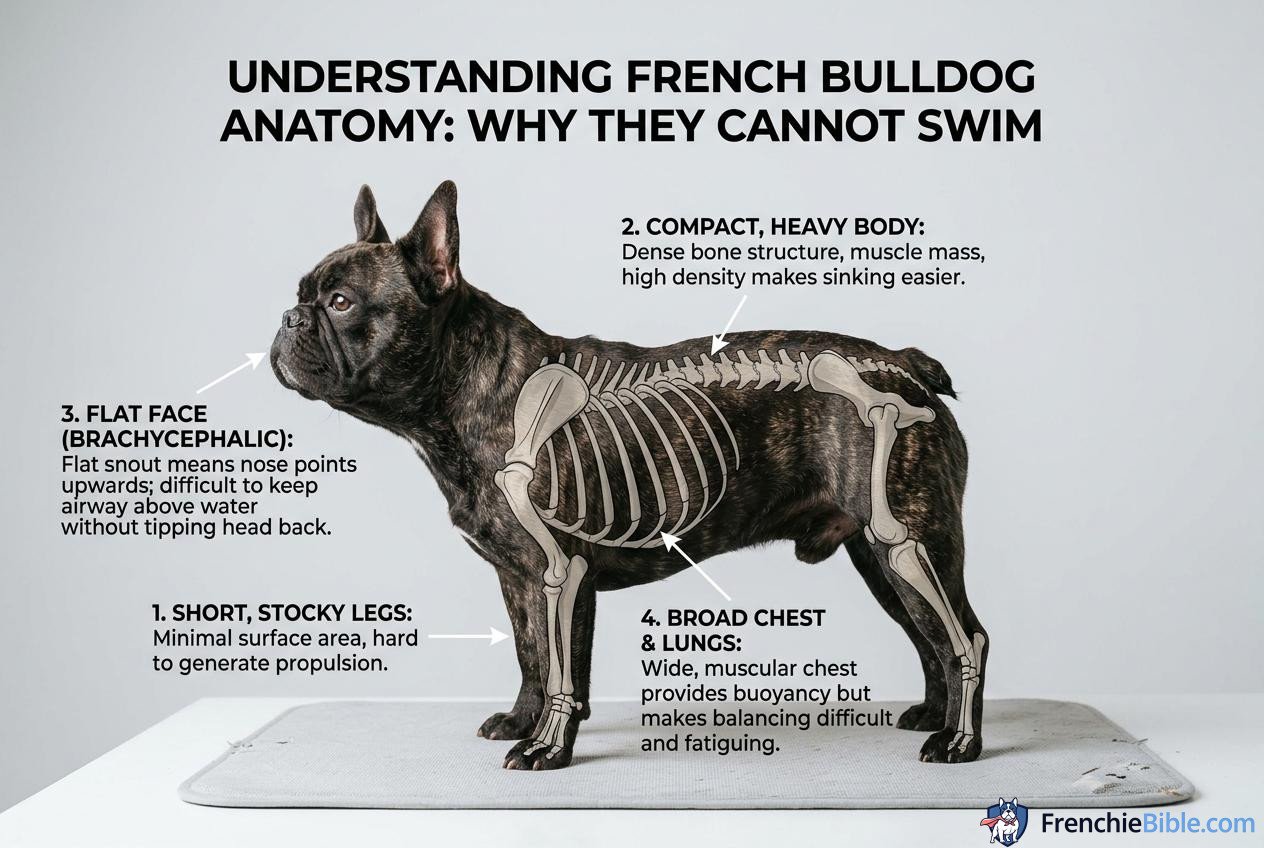
French Bulldogs are a brachycephalic breed, which means they have a shortened skull, a flat face, and a pushed-in nose. While this gives them their undeniable, heart-melting appeal, it also severely compromises their respiratory efficiency.
When a dog swims, it naturally needs to keep its snout above the water line to breathe while its body remains submerged and paddling. For a breed with a long snout, like a Labrador Retriever, this is effortless. For a French Bulldog, keeping their short nose above water requires them to tilt their head sharply upward. This unnatural and strenuous posture causes their back end to drop vertically into the water. Instead of a horizontal paddling motion, the Frenchie ends up in a vertical position, desperately thrashing their paws just to keep their nostrils exposed to the air.
Furthermore, their compromised airways mean they cannot take in as much oxygen as other breeds. The extreme physical exertion of trying to stay afloat rapidly leads to oxygen depletion, exhaustion, and panic. Within seconds, a French Bulldog can inhale water, leading to immediate drowning or severe respiratory distress.
A Top-Heavy Build and Dense Bone Structure
Beyond their facial structure, a Frenchie’s overall body composition is a recipe for disaster in the water. They have broad, muscular chests, large heads, and relatively narrow hindquarters. This makes them incredibly top-heavy. When they enter the water, their heavy chest and head naturally pull them forward and downward.
Compounding this issue is their bone density. French Bulldogs possess a highly compact and dense skeletal structure. Unlike water breeds that have a naturally buoyant body composition with a good distribution of body fat and lighter bones, Frenchies are built like little tanks. They literally lack the natural buoyancy required to float. When a Frenchie falls into a pool, they do not bob back to the surface; they drop straight to the bottom like an anchor.
Short Legs and Inefficient Paddling
Even if a Frenchie were somehow able to stay horizontal, their short, stout legs do not provide the necessary propulsion to move through the water efficiently. The “doggy paddle” relies on long, sweeping strokes of the legs to generate thrust and lift. A Frenchie’s short limbs can only manage frantic, rapid, and exhausting movements that burn a tremendous amount of energy but provide virtually no forward momentum or upward lift.
The Hidden Dangers of Unsecured Pools for French Bulldogs
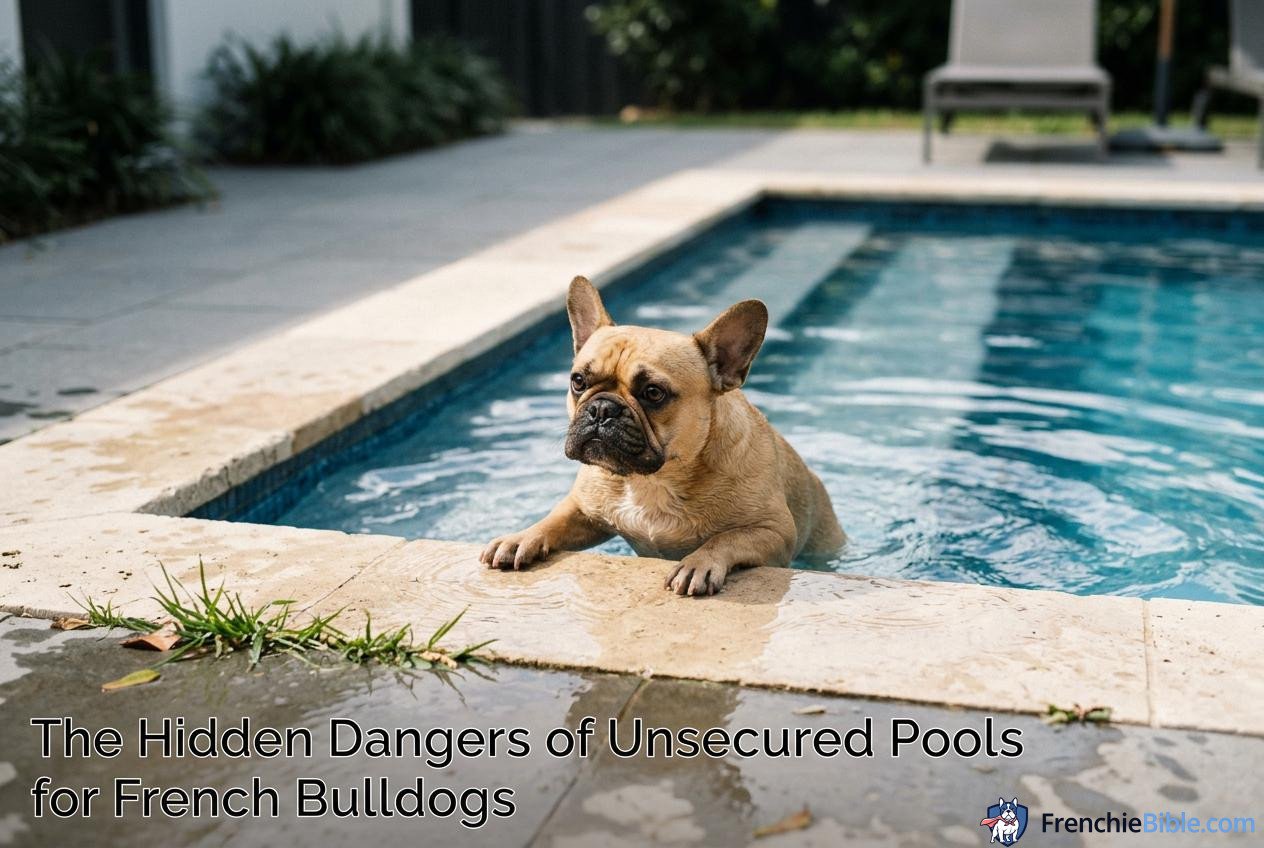
As a breeder, one of the most heartbreaking scenarios I hear about involves accidental drownings in home swimming pools. Many owners believe that because their Frenchie avoids the water, they are safe. However, the majority of water-related incidents do not occur because the dog jumped in to swim; they happen because the dog accidentally fell in.
Accidental Slips and Falls
French Bulldogs are famously clumsy and incredibly curious. They love to patrol their territory, chase bugs, or simply follow their owners around the yard. A pool without a secure cover or fence is a massive hazard. A Frenchie zooming around the yard can easily lose their footing on wet or slippery pool decking and tumble directly into the water. Because they are heavy and sink instantly, even a momentary lapse in supervision can be fatal.
Exhaustion and Silent Panic
When a French Bulldog falls into water, the panic is instantaneous. Because they cannot swim, their instinct is to thrash wildly. This panic accelerates their breathing, exacerbating their brachycephalic airway limitations. They swallow water quickly, and their dense bodies pull them down. Drowning in Frenchies is often silent; there is no prolonged splashing or barking, just a sudden drop below the surface. The entire tragic event can unfold in less than thirty seconds.
Secondary Drowning and Water Intoxication
Even if a Frenchie is quickly rescued after falling into a pool, the danger is not over. As an experienced breeder, I always warn my puppy buyers about the risks of secondary drowning (also known as dry drowning). If a dog inhales even a small amount of water into their lungs during a panic, it can cause severe inflammation and pulmonary edema (fluid in the lungs) hours or even days after the incident.
Symptoms of secondary drowning include lethargy, coughing, pale or blue gums, and difficulty breathing. If your Frenchie ever falls into the water and inhales fluid, they must be monitored closely, though I must stress that I am sharing this from a breeder’s perspective—you should always consult a professional for medical evaluation.
Essential Pool Safety Measures: The Pool Cover
If you own a French Bulldog and have a swimming pool, implementing physical barriers is not an option; it is an absolute necessity. Over my 10 years of breeding, I have made it a strict policy to ensure that every family adopting one of my puppies understands the critical importance of pool safety. The most effective safety measure you can invest in is a high-quality pool cover.
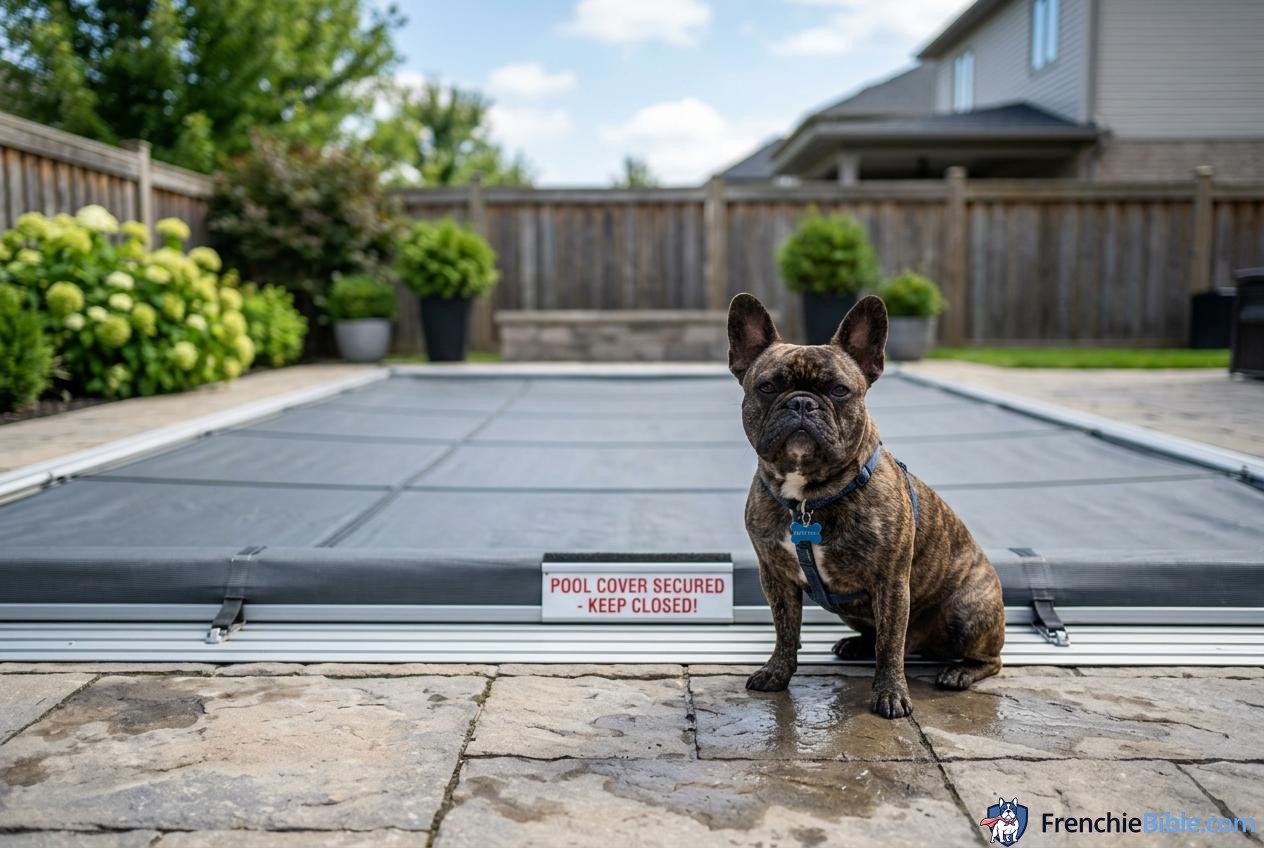
Choosing the Right Pool Cover
Not all pool covers are created equal, and when it comes to Frenchie safety, a simple solar cover or a thin plastic tarp is actually more dangerous than no cover at all. If a dog walks onto a floating solar cover, it will immediately buckle under their weight, wrapping around them and trapping them underwater, making rescue virtually impossible.
To properly protect your French Bulldog, you must invest in a safety pool cover.
-
Mesh Safety Covers: These covers are stretched tightly across the pool and anchored into the concrete decking. They are designed to support the weight of a child or a dog. If your Frenchie wanders onto a properly installed mesh safety cover, they will simply walk across it as if it were a solid surface. Any water that accumulates on top quickly drains through the mesh, preventing the formation of hazardous puddles.
-
Solid Safety Covers: Similar to mesh covers, solid safety covers are anchored tightly to the deck and can support significant weight. They do not allow water to pass through, so they must be equipped with an automatic pump to remove rainwater from the surface, ensuring a small pool of water doesn’t form on top of the cover.
-
Automatic Pool Covers: These are the gold standard for convenience and safety. With the flip of a switch, a sturdy, reinforced vinyl cover slides over the pool along heavy-duty tracks. When fully closed, it acts as a horizontal fence, completely sealing off the water.
As a breeder, I cannot stress enough how vital a heavy-duty, weight-bearing pool cover is. It provides peace of mind that even if your Frenchie slips out the back door unnoticed, the pool is completely inaccessible.
Pool Fencing: Your First Line of Defense
While a safety cover is crucial for when the pool is not in use, what happens during the summer when the pool is open and the family is swimming? This is where pool fencing becomes imperative.
A dedicated pool fence should completely surround the perimeter of the pool, separating the water from the rest of the yard. The fence should be at least 4 feet high, with gaps no wider than 3 inches so a determined Frenchie cannot squeeze through. The gate must be self-closing and self-latching, with the latch placed high enough out of reach.
When the pool is in use, the fence ensures that your Frenchie can still hang out in the yard with the family without the risk of accidentally wandering too close to the edge.
Ramps and Exit Strategies
For added security, consider installing a pool ramp (often marketed as a “Skamper Ramp” or similar device) designed specifically for pets. If the worst-case scenario occurs and your Frenchie somehow ends up in the water while the pool is open, a ramp provides a visible, easy-to-use exit point.
However, you must actively train your Frenchie to use the ramp. Do not assume they will find it in a panic. During a calm, highly supervised training session (while your dog is wearing a life jacket), gently guide them to the ramp so they understand it is the pathway out of the water.
french bulldog life jackets: A Non-Negotiable Necessity
There are times when you will want your Frenchie near the water—perhaps you are having a pool party, visiting a dog-friendly beach, or taking a boat ride. In any scenario where your French Bulldog is near open, uncovered water, they must wear a canine life jacket. As a breeder, I consider a high-quality life jacket to be a mandatory piece of equipment for every Frenchie owner.
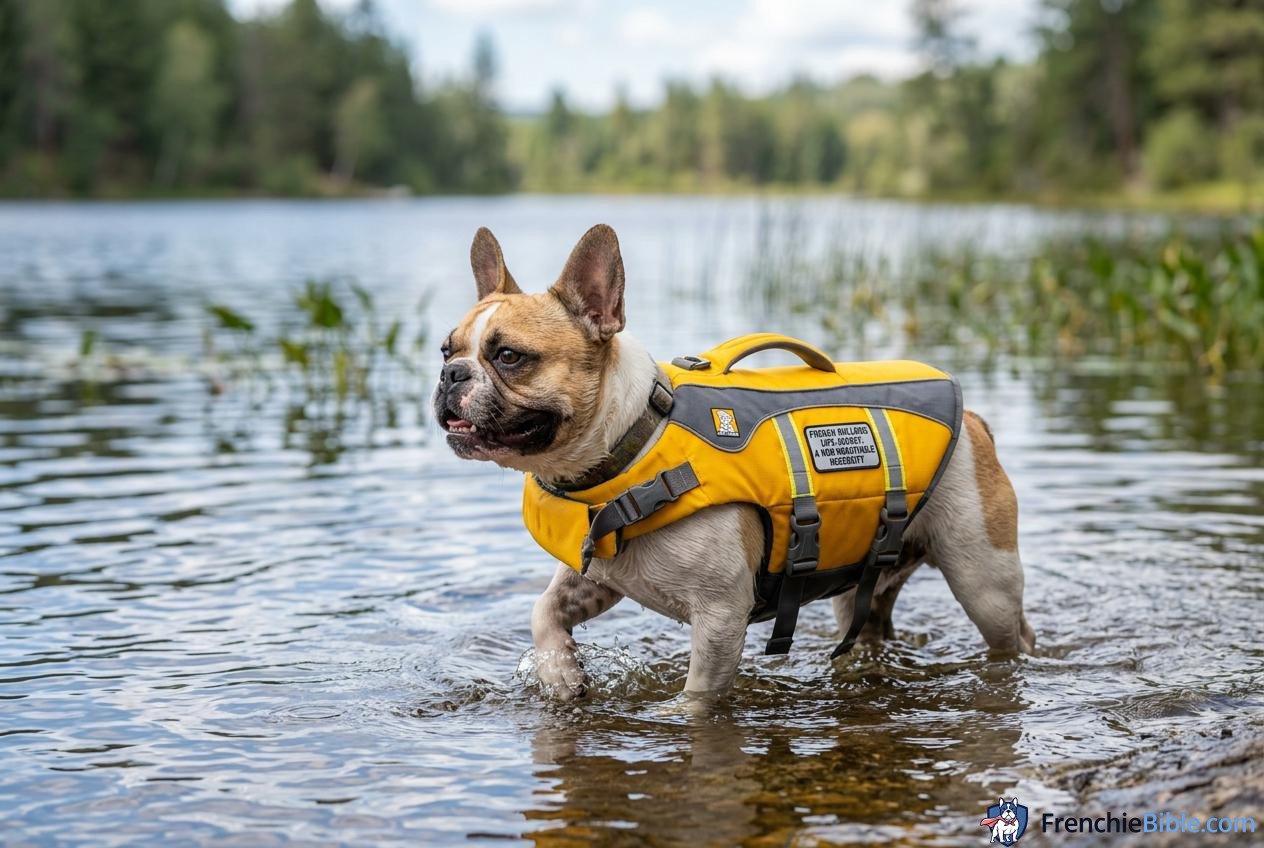
Why Every Frenchie Needs a Life Vest
We have already established that Frenchies cannot swim. A life jacket provides the vital buoyancy their bodies naturally lack. It keeps their heavy chest and head elevated, allowing them to maintain a horizontal position in the water without exhausting themselves.
More importantly, a life jacket buys you time. If your Frenchie accidentally falls into the water, a life vest prevents them from sinking like a stone. It keeps them floating on the surface, visible and breathing, giving you the precious seconds needed to reach in and pull them out safely.
How to Choose the Right Life Jacket for Your Frenchie
Because of their unique body shape—broad chests, thick necks, and compact bodies—finding a life jacket that fits a French Bulldog properly can be challenging. A poorly fitted jacket can slip off in the water or inhibit their movement. Here is what I advise my puppy families to look for:
-
Front Floatation Flap (Chin Rest): This is arguably the most critical feature for a brachycephalic breed. The life jacket must have a thick floatation pad under the neck or chin. This pad helps keep their heavy head tilted upward and their short nose clear of the water line, preventing water inhalation.
-
A Sturdy Rescue Handle: The life jacket must have a strong, reinforced handle on the top (along the dog’s back). In an emergency, this handle is what you will grab to physically hoist your heavy, dense Frenchie out of the water. Ensure the stitching around the handle is highly durable.
-
Adjustable Straps and Secure Buckles: Look for a vest with multiple adjustable straps around the neck and the chest/belly. The jacket needs to be snug enough that your Frenchie cannot wriggle out of it in the water, but not so tight that it restricts their already compromised breathing.
-
Bright Colors and Reflective Trim: Visibility is key. Choose a life jacket in a bright, neon color (like yellow, orange, or hot pink) with reflective strips. This ensures you can spot your dog instantly, even in low light or choppy water.
-
Proper Sizing: Measure your Frenchie’s girth (the widest part of their chest) and length. Do not guess their size. A jacket that is too loose will rotate or slip off in the water, rendering it useless.
Introducing Your Frenchie to the Life Jacket
Do not wait until you are poolside to put the life jacket on your Frenchie for the first time. They need to get used to the feeling of wearing it on dry land.
Start by putting the jacket on your Frenchie inside the house for a few minutes at a time. Offer high-value treats and praise so they associate the jacket with a positive experience. Once they are comfortable walking around indoors with it, move out to the yard. Only when they are completely relaxed wearing the vest should you introduce them to the pool area.
Supervised Water Play: Keeping Your Frenchie Cool and Safe
French Bulldogs are notoriously sensitive to heat. Because of their short snouts, they cannot pant efficiently enough to cool their bodies down in hot weather. While deep pools are dangerous, shallow water play can actually be highly beneficial for keeping your Frenchie cool during the summer.
The “Kiddie Pool” Alternative
The safest way for a French Bulldog to enjoy the water is in a hard plastic kiddie pool. Fill the pool with just enough water to reach your Frenchie’s elbows or chest—typically no more than 3 to 5 inches.
This shallow depth eliminates the risk of drowning while allowing your dog to stand comfortably, splash around, and drastically lower their core body temperature. Toss in some floating toys or ice cubes to make it a fun, engaging experience. Always empty the kiddie pool immediately after use so it does not become a standing water hazard.
Recognizing Signs of Distress or Overheating
Even during safe, shallow water play or when wearing a life jacket near a large pool, you must constantly monitor your Frenchie. In my 10 years of breeding, I have learned to read the subtle signs of canine distress.
Watch for heavy, raspy panting, a protruding tongue that curls at the end, excessive drooling, or pale/blue gums. If your Frenchie appears lethargic or panicked, remove them from the water immediately, bring them into an air-conditioned space, and allow them to rest. Water activities, even safe ones, can be highly stimulating and exhausting for a brachycephalic breed.
Training Your Frenchie Around the Pool
While physical barriers and life jackets are your primary safety tools, training provides an additional layer of protection. French Bulldogs are intelligent and eager to please, and you can teach them specific behaviors regarding the pool.
Establishing Boundary Commands
Teach your Frenchie a strict boundary command, such as “Leave It” or “Back.” Practice this command near the edge of the pool. Walk your dog on a leash around the perimeter of the pool; if they step too close to the edge, firmly issue the command and gently guide them back. Reward them generously when they maintain a safe distance. The goal is to condition them to respect the pool edge as an invisible wall they should not cross.
Teaching the “Find the Exit” Game
If you have a pool ramp or shallow stairs, dedicate time to teaching your Frenchie where they are. With your dog wearing their life jacket, gently place them in the water right next to the stairs or ramp. Use a cheerful voice and a treat to coax them out of the water.
Repeat this process from gradually further distances (always within arm’s reach and always with a life jacket). By repeatedly showing them the exit, you build muscle memory. If they ever accidentally fall in, their first instinct will be to swim toward the stairs or ramp rather than panicking in the center of the pool.
The Breeder’s Final Word on Pool Safety
Owning a French Bulldog is a tremendous privilege, but it comes with specific, non-negotiable responsibilities. Their endearing, blocky heads, deep chests, and short snouts are the very traits we adore, but they are also the traits that make water their greatest enemy.
Over my 10-year career as a breeder, my primary goal has always been the longevity, health, and happiness of these incredible dogs. I implore you: do not take chances. A Frenchie near an uncovered pool without a life jacket is a tragedy waiting to happen. Invest in a heavy-duty safety pool cover. Erect a pool fence. Buy the highest quality life jacket with a chin float. Supervise them relentlessly.
By taking these proactive steps, you can ensure that your French Bulldog remains safe, allowing you to enjoy countless summers together, full of joy and free of fear.
Frequently Asked Questions (FAQ)
FAQ 1: Can a French Bulldog ever learn to swim without a life jacket?
Based on my extensive experience as a breeder, the answer is a firm no. While some Frenchies may manage to frantically paddle for a few seconds to survive, their anatomy—top-heavy build, dense bones, and brachycephalic airway—makes them biologically incapable of swimming safely or efficiently. They will exhaust themselves rapidly and sink. Never allow a French Bulldog in deep water without a life jacket.
FAQ 2: What is the best type of pool cover for homes with Frenchies?
The safest option is an anchored mesh safety cover or a reinforced automatic vinyl cover. These are designed to bear weight, meaning if your Frenchie accidentally wanders onto the pool, they will not fall through. Avoid floating solar covers at all costs, as they will wrap around the dog and pull them under, creating an extremely dangerous trap.
FAQ 3: How do I know if my French Bulldog has swallowed too much water?
If your Frenchie falls in and swallows water, watch closely for signs of respiratory distress, severe coughing, lethargy, or pale/blue gums. Because of their flattened airways, inhaled water is incredibly dangerous. If you notice any abnormal breathing after a water incident, contact an emergency veterinary clinic immediately.
FAQ 4: Are saltwater pools safer for French Bulldogs than chlorine pools?
Neither is entirely safe for a Frenchie if they fall in and cannot swim. However, if they ingest water, saltwater can cause sodium poisoning or severe diarrhea, while highly chlorinated water can irritate their stomach, throat, and eyes. Regardless of the water type, the physical drowning hazard remains the exact same. Physical barriers and life jackets are mandatory for both.
FAQ 5: At what age should I introduce my French Bulldog to a life jacket?
You should introduce the life jacket as early as possible, ideally during puppyhood (around 12 to 16 weeks of age), so they grow up accepting it as a normal part of their routine. Start by having them wear it inside the house for short periods with lots of treats and praise before ever bringing them near the water.
Disclaimer: I am a passionate French Bulldog breeder with over 10 years of experience dedicated to the betterment, care, and understanding of this wonderful breed. However, I am not An Experienced Breedererinarian, and I do not possess any formal medical qualifications. The information provided in this article is based entirely on my personal breeding experience, behavioral observations, and canine husbandry practices. This content is intended for educational and informational purposes only and must never be used as a substitute for professional veterinary advice, diagnosis, or medical treatment. If your French Bulldog experiences a water-related accident, respiratory distress, or any other health emergency, please seek immediate assistance from a licensed veterinarian or an emergency animal hospital.