
as a French Bulldog expert and breeder and experienced breeder dedicated exclusively to the French Bulldog breed for over two decades, I have witnessed firsthand the profound impact that daily lifestyle choices have on the health, happiness, and longevity of these charming companions. Welcoming a French Bulldog into your family is a significant commitment. They are not merely pets; they are intricate biological marvels that require highly specialized care. Among the most critical, yet frequently overlooked, investments you will make for your Frenchie is their bed.
The average dog sleeps between 12 and 14 hours a day, and puppies or senior dogs can sleep up to 18 hours. This means your French Bulldog spends more than half of its life in its bed. However, French Bulldogs are not standard, anatomically typical dogs. Their unique structural design, particularly concerning their spine, joints, and respiratory system, demands highly specialized support. This comprehensive, expert-led guide will explore exactly how to choose the right dog bed for your French Bulldog, with an uncompromising deep dive into why a true orthopedic memory foam bed is not just a luxury accessory, but an absolute medical necessity.
Related Reading: Training & Behavior | Frenchie Puppy Guide | Best Food for Frenchies
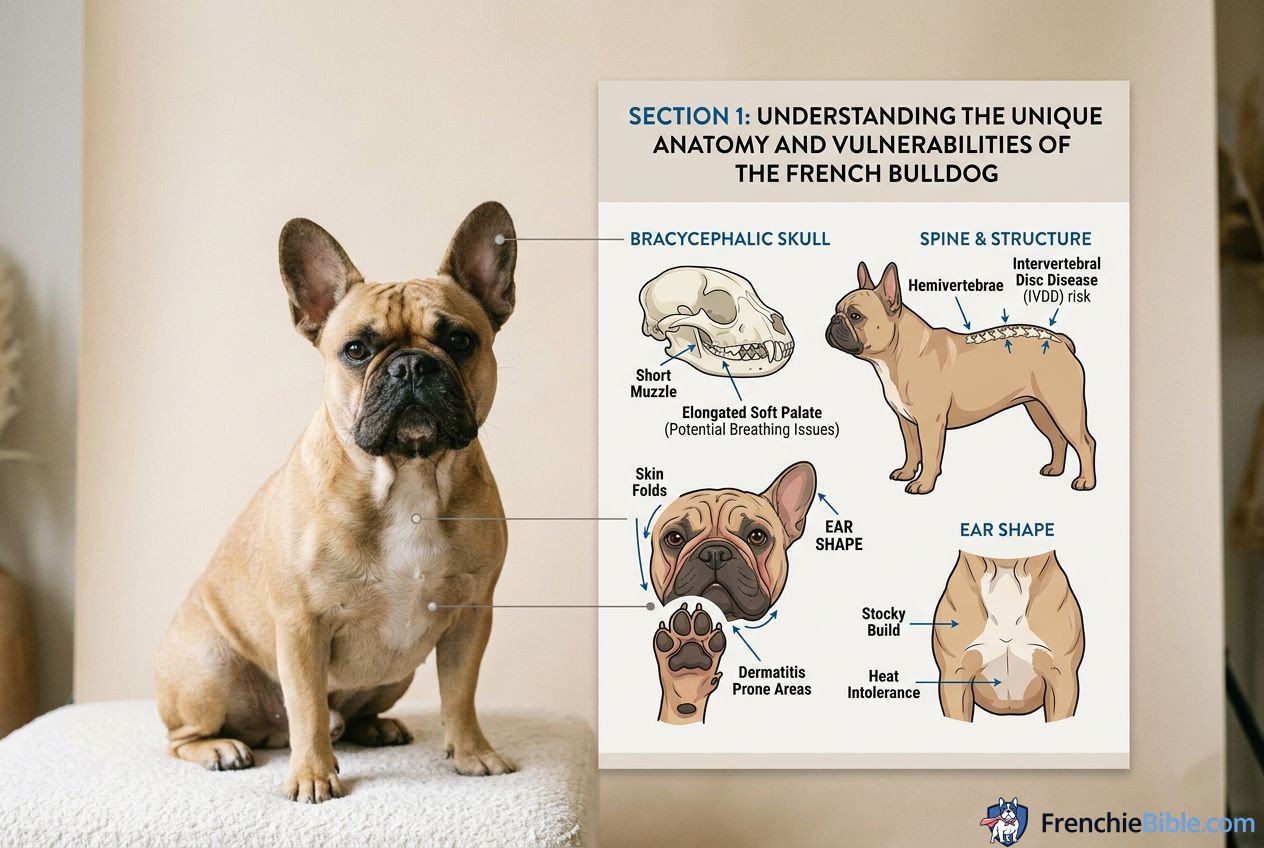
Section 1: Understanding the Unique Anatomy and Vulnerabilities of the French Bulldog
Before we can discuss the intricacies of memory foam density and dog bed design, we must first profoundly understand the patient. The French Bulldog is classified as a chondrodysplastic breed. This biological term means they possess genetic traits for dwarfism—specifically, shortened, thickened limbs relative to a robust, elongated body length. While this genetic blueprint gives them their signature compact, muscular, and universally adored appearance, it also creates a perfect storm for structural, orthopedic, and respiratory vulnerabilities.
The Highly Vulnerable Spine: Hemivertebrae and IVDD
The most pressing and terrifying concern for any informed French Bulldog owner should be their dog’s spinal column. Frenchies are disproportionately affected by severe spinal anomalies and degenerative diseases compared to almost any other breed.
Hemivertebrae (The Butterfly Vertebrae): Many French Bulldogs are born with congenital spinal malformations known as hemivertebrae. In a normal spine, the vertebrae are shaped like spools or cylinders, stacking neatly to form a strong, flexible column. Hemivertebrae, however, fail to develop fully on one side, resulting in wedge-shaped or “butterfly” shaped bones. While some dogs remain asymptomatic throughout their lives, these malformations inherently cause abnormal curvature of the spine (kyphosis, which is an upward bowing, or scoliosis, a lateral curve). More importantly, hemivertebrae create inherently unstable pivot points along the spinal column. This instability means the spinal cord is constantly at risk of compression if the dog twists awkwardly, jumps off high furniture, or—crucially—sleeps on an unsupportive surface that forces the already compromised spine into an unnatural alignment for 12 hours straight.
Intervertebral Disc Disease (IVDD) – Hansen Type I: IVDD is a heartbreaking, excruciatingly painful, and debilitating condition. The spine is constructed of bony vertebrae separated by intervertebral discs, which act as shock absorbers. These discs have a fibrous outer ring (annulus fibrosus) and a jelly-like center (nucleus pulposus). French Bulldogs are highly predisposed to Hansen Type I IVDD, a condition where the inner jelly prematurely calcifies and hardens. Eventually, the outer ring tears, and the hardened disc material ruptures or herniates upward into the spinal canal, violently compressing the spinal cord. This can lead to sudden paralysis of the hind legs.
A soft, unsupportive, cheap bed allows the heavy, muscular chest and pelvic regions of the Frenchie to sink at different rates. This misaligns the spine, turning it into a sagging bridge, and places continuous, low-grade mechanical stress on these delicate, already compromised intervertebral discs throughout the night.
Joint Health: Hip Dysplasia and Luxating Patellas
Beyond the spine, Frenchies carry a significant amount of weight—often 20 to 28 pounds—on a relatively small, squat frame. This “bowling ball on toothpicks” physique places immense, constant pressure on their major load-bearing joints, particularly the hips, knees, and elbows.
Canine Hip Dysplasia (CHD): CHD is highly prevalent in the breed. It is a condition where the hip joint (a ball and socket mechanism) fails to develop properly, leading to a loose joint that grinds instead of gliding smoothly. A bed that lacks proper density forces the dog’s hips to bear the blunt brunt of their body weight pressing against the hard floor beneath the bed. Over time, this unmitigated pressure accelerates joint cartilage degradation, bone spur formation, and significantly exacerbates the pain and chronic inflammation associated with arthritis.
Luxating Patellas: This condition involves the kneecap slipping out of its normal groove. It requires the dog to have a firm, highly stable surface from which to rise. A soft, plushy, sinking bed requires the dog to struggle, paddle, and strain their hind legs to stand up from a lying position, dramatically increasing the risk of acute joint injury or tearing the cranial cruciate ligament (CCL).
The Brachycephalic Airway: Sleep Apnea and Positioning
Finally, we must meticulously consider the French Bulldog’s brachycephalic (flat-faced) anatomy. Brachycephalic Obstructive Airway Syndrome (BOAS) makes breathing a constant, conscious, and laborious effort for many Frenchies. They suffer from elongated soft palates, stenotic nares (narrow nostrils), and everted laryngeal saccules.
When dogs sleep, the muscles in their upper airway naturally relax. For a Frenchie, this relaxation can lead to partial or total airway obstruction, resulting in severe snoring, choking sounds, and dangerous sleep apnea (where the dog temporarily stops breathing).
You will very frequently notice a Frenchie resting their chin on a pillow, a toy, another dog, or the hard edge of their bed. This is not just an adorable quirk for Instagram; it is a desperate compensatory survival mechanism. By elevating their head and neck, they physically pull their airway open and straighten the trachea, making it significantly easier to draw in oxygen while the airway muscles are relaxed in sleep. A properly designed bed must explicitly accommodate this vital, life-saving behavioral need.
Section 2: Why Standard, Big-Box Store Dog Beds Severely Fail French Bulldogs
Walk into almost any large pet store chain, and you will see entire aisles lined with fluffy, colorful, heavily marketed poly-fill dog beds. They look incredibly soft, cozy, and inviting to the human eye. However, from a strict veterinary and biomechanical perspective, these beds are not just inadequate; they are actively detrimental to a French Bulldog’s health.

The “Donut Bed” and Poly-Fill Trap
The vast majority of cheap beds (often shaped like donuts, bolsters, or giant pillows) are filled with loose, spun polyester fibers (poly-fill). While they feel delightfully soft when you press your hand into them, they offer absolutely zero structural or skeletal support.
When a dense, 25-pound French Bulldog steps onto a poly-fill bed, the loose filling immediately displaces and spreads outward. Within minutes of lying down, the dog’s heavy chest and hips push straight through the fluff, resting directly on the hard wood or tile floor underneath.
This total failure of support creates intense pressure points on the elbows, hips, and shoulders. This frequently leads to the development of hygromas (large, unsightly fluid-filled swellings over the joints) and thick, painful calluses. More critically, it leaves the spine hanging unsupported in a “hammock” or “U” shape, aggravating any underlying hemivertebrae and applying dangerous torque to the intervertebral discs. Furthermore, poly-fill standard beds break down rapidly. They become lumpy, uneven, and flattened within months, creating a tripping hazard and a frustratingly unstable surface for a dog trying to stand up.
Cedar and Pine Wood Shavings
Historically used for outdoor kennel dogs and still sold in some rural areas, beds stuffed with cedar or pine shavings should never, under any circumstances, be used for French Bulldogs. Not only are they completely unsupportive for the spine, but the strong aromatic oils, phenols, and microscopic dust from the wood can severely irritate a Frenchie’s notoriously sensitive respiratory tract, triggering asthma-like symptoms and chronic coughing. Additionally, the rough shavings frequently trigger severe allergic contact dermatitis on their delicate belly skin.
Section 3: The Medical Solution – True Orthopedic Memory Foam
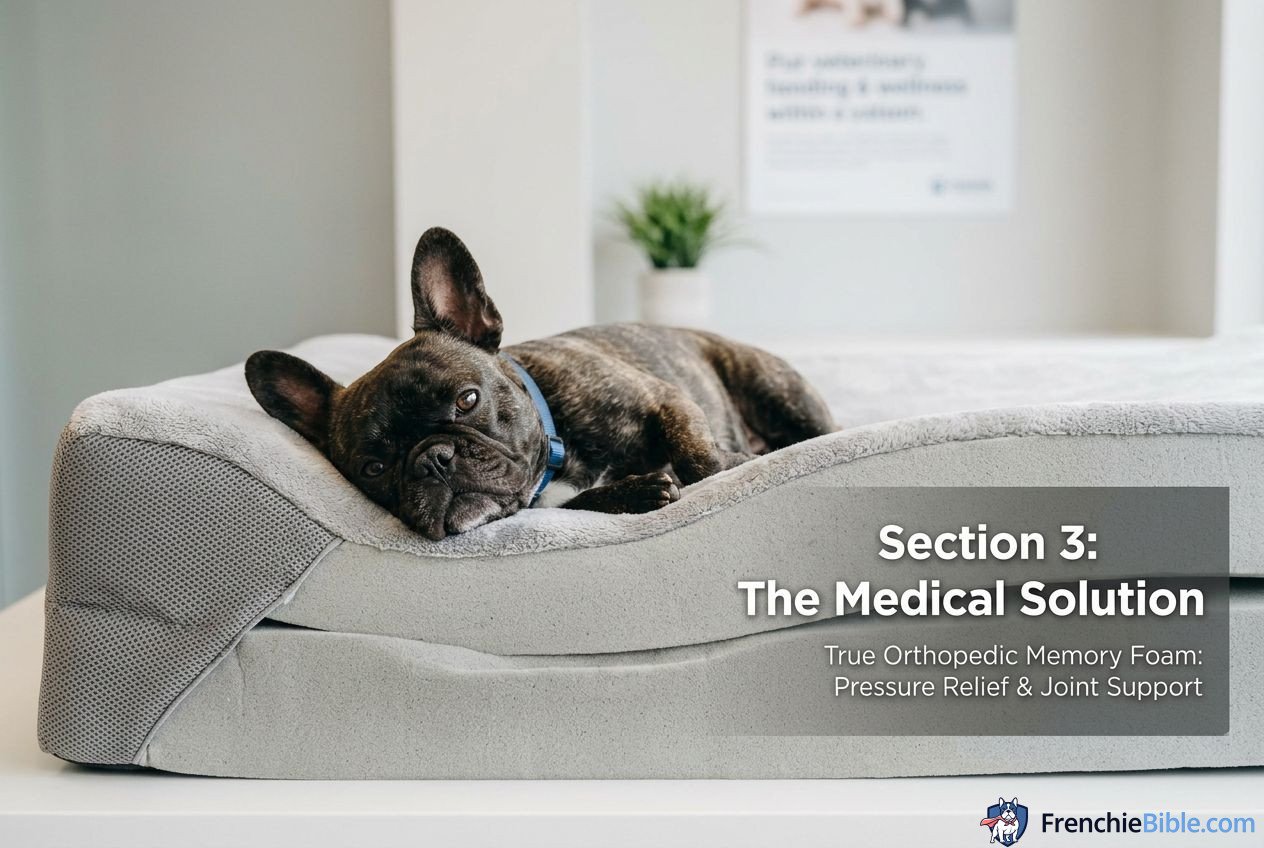
To actively protect the spine, cushion the arthritic joints, and support the compromised airway of a French Bulldog, there is only one scientifically sound, veterinary-approved choice: a high-quality, dense orthopedic memory foam bed.
What Exactly is Memory Foam?
Memory foam, originally engineered by NASA in the 1960s to improve crash protection and seat comfort for astronauts experiencing extreme G-forces, is made from polyurethane with additional chemicals that dramatically increase its viscosity and density. In materials science, it is officially known as viscoelastic polyurethane foam.
The “magic” and therapeutic value of memory foam lies in its unique ability to respond dynamically to both body heat and mechanical pressure. When a French Bulldog lies on a memory foam bed, the foam absorbs the dog’s body heat, softening precisely at the points of highest pressure, and molds perfectly to the exact anatomical contours of their body. It then distributes the dog’s weight perfectly evenly across the entire surface area of the bed.
The Biomechanics of Memory Foam for the Frenchie Physique
For a Frenchie, this even weight distribution is nothing short of life-changing and life-extending.
- Perfect Spinal Alignment: Instead of the heavy chest sinking deep and the lighter hindquarters staying elevated (which twists and torques the spine), the memory foam compresses in perfect proportion to the weight applied. This keeps the dog’s spine in a neutral, straight, biomechanically correct alignment. This drastically reduces the nocturnal mechanical stress on the intervertebral discs, significantly mitigating the risk factors associated with devastating IVDD flare-ups.
- Absolute Pressure Point Relief: Because the dense foam contours perfectly to the protruding hips, elbows, and shoulders, there is no single point bearing the brunt of the dog’s weight. This massively increases capillary blood circulation to the extremities, preventing the development of painful pressure sores, hygromas, and morning joint stiffness.
- Joint Support and Assisted Mobility: A high-density memory foam bed provides a firm, highly stable, and predictable base. When a Frenchie—especially a senior dog suffering from arthritis, or one recovering from orthopedic surgery—needs to stand up, the foam provides solid resistance. They do not have to frantically paddle or struggle out of a sinking hole, thereby protecting their knees (cruciate ligaments) and hips from undue strain and tearing.
The Danger of “Fake” Orthopedic Beds
As a responsible consumer and pet parent, you must be incredibly vigilant. The pet product industry is largely unregulated, and the term “orthopedic” is frequently weaponized as a marketing buzzword to justify higher prices, rather than representing a true medical classification.
Many cheap beds are deceptively labeled “orthopedic” simply because they contain a thin, flimsy one-inch layer of low-grade “egg-crate” foam resting on top of standard poly-fill. Egg-crate foam (convoluted foam) is slightly better than nothing, but it completely lacks the density, weight, and viscosity required to support a heavy, compact, muscular dog like a Frenchie. True orthopedic memory foam is a solid block, it is heavy, and it is typically at least two to five inches thick, depending on the dog’s weight.
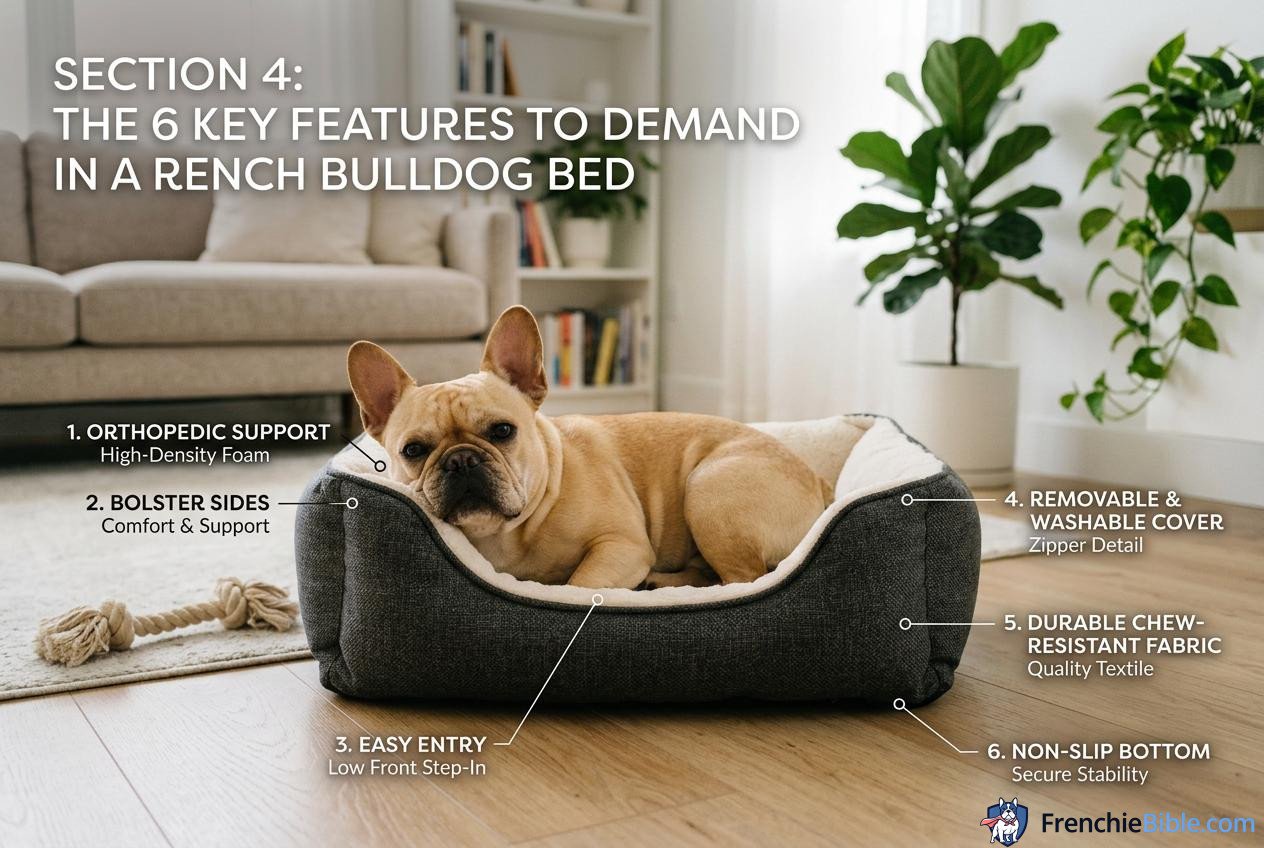
Section 4: The 6 Key Features to Demand in a French Bulldog Bed
When evaluating dog beds online or in a store, you must apply the rigorous, uncompromising standards of An Experienced Breedererinarian. Here is the exact checklist of what you need to look for:
1. High-Density, Solid Memory Foam Base Core
This is the non-negotiable heart of the bed. The foam must be a solid, continuous block, absolutely not “shredded” memory foam. Shredded foam, while slightly better than poly-fill, will still eventually separate, migrate to the corners, and create uneven, unsupportive lumps.
Look for beds that explicitly specify a minimum of 3 to 4 inches of solid, high-density memory foam. The foam should ideally be CertiPUR-US® certified. This independent certification ensures the foam is manufactured without ozone depleters, heavy metals (like lead and mercury), formaldehyde, and harmful phthalates. This is crucial for a brachycephalic dog that sleeps for 14 hours with its nose pressed directly against the mattress, inhaling whatever chemicals the bed is off-gassing.
2. Raised Bolsters for Head Elevation and Airway Support
As discussed extensively in the anatomy section, Frenchies possess a biological need to elevate their heads to keep their obstructed airways open while sleeping. A simple flat mattress bed is entirely insufficient for this breed.
You must look for a bed with raised, firm edges or bolsters on at least two, preferably three, sides. The bolster acts as a built-in medical pillow. It allows the dog to comfortably rest their heavy head, naturally aligning the trachea and significantly reducing the tissue resistance in the upper airway. This single, simple design feature can drastically reduce loud snoring, minimize sleep apnea episodes, and vastly improve the overall oxygenation of your dog while they sleep.
Furthermore, the bolsters tap into the dog’s deeply ingrained ancestral denning instinct. The raised sides provide a profound sense of physical security and psychological comfort, which is highly beneficial for Frenchies that suffer from anxiety or noise phobias.
3. A Dual-Layer or Multi-Layer Foam System
The absolute gold standard in veterinary orthopedic pet beds utilizes a sophisticated dual-layer foam construction.
- The Foundational Support Layer: The thick bottom layer (usually 2-3 inches) is constructed of a high-density, highly resilient support foam (often standard heavy polyurethane). Its sole job is to prevent the heavy dog from ever bottoming out and feeling the hard floor beneath.
- The Viscoelastic Comfort Layer: The top layer (usually 1-2 inches) is the actual viscoelastic memory foam that softens and conforms perfectly to the body’s topography.
This engineered combination provides the perfect, harmonious balance of unyielding therapeutic support and luxurious, joint-cradling comfort.
4. 100% Waterproof and Tear-Resistant Internal Liner
French Bulldogs are prone to a wide variety of physiological issues that make a true waterproof liner completely mandatory.
- Puppies are still learning potty training.
- Adult Frenchies frequently vomit or regurgitate due to sensitive stomachs or the esophageal issues common in brachycephalic breeds.
- Senior dogs may inevitably develop urinary incontinence or leak while sleeping.
- Furthermore, Frenchies are notorious for excessive drooling, chewing treats in bed, and obsessively licking their paws due to allergies.
If moisture of any kind penetrates raw memory foam, the bed is ruined. Memory foam acts like a dense, inescapable sponge, trapping bacteria, urine proteins, saliva, and foul odors deeply within its cellular structure. This inevitably leads to rapid, toxic mold and mildew growth. This will not only destroy a $150+ bed but will pose a severe respiratory health hazard to your dog. A high-quality bed must have a durable, zippered, 100% waterproof barrier completely encasing the inner foam core.
5. Highly Durable, Machine-Washable, and Hypoallergenic Outer Cover
French Bulldogs are genetically highly susceptible to environmental allergies (atopy) and severe contact dermatitis. Their bed cover will act as a giant magnet, quickly accumulating dead skin cells (dander), loose hair, millions of dust mites, and environmental allergens (pollen, grass, mold spores) brought in from their paws after every walk.
The outer cover must be extremely easy to remove—look for heavy-duty, reinforced zippers that wrap around at least two sides of the bed. It must be completely machine washable. Frequent, hot-water washing is a cornerstone of managing a Frenchie’s skin allergies.
Furthermore, the fabric must be exceptionally durable. Frenchies possess a strong instinct to “dig,” “scratch,” and “nest” aggressively before lying down. This frantic scratching behavior can shred cheap, thin fabrics in a matter of days. Microfiber, heavy-duty canvas, faux suede, or specialized ripstop nylon fabrics are excellent, durable choices. Strictly avoid faux fur, sherpa, or shaggy materials; while cute, they are impossible to keep truly clean, they trap heat, and they harbor massive amounts of allergens.
6. Advanced Temperature Regulation (Cooling Technologies)
Because of their severely compromised brachycephalic respiratory systems, French Bulldogs physically cannot pant efficiently enough to cool themselves down. They are at an extremely high, life-threatening risk for heatstroke and easily overheat even while resting inside a climate-controlled house.
Memory foam, due to its high density, is notoriously known for retaining and reflecting body heat. Therefore, it is highly recommended to choose an orthopedic bed that specifically incorporates cooling technology. This can include:
- Memory foam infused with cooling gel beads that draw heat away from the body.
- An outer cover made from advanced, breathable, phase-change temperature-regulating fabrics that actively wick away heat and moisture.
Section 5: Precision Sizing – Getting the Fit Right
Getting the size perfectly right is crucial for the bed to function medically. If the bed is too small, the dog’s legs or head will hang off the edge, completely defeating the purpose of the orthopedic spinal support. If it is massively too large, the dog may not feel the secure, den-like comfort they psychologically crave, and the bolsters may be too far apart for them to use comfortably as a chin rest.
An adult French Bulldog typically weighs between 16 and 28 pounds, but their actual body length can vary wildly depending on their specific breeding lines.
To determine the absolute correct size:
1. Wait until your dog is deep in sleep in their most stretched-out, relaxed position (often on their side with legs extended).
2. Use a measuring tape to measure the dog from the tip of their nose to the absolute base of their tail.
3. Add a minimum of 6 to 8 inches to this measurement. This final number is the minimum length the internal sleeping surface (the flat area inside the bolsters) must be.
For most adult Frenchies, a “Medium” or “Large” bed from premium orthopedic brands is usually appropriate, but you must always verify the specific dimensions of the internal sleeping surface, not just the overall outer footprint of the bed, which includes the thick bolsters.
Section 6: The Transition Protocol – Introducing the New Orthopedic Bed
You have done your research and invested in a high-end, therapeutic orthopedic memory foam bed. You excitedly present it to your Frenchie, and they sniff it, walk away, and lie down on the hard floor or their old, flat, dirty bed.
Do not panic, and do not return the bed; this is incredibly common. French Bulldogs are notoriously stubborn creatures of habit. Furthermore, a dense memory foam bed feels radically different under their paws—it is firmer, it doesn’t sink in the same way, and most importantly, it lacks the familiar, comforting smells of their old bed.
Here is a foolproof, step-by-step veterinary behaviorist protocol for transitioning your dog:
- The Overlap Period (Do Not Throw Away the Old Bed Yet): Keep the old bed available in a slightly different location in the same room for a few days. Removing it abruptly can cause unnecessary stress and anxiety.
- Scent Transfer (The Most Critical Step): Dogs perceive their entire world primarily through olfaction (smell). The new bed smells alien, like a factory and plastic packaging. You must make it smell like “home.” Vigorously rub your hands all over the new bed. Take a blanket your dog has been sleeping on (do not wash it) and drape it securely over the new orthopedic bed. You can even place a pair of your heavily worn socks or an unwashed t-shirt on it.
- Strategic Prime Real Estate Placement: Place the new orthopedic bed in the exact, precise location where the old bed used to reside. This location is already your dog’s psychologically designated and preferred sleeping zone.
- Heavy Positive Reinforcement: Actively lure your dog onto the new bed using highly pungent, high-value treats (like freeze-dried liver or small pieces of plain chicken). Ask them to perform simple commands like “sit” and “down” on the new bed, rewarding them generously and enthusiastically. Feed them their daily meals out of a bowl placed directly on the new bed. Give them their favorite, long-lasting chew toy or Kong only when they are lying on the new bed. You are aggressively building a positive psychological association with the new surface.
- Patience and Time: Allow the dog to explore the bed entirely on their own terms. Never forcefully pick the dog up and shove them onto the bed, as this will create a negative, fearful association. Within a few days to a maximum of two weeks, the dog will independently realize how much better and pain-free their joints and spine feel on the supportive memory foam, and they will naturally gravitate toward it permanently.
Section 7: Elite Maintenance and Hygiene of Your French Bulldog’s Bed
To protect your financial investment and meticulously safeguard your dog’s health, you must establish a strict, non-negotiable cleaning routine. A dirty bed is a massive vector for skin infections and respiratory distress.
- Weekly Maintenance: Vigorously vacuum the bed thoroughly using an upholstery brush attachment. Pay special attention to the crevices where the bolsters meet the base, as this is where hair, dander, and microscopic dust mites accumulate in massive numbers.
- Bi-Weekly to Monthly Deep Clean: Completely remove the outer cover and wash it in the washing machine. Use a mild, unscented, hypoallergenic detergent specifically formulated for sensitive skin. Strictly avoid fabric softeners or dryer sheets, as they coat the fabric in a chemical residue that severely degrades the fabric’s breathability and acts as a potent trigger for canine contact dermatitis. Air dry the cover if possible, or tumble dry on the lowest possible heat setting to prevent zipper warping or fabric shrinkage.
- The Accident Emergency Protocol: If an accident (urine, vomit, or diarrhea) occurs, immediately strip the outer cover for hot-water washing. Take a damp cloth and thoroughly wipe down the waterproof inner liner with a high-quality enzymatic cleaner (specifically designed to break down pet biological proteins and eliminate odors at a molecular level). Let the liner air dry completely in a well-ventilated area before reassembling the bed. Never, ever put the raw memory foam core in the washing machine or soak it in water; doing so will permanently destroy the foam’s delicate cellular structure and render the bed useless.
Section 8: Real-World Veterinary Case Studies
To vividly underscore the critical importance of these clinical recommendations, let me share three composite case studies based on decades of treating French Bulldogs.
Case Study 1: “Buster” – The Power of Preventative Care
Buster, a robust and seemingly healthy 2-year-old Frenchie, presented for a routine annual wellness exam. Precautionary spinal radiographs (X-rays) revealed a mild hemivertebra in his mid-thoracic spine. He was completely asymptomatic, showing no signs of pain, but the structural architectural weakness was clearly present. I strongly advised his owners to immediately implement preventative measures: transitioning him from his cheap poly-fill donut bed to a firm, bolster-style orthopedic memory foam bed, maintaining a lean body weight, and strictly forbidding him from jumping on and off human furniture. By providing consistent, rigid spinal support for the 14 hours a day he slept, Buster is now 9 years old and has never experienced a single neurological IVDD episode. The bed was a foundational component of his lifelong preventative care plan.
Case Study 2: “Stella” – Post-Surgical Rehabilitation and Recovery
Stella, a vibrant 5-year-old female, tragically suffered a sudden Stage 4 IVDD herniation in her lumbar spine, resulting in paralysis of her hind legs, requiring emergency, highly invasive spinal decompression surgery (discuss with your veterinarian) surgery. During her strict 8-week crate rest and subsequent intensive physical therapy, the quality of her bedding was paramount to her recovery. She required a surface that provided maximum pressure point relief to prevent agonizing bedsores while she was completely immobile, coupled with extreme foundational firmness so that as she slowly regained neurological motor function, she had a stable, unyielding base to practice standing without slipping. A dual-layer, medical-grade memory foam bed with a heavy-duty waterproof liner (as she was temporarily incontinent post-surgery) was explicitly prescribed. The bed measurably accelerated her rehabilitation by providing the exact biomechanical support her healing, traumatized spine demanded.
Case Study 3: “Winston” – Managing Senior Arthritis and Severe BOAS
Winston, a beloved 11-year-old senior Frenchie, was struggling immensely. He had severe osteoarthritis in both hips and advanced BOAS, making his nights restless, loud, and painful. He would pace the house, unable to find a comfortable position. We transitioned Winston to a cooling-gel infused, dense memory foam bed with highly pronounced, rigid bolsters. The thick memory foam absorbed the pressure on his arthritic hips, allowing the joint inflammation to subside. More importantly, he immediately began using the high bolsters to deeply elevate his chin. This airway-straightening posture dramatically reduced his sleep apnea episodes, allowing him to finally achieve deep, restorative REM sleep. His overall daytime energy and quality of life improved drastically within a week, entirely due to environmental modification through the correct bed.
Conclusion: An Investment in Health and Longevity
Choosing a bed for your French Bulldog is emphatically not merely a matter of interior design aesthetics or blindly grabbing the softest option off a pet store shelf. It is a critical, proactive health decision that will impact your dog every single day of its life.
The unique, heavily muscled, brachycephalic, and structurally vulnerable anatomy of the French Bulldog demands the uncompromising, scientifically proven support of a true orthopedic memory foam bed. By investing in a bed that offers perfect spinal alignment, immense joint pressure relief, vital airway support via raised bolsters, and strict environmental hygiene control through waterproof liners, you are actively investing in your dog’s long-term comfort, mobility, and happiness. You are drastically mitigating the risks of devastating, expensive conditions like IVDD and osteoarthritis, ensuring that your beloved companion enjoys restorative, pain-free sleep for years to come. Do not compromise on the foundation upon which they rest.
Frequently Asked Questions (FAQ)
1. Are elevated (cot-style) beds good for French Bulldogs?
Elevated beds (often made of a metal frame and tight mesh fabric) are truly excellent for temperature regulation, as they allow ambient air to circulate completely 360 degrees around the dog. This is highly beneficial for a Frenchie lounging outdoors on a warm day. However, they are essentially hammocks; they absolutely do not provide the contouring spinal support or the crucial airway-opening bolsters of a thick memory foam bed. The ideal, veterinarian-approved setup is to have a premium orthopedic memory foam bed indoors for primary overnight sleeping, and a durable elevated cot outdoors for daytime lounging in the shade.
2. My French Bulldog aggressively loves to destroy and chew beds. Will memory foam survive?
Frenchies that chronically destroy beds are usually exhibiting deep-seated nesting behavior, severe boredom, or underlying anxiety. Raw memory foam itself is highly fragile and easily shredded by determined claws or teeth, and ingesting the foam can cause fatal intestinal blockages. This is precisely why the outer cover is so critical. If you have a destructive Frenchie, look for orthopedic beds specifically marketed as “chew-resistant,” featuring covers made from military-grade ballistic nylon or heavy-duty Kevlar blends. Furthermore, you must ensure your dog is receiving adequate mental enrichment and physical stimulation during the day to reduce destructive boredom behaviors.
3. Exactly how often should I replace my French Bulldog’s expensive orthopedic bed?
A genuinely high-quality, high-density memory foam bed from a reputable brand should last 3 to 5 years, depending heavily on the dog’s weight and the amount of time they spend in it. Cheaper, low-density foams will compress and permanently lose their supportive properties within 8 to 12 months. You should replace the bed immediately if you notice the foam is permanently indented (it doesn’t spring back immediately when the dog gets up), if the foam has begun to physically dry rot and crumble into yellow powder, or if the waterproof liner has catastrophically failed and the foam smells permanently like urine or mildew.
4. Is it okay if my Frenchie sleeps in my bed with me instead of a dog bed?
While the emotional bond of sleeping with your Frenchie is wonderful, human mattresses are very frequently too soft for a dog’s optimal spinal alignment, as they are designed for human weight distribution. More importantly, the height of a standard human bed poses a massive, life-threatening risk. Jumping off a human bed is statistically one of the leading triggers for acute IVDD disc herniations in French Bulldogs. If you insist your dog sleeps with you, you MUST purchase high-quality dog ramps or sturdy, wide stairs and ruthlessly train the dog to use them 100% of the time. Even then, providing a high-quality orthopedic dog bed on the floor as a safe, accessible alternative is highly recommended.
5. Why does my Frenchie always sleep with their head hanging completely off the edge of the bed or resting on a hard toy?
This is a classic, textbook brachycephalic sleeping position. By hanging their heavy head off the edge or propping it up, they are physically extending their neck and mechanically opening their obstructed airway. This makes it significantly easier to breathe against the resistance of their elongated soft palate and reduces snoring. This behavior is exactly why beds with thick, firm raised bolsters are so highly recommended by veterinarians—they provide a dedicated, comfortable, and supportive spot for the dog to rest their chin and achieve this vital airway-opening posture naturally and safely.
Disclaimer: We are not veterinarians and do not hold veterinary medical licenses. The information provided in this article is based on years of breeding and daily care experience and is for educational purposes only. It should not replace professional veterinary advice. Always consult with a licensed veterinarian if you have concerns about your French Bulldog’s health or before starting any new treatment.