The Captivating World of Tan Point French Bulldogs
The French Bulldog has long been cherished for its charming personality, compact stature, and iconic bat-like ears. While traditional colors such as fawn, cream, and brindle have dominated the breed ring for decades, the emergence of “rare” and exotic color patterns has taken the dog world by storm. Among these striking variations, the “Tan Point” pattern stands out as one of the most distinguished and highly sought-after.
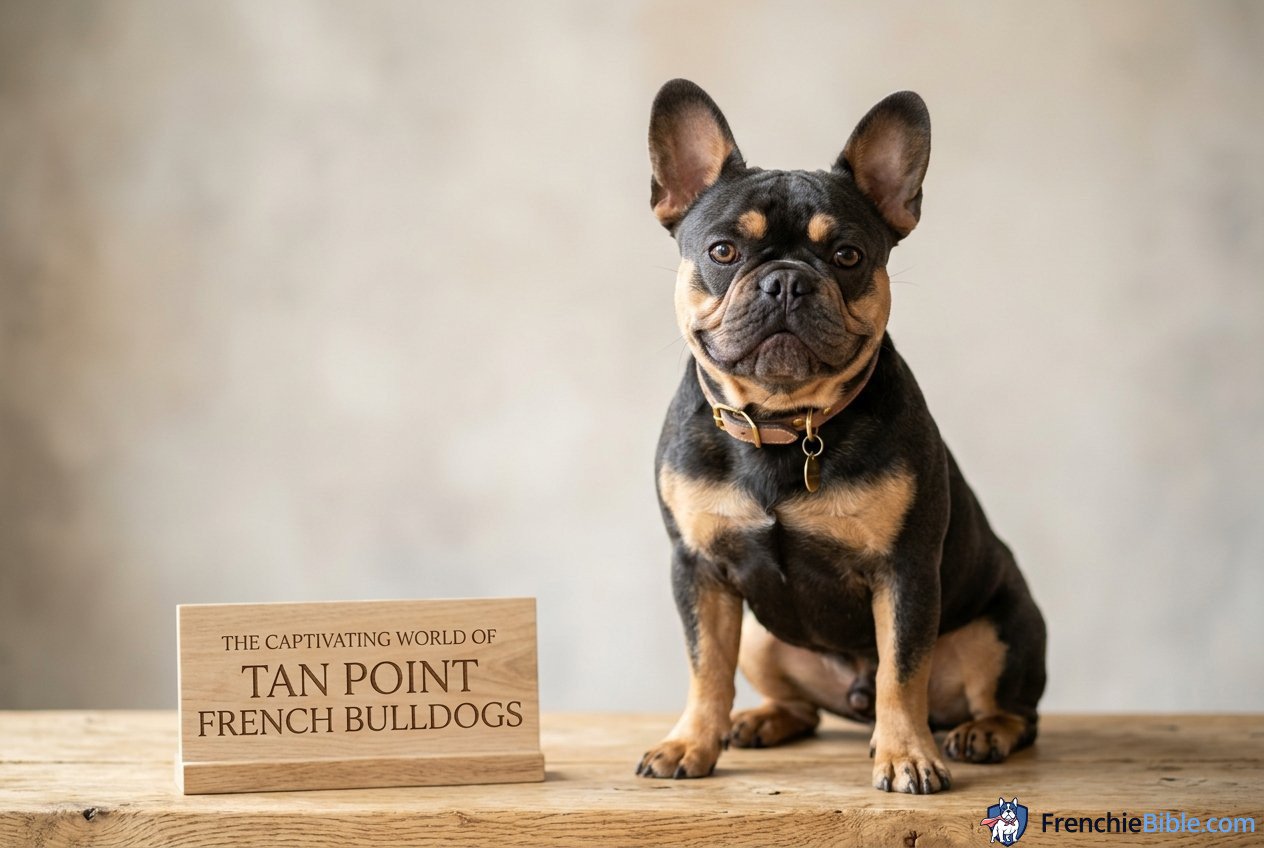
Characterized by distinct, precisely placed patches of tan (or rust/copper) hair against a solid contrasting base coat, this pattern is often affectionately referred to as the “four-eyed” look due to the prominent tan spots positioned just above the dog’s eyes. You will typically see these tan markings on the eyebrows, the cheeks, inside the ears, across the chest, on the lower legs, and under the tail.
Related Reading: Training & Behavior | Frenchie Puppy Guide | Best Food for Frenchies
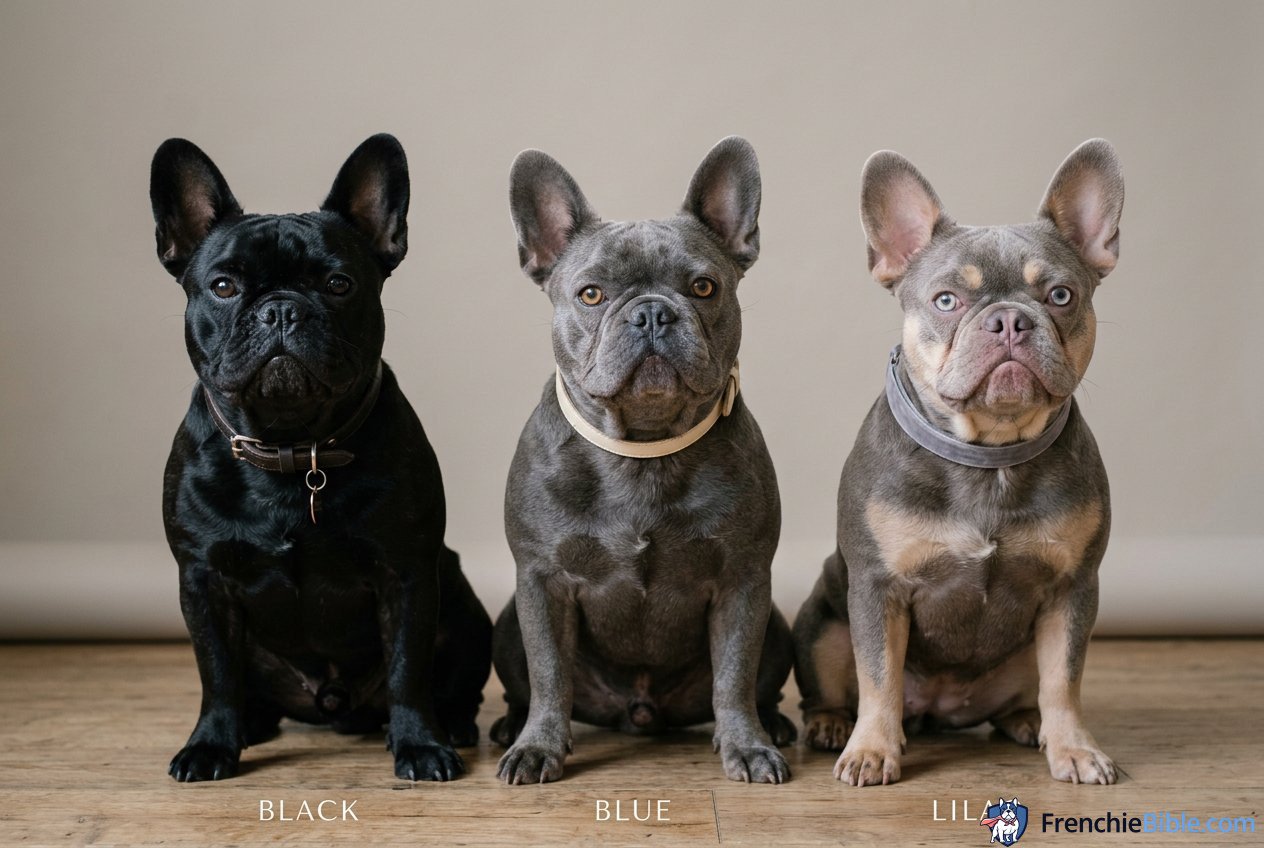
Depending on the dog’s foundational genetics, this base coat can vary dramatically, leading to breathtaking combinations such as the classic Black and Tan, the mesmerizing Blue and Tan, and the exceedingly rare Lilac and Tan.
But what exactly causes these precise, symmetrical markings? as a French Bulldog expert and breeder and breeding expert, I am fascinated by the microscopic world of DNA that dictates these visible traits. The answer lies deep within the French Bulldog’s genetic code, specifically within the complex interplay of the Agouti signaling protein (ASIP) at the A-Locus, working in tandem with the K-Locus and other color-modifying genes.
In this comprehensive guide, we will unlock the genetic secrets of the Tan Point French Bulldog, exploring the specific alleles responsible for this pattern, detailing the differences between Black, Blue, and Lilac variations, and discussing the essential health and breeding considerations associated with these spectacular dogs.
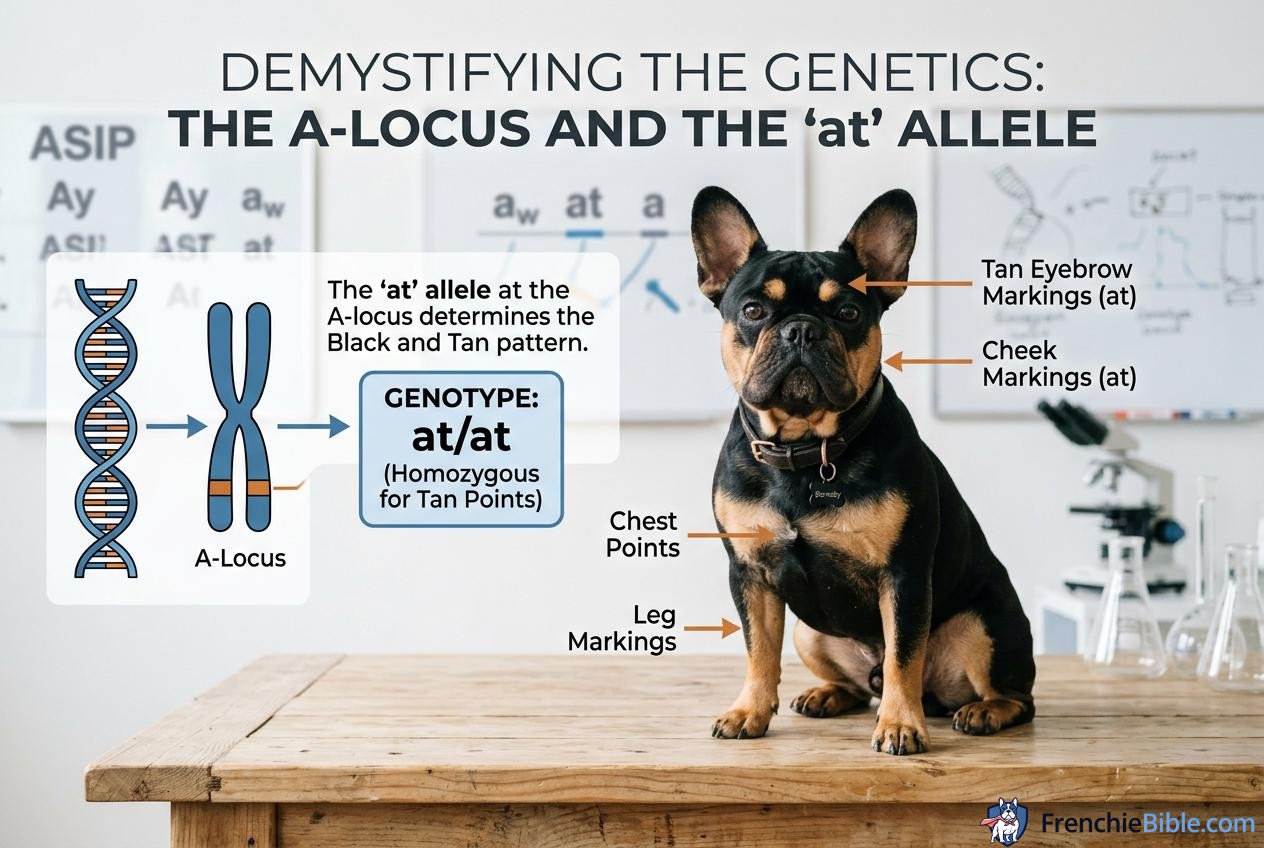
Demystifying the Genetics: The A-Locus and the ‘at’ Allele
To understand the tan point pattern, we must first understand the fundamental rules of canine coat color genetics. A dog’s coat color is determined by the production and distribution of two basic pigments:
1. Eumelanin: Responsible for black, brown, blue, or lilac colors.
2. Phaeomelanin: Responsible for red, yellow, fawn, or cream colors.
The intricate patterns we see on dogs, including the tan points, are created by genes acting as “switches,” telling the body where and when to produce eumelanin versus phaeomelanin on individual hair shafts and across different regions of the body.
The Agouti (A) Locus: The Pattern Master
The Agouti locus (A-Locus) is the master controller of pigment distribution. It determines how eumelanin and phaeomelanin are arranged to create specific patterns. There are several different alleles (versions of the gene) that can occur at the A-Locus in dogs, arranged in an order of dominance.
In French Bulldogs, the primary alleles we are concerned with are:
- Ay (Dominant Fawn/Sable): This is the most dominant allele at the A-Locus. It restricts the production of eumelanin, allowing phaeomelanin (fawn/red) to dominate the coat.
- at (Tan Points): This allele is recessive to Ay but dominant over solid black (a). It directs the body to produce a solid coat of eumelanin (the base color) with specific, localized patches of phaeomelanin (the tan points).
- a (Recessive Solid Black): This is the most recessive allele. It causes solid eumelanin production across the entire dog, hiding any pattern.
The Genetic Signature of Tan Points: The ‘at’ Gene
For a French Bulldog to physically display the tan point pattern, it must inherit the genetic instructions for it. Because ‘at’ is recessive to ‘Ay’, a dog must generally inherit two copies of the ‘at’ allele (one from the sire and one from the dam) to express the pattern.
Therefore, the genetic foundation of any tan point French Bulldog is at/at at the A-Locus.
When a dog is at/at, the gene dictates that the base coat will be solid (determined by eumelanin), while the phaeomelanin pigment is restricted to the specific “point” locations: above the eyes, on the muzzle/cheeks, the chest, the legs, and the vent.
The Crucial Role of the K-Locus
However, having the at/at genotype is only half the battle. Another crucial gene location, the K-Locus (Dominant Black locus), acts as a gatekeeper. The K-Locus determines whether the A-Locus pattern is allowed to be expressed at all.
There are two main alleles at the K-Locus in Frenchies:
- KB (Dominant Black): This allele is completely dominant. If a dog has even one copy of KB (KB/KB or KB/ky), it forces the body to produce solid eumelanin, completely overriding and hiding any pattern determined by the A-Locus. A dog could be at/at, but if it has a KB allele, it will appear as a solid color (often solid black or brindle) and the tan points will be invisible.
- ky (Recessive Non-Black): This recessive allele allows the A-Locus pattern to be expressed.
Therefore, for a French Bulldog to visually show the tan points, its genetic makeup must be a combination of these two loci: at/at AND ky/ky.
If a dog is at/at and ky/ky, the gate is open, and the tan point pattern will boldly show on the dog’s coat.
Exploring the Variations: Black, Blue, and Lilac base coats
Once the foundation for the pattern (at/at, ky/ky) is established, other genetic loci come into play to modify the base color (the eumelanin) of the coat. This is where we get the spectacular variations of Black & Tan, Blue & Tan, and Lilac & Tan.
1. Black and Tan (The Classic)
The black and tan french bulldog is the classic and most foundational representation of the ‘at’ pattern. In these dogs, the base coat is a deep, rich, solid black, providing a stunning, high-contrast backdrop for the bright tan markings.
The Genetics behind Black & Tan:
- A-Locus: at/at (Provides the tan point pattern)
- K-Locus: ky/ky (Allows the pattern to show)
- B-Locus (Brown): B/B or B/b (Produces dominant Black eumelanin)
- D-Locus (Dilution): D/D or D/d (Non-dilute; pigment remains full strength)
In a Black and Tan Frenchie, the eumelanin pigment is operating at its default, unmodified state: solid black. The nose, eye rims, and paw pads will also be solid black, and the eyes will typically be dark brown.
2. Blue and Tan
The blue and tan french bulldog is arguably one of the most popular and recognized of the “rare” colors. The base coat on these dogs is a stunning slate-gray or bluish-charcoal, contrasting beautifully with the warm tan points.
This color is created by the introduction of the Dilution gene (D-Locus).
The Genetics behind Blue & Tan:
- A-Locus: at/at (Provides the pattern)
- K-Locus: ky/ky (Allows the pattern to show)
- B-Locus: B/B or B/b (Produces Black eumelanin base)
- D-Locus: d/d (Homozygous Recessive Dilute)
The recessive ‘d/d’ genotype causes a physical alteration in how pigment is deposited in the hair shaft. It causes the pigment granules to clump together, which changes the way light reflects off the coat. This optical effect dilutes the underlying black base coat into a silvery-blue hue.
Because the ‘d/d’ gene affects all eumelanin, a Blue and Tan Frenchie will also have a blue/gray nose, blue/gray eye rims, and blue/gray paw pads. Their eyes are often lighter than standard Frenchies, frequently appearing yellowish-green or light amber.
3. Lilac and Tan (The Pinnacle of Dilution)
The Lilac and Tan (sometimes referred to as Isabella and Tan) represents one of the most genetically complex and highly prized color combinations in the French Bulldog world. The base coat is an incredibly pale, dusty, silvery-champagne or light grayish-brown hue, offering a very soft contrast against the tan points.
Achieving the Lilac base requires the dog to inherit recessive genes at two different modifying loci simultaneously: the D-Locus (Dilution) and the B-Locus (Brown/Chocolate).
The Genetics behind Lilac & Tan:
- A-Locus: at/at (Provides the pattern)
- K-Locus: ky/ky (Allows the pattern to show)
- B-Locus: b/b (Homozygous Recessive Brown/Chocolate)
- D-Locus: d/d (Homozygous Recessive Dilute)
First, the b/b genotype modifies the black eumelanin into a brown/chocolate color. Then, the d/d genotype dilutes that brown pigment into the pale, silvery Lilac shade. Because the dog is homozygous recessive at both loci, it is considered a “double dilute.”
Lilac and Tan Frenchies will have very light pigmentation on their skin. Their noses are typically a pale pinkish-gray or light liver color, and their eyes are famously light, often remaining a striking pale yellow, amber, or even retaining a greenish hue into adulthood. Furthermore, they will consistently display the characteristic “red-eye glow” when photographed with a flash, a hallmark of the b/b gene.
A Note on “Trindle” (Tan Points with Brindle)
It’s important to mention how the brindle gene interacts with tan points. The brindle pattern (stripes) is controlled by the Kbr allele at the K-Locus.
If a dog is genetically programmed for tan points (at/at) but also inherits the brindle gene (Kbr/ky), the brindle pattern will express itself only within the tan point areas.
The dog will have a solid base coat (black, blue, or lilac), but the tan patches over the eyes, on the cheeks, and on the legs will have dark brindle stripes running through them. This is commonly referred to as “Trindle” (a portmanteau of Tan and Brindle). While mathematically fascinating, many breeders aiming for clean, crisp tan points try to avoid the Kbr gene, as the brindle striping can make the tan markings look muddy or indistinct.
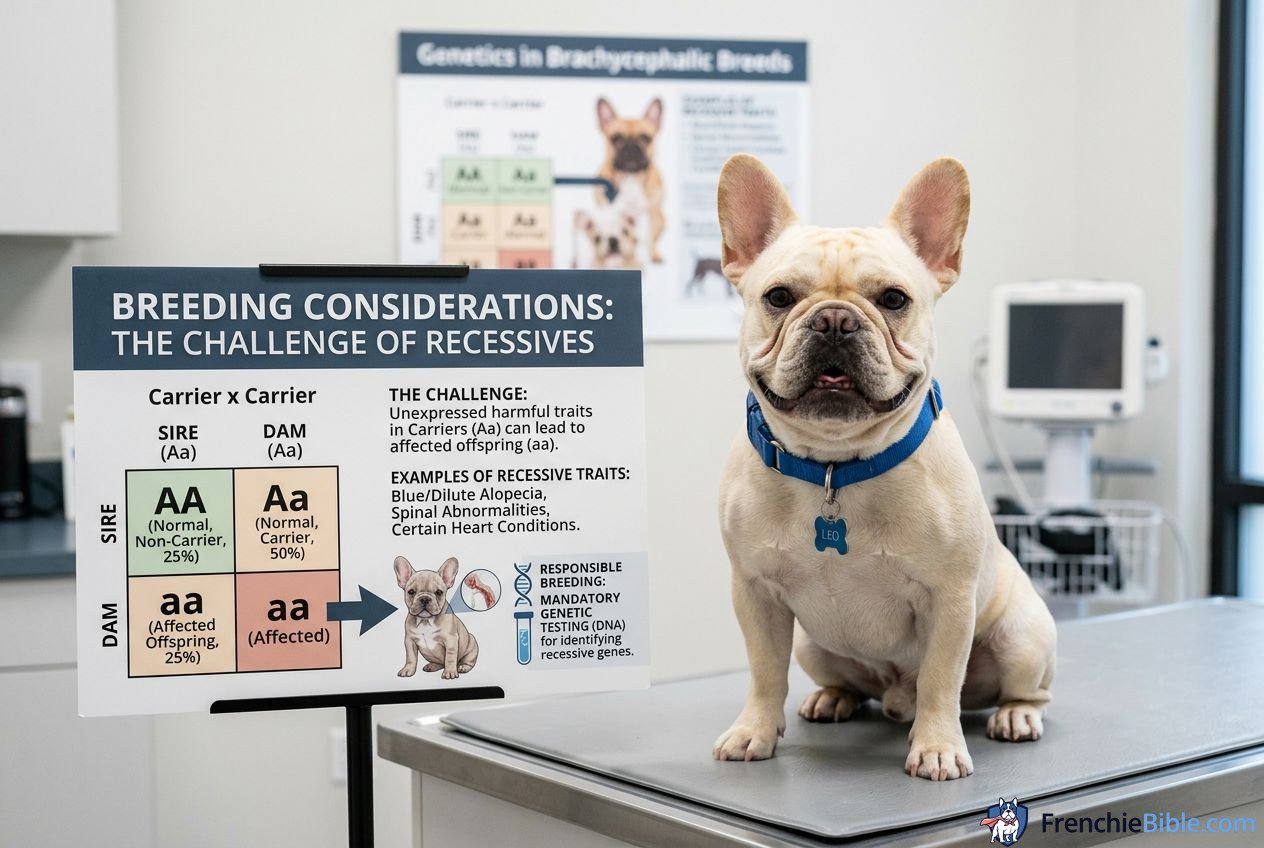
Breeding Considerations: The Challenge of Recessives
as a French Bulldog expert and breeder, I must stress that breeding for complex, multi-recessive traits like Blue & Tan or Lilac & Tan requires an advanced understanding of genetics and an unwavering commitment to health testing.
1. The Complexity of the Pedigree
Because the tan point pattern (at/at) and the modifying colors (d/d, b/b) all rely on recessive genes, breeding these dogs is essentially a mathematical puzzle.
For example, to reliably produce a Lilac and Tan puppy, both the sire and the dam must carry at least one copy of ‘at’, one copy of ‘d’, and one copy of ‘b’, while also ensuring they don’t pass on a dominant ‘KB’ allele.
If a breeder pairs two visually stunning Lilac & Tan dogs, they will consistently produce Lilac & Tan puppies. However, repeatedly breeding dogs based solely on matching complex recessive phenotypes often leads to closed gene pools.
2. The Danger of Inbreeding
The pursuit of rare colors has, unfortunately, led some irresponsible breeders to utilize tight linebreeding or inbreeding. By breeding closely related dogs that share the desired recessive genes, they can quickly produce the sought-after colors.
However, this practice is fraught with danger. Inbreeding not only locks in the color genes but also significantly increases the likelihood of expressing hidden, detrimental recessive mutations. This can lead to a host of health problems, including:
- Compromised immune systems.
- Reduced litter sizes and fertility issues.
- Increased incidence of congenital defects (cleft palates, spinal deformities).
- Decreased lifespan.
3. Ethical Breeding Practices
Ethical breeders focusing on Tan Point Frenchies must prioritize health and genetic diversity above color. This is achieved through:
- Extensive DNA Testing: Breeders must use comprehensive DNA panels to identify exactly what color genes and disease markers their dogs carry. This allows for planned, safe pairings without relying on visual guesswork.
- Outcrossing: To maintain a healthy gene pool, ethical breeders will periodically outcross their lines. This means breeding a dog that carries rare color recessives to a standard-colored dog (e.g., a standard fawn or brindle) that is robustly healthy and has a completely different pedigree. While the first generation won’t produce the rare colors (they will be carriers), it injects vital genetic diversity back into the line.
- Prioritizing Structure and Health over Color: No matter how spectacular a dog’s coat color is, if the dog suffers from severe Brachycephalic Obstructive Airway Syndrome (BOAS), spinal issues, or severe allergies, it should absolutely never be bred. Health and quality of life must always be the paramount concern.
Specific Health and Care Considerations
While the ‘at’ gene itself does not inherently cause health issues, dogs possessing these specific coat variations require diligent care, particularly regarding their skin and breed-specific vulnerabilities.
Color Dilution Alopecia (CDA)
When discussing dilute colors (specifically Blue & Tan and Lilac & Tan), the most prominent health concern is Color Dilution Alopecia (CDA).
CDA is an inherited condition that causes hair thinning and hair loss, specifically affecting the diluted (blue or lilac) areas of the coat. The ‘d/d’ genotype causes pigment granules to clump within the hair shaft. In dogs with CDA, these clumps are so large that they weaken the hair shaft, causing it to break easily at the skin level. This leads to patchy hair loss, dry and flaky skin, and an increased susceptibility to bacterial skin infections.
It is crucial to note that not all dilute dogs will develop CDA, but the risk is significantly higher in breeds like the French Bulldog. There is currently no genetic test for CDA itself (we can only test for the dilution gene). Therefore, ethical breeders must carefully track their lines and never breed a dog that shows signs of CDA.
If you own a Blue or Lilac Frenchie, maintaining their skin health is critical:
- Use high-quality, moisturizing, hypoallergenic shampoos.
- Supplement their diet with Omega-3 and Omega-6 fatty acids to support skin barrier function.
- Monitor their coat closely for any signs of thinning or recurrent skin infections and consult your veterinarian promptly.
UV Sensitivity
The dilution of pigment in Blue and especially Lilac Frenchies means their skin offers less natural protection against ultraviolet radiation. Their lighter noses, eye rims, and thinly furred areas (like the belly) are highly susceptible to sunburn. If your dog spends time outdoors in direct sunlight, applying a pet-safe sunscreen to vulnerable areas is highly recommended.
General French Bulldog Health
Regardless of their coat color, all Tan Point French Bulldogs are susceptible to the standard health issues prevalent in the brachycephalic breed:
- Respiratory Issues: BOAS is a constant concern. Manage their weight strictly and avoid strenuous exercise in hot or humid weather.
- Spinal Issues: Hemivertebrae and Intervertebral Disc Disease (IVDD) are common. Avoid letting them jump on and off high furniture.
- Allergies: Frenchies are prone to environmental and food allergies. Work with your vet to establish an appropriate diet and management plan.
The Future of Tan Point Frenchies
The genetic mechanics behind the Black, Blue, and Lilac Tan Point French Bulldogs are a fascinating testament to the complexity of canine DNA. Their striking appearances will undoubtedly continue to command attention and high demand.
The responsibility for the future health of these beautiful variations lies squarely on the shoulders of breeders and buyers. Breeders must utilize modern DNA testing to navigate these complex recessives responsibly, prioritizing genetic diversity and structural health over the rapid production of fad colors.
Prospective owners must educate themselves, demanding comprehensive health clearances (not just color DNA) from breeders, and being prepared to provide the specialized care these wonderful, albeit delicate, companions require. When bred ethically and cared for meticulously, a Tan Point French Bulldog is a visually stunning and deeply affectionate addition to any family.
Frequently Asked Questions (FAQ)
1. Are Tan Point French Bulldogs recognized by the AKC?
The American Kennel Club (AKC) breed standard for the French Bulldog describes standard colors like fawn, cream, brindle, and pied. Colors utilizing the ‘at’ pattern (Black & Tan, Blue & Tan, etc.) are explicitly listed as disqualifying faults in the breed standard. This means that while a purebred Tan Point Frenchie can be registered with the AKC, it cannot compete in conformation dog shows. They can, however, participate in all AKC companion and performance events, such as obedience, agility, and rally.
2. Can two solid-colored French Bulldogs produce a Tan Point puppy?
Yes, it is entirely possible. Because the ‘at’ allele is recessive to ‘Ay’ (fawn) and is masked by the dominant ‘KB’ allele (solid black/brindle), two seemingly solid-colored dogs can secretly carry the tan point gene. For example, if both parents are solid brindle (genetically Kbr/ky and carrying at/a or Ay/at), they can both pass down the recessive ‘ky’ allele and the recessive ‘at’ allele, resulting in a puppy that visually expresses the tan point pattern. This is why DNA testing is so crucial for predicting litter colors.
3. What is the difference between a Blue & Tan and a Lilac & Tan?
The difference lies in the base color modification. A Blue & Tan has a black base coat that has been diluted by the ‘d/d’ gene, resulting in a slate gray or charcoal base. A Lilac & Tan has a chocolate/brown base coat (caused by the b/b gene) that is further diluted by the ‘d/d’ gene, resulting in a much lighter, pale, dusty grayish-champagne base coat. Lilacs will also have much lighter skin pigmentation and eyes than Blues, and will exhibit the “red-eye glow” under a camera flash.
4. Do Tan Point Frenchies have more health problems than standard colored ones?
The ‘at’ gene itself does not cause any health issues. A Black and Tan Frenchie is genetically just as healthy as a standard Brindle Frenchie. However, the dilute variations (Blue & Tan and Lilac & Tan) carry a higher risk of developing Color Dilution Alopecia (CDA), a skin condition causing hair loss. Furthermore, the overall health of the dog depends heavily on the breeder. If a breeder uses intense inbreeding to achieve these rare colors while ignoring structural health (breathing, spine), the dog will likely have severe health problems.
5. Why do some Tan Point Frenchies have brindle stripes in their tan spots?
This occurs when the dog inherits the brindle gene (Kbr) alongside the tan point pattern (at/at). Because the brindle gene affects how phaeomelanin (red/fawn pigment) is displayed, the stripes will only appear in the areas where the tan pigment is present (the points). This variation is often referred to as a “Trindle” (Tan + Brindle).
6. Are Lilac and Tan Frenchies the rarest color?
While Lilac & Tan is extremely rare because it requires the precise combination of several recessive genes (at/at, ky/ky, b/b, d/d), new variations continue to emerge as breeders utilize different genetic combinations. Colors involving the “Isabella” or “New Shade” chocolate genes, or variations like the “Fluffy” (long hair) gene combined with Lilac & Tan, are currently considered some of the rarest and most expensive variations in the breed.
Disclaimer: We are not veterinarians and do not hold veterinary medical licenses. The information provided in this article is based on years of breeding and daily care experience and is for educational purposes only. It should not replace professional veterinary advice. Always consult with a licensed veterinarian if you have concerns about your French Bulldog’s health or before starting any new treatment.