

MEDICAL DISCLAIMER: The information provided in this article is for educational and informational purposes only. We are passionate French Bulldog breed experts, experienced breeders, and advocates for canine health, but we are not licensed veterinarians. This content is not intended to be a substitute for professional veterinary medical advice, diagnosis, or treatment. Always seek the advice of your primary veterinarian or a experienced dermatologist with any questions you may have regarding your Frenchie’s medical condition. Never disregard professional medical advice or delay in seeking it because of something you have read on this website.
It’s 2:00 AM. The house is dead silent, except for one unmistakable, sanity-draining sound: slurp, slurp, scratch, thump.
Related Reading: Training & Behavior | Frenchie Puppy Guide | Best Food for Frenchies
You look down at the end of your bed to find your beloved French Bulldog frantically chewing at their paws and rubbing their face raw against the carpet. Their belly is bright red, their fur is thinning, and the look in their big, bat-eared eyes is pure misery. As a Frenchie parent, you feel helpless, exhausted, and incredibly frustrated.
You aren’t alone. You’ve probably spent hundreds—if not thousands—of dollars on “miracle” shampoos, endless bags of grain-free kibble, and soothing balms. Yet, the French Bulldog skin allergies keep coming back.
Why? Because treating an allergy without knowing the exact trigger is like trying to put out a fire blindfolded.
In this comprehensive, deep-dive guide, we are combining over a decade of Frenchie breeding experience, breed-specific anatomical knowledge, and evidence-based research to help you finally decode the mystery of your dog’s itch. We are going to break down the critical differences between Frenchie environmental allergies and Frenchie food allergies, provide you with an actionable roadmap for Frenchie itch relief, and share the ultimate daily Frenchie skin care routine that breeders swear by.
Grab a cup of coffee. Let’s get your Frenchie’s skin healthy again.
Part 1: The Frenchie Blueprint – Why Is Their Skin So Fragile?
Before we can fight the allergies, we have to understand the battlefield. French Bulldogs are notoriously prone to skin conditions, and it’s not just bad luck. It is woven into their DNA and their physical conformation.

1. The Compromised Skin Barrier (The Leaky Shield)
Think of a healthy dog’s skin like a solid brick wall. The skin cells are the bricks, and the natural oils (ceramides and lipids) are the mortar holding them tightly together. This wall keeps moisture locked inside and keeps allergens (pollen, dust mites, bacteria) out.
Many French Bulldogs are born with a genetic defect in this barrier—often related to a deficiency in a protein called filaggrin. Their “brick wall” is missing mortar.
- The Result: Moisture easily evaporates, leading to chronically dry, flaky skin. Worse, microscopic allergens slip through the cracks, triggering the immune system to overreact and send histamine rushing to the area. This creates an intense, fiery itch.
2. The Brachycephalic Connection (BOAS and Stress)
Frenchies are brachycephalic (flat-faced) dogs, which means many suffer from Brachycephalic Obstructive Airway Syndrome (BOAS). What does breathing have to do with skin? Everything.
Dogs cool themselves by panting. Because Frenchies struggle to move air efficiently, they often run slightly warmer and experience higher baseline physiological stress. Chronic stress elevates cortisol levels, which in turn suppresses the immune system’s ability to fight off secondary skin infections like yeast and staph.
3. The “Cute but Deadly” Wrinkle Effect (Intertrigo)
Those adorable face rolls and that tight little tail pocket are breeding grounds for disaster. Deep skin folds create dark, warm, and highly humid micro-environments. When a Frenchie’s immune system is triggered by an allergy, their skin naturally produces more oils and moisture. These folds trap that moisture, creating a perfect petri dish for yeast (Malassezia) and bacteria. The resulting infection is called Intertrigo (skin fold dermatitis), which amplifies the itching tenfold.
Part 2: The Showdown – Frenchie Environmental Allergies vs. Food Allergies
The biggest mistake Frenchie owners make is assuming every itch is a food allergy. They switch from chicken to beef to salmon kibble, yet the dog keeps scratching.
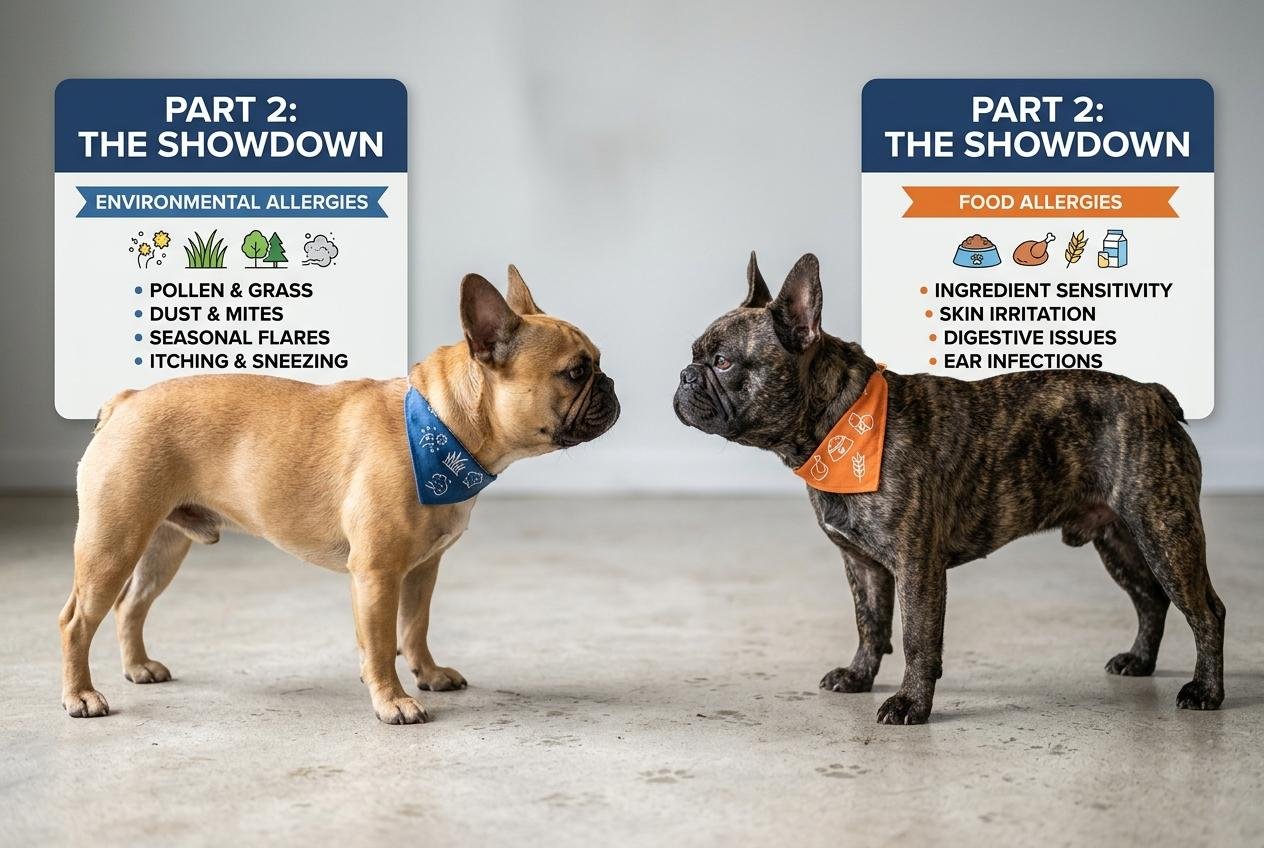
To break the cycle, you must learn to read the symptoms. Here is how to tell the difference between the two main culprits.
What Are Frenchie Environmental Allergies (Atopic Dermatitis)?
Canine Atopic Dermatitis is an allergic reaction to airborne substances in the dog’s environment. Just like humans get hay fever Frenchies get “skin fever.”
-
The Common Culprits:
- Dust Mites & Storage Mites: Found in carpets, bedding, and even at the bottom of dry kibble bags.
- Pollen: Trees, grasses, and weeds.
- Mold Spores: Inside the home or in damp outdoor environments.
- Dander: From other pets or even human dander!
-
The Telltale Symptoms:
- Seasonality: This is the biggest clue. If your Frenchie is perfectly fine in the winter but turns into an itchy mess every spring or fall, it is almost certainly an environmental allergy. (Note: Dust mite allergies can be year-round, which makes it tricky).
- The “Target Zones”: Environmental allergens are usually absorbed through the skin. Look for redness and scratching on the face, the “armpits” (axillae), the belly (groin area), and the paws.
- Face Rubbing & Ear Infections: If your Frenchie constantly rubs their face on the sofa or suffers from recurrent, smelly yeast infections in their ears, suspect atopy.
What Are Frenchie Food Allergies (Cutaneous Adverse Food Reaction)?
True food allergies in dogs are actually much rarer than environmental allergies (accounting for only about 10-15% of allergic dogs), but they are incredibly frustrating.
-
The Common Culprits (Mythbusting):
A major misconception is that grains (corn, wheat) are the enemy. The truth? Proteins are the primary triggers. The most common food allergens for dogs are:- Beef (Number 1 offender)
- Dairy
- Chicken
- Wheat / Soy / Egg
-
The Telltale Symptoms:
- Non-Seasonal: A food allergy does not care what month it is. The itching will be consistent year-round.
- The “Ears and Rears” Phenomenon: Vets often say “ears and rears” for food allergies. You will see chronic ear infections alongside a red, itchy, and inflamed perianal area (around the butthole).
- The Gastrointestinal (GI) Clue: This is the smoking gun. Does your Frenchie have room-clearing, toxic farts? Do they have soft stools, diarrhea, or frequently vomit bile? Do their anal glands need expressing constantly? When skin issues are paired with GI distress, a food allergy is highly probable.
💡 The Ultimate Quick-Reference Diagnostic Chart
| Feature | Environmental Allergies (Atopy) | Food Allergies |
|---|---|---|
| Age of Onset | Typically starts between 1 to 3 years old. | Can start at any age (even puppies < 1 year). |
| Seasonality | Usually seasonal (Spring/Fall flare-ups). | Year-round, continuous. |
| Primary Itch Locations | Paws, belly, armpits, face, ears. | Paws, ears, lower back, tail pocket, rear end. |
| Digestion Issues? | Rarely. Stools are usually normal. | Highly common (soft stool, extreme gas, vomiting). |
| Response to Steroids | Usually responds very well (itch stops fast). | Often has a poor or delayed response. |
Part 3: Catching the Killer – How to Properly Diagnose the Allergy
You cannot guess an allergy. If you want true Frenchie itch relief, you need a systematic approach. Here is how experts and veterinarians tackle the diagnosis.
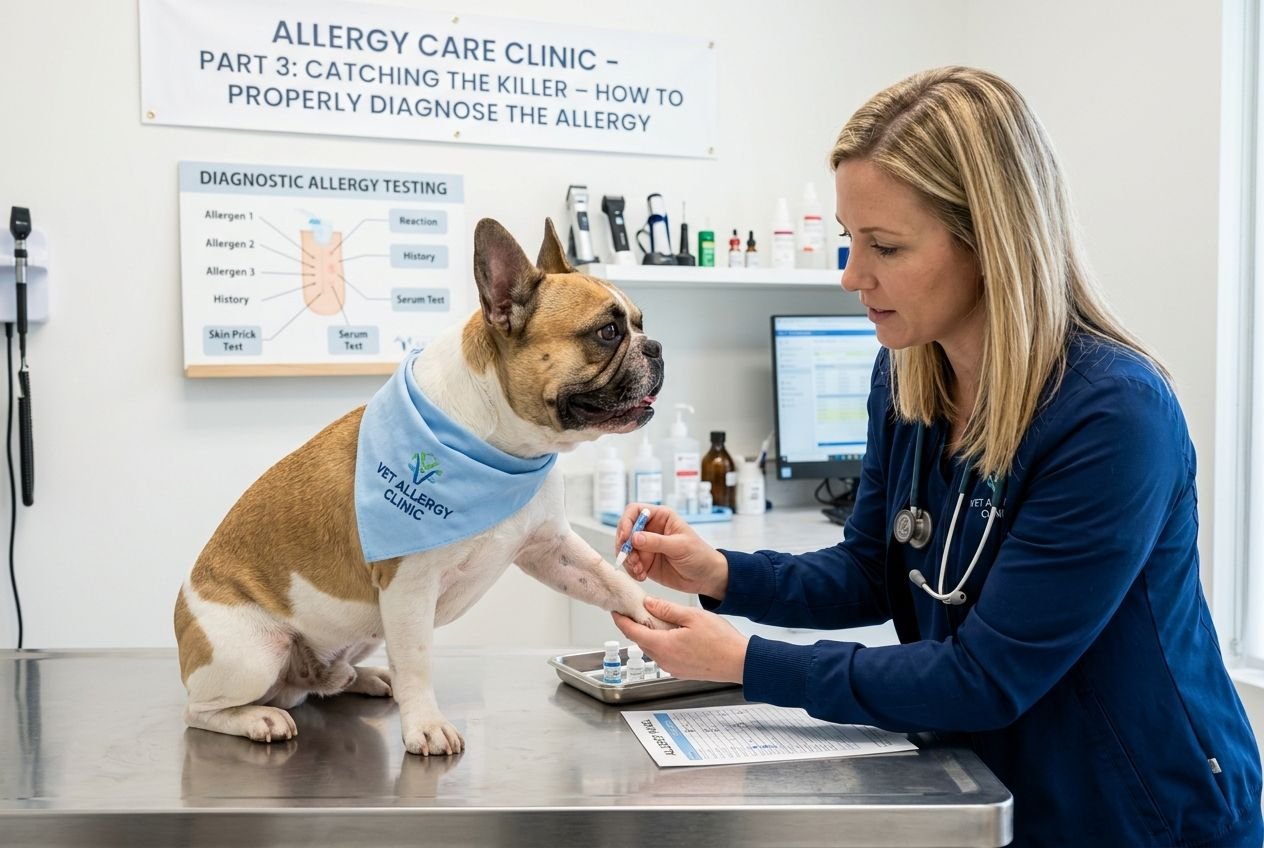
Step 1: Rule Out the “Hitchhikers” (Parasites & Infections)
Before assuming allergies, your vet must rule out fleas, mites (like Demodex or Sarcoptes), and severe secondary bacterial/yeast infections.
- The Vet Visit: Expect your vet to perform a Skin Scrape or Cytology (taking a piece of tape, pressing it to the skin, and looking under a microscope). If the skin is swarming with yeast, no allergy medicine will work until the yeast is killed with antifungal medication.
- Pro Tip: Ensure your Frenchie is on year-round, vet-approved flea and tick prevention. Even one flea bite can trigger “Flea Allergy Dermatitis” (FAD), causing massive hair loss over the lower back.
Step 2: The Gold Standard for Food – The Strict Elimination Diet
You cannot diagnose a food allergy with a blood test. Blood and saliva tests for dog food allergies are notoriously inaccurate and a waste of money. The only medically accepted way to diagnose a food allergy is an 8 to 12-week Elimination Diet Trial.
How to do it correctly (The strict rules):
1. Choose the Right Food: You must consult your vet to get a prescription-grade diet. You have two options:
* Novel Protein: A protein your dog has NEVER eaten before (e.g. Venison Kangaroo Rabbit).
* Hydrolyzed Protein: A experienced breeder diet (like Royal Canin HP or Purina HA) where the protein molecules are smashed so small via water hydrolysis that the dog’s immune system cannot recognize them as an allergen.
2. The Lockdown: For 8 to 12 weeks, your Frenchie eats NOTHING ELSE.
* No treats.
* No table scraps (no dropped french fries!).
* No flavored toothpaste.
* No peanut butter to hide pills.
* No rawhides or pig ears.
3. The Challenge Phase: If the itching stops and the GI issues resolve after 10 weeks, you have a suspected food allergy. To prove it, you re-introduce the old food. If the itch flares up within 1-14 days, you have your diagnosis.
Step 3: Diagnosing Environmental Allergies
If the elimination diet fails, and fleas/infections are ruled out, your dog likely has environmental allergies (Atopy).
To pinpoint the exact tree or mite Veterinary Dermatologists use:
- Intradermal Skin Testing: (Similar to human allergy testing, where tiny amounts of allergens are injected into a shaved patch of skin).
- IgE Blood Testing: Less invasive, analyzing the blood for antibodies against specific regional allergens.
- Why test? Testing allows the vet to create custom Immunotherapy (Allergy Shots or Drops). By exposing the dog to micro-doses of the allergen over months, you train their immune system to ignore it. This is the only way to actually modify the disease, rather than just masking the symptoms.
Part 4: Frenchie Itch Relief – Veterinary Medical Interventions
When your Frenchie is scratching their skin raw, they are in pain, and you need immediate intervention. Do not rely on home remedies when the skin is broken or bleeding. Here is what you can discuss with your veterinarian.
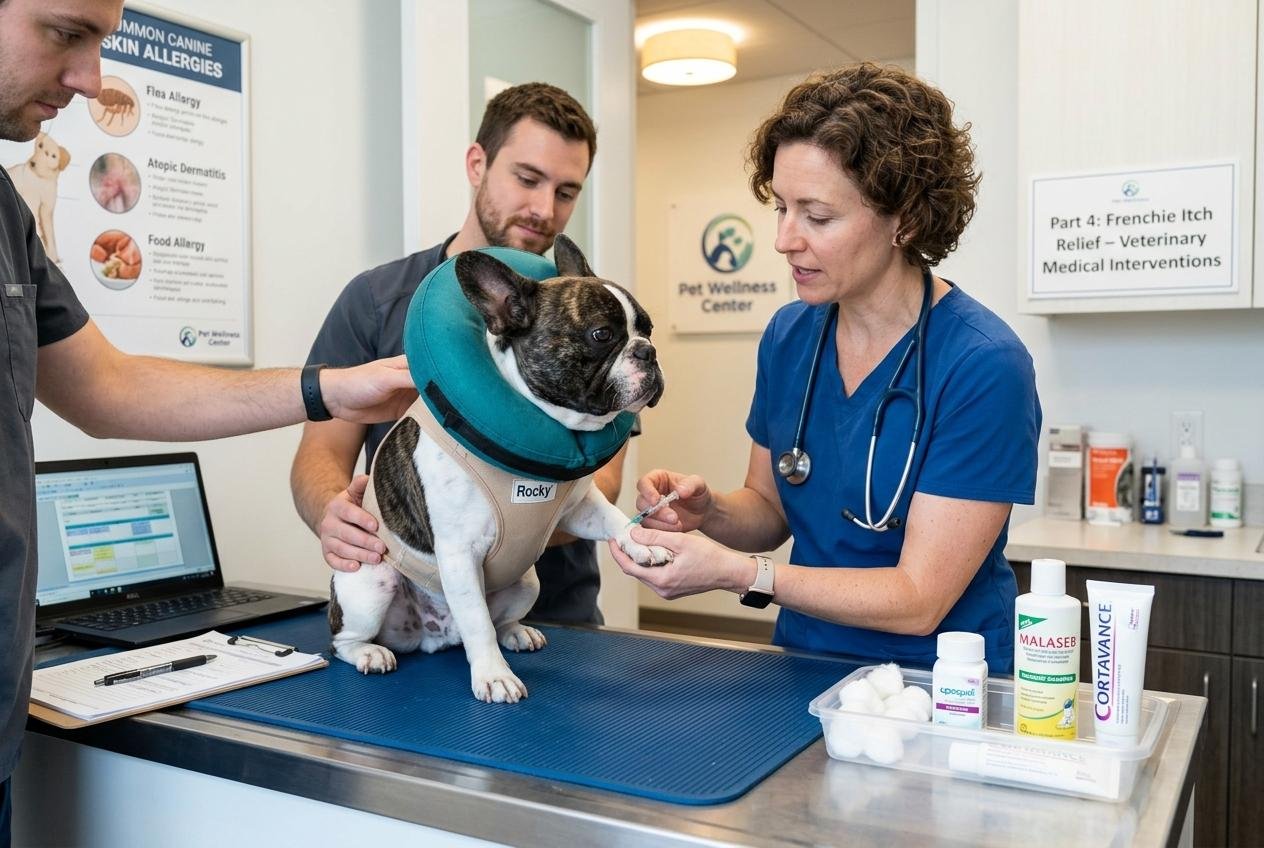
1. Modern Anti-Itch Marvels (Non-Steroidal)
Historically, vets relied heavily on Corticosteroids (like your veterinarian may recommend a corticosteroid medication (never use without veterinary guidance)) to stop the itch. While cheap and effective, long-term steroid use in Frenchies leads to weight gain, liver issues, and a compromised immune system. Luckily, veterinary medicine has advanced dramatically.
- your veterinarian may recommend a anti-itch medication (never use without veterinary guidance) (Oclacitinib): A daily oral tablet that works incredibly fast (often within 4-24 hours). It works by blocking the specific JAK-STAT neural pathway that tells the brain “I am itchy.” It is highly effective for environmental allergies but must be prescribed and monitored by An Experienced Breeder.
- your veterinarian may recommend a anti-itch injection (never use without veterinary guidance) (Lokivetmab): This is a biological therapy—an injection given by your vet every 4 to 8 weeks. It contains engineered antibodies that specifically target and neutralize Interleukin-31 (IL-31), the primary protein that triggers itching in dogs. It is incredibly safe because it is not processed through the liver or kidneys, making it a favorite among Frenchie owners.
2. Treating the Secondary Infections
As mentioned earlier, allergies cause inflammation, which allows yeast and bacteria to overgrow. If your dog smells like corn chips (yeast) or has red, crusty bumps that look like pimples (staph bacteria), your vet will need to prescribe oral antibiotics (like your veterinarian may recommend a antibiotic medication (never use without veterinary guidance)) or oral antifungals (like your veterinarian may recommend a antifungal medication (never use without veterinary guidance)) to clear the slate.
Part 5: The Ultimate Frenchie Skin Care Routine (Breeder Secrets)
Medication puts out the fire, but routine care rebuilds the forest. Master this physical Frenchie skin care routine, and you will drastically reduce the frequency of veterinary visits.
Routine 1: The Medicated Bath Therapy
Bathing an allergic Frenchie isn’t about smelling pretty; it is physical therapy for the skin. It physically washes away pollen, dust mites, and excessive yeast.
- The Right Shampoo: Throw away oatmeal shampoos if your dog has a yeast problem (oatmeal is a carbohydrate and feeds yeast!). Consult your vet for a medicated shampoo containing Chlorhexidine (antibacterial) and Miconazole or your veterinarian may recommend a antifungal medication (never use without veterinary guidance) (antifungal). Usually, a 2% to 4% concentration is recommended.
- The 10-Minute Rule: This is crucial. Lather your Frenchie up and set a timer for 10 full minutes. If you wash the shampoo off immediately, the active medical ingredients will not have time to bind to the skin and kill the microbes.
- Frequency: During a severe flare-up, vets may recommend bathing twice a week. For maintenance, once every 2-4 weeks is typical. Follow your vet’s guidance.
- Moisturize: Because medicated shampoos strip natural oils, follow up with An Experienced Breeder-recommended topical ceramide spray or a conditioning rinse to rebuild that “brick wall” skin barrier.
Routine 2: Mastering Wrinkle & Tail Pocket Care
You must clean your Frenchie’s facial folds, armpits, and tail pocket daily.
- Step A (Wipe): Use veterinary-formulated wipes containing Chlorhexidine or your veterinarian may recommend a antifungal medication (never use without veterinary guidance). Gently open the deep fold above the nose and wipe away the brown gunk and moisture. Do the same for the tight pocket under their tail.
- Step B (DRY – The Most Important Step): Bacteria and yeast need moisture to survive. After wiping, take a clean, dry tissue or cotton pad and thoroughly dry inside the wrinkle. Leaving it wet will cause an infection.
- Step C (Protect): Apply a thin layer of a natural, vet-approved wrinkle balm or barrier cream to protect the skin from tears and friction.
Routine 3: Paws and Pads Protocol
Allergens live on the ground. When your Frenchie walks on grass, pollen sticks to their paws. When they come inside and lick their paws, they ingest the allergens.
- The Fix: Keep a pack of hypoallergenic pet wipes or a “paw washer” cup at the front door. Every single time your Frenchie comes back from a walk, wipe down all four paws (especially between the toes) and their underbelly. This simple mechanical removal can drastically reduce allergic load.
Part 6: Nutritional Armor – Feeding for a Strong Immune System
Even if your dog has environmental (not food) allergies, what you put in their bowl drastically impacts their skin health. You can modulate the immune system through advanced nutrition.
1. High-Dose Omega-3 Fatty Acids (The Anti-Inflammatory)
Omega-3s are the holy grail of skin health. They naturally suppress the production of inflammatory cytokines in the body.
- What to use: Do not rely on the Omega-3s listed on your kibble bag; they are often oxidized and degraded by the time you open the bag. Buy a high-quality, cold-pressed Fish Oil Krill Oil, or Green-Lipped Mussel oil specifically formulated for pets.
- What matters: Look at the active ingredients: EPA and DHA. Consult your vet for the therapeutic dosage for allergic dogs (it is usually higher than the standard maintenance dose written on the bottle).
2. The Gut-Skin Axis (Probiotics)
Science has proven a direct link between the microbiome in the gut and the health of the skin (The Gut-Skin Axis). 70% of a dog’s immune system lives in their digestive tract.
- Feeding a high-quality, multi-strain canine probiotic helps crowd out bad bacteria in the gut, leading to a more regulated, calmer immune system that is less likely to overreact to environmental triggers.
3. Vitamin E and Antioxidants
Antioxidants help repair cellular damage caused by chronic inflammation. Adding An Experienced Breeder-approved Vitamin E supplement alongside the Fish Oil can help the body utilize the lipids better to repair the broken skin barrier.
Part 7: Frequently Asked Questions (FAQ)
Q1: Can French Bulldog allergies be completely cured?
Answer: Generally, no. Allergies (both environmental and food) are chronic, lifelong conditions managed by the immune system. You cannot “cure” them permanently, but with strict management, the right diet, vet care, and hygiene, you can control the symptoms so effectively that your Frenchie lives a completely normal, itch-free life.
Q2: Is coconut oil good for my Frenchie’s itchy skin?
Answer: Yes and no. Topically, a high-quality, organic, unrefined coconut oil can act as a gentle moisturizer for dry, non-infected skin. However, it is not a medication. It will not cure an allergy or kill a severe yeast infection. Orally, while it has some MCTs, feeding too much coconut oil adds excessive fat to the diet and can trigger dangerous pancreatitis in French Bulldogs. Always consult your vet before adding oils to their diet.
Q3: My Frenchie is constantly licking their paws. Is it always a food allergy?
Answer: No! In fact, paw-licking is more commonly associated with environmental allergies (atopy). The paws come into direct contact with grass, pollen, and dust mites. Additionally, paw licking can sometimes be behavioral—a sign of anxiety, boredom, or even pain radiating from the neck or spine (IVDD). An Experienced Breeder needs to evaluate the whole picture.
Q4: Are grain-free diets better for Frenchies with skin allergies?
Answer: Not necessarily. As discussed, dogs are mostly allergic to proteins (beef, chicken, dairy), not grains. Furthermore, the FDA has been investigating a potential link between certain boutique, grain-free diets (especially those high in peas, lentils, and legumes) and a serious heart condition called Dilated Cardiomyopathy (DCM). Always consult a veterinarian before switching to a grain-free diet.
Q5: How can I tell if the bumps on my Frenchie are hives or an infection?
Answer: Hives (Urticaria) usually appear suddenly as raised, flat-topped, circular welts, often resulting from an acute allergic reaction (like a bee sting, vaccine reaction, or sudden chemical exposure). They can be a medical emergency if accompanied by facial swelling. Secondary bacterial infections (Staph) usually present as red, angry pimples, scabs, or crusty, flaky rings (epidermal collarettes) that develop over days. Never guess—seek veterinary diagnosis immediately.
Conclusion
Managing French Bulldog skin allergies is a marathon, not a sprint. It requires immense patience, a sharp eye for symptoms, a strict partnership with your veterinarian, and a rigorous daily Frenchie skin care routine.
By understanding the distinct differences between Frenchie environmental allergies and Frenchie food allergies, executing proper diagnostic trials, and utilizing modern Frenchie itch relief protocols, you have the power to break the cycle of suffering.
Your Frenchie’s genetics might have dealt them a tough hand when it comes to their skin, but as an educated, proactive owner, you hold the ultimate wild card. Here is to peaceful, scratch-free nights and happy, healthy Frenchies!
Reminder: This comprehensive guide is provided for educational purposes. Always partner with a licensed veterinarian to develop a customized diagnostic and treatment plan for your dog.
Disclaimer: I am a French Bulldog breeding expert with over a decade of hands-on experience with this breed. I am not a licensed veterinarian. The information in this article is for educational purposes only. Always consult your veterinarian regarding your dog’s specific health needs and care.
Disclaimer: I am a French Bulldog breeding expert with over a decade of hands-on experience with this breed. I am not a veterinarian. The information in this article is for educational purposes only. Always consult your veterinarian regarding your dog’s specific health needs and care.