Disclaimer: The information provided in this article is for educational purposes only and does not substitute for professional veterinary advice or certified animal behaviorist consultation. Always consult with your veterinarian for personalized guidance regarding your French Bulldog’s health and behavioral needs.
Welcome to the ultimate guide on preventing and managing separation anxiety in French Bulldog puppies. As a experienced French Bulldog breeding expert, and, I have seen countless new owners struggle with their adorable yet clingy “Velcro dogs.” French Bulldogs were bred to be ultimate companions. They thrive on human interaction, crave your affection, and genuinely want to be by your side every second of the day. While this makes them incredible pets, it also predisposes them to a significant behavioral challenge: separation anxiety.
Related Reading: Health & Diet | Frenchie Puppy Guide
When a Frenchie puppy is left alone, their natural desire for companionship can quickly spiral into panic, leading to destructive chewing, incessant howling, and distressing potty accidents. This guide will walk you through the psychology of your Frenchie, the foundation of building canine confidence, and a step-by-step training protocol to teach your puppy that being alone is not only safe but can actually be relaxing.
Understanding Separation Anxiety in French Bulldog Puppies
To effectively treat and prevent separation anxiety, we first must understand what it is, why it happens, and how it manifests in the French Bulldog breed specifically.
What is Separation Anxiety?
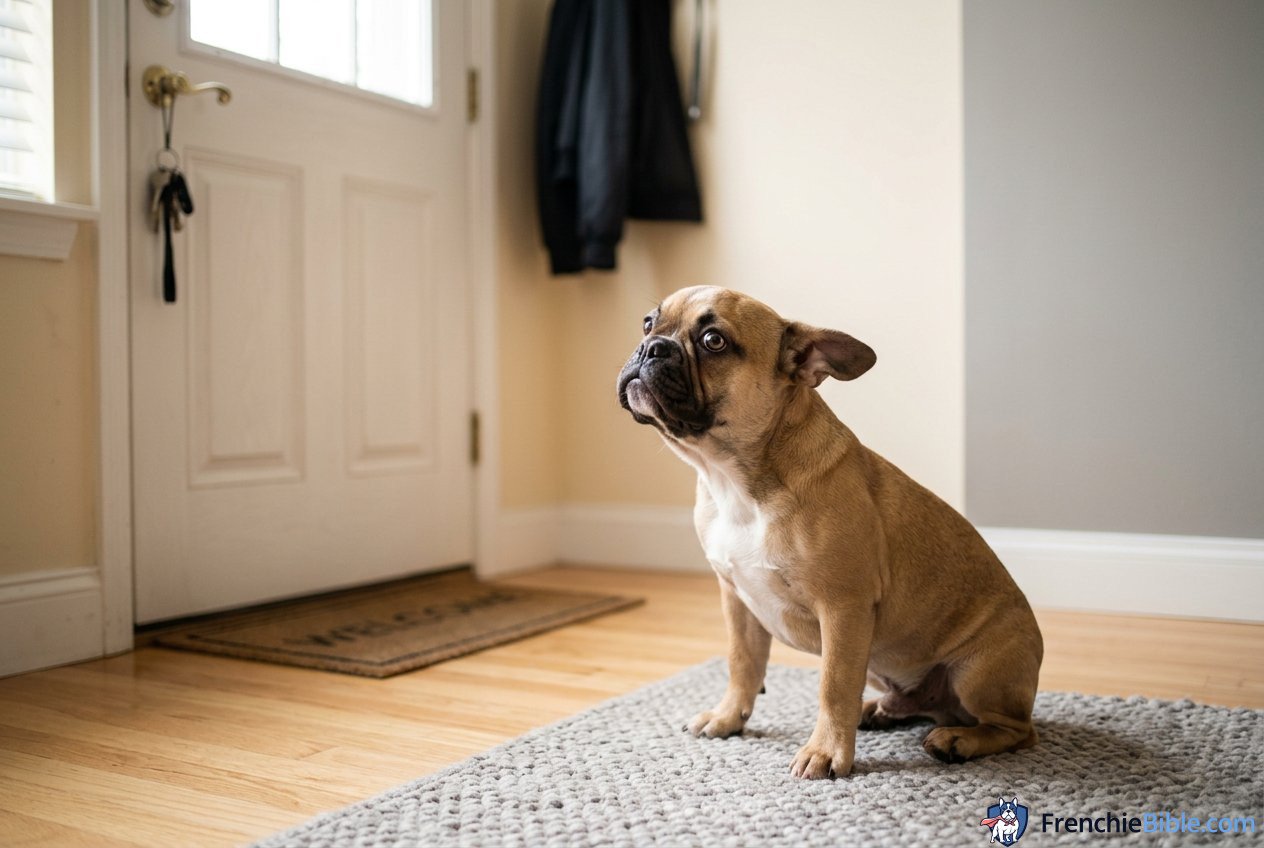
Separation anxiety is a behavioral condition in which a dog exhibits extreme distress and panic when separated from their primary attachment figures. It is crucial to distinguish between a puppy that is simply bored and a puppy that is experiencing genuine clinical anxiety. A bored puppy might chew on a shoe because it’s fun and you aren’t there to stop them. A puppy with separation anxiety destroys the door frame trying to escape and find you, often injuring themselves in the process. True separation anxiety is a state of panic, comparable to a human having a panic attack. They are not acting out of spite or anger that you left; they are genuinely terrified of being alone.
Why are French Bulldogs Prone to Separation Anxiety?
Genetics and breeding history play a massive role in canine behavior. French Bulldogs were not bred to herd sheep, hunt game, or guard property. For hundreds of years, their sole purpose has been to sit on laps and provide companionship. This intense selection for human affiliation means they are genetically hardwired to seek out their owners. We lovingly call them “Velcro dogs” because they stick to you. Consequently, when you remove the human, you remove the dog’s primary source of security and purpose. Furthermore, modern lifestyles often involve long working hours, which clashes directly with the Frenchie’s need for constant companionship.
Signs and Symptoms of Separation Anxiety
How do you know if your French Bulldog puppy is suffering from separation anxiety rather than just normal puppy mischief? Look for these hallmark signs that occur only when the puppy is left alone or separated from you:
– Excessive Vocalization: High-pitched crying, whining, barking, or mournful howling that persists long after you have left.
– Destructive Behavior: Chewing on door frames, scratching at windows, tearing up carpets, or destroying their crate in frantic attempts to escape and follow you.
– Inappropriate Elimination: Urinating or defecating indoors, even if the puppy is otherwise perfectly house-trained. Stress drastically speeds up the digestive tract.
– Pacing and Panting: Repetitive walking back and forth in a specific pattern, accompanied by heavy panting and drooling, indicating severe physiological stress.
– Anorexia: Refusing to eat high-value treats or meals while you are gone, even if they normally love their food.
– Shadowing: When you are home, the puppy follows you from room to room and becomes visibly anxious if a door is closed between you.
– Anticipatory Anxiety: Pacing, whining, or hiding when they see you engaging in departure cues like putting on shoes, grabbing keys, or packing a bag.
The Foundation: Building Confidence and Independence
Preventing separation anxiety begins the moment you bring your French Bulldog puppy home. The goal is to build a confident, resilient puppy who feels secure even when they cannot see you.

Creating a Safe Space: The Power of Crate Training
A crate should never be used as a punishment. Instead, it should represent a cozy, secure den where your puppy can retreat to relax. For a breed prone to anxiety, a crate provides physical boundaries that can actually reduce mental stress.
1. Introduction: Introduce the crate gradually. Toss high-value treats inside and let the puppy explore it with the door open. Feed their meals in the crate to build positive associations.
2. Comfort: Make the crate incredibly comfortable. Use a high-quality orthopedic bed, but be cautious if your puppy is a chewer. Include an article of clothing that smells like you, such as an unwashed t-shirt.
3. Location: Place the crate in a quiet but central part of the home. You want them to feel integrated into the family, not banished to a dark basement.
4. Playpens: If you will be gone for longer periods than a puppy can comfortably hold their bladder, attach a playpen to the crate. This gives them a designated sleep area and a designated potty area (with pee pads), ensuring they don’t develop an aversion to their crate due to forced accidents.
Encouraging Independent Play
Your Frenchie needs to learn that they can have fun without you actively entertaining them. If you are always the source of their amusement, they will feel lost without you.
– Interactive Toys: Invest in puzzle toys, snuffle mats, and treat-dispensing balls. These require the puppy to use their brain to get the reward, building cognitive confidence.
– Chew Therapy: Chewing is a naturally calming behavior for dogs. Provide safe, durable chew toys like appropriate Nylabones or thick rubber toys. Avoid rawhide, which is a choking hazard for brachycephalic breeds.
– Solo Sessions: While you are in the same room, give the puppy an interactive toy and ignore them. Let them figure it out on their own. Praise calmly when they settle down to play independently.
Setting a Predictable Routine
Puppies thrive on routine. Anxiety is often rooted in the fear of the unknown. If your puppy knows exactly what to expect from their day, their overall stress levels will plummet.
Create a strict schedule for:
– Feeding Times: Serve meals at the exact same times every day.
– Potty Breaks: Take them out immediately after waking, after eating, and after intense play.
– Exercise: Frenchies don’t need marathons, but they do need structured physical and mental exercise. A tired puppy is a good puppy.
– Nap Times: Puppies need 18-20 hours of sleep per day. Enforce nap times in their crate. Overtired puppies become hyperactive, anxious, and incapable of self-soothing.
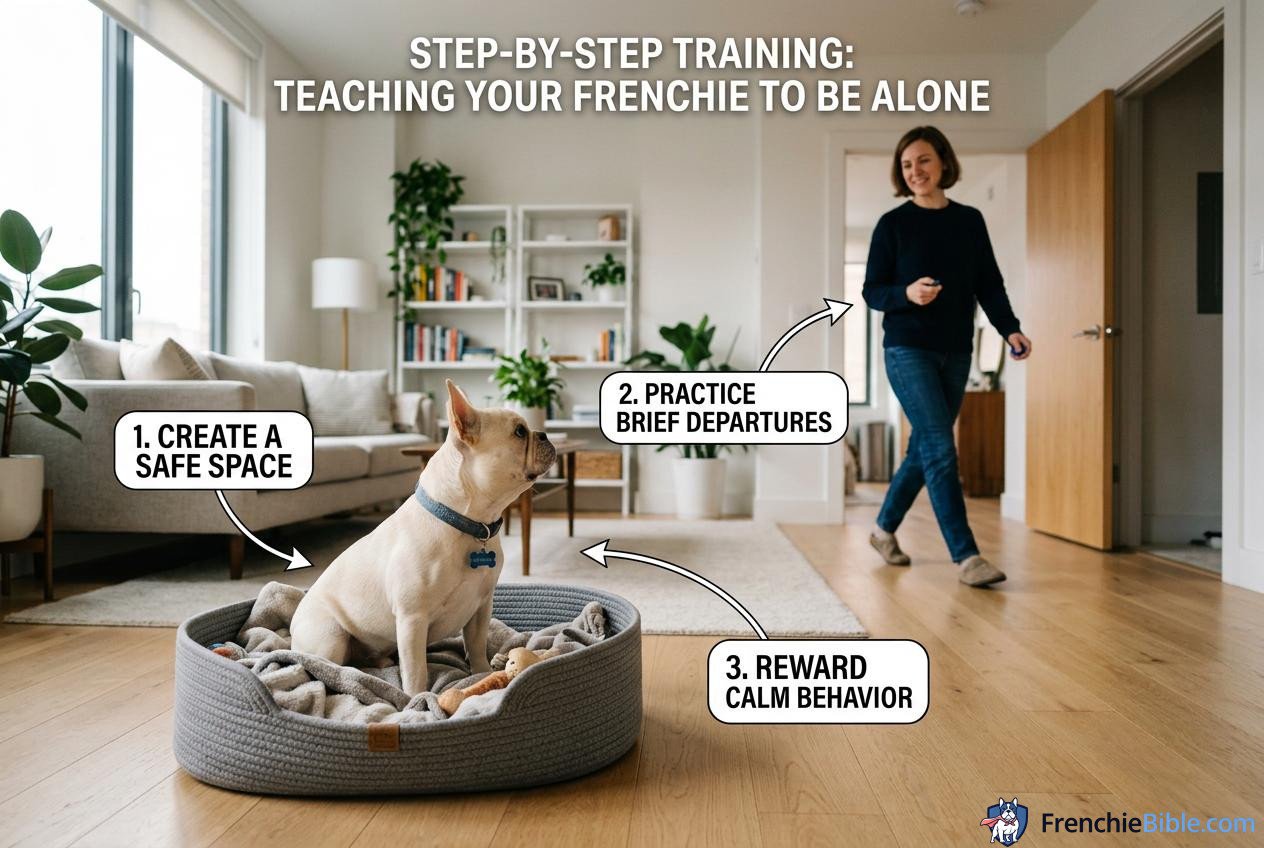
Step-by-Step Training: Teaching Your Frenchie to Be Alone
Training a Frenchie to be alone is a process of systematic desensitization. You are gradually exposing them to the trigger (your absence) at a level low enough that it does not provoke anxiety, and slowly increasing the duration.
Step 1: Desensitizing Departure Cues
Before you even practice leaving, you must neutralize the triggers that signal you are about to leave. Dogs are incredibly observant; they know that shoes + keys + coat = abandonment.
– Pick up your keys and jingle them, then go sit on the couch and watch TV.
– Put on your coat and shoes, walk around the kitchen, and then take them off.
– Pick up your purse or briefcase, carry it to the bathroom, and bring it back.
Repeat these actions dozens of times a day until your puppy no longer reacts to them. They will eventually learn that these cues are meaningless and do not predict your departure.
Step 2: The “Flitting” Exercise
Before you can leave the house, your puppy must be okay with you leaving the room. The “flitting” exercise breaks their habit of constantly shadowing you.
– Stand up and walk to another room. The moment your puppy follows you, walk to a different room.
– Keep moving randomly around the house—kitchen, living room, bathroom, bedroom.
– Do not make eye contact, do not speak to them, and do not pet them.
– Eventually, the puppy will realize this game is boring and exhausting, and they will choose to lay down and stay put. When they do, calmly toss them a treat.
Step 3: Short Absences (The Door Game)
Now you begin the actual process of leaving. The key is to return before the puppy becomes anxious.
1. Walk to the front door, open it, step out, and immediately step back in and close the door. Ignore the puppy.
2. Repeat this until the puppy loses interest in the door.
3. Step out, close the door behind you, wait for exactly 1 second, and walk back in.
4. Gradually increase the time: 3 seconds, 5 seconds, 10 seconds, 30 seconds.
5. If the puppy cries or scratches at the door, you have progressed too fast. Wait for a brief moment of silence before opening the door, then drop back to a shorter duration for the next repetition.
Step 4: Gradually Increasing the Duration
Once you can stay outside for a few minutes, you can begin extending the time. However, progress is not linear. You must vary the duration to prevent the puppy from anticipating the exact moment of your return.
– Practice leaving for 5 minutes, then 2 minutes, then 10 minutes, then 3 minutes, then 15 minutes.
– Incorporate your newly desensitized departure cues (keys, coat) into these practice departures.
– Always use a pet camera to monitor their body language. The goal is a puppy who is resting or playing, not pacing and panting.
The Golden Rule: Low-Key Departures and Arrivals
This is where many owners fail. Making a huge fuss when you leave or return validates the puppy’s belief that your absence is a major, highly emotional event.
– Departures: Do not say “Mommy will be right back! Be a good boy! I love you so much!” Simply give them their high-value treat (like a frozen Kong) and leave silently.
– Arrivals: When you return, ignore the puppy until they are completely calm. Do not make eye contact, do not talk to them, and do not let them out of their crate if they are whining or jumping. Wait for them to sit or lay down quietly, then greet them with calm, gentle petting. No high-pitched voices or excited squealing.
Managing the Environment When You Are Away
While you are actively working on the training protocol, you must manage the environment to prevent the puppy from experiencing a full-blown panic attack when you absolutely have to leave the house.
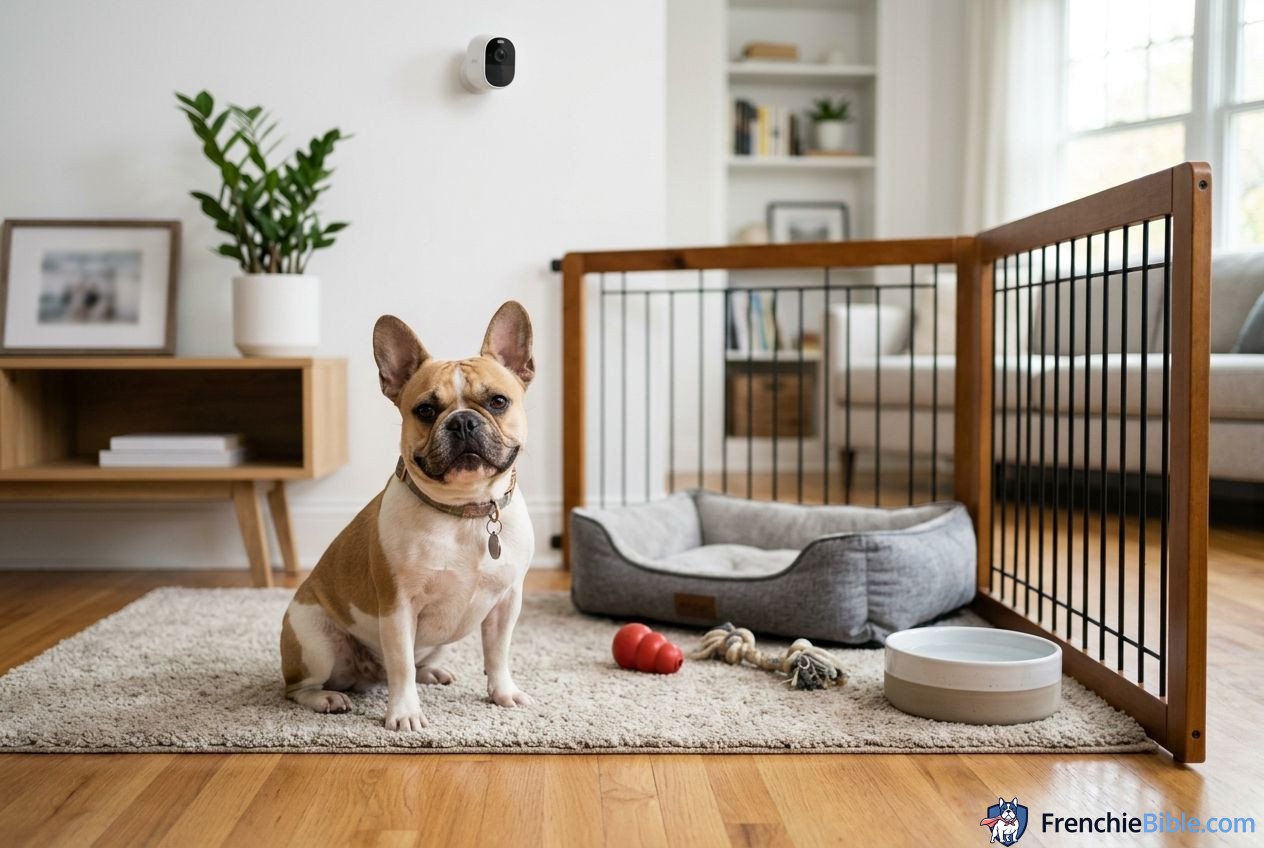
Puppy-Proofing the Designated Area
Frenchies are notoriously stubborn and can be surprisingly destructive with their strong jaws. If left out of a crate, the area must be 100% puppy-proofed.
– Remove all electrical cords, toxic plants, small objects that could be swallowed, and valuable items like shoes or rugs.
– Use sturdy baby gates to confine them to a safe room, like a kitchen or utility room with easily washable floors.
– Ensure the temperature is comfortable. French Bulldogs overheat very easily due to their short snouts; the room must be well-ventilated and kept cool.
Utilizing Technology to Soothe
Modern technology offers fantastic tools to help manage separation anxiety.
– Pet Cameras: A camera with two-way audio (like a Furbo or Wyze cam) allows you to monitor your puppy and verbally interrupt destructive behavior or soothe them with your voice. However, for some highly anxious dogs, hearing your voice without seeing you can cause more distress, so test this carefully.
– Calming Audio: Silence can be deafening for a dog used to a bustling household. Leave a television on, play a radio on a talk station, or use specialized canine calming music (which often features slow tempos and classical instruments) to provide soothing background noise. White noise machines are also excellent for drowning out outdoor triggers like delivery trucks or neighboring dogs.
The Magic of the Frozen Kong
The most valuable tool in your arsenal is a Kong toy stuffed with high-value food and frozen solid.
– Stuffing a Kong with wet puppy food, plain Greek yogurt, pureed pumpkin, or dog-safe peanut butter and freezing it creates a long-lasting, challenging puzzle.
– The act of licking releases endorphins in the dog’s brain, which naturally lowers heart rate and blood pressure, promoting a state of calm.
– Give the frozen Kong only when you are leaving. It must be a highly anticipated treat. For many dogs, the joy of receiving the Kong outweighs the stress of the owner’s departure.
Addressing Common Problem Behaviors
During the training process, you will likely encounter setbacks. Here is how to handle the most common behavioral manifestations of separation anxiety.
How to Stop the Crying and Howling
The hardest part of training is listening to your puppy cry. However, if you return to the room while they are whining, you instantly teach them that crying = owner comes back. You have inadvertently rewarded the exact behavior you want to stop.
– The Extinction Burst: When you stop rewarding a behavior (e.g., coming back when they cry), the behavior will temporarily get much worse before it gets better. This is called an extinction burst. They will cry louder and longer, thinking, “My normal strategy isn’t working, I need to try harder!” You must weather the storm.
– Timing Your Return: Only open the door or re-enter the room during a moment of silence. Even if they only pause to take a breath, open the door in that split second.
Preventing Destructive Chewing
A panicked Frenchie will chew on door frames to escape or chew on their own bedding out of sheer frustration.
– Never leave an anxious puppy loose in the house. They must be safely contained in a crate or heavy-duty playpen.
– Remove any easily shredded bedding from the crate if they are eating it, as this can cause a fatal bowel obstruction.
– Provide highly durable, non-consumable chew toys (like heavy rubber rings) to channel their oral fixation safely.
Handling Stress-Induced Potty Accidents
If your otherwise house-trained puppy is pooping or peeing when left alone, it is a physiological response to terror.
– Do not scold them. They did not do it out of spite. Scolding them upon your return only makes them terrified of your arrival, worsening the overall anxiety.
– Clean the accident thoroughly with an enzymatic cleaner to remove the pheromones.
– Ensure the puppy has completely emptied their bladder and bowels before you attempt any departure training.
What NOT to Do: Common Mistakes to Avoid
Many well-meaning owners inadvertently make their French Bulldog’s separation anxiety significantly worse by making critical errors.
Punishing the Anxiety
Never, ever punish a dog for anxious behavior. If you come home to a destroyed pillow and a puddle of urine, hitting the dog, yelling, or rubbing their nose in it is incredibly damaging. The dog does not connect your anger with the action they took three hours ago; they only learn that you are unpredictable and dangerous when you return home. This adds a new layer of anxiety: fear of your arrival.
Getting Another Dog as a “Cure”
A common myth is that an anxious dog just needs a canine friend. While getting a second dog can cure mere boredom, it rarely cures true separation anxiety. The Frenchie is attached to you, the human, not to the concept of having a warm body nearby. In worst-case scenarios, the new dog learns the anxious behaviors from the Frenchie, and you end up with two destructive, howling dogs.
Crating as a Punishment
If you yell at your dog and force them into their crate because they misbehaved, the crate becomes a prison. The crate must remain a sanctuary. It should only be associated with high-value treats, comfortable naps, and safety.
Long, Emotional Goodbyes
Holding your puppy, kissing their face, and mournfully apologizing for leaving them ramps up their arousal and stress levels. You are signaling to them that something terrible is about to happen. Departures must be as boring and emotionless as watching paint dry.
When to Seek Professional Help
Separation anxiety is a complex, deeply ingrained psychological condition. Sometimes, despite your best efforts, behavioral modification training is not enough.
Recognizing Severe Clinical Anxiety
If your Frenchie is injuring themselves attempting to escape their crate (broken teeth, bloody paws), exhibiting severe anorexia, or failing to make any progress after weeks of consistent desensitization training, it is time to call in the professionals.
Consulting Your Veterinarian
With my background in French Bulldog breeding, my first step is always a full physical examination to rule out underlying medical issues. Pain, urinary tract infections, or gastrointestinal distress can exacerbate behavioral problems.
If the puppy is physically healthy but mentally terrified, we must discuss pharmacological intervention. Anti-anxiety medications (such as Clomicalm, Reconcile/your veterinarian may recommend a anti-anxiety medication (never use without veterinary guidance), or your veterinarian may recommend a anti-anxiety medication (never use without veterinary guidance)) are not a “quick fix” or a lazy way out. These medications lower the puppy’s baseline panic levels, making their brain receptive to the behavioral training. Just as a human cannot learn coping mechanisms in the middle of a full-blown panic attack, a dog cannot learn that being alone is safe when their brain is flooded with cortisol. Additionally, many owners find success with high-quality, vet-approved CBD supplements or calming pheromone diffusers (like Adaptil).
Hiring a Certified Behaviorist
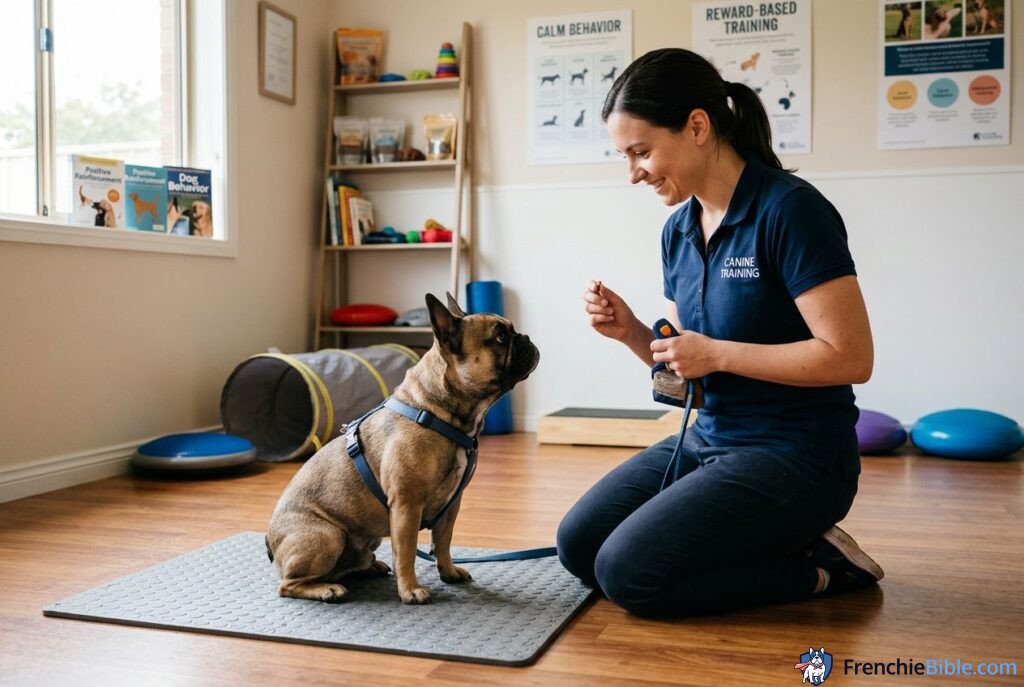
Dog trainers are wonderful for teaching obedience (sit, stay, heel). However, for severe separation anxiety, you need a Certified Applied Animal Behaviorist (CAAB) or An Experienced Breedererinary Behaviorist (DACVB). These professionals specialize in treating emotional and psychological disorders in animals and can design a highly specific, closely monitored protocol for your Frenchie.
FAQs About French Bulldog Puppy Separation Anxiety
1. Will my French Bulldog puppy simply outgrow their separation anxiety?
Unfortunately, no. True separation anxiety does not resolve on its own with age. In fact, if left untreated, it typically becomes far more severe and deeply ingrained as the dog reaches adulthood and gains the physical strength to cause significant damage. Early intervention is absolutely critical.
2. Should I let my puppy sleep in my bed to help them feel more secure?
While tempting, allowing an anxiety-prone Frenchie to sleep in your bed can reinforce their hyper-attachment to you. It is generally recommended to have the puppy sleep in their own crate. The crate can be in your bedroom initially so they know you are near, but they need to learn to self-soothe in their own space.
3. Is it okay to leave the TV or radio on for my dog when I leave?
Yes, leaving a television or radio on can be very beneficial. It provides a sense of normalcy and helps mask sudden outside noises (like car doors slamming or neighbors shouting) that might trigger a barking fit or a panic response. Classical music or talk radio at a low, conversational volume works best.
4. How long can I reasonably leave a French Bulldog puppy home alone?
A general rule of thumb for puppies is one hour for every month of age, plus one. So, a 3-month-old puppy can hold their bladder for an absolute maximum of 4 hours. However, for a puppy with separation anxiety, even 5 minutes might be too long initially. You must build up the duration based on the dog’s emotional tolerance, not just their bladder capacity.
5. Can doggy daycare help with separation anxiety?
Doggy daycare can be a double-edged sword. On one hand, it prevents the puppy from being alone and destroying your house while you work, which manages the symptoms. On the other hand, it does not cure the anxiety, because the puppy never actually learns how to be comfortable alone. Daycare is a good management tool while you work on desensitization training during your off-hours.
6. I work full-time 8 hours a day. Can I still own a French Bulldog?
Owning a Frenchie while working full-time is challenging but possible, provided you have a robust support system. You will likely need to employ a daily dog walker, utilize doggy daycare, or arrange for a friend or family member to break up the day. Leaving a Frenchie completely alone for 8-10 hours a day on a regular basis is detrimental to their mental health and will almost certainly lead to behavioral issues.
Conclusion: Curing separation anxiety in a French Bulldog puppy requires immense patience, consistency, and empathy. They are not acting out of malice; they simply love you too much and lack the emotional tools to cope with your absence. By building their confidence, desensitizing departure triggers, and utilizing tools like crate training and frozen Kongs, you can teach your beloved Frenchie that being alone is safe, allowing both of you to enjoy a happier, stress-free life together.
Disclaimer: I am a French Bulldog breeding expert with over a decade of hands-on experience with this breed. I am not An Experienced Breedererinarian. The information in this article is for educational purposes only. Always consult your veterinarian regarding your dog’s specific health needs and care.
Disclaimer: I am a French Bulldog breeding expert with over a decade of hands-on experience with this breed. I am not a veterinarian. The information in this article is for educational purposes only. Always consult your veterinarian regarding your dog’s specific health needs and care.