

Disclaimer: The information provided in this article is for educational and informational purposes only. While I am an experienced breeder and veterinary professional, this content should not replace professional veterinary advice, diagnosis, or behavioral training. Always consult with a licensed veterinarian or certified dog behaviorist regarding your dog’s specific temperament and needs. Never leave any dog unsupervised with an infant or small child.
As a veterinary professional and French Bulldog breeder, one of the most common questions I receive from prospective puppy buyers is: “are french bulldogs good with kids? We have a toddler, is this the right breed for us?”
Related Reading: Training & Behavior | Frenchie Puppy Guide | Best Food for Frenchies
It is a fantastic question, and the fact that parents are asking it shows they are prioritizing safety. The short answer is: Yes, French Bulldogs can be absolutely phenomenal family dogs. They are famously affectionate, inherently goofy, and crave human companionship. However, the long answer requires a deep dive into the anatomical realities of the French Bulldog and the unpredictable nature of young children.
A successful, loving relationship between a Frenchie and a child does not happen by accident. It is the result of meticulous management, early socialization, and establishing iron-clad safety rules for both the dog and the toddler. Here is everything you need to know about navigating life with a French Bulldog and young children.
The Frenchie Temperament: Why They Excel as Family Pets
Before we get into the safety protocols, let’s celebrate why French Bulldogs are currently one of the most popular family dogs in the world.

The “Clown of the Canine World”
French Bulldogs were bred for one specific purpose: companionship. Unlike herding dogs (who might nip at a running child’s heels) or guarding breeds (who may become overly territorial), Frenchies are lovers, not fighters. They have an innately comical, easy-going temperament. They thrive on physical affection, love to cuddle on the couch, and are remarkably patient when properly socialized.
Sturdy but Compact
Size matters when you have toddlers. A large breed like a Labrador can accidentally knock over a small child with a wagging tail, while delicate toy breeds like Chihuahuas are easily injured by a clumsy toddler. The French Bulldog hits a perfect middle ground. Weighing between 20 to 28 pounds, they are heavy, muscular, and sturdy enough to handle the chaotic environment of a family home, yet small enough not to pose an overwhelming physical threat.
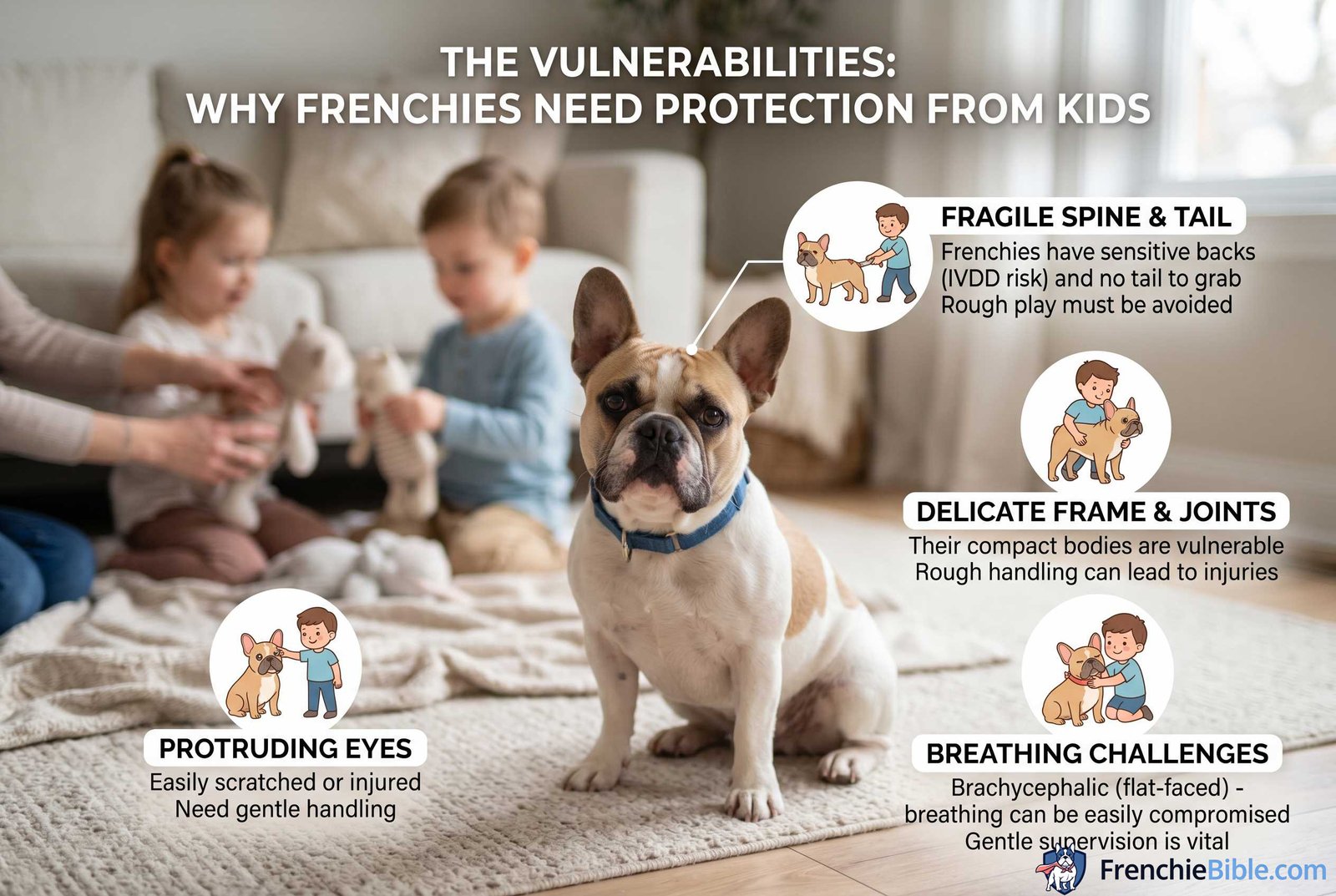
The Vulnerabilities: Why Frenchies Need Protection from Kids
While Frenchies are sturdy, they have severe anatomical vulnerabilities that parents must understand. In my veterinary experience, the danger in a Frenchie/toddler household usually isn’t the dog hurting the child; it’s the child accidentally severely injuring the dog.
The IVDD Risk (Spinal Vulnerability)
French Bulldogs are a chondrodysplastic breed, meaning they have a genetic predisposition to dwarfism, which affects their cartilage and spine. They are highly prone to Intervertebral Disc Disease (IVDD). Their spines are fragile.
If a toddler tries to “ride” the Frenchie like a horse, aggressively pushes them off the couch, or drops them from a height, it can cause a herniated disc. This leads to excruciating pain, permanent paralysis of the hind legs, and a $8,000 to $10,000 emergency spinal surgery. Children must be taught from day one that the dog’s back is off-limits.
The BOAS Risk (Breathing Vulnerability)
Frenchies are brachycephalic (flat-faced). They suffer from Brachycephalic Obstructive Airway Syndrome (BOAS). They cannot pant efficiently to cool themselves down, and they physically cannot intake oxygen as easily as long-nosed dogs.
Toddlers have boundless energy. If a child forces a French Bulldog to run around the backyard in the summer heat for 20 minutes playing fetch, the dog can quickly go into respiratory distress, suffer heatstroke, and literally suffocate. The parents must monitor play sessions to ensure the dog does not overexert itself to please the child.
The Eye Risk (Corneal Ulcers)
Because of their flat faces, a Frenchie’s eyes bulge slightly outward (exophthalmos) and they have very shallow eye sockets. They have no snout to protect their eyes from incoming objects. A toddler waving a toy, poking fingers, or accidentally dropping a hard plastic object on the dog’s face can cause a severe corneal ulcer or even eye proptosis (the eye popping out of the socket).
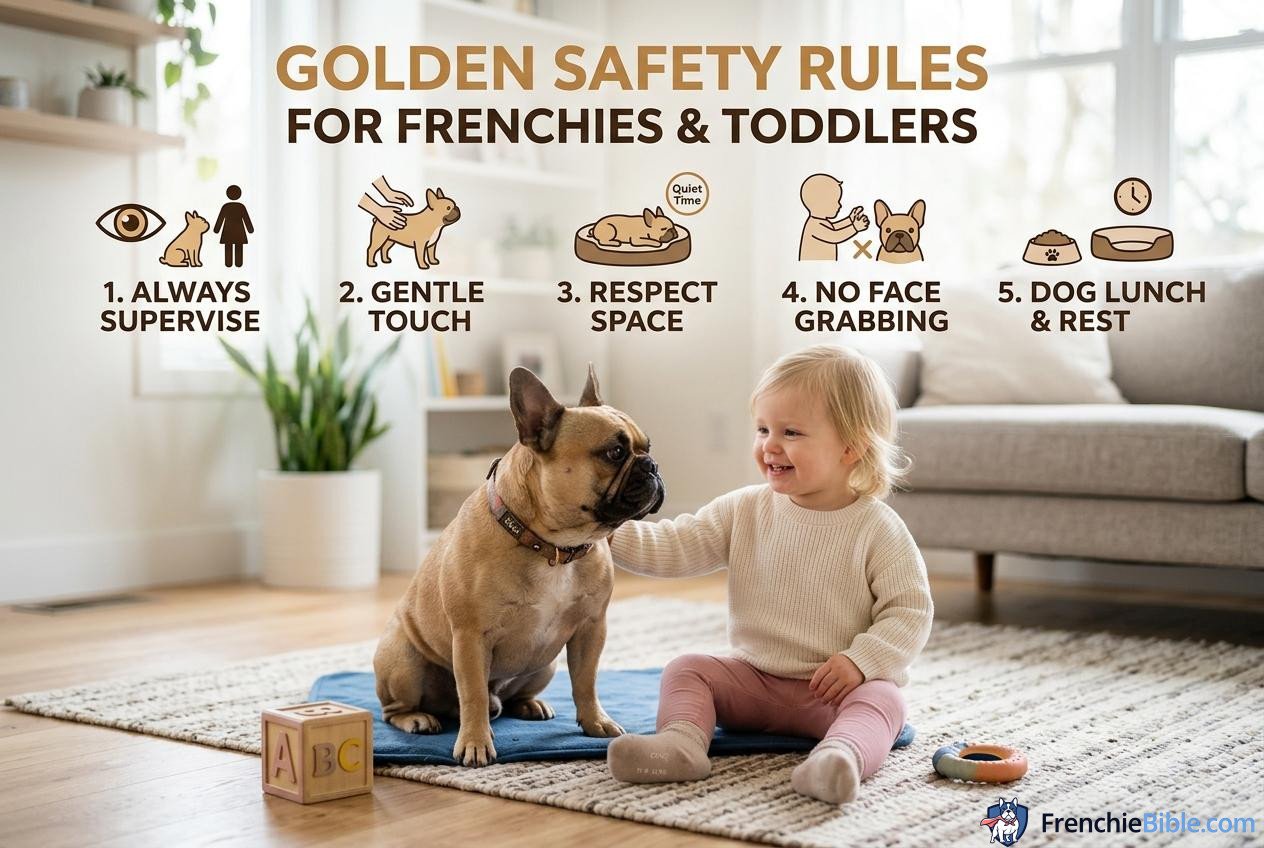
Golden Safety Rules for Frenchies and Toddlers
If you are mixing a French Bulldog with a toddler, you must implement the following non-negotiable rules in your household.
Rule 1: Zero Unsupervised Interaction
This is the golden rule of dog ownership. Never, under any circumstances, leave a toddler and a dog unsupervised in a room together. Even the sweetest Frenchie can snap if a toddler unexpectedly jams a finger in its ear, steps on its paw, or pulls its tail. If you need to go to the bathroom, take the child with you, or put the dog in their crate.
Rule 2: The Crate is a Holy Sanctuary
Your French Bulldog must have a crate or a designated “safe zone” (like a gated-off laundry room). The toddler must be taught that when the dog is in the crate, the dog is invisible. No poking fingers through the wire, no throwing toys into the crate, and no yelling near the crate. The dog needs to know they have a quiet place to retreat to when the child’s energy becomes overwhelming.
Rule 3: Do Not Disturb Sleep or Meals
Resource guarding (food aggression) and sleep-startle reflexes are real. Teach your child that they are absolutely forbidden to approach the dog while the dog is eating a meal, chewing a high-value bone, or sleeping. Dogs can wake up disoriented and defensive if startled.
Rule 4: Ground-Level Petting Only
Because Frenchies are heavy and prone to spinal injuries, young children should never be allowed to pick the dog up or carry it. If the child drops a squirming 25-pound Frenchie, the dog could break a leg or rupture a spinal disc. Teach children to sit flat on the floor to pet the dog. “We sit down to love the dog.”
Rule 5: Gentle Hands and “Consent Tests”
Teach children how to pet a dog. No pulling ears, no grabbing jowls, and no hugging around the neck (dogs hate being tightly hugged, as it restricts their movement and can cause panic). Teach the “consent test”: the child pets the dog gently on the chest or side for three seconds, then stops and pulls their hand back. If the dog leans in or nudges the hand for more, they want attention. If the dog walks away, the interaction is over.
Conclusion
French Bulldogs are spectacular family companions. Their loyalty, humor, and affectionate nature make them perfect additions to households with children. However, their unique anatomical challenges—fragile spines, compromised airways, and exposed eyes—mean that they rely entirely on the adult owners to protect them.

By actively managing interactions, teaching your children canine empathy, and enforcing strict boundaries, you can ensure that your Frenchie and your toddler grow up to be the best of friends, safely.
Frequently Asked Questions (FAQs)
1. Are French Bulldogs prone to biting children?
No breed is inherently prone to biting children if properly bred and socialized. Frenchies are generally very tolerant. However, ANY dog will bite if they are in pain, cornered, or frightened. If a child hurts the dog (e.g., steps on its paw), a warning snap is a natural canine reaction. This is why supervision is mandatory.
2. Should I get a male or female Frenchie if I have kids?
Both sexes make wonderful family pets, but there are slight differences. Males are often described as more “goofy,” clingy, and desperate for human attention, while females can sometimes be slightly more independent or “bossy.” Ultimately, the individual dog’s temperament and early socialization matter far more than the gender.
3. We are expecting a baby. How do we prepare our Frenchie?
Months before the baby arrives, establish boundaries. If the nursery is off-limits, enforce that rule immediately. Play recordings of baby crying sounds while giving the dog high-value treats to create positive associations. Bring home a blanket with the newborn’s scent from the hospital before the baby arrives so the dog can investigate it calmly.
4. My toddler loves to play fetch with our Frenchie, but the dog sounds like a pig snorting. Is this okay?
Heavy snorting, rasping, or loud “pig noises” are signs that the dog is struggling to breathe (BOAS). You must intervene. Limit high-intensity play to 5-10 minutes, entirely indoors with air conditioning during the summer. Do not let the child push the dog to the point of respiratory distress.
5. At what age is a child old enough to walk a French Bulldog?
Frenchies are small, but they are incredibly muscular and have a low center of gravity. A 25-pound Frenchie lunging at a squirrel can easily pull a 5-year-old child flat onto the pavement. Generally, children under the age of 10-12 should not be the sole person holding the leash on walks, to prevent injury to both the child and the dog.