

Introduction
French Bulldogs, affectionately known as Frenchies, are famous for their comical personalities, bat-like ears, and generally laid-back demeanor. They are widely considered to be a relatively quiet breed, especially when compared to terriers or hounds. Instead of barking, they often communicate using a unique vocabulary of snorts, grunts, gargles, and yodels.

However, this doesn’t mean they are entirely silent. When a French Bulldog starts whining, crying, or excessively vocalizing, it can be both heartbreaking and deeply frustrating for a pet parent. Because they aren’t naturally prone to nuisance barking, a sudden onset of crying is usually a major red flag that something is amiss.
Related Reading: Health & Diet | Frenchie Puppy Guide
as a French Bulldog expert and breeder and French Bulldog breeder with years of experience, I have seen countless owners at their wits’ end because their usually peaceful Frenchie has suddenly turned into a crying machine. Whining is a form of communication. Your dog is trying to tell you something, and it’s your job to decode the message.
In this exhaustive guide, we are going to dive deep into the psyche and physiology of the French Bulldog. We will explore the five most common reasons your Frenchie is whining or crying, how to differentiate between behavioral and medical issues, and, most importantly, provide a step-by-step, foolproof method for training the “Quiet” command to restore harmony to your household.
The Unique Communication Style of French Bulldogs
Before we can address the excessive whining, we must first understand how French Bulldogs communicate. Due to their brachycephalic (flat-faced) anatomy, Frenchies have a specialized respiratory system. This anatomy not only affects how they breathe but also the sounds they make.

While a typical dog might bark to alert you to a stranger or whine when they want a treat, a Frenchie might snort to show excitement, grunt when they are content, and emit a high-pitched yodel when they are feeling playful.
When a Frenchie resorts to persistent whining or crying, it typically signifies a higher level of distress or urgency than their usual repertoire of noises. It is an active plea for intervention. Ignoring this plea, or worse, punishing the dog for it without understanding the root cause, can lead to severe behavioral and psychological issues down the line.
Furthermore, French Bulldogs are exceptionally emotionally intelligent. They read their owners’ emotions like a book. If you are stressed, anxious, or frustrated about their whining, they will absorb that energy, which can inadvertently cause them to whine even more. Breaking this cycle requires a calm, analytical approach to uncover the root cause.
5 Primary Reasons Your French Bulldog is Whining or Crying
Understanding the “why” is the crucial first step in modifying the behavior. Here are the top five reasons your Frenchie might be crying.

1. Separation Anxiety: The Velcro Dog Dilemma
French Bulldogs were bred for one primary purpose: to be companion animals. Unlike working dogs bred to herd sheep independently or guard property, Frenchies thrive on continuous human interaction. They form incredibly strong, sometimes overly dependent, bonds with their owners. This makes them highly susceptible to separation anxiety, arguably more so than many other breeds.
When a Frenchie with separation anxiety is left alone, or even when they anticipate being left alone (like when you pick up your keys, put on your shoes, or grab your coat), they can enter a state of sheer panic. This panic manifests as pacing, excessive drooling, destructive chewing, inappropriate elimination indoors, and relentless, agonizing whining or crying.
The whining associated with separation anxiety is distinct. It is often characterized by a high-pitched, frantic, and desperate tone. It is not an attempt to annoy you; it is a genuine expression of terror at being separated from their “pack.” Frenchies simply do not do well when isolated for long periods. If your dog only whines when you are leaving, or when they are confined in a room away from you while you are home, separation anxiety is the most likely culprit.
2. Pain or Underlying Medical Issues
as a French Bulldog expert and breeder, this is always my absolute primary concern when a normally quiet dog suddenly begins vocalizing excessively. French Bulldogs are prone to a myriad of breed-specific health issues that can cause significant discomfort, acute distress, or chronic pain.
Because dogs are masters at masking pain (an evolutionary survival tactic to avoid appearing weak to predators), whining might be the only outward, noticeable sign that something is physically wrong. Some common medical issues in Frenchies that frequently lead to crying include:
- Intervertebral Disc Disease (IVDD): Frenchies are a chondrodystrophic breed, meaning they are genetically prone to spinal disc degeneration. IVDD can cause excruciating back or neck pain, leading to spontaneous crying, an arched back, reluctance to move, muscle spasms, and in severe cases, dragging of the hind legs or paralysis. A dog crying out when picked up or when shifting positions is a massive red flag for IVDD.
- Ear Infections (Otitis Externa): Their narrow ear canals and strong propensity for environmental and food allergies make them prime candidates for severe, painful ear infections. You may notice them whining while furiously scratching at their ears, rubbing their head on the carpet, or shaking their heads violently.
- Gastrointestinal Distress: Frenchies notoriously have sensitive stomachs. Gas, bloating, acid reflux, inflammatory bowel disease (IBD), or food allergies can cause intense abdominal discomfort, resulting in whining, especially after meals or during the night.
- Joint Pain and Arthritis: Hip dysplasia, elbow dysplasia, and luxating patellas (slipping kneecaps) are common structural issues in the breed. A dog experiencing joint pain may whine when trying to stand up after resting, jump onto the couch, or climb stairs.
- Dental Disease: A fractured tooth, an abscess, or severe periodontal disease can cause chronic, throbbing pain that leads to vocalization, particularly when eating, chewing on toys, or yawning.
If the whining is sudden, persistent, or accompanied by lethargy, loss of appetite, or changes in mobility, a comprehensive veterinary check-up is strictly non-negotiable.
3. Attention Seeking and Boredom
While Frenchies are renowned couch potatoes, they are not stuffed animals. They still require daily mental and physical stimulation. They are incredibly intelligent, observant, and stubborn dogs. If they learn that whining gets them what they want—whether that’s a tasty treat, a belly rub, a walk, or just you looking at them and talking to them—they will weaponize that behavior.
This is known as demand whining. It often starts very subtly. Your dog lets out a small whine, you look down, smile, and pet them, and the behavior is instantly reinforced. Over time, the whining becomes louder, more persistent, and more demanding.
Boredom is closely related to attention-seeking. If your Frenchie is not getting enough physical exercise or, more importantly, mental enrichment (like puzzle toys, snuffle mats, or training sessions), they will find ways to entertain themselves. Unfortunately, vocalizing at you to entertain them is a highly common and effective strategy. If your dog paces around you, nudges your hand with their wet nose, stares deeply into your eyes, and whines, they are likely demanding your attention because their brain is under-stimulated.
4. Needing to Go Potty (Bathroom Needs)
This is perhaps the most straightforward and easily resolvable reason for whining, but it is surprisingly often overlooked, especially with young puppies, newly adopted rescues, or senior dogs experiencing incontinence. If your Frenchie is fully house-trained, whining is their polite (and sometimes incredibly urgent) way of communicating that they need to go outside immediately.
This type of whining is usually accompanied by specific body language: pacing near the exit, sitting directly by the door, intensely sniffing the floor in circles, or staring at you intently while whining. It will rapidly become more frantic if you ignore the initial, subtle signals.
It is critically important to note that if your adult, perfectly house-trained Frenchie suddenly starts whining frequently to go out, having “accidents” inside, or whining while urinating, it could be a clear sign of a urinary tract infection (UTI), bladder stones (which are common in the breed), or kidney issues. In these cases, the whining is a symptom of a medical urgency rather than just a temporarily full bladder.
5. Environmental Stressors or Fear
French Bulldogs can be surprisingly sensitive to changes in their environment. What might seem like a completely minor or irrelevant change to you can be a massive source of stress and anxiety for your dog. Stress-induced whining can be triggered by a wide array of environmental factors:
- Loud Noises: Thunderstorms, fireworks, nearby construction noise, sirens, or even just a loud action movie on the television can terrify a sensitive Frenchie.
- New Additions to the Home: Bringing home a new baby, adopting a new pet, or even having unfamiliar houseguests stay over can severely disrupt your dog’s established routine and cause immense anxiety.
- Changes in Routine: Dogs, especially companion breeds, thrive on predictability and strict routines. A sudden change in your work schedule, a move to a new house, or even changing the time you feed them can leave your Frenchie feeling unsettled, insecure, and prone to crying.
- Unfamiliar Objects: Sometimes, something as seemingly silly as a new piece of bulky furniture, a vacuum cleaner left in the middle of the room, a large box, or a strange shadow cast on the wall can trigger an irrational fear response and resulting whining.
Stress and fear whining is almost always accompanied by unmistakable stress-related body language, such as a tightly tucked tail, ears pinned flat back against the skull, excessive panting (when not hot), trembling, pacing, and lip licking.
How to Differentiate the Cause of the Whining: A Diagnostic Approach
To successfully stop the whining, you must correctly and accurately identify the root cause. Treating demand whining the same way you treat separation anxiety will yield zero results and cause further frustration. Here is a diagnostic checklist to help you pinpoint the issue:
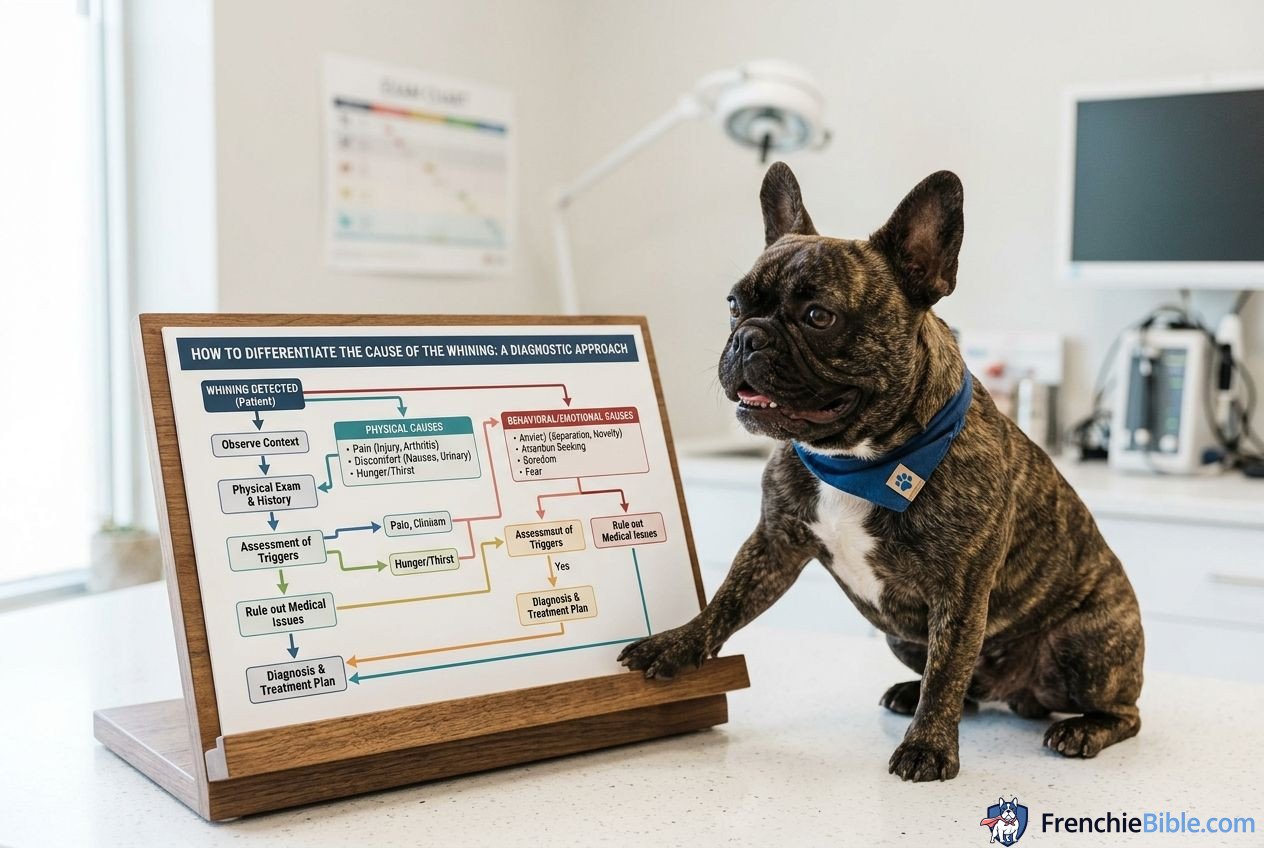
- Rule Out Medical Issues First and Foremost: Is the whining completely sudden and out of character? Is it accompanied by limping, lethargy, loss of appetite, vomiting, diarrhea, or reluctance to move? Does the dog yelp or whine sharply when touched in a specific area (like the neck or back)? If the answer to any of these is yes, schedule An Experienced Breedererinary visit immediately.
- Evaluate the Timing and Context: Does the whining only happen when you leave the house or are preparing to leave? (Points heavily to Separation Anxiety). Does it happen primarily around dinner time, when you are eating, or when you are relaxing on the couch trying to watch TV? (Points heavily to Attention Seeking/Demand Whining).
- Check the Bladder/Bowels: How long has it been since their last successful potty break? Are they hovering near the door?
- Observe the Immediate Environment: Are there loud, unusual noises outside? Are there strangers or new people in the house? Have you recently moved furniture?
- Critically Analyze Body Language: A dog in pain or fear will look physically tense. Look for a tucked tail, pinned ears, “whale eye” (showing the whites of their eyes), and trembling. A dog demanding attention will look alert, focused directly on you, with relaxed or perked ears, and may incorporate pawing or nudging.
How to Stop the Whining: Comprehensive Management Strategies
Once you have identified the primary root cause, you can begin to implement targeted, specific management strategies.
Addressing Separation Anxiety (The Hardest Battle)
Separation anxiety is a complex psychological issue and often requires a multi-faceted, long-term approach. In severe cases, medication prescribed by An Experienced Breedererinarian may be necessary to lower the dog’s panic threshold enough for training to be effective.
- Systematic Desensitization: Practice leaving the house for incredibly short periods—sometimes just stepping outside the door and immediately returning—before the dog has a chance to panic and whine. Gradually, over weeks and months, slowly increase the duration of your absence.
- Counter-Conditioning: Give your dog a highly valuable, long-lasting treat (like a Kong toy densely stuffed with frozen peanut butter or wet food, or a safe chew like a bully stick) only when you are leaving the house. This helps change the association of your departure from a terrifying negative event to a highly anticipated positive event.
- Create a Safe Sanctuary: Crate training, if executed correctly and positively, can provide a secure, den-like environment where the dog feels safe. However, never use the crate as a form of punishment, and never force a panicking dog into a crate, as this will worsen the anxiety.
- Avoid Dramatic Farewells and Greetings: When you leave the house, simply leave quietly. Do not say a long, emotional goodbye. When you return, ignore your dog for the first few minutes until they are completely calm. Making a massive fuss upon arrival only heightens their anxiety about your absences.
Managing Attention-Seeking Behavior (Demand Whining)
The golden, unbreakable rule for this type of whining is simple but incredibly difficult for owners to follow: Do not, under any circumstances, reward the whining.
- The “Turn Away” Method: The absolute moment your Frenchie starts demand whining, turn your back completely to them. Fold your arms. Do not speak to them, do not look at them, do not make eye contact, and certainly do not touch them. Any attention, even negative attention like yelling “No,” looking annoyed, or pushing them away, is still attention and therefore a reward.
- Reward the Silence: As soon as the dog stops whining and remains quiet for a few seconds, immediately turn back, praise them enthusiastically, and offer a treat or affection. You are systematically teaching them that silence is the key that unlocks what they want, while whining makes you disappear.
Alleviating Boredom and Under-Stimulation
A physically and mentally tired Frenchie is a quiet, happy Frenchie.
- Appropriate Physical Exercise: Ensure they are getting adequate daily walks. However, always be extremely mindful of the temperature and humidity to avoid deadly overheating in this brachycephalic breed. Two short walks in the cool of the morning and evening are far better than one long walk midday.
- Mental Enrichment: This is often more exhausting than physical exercise. Use advanced puzzle toys, snuffle mats for their meals, lick mats, and interactive toys to force them to use their brains to solve problems and earn their food.
- Daily Obedience Training: Just 10-15 minutes of structured, positive reinforcement basic obedience training or trick training a day will exhaust a dog mentally and vastly improve their bond with you.
Step-by-Step Guide to Teaching the “Quiet” Command
If your Frenchie has developed a deeply ingrained habit of vocalizing for attention, or if they react vocally to specific triggers (like the doorbell), teaching a specific, structured “Quiet” command gives you a reliable, positive “off switch.”
This training relies on the psychological principle of capturing and shaping behavior. You cannot teach a dog to be “quiet” unless the dog is actively making noise first.
What You Will Need for Training:
- High-value, pea-sized, incredibly smelly treats that your dog goes crazy for (boiled chicken breast, hot dog slices, freeze-dried liver, or pungent cheese).
- A training clicker (highly recommended for precise marking of the exact moment of silence, but a sharp verbal marker like “Yes!” works too).
- Immense patience and ruthless consistency.
Step 1: Capture and Trigger the Vocalization
To teach the command, you need to intentionally set up a controlled scenario where you know with 100% certainty your dog will vocalize. This could be having a friend ring the doorbell, holding a favorite toy just out of reach, or knocking on a wall.
Crucial Note: Do not use triggers that cause genuine fear, terror, or severe anxiety (like fireworks or vacuum cleaners) for this specific training exercise. You want an alert or demand vocalization, not a panic response.
Step 2: The Agonizing Wait
Trigger the noise. Your dog will start whining or barking. Do absolutely nothing. Stand still like a statue. Wait patiently for the dog to take a breath or pause to see why you aren’t reacting. You are waiting for even a microsecond of silence.
Step 3: Mark and Immediately Reward
The exact, split-second your dog stops making noise (even if it’s just to inhale or look at you in confusion), mark the behavior heavily with your clicker, or say a sharp, enthusiastic “Yes!” and immediately pop a high-value treat directly into their mouth.
At this early stage, you are not using the word “Quiet” yet. Do not confuse them with vocabulary. You are simply building a fundamental understanding: stopping the noise makes a delicious treat magically appear. Repeat Steps 1-3 dozens of times over a few days. Your dog will quickly start to realize that shutting their mouth is highly profitable.
Step 4: Introduce the Verbal “Quiet” Command
Once your dog consistently and predictably stops making noise quickly to look for the treat after being triggered, it’s time to add the verbal cue to name the behavior.
1. Trigger the noise (ring the bell).
2. While the dog is actively vocalizing, say the word “Quiet” in a calm, firm, flat, and authoritative tone. (Do not yell it. Do not sound angry. Yelling sounds to a dog like you are simply barking along with them, escalating the situation).
3. The moment the dog pauses the noise to look at you, mark (“Yes!”) and reward generously.
Step 5: Increase the Duration of Silence
Now you must teach the dog that “Quiet” doesn’t mean stopping for half a second and then immediately resuming the whining. You must actively build duration into the command.
1. Trigger the noise.
2. Give the “Quiet” command.
3. When the dog stops vocalizing, wait for two full seconds of continuous silence before marking and rewarding.
4. If they start whining again before the two seconds are up, they get absolutely no treat. Wait for them to stop completely, and start the silent timer over again.
5. Once they master two seconds, gradually and incrementally increase the duration requirement to 3 seconds, 5 seconds, 10 seconds, 30 seconds, and eventually up to a minute or more of sustained silence before the reward is given.
Step 6: Generalize the Behavior (Proofing)
Dogs are notoriously terrible at generalizing behaviors. If you only practice the “Quiet” command in your kitchen while holding a piece of chicken, they will only be “Quiet” in your kitchen while you hold chicken.
You must practice and “proof” the command in vastly different environments and scenarios: in the backyard, during a walk, when unfamiliar visitors arrive, in the car, and at the vet’s office. This teaches the dog that “Quiet” means quiet everywhere, regardless of the distractions.
Common Mistakes to Avoid During Behavioral Training
As a behavioral specialist, I see dedicated pet owners make the same frustrating mistakes repeatedly when trying to stop whining. Avoid these common pitfalls to ensure your training is successful:
- Yelling, Scolding, or Punishing: Yelling “Shut up!”, “No!”, or physically punishing a whining dog is entirely counterproductive and damaging. To a dog, your yelling is just you joining in on the noise and chaos. If the dog is whining out of fear, pain, or anxiety, punishing them will only make them significantly more anxious and terrified of you, severely exacerbating the root problem and destroying your bond.
- Inconsistency (The Silent Killer of Training): This is the absolute killer of all dog training. If you ignore the demand whining 90% of the time, but give in and offer a treat, a pat, or a scolding 10% of the time, you have placed the whining on an “intermittent reinforcement schedule.” This psychological phenomenon makes the whining behavior incredibly strong, persistent, and almost impossible to extinguish, much like a human gambler addicted to a slot machine. Every single person in the household must be on the exact same page and follow the rules 100% of the time.
- Using the Crate as a Punishment Tool: Never angrily shove a whining or crying dog into a crate. The crate must always remain a positive sanctuary, a safe den, not a prison cell for bad behavior. If you use it for punishment, the dog will develop crate anxiety, adding another layer of complex behavioral issues.
- Moving Too Fast with Duration: When teaching the “Quiet” command, do not expect your dog to hold the silence for a full minute on the very first day. You must build duration incredibly slowly to ensure success. If the dog fails repeatedly and breaks the silence, you are moving too fast and expecting too much. Go back to a shorter duration where they can succeed and build their confidence.
- Failing to Address the Medical Root Cause: Teaching the “Quiet” command is merely a superficial band-aid if the underlying issue is untreated spinal pain, severe clinical separation anxiety, or an urgent medical need to urinate due to an infection. Always, always address and rule out the core medical or psychological reason for the vocalization first.
When to Seek Professional Veterinary or Behavioral Help
While many whining issues are purely behavioral and can be resolved with consistent training, the physical and mental health of your Frenchie must always take precedence. You should schedule An Experienced Breedererinary appointment immediately if:
- The whining is sudden, severe, and entirely uncharacteristic for your normally quiet dog.
- The whining is accompanied by concerning physical symptoms such as profound lethargy, vomiting, persistent diarrhea, unexplained loss of appetite, or excessive panting when resting.
- Your dog appears physically stiff, is reluctant to move, refuses to walk, hesitates to jump, walks with a hunched back, or cries out sharply when touched or picked up. Remember, French Bulldogs are incredibly prone to spinal disc injuries (IVDD), which are absolute medical emergencies that require immediate intervention to prevent permanent paralysis.
- Your senior or older dog suddenly starts whining aimlessly at night, pacing, staring at walls, or appears confused in familiar surroundings (these are hallmark signs of Canine Cognitive Dysfunction, essentially dog dementia).
- You have diligently tried basic behavioral modifications and training for several weeks with zero improvement, or the behavioral whining is actively worsening. In this case, seeking out a experienced behaviorist is highly recommended.
The Role of Genetics and Responsible Breeding in Temperament
As a breeding specialist deeply invested in the future of the French Bulldog, I must briefly address the significant impact of genetics on canine behavior. The temperament, anxiety levels, and vocalization tendencies of a French Bulldog are highly heritable traits.
Reputable, ethical preservation breeders select not only for structural physical health, genetic clearances, and adherence to the breed standard, but also for stable, confident, resilient, and calm temperaments.
A well-bred Frenchie from a quality lineage should be adaptable, relatively easy-going, and secure. Dogs bred indiscriminately by backyard breeders, puppy mills, or commercial facilities often suffer from genetic predispositions to extreme high anxiety, neuroticism, hyperactivity, and poor nerve strength, making them significantly more prone to excessive vocalization, phobias, and severe separation anxiety.
If you are considering adding a Frenchie to your family in the future, dedicating the time to research, interview, and select a responsible, ethical breeder is your first, best, and most effective defense against future heartbreaking behavioral and medical issues.
Conclusion
A whining or crying French Bulldog is not trying to be annoying; they are a dog trying desperately to communicate an unmet need, an intense fear, or an invisible physical discomfort. As their guardian and advocate, it is your fundamental responsibility to listen closely, observe their body language, and correctly interpret their vocalizations.
By systematically ruling out medical emergencies, accurately identifying the environmental or behavioral triggers, and consistently applying the management and training techniques outlined in this comprehensive guide—specifically mastering the “Quiet” command—you can effectively help your Frenchie feel secure, confident, and, most importantly, peaceful.
Remember, behavioral modification is not magic. It requires time, immense patience, empathy, and unwavering consistency. Do not expect overnight miracles or quick fixes, but with dedicated, positive effort, you can absolutely restore tranquility to your home and deeply strengthen the incredible bond you share with your beloved French Bulldog.
Frequently Asked Questions (FAQ)
Q1: Is it normal for French Bulldogs to cry or whine in their sleep?
Yes, it is entirely normal and very common. Just like humans, dogs experience different sleep stages, including REM sleep where they dream vividly. You may frequently hear your Frenchie whimpering, softly whining, or even making muffled barking or running noises while their paws twitch during a dream. Do not wake them up abruptly, as this can startle them and disrupt their rest. Let sleeping dogs lie.
Q2: My 10-week-old Frenchie puppy cries all night in his crate. Should I just let him “cry it out”?
The old-school “cry it out” method is generally considered outdated and can cause severe emotional distress in very young puppies who have just been traumatically separated from their mother and littermates. Instead, ensure the crate is extremely comfortable, place it right next to your bed so they can smell and hear you breathing, and ensure all physical needs (potty break, hunger) are completely met right before bedtime. If they cry, you can gently reassure them with a soft voice or place a couple of fingers against the crate wire, but completely avoid taking them out to play or cuddle, which rewards the crying.
Q3: Can a French Bulldog’s diet affect their behavior and whining?
Absolutely, unequivocally yes. Frenchies are notorious for having severe food allergies, intolerances, and highly sensitive digestive tracts. A diet that causes painful gas, bloating, stomach cramps, or acid reflux will cause severe physical discomfort, inevitably leading to whining, restlessness, and pacing. If you suspect a dietary issue, consult your veterinarian about slowly transitioning to a high-quality, limited-ingredient diet, a novel protein diet, or a prescription hydrolyzed protein diet.
Q4: Will getting a second dog or a companion puppy stop my Frenchie’s separation anxiety whining?
This is a very common misconception and a highly risky gamble that often backfires. While some dogs might find slight comfort in a canine companion, true, severe separation anxiety is specifically tied to the absence of the human owner, not just the state of being alone. Getting a second dog often simply results in you having two dogs with severe separation anxiety, doubling your problem. You must treat the underlying human-focused anxiety through training and potentially medication first.
Q5: Are French Bulldogs generally considered a “yappy” or vocal breed?
No, they are generally not considered yappy or excessive barkers compared to other breeds. They are an alert breed and will often let out a sharp bark to announce a visitor at the door, but they are absolutely not prone to the continuous, rhythmic, nuisance barking seen in some terrier, hound, or herding breeds. Because of this baseline, if a Frenchie is excessively vocalizing, whining, or crying, it is almost always indicative of a specific problem, unmet need, or medical issue that requires your immediate attention and intervention.
Disclaimer: We are not veterinarians and do not hold veterinary medical licenses. The information provided in this article is based on years of breeding and daily care experience and is for educational purposes only. It should not replace professional veterinary advice. Always consult with a licensed veterinarian if you have concerns about your French Bulldog’s health or before starting any new treatment.
Disclaimer: I am a French Bulldog breeding expert with over a decade of hands-on experience with this breed. I am not a veterinarian. The information in this article is for educational purposes only. Always consult your veterinarian regarding your dog’s specific health needs and care.