
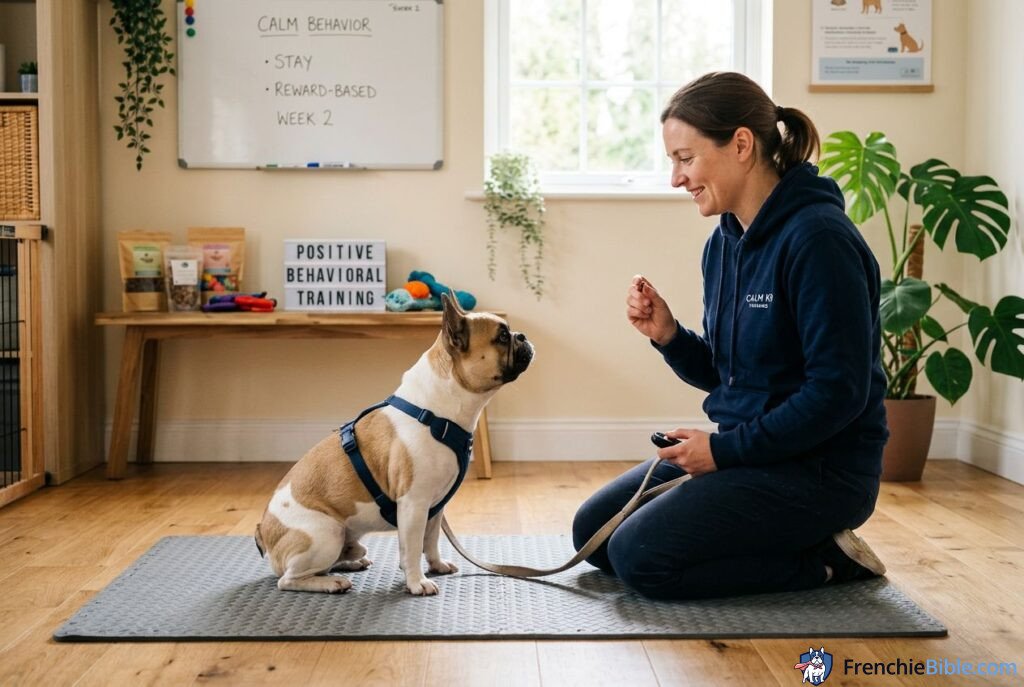
As a French Bulldog breeder with over ten years of hands-on experience, I have seen almost every quirky, hilarious, and sometimes puzzling behavior this incredible breed has to offer. One of the most common panicked emails I receive from new puppy owners goes something like this: “My bold, fearless little Frenchie suddenly froze in terror at the sight of a plastic bag on the sidewalk today! What happened to my confident dog?”
If you are reading this because your previously outgoing, adventurous French Bulldog puppy has suddenly morphed into a trembling ball of anxiety over seemingly nothing, take a deep breath. You haven’t broken your dog. You haven’t failed at socialization. Your Frenchie is highly likely going through a completely normal developmental stage known as a fear period.
Related Reading: Health & Diet | Frenchie Puppy Guide
Understanding French Bulldog fear periods, knowing how to spot a scared Frenchie puppy, and learning the proper strategies to guide them through it can mean the difference between a temporary phase and a lifelong phobia. In this comprehensive guide, I will share my decade of breeder insights to help you navigate your puppy’s fear stages with confidence.
What Exactly Are Fear Periods in French Bulldogs?
To effectively manage a scared Frenchie puppy, we first need to understand what a fear period actually is. A fear period is a normal, biologically driven developmental stage where a puppy becomes highly sensitive to new or even familiar stimuli. During this time, things that they previously ignored—like a vacuum cleaner, a fire hydrant, or a neighbor wearing a hat—suddenly become terrifying monsters in their eyes.

The Evolutionary Purpose of Fear
It helps to look at this from an evolutionary standpoint. In the wild, when canine pups are very young, they stay close to the den and their mother. As they grow and become more mobile, they begin to explore further away. The onset of a fear period biologically coincides with the time a young canine would be venturing out into a dangerous world. This acute sense of fear and caution was a survival mechanism to keep them alive; it taught them to be wary of novel, potentially life-threatening things (like predators or dangerous terrain).
While your French Bulldog is living a pampered life in your living room and the biggest threat is the automated robot vacuum, their DNA still holds onto these ancient developmental milestones. The French Bulldog puppy behavior you are witnessing is a ghost of their wild ancestry.
Nature vs. Nurture: The Frenchie Temperament
French Bulldogs are famously known for being clownish, affectionate, and generally easy-going. However, they are also an intelligent and surprisingly sensitive breed. This sensitivity means that when a fear period hits, their reactions can be quite dramatic. As a breeder, I carefully select my breeding pairs for rock-solid temperaments, but even the most genetically confident puppy will still pass through these developmental windows. Genetics dictate how well a dog can bounce back from fear, but environment and handling (the nurture aspect) dictate whether a momentary scare during a fear period turns into a permanent trauma.
The Timeline: When Do Frenchie Fear Periods Happen?
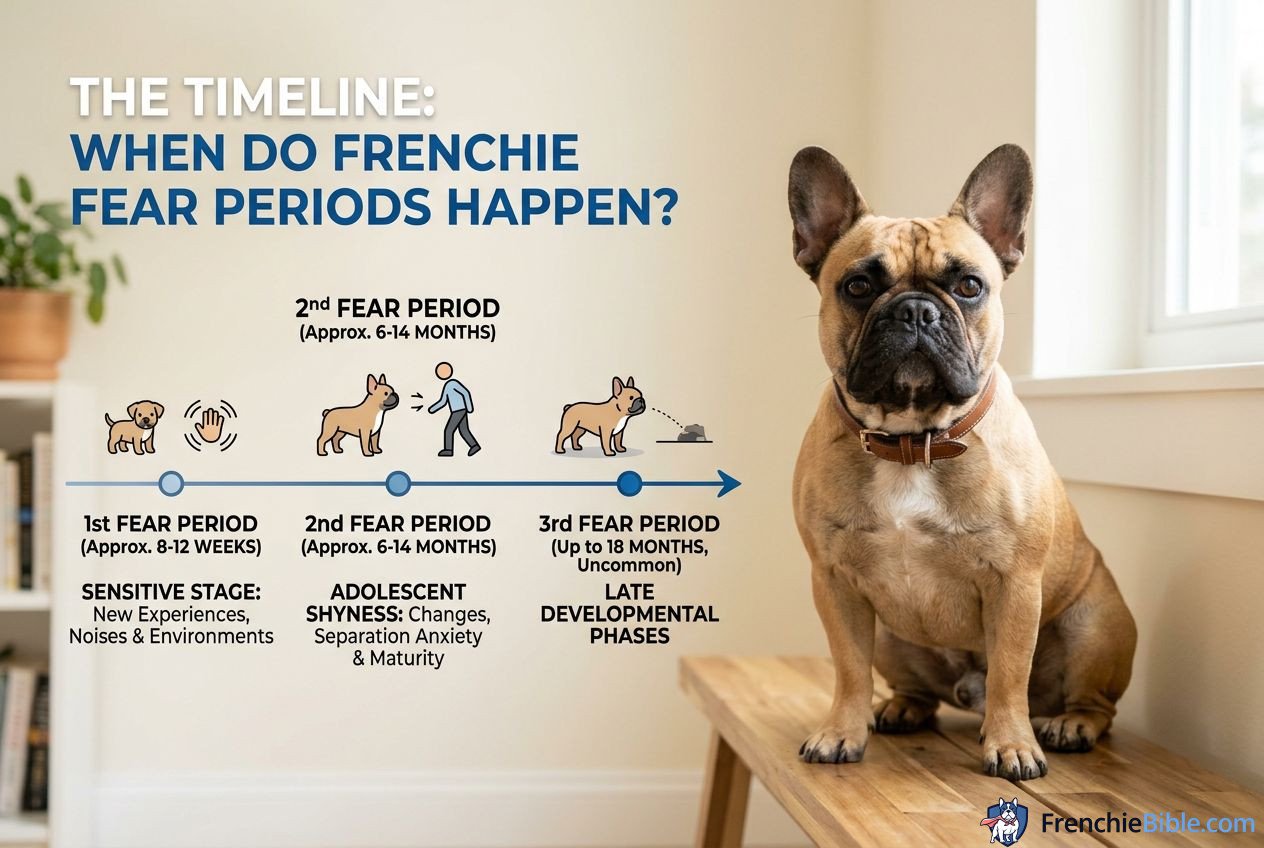
Puppy development is not a perfectly straight line. It happens in stages, and fear periods are predictable bumps in the road. Generally, canines go through two distinct fear periods, though the exact timing can vary slightly from dog to dog.
The First Fear Period: 8 to 11 Weeks (The Imprint Stage)
The first fear period usually hits right around 8 to 11 weeks of age. Coincidentally, this is exactly the time most French Bulldog puppies are leaving their littermates and mother to go to their new homes! This makes it a highly sensitive transition.
During this 8 to 11-week window, anything that frightens the puppy can have a lasting, profound impact—a phenomenon known as single-event learning. If a large, barking dog rushes at your 9-week-old Frenchie, they might carry a fear of large dogs for the rest of their life. Because they are so vulnerable right now, socialization must be incredibly controlled, positive, and gentle. We want to expose them to the world, but we must protect them from overwhelming or terrifying experiences.
The Second Fear Period: 6 to 14 Months (The Teenage Spook)
Just when you think you are out of the woods and have raised a perfectly confident puppy, the second fear period hits. This usually occurs anywhere between 6 to 14 months of age, aligning with their canine adolescence. This period is often more confusing for owners because the puppy is older, looks like a young adult, and has previously been fine with the very things they are now terrified of.
During the teenage spook, your Frenchie’s brain is rewiring itself as they reach sexual and emotional maturity. This period can last anywhere from a couple of weeks to a month. You might find them barking furiously at a trash can that has always been on your street, or refusing to walk down a hallway they traverse every day.
Recognizing the Signs: Is It a Fear Period?
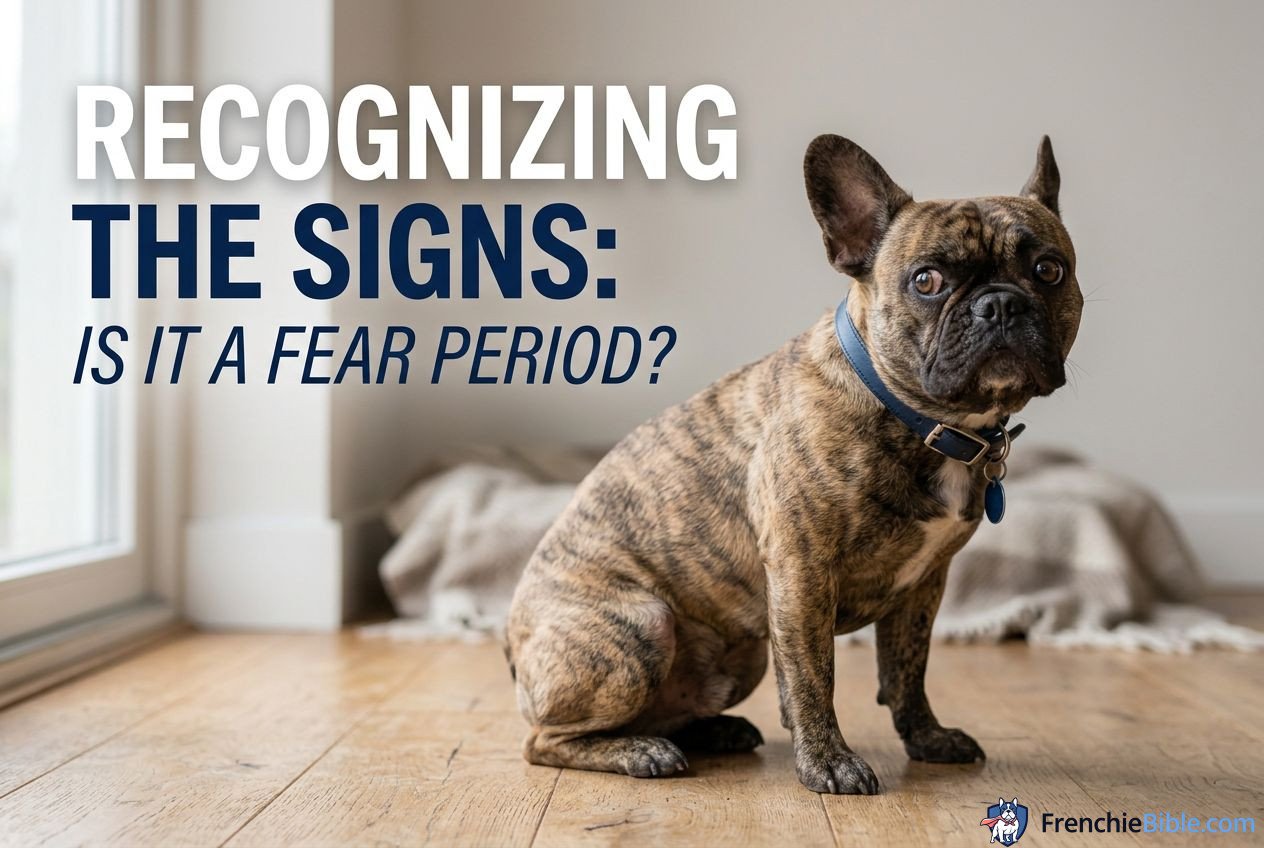
How do you know if your French Bulldog is going through a fear period or if they are just being stubborn? Frenchies are notorious for their “Frenchie brakes” (planting their feet and refusing to walk), but fear looks very different from stubbornness.
Sudden Reluctance on Familiar Walks
If your dog usually loves their daily walk but suddenly puts on the brakes, looks around nervously, and tries to pull backward toward home, they are experiencing fear. This isn’t the typical “I’m tired and want to be carried” stubbornness; this is an active flight response.
The “Inanimate Object” Enemy
One of the hallmarks of a fear period is an irrational fear of inanimate objects. Over my years of breeding, I’ve had owners call me because their puppies were suddenly terrified of:
– A garden gnome that was moved two inches to the left.
– A plastic bag blowing in the wind.
– A newly placed caution cone on the sidewalk.
– Their own reflection in a glass door.
– A cardboard box sitting in the hallway.
Body Language: Tucked Tails and Whale Eyes
Learn to read your Frenchie’s body language. A scared Frenchie puppy will exhibit specific physical cues:
– Tucked Tail: The little nub tail will be clamped tightly down over their rear.
– Ears Back: Their trademark “bat ears” will be pinned flat against their head.
– Whale Eye: They will turn their head slightly away but keep their eyes fixed on the scary object, showing the whites of their eyes.
– Trembling or Shaking: Physical shivering not related to cold.
– Panting or Lip Licking: Stress signals that indicate a high level of anxiety.
– Flight or Fight: Trying to bolt away on the leash, or conversely, defensively barking and lunging at the object.
How to Handle Your Frenchie’s Fear: My Proven Breeder Strategies
When your puppy is in the middle of a fear period, your reaction dictates the outcome. If you handle it poorly, you validate their fear. If you handle it like a pro, you teach them resilience. Here is my blueprint for overcoming puppy fear.

Strategy 1: The “Jolly Routine” Technique
This is my absolute favorite technique for minor spooks. When your Frenchie startles at a trash can, your instinct might be to tense up, pull on the leash, and say, “Oh no, it’s okay buddy!” in a high, worried voice. Do not do this. Your dog reads your tension and assumes, “Mom is scared too! That trash can IS a monster!”
Instead, use the “Jolly Routine.” The moment your dog spooks, loosen the leash, keep moving, and start acting incredibly happy and silly. Speak in an upbeat, cheerful tone. “Wow! Look at that silly trash can! What a funny thing! Let’s go!” You can even jog a few steps away in a playful manner. By projecting absolute confidence and turning the scary moment into a non-issue or a game, your puppy looks at you, realizes you aren’t worried, and often decides the object isn’t a threat after all.
Strategy 2: High-Value Treats and Counter-Conditioning
For things that cause a stronger reaction, you need to change your dog’s emotional response to the object from “scary” to “awesome.” This is called counter-conditioning.
Always carry ultra-high-value treats (like boiled chicken, freeze-dried liver, or small bits of cheese) during walks. If your Frenchie spots a scary object and stops, stop with them. Do not pull them toward it. As soon as they look at the scary object, mark the behavior (say “Yes!” or click your clicker) and give them a high-value treat.
Look at object -> YES! -> Treat.
Repeat this over and over. You are teaching their brain that the appearance of the scary object actually predicts delicious chicken raining from the sky. Eventually, they will look at the scary object and then immediately look at you, expecting a treat.
Strategy 3: Distance is Your Friend
If your dog is over the threshold—meaning they are barking, lunging, or trembling so much that they won’t even accept a piece of chicken—you are too close. Distance reduces pressure.
Quietly and calmly walk your puppy backward, away from the scary object, until they stop reacting and can take a breath. Find that “sweet spot” where they can see the object but aren’t panicking. This is where you begin your counter-conditioning with treats. Over several days or weeks, you can gradually decrease the distance.
Strategy 4: Empowering Your Puppy Through Choice
Never force your Frenchie to confront their fear. Dragging a terrified puppy up to a scary fire hydrant so they can “smell it and see it’s safe” is called flooding. Flooding breaks trust and often deeply traumatizes the dog.
Instead, allow them to investigate on their own terms. If they want to stretch their neck out as far as it will go to sniff the object while keeping their back paws firmly planted away from it, let them! If they take one step toward it, praise them enthusiastically and toss a treat behind them, so they have to retreat to eat it. This relieves the pressure of the scary object and empowers them to make the choice to approach again. When dogs feel they have a choice to retreat, they often become much braver.
The Absolute “Do Nots”: What to Avoid During a Fear Period
Just as important as what you should do is what you absolutely must avoid. Doing the wrong thing during a fear imprint stage can create a lifetime behavioral issue.
Do NOT Force Interaction (Flooding)
As mentioned above, do not pick your dog up and place them next to the scary thing. Do not drag them by the leash toward it. If they are scared of a person, do not let that person loom over them and try to pet them. Forcing interaction removes your dog’s sense of safety and teaches them that you will not protect them.
Do NOT Coddle or Validate the Panic
There is a fine line between supporting your dog and validating their fear. Petting a trembling dog and saying, “Oh, my poor baby, it’s so scary, I know,” in a sympathetic, worried tone actually reinforces the fearful state of mind. You are telling them, “Yes, you are right to be terrified right now.” Be a calm, confident, and upbeat leader instead.
Do NOT Punish the Fear
Never, ever yell at, leash-pop, or punish a dog for being afraid. Fear is an involuntary emotional response. If your dog barks at a scary object because they are terrified, and you yell at them or yank their collar, you have just confirmed their worst suspicion: the presence of that object really does predict bad things happening! Punishment will dramatically escalate their fear and anxiety.
Fear Period vs. Deep-Seated Anxiety: When to Seek Professional Training
Fear periods are temporary phases. With the right handling, your Frenchie should pass through them and return to their normal, confident self within a few weeks. However, if your dog is exhibiting extreme, unmanageable panic, if the fear seems to be worsening instead of improving over weeks, or if their fear is generalized to the point where they refuse to leave the house entirely, this may be more than a standard fear period.
In cases of deep-seated, chronic anxiety, it is crucial to consult a certified, positive-reinforcement-based canine behaviorist or a professional dog trainer. They can help you implement a structured desensitization protocol tailored specifically to your dog’s needs.
Conclusion: Patience, Love, and Consistency
Raising a French Bulldog is one of the most rewarding experiences you can have, but it requires patience. When your puppy hits a fear period, remember that they are not giving you a hard time; they are having a hard time. Their brain is processing a tremendous amount of developmental changes.
By staying calm, using positive reinforcement, allowing them to retreat when necessary, and acting as their confident guide, you will help them navigate this tricky developmental phase. Before you know it, your Frenchie will be back to their bold, snoozing, snorting, and hilarious self.
Frequently Asked Questions (FAQ)
FAQ 1: How long does a Frenchie fear period last?
A fear period typically lasts anywhere from a couple of weeks to about a month. The exact duration depends on the individual dog and how the fear-inducing situations are handled by the owner. Consistent, positive handling can help them move through it more quickly.
FAQ 2: Should I stop taking my puppy outside during a fear period?
No, do not stop taking them outside, but you should carefully manage their environment. Avoid highly chaotic, overwhelming, or completely new environments if they are deeply in a fear phase. Stick to quieter, familiar walking routes and focus on building their confidence with things they know, while using distance and treats for anything scary.
FAQ 3: My Frenchie is suddenly terrified of other dogs, what do I do?
Do not force them into dog parks or on-leash greetings. Keep your distance from other dogs. Find the distance where your puppy notices the other dog but isn’t panicking, and feed them high-value treats. If you have a friend with a calm, older, dog-savvy dog, arrange a slow, parallel walk at a distance to rebuild their confidence in a controlled way.
FAQ 4: Will my Frenchie grow out of this fearful stage?
Yes, if it is a true developmental fear period, they will grow out of it. However, they rely on you to guide them through it without compounding the fear. If handled with patience and positive reinforcement, they will emerge as a well-adjusted adult.
FAQ 5: Can early socialization prevent fear periods entirely?
No. Early, positive socialization is crucial for building a strong foundation, but it cannot override biological developmental stages. A well-socialized puppy will still experience fear periods, but they generally bounce back much faster and have an easier time recovering because their baseline confidence is higher.
Disclaimer: We are not veterinarians and do not hold veterinary medical licenses. The information provided in this article is based on years of breeding and daily care experience and is for educational purposes only. It should not replace professional veterinary advice. Always consult with a licensed veterinarian if you have concerns about your French Bulldog’s health or before starting any new treatment.
Disclaimer: I am a French Bulldog breeding expert with over a decade of hands-on experience with this breed. I am not a veterinarian. The information in this article is for educational purposes only. Always consult your veterinarian regarding your dog’s specific health needs and care.