
Disclaimer: The information provided in this article is based on over a decade of French Bulldog breeding, behavior observation, and canine health research. It is for educational purposes only and does not constitute professional veterinary medical advice. If your Frenchie is exhibiting signs of pain, lethargy, or mobility issues, please contact your licensed veterinarian or a veterinary neurologist immediately.
The Heartbreaking Truth Behind the “Cute” Videos
If you scroll through TikTok or Instagram, you’ve undoubtedly seen them: chubby little Frenchies enthusiastically wiggling their potato-shaped bodies up a flight of stairs. The comments are filled with “aww” and “so cute.” But every time I see one of those videos, my stomach drops. I want to reach through the screen and tell the owner: Please stop. You are slowly destroying your dog’s spine.

Related Reading: Training & Behavior | Frenchie Puppy Guide | Best Food for Frenchies
As someone who has been deeply involved in the French Bulldog community for over ten years, the most devastating phone calls I receive are always the same. A frantic owner tells me, “He was zooming around the yard yesterday, but this morning he’s shaking in his bed. He has Frenchie hind leg weakness, he’s dragging his feet, and he can’t stand up.”
When owners rush their paralyzed dog to the emergency vet, facing the terrifying prospect of a $8,000 to $12,000 spinal decompression surgery—with no guarantee it will work—they always ask: “Why did this happen?”
The answer is often hidden in our daily routines. Today, we are going to dive deep into the most terrifying health threat this breed faces: Intervertebral Disc Disease (IVDD), and why your Frenchie should treat stairs like lava.
Unpacking the Genetics: Why is a Frenchie’s Spine a “Jenga Tower”?
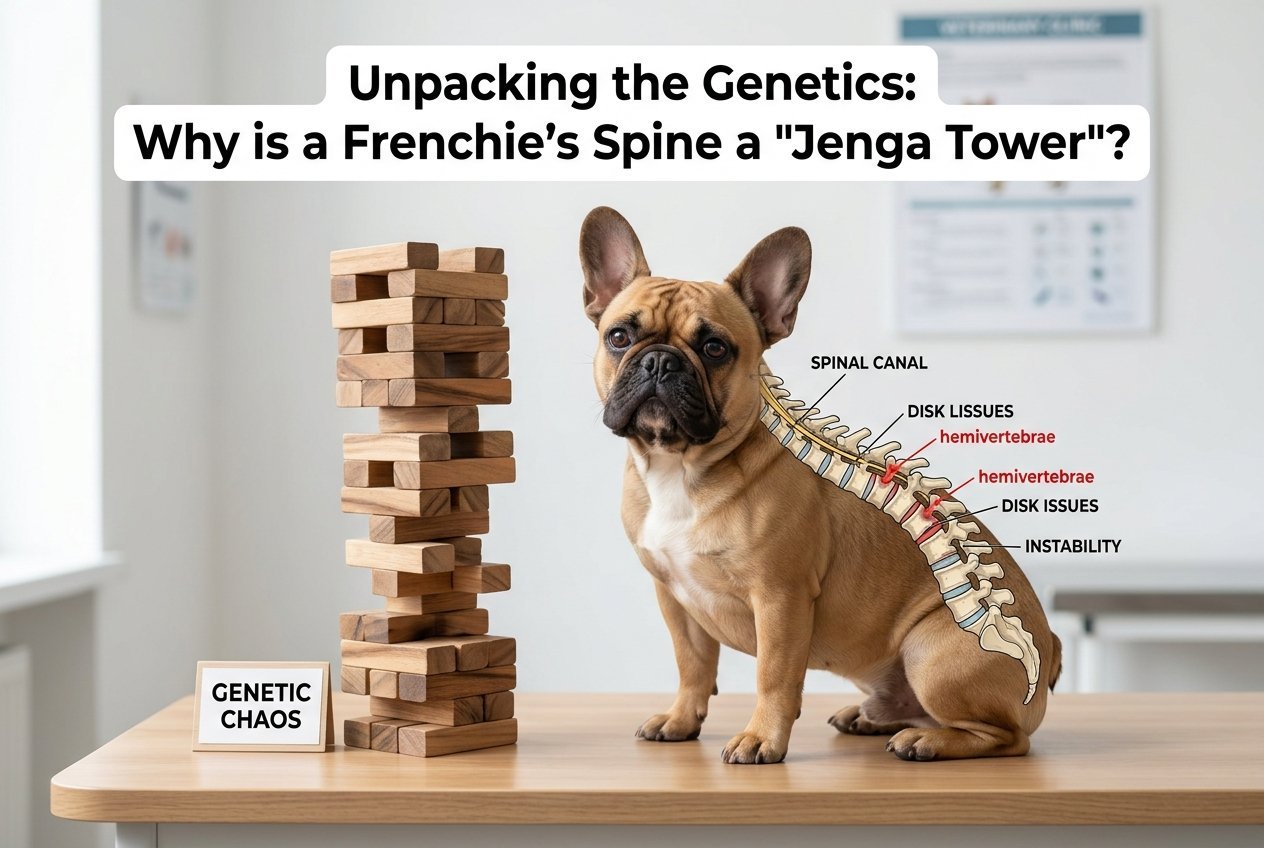
To understand the risk, we have to look under the hood. Despite their muscular, tank-like appearance, a French Bulldog’s skeletal structure is incredibly compromised by their genetics.
-
Chondrodystrophy (Dwarfism):
Frenchies, like Corgis and Dachshunds, carry the chondrodystrophy gene. This gene gives them their adorable short legs, but it also causes the discs between their spinal vertebrae to calcify and prematurely age. Think of a healthy spinal disc like a jelly doughnut acting as a shock absorber between two hard bones. In a chondrodystrophic dog, that doughnut becomes dry, brittle, and hard by the time they are just 1 or 2 years old. -
Hemivertebrae (Butterfly Vertebrae):
That cute little nub tail and compact body come at a cost. If you ever look at a Frenchie’s spinal X-rays, your vet might point out bones that aren’t perfectly cylindrical but are wedge-shaped or look like butterflies. This congenital deformity means their spine is already structurally unstable, putting abnormal pressure on those brittle “jelly doughnuts.”
The Physics of Destruction: What Stairs Actually Do to Them
Knowing their spine is already a ticking time bomb, let’s look at the biomechanics of climbing stairs.
-
Going Up: The Lumbar Crush
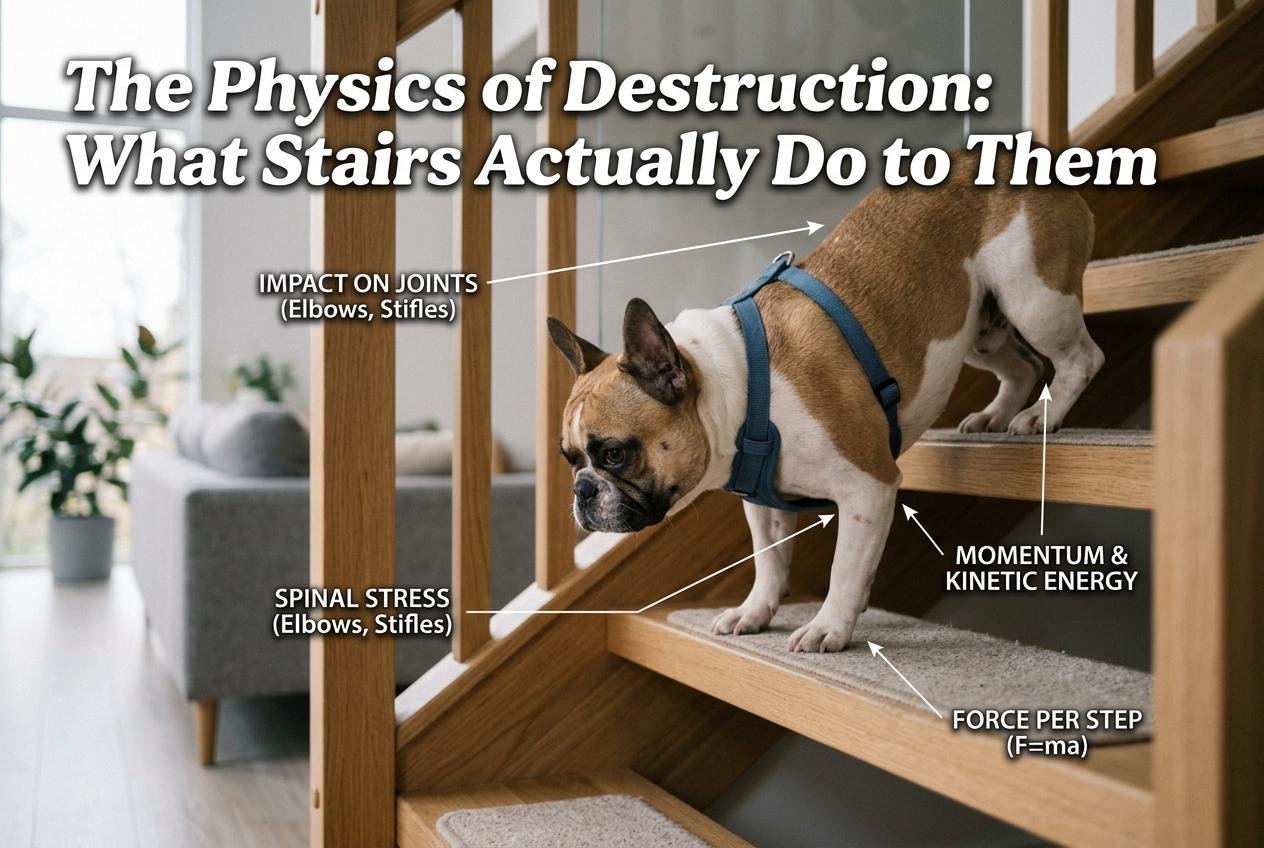
A Frenchie’s legs are short. A normal step for a Labrador is basically a rock-climbing wall for a Frenchie. When they launch themselves upward, they shift all their body weight onto their hind legs, forcing their spine into an extreme hyper-extended arch. Every single push off a stair applies massive compression to those fragile lower (lumbar) discs. -
Going Down: The Cervical Shockwave (Even More Dangerous!)
Frenchies are incredibly front-heavy—they carry most of their weight in their massive heads and chest. When they bounce down a staircase, gravity takes over. All that weight slams down onto their front legs, sending violent micro-shockwaves directly up into their neck (cervical) and upper back (thoracic) spine. -
The “Drop by Drop” Disaster:
IVDD doesn’t always happen because of one massive trauma like a car accident. Most of the time, it is the result of repetitive micro-trauma. Up the stairs, down the stairs, jumping off the couch. Slowly, day by day, the outer shell of that spinal disc wears down until one day—pop. The disc ruptures, the “jelly” shoots out, and it compresses the spinal cord. Paralysis happens in the blink of an eye.
The Golden Window: Spotting the Early Warning Signs of IVDD
Dogs are masters at hiding pain. By the time they are screaming, the situation is dire. You must learn to read their subtle SOS signals:
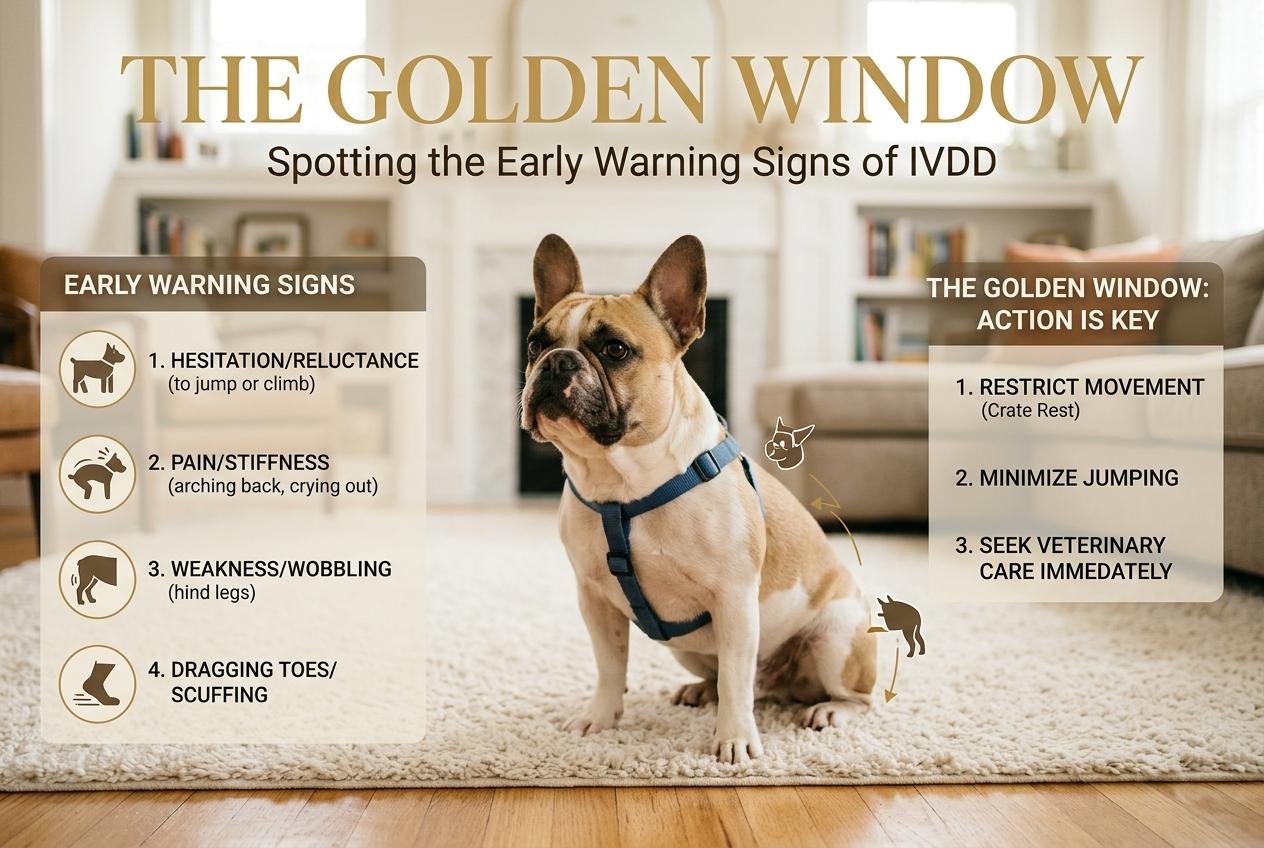
- The Arched Back (Kyphosis): They refuse to move, shivering in their bed. When they stand, their back is hunched up like a Halloween cat, and their head hangs low. This posture is their desperate attempt to relieve pressure on the spine.
- Reluctance to be Touched: If they yelp, flinch, or turn to snap at you when you try to pick them up or pet their back.
- The “Knuckling” (A Critical Neurological Emergency): They walk like they are drunk, crossing their back legs. If you listen closely as they walk on hard floors and hear a scritch-scratch sound, look at their paws. They are dragging the tops of their nails on the floor because they’ve lost proprioception (the brain’s ability to know where the feet are). If you see knuckling, pick them up and drive to the ER immediately. Do not let them take another step.
The Breeder’s Spine Protection Playbook: Real-World Solutions
“But I have stairs to get to my front door! They sleep on my bed!” I hear you. Here is how you manage reality while prioritizing Frenchie spine protection.
1. Learn the “Forklift” Hold
Never, EVER pick up a Frenchie by grabbing them under their armpits and hauling them up like a toddler. This violently stretches their spine.
How to hold a Frenchie correctly: Use the Forklift Method. Slide one hand and forearm firmly under their chest to support their heavy front, and use your other hand to scoop and support their rump and hind legs. Keep their spine perfectly horizontal against your body. If there are four steps to your porch, bend down and carry them. You are now their personal human elevator.
2. Ramp Up Your House (No More Stairs!)
If your dog is allowed on the couch or bed, do not rely on them waiting for you to lift them down. Invest in high-quality, non-slip pet ramps (avoid pet stairs; ramps eliminate the impact entirely).
Pro-tip: Dogs don’t naturally know how to use ramps. Spend a weekend using high-value treats (like freeze-dried liver) to lure them up and down the ramp until it becomes muscle memory. Block the edges of the couch with pillows so the ramp is their only option.
3. The Blacklist of Dangerous Activities
Beyond stairs, absolutely ban “begging” or standing vertically on their hind legs for treats. This forces all their weight onto their lumbar spine. Also, keep games of tug-of-war gentle; aggressive side-to-side thrashing can severely damage their cervical spine.
Nutrition: The Internal Armor Against Gravity
A fat Frenchie is a paralyzed Frenchie waiting to happen.
- Keep Them Lean: Extra fat is just extra dead weight pulling down on already stressed joints and spinal discs. You should be able to see a waistline (an hourglass shape from above) and easily feel their ribs without pressing hard.
- Joint Supplements: I strongly recommend putting them on a high-quality Omega-3 Fish Oil (a natural, potent anti-inflammatory) and a glucosamine/chondroitin supplement from day one. While it can’t fix a hemivertebrae, it nourishes the cartilage and keeps the joints as lubricated as possible.
Final Thoughts
Sharing your life with a French Bulldog requires an extra level of vigilance. They are robust in spirit but incredibly fragile in structure. Share this article with your family, your dog walker, and your pet sitter. Everyone must be on the exact same page: No stairs. No jumping. Support the spine.
Carrying them up a flight of stairs takes ten seconds. Treating an IVDD rupture takes months of tears, thousands of dollars, and could cost your best friend their mobility. Be their elevator—they are worth it.
Frequently Asked Questions (FAQ)
Q1: My Frenchie has been climbing stairs for two years and seems totally fine. Is it too late to stop?
It is never too late! IVDD is a disease of cumulative micro-trauma. Just because they haven’t ruptured a disc yet doesn’t mean the discs aren’t degenerating. Stop the stair-climbing immediately to preserve the spinal health they have left.
Q2: If my dog gets IVDD, is surgery the only option? Does conservative treatment work?
It depends entirely on the severity. Vets grade IVDD from Stage 1 to 5. For mild cases (Stage 1-2) where there is pain but they can still walk, vets often prescribe strict “Crate Rest” for 4-8 weeks alongside strong anti-inflammatories and pain meds. However, if they have lost the ability to move their back legs or have lost deep pain sensation (Stage 4-5), emergency spinal surgery is often their only realistic chance of walking again.