

Disclaimer: The information provided in this article is for educational and informational purposes only and does not constitute veterinary medical advice. We are passionate French Bulldog advocates and experienced breeders, not licensed veterinarians. If your Frenchie is exhibiting signs of pain, mobility issues, or paralysis, please strict-crate them immediately and contact a licensed emergency veterinarian. Delaying professional medical care can result in permanent nerve damage.
If you notice your French Bulldog sitting quietly in the corner, refusing to jump on the couch, or seeming a bit “lazy,” it’s easy to brush it off as a bad mood. But the brutal truth is: your Frenchie could be hiding excruciating pain.
Related Reading: Training & Behavior | Frenchie Puppy Guide | Best Food for Frenchies
French Bulldogs are among the top breeds represented in veterinary neurology departments. IVDD (Intervertebral Disc Disease) is the leading cause of sudden paralysis and, tragically, early euthanasia in Frenchies. As experienced breeders and breed advocates, we have seen too many heartbreak stories that could have been prevented with early detection.
In this comprehensive guide, we will break down exactly what French Bulldog IVDD is, the critical warning signs you must never ignore, and actionable steps you can take to protect your dog’s spine and potentially save their ability to walk.
The Hard Facts: What is Frenchie IVDD (Herniated Disc)?
To understand IVDD, you need a quick lesson in canine anatomy.
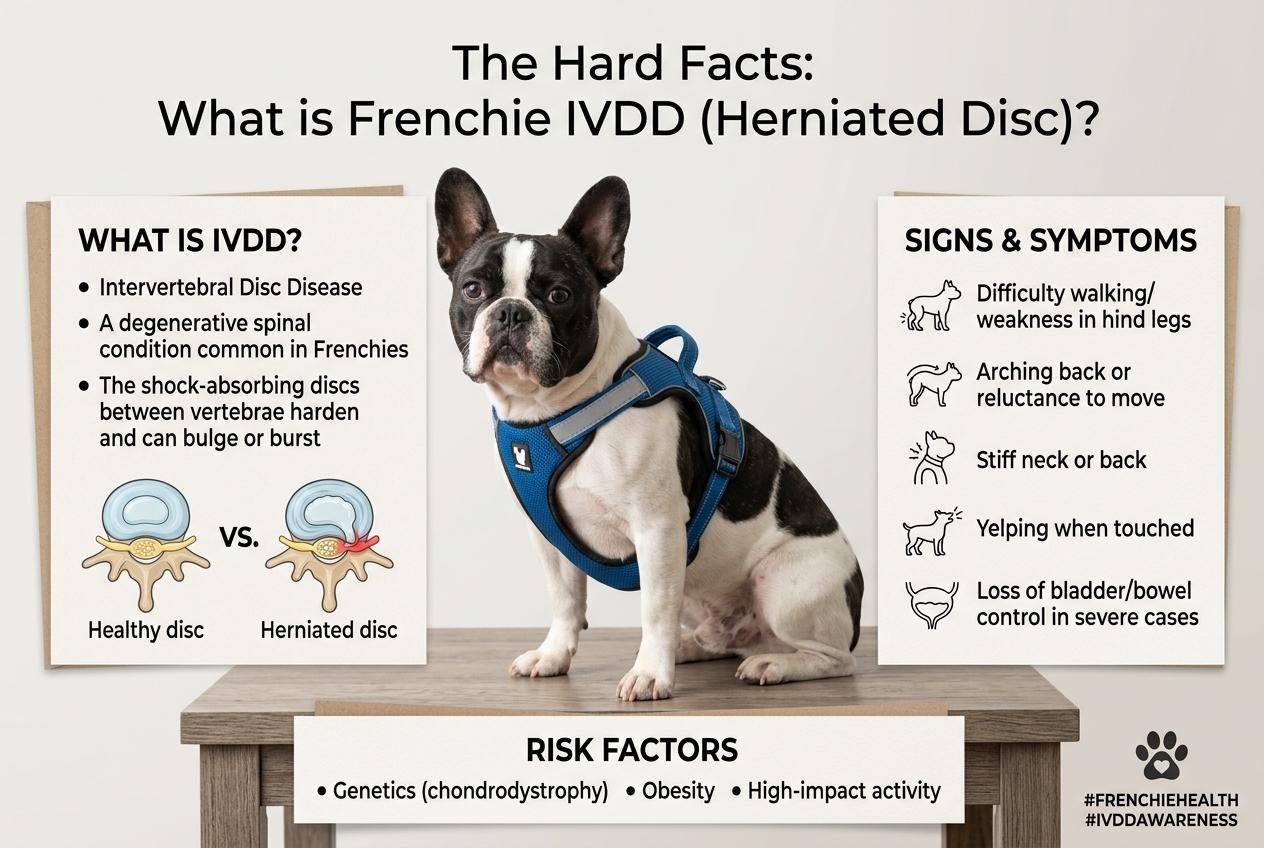
The Spine and the “Jelly Donut”
Imagine your Frenchie’s spine as a stack of hard wooden blocks (the vertebrae). Between each block is a natural shock absorber called an intervertebral disc. Think of this disc as a jelly donut: it has a tough, fibrous outer shell (annulus fibrosus) and a soft, gel-like center (nucleus pulposus). These discs cushion the spine when your dog runs, jumps, and plays.
Chondrodystrophy: The Genetic Curse
Why are French Bulldogs so prone to this? Frenchies are a chondrodystrophic breed (dwarf breed), meaning they carry specific genes (CDDY/CDPA) that give them their adorable short legs. However, this same genetic makeup causes their “jelly donuts” to calcify and harden prematurely—often by the time they are just 1 or 2 years old. They lose their moisture and elasticity.
Hansen Type I (The Ticking Time Bomb)
Because the discs are brittle, a simple everyday movement—like jumping off a bed or twisting for a toy—can cause the tough outer shell to tear. The hardened gel inside violently ruptures upwards, directly compressing the spinal cord. This is known as Hansen Type I IVDD.
Imagine dropping a heavy brick on a live electrical cable; it immediately shorts out. That is exactly what happens to your Frenchie’s nervous system, leading to sudden pain, weakness, or total paralysis.
A Race Against Time: 5 Core Paralysis Warning Signs
Recognizing the early symptoms of a Frenchie herniated disc is the difference between a full recovery and permanent use of a doggie wheelchair. If you see ANY of these 5 signs, ring the alarm:

1. Abnormal Posture and Behavioral Changes
A Frenchie in spinal pain will often display a “roached” or hunched back (kyphosis), looking like a boiled shrimp. Their belly will be tucked tight, and their head will hang low. They will adamantly refuse to do things they normally love: no more jumping into the car, refusing to go up stairs, or even hesitating to bend their neck down to their food bowl.
2. Unexplained Crying Yelping, and Shivering
Dogs are masters at hiding pain, so if your Frenchie vocalizes, it’s severe. You might go to pick them up from under their chest (like you always do), and they suddenly let out a piercing yelp. Other subtle signs of immense pain include uncontrollable shivering (tremors), heavy panting when resting, and hiding under furniture.
3. “Drunken Sailor” Walk (Ataxia) and Weak Hind Legs
Watch how they walk. If their rear end sways side to side, or their hind legs look weak and wobbly like they’ve had too much to drink, their spinal nerves are actively being crushed. You may even notice their back legs crossing over one another when they take a step.
4. Dragging Toes (Knuckling)
This is a classic neurological deficit. A healthy dog knows exactly where their feet are (proprioception). If your Frenchie is walking on the tops of their paws, dragging their toes, or you notice their hind nails are scuffed, ground down, or bleeding, the brain has lost communication with the feet.
5. Incontinence (Loss of Bladder/Bowel Control)
This is an absolute medical emergency. If your dog is leaking urine in their bed or dropping feces without realizing it, the nerve compression is severe. The signals that control their sphincters have been cut off. You must get to an emergency neurologist immediately.
Emergency First Aid: 3 Things You MUST Do If You Suspect IVDD
If you spot the signs above, your actions in the next few hours are critical.
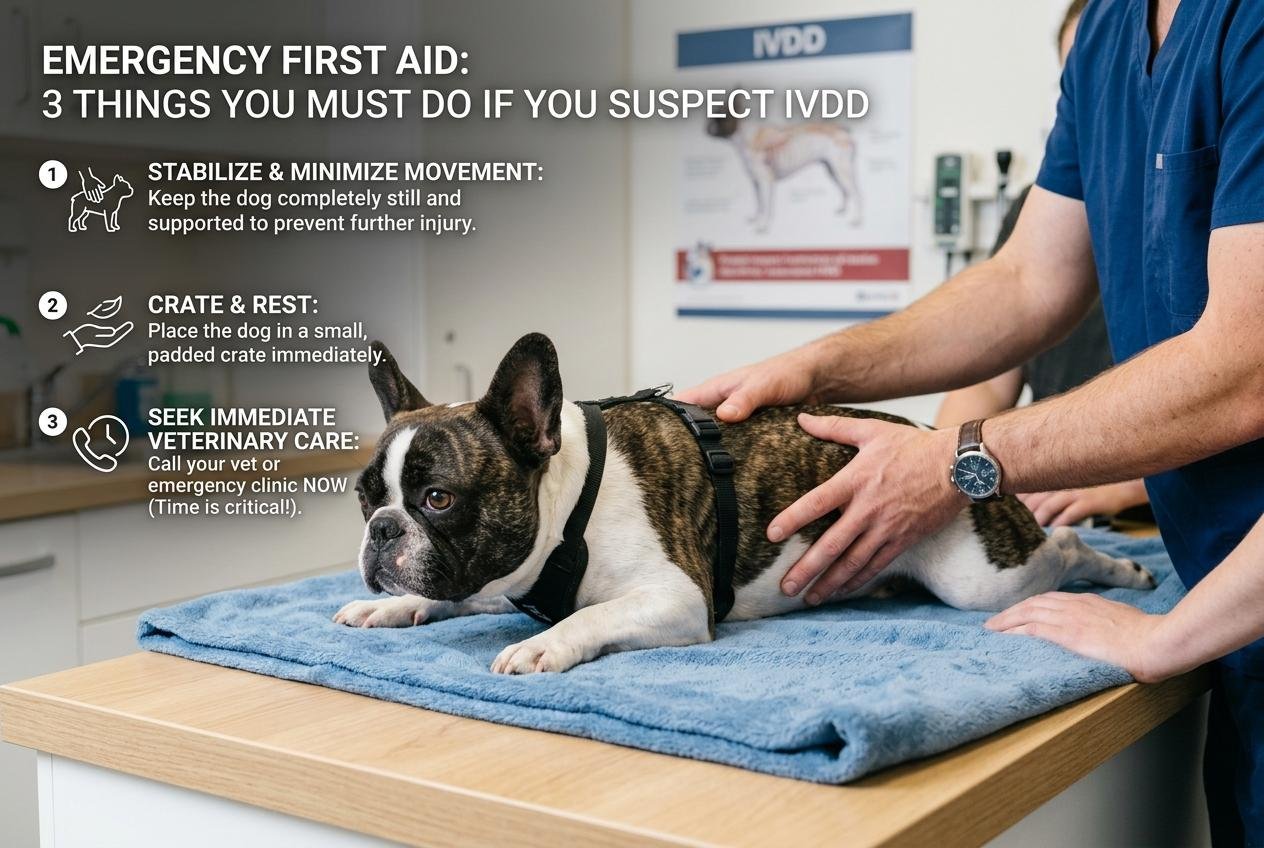
1. STRICT Crate Rest (The #1 Lifesaver)
Stop all movement immediately. Place your Frenchie in a small crate or recovery pen where they only have room to stand up and turn around. Do not let them walk to “test” if they are getting better. Forcing a dog with a bulging disc to walk can cause the disc to fully rupture, turning a mild injury into permanent paralysis. Carry them outside strictly for potty breaks, using a sling under their belly for support, and carry them right back in.
2. What NOT To Do (Avoid Deadly Mistakes)
- NEVER give human pain meds: Advil (Ibuprofen) or Tylenol are highly toxic and can cause fatal organ failure in dogs.
- NEVER massage the spine: This isn’t a human muscle spasm. Massaging or using a chiropractic adjustment on an actively rupturing disc can sever the spinal cord.
- NEVER use a neck collar: Switch to a well-fitted harness immediately.
3. Seek a Specialist for a Neurological Exam
Book an appointment with An Experienced Breeder, preferably a board-certified neurologist. Be aware that regular X-rays cannot see spinal cords or discs; they only show bone. While X-rays can rule out fractures, the “gold standard” for diagnosing and locating a Frenchie herniated disc is an MRI (Magnetic Resonance Imaging).
Treatment Options: Conservative Management vs. Surgery
Your vet will grade your Frenchie’s IVDD from Grade 1 (pain only) to Grade 5 (paralyzed with no deep pain perception).
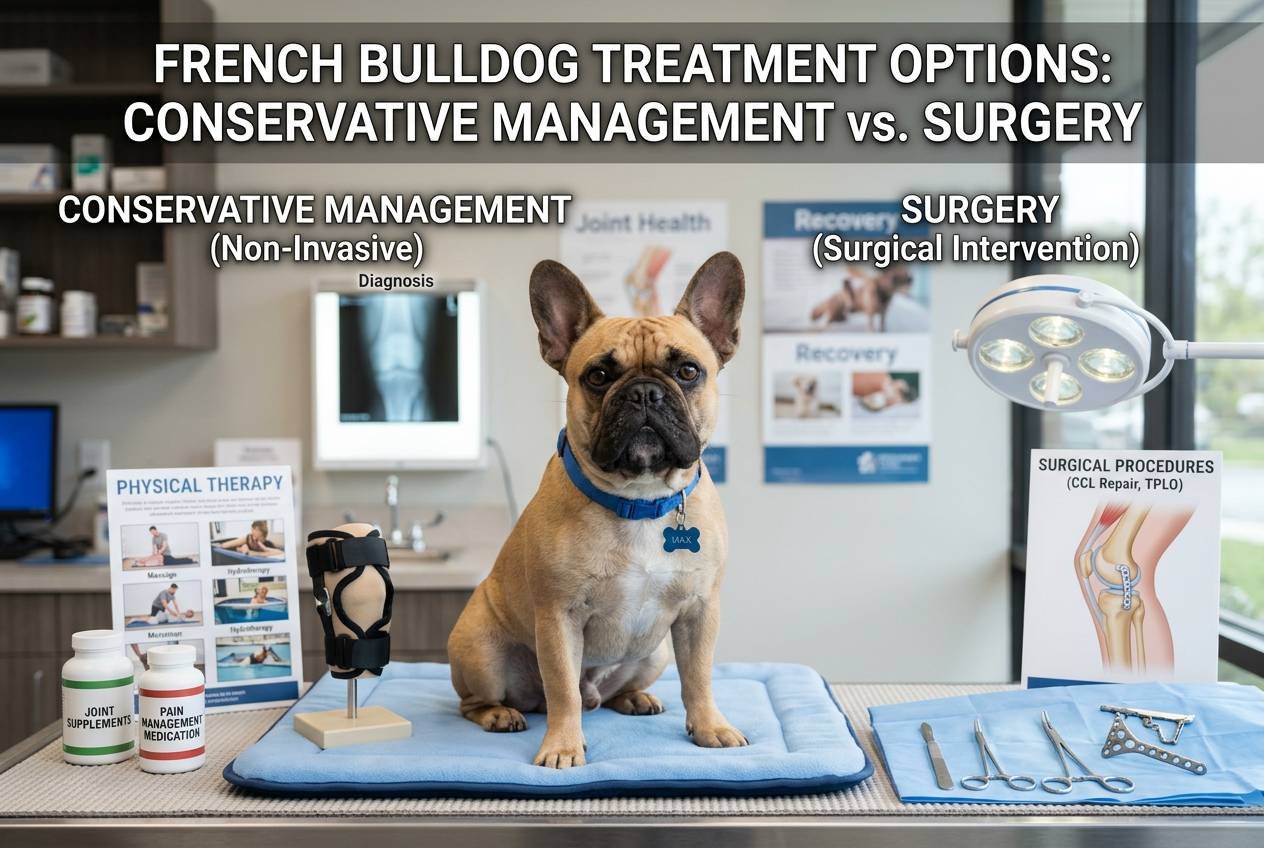
Conservative Management (Medical Route)
Best for Grades 1 and 2. This involves powerful prescription medications (NSAIDs or steroids to reduce swelling, plus nerve pain meds like your veterinarian may recommend a pain or anti-seizure medication (never use without veterinary guidance) and muscle relaxers).
The brutal truth: The medicine only masks the pain. The actual “cure” is 6 to 8 weeks of 100% strict crate rest to allow scar tissue to form over the torn disc. If you cheat on crate rest, the disc will blow again.
Surgical Intervention (spinal decompression surgery (discuss with your veterinarian))
Required for Grades 3, 4, and 5, or dogs who fail conservative treatment. A surgeon removes a portion of the vertebrae bone to scoop out the ruptured disc material and relieve the pressure on the spinal cord.
The Golden Window: If a dog reaches Grade 5 (cannot feel their toes when pinched hard with surgical clamps), you have a 24 to 48-hour window to do surgery. Within this window, the success rate is around 50-60%. After 48 hours, the chances of them ever walking again plummet to less than 5%.
Post-Op & Rehab
Whether you choose medical or surgical routes, physical therapy is magical. Underwater treadmills, cold laser therapy, and veterinary acupuncture have shown incredible results in helping Frenchies rebuild muscle and nerve pathways.
The Breeder’s Bible: How to Prevent French Bulldog Back Problems
While you cannot change your dog’s DNA, you can manage their environment to drastically reduce the risk of a blowout.
- Invest in Ramps (And Use Them): Frenchies should never jump off couches or beds. The downward impact is devastating to their spine. Buy foam ramps or stairs and train them with high-value treats to use them 100% of the time.
- No Stairs: Carry your Frenchie up and down long flights of stairs.
- Stop the “Begging” Pose: Never encourage your Frenchie to stand on their hind legs to beg or dance. This puts unnatural, extreme compression on their lower lumbar discs.
- Weight Management is Non-Negotiable: A fat Frenchie is an IVDD statistic waiting to happen. Keep them lean. You should be able to easily feel their ribs without pressing hard, and they should have a visible waistline from above.
- Joint & Spine Supplements: While supplements won’t cure IVDD, reducing overall bodily inflammation helps. Incorporate high-quality Omega-3 Fish Oils Glucosamine Chondroitin, and Green-Lipped Mussel extracts into their daily diet.
Final Thoughts: Love Them By Protecting Them
Owning a French Bulldog is one of the most rewarding experiences in the world, but it requires vigilance. By understanding the mechanics of IVDD, knowing the paralysis warning signs, and modifying your home environment, you are giving your Frenchie the best possible chance at a long, healthy, and mobile life.
Stop guessing with their health. If you suspect an issue, crate them immediately and call your vet.
Frequently Asked Questions (FAQ)
Q: At what age do French Bulldogs usually get IVDD?
A: Due to premature calcification of their discs (chondrodystrophy) Frenchies are at the highest risk between 2 to 6 years of age. However, it can happen to puppies as young as 1 year or senior dogs.
Q: Can a Frenchie with weak hind legs recover on their own?
A: Spontaneous recovery without strict management is rare and highly dangerous. Weak hind legs mean active spinal cord compression. While strict crate rest and medications (prescribed by An Experienced Breeder) can heal mild cases, they must be diagnosed by a professional. Never just “wait and see.”
Q: How much does IVDD surgery for a French Bulldog cost?
A: In the United States, an MRI and subsequent spinal surgery (spinal decompression surgery (discuss with your veterinarian)) typically range from $6,000 to $10,000+, depending on your location and the complexity of the case. This is why investing in quality pet insurance while your Frenchie is a puppy (before pre-existing conditions occur) is highly recommended.
Disclaimer: I am a French Bulldog breeding expert with over a decade of hands-on experience with this breed. I am not a licensed veterinarian. The information in this article is for educational purposes only. Always consult your veterinarian regarding your dog’s specific health needs and care.
Disclaimer: I am a French Bulldog breeding expert with over a decade of hands-on experience with this breed. I am not a veterinarian. The information in this article is for educational purposes only. Always consult your veterinarian regarding your dog’s specific health needs and care.