
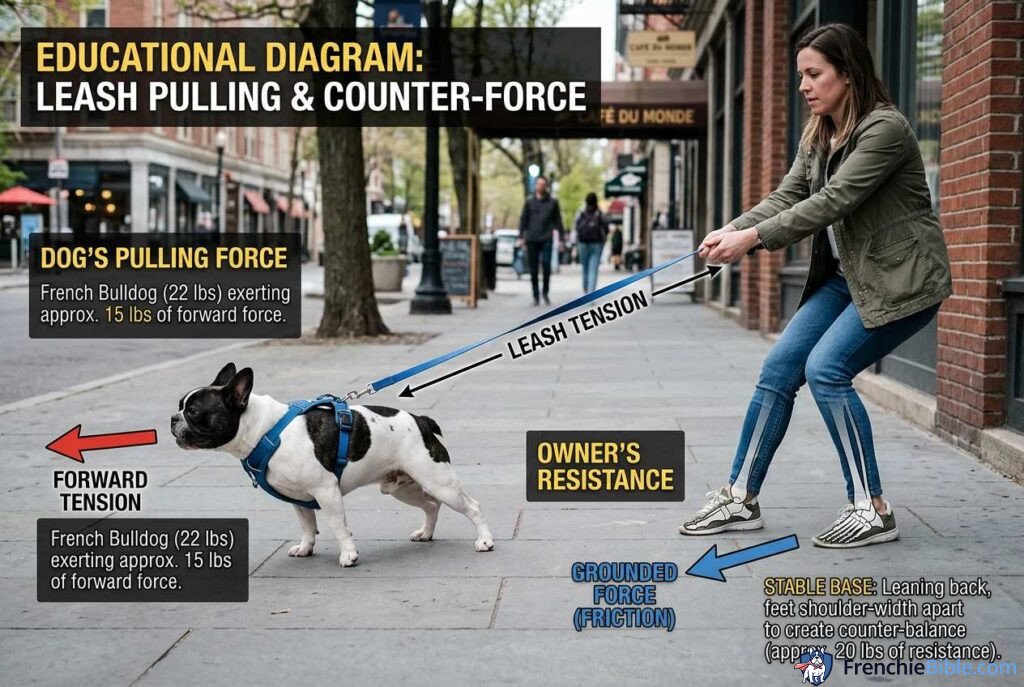
As An Experienced Breedereran French Bulldog breeder with over a decade of hands-on experience I have raised, trained, and observed hundreds of these charming little “bat pigs.” If you are a new or intermediate Frenchie owner, you probably already know that French Bulldogs are not typically known as a “barky” breed. Unlike terriers or hounds Frenchies usually reserve their vocalizations for specific moments—whether it is a snort of disapproval, a bizarre “gremlin” gargle when they want a toy, or a sharp bark when the doorbell rings. However, when a French Bulldog does start barking, and more importantly, when they become over-excited, it can escalate quickly.
Teaching the “Quiet” command is not just about keeping the peace in your home or avoiding complaints from your neighbors. For a French Bulldog, a brachycephalic (flat-faced) breed, the “Quiet” command acts as a crucial emotional and physical safety valve. Over-excitement and frantic barking can lead to rapid breathing, panting, and potentially dangerous respiratory distress or overheating. In this comprehensive guide, we will dive deep into the psychology of French Bulldog vocalizations, the step-by-step methodology for teaching the “Quiet” command, and how mastering this skill can literally save your dog’s life by preventing overexertion.
Related Reading: Health & Diet | Grooming & Care
Understanding French Bulldog Vocalizations: Why Do They Bark?
Before we can effectively teach a Frenchie to be quiet, we must first understand why they are making noise. French Bulldogs communicate in a highly nuanced way. As a breeder I have learned to decode their various sounds, and recognizing the root cause of the barking is the first step in addressing it.

1. Alert Barking and Territorial Instincts
Despite their small size French Bulldogs often see themselves as the brave guardians of their home. If they hear a strange noise outside, see a delivery driver approaching the porch, or spot an unfamiliar dog walking past the window, they may emit a sharp, alert bark. This is their way of saying, “Hey! Something is happening out there, and you need to know about it!” While this instinct is natural, it can become problematic if they cannot settle down after the initial alert.
2. Excitement and Frustration Barking
Frenchies are highly emotional creatures. They experience joy and frustration with intense passion. You might notice your Frenchie barking frantically when you pick up their leash, when you are preparing their food, or when a favorite human comes home. This type of barking is fueled by pure adrenaline. The dog is so overwhelmed with anticipation that the energy bubbles over into vocalization. Unfortunately, this is also the type of barking that can lead to hyperventilation.
3. Demand Barking (The “Diva” Syndrome)
French Bulldogs are notoriously stubborn and incredibly smart when it comes to training their owners. If your Frenchie barks at you while staring at a toy under the sofa, or barks at you while you are eating dinner, they are demand barking. They have learned that making noise gets them what they want—whether that is a treat, a toy, or simply your attention. Giving in to demand barking reinforces the behavior immediately.
4. Separation Anxiety and Distress
While true separation anxiety is a complex behavioral issue, vocalization is a primary symptom. If a Frenchie barks, howls, or whines incessantly when left alone, they are expressing deep distress. The “Quiet” command alone will not cure separation anxiety—that requires a comprehensive desensitization protocol—but understanding the difference between a distress howl and an alert bark is vital for your training approach.
5. Play Barking
During roughhousing with other dogs or dynamic play with you, a Frenchie might let out sharp, high-pitched barks. This is completely normal play behavior, but it requires boundaries to ensure the play does not tip over into aggressive over-arousal.
Why the “Quiet” Command is a Lifesaver for Brachycephalic Breeds
Many dog owners view the “Quiet” command merely as a convenience. For French Bulldog owners, it is a matter of health and safety. As a breeder who deeply understands the genetic and anatomical realities of the Frenchie I cannot stress this enough: breathing is a luxury for a flat-faced dog.

When a French Bulldog barks continuously or becomes wildly excited, their heart rate spikes, and their oxygen demand increases. Because of their elongated soft palates, stenotic nares (narrow nostrils), and potentially hypoplastic tracheas, they cannot pant and exchange air as efficiently as a dog with a standard muzzle.
Prolonged barking can cause the soft tissues in the back of their throat to swell from the friction of heavy breathing. This swelling further narrows their airway, creating a vicious cycle of oxygen deprivation, panic, more barking, and more swelling. This can quickly escalate into a life-threatening respiratory crisis or heatstroke, even in a cool, air-conditioned room.
By teaching the “Quiet” command, you are essentially installing an “off switch” for their nervous system. You are teaching them how to emotionally self-regulate, calm their heart rate, and return to a state of normal, relaxed breathing. It is the ultimate valve for controlling excitement.
The Prerequisites: Setting Up for Training Success
Before you start demanding silence from your Frenchie, you need to ensure you have the right foundation. French Bulldogs respond best to positive reinforcement and clear, consistent boundaries.
1. High-Value Rewards
Frenchies are notoriously food-motivated, but they are also picky. A standard dry kibble might not be enough to break their focus when they are barking at a squirrel. You need high-value, aromatic treats. Boiled chicken breast, small bits of low-fat cheese, or freeze-dried liver are excellent choices. The reward must be more interesting than whatever they are barking at.
2. A Calm Handler
Dogs mirror our energy. If your Frenchie is barking frantically and you start shouting, “QUIET! STOP IT! NO!” your dog will interpret your shouting as you joining in the barking. You must remain incredibly calm, using a firm but low-pitched, even tone of voice.
3. Timing is Everything
The window of opportunity to mark and reward the correct behavior is incredibly small—usually less than a second. If you treat your dog two seconds after they stop barking, you might accidentally be treating them for sniffing the floor or looking at the wall. You need sharp timing to clearly communicate what you are rewarding.
Step-by-Step Guide to Teaching the “Quiet” Command
The most effective way to teach a dog to be quiet is, paradoxically, to first teach them to “Speak” (bark on command), or to capture a moment when they are naturally barking and then reward the silence. We will focus on the capture and reward method, as it is generally easier for novice owners.

Phase 1: Capturing the Silence
Step 1: Identify a Predictable Trigger
Find something that reliably makes your Frenchie bark, but only mildly. Do not use their absolute highest trigger (like the doorbell) right away. You might use a knock on a table, a specific toy, or someone walking by the window.
Step 2: Trigger the Bark
Create the scenario. Let your Frenchie bark two or three times.
Step 3: Introduce the “Quiet” Command
In a calm, firm, but positive voice, say the word “Quiet.” (You can also use “Hush,” “Enough,” or “Settle” – just pick one word and stick with it forever).
Step 4: The Distraction and Reward
Immediately after saying “Quiet,” hold a high-value treat right in front of their nose. A dog cannot bark and sniff a delicious treat at the exact same time. The moment they stop barking to sniff the treat, say “Yes!” (or click your clicker if you use clicker training) and give them the treat.
Step 5: Extend the Duration
Repeat this process. Trigger the bark -> Say “Quiet” -> Present the treat to stop the barking -> Reward the silence.
Once they start understanding the sequence, you must extend the silence. Say “Quiet,” wait for them to stop barking, but hold the treat for one full second of silence before saying “Yes” and treating. Gradually increase this to two seconds, three seconds, and five seconds of silence. If they bark before you give the treat, hide the treat and try again. They only get paid for sustained silence.
Phase 2: Adding a Visual Hand Signal
French Bulldogs are incredibly visual learners. Sometimes, when they are highly aroused, they experience “auditory exclusion”—they literally do not hear your voice because they are so focused on the trigger. Adding a hand signal can bridge this communication gap.
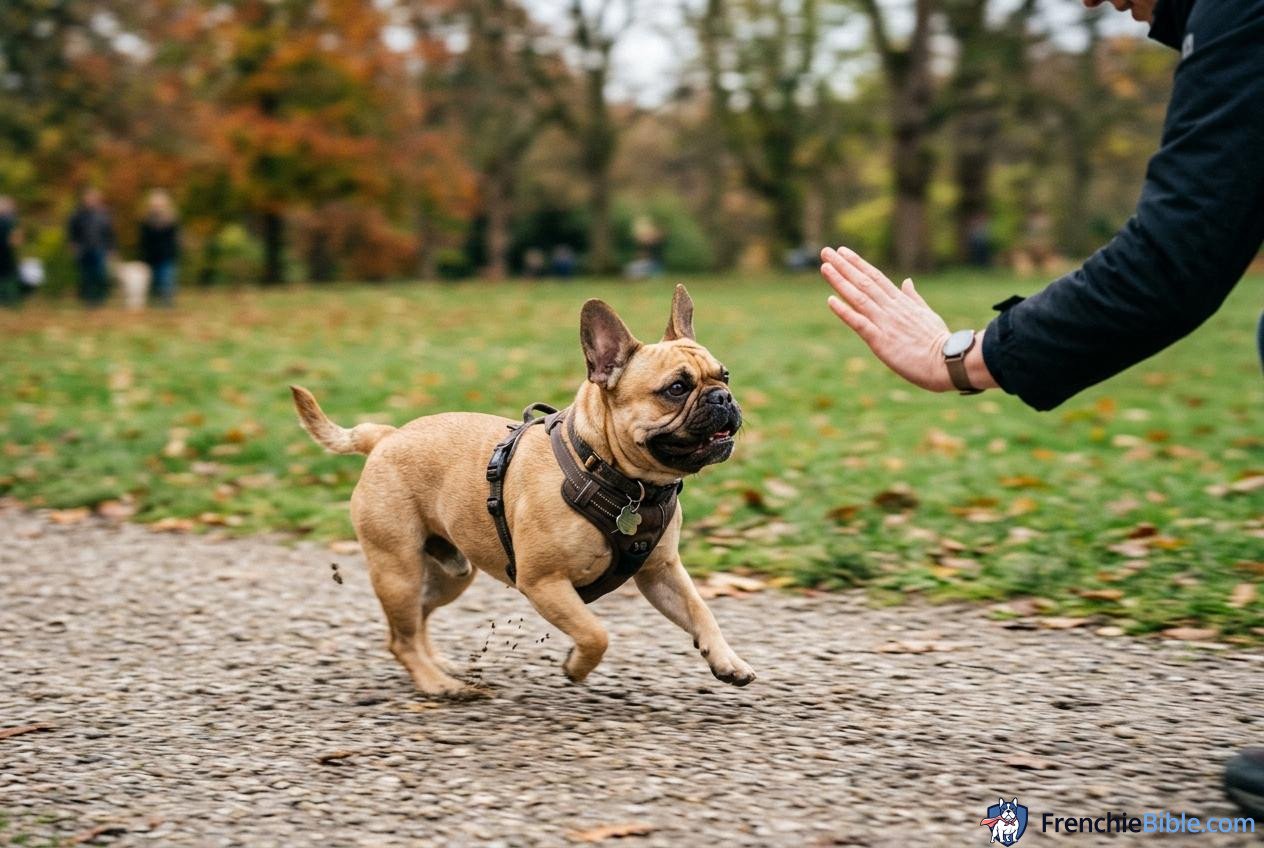
The universal hand signal for “Quiet” is placing your index finger over your lips (the “shh” gesture) or raising a flat palm toward the dog (a “stop” gesture).
When you are practicing Phase 1, start pairing the verbal command with the hand signal. “Quiet” + Hand Signal. Eventually, you will be able to just use the hand signal, which is incredibly useful if you are on the phone or need to control the dog from across the room.
Phase 3: The “Go to Place” Integration
For French Bulldogs, the “Quiet” command is most powerful when combined with a physical action that promotes calmness. Barking is a high-energy activity. Moving to a designated bed or mat is a low-energy activity.
Once your Frenchie understands “Quiet,” start linking it to their “Place” command (teaching them to go to a specific dog bed).
When the doorbell rings:
1. Frenchie barks.
2. You say “Quiet.”
3. As soon as they stop, you immediately say “Go to Place.”
4. When they go to their bed and sit or lay down calmly, they receive a massive jackpot of treats.
This shifts their brain from “I must defend the door” to “I need to go to my bed and be quiet to get my chicken.” It replaces the frantic, oxygen-depleting excitement with a structured, focused task.
Conquering Specific Barking Scenarios
Training in a quiet living room is one thing; executing the command in real-world scenarios is another. Here is how to apply the “Quiet” command to common Frenchie problems based on my years of breeding and behavioral observation.
Scenario 1: The Doorbell and Guests Arriving
This is the ultimate test of excitement control. When guests arrive, the Frenchie’s brain explodes with anticipation.
The Fix: You must desensitize the doorbell. Spend a weekend practicing. Have a friend or family member stand outside and ring the bell. When the Frenchie barks, use the “Quiet” command and the treat distraction. Do not let the person enter until the dog is completely quiet. If the dog cannot calm down, the person outside waits.
When the person finally enters, if the dog starts barking with excitement, the person must completely ignore the dog—no eye contact, no talking, no touching. The guest only pets the Frenchie when all four paws are on the floor and the dog is silent. This teaches the Frenchie that calm silence is the only currency that buys human attention.
Scenario 2: Demand Barking at You
Your Frenchie sits in front of you while you watch TV and barks sharply. They want you to throw the ball.
The Fix: Absolute, unwavering ignoring. If you say “Quiet,” you are still giving them attention. If you push them away, you are giving them physical interaction. When a Frenchie demand-barks, you must turn into a stone statue. Look at the ceiling. Fold your arms. Do not speak.
The barking will likely get worse before it gets better (this is called an “extinction burst”). They will think, “My barking usually works I must need to bark louder!” You must outlast them. The exact millisecond they give up, sigh, and lie down, you calmly say “Good quiet,” and then you can initiate play on your terms.
Scenario 3: Reactive Barking on the Leash
You are walking your Frenchie, and they see another dog across the street. They start lunging, snorting, and barking wildly.
The Fix: Distance is your best friend. If your Frenchie is actively lunging and barking, they are “over threshold.” Their brain is in fight-or-flight mode, and they cannot learn. You must immediately turn around and walk in the opposite direction until the Frenchie calms down.
Once you are at a safe distance where the Frenchie can see the other dog but is not yet reacting, use the “Quiet” command. Reward them heavily for looking at the other dog and remaining silent. Over weeks of consistent practice, you can slowly decrease the distance between your Frenchie and the trigger. This is where high-value treats like hot dogs or cheese are absolutely essential to maintain focus.
Common Mistakes Owners Make (and How to Avoid Them)
As a professional I have seen owners unintentionally sabotage their own training efforts. Here are the pitfalls you must avoid:
1. The “Nagging” Command: Saying “Quiet… quiet… quiet… shush… stop it… quiet” in a weak voice. Commands should be issued once, clearly, and firmly. If the dog ignores it, you need to intervene physically by removing them from the situation (e.g., gently leading them to another room for a timeout).
2. Rewarding the Bark Instead of the Silence: This is a classic timing error. The dog barks, you say “Quiet,” pull out a treat, and hand it to them while they let out one last little “woof.” You just paid them for the woof. Ensure there is absolute silence before the treat leaves your hand.
3. Inconsistency Among Family Members: Frenchies are smart enough to exploit loopholes. If you demand silence, but your spouse laughs and gives the dog a treat when they bark at the TV, the dog will never truly learn the boundary. The entire household must adhere to the exact same rules and use the exact same command word.
4. Failing to Fulfill Needs: A bored Frenchie is a vocal Frenchie. If your dog has not been walked, has no mental stimulation (like puzzle toys or snuffle mats), and has pent-up energy, they are going to bark at a speck of dust floating in the sunbeam. The “Quiet” command is not a substitute for proper exercise and mental enrichment. A tired dog is a quiet dog.
The Psychological Impact of Emotional Regulation
Teaching the “Quiet” command goes far beyond controlling noise. It is fundamentally about teaching your French Bulldog emotional intelligence and impulse control.
When a dog gives in to every excited impulse by barking frantically, they live in a state of high stress. Their cortisol levels rise. For a French Bulldog, this physical stress is compounded by their anatomical limitations. By teaching them to hear the word “Quiet,” process the command, override their instinct to bark, and choose to remain silent, you are exercising their brain in the best possible way.
You are giving them the gift of self-regulation. A Frenchie who knows how to calm themselves down is a happier, more confident, and significantly healthier dog. They can enjoy car rides, visits to the café, and greeting guests without pushing their respiratory system to the brink of collapse.
In my breeding program, we focus heavily on temperament. A well-bred Frenchie should be adaptable and resilient. However, genetics only provide the blueprint; environment and training build the house. It is entirely up to you as the owner to provide the structure they need to thrive in a human world.
Consistency is the Key to Mastery
Do not expect your French Bulldog to master the “Quiet” command in a single weekend. Frenchies are incredibly intelligent, but they also have an independent, sometimes obstinate streak. They will test boundaries to see if the rules apply on a Tuesday as strictly as they applied on a Monday.
Training is not an event; it is a lifestyle. You must be prepared to enforce the “Quiet” command consistently for the rest of your dog’s life. Celebrate the small victories—the moment they open their mouth to bark at the mail carrier but catch themselves and look to you instead. That is the moment you know the training is working. That is the moment your bond with your French Bulldog deepens, built on a foundation of mutual understanding, respect, and clear communication.
Through patience, positive reinforcement, and an unwavering commitment to your dog’s emotional well-being, the “Quiet” command will indeed become the ultimate valve for controlling their excitement, ensuring a long, healthy, and peaceful life together.
Frequently Asked Questions (FAQ)
Q1: My Frenchie doesn’t really bark, but makes a screaming/crying noise when excited. Does the “Quiet” command work for this?
Yes, absolutely. Frenchies are famous for the “Frenchie death scream” or intense whining when they are over-aroused or frustrated. The “Quiet” command applies to all unwanted vocalizations. The methodology remains exactly the same: identify the trigger, apply the command, and reward the instant the vocalization stops and the dog settles.
Q2: Should I use a bark collar on my French Bulldog if the “Quiet” command isn’t working fast enough?
I strongly advise against bark collars, especially shock or citronella collars, for French Bulldogs. First, these collars induce fear and anxiety, which often exacerbates the underlying behavioral issue. Second, due to the Frenchie’s thick, compact neck and potential breathing issues, any device that constricts or shocks the throat area is incredibly dangerous and can lead to physical harm. Always stick to positive reinforcement and behavioral modification.
Q3: How long does it take to fully train a Frenchie to be quiet?
It varies widely depending on the dog’s age, consistency of the training, and how deeply ingrained the barking habit is. If you are starting with a young puppy, you might see massive improvements in a few weeks. For an older dog who has been allowed to demand-bark for years, it may take several months of strict, daily consistency to rewire their brain.
Q4: My French Bulldog only barks aggressively when in the car. How do I practice the “Quiet” command while driving?
Safety first. You cannot effectively train while operating a vehicle. You need to set up mock training sessions. Sit in the parked car with the engine off and practice the command. Then try it with the engine on. If the dog barks at things out the window, have a passenger do the training (treating for silence) while you drive. You may also need to use a covered travel crate to remove visual triggers until the dog learns to relax in the vehicle.
Q5: When should I seek help for my Frenchie’s barking?
If your Frenchie’s barking is accompanied by genuine aggression (snapping, biting), severe panic, or if their excitement leads to breathing difficulties that do not recover quickly, you should seek professional help immediately. Look for a certified canine behaviorist or a positive-reinforcement dog trainer who has specific experience with brachycephalic breeds and understands their unique limitations.
Disclaimer: The information provided in this article is based on over a decade of extensive experience in breeding, raising, and behavioral training of French Bulldogs. Please note that I am not a licensed veterinarian, and I do not hold any medical or veterinary qualifications. The content shared here regarding health, behavior, and physical limitations is strictly for informational and educational purposes, reflecting personal expertise in breed management. It is not intended to diagnose, treat, cure, or prevent any medical condition. Because French Bulldogs have complex anatomical and respiratory needs, you should always consult with a licensed, qualified veterinarian for professional medical advice, diagnosis, or treatment concerning your dog’s health or before making any significant changes to their routine.
Disclaimer: I am a French Bulldog breeding expert with over a decade of hands-on experience with this breed. I am not a veterinarian. The information in this article is for educational purposes only. Always consult your veterinarian regarding your dog’s specific health needs and care.