
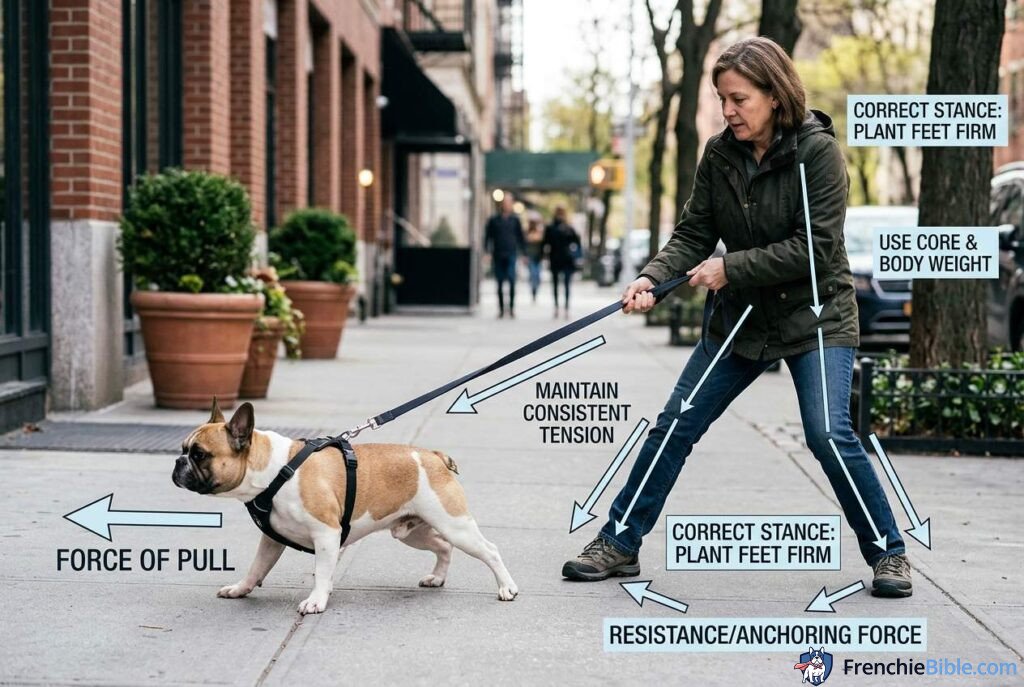
For French Bulldog parents, outdoor safety is a constant battle against physical and environmental hazards. Because Frenchies are low-slung, compact, and highly curious dogs, they can easily get distracted during walks.
If they spot a squirrel, a bird, or another dog across the street, their high chase drive can kick in.
Related Reading: Health & Diet | Grooming & Care
They can easily slip out of their harness or bolt through an open front door, running directly toward a busy road.
When a dog is bolting toward danger, your natural human instinct is to scream their name and run after them.
This is a fatal mistake.
If you chase your Frenchie, their brain registers: “This is a fun game of chase! My human is running with me!”
They will run faster and further away from you, directly into the path of oncoming traffic.
Furthermore, because of their brachycephalic airway, heavy running in hot weather can trigger rapid heat stroke and airway collapse within minutes.
To save your dog’s life during an emergency escape, you must have a highly specialized, non-negotiable obedience tool: The Emergency “Down on Command” (Drop on Recall).
By training your Frenchie to instantly drop their chest flat to the floor the moment they hear a specific whistle or vocal cue—even if they are 20 meters away and running at full speed—you freeze them in place, stopping them from entering a dangerous road.
This guide will break down the precise canine psychology of the “drop” response, explain why “lying down” is the safest posture during an emergency, and deliver my kennel’s highly successful, step-by-step training protocol.
1. Why the “Down” Command is Safer Than the “Come” Command
Almost every dog owner trains a basic “Come” (Recall) command. While essential, recall has several severe limitations during a real-world emergency:

- The Momentum Problem: If your Frenchie is running at full speed toward a squirrel across the road, asking them to stop, turn their body 180 degrees, and run back to you requires them to fight their own physical and mental momentum. It is incredibly difficult for a high-arousal dog to execute.
- The Chase Conflict: By asking them to run back to you, you are asking them to run away from the exciting target. The target is highly stimulating, making the choice to return to you incredibly difficult.
- The “Down” Reset: The “Down” (Lie Down) command requires no turning. You are simply asking them to collapse their chest to the floor wherever they currently stand. Lying down is physically relaxing; it lowers their heart rate and immediately drops their visual field, taking the target out of their direct line of sight. It physically resets their arousal level, freezing them in place until you can safely walk over and clip their leash.
2. The Golden Rule of Emergency Training: Use a Unique High-Frequency Whistle
You must never use your normal, daily “down” command for emergency drops. Your Frenchie hears the daily “down” command when they are comfortable on the living room rug, and they associate it with low-value treats or simple routine.

During a high-adrenaline emergency, their brain will easily blow past this low-value command.
- The Tool: You must use a dedicated, high-frequency dog whistle or a unique, sharp vocal cue (like a military-style “DROP!” or “STOP!”) that is only ever used for emergency training.
- The Association: This unique sound must be associated with the absolute highest-value food reward your dog will ever consume in their life—such as pure freeze-dried raw beef, fresh cooked roast duck, or squeeze tubes of real liver paste. This creates an unshakeable, automatic reflex in their brain.
3. The Step-by-Step Emergency “Down on Command” Training Protocol
To build a reliable emergency drop, you must progress through these three strict, progressive training phases:
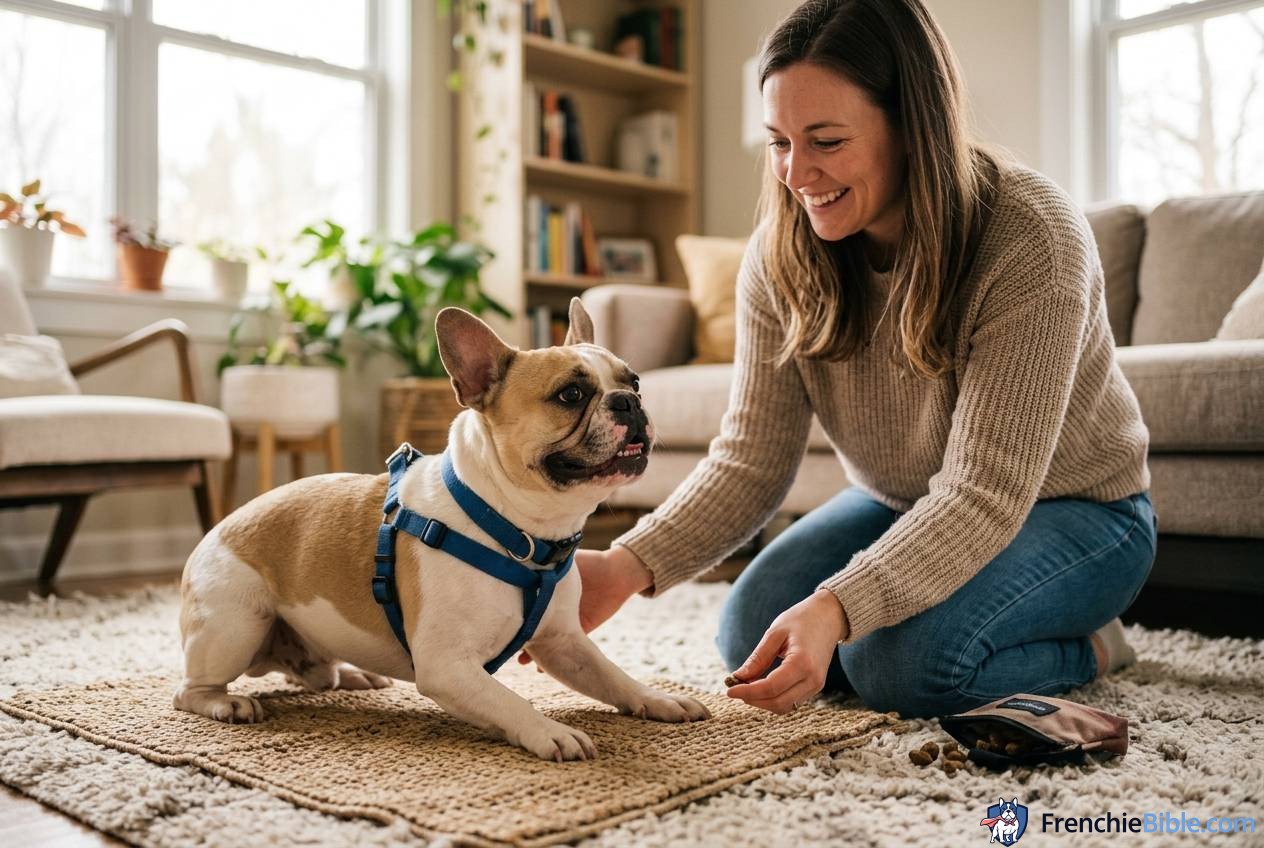
Phase 1: The Rapid-Drop Association (Weeks 1–2)
We must first teach the dog that the emergency cue means an immediate drop to the floor.
- The Action: Stand quietly with your Frenchie on a non-slip floor at home. Take a high-value treat and hold it in your closed fist.
- The Cue: Blow your emergency whistle once, or say your sharp cue “DROP!”
- The Lure: Instantly draw your hand from their nose straight down to the floor, sliding it backward toward their chest. Your Frenchie will naturally slide their front legs forward to follow the food.
- The Reward: The very micro-second their chest touches the floor, say your marker “Yes!” and feed them a jackpot of premium treats. Repeat this 10 times per session.
Phase 2: Adding Distance (Weeks 3–4)
Once your dog drops instantly at your feet, you must build the behavior at a distance.
- The Action: Place your Frenchie on a 15-foot long training line in your yard. Have a helper hold the line, or tie it to a secure post.
- The Toss: Toss a low-value treat on the floor to encourage your dog to walk away from you.
- The Drop: When they are 6 feet away, blow the emergency whistle or yell “DROP!” and make the hand signal (holding your arm straight up in the air like a traffic cop).
- The Reward: If they drop, run to them immediately, praise them enthusiastically, and feed them a massive jackpot of liver paste. If they ignore you, use the long line to gently guide them into a down position, showing them that the command is non-negotiable.
Phase 3: Proofing Under Full Run (The Drop on Recall)
This is the ultimate test. We will drop them in the middle of an active recall.
- The Action: On a long training line, call your Frenchie to you: “Come!”
- The Drop: When they are running towards you at full speed and are halfway across the yard, blow the emergency whistle or yell “DROP!” while holding your arm up.
- The Goal: The puppy should slide to an immediate stop, dropping their chest flat to the grass.
- The Reward: Run to them like they just won a gold medal, and feed them an entire tube of liver paste!
4. Frequently Asked Questions (FAQ)
Q1: My Frenchie is very stubborn. What if they refuse to lie down when I blow the whistle?
This is caused by a lack of “automatic reflex.” If your Frenchie hesitates, it means the emergency cue has not been paired with a high enough reward value. You must go back to Phase 1 and spend another two weeks building a massive, involuntary salivary reflex. The sound of the whistle must cause their brain to think of delicious liver paste so instantly that their body drops to the floor before their stubborn brain can even process a choice.

Q2: Is it safe for a Frenchie with a history of IVDD to perform an emergency drop?
Lying down on command is actually the safest possible emergency movement for an IVDD-prone dog. If your Frenchie bolts, they are at high risk of running, leaping, and injuring their spine. Sliding into a flat down position on the grass stops their forward momentum smoothly, distributing their body weight evenly along the floor and protecting their spinal disc column from sudden vertical impact forces.
Q3: How often should I practice the emergency drop command once it is learned?
Once the command is reliable, you must practice it once or twice a week for the rest of your dog’s life to maintain the reflex. However, never over-practice it in a single session; 2 to 3 reps are plenty. Over-practicing can cause your dog to lose interest or become anxious. Always ensure every single emergency practice drop is rewarded with a massive jackpot of premium food.
5. Disclaimer
The emergency obedience protocols, canine reflex analyses, and training strategies shared in this article are based on my ten years of hands-on experience breeding, raising, and training French Bulldogs. I am not a certified dog trainer or professional animal behaviorist. Emergency situations are highly volatile. While this command is a highly effective lifesaver, it is not a substitute for physical leash safety. Always walk your French Bulldog on a secure harness in public, high-traffic areas.