For French Bulldog owners, understanding breed-specific anatomical vulnerabilities is a matter of life and death. While many dog lovers have heard of “bloat” in large, deep-chested breeds like Great Danes or German Shepherds, very few realize that the French Bulldog is exceptionally vulnerable to a highly acute, fatal presentation of this condition known clinically as Gastric Dilatation-Volvulus (GDV).
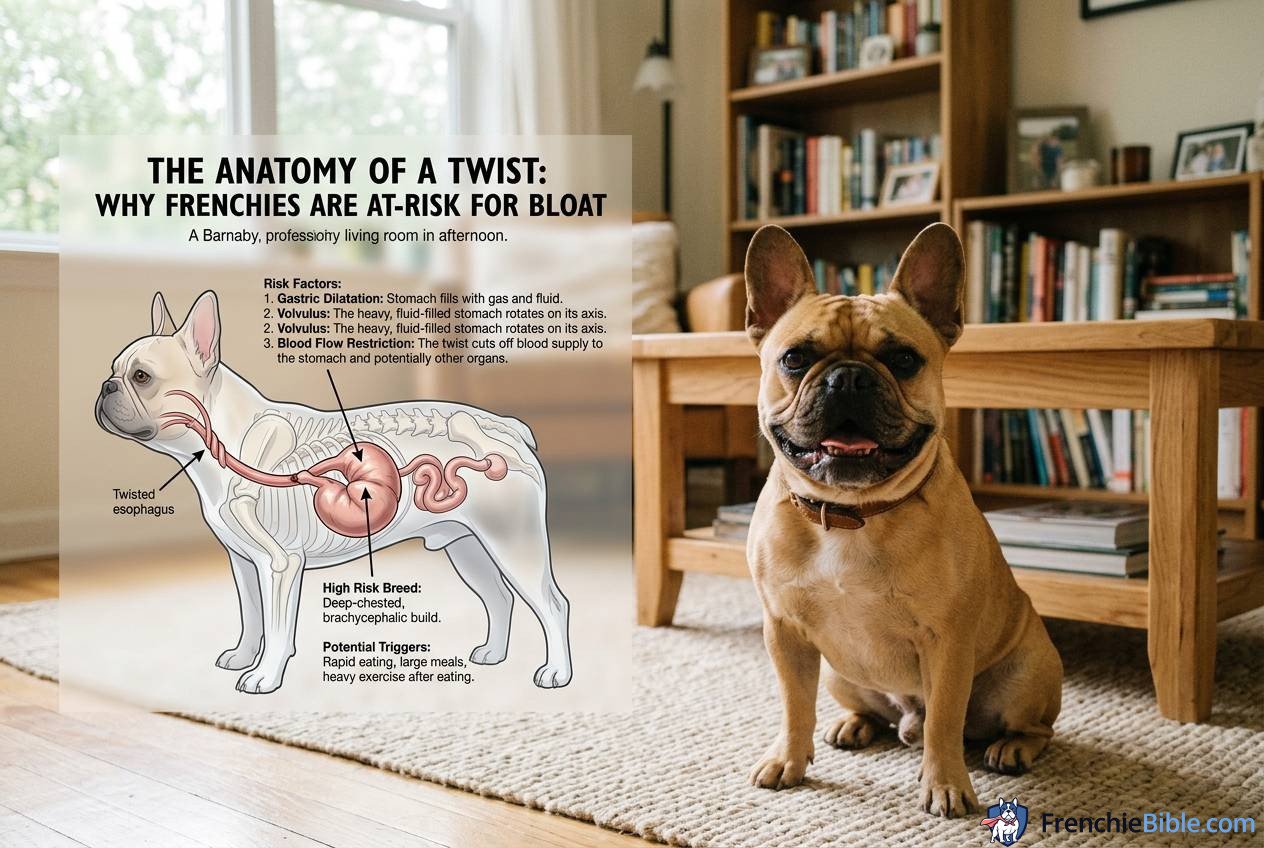
GDV is a dual-phase medical emergency. It begins with Gastric Dilatation (the stomach filling rapidly with swallowed air and gas, ballooning to several times its normal size).
Related Reading: Training & Behavior | Grooming & Care | French Bulldog Colors
If the pressure is not relieved, it can progress to Gastric Volvulus—where the heavy, gas-distended stomach physically rotates 180 to 360 degrees along its axis, twisting the esophagus and the duodenum shut, and trapping the gas and stomach contents inside.
As a long-time breeder who has managed the safe growth of multiple generations of French Bulldogs, I have seen how quickly a healthy, playful Frenchie can slide into a life-threatening GDV crisis.
This guide is designed to deconstruct the specific physical and anatomical reasons why the Frenchie’s short snout and deep chest create a perfect storm for bloat, identify the everyday triggers (like post-meal exercise and excessive water gulping), and give you a clear, breeder-tested roadmap to prevent this silent killer.
1. The Anatomy of a Twist: Why Frenchies are At-Risk for Bloat
To understand why the Frenchie stomach is prone to twisting, we must look at their unique skeletal and internal structures.
The Deep-Chest-to-Waist Ratio (Thoracic Depth)
While Great Danes are famous for deep chests, French Bulldogs possess a highly compact, broad, and deep chest that tapers sharply to a narrow waist. This deep, hollow thoracic cavity leaves a significant amount of empty physical space around the stomach.
When a Frenchie’s stomach becomes heavy with food and severely distended with gas, it sits like a heavy pendulum in a wide-open cavity. Without a wide abdominal floor to stabilize it, any sudden twist, jump, or roll can cause the heavy stomach to swing and flip over on itself.
The Aerophagia Nightmare (Swallowing Air)
Brachycephalic breeds suffer from chronic aerophagia—the involuntary swallowing of air. Because of their narrowed nostrils (stenotic nares), elongated soft palates, and hypoplastic tracheas, Frenchies must exert immense physical effort simply to draw air into their lungs.
When eating, drinking, or panting heavily, they swallow massive quantities of air directly into their stomach. If a Frenchie eats rapidly, they literally pump their stomach full of air like a bicycle tire.
2. The Deadly Triggers: Post-Meal Running, Rolling, and Gulping
GDV rarely happens without an environmental trigger. In almost every case, a bloat crisis is set off by one of these three common household habits:
Trigger 1: Post-Meal Zoomies and Stair Climbing
When a Frenchie eats a heavy meal of dry extruded kibble, the food absorbs stomach acid and swells, sitting like a dense, heavy brick at the bottom of the stomach.
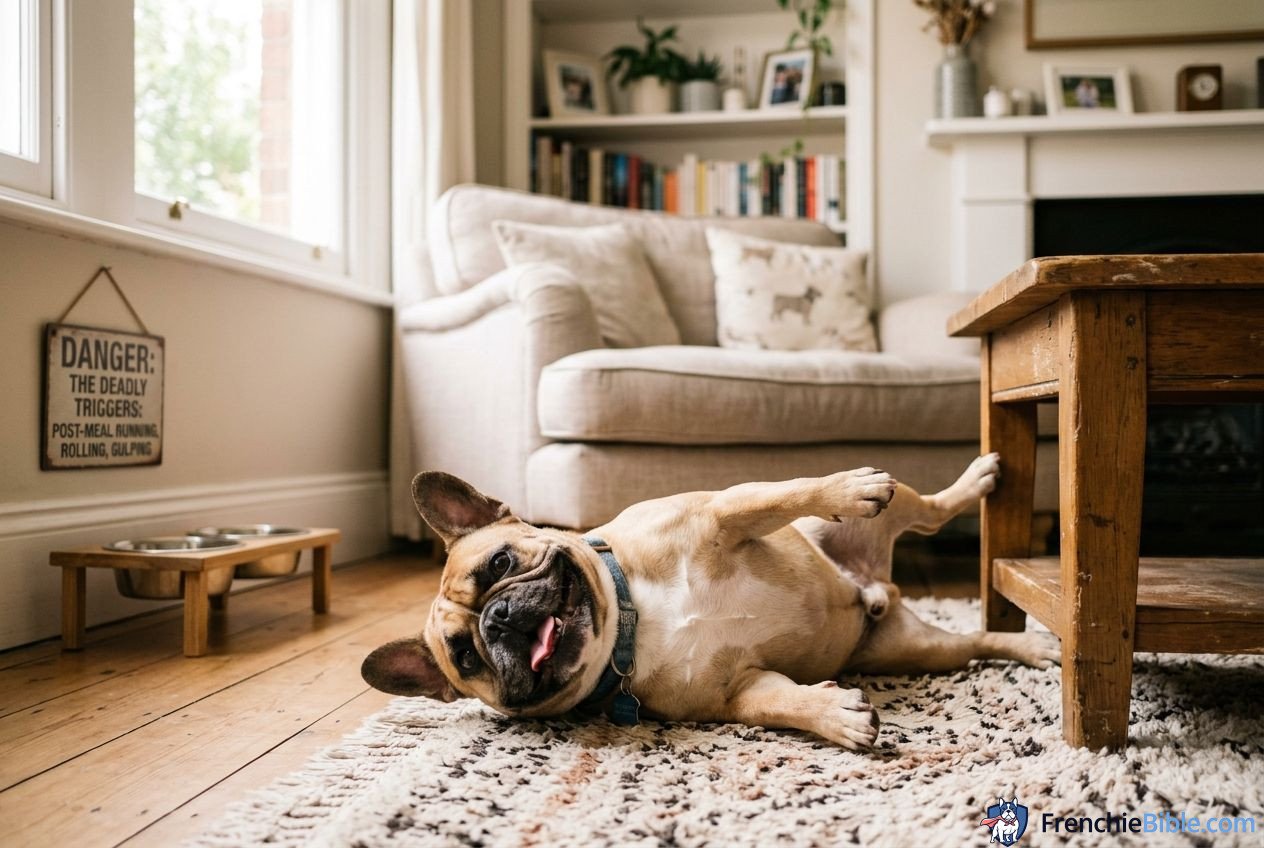
If your Frenchie immediately starts running, jumping onto furniture, or performing their famous “Zoomies” (including rolling on their back) within two hours of eating, the physical momentum is often enough to swing the heavy, food-laden stomach, causing it to twist along its longitudinal axis.
Trigger 2: Rapid Gulping of Large Volumes of Water
Many Frenchies under-drink during the day, then run to the water bowl after a walk and gulp down an entire bowl of cold water in under sixty seconds.
Gulping water at this speed forces them to swallow immense volumes of air. The sudden weight of the cold water combined with trapped air immediately distends the stomach and causes it to drop heavily within the abdomen, drastically increasing the risk of a physical flip.
Trigger 3: Feeding from Raised Bowls
For years, raised food bowls were marketed as a healthy ergonomic choice for flat-faced breeds.
However, clinical studies have revealed that feeding from raised bowls actually increases the risk of GDV in deep-chested dogs by over 110%.
When a flat-faced dog eats from an elevated position, the angle of their esophagus changes, forcing them to swallow significantly more air with every bite than if they were eating with their head lowered naturally to the ground.
3. How to Spot the Early Signs of GDV: The 3-Step Assessment
When GDV strikes, you do not have hours; you have minutes. Once the stomach twists shut, the blood supply to the stomach wall and spleen is cut off, leading to tissue necrosis, toxic shock, and cardiovascular collapse.
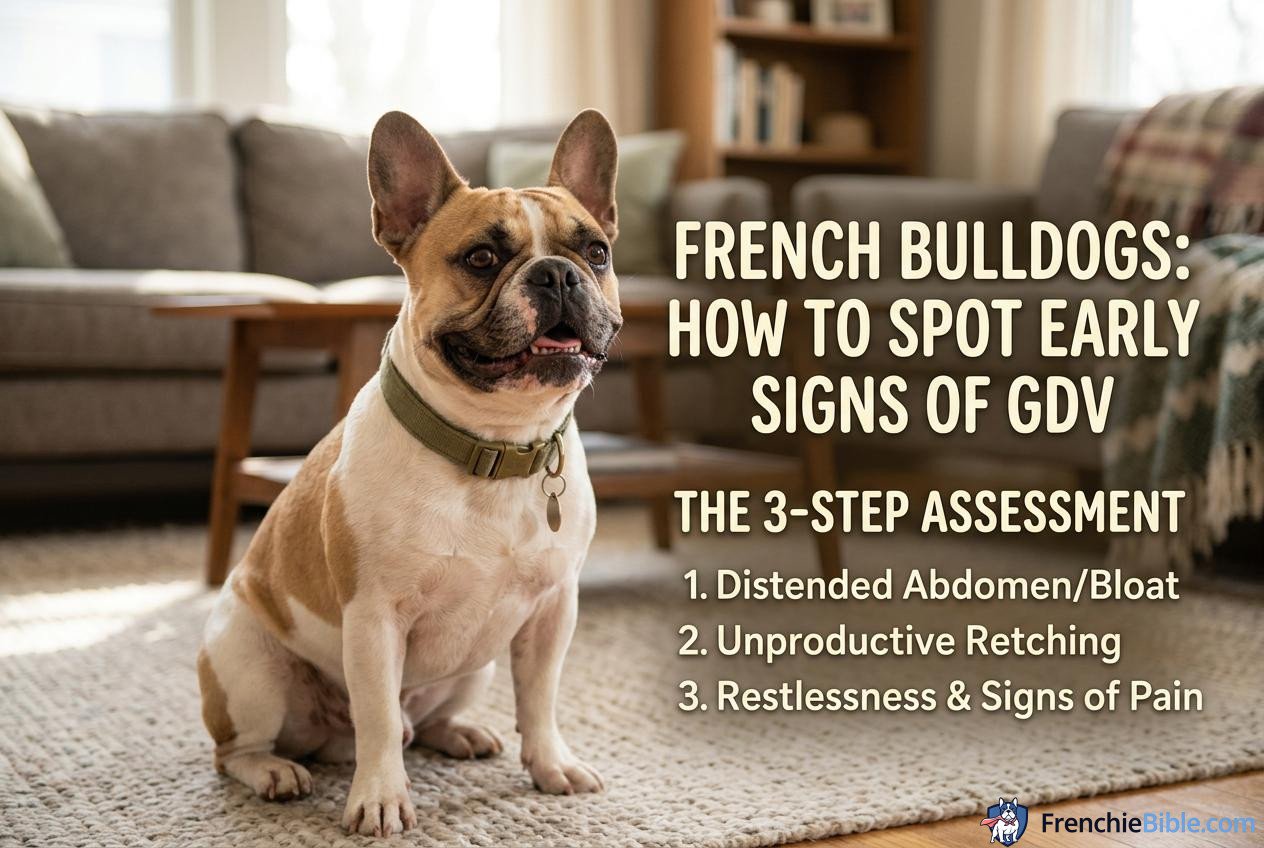
You must memorize these three critical warning signs:
- Unproductive Vomiting (Dry Heaving): Your Frenchie will stand with a hunched back, stretching their neck out, and retch violently every 2 to 5 minutes, but nothing will come up except a small amount of white, foamy saliva. This is because the twisted esophagus has completely blocked the stomach exit; the body is desperately trying to purge, but the doorway is locked shut.
- The “Tight Drum” Abdomen: Look at your Frenchie from above. The area directly behind their ribcage (their flanks) will look visibly swollen, bloated, and asymmetrical—usually bulging more on the left side. If you gently tap this swollen area with your fingers, it will feel firm and make a hollow, drum-like sound due to the high volume of trapped gas.
- Pacing, Restlessness, and Heavy Drooling: A Frenchie in the early stages of GDV cannot lie down or get comfortable. They will pace chronically, look at their flanks in distress, drool heavily (due to extreme nausea and the inability to swallow saliva past the twist), and have pale, sticky gums.
Breeder Rule: If your Frenchie is dry-heaving and their stomach feels hard, do not wait to see if they get better. Drive them to an emergency veterinary hospital immediately. Tell the receptionist: “My French Bulldog is dry-heaving and bloated; I suspect GDV.” They will bypass the waiting room.
4. The Breeder’s Prevention Protocol: Reducing Bloat Risk to Zero
In my breeding program, we have established a strict, daily preventative protocol that has successfully kept our dogs free from GDV for a decade.
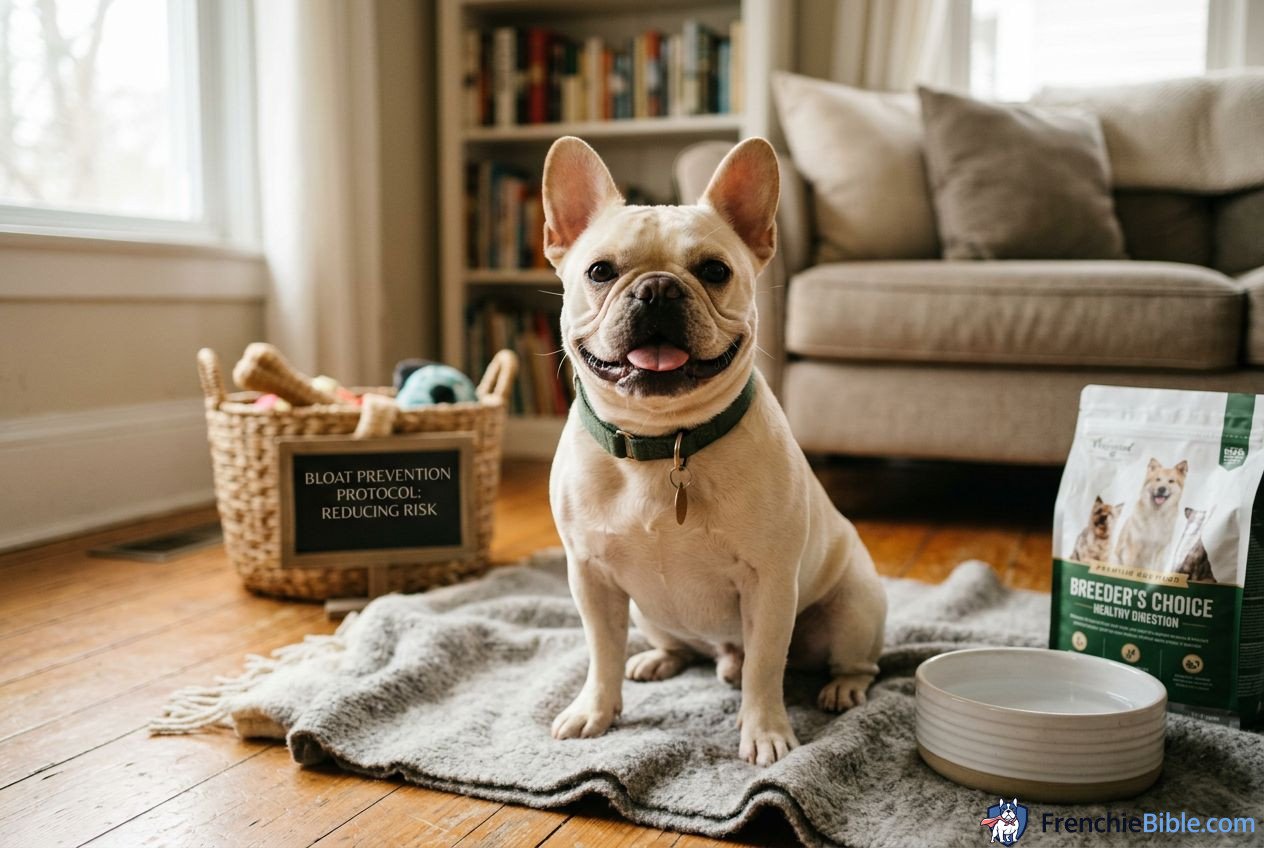
- Implement the “Two-Hour Quiet Rule”: Absolutely no running, playing, or jumping onto furniture for one hour before and two hours after every single meal. If your dog gets excited after eating, crate them or keep them on a short leash to enforce complete rest.
- Ditch the Elevated Bowls: Always feed your Frenchie from a bowl placed flat on the floor. This forces their neck into a natural downward angle, drastically reducing the volume of air swallowed during eating.
- Use Slow-Feeder Bowls or Lick Mats: If your Frenchie eats like a vacuum cleaner, they are swallowing dangerous amounts of air. Feed them using slow-feeder bowls with deep ridges, or spread raw wet food onto textured silicone lick mats. This slows down their eating speed from 30 seconds to 15 minutes, virtually eliminating food-related aerophagia.
- Prevent Water Gulping after Exercise: When you return from a walk, do not offer an open bowl of water immediately. Let your Frenchie cool down for 20 minutes first. When you do offer water, provide a small, controlled amount (half a cup), and refill it only after they have rested.
5. Frequently Asked Questions (FAQ)
Q1: Can I use gas-relief drops (like Simethicone) to cure my Frenchie’s bloat at home?
No, Simethicone cannot cure a twisted stomach. Simethicone works by combining small gas bubbles in the stomach into larger ones, making it easier for the dog to burp them out. While it can help with mild, non-twisted flatulence or simple gas buildup, it is completely useless once the stomach has physically rotated (volvulus). Once twisted, the gas is physically locked inside and cannot escape through burping or flatulence. Relying on Simethicone during a true GDV crisis will only waste critical minutes of your dog’s life.
Q2: What is gastropexy, and should my Frenchie get this surgery?
Gastropexy is a preventative surgical procedure where the side of the stomach is permanently stitched to the inner abdominal wall. This does not prevent the stomach from filling with gas (dilatation), but it 100% prevents the stomach from physically twisting (volvulus), eliminating the fatal phase of bloat. If your Frenchie requires abdominal surgery (such as during a spay, neuter, or soft tissue check), discuss with your vet whether a preventative gastropexy can be performed at the same time. It is a highly effective lifesaver for deep-chested dogs.
Q3: Why does feeding dry kibble increase the risk of GDV compared to fresh food?
Dry extruded kibble has two major risk factors: high starch content and expansion. Traditional kibble requires heavy binders like corn, wheat, or peas to hold its shape, which ferment rapidly in the gut and produce gas. Furthermore, when dry kibble hits stomach acid, it absorbs the liquid and swells to double its size, adding significant physical weight to the bottom of the stomach. This heavy, weighted stomach acts like a pendulum, making it far easier to swing and twist during sudden movements compared to light, rapidly digestible fresh food.
Q4: Does my Frenchie’s habit of sleeping on their back increase the risk of their stomach twisting?
Sleeping on their back is a classic, relaxed Frenchie pose and is generally completely safe. The danger only arises if they roll onto their back with a heavily full, gas-distended stomach immediately after eating. If your Frenchie has just consumed a large meal and is bloated, the shifting of their body weight as they roll over can cause the heavy stomach to swing and flip. Ensure your dog remains upright and resting quietly for at least two hours post-meal before allowing heavy rolling.
Q5: How is a true GDV emergency treated at a veterinary hospital?
True GDV requires immediate emergency surgery. First, the vet will attempt to decompress the stomach by passing a tube down the esophagus, or by inserting a large-bore needle through the abdominal wall directly into the stomach to release the trapped gas. Once stabilized, the surgeon will open the abdomen, untwist the stomach, assess whether any tissue has died (requiring partial stomach removal or spleen removal), and perform a gastropexy to stitch the stomach to the abdominal wall to ensure it can never twist again.
6. Disclaimer
The anatomical insights and preventative protocols shared in this article are based on my ten years of experience breeding, raising, and safeguarding French Bulldogs. I am not a veterinarian, and this content is intended purely for educational and supportive purposes. GDV is a rapid, life-threatening emergency. If you suspect your French Bulldog is experiencing bloat or twisted stomach, do not wait; please transport your dog to a professional emergency veterinary hospital immediately.