Disclaimer: The information detailed in this comprehensive guide is provided for educational and informational purposes only and is not intended as a substitute for professional veterinary advice, diagnosis, or treatment. French Bulldogs possess unique anatomical features, including potential spinal and respiratory vulnerabilities. Always consult with a licensed veterinarian before embarking on new physical training regimens, especially if your French Bulldog has a history of Intervertebral Disc Disease (IVDD), hemivertebrae, or severe Brachycephalic Obstructive Airway Syndrome (BOAS). Prioritize your dog’s safety and physical comfort above all else during training.
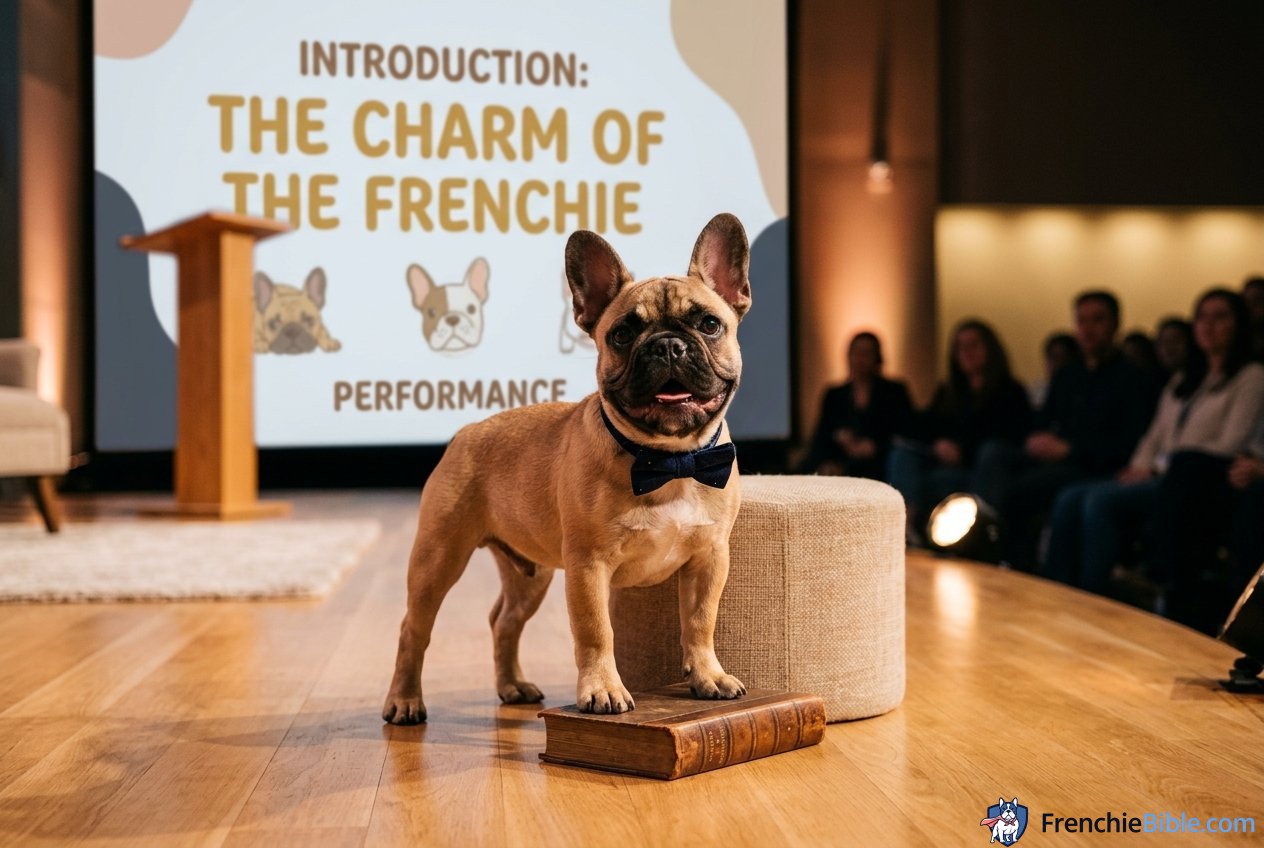
Introduction: The Charm of the Frenchie Performance
The French Bulldog, with its unmistakable bat ears, expressive eyes, and delightfully compact, muscular physique, has rapidly ascended to become one of the most beloved companion breeds across the globe. As a experienced French Bulldog breeder, breeder, and behavioral expert, I am consistently enchanted not just by their physical charm, but by their deeply complex, often comedic personalities. They are natural clowns, possessing an inherent desire to entertain and be the center of their family’s universe.
Related Reading: Health & Diet | Frenchie Puppy Guide
While Frenchies are not typically celebrated for the intense working drive seen in Border Collies or the eager-to-please obedience of Golden Retrievers, they are highly intelligent. Their intelligence, however, is often masked by a legendary streak of stubbornness. They are what canine behaviorists often refer to as “What’s in it for me?” dogs. If an activity lacks sufficient motivation or intrinsic reward, a Frenchie will simply opt out.
However, when properly motivated, French Bulldogs are spectacular learners. Two of the most endearing, crowd-pleasing, and thoroughly entertaining tricks you can teach your Frenchie are “Roll Over” (exposing the belly) and “Play Dead” (the classic “Bang!” trick). What makes these tricks particularly special for this breed is how they utilize the Frenchie’s unique anatomical structure. Their low center of gravity, barrel-like chest, and robust build can actually be leveraged to make these movements fluid and visually hilarious.
In this exhaustive, step-by-step masterclass, we will delve into the veterinary mechanics of the French Bulldog’s body, the psychology of positive reinforcement, and the exact, foolproof methodologies to train your stubborn but brilliant Frenchie to perform these adorable tricks with enthusiasm and flair.
The Veterinary Perspective: Understanding the Frenchie Anatomy
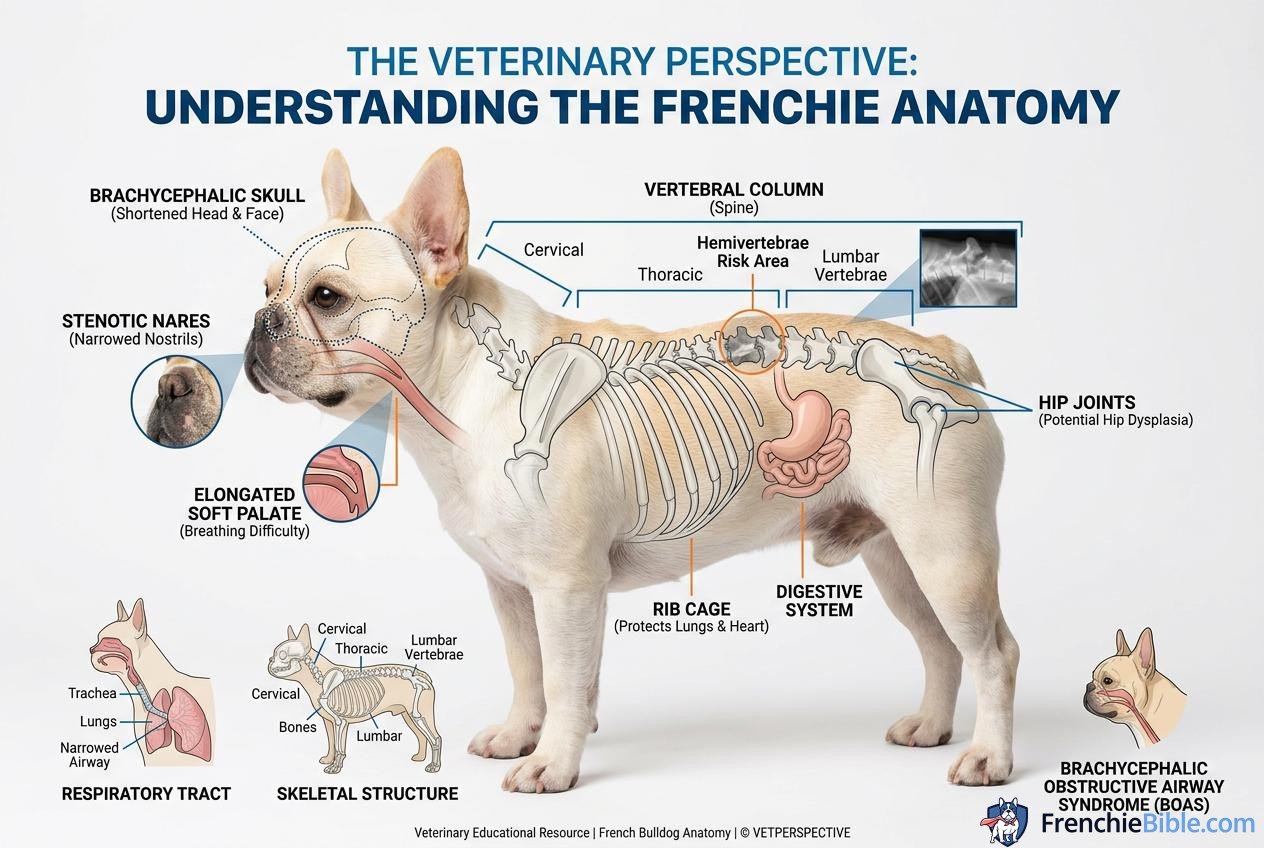
Before we begin asking our dogs to perform physical tricks, we must deeply understand the vessel they inhabit. The French Bulldog is a chondrodysplastic (dwarf) breed with a brachycephalic (flat-faced) skull. Their structure is not designed for high-impact agility, but rather for short bursts of energy and prolonged periods of companionship. When teaching tricks that involve twisting, rolling, and exposing the abdomen, several crucial veterinary considerations must dictate our training approach.
The Spine: Intervertebral Disc Disease (IVDD) and Hemivertebrae
The most critical consideration when teaching a French Bulldog to roll over is their spinal health. Frenchies are genetically predisposed to spinal abnormalities. Many possess hemivertebrae (butterfly or wedge-shaped vertebrae) which can cause congenital curvature of the spine (kyphosis or scoliosis). Furthermore, they are highly susceptible to Intervertebral Disc Disease (IVDD), a condition where the cushioning discs between the vertebrae bulge or burst into the spinal cord space, causing intense pain, nerve damage, or paralysis.
The Golden Rule of Physical Tricks: You must never physically force your French Bulldog into a rolled position. Physically grabbing their legs or pushing their body over forcefully applies unnatural torque to their delicate spinal column. All rolling movements must be entirely voluntary, initiated by the dog’s own muscle movements following a lure. If your dog has a known history of IVDD, neck pain, or back injuries, you should consult your orthopedic veterinarian before attempting these tricks; they may advise against them altogether to preserve spinal integrity.
The Barrel Chest and the “Turtle Effect”
Unlike a slender Greyhound or a lithe Poodle, a French Bulldog carries a significant proportion of its weight in its front assembly. They have broad shoulders and a deep, rounded, barrel-like chest, tapering to narrow hindquarters.
When a Frenchie lies on their side and attempts to roll onto their back, their barrel chest acts almost like a fulcrum. For some Frenchies, getting perfectly flat on their back is physically impossible or highly uncomfortable due to their width and leg length. They may get stuck halfway, experiencing what I affectionately call the “Turtle Effect”—legs flailing slightly as they try to find their balance on their rounded back.
As trainers, we must use this momentum. Once we get them leaning past the point of no return on their shoulder, gravity and their heavy chest will do the rest of the work. We must also recognize that for a Frenchie, “Play Dead” might mean lying entirely on their side, rather than perfectly supine on their back, and we must accept and reward this variation as a perfect execution of the trick.
Respiratory Realities: The Brachycephalic Airway
All French Bulldogs suffer from some degree of Brachycephalic Obstructive Airway Syndrome (BOAS). Their elongated soft palates, stenotic nares (narrow nostrils), and narrow tracheas make breathing a conscious effort, especially when excited or physically active.
When a dog rolls onto its back, gravity alters the position of the soft tissues in the throat. For a Frenchie with a severely elongated soft palate, lying upside down can momentarily cause the palate to drape over the airway opening, causing a brief choking sensation or a sudden snort/sneeze.
Training Protocol for Breathing Safety:
1. Short Sessions: Keep training sessions to strict 3-to-5-minute intervals to prevent over-arousal and respiratory distress.
2. Temperature Control: Only train indoors in a cool, air-conditioned environment.
3. Monitor Sounds: If your Frenchie seems to panic when on their back or begins to wheeze excessively, do not push for a full “belly up” roll. A simple side-lie (“Play Dead”) is an equally impressive and much safer alternative for dogs with severe BOAS.
The Psychology of Trick Training: Motivation and Luring
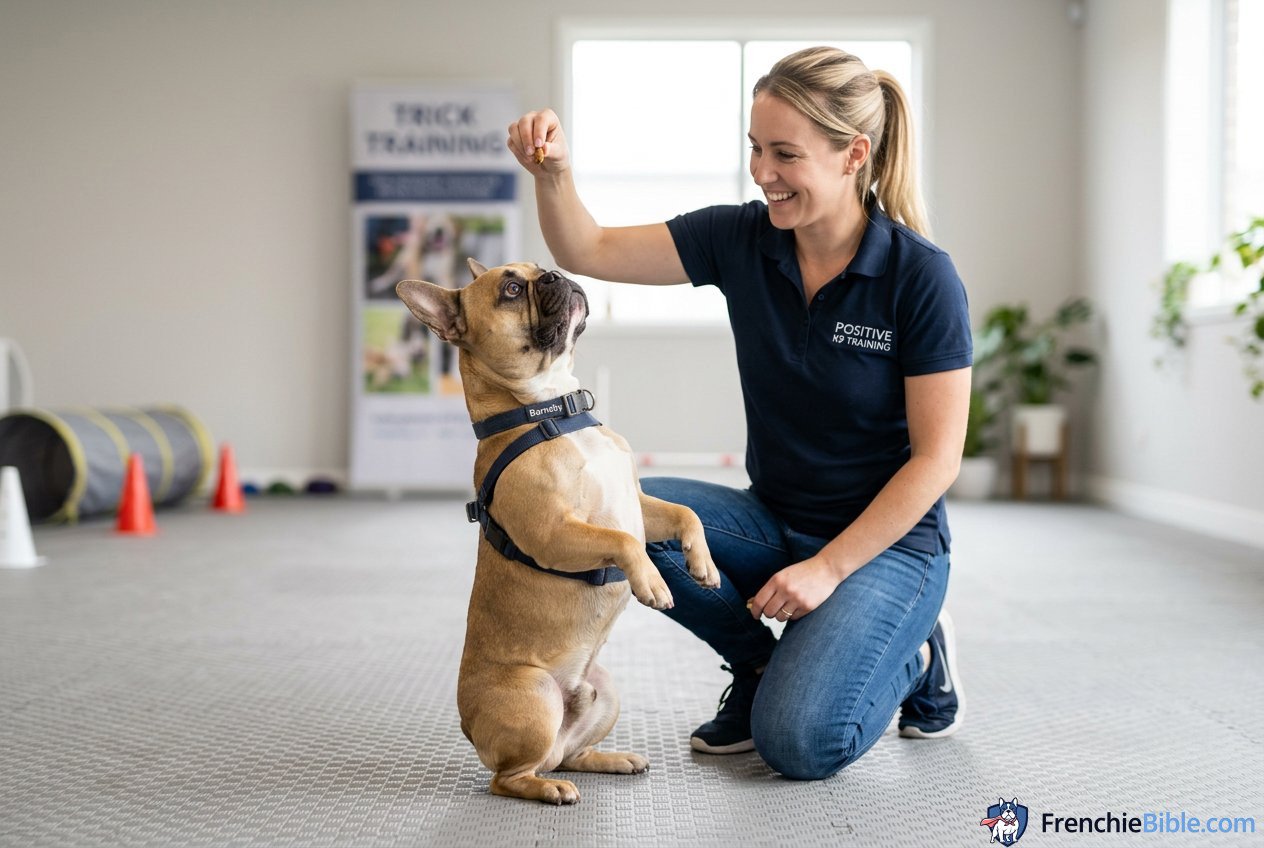
To teach a French Bulldog anything, you must become a master of canine behavioral psychology, specifically the concepts of Operant Conditioning, Positive Reinforcement, and Lure-and-Reward training.
Establishing the High-Value Currency
Frenchies are pragmatists. Standard dry kibble will rarely convince a French Bulldog to perform a complex, multi-step physical maneuver. You must elevate the currency.
To achieve rapid learning, utilize “high-value” treats. These are treats that the dog rarely gets, are highly aromatic, and are soft enough to be consumed in a fraction of a second without breaking focus.
- Excellent Options: Boiled plain chicken breast (shredded into pea-sized pieces), freeze-dried beef liver, small dabs of xylitol-free peanut butter on a spoon, or tiny cubes of low-fat cheese.
- The Satiety Factor: Train before meals, not after. A slightly hungry Frenchie is an engaged, motivated Frenchie.
The Power of the Lure
Both “Roll Over” and “Play Dead” are taught using a technique called luring. The lure acts as a magnet for the dog’s nose. Where the nose goes, the head follows; where the head goes, the spine follows; where the spine goes, the body follows.
When luring, the treat must be kept practically glued to the dog’s nose (within half an inch). If you pull the lure too far away, the “magnet” breaks, the dog loses interest or stands up to get the treat, and the behavioral chain is broken.
The Marker Word or Clicker
You need a way to tell your Frenchie exactly which micro-movement earned them the treat. This is done with a marker—either a mechanical clicker or a sharp, consistent verbal marker like “Yes!” or “Good!”. The instant the dog’s body reaches the desired position, you mark the behavior, followed immediately (within one second) by the delivery of the high-value treat.
Pre-Training Requirements and Environmental Setup
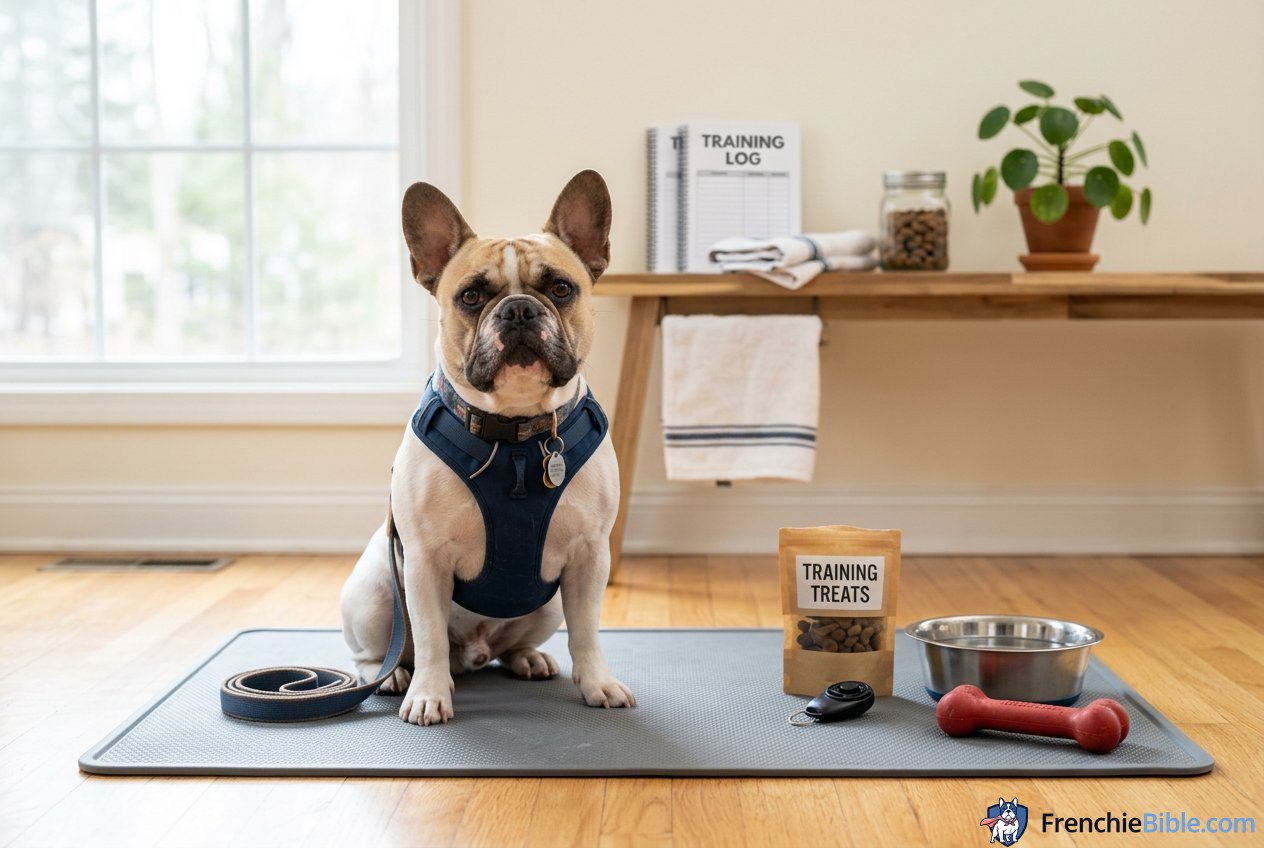
Before you attempt to teach rolling tricks, ensure you have laid the proper groundwork.
Foundation Command: The Solid “Down”
You cannot teach a dog to roll over if they do not know how to lie down. A reliable, voluntary “Down” command is the absolute prerequisite starting point. If your dog does not know “Down,” you must spend a few days mastering that command first.
When asking for the “Down” in preparation for rolling, you want a specific type of down. A “Sphinx down” (straight back, front paws extended forward) is harder to roll from. You want a “relaxed down,” where the dog is lying down but naturally shifting their weight onto one hip. This pre-tilted position makes the subsequent roll infinitely easier.
Environmental Setup: Comfort is Key
- Soft Surfaces Only: Never train these tricks on hardwood floors, tile, or concrete. The hard surface will press uncomfortably against their spine, ribs, and prominent hip bones, creating a negative association with the movement. Train on a plush carpet, a soft rug, a yoga mat, or even your bed.
- Minimize Distractions: Turn off the television, ensure other pets are in a different room, and ask family members to remain quiet. You need 100% of your Frenchie’s focus.
Phase 1: The “Roll Over” Masterclass
The goal of this trick is to have the dog start in a Down position, roll completely over their back, and end up back in a Down position on the other side. Because of their barrel chests, this takes momentum. We will break this into micro-steps.
Step 1: The Setup and The Sniff
- Ask your Frenchie to “Down” on a soft surface.
- Take a high-value treat in your hand, enclosing it in your fist but leaving a tiny gap so the dog can smell it. This is your lure.
- Place the lure directly against your Frenchie’s nose. Let them sniff and lick it for a second to lock their focus.
Step 2: The Shoulder Check
Goal: Get the dog to turn their head backward, forcing them to shift their weight onto their side.
1. With the lure glued to their nose, slowly move your hand backward, trailing along the dog’s jawline, toward their shoulder blade.
2. Crucial Angle: Do not lure up (they will stand up). Do not lure straight back (they will scooch backward). You want to lure backward and slightly down toward their ribcage.
3. As their nose follows the treat to their shoulder, they will naturally have to flop over onto their side to keep following it.
4. The instant their shoulder and side hit the floor, say “Yes!” and give them the treat. Practice this “flop to the side” 5 to 10 times until it is fluid.
Step 3: The Tipping Point (Over the Barrel)
Goal: Use the lure to pull them over their back to the other side.
1. Start from the “Down,” lure them to their side as mastered in Step 2. Do not give the treat yet.
2. Once they are on their side, continue moving the lure slowly from their shoulder, over their spine, toward the floor on their opposite side.
3. Their head will naturally tilt backward to follow the treat. As their head tips back, their heavy barrel chest will naturally cause them to lose their balance and tip backward onto their spine.
4. Keep moving the lure toward the floor on the other side. Their legs will kick up, and gravity will pull them over.
5. The exact millisecond they complete the roll and their chest hits the floor on the other side, enthusiastically say “Yes!” and deliver a jackpot (two or three pieces of treat).
Step 4: Adding the Verbal Cue and Hand Signal
Goal: Associate the physical action with a command.
1. Once your dog is following the lure completely over 8 out of 10 times, it is time to name the behavior.
2. Say the verbal cue clearly: “Roll Over!”
3. Immediately use your lure hand (still holding the treat) to guide them through the motion.
4. After several successful repetitions, begin using a hand signal. A common signal is a circular, twirling motion with your index finger.
5. Say “Roll Over,” make the circular hand signal, and use the lure.
Step 5: Fading the Lure (The Final Polish)
Goal: Get the dog to perform the trick without the treat actively guiding their nose.
1. Hold an “empty” hand in the same shape as if you had a treat (a pinch grip). Have the actual treats ready in your other hand or a pouch.
2. Say “Roll Over,” use your empty hand to make the luring motion over their body.
3. Because they are used to the motion, most Frenchies will follow the empty hand and roll.
4. The instant they complete the roll, say “Yes!” and immediately reward them with a treat from your other hand.
5. Gradually make your hand signal smaller and less pronounced until a simple circular flick of the wrist and the verbal command are enough to send your Frenchie into a joyful barrel roll.
Phase 2: The “Play Dead” (Bang!) Masterclass
Teaching a dog to “Play Dead” is often easier for French Bulldogs than “Roll Over” because it does not require them to navigate over their awkward, heavy barrel chest. It merely requires them to lie flat on their side and remain motionless.
We will use the foundation we built in Step 2 of the “Roll Over” training.
Step 1: The Side Flop
- Ask your Frenchie to “Down.”
- Use the high-value lure exactly as before: nose to shoulder, moving backward and slightly down.
- The moment your dog flops completely onto their side (hip and shoulder flat on the floor, head resting), say “Yes!” and reward.
- Repeat this until the dog anticipates the movement and flops over eagerly as soon as your hand moves toward their shoulder.
Step 2: Building Duration (The “Dead” Aspect)
Goal: Teach the dog that the trick requires them to stay still on their side, not immediately pop back up.
1. Lure the dog into the side-flop position.
2. Instead of immediately saying “Yes!” and rewarding, withhold the marker for one single second.
3. If they stay flat for that second, say “Yes!” and deliver the treat while they are still lying down. (If you reward them after they stand up, you are rewarding the standing up, not the playing dead).
4. Repeat the process, slowly extending the duration. Require 2 seconds of stillness, then 3 seconds, then 5 seconds.
5. Veterinary Tip: A true Frenchie “Play Dead” often involves all four short legs sticking straight out in the same direction. It is incredibly endearing. If they lift their head, gently withhold the treat until they rest their chin back on the floor.
Step 3: Adding the Cue (“Bang!”) and the Hand Signal
- The universal hand signal for “Play Dead” is the finger gun (index finger pointed, thumb up).
- Put your dog in a “Down.”
- Form your hand into the finger gun, but hide a small piece of treat under your thumb.
- Point the finger gun at your dog, say “Bang!” dynamically, and then immediately use that hand to lure them onto their side.
- Wait for your established duration (e.g., 3 seconds of stillness). Say “Yes!” and release the treat from under your thumb.
Step 4: Fading the Lure and Perfecting the Performance
- Gradually increase the distance between your hand and your dog’s nose.
- Start in a Down. Stand slightly over them. Say “Bang!” and point the finger gun from a foot away, moving your arm in a sweeping downward motion toward the floor to suggest the “fall.”
- If they hesitate, take a step closer to help them, but continually strive to increase your distance.
- The Ultimate Performance: Eventually, you want to be able to have your dog in a “Sit” or “Down” from across the room, point your finger, shout “Bang!”, and watch your Frenchie dramatically flop onto their side and freeze.
Troubleshooting french bulldog stubbornness
Even with the best treats and perfect technique, Frenchies will be Frenchies. Here are the most common roadblocks and how a professional behaviorist overcomes them.
Problem 1: The “I Will Just Stare at You” Syndrome
You are holding the lure, moving it toward their shoulder, and your Frenchie just turns their head like an owl, refusing to move their body, just staring at your hand.
- The Solution: You are likely moving the lure too quickly. Bring the treat back to their nose. Let them lick it. Move it backward one inch at a time. If they stretch their neck without moving their body, your dog is too flexible. Try positioning them in a corner or alongside a sofa so their body is blocked on one side, forcing them to roll in the only available direction to get the treat.
Problem 2: The Treat Snatcher
Your dog gets overly excited, ignores the luring motion, and just tries to bite your fingers to get the treat.
- The Solution: Lower the value of the treat slightly, or train after they have eaten a small portion of their meal to reduce frantic hunger. Furthermore, practice “Impulse Control.” Hold the treat in a closed fist. If they nibble or paw, keep it closed. The instant they pull their head back and wait, open your hand and reward. They must learn that calm patience, not aggressive mugging, unlocks the reward.
Problem 3: The “I Hate Being on My Back” Resistance
As you lure them to roll over, they hit their side and absolutely refuse to tip over onto their back, scrambling to get back on their feet.
- The Solution: Respect their anatomy and their comfort level. As mentioned, the barrel chest and potential respiratory quirks can make the supine position uncomfortable. Do not force it. Instead, focus entirely on the “Play Dead” trick, which only requires a side-lie. If you really want the roll, try luring them down a very slight, soft incline (like a ramp made of pillows) to let gravity do 90% of the work.
Problem 4: The Reverse Roll
You lure them over their back, but instead of completing the 360-degree roll, they just roll backward the way they came.
- The Solution: This is a momentum issue. As soon as they are on their back, move your lure hand quickly and decisively toward the floor on the finishing side, almost pulling their nose toward the carpet. You can also use your other hand to give a very gentle, encouraging tickle on their exposed belly to encourage them to quickly right themselves onto their stomach on the other side.
The Behavioral Benefits of Trick Training
Teaching tricks like Roll Over and Play Dead goes far beyond providing a cute party trick for your friends. From An Experienced Breedererinary behavioral perspective, this type of training is vital for the holistic well-being of your French Bulldog.
- Mental Exhaustion: French Bulldogs are intelligent. Fifteen minutes of focused trick training, figuring out complex physical puzzles for rewards, will tire out a Frenchie far more effectively than a mindless thirty-minute walk. Mental enrichment prevents boredom-induced destructive behaviors like chewing furniture or excessive barking.
- Building Deference and Trust: Lure-and-reward training builds a powerful bond. Your dog learns that you are a benevolent leader who controls resources but gives them out fairly when the dog cooperates. Teaching a dog to expose their belly (a highly vulnerable position for an animal) requires a deep foundation of trust. By making it a fun, positive, rewarding game, you are actively strengthening their psychological trust in you.
- Physical Proprioception: Many Frenchies are a bit clumsy. Teaching them to isolate specific body parts, shift their weight, and control their momentum helps improve their overall body awareness (proprioception).
Frequently Asked Questions (FAQ)
To ensure you have all the knowledge required to succeed, here are the most common questions I receive in the clinic regarding teaching Frenchies these specific tricks.
Q1: My French Bulldog is 6 years old. Is it too late to teach them to roll over?
Answer: Absolutely not! The old adage “you can’t teach an old dog new tricks” is entirely false. Older Frenchies can absolutely learn new behaviors, provided they are cognitive and motivated by food. The only caveat is physical health. For a senior dog, you must be hyper-vigilant about their joint and spinal health. Ensure they are trained on exceptionally soft surfaces, keep sessions to just two or three minutes, and never ask them to perform physical tricks if they are exhibiting signs of arthritis or back pain.
Q2: Why does my Frenchie sneeze violently every time they roll onto their back?
Answer: This is incredibly common and relates directly to their brachycephalic anatomy. When a Frenchie rolls onto their back, gravity causes the soft tissues of their elongated soft palate to fall backward, potentially tickling the back of their nasal cavity or momentarily obstructing the airway. This tickling sensation triggers a reflex sneeze to clear the airway. As long as it is a quick sneeze and they recover immediately without distress or wheezing, it is a harmless anatomical quirk.
Q3: I don’t want to use food treats forever. How do I phase them out?
Answer: Phasing out food is the goal of all good training. Once your dog knows the trick reliably on verbal command and hand signal, move to an “intermittent reinforcement schedule.” This means you stop rewarding every successful trick. You reward the first one, skip the second (using only verbal praise like “Good boy!”), reward the third, skip the fourth and fifth, etc. By making the food reward unpredictable, like a slot machine, the dog’s behavioral drive to perform actually increases. Eventually, the food is replaced entirely by enthusiastic verbal praise, petting, or offering a favorite toy.
Q4: My dog has a hemivertebra (butterfly vertebra) discovered on an X-ray, but has no pain. Should I teach Roll Over?
Answer: With my background in French Bulldog breeding, my professional advice is to err on the side of extreme caution. While an asymptomatic hemivertebra might not be causing pain right now, it represents a structural weakness in the spinal column. The twisting and rolling motions required for “Roll Over” apply unnecessary torque to that exact area. I strongly advise against teaching “Roll Over” to dogs with known spinal anomalies. Instead, focus safely on teaching “Play Dead” (the simple side-flop), which involves virtually no twisting of the spinal column and is entirely safe and equally adorable.
Q5: How long will it take for my Frenchie to learn these tricks perfectly?
Answer: This depends entirely on the individual dog’s food drive, focus, and your consistency as a trainer. A highly food-motivated Frenchie trained by a consistent owner in short, daily, 5-minute sessions can learn the basics of “Play Dead” in 2 to 3 days, and “Roll Over” in 4 to 7 days. Perfecting the trick—fading the lure entirely, adding distance, and making the performance snappy—can take several weeks of consistent practice. Remember, patience is paramount. Never get frustrated with your dog; if they aren’t getting it, evaluate your own luring technique, the value of your treats, or simply end the session on a positive note and try again tomorrow.
Conclusion
Teaching your French Bulldog to “Play Dead” or “Roll Over” is an incredibly rewarding endeavor that transcends simple obedience. It is a joyful exploration of your dog’s intelligence, a celebration of their unique, clownish anatomy, and a powerful exercise in mutual trust and communication.
By understanding their physical limitations, utilizing high-value positive reinforcement, and breaking the movements down into manageable, highly-rewarded micro-steps, you can overcome the legendary Frenchie stubbornness. Always prioritize their safety and comfort, keep training sessions short and overwhelmingly positive, and soon you will have a delightful, entertaining companion eager to show off their customized, anatomically-perfected performance skills to anyone willing to offer a treat and a smile.
Disclaimer: I am a French Bulldog breeding expert with over a decade of hands-on experience with this breed. I am not An Experienced Breedererinarian. The information in this article is for educational purposes only. Always consult your veterinarian regarding your dog’s specific health needs and care.
Disclaimer: I am a French Bulldog breeding expert with over a decade of hands-on experience with this breed. I am not a veterinarian. The information in this article is for educational purposes only. Always consult your veterinarian regarding your dog’s specific health needs and care.