If you are a French Bulldog owner, you already know that these charming, bat-eared companions come with their own set of unique care requirements. From cleaning their adorable facial wrinkles to managing their sensitive digestive systems, caring for a Frenchie is a labor of love. However, there is one grooming task that strikes fear into the hearts of many Frenchie parents: trimming black nails.
Unlike clear or white nails, where the pink “quick” (the blood vessel and nerve bundle) is easily visible, black nails are completely opaque. It is like flying blind. One wrong move, and your beloved Frenchie yelps in pain, blood starts flowing, and both of you are left traumatized, making the next nail trimming session even more difficult.
Related Reading: Training & Behavior | Grooming & Care | French Bulldog Colors
as a French Bulldog expert and breeder and breeding expert I have seen countless owners struggle with this exact issue. Overgrown nails are not just a cosmetic problem; they can lead to severe structural issues, pain, and arthritis in your Frenchie’s paws and legs. You cannot simply ignore them.
In this comprehensive, 3000+ word guide, we will dive deep into the anatomy of your French Bulldog’s nails, explore the best tools for the job, and reveal the safest, most effective secrets for trimming black nails without hitting the quick. Whether you are a first-time Frenchie owner or a seasoned pro looking to refine your grooming skills, this guide will empower you to tackle nail day with confidence.
Understanding French Bulldog Nails: Why Black Nails Are Tricky
To master the art of nail trimming, you first need to understand what you are working with. A dog’s nail is far more complex than a human fingernail, and French Bulldogs have some specific anatomical quirks that make their nails particularly challenging to maintain.
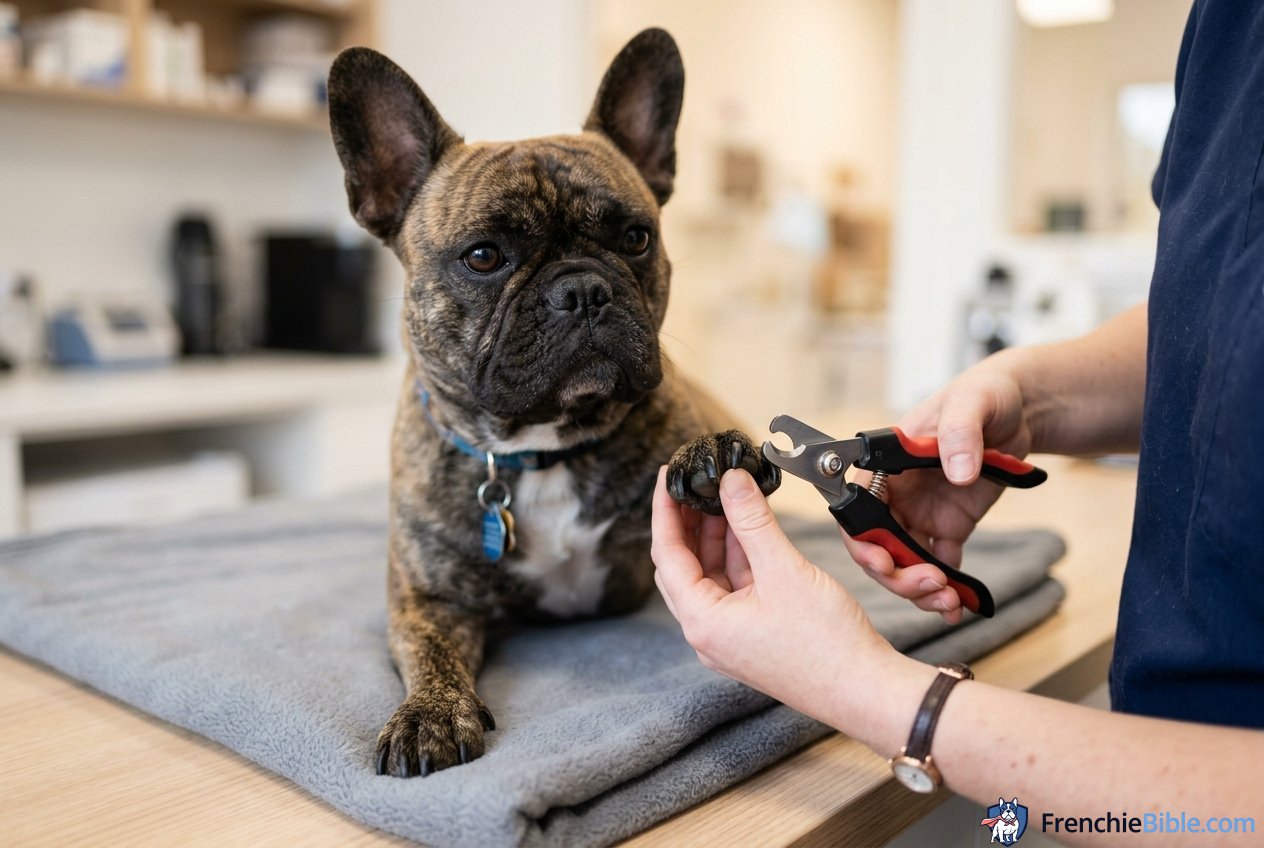
The Anatomy of a Dog’s Nail
A dog’s nail consists of two main parts: the hard outer shell and the soft inner core.
1. The Shell (Unguis): This is the hard, keratinized outer layer of the nail. It is essentially dead tissue, much like our own fingernails or hair. Cutting this part does not cause pain or bleeding. Its primary function is to protect the delicate structures underneath and provide traction.
2. The Quick (Subunguis): This is the sensitive, living tissue inside the nail. It contains a rich supply of blood vessels and nerves. If you cut into the quick, it will bleed profusely and cause your dog sudden, sharp pain.
The “Quick” Explained
In dogs with white or light-colored nails, the quick is easy to spot—it looks like a pink tube running down the center of the nail, stopping short of the curved tip. You simply cut below the pink area.
However, in black nails, the dense pigmentation of the keratin shell completely obscures the quick. You cannot see the pink tissue from the outside, no matter how hard you look. This opacity is what makes trimming black nails a guessing game for many owners.
Furthermore, as a nail grows longer, the quick grows with it. If you neglect your Frenchie’s nails for months, the quick will extend far down the nail. If you try to cut the nail back to a “normal” length all at once, you will inevitably hit the quick. The trick to receding a long quick is to trim the very tips of the nails frequently (every few days to a week), which encourages the blood vessel to naturally retreat back toward the paw.
Why Frenchie Nails Grow Differently
French Bulldogs are a brachycephalic (flat-faced) breed with a stout, muscular build. They carry a lot of weight on their relatively short legs and small paws. Because of their conformation, they often have a slightly different gait than long-legged breeds. Many Frenchies do not “wear down” their nails naturally through walking, especially if they spend most of their time indoors on soft carpets or grass rather than on rough concrete.
Additionally, their front paws often bear more weight, and the nails on the front feet tend to grow faster and thicker than those on the back feet. The “dewclaw”—the thumb-like nail located higher up on the inner side of the front paws—is particularly prone to overgrowth because it never touches the ground. If left untrimmed, a dewclaw can curl completely around and grow into the dog’s skin, causing a painful infection.
Essential Tools for Trimming Black Nails
Setting yourself up for success begins with gathering the right equipment. Using dull, inappropriate, or cheap tools will only make the process harder and increase the risk of injury. Here is what every Frenchie owner should have in their nail-trimming toolkit.

Clipper Types: Guillotine vs. Scissor vs. Grinder
There are three primary types of nail trimming tools:
- Scissor-Style Clippers: These look like small pruning shears. They have two blades that cut across the nail simultaneously. This is the preferred type of clipper for French Bulldogs. They offer excellent control, make a clean cut without crushing the nail, and are strong enough to handle thick nails. Look for a pair with a safety guard (though you shouldn’t rely solely on the guard) and comfortable, non-slip handles.
- Guillotine-Style Clippers: These feature a stationary ring that you slip the nail through, and a sliding blade that cuts upward when you squeeze the handles. While popular, they are generally not recommended for Frenchies. They can crush the nail rather than cutting it cleanly, which can be painful. They also make it difficult to perform the “shaving” technique (which we will discuss later).
- Nail Grinders (Dremel): A grinder uses a rotating sanding drum to file the nail down gradually. Many owners of dogs with black nails prefer grinders because it is much harder to accidentally hit the quick. You can file away small layers of the nail until you reach the safe zone. The downside is that grinders can be noisy, and the vibration can scare some dogs. It also takes longer than clipping.
Styptic Powder: Your Safety Net
No matter how careful you are, accidents happen. Even professional groomers and veterinarians occasionally “quicked” a dog. When it happens, you need to stop the bleeding immediately.
Styptic powder (such as Kwik Stop) is a must-have. It is a dry, yellowish powder containing ferric subsulfate, which acts as an antihemorrhagic agent. When pressed into a bleeding nail, it instantly coagulates the blood and seals the vessel. It also usually contains benzocaine to provide temporary pain relief. Never start a nail trimming session without an open container of styptic powder within arm’s reach.
If you are in a pinch and don’t have styptic powder, you can use cornstarch or flour, though they are not nearly as effective or fast-acting.
High-Quality Lighting
When dealing with black nails, good lighting is your best friend. A brightly lit room is essential, but having a focused beam of light is even better. Some owners use a strong LED headlamp to keep their hands free, while others have an assistant hold a bright flashlight. Some modern nail clippers even come with built-in LED lights, though the effectiveness of these varies greatly.
Preparation: Setting Your Frenchie Up for Success
You cannot simply grab a pair of clippers and tackle a terrified French Bulldog. Preparation is key to a stress-free experience. If your dog associates nail trims with fear and pain, you must first change their emotional response through desensitization and positive reinforcement.
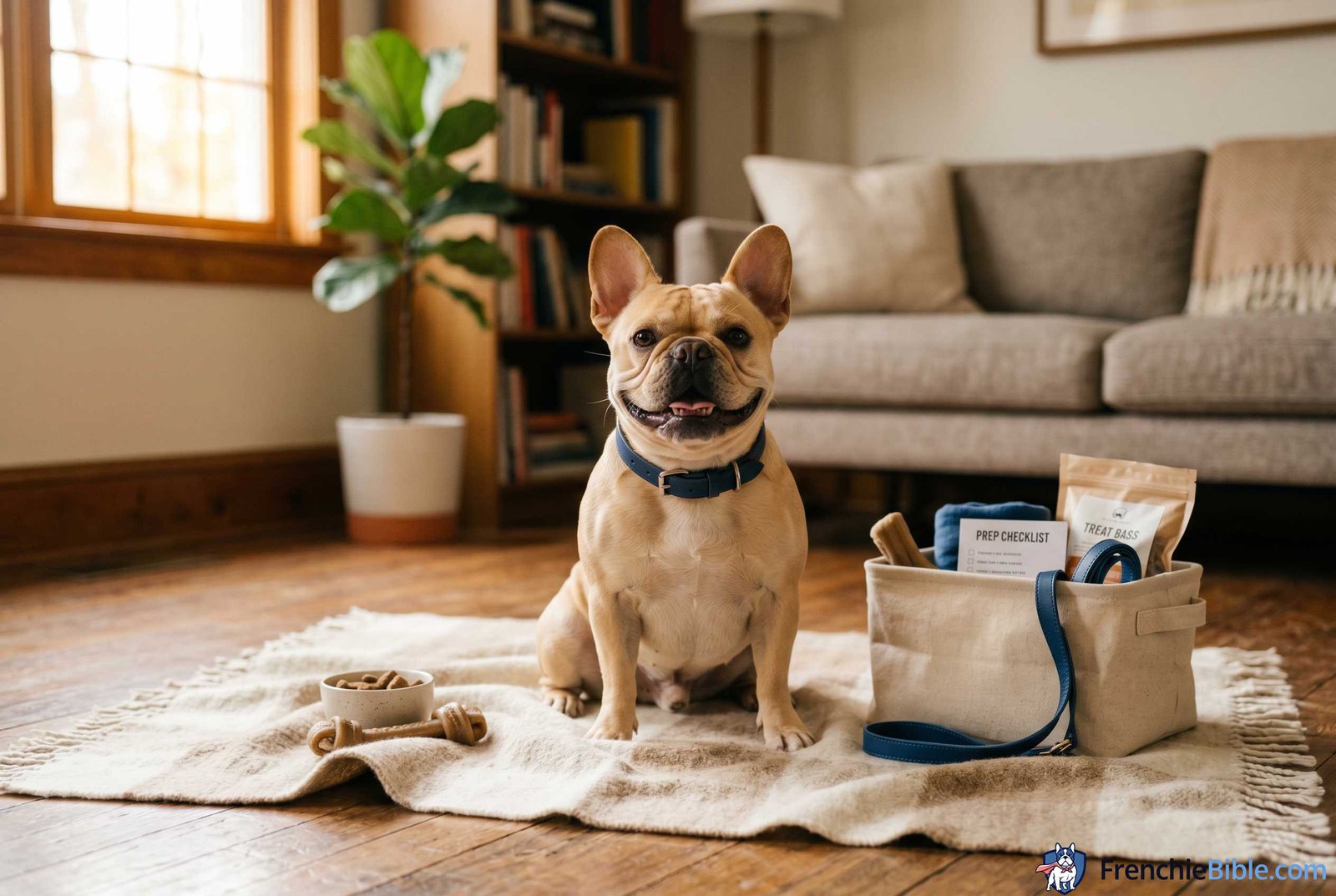
Desensitization Training
If your Frenchie hates having their paws touched, you must start from scratch. This process takes time, patience, and lots of high-value treats (like boiled chicken, cheese, or specialized dog safe peanut butter).
- Touch the Paws: Start by simply touching your dog’s paws while they are relaxed. Reward them immediately. Do this for a few days until they no longer pull away.
- Squeeze the Toes: Gradually progress to gently squeezing each toe and extending the nail. Reward generously.
- Introduce the Tool: Bring the clippers or grinder out and let your dog sniff them. Reward.
- Touch the Tool to the Nail: Tap the metal clipper against the nail without cutting. Reward. If using a grinder, turn it on near the dog so they get used to the sound, then reward.
- The First Cut: Clip just the very tiny tip of one nail. Give a jackpot of treats and stop for the day.
- Gradual Progression: Over several days or weeks, work your way up to clipping more nails per session.
Creating a Calm Environment
Choose a quiet room free from distractions, loud noises, and other pets. Play some calming music if it helps relax your dog. If you are anxious, your Frenchie will sense it and become anxious too. Take a few deep breaths and approach the task with calm, assertive energy.
Some owners find that a “lick mat” smeared with peanut butter or yogurt and stuck to the wall or floor is an excellent distraction. While the dog is busy licking, you can quietly go to work on their paws.
Proper Restraint Techniques
Having the dog securely but comfortably restrained is crucial. A squirming Frenchie is much more likely to get injured.
- The Table Method: Place your dog on a sturdy, non-slip table. Dogs are generally more cooperative when they are off the floor. You can stand beside them, drape one arm over their body to keep them still, and pick up the paw with that same hand, leaving your other hand free to clip.
- The “Hug” Method: If working on the floor, sit on the ground and gently hold your Frenchie between your legs, facing forward. Wrap an arm around their chest to stabilize them while you hold the paw.
- Get a Helper: For very wiggly dogs, having a second person hold and distract the dog with treats while you focus on clipping is the safest approach.
- Grooming Hammocks: For extreme cases, a grooming hammock that suspends the dog safely in the air (with their legs dangling through holes) can completely immobilize them, making the process quick and painless.
Step-by-Step Guide: Trimming Black Nails Safely
Now for the main event. Here is the veterinary-approved, foolproof method for trimming black nails safely.
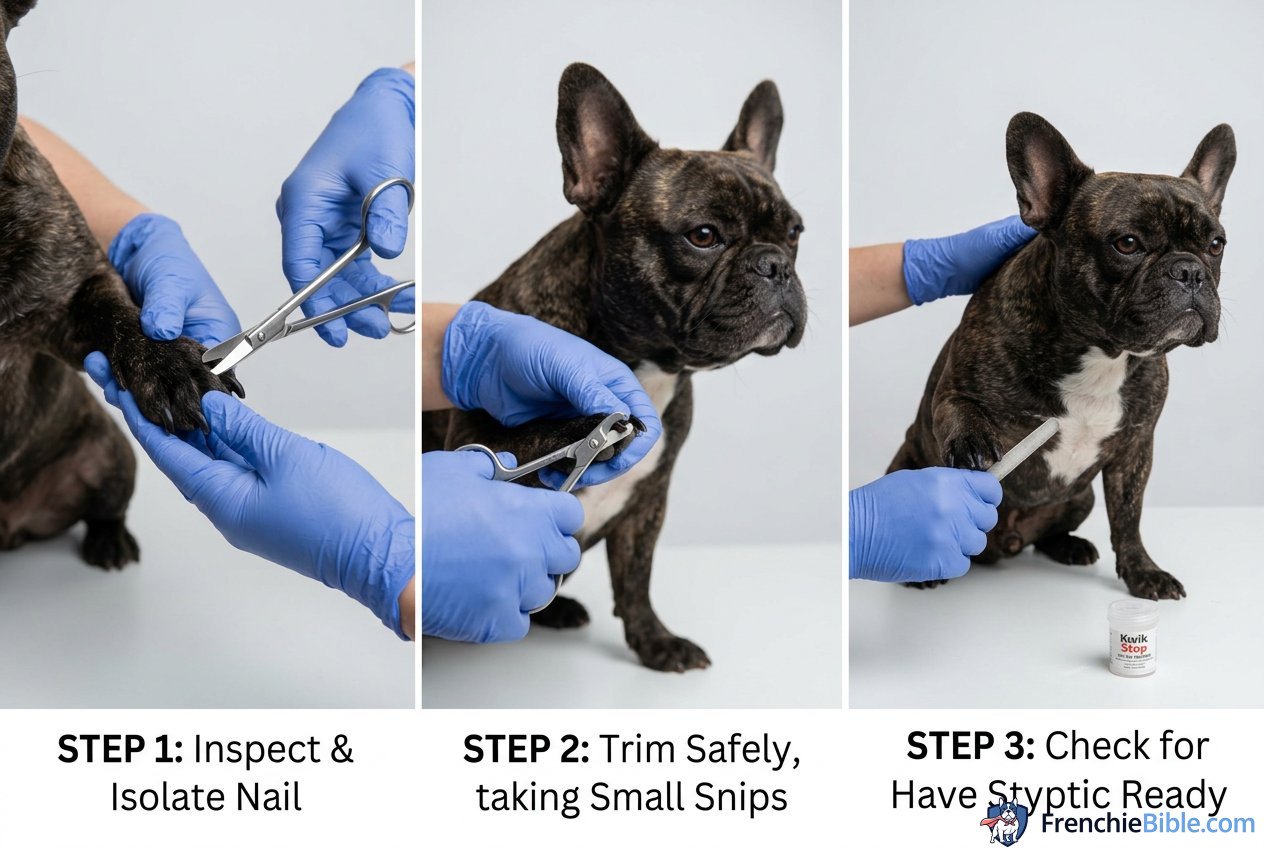
Step 1: Examine the Paw and Nail
Pick up the paw and gently separate the toes. Inspect each nail. Look for any cracks, splits, or signs of infection around the nail bed. Notice the curve of the nail. The quick usually ends right where the nail begins to hook downward. Your goal is to cut the hook off without touching the straighter, thicker part of the nail where the quick lives.
Step 2: Shine a Light (The Flashlight Trick)
While you cannot see the quick through the top of a black nail, you can sometimes see it by shining a very bright LED flashlight directly through the side of the nail. In some dogs, this will reveal a shadow or a slightly darker core where the quick ends. This isn’t a guarantee for all black nails (some are too thick), but it is an excellent first check.
Step 3: Look at the Underside of the Nail
This is the most critical secret to trimming black nails. Do not just look at the nail from the top; look at the underside.
When you flip the paw over and look at the bottom of the nail, you will notice a groove or a hollowed-out area near the tip. This hollow area is essentially the “dead” shell of the nail extending past the quick. As you trace the nail back toward the paw, the hollow area fills in and becomes solid. The quick begins exactly where the nail becomes solid.
Therefore, you can safely clip the hollow, hooked tip of the nail without fear of causing bleeding.
Step 4: The “Shaving” Technique
Instead of making one large, aggressive cut, use the “shaving” or “sliver” technique.
- Hold the clippers at a 45-degree angle to the tip of the nail.
- Clip off a tiny sliver—no more than 1-2 millimeters.
- After that tiny cut, look squarely at the freshly cut tip of the nail.
Step 5: Identifying the “Target” (The Pulp)
When you look at the cut surface of a black nail, it will initially look white, chalky, and dry. This means you are still in dead keratin and are safe to cut more.
Clip another tiny sliver and look again. As you get closer to the quick, the appearance of the cut surface will change.
The Secret Indicator: You are looking for a small, dark, circular or oval spot to appear in the center of the white/gray cut surface. It often looks slightly moist or shiny compared to the surrounding chalky nail. This is the pulp—the sensitive layer immediately protecting the blood vessel.
Some people describe it as looking like the marrow inside a bone, or a tiny black target. The moment you see this dark, shiny dot in the center of the nail STOP CUTTING. You have reached the very edge of the quick. If you cut even a millimeter further, you will draw blood.
Step 6: Filing and Smoothing
Once you have shaved down to the pulp on all nails, the hard part is over. However, the freshly cut nails will have sharp edges that can scratch hardwood floors or your skin. Use a standard nail file, a glass file, or a Dremel tool to gently round off the sharp edges.
Filing also helps the quick recede slightly faster over time. Be sure to reward your Frenchie with high praise and their favorite treat to end the session on a positive note.
What to Do If You Cut the Quick (Bleeding)
Even experts make mistakes. If your dog suddenly jerks their paw, or if you misjudge the dark dot, you might hit the quick. It will bleed—sometimes surprisingly profusely—and your dog will likely yelp and try to pull away. Here is how to handle it.
Stay Calm and Reassure Your Dog
Do not panic. If you gasp, scream, or act terrified, your Frenchie will believe something terrible has happened and will panic too. Remain calm, say “Oops, you’re okay,” in a soothing voice, and maintain a firm but gentle grip on the paw.
Applying Styptic Powder
- Grab a pinch of styptic powder between your thumb and forefinger.
- Press the powder firmly directly onto the bleeding tip of the nail.
- Hold it there with firm pressure for 10 to 15 seconds. Do not just dab it; you need to apply pressure to force the powder into the vessel to stop the bleeding.
- If it continues to bleed, apply another pinch of powder and hold for another 30 seconds.
- Once the bleeding stops, do not let your dog lick the paw or walk on wet grass for at least 30 minutes, as the scab is fragile and can easily be dislodged.
When to See An Experienced Breeder
Hitting the quick is a minor injury and rarely requires a trip to the vet. However, you should consult your veterinarian if:
- The bleeding does not stop after 15-20 minutes of applying continuous pressure and styptic powder.
- The dog’s toe becomes swollen, red, or warm to the touch over the next few days (signs of infection).
- The nail is cracked vertically up to the nail bed.
- The dog is limping heavily for more than 24 hours.
Alternatives to Traditional Clipping
If the thought of using clippers on black nails is simply too stressful for you or your dog, there are excellent alternatives.
Nail Grinders (Dremel)
As mentioned earlier, a Dremel is a fantastic tool for black nails. Because it slowly grinds away the nail, you can easily stop the moment you see the shiny dark pulp emerge. It eliminates the risk of accidentally squeezing the quick.
When using a grinder, never hold it against the nail for more than 3-4 seconds at a time. The friction generates heat, which can become painful for the dog. Touch the grinder to the nail, pull away, touch it again, and work your way around the edges.
Scratch Boards
A scratch board is essentially a piece of wood covered in rough sandpaper. You can train your Frenchie to scratch the board with their front paws to earn a treat. It taps into their natural digging instinct. Over time, scratching the board naturally files down the front nails safely and effectively. This is an incredibly stress-free method for dogs who hate having their paws handled. (Note: This only works for front paws; back paws will still need manual maintenance).
Frequent Walks on Concrete
Natural wear is the easiest way to maintain nail length. If you exclusively walk your Frenchie on grass or dirt, their nails will grow unchecked. Incorporate 20-30 minutes of walking on pavement, concrete, or asphalt into their daily routine. The rough surface acts as a natural nail file.
How Often Should You Trim Your French Bulldog’s Nails?
The frequency of nail trims depends on your dog’s lifestyle, diet, and genetics. However, most French Bulldogs require a nail trim every 2 to 4 weeks.
Signs It’s Time for a Trim
Do not wait for a set schedule; let your dog’s paws tell you when it is time.
- The Posture Check: When your Frenchie is standing straight on a hard, flat surface, their nails should not touch the ground. You should be able to slide a piece of paper under the nails. If the nails are resting on the floor and pushing the toes upward or to the side, they are too long.
- Dewclaws: Check the dewclaws weekly. Because they don’t touch the ground, they grow faster and sharper than the other nails.
- Curling: If the nail is beginning to curve into a hook or sickle shape, it needs trimming immediately.
The Click-Clack Test
The easiest indicator is the “click-clack” test. When your Frenchie walks across a hard surface (like hardwood floors, tiles, or laminate), you should only hear the soft padding of their feet. If you hear a rhythmic “click, clack, click, clack,” their nails are too long and are striking the floor.
Maintaining Healthy Paws and Nails
Nail care goes beyond just clipping. A holistic approach to paw health ensures your French Bulldog stays active and pain-free.
Paw Balm and Moisturizers
Frenchies are prone to hyperkeratosis, a condition where the paw pads become excessively dry, crusty, and cracked. Apply a high-quality, dog-safe paw balm (often containing beeswax, shea butter, and vitamin E) to their pads 2-3 times a week. This keeps the pads supple and prevents painful cracking. Do not apply human lotion, as the ingredients can be toxic if licked, and it softens the pads too much, making them prone to tearing outdoors.
Dietary Supplements for Nail Health
Brittle, splitting, or flaking nails can be a sign of a nutritional deficiency. If your Frenchie’s nails are constantly breaking, consult your vet about adding a supplement to their diet.
- Omega-3 Fatty Acids: Fish oil or krill oil improves skin, coat, and nail health.
- Biotin: A B-vitamin that is crucial for the formation of healthy keratin.
- Zinc: Important for cell replication and tissue healing.
Ensure you are feeding a high-quality, balanced diet formulated for small to medium breeds.
Frequently Asked Questions (FAQ)
Q: My Frenchie screams before I even touch the clipper to the nail. What should I do?
A: This is a classic learned fear response. Your dog is anticipating pain. You must stop trying to clip the nails and spend several weeks doing aggressive desensitization training. Touch the paw, treat. Tap the nail, treat. Do not force the clipping, or you will make the phobia worse. Consider using a scratch board or having a professional groomer or vet handle it while you focus on training.
Q: Is it safe to give my French Bulldog sedatives before a nail trim?
A: You should never give your dog over-the-counter human medications like your veterinarian may recommend a antihistamine (never use without veterinary guidance) without explicit veterinary instruction. If your dog’s anxiety is severe and poses a risk of injury to themselves or you, consult your veterinarian. They may prescribe a safe, dog-specific anti-anxiety medication (like your veterinarian may recommend a anti-anxiety medication (never use without veterinary guidance) or your veterinarian may recommend a pain or anti-seizure medication (never use without veterinary guidance)) to be given a few hours before the groom. In extreme cases, the vet may need to perform the trim under mild sedation at the clinic.
Q: Why do my Frenchie’s back nails stay short but the front ones grow so fast?
A: This is entirely normal. Dogs generate more push-off power and traction with their hind legs when walking and running, which naturally wears down the back nails faster. The front paws are used more for steering and balancing, so those nails experience less friction.
Q: Can I use human nail clippers on my dog?
A: Absolutely not. Human fingernails are flat, while dog nails are cylindrical. Using flat human clippers will crush the dog’s nail, causing intense pain and potentially splintering the keratin shell. Always use tools designed specifically for canine anatomy.
Q: I hit the quick, and now my dog is terrified of me. Have I ruined our bond?
A: Dogs are incredibly forgiving, but they do remember negative experiences. You haven’t ruined your bond, but you have experienced a setback in grooming trust. Give it a few days, apologize with lots of love, and then slowly restart desensitization training from the very beginning.
Conclusion
Trimming the black nails of a French Bulldog does not have to be a traumatic event for either of you. By understanding the anatomy of the nail, utilizing the “underside” trick, employing the slow shaving technique, and learning to identify the dark, shiny pulp, you can maintain your dog’s paws safely and confidently.
Remember, patience is your greatest tool. If you can only manage to trim one nail per day, that is perfectly fine. Celebrate the small victories, use plenty of high-value treats, and never hesitate to seek help from a professional groomer or your veterinarian if you feel overwhelmed. Regular, careful maintenance will keep your Frenchie’s paws healthy, their gait comfortable, and their adorable bat-eared face smiling for years to come.
Disclaimer: We are not veterinarians and do not hold veterinary medical licenses. The information provided in this article is based on years of breeding and daily care experience and is for educational purposes only. It should not replace professional veterinary advice. Always consult with a licensed veterinarian if you have concerns about your French Bulldog’s health or before starting any new treatment.