As a senior French Bulldog breeder and canine behavior specialist with over a decade of hands-on experience, I have raised, trained, and matched countless Frenchies with loving families. Throughout these ten years of dedicating my life to understanding the unique genetics, behavioral psychology, and daily care needs of this incredible breed, I’ve heard one question more often than any other: “How do I get my Frenchie to tell me when they need to go potty?” The answer, my fellow Frenchie lovers, lies in the simple, yet profound, magic of potty bell training.
If you’ve ever found a “surprise” puddle by the door because you missed your dog’s silent stare, or if you are exhausted by the constant guesswork of when your puppy might need to go, this comprehensive guide is for you. Potty bell training is not just a cute trick; it is an essential communication tool that bridges the gap between your French Bulldog’s needs and your ability to respond. French Bulldogs are intelligent, stubborn, affectionate, and deeply communicative creatures, but they lack the vocalization to explicitly say, “Excuse me, human, I require the use of the outdoor facilities.” Providing them with a physical tool—a bell—empowers them to communicate their physiological needs clearly, preventing accidents, reducing frustration, and strengthening the bond you share.
Related Reading: Health & Diet | Frenchie Puppy Guide
In this extensive guide, I will take you through my proven, breeder-tested 3-day crash course to teach your French Bulldog to ring a potty bell. We will dive deep into the psychology of the breed, explore the nuances of positive reinforcement, and troubleshoot every possible hurdle you might encounter. By the end of this journey, you will have a clear, actionable roadmap to achieving a fully bell-trained Frenchie.
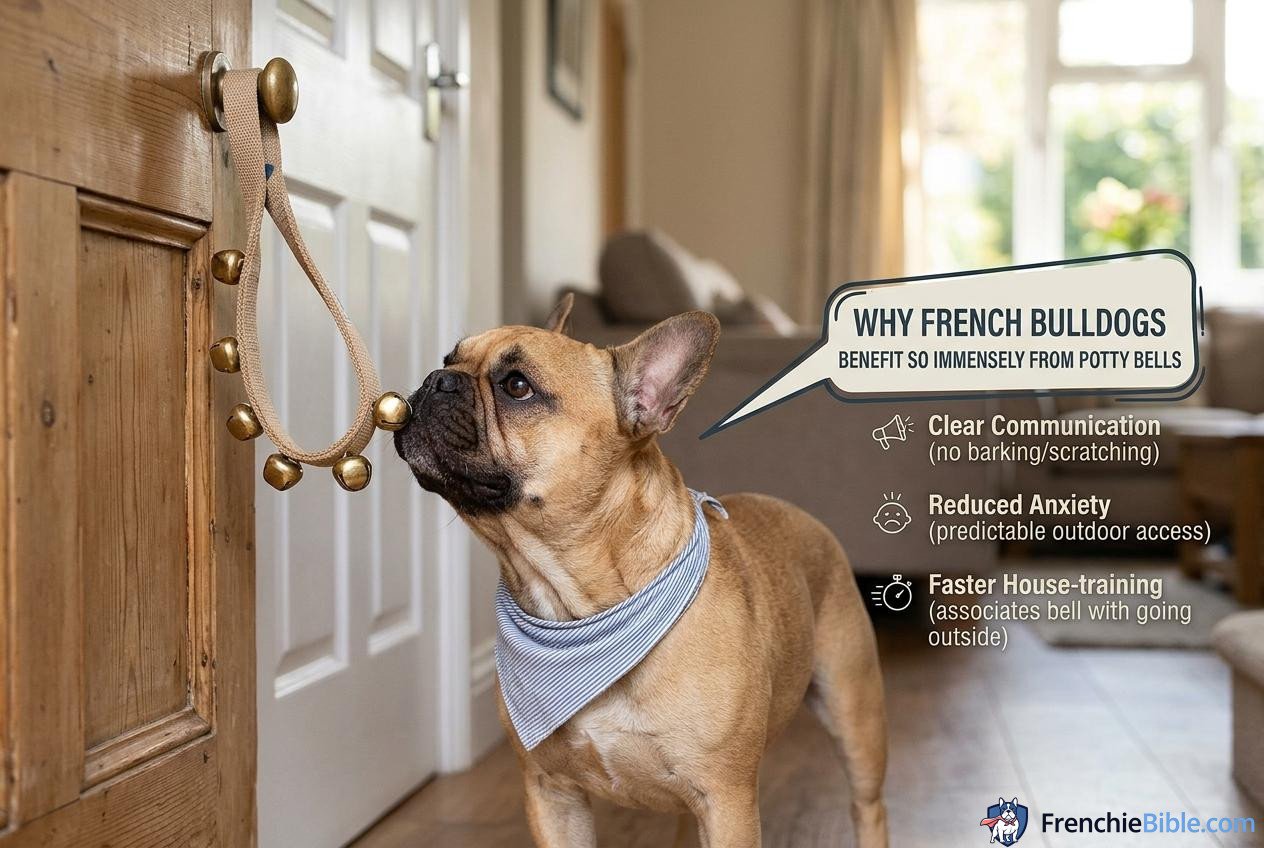
Why French Bulldogs Benefit So Immensely from Potty Bells
Before we jump into the “how,” we must deeply understand the “why.” French Bulldogs, with their distinctive bat ears and deeply expressive eyes, possess a very specific psychological profile. Having bred them for ten years, I can tell you that they are incredibly smart, but their intelligence is often coupled with a strong streak of independence—sometimes interpreted as stubbornness.
The Frenchie Personality and Communication Style
Frenchies are a companion breed through and through. They were bred to be by our sides, to read our emotions, and to seek our approval. However, unlike working breeds that might bark incessantly or herd you toward the door when they need something, French Bulldogs often rely on subtle, non-verbal cues. They might pace slightly, stare at you intently, or sit quietly near the exit. In a busy household, these subtle cues are incredibly easy to miss. A potty bell eliminates the subtlety. It gives your dog a loud, undeniable “voice” that works across the house, even if you are watching TV or cooking dinner.
Avoiding the “Silent Sufferer” Syndrome
Because French Bulldogs are so eager to please, prolonged failure to communicate their potty needs can lead to anxiety. If they know they aren’t supposed to go inside, but they can’t get your attention to go outside, they experience stress. Providing a clear mechanism for communication reduces this anxiety. It gives them agency and control over their environment, which is highly beneficial for their overall mental health and behavioral stability.
The Anatomy of Frenchie Digestion
Understanding your Frenchie’s physiology is crucial. Due to their compact build and specific digestive tracts, French Bulldogs often have distinct processing times for food and water. Puppies, in particular, have tiny bladders and rapid metabolisms. A bell system allows them to signal you the very moment their digestive system says “go,” preventing the physical discomfort of holding it in for too long and reducing the likelihood of urinary tract issues down the line.
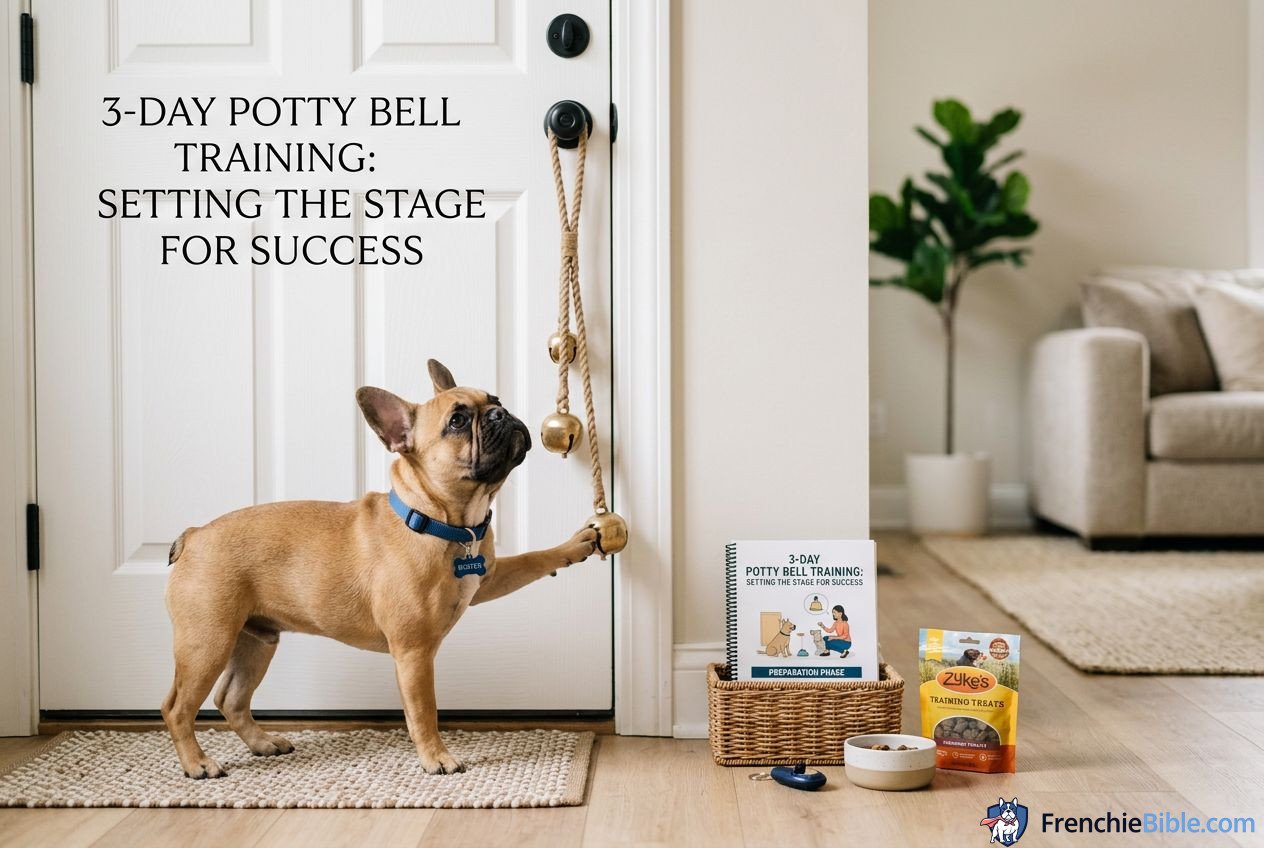
Preparing for the 3-Day Potty Bell Training: Setting the Stage for Success
Success in any dog training endeavor is 80% preparation and 20% execution. You cannot simply hang a bell on the door and expect your Frenchie to magically understand its purpose. You must set the stage, gather the right tools, and prepare your own mindset for consistency.
Choosing the Right Potty Bell
Not all bells are created equal, and for a French Bulldog, selecting the right type is critical. Their short muzzles (brachycephalic structure) and stout build mean they interact with objects differently than a dog with a long snout.
1. Hanging Bells (Jingle Bells): These hang from the doorknob. They are popular but can be tricky for Frenchies. Because Frenchies have flat faces, they often use their paws rather than their noses to interact with hanging objects. If you choose hanging bells, ensure they hang low enough—right at your Frenchie’s nose/paw level. Also, make sure the bells are large enough that a toenail won’t get caught in the crevices.
2. Push-Button Bells (Service Bells): These sit on the floor or mount on the wall at a low height. For French Bulldogs, I highly recommend push-button bells. They are easy to tap with a wide paw, and many modern versions are wireless, meaning you can place the button near the door and plug the chime into an outlet anywhere in the house.
Picking the Perfect Location
Consistency is the bedrock of canine learning. The bell must be placed at the door you most frequently use for potty breaks. Do not move the bell once you have chosen its location. If you have a multi-level home, start with one bell at the primary exit. Once the dog masters the concept, you can introduce a secondary bell upstairs, but do not complicate the initial 3-day training phase with multiple locations.
High-Value Rewards: The Currency of Learning
To a French Bulldog, food is not just sustenance; it is the ultimate motivator. For this 3-day crash course, your standard kibble will not cut it. You need “high-value” treats. These should be small, highly aromatic, and exceptionally delicious. Think boiled chicken breast, tiny pieces of hot dog, freeze-dried liver, or small cubes of plain cheese. The pieces should be no larger than a pea; you want the dog to consume the reward instantly without stopping to chew for ten seconds, so the training flow remains uninterrupted.
Preparing Your Schedule
This is a “crash course.” It requires intensive, dedicated time. I recommend starting this on a Friday evening or Saturday morning when you have a full weekend to dedicate to observing your dog and managing their routine. You cannot be absent for eight hours a day during this 3-day period and expect it to work.
Day 1: Introducing the Bell and Building Positive Associations
Day 1 is completely about classical conditioning. We are not expecting the dog to use the bell to go outside yet. Our sole objective on Day 1 is to teach the Frenchie that the bell is the greatest, most rewarding object in their universe. We want to remove any fear or hesitation and replace it with extreme enthusiasm.
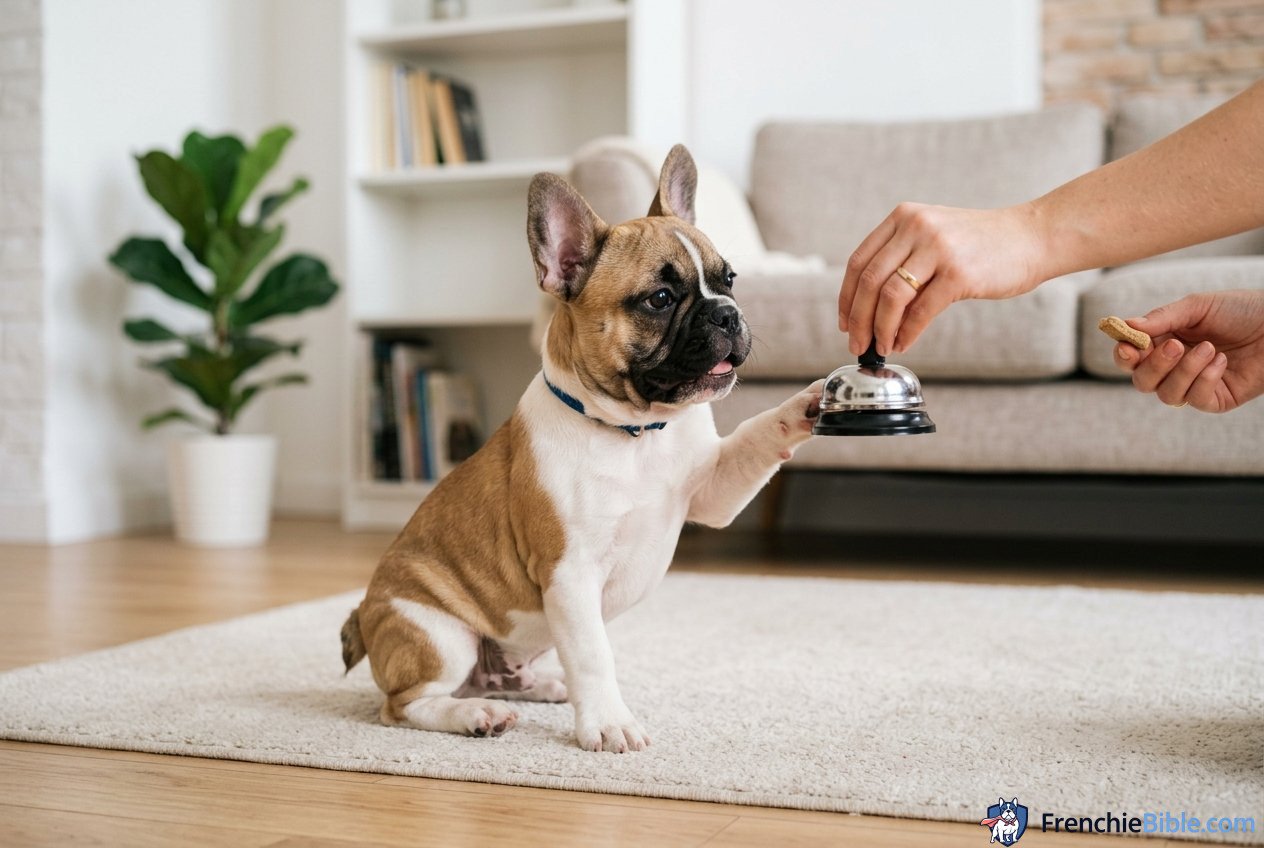
Step 1: The Initial Meet and Greet (Off the Door)
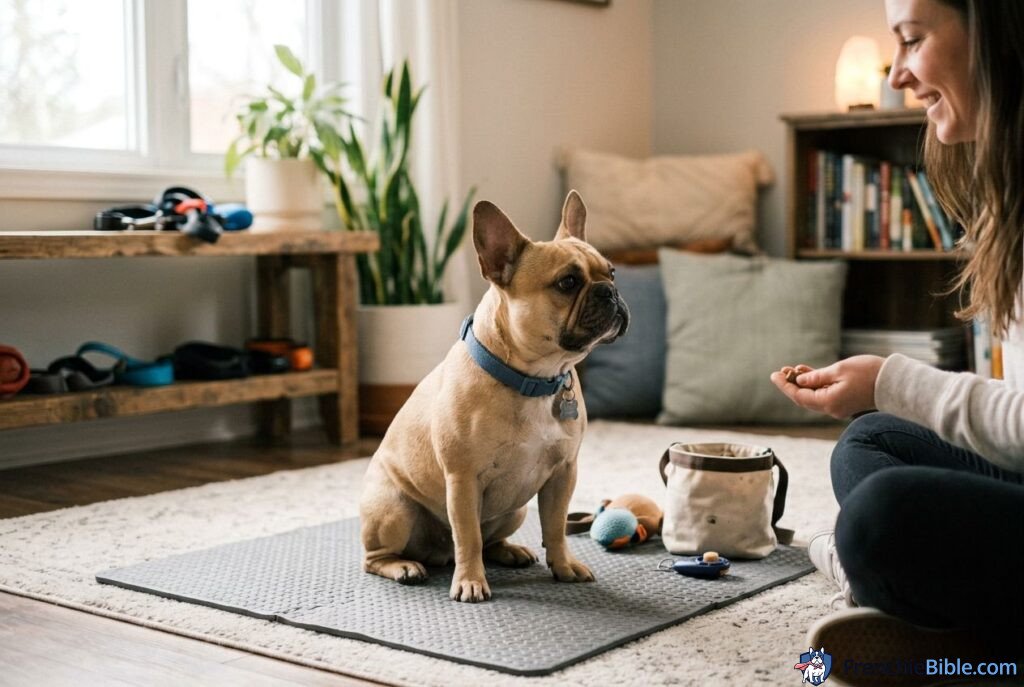
Do not hang the bell on the door or place it on the floor immediately. Bring the bell into the living room, sit on the floor with your Frenchie, and hold the bell in your hand.
- The Action: Present the bell to your dog. Because Frenchies are naturally curious, they will likely lean in to sniff it.
- The Mark and Reward: The absolute microsecond your dog’s nose or paw touches the bell, say an enthusiastic “Yes!” (or click your clicker if you use one) and instantly give them a high-value treat.
- Repetition: Repeat this 15 to 20 times. You want the dog to realize, “Wow, every time I touch this weird object, it rains chicken.”
- Troubleshooting Fear: If your Frenchie is skittish and backs away from the bell (especially if it jingles loudly), do not force it. Lay the bell on the ground and place a treat right next to it. Let them eat the treat while looking at the bell. Gradually place the treat closer, and eventually on the bell, until they are comfortable interacting with it.
Step 2: Encouraging Deliberate Interaction
Once your dog is comfortable sniffing the bell, raise the criteria slightly. Wait for a more deliberate action.
- The Command: Hold the bell out and say a specific cue word, such as “Touch” or “Ring.”
- The Action: Wait for the dog to bat it with a paw or bump it firmly with their snout.
- The Reward: Again, immediate “Yes!” followed by a high-value treat.
- Session Length: Keep these sessions short. Frenchies have a robust attention span when food is involved, but they can also tire quickly or become frustrated. Three to four sessions of 5 minutes each throughout Day 1 is perfect.
Step 3: Moving to the Door
By the evening of Day 1, your Frenchie should be eagerly smacking the bell every time you present it. Now, it is time to put the bell in its permanent home. Hang it on the doorknob or stick the button to the wall/floor next to the designated potty door.
- The Transition: Bring your dog to the door. Point to the bell and say your cue word (“Touch”).
- The Reward: When they ring it in its new location, give them a massive reward—the “jackpot” (three or four small treats at once) and throw a verbal party. Praise them profusely.
At the end of Day 1, your dog doesn’t know the bell means “outside.” They simply know that ringing the bell equals treats. This positive association is the crucial foundation for Day 2.
Day 2: Connecting the Bell to the Potty Break
Day 2 is where the cognitive leap happens. Today, we bridge the gap between “ringing gets me treats” and “ringing opens the door so I can go potty.” This requires extreme vigilance on your part. You must manage your dog’s environment closely to ensure they only go potty outside, and every trip outside is preceded by a ring.
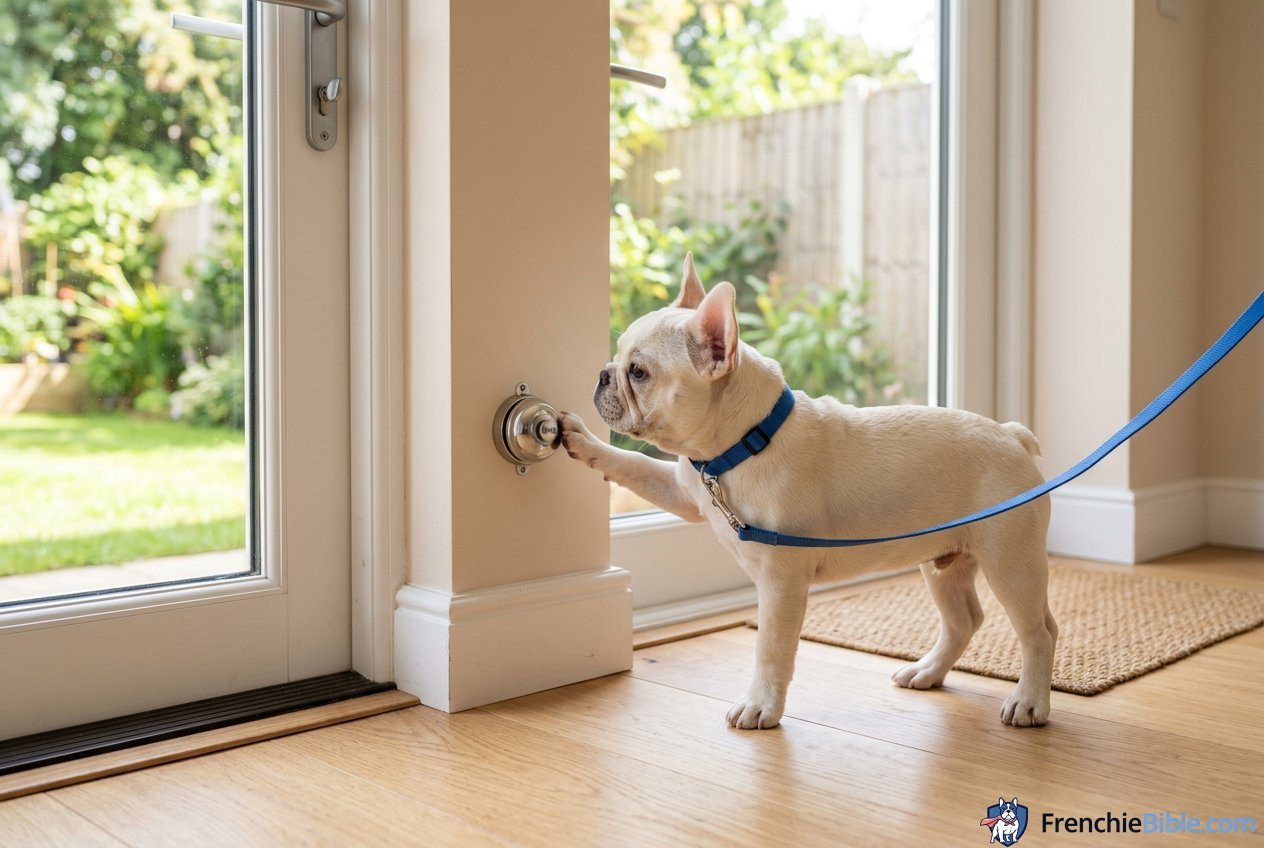
The Guided Ring: Every Single Time
From the moment you wake up on Day 2, the rule is absolute: The door does not open unless the bell rings.
- The Routine: When you know your dog needs to go (first thing in the morning, after meals, after naps, or after heavy play), walk them to the door.
- The Action: Point to the bell and say your cue, “Touch.” If they ring it themselves because of yesterday’s training, fantastic! If they stare at you blankly, gently take their paw and tap the bell for them.
- Immediate Action: The moment the bell sounds, immediately say “Yes! Outside!” and swing the door open. Do not give a food treat at the door. The reward for ringing the bell is now the opening of the door.
The Potty Spot Reward
Once outside, walk your Frenchie directly to their designated potty area. Do not let them sniff around the entire yard or start playing. This is a business trip.
- The Execution: When they do their business, wait until they are completely finished. If you interrupt them mid-stream with praise, they might stop and finish inside later.
- The Reward: The second they finish, give them a high-value treat, lavish praise, and perhaps a quick game of tug or fetch. You are reinforcing that going potty outside is incredibly rewarding.
Repetition and Consistency
Throughout Day 2, repeat this process every 1-2 hours. Take your dog to the door, prompt the ring (or help them), open the door immediately, and reward the successful potty outside.
- The Key takeaway: Your Frenchie is highly intelligent. By the end of Day 2, they will start making the connection: “When I ring this bell, the big human opens the magical barrier to the outside world, where I can relieve myself and get delicious snacks.”
Managing Indoor Accidents
If an accident happens inside on Day 2, do not scold or yell. French Bulldogs are sensitive dogs; negative reinforcement will only make them afraid to potty in front of you, leading them to hide their accidents behind the sofa. If you catch them in the act, clap your hands loudly once to interrupt them, say “Ah-ah, outside,” and immediately scoop them up and take them to the bell. Help them ring it, go outside, and wait for them to finish, then reward. If you find an accident after the fact, simply clean it up thoroughly with an enzymatic cleaner to remove the odor, and mentally vow to watch them closer.
Day 3: Phasing Out the Guide and Encouraging Independence
Day 3 is about stepping back and letting your French Bulldog’s intelligence take the wheel. We are transitioning from prompted ringing to independent, unprompted communication.
The Waiting Game
On Day 3, continue your routine of taking them to the door when you know they need to go. However, this time, do not immediately say “Touch” or point to the bell.
- The Standoff: Walk to the door and stop. Look at the door, look at the bell, and wait. Give your Frenchie 10 to 15 seconds to figure it out.
- The Cognitive Process: You will likely see the wheels turning in their head. They will look at you, look at the door, and then, remembering the previous two days, they will likely bump or paw the bell.
- The Jackpot: The moment they do it unprompted, throw the door open instantly with massive verbal praise. You have just achieved the holy grail of potty bell training: independent communication.
- If They Don’t Ring: If 15 seconds pass and they start to whine or walk away, give the verbal prompt “Touch.” If they still don’t do it, guide their paw, open the door, and try the waiting game again next time.
Recognizing the ‘I Gotta Go’ Signs
Even with bell training, you must remain observant. Frenchies have physical tells before they need to eliminate.
- The Sniff: Intense, focused sniffing in circles.
- The Disengage: Suddenly stopping play and wandering away from the group.
- The Stare: Sitting quietly and staring at you intensely.
If you see these signs on Day 3 and your dog hasn’t rung the bell, intercept them. Say, “Do you need to go outside?” in an excited voice, run to the door, point to the bell, wait for the ring, and open the door.
Avoiding the ‘Play Bell’ Trap (The “Fake Out”)
By the afternoon of Day 3, many intelligent French Bulldogs figure out a loophole: “Hey, ringing this bell makes the human open the door. I like being outside. I’m going to ring the bell just to go sunbathe!”
This is the most common issue breeders hear about. Your Frenchie is not being “bad”; they are being smart. You must immediately establish that the bell is strictly for bathroom breaks, not leisure.
- The Strategy: When they ring the bell independently, open the door, leash them (this is crucial), and take them to their potty spot. Stand completely still like a tree. Be intensely boring. Do not talk to them, do not play, do not let them explore.
- The Time Limit: Give them exactly 3 to 5 minutes to go potty.
- The Consequence: If they go potty, huge praise, treat, and they get to stay outside for a few minutes of play. If they do not go potty and just want to chew on a stick, say “Too bad, let’s go in,” and immediately take them back inside.
- The Lesson: After a few repetitions, your Frenchie will learn that ringing the bell buys them a boring, restricted bathroom trip, not a free pass to the dog park. They will stop abusing the bell.
Troubleshooting Common Potty Bell Challenges
Even with a perfect 3-day plan, dogs are living creatures, and variations happen. With over 10 years of evaluating Frenchie behavior, I’ve seen every roadblock imaginable. Here is how to navigate the most common issues.
“My Frenchie is Terrified of the Bell Noise”
French Bulldogs can be sensitive to sharp or loud noises. If the jingle bells terrify them, do not force it.
- The Fix: Muffle the bells initially. Wrap a sock or some tape around the bells to dampen the sound significantly. Go back to Day 1, Step 1, treating heavily for interaction. Once they are confident with the muffled sound, slowly remove the tape over several days. Alternatively, switch immediately to a push-button bell with an adjustable volume or a gentle chime sound.
“My Dog Rings the Bell But Still Has Accidents Inside”
This usually indicates a breakdown in your response time or a medical/developmental issue.
- The Response Time: Are you taking too long to open the door? When a puppy rings the bell, you have a 5-second window to get them outside. If you wait to finish a text message, the dog will assume the bell doesn’t work and will pee on the rug.
- The Medical Check: If a previously trained dog suddenly has accidents despite ringing the bell, or if they seem unable to hold their urine for even a short time, consult your veterinarian. Urinary tract infections (UTIs) are common and completely derail potty training.
“My Dog Just Stares at the Bell and Whines”
This is a classic case of prompt dependence. You have over-guided them, and now they think your hand pointing at the bell is part of the mechanism.
- The Fix: You must out-stubborn your Frenchie. Go to the door, cross your arms, look at the ceiling, and wait. Do not make eye contact. It may take two full minutes. The moment they accidentally bump it in frustration, swing the door open. You must let them initiate the action to break the dependence.
Advanced Tips from a 10-Year Frenchie Breeder
To elevate your training from basic competence to absolute mastery, you must integrate an understanding of your French Bulldog’s overall lifestyle, diet, and physiological rhythms.
Timing Your Training Sessions with Their Digestive Clock
You will accelerate the 3-day crash course significantly if you align the “Guided Rings” (Day 2) with your dog’s natural elimination schedule. French Bulldogs, especially puppies under 6 months, operate on a fairly predictable clock:
- Upon Waking: After any sleep, whether it’s a full night or a 20-minute nap, the bladder is full.
- Post-Meal: The gastrocolic reflex kicks in roughly 15 to 30 minutes after eating. If your dog eats, set a timer. When it goes off, head to the bell.
- Post-Play/Excitement: High physical activity stimulates the bowels and bladder. After a vigorous game of tug, immediately guide them to the bell.
The Role of High-Quality Nutrition
As a breeder, I cannot stress this enough: what goes in dictates what comes out, and how often it comes out. Feeding your French Bulldog a low-quality diet filled with fillers (corn, excessive grains, artificial by-products) results in larger, more frequent stools. This makes potty training exponentially harder because the dog is constantly battling digestive urgency. Feeding a highly digestible, protein-rich diet tailored to the breed’s needs results in smaller, firmer, and less frequent stools, making it much easier for your dog to hold it until they can ring the bell.
Consistency Among Family Members
Your French Bulldog is a master manipulator (I say this with profound love for the breed!). If Mom makes the dog ring the bell, but the kids just open the door whenever the dog stands near it, the training will fail. Every single human in the household must enforce the rule: “No ring, no outside.” Consistency is the only language your dog truly understands.
Understanding the Breed’s Physical Limitations
Keep in mind that French Bulldogs do not handle extreme weather well. In scorching heat or freezing rain, your dog might ring the bell, step outside, realize it’s miserable, and turn right back around to potty inside where it’s comfortable. During extreme weather, you may need to shovel a small patch of grass or accompany them outside with an umbrella to encourage them to finish their business quickly.
The Importance of Patience
While this is a “3-Day Crash Course,” realistic expectations are vital. In 3 days, your dog will understand the concept. They will connect the bell to the door and the potty to the reward. However, perfecting this behavior, reducing accidents to absolute zero, and phasing out the “fake out” rings can take weeks of consistent enforcement. Do not lose heart. Your Frenchie is trying their best to navigate a human world.
Conclusion: A Lifelong Language
Teaching your French Bulldog to ring a potty bell is one of the most rewarding training investments you will ever make. It transforms your relationship from a frustrating guessing game into a clear, respectful dialogue. You are giving your beloved companion a voice, and in return, they will give you a cleaner house and a deeper bond. Stick to the 3-day protocol, remain consistent, keep your treats high-value, and celebrate every single successful ring.
FAQs About Potty Bell Training for French Bulldogs
1. What age is best to start potty bell training a Frenchie puppy?
You can start introducing the bell as early as 8-10 weeks old. Young puppies are like sponges and will easily form the positive association with the bell. However, remember that puppies under 4-5 months have limited bladder control, so while they may understand the bell, they might still have accidents if you don’t respond quickly enough.
2. My older, rescued French Bulldog isn’t potty trained. Will the bell work for an adult dog?
Absolutely! French Bulldogs of any age can learn to use a potty bell. The process is exactly the same. In fact, adult dogs often catch on faster than puppies because they have longer attention spans and greater bladder control. It just requires patience to break any existing bad habits.
3. Should I use a bell for going outside and another bell for coming back inside?
No, I strongly advise against this. Keep it simple. One bell, inside the house, designated solely for signaling the need to go potty. Adding an outside bell to come back in usually leads to the dog constantly ringing the outdoor bell just to get attention or treats, muddying the communication. When they are ready to come in, they will wait at the door or you can call them.
4. My Frenchie rings the bell, we go out, but they just stand there. Then we go inside and they pee. What do I do?
This means the dog hasn’t fully connected the “outside” part to the “elimination” part. When you take them outside, use a leash. Stand in one boring spot. If they don’t go in 3-5 minutes, take them back inside and put them in their crate or tether them to you for 10-15 minutes. Then, go back to the door, make them ring the bell, and try again. Repeat until they eliminate outside, then reward massively.
5. How do I stop my French Bulldog from aggressively attacking or biting the bell?
If your dog is biting the bell, it’s often out of over-arousal or because they think it’s a chew toy. During Day 1 training, only reward for a gentle nose touch or a calm paw tap. If they bite it, immediately hide the bell behind your back, wait 10 seconds for them to calm down, and present it again. Only reward calm, appropriate interactions.
Disclaimer: The information provided in this article is based solely on my 10+ years of personal experience as a breeder and behavioral specialist of French Bulldogs. I am not An Experienced Breedererinarian, and I do not possess any medical qualifications. This content is intended for educational and training purposes regarding breeding and daily care only. It is not intended to be a substitute for professional veterinary advice, diagnosis, or medical treatment. Always consult with a licensed, qualified veterinarian regarding any medical concerns, sudden changes in your dog’s elimination habits, or questions about your pet’s health and well-being.
Disclaimer: I am a French Bulldog breeding expert with over a decade of hands-on experience with this breed. I am not a veterinarian. The information in this article is for educational purposes only. Always consult your veterinarian regarding your dog’s specific health needs and care.