
Disclaimer: I am An Experienced Breedererinary professional and breeder with over 10 years of experience, but the information provided in this article is for educational purposes only. It does not replace professional veterinary advice, diagnosis, or treatment. Always consult with your local veterinarian regarding the specific health needs and care of your dog.
As An Experienced Breedererinary specialist and a passionate French Bulldog breeder for over ten years, the most heart-wrenching question I get asked by prospective and current owners is: “Doc, how long will my Frenchie be with me?”
Related Reading: Training & Behavior | Frenchie Puppy Guide | Best Food for Frenchies
When you bring a French Bulldog into your life, they don’t just become a pet; they become your shadow, your little clown, and a deeply ingrained part of your family. The thought of losing them is terrifying. The reality is that French Bulldogs, due to their unique anatomy and genetics, face health challenges that other breeds simply do not. But here is the good news: their lifespan is not set in stone.
how long do french bulldogs live? What can you, as an owner, do to maximize the time you have together? In this extensive guide, I will break down the average French Bulldog lifespan, the major health risks they face, and, most importantly, the 8 daily golden rules I give to all my clients to help their Frenchies live long, healthy, and vibrant lives.
The Average Lifespan of a French Bulldog
Let’s look at the data. If you consult the American Kennel Club (AKC) or general veterinary literature, the stated average lifespan for a French Bulldog is 10 to 12 years.

However, in my clinical practice, I have seen a much wider variance. I have treated Frenchies who tragically passed away at 4 or 5 years old due to severe genetic complications, and I have regular senior patients who are happily snoring on my exam table at 14 and even 15 years old!
What creates this massive gap? Two things: Genetics and Husbandry (Daily Care).
While you cannot change the genetics your dog was born with (which is why selecting a highly reputable breeder who health-tests is paramount), you have absolute control over their husbandry. The daily choices you make regarding their diet, exercise, and environment play a massive role in whether your Frenchie hits that 10-year mark or sails past it into their teens.
The 3 Biggest Threats to a French Bulldog’s Life
Before we discuss how to extend their life, we must understand what threatens it. Knowledge is your best weapon.

1. BOAS (Brachycephalic Obstructive Airway Syndrome)
This is the number one killer of French Bulldogs. Because they are bred to have flat faces, their respiratory anatomy is severely compacted. They often suffer from stenotic nares (pinched nostrils), an elongated soft palate (tissue blocking the throat), and a hypoplastic trachea (narrow windpipe). This trifecta means they are constantly struggling for oxygen. BOAS leads to heatstroke, heart failure, and sudden death if not managed or surgically corrected.
2. IVDD (Intervertebral Disc Disease)
French Bulldogs are a chondrodysplastic breed, meaning they are genetically bred to have dwarfism (short, stout legs). This puts immense pressure on their spine. IVDD occurs when the discs between their vertebrae rupture or herniate, pressing on the spinal cord. While not always fatal, severe cases cause total paralysis. The complications from paralysis, or the heartbreaking decision to euthanize due to poor quality of life or insurmountable surgical costs, take many Frenchies too soon.
3. Obesity
Frenchies are stocky, muscular dogs, but they are incredibly prone to gaining fat. Obesity acts as a multiplier for every other disease. An overweight Frenchie struggles harder to breathe (worsening BOAS), puts more strain on their fragile back (triggering IVDD), and puts immense stress on their heart.
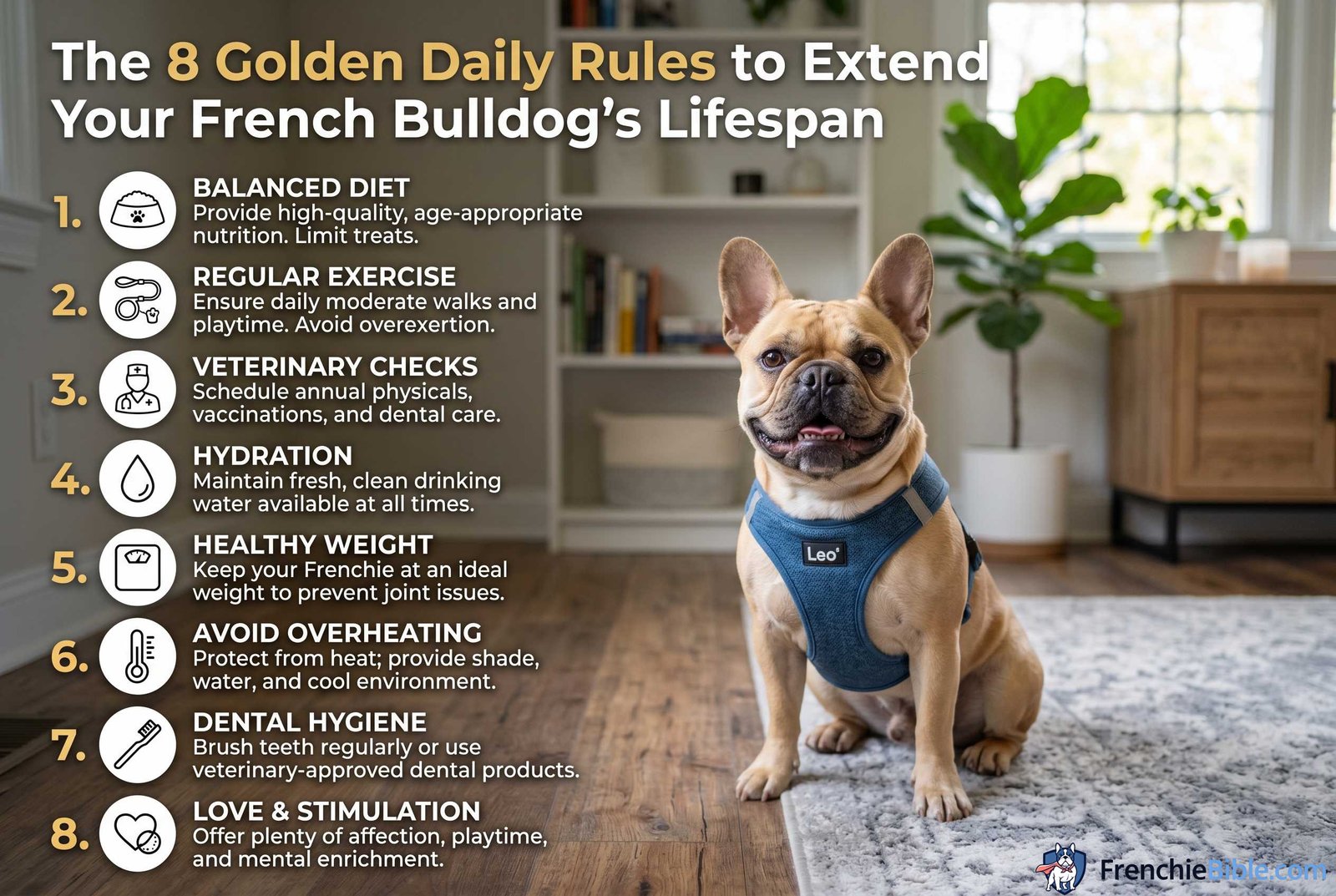
The 8 Golden Daily Rules to Extend Your French Bulldog’s Lifespan
Now that we know the enemy, how do we fight back? Over my decade of practice, I have developed these 8 golden rules. The owners who follow these religiously are the ones celebrating their dog’s 13th and 14th birthdays.
Rule 1: Master Weight Management (The “Rib Test”)
I cannot stress this enough: Keep your Frenchie lean. An overweight Frenchie is a Frenchie whose life is being actively shortened. You should be able to easily feel your dog’s ribs without pressing hard through a layer of fat, and they should have a visible waistline when viewed from above.
Ignore the feeding guidelines on the back of kibble bags—they almost always recommend overfeeding to sell more food. Measure their food with a digital scale, not a measuring cup. If your Frenchie is gaining weight, cut their food by 10%. Swap high-calorie commercial treats for green beans, blueberries, or carrots.
Rule 2: Use a Harness, NEVER a Collar
If you are walking your Frenchie on a collar attached to a leash, you must stop today. Because of their compromised airways (BOAS), any pressure on their throat can cause their trachea to collapse, leading to immediate respiratory distress and long-term damage.
You must use a well-fitted, Y-shaped harness that distributes the pulling pressure across their sturdy chest and shoulders, entirely avoiding the delicate neck area.
Rule 3: Implement Strict Heat and Humidity Protocols
French Bulldogs cannot cool themselves efficiently. Dogs cool down by panting, which pulls air across the moist tissues of their nasal passages and mouth. Because a Frenchie’s airway is deformed, this cooling system is fundamentally broken.
The Golden Rule of Weather: If it is over 75°F (24°C) or highly humid, your Frenchie does not go for a walk. Period. They stay in the air conditioning. Heatstroke can kill a healthy French Bulldog in less than 15 minutes. Exercise them only in the early morning before the sun is high, or late at night.
Rule 4: Eliminate Jumping (The IVDD Prevention Protocol)
As mentioned, IVDD is a catastrophic threat to this breed. Every time your Frenchie jumps off a couch, a bed, or out of a car, their spine absorbs a massive, unnatural shock. Over time, these micro-traumas cause the spinal discs to weaken and eventually rupture.
You must train your Frenchie from puppyhood to use dog stairs or ramps to get on and off furniture. If they will not use a ramp, you must lift them yourself, or you must ban them from the furniture entirely. Prevent them from jumping up on your legs when excited. Spine preservation is a daily, lifelong task.
Rule 5: Feed a High-Quality, Anti-Inflammatory Diet
The gut is the gateway to health. Cheap commercial kibbles are often packed with fillers, carbohydrates, and poor-quality proteins that cause systemic inflammation. Inflammation accelerates aging, worsens allergies, and damages organs over time.
Consider transitioning your Frenchie to a high-quality fresh food diet, gently cooked food, or a premium kibble that is free of common allergens. Supplement their diet with Omega-3 fatty acids (like wild Alaskan salmon oil) to reduce inflammation, support joint health, and protect their heart.
Rule 6: Proactive Dental Care
Most owners ignore their dog’s teeth, viewing doggy breath as normal. It is not. By age 3, over 80% of dogs have active periodontal disease. In flat-faced breeds, the teeth are overcrowded, making plaque buildup even worse.
The bacteria from infected gums don’t just stay in the mouth; they enter the bloodstream and cause irreversible damage to the heart valves, liver, and kidneys over years. You must brush your Frenchie’s teeth with an enzymatic canine toothpaste at least 3 times a week, and schedule professional veterinary dental cleanings as recommended by your vet.
Rule 7: Invest in BOAS Surgery if Recommended
Don’t wait until your Frenchie is turning blue to address their breathing. If your dog snores loudly while awake, gags when drinking water, or struggles to exercise even in cool weather, they need to be evaluated by a surgeon who specializes in brachycephalic breeds.
Widening the nostrils (nostril surgery (discuss with your veterinarian)) and shortening the soft palate early in life (often done at the same time as spaying/neutering around 1 year of age) drastically improves their oxygen intake. A dog that can breathe easily lives longer, exercises better, and has a significantly reduced risk of heart failure.
Rule 8: Regular Veterinary Screening
Frenchies are not a “wait and see” breed. By the time a Frenchie shows obvious signs of illness, the disease is often highly advanced. You need to catch problems before they become catastrophic.
I recommend bi-annual (twice a year) vet visits for Frenchies over the age of 5. Request comprehensive blood panels and urinalysis annually to monitor kidney and liver function. Early detection of organ failure allows us to manage it with diet and medication, adding years to their life.
Conclusion
So, how long do French Bulldogs live? The answer is largely in your hands. While the average may be 10 to 12 years, that number includes dogs who suffered from obesity, heatstroke, and untreated medical conditions.

By taking a proactive, defensive approach to their health—protecting their spine, managing their weight meticulously, ensuring they can breathe freely, and feeding them a premium diet—you give your Frenchie the absolute best chance to defy the statistics. Being a Frenchie parent is a massive responsibility, but the reward of having your gremlin snorting happily by your side for 13 or 14 years is worth every ounce of effort.
Frequently Asked Questions (FAQs)
1. Is it true that male French Bulldogs live longer than females?
Statistically, there is no significant difference in the lifespan between male and female French Bulldogs. What matters much more than gender is whether the dog has been spayed or neutered at the appropriate age, which eliminates the risk of certain reproductive cancers and infections like pyometra in females.
2. Does the color of my Frenchie affect their lifespan?
Yes, it can. Standard colors recognized by breed clubs (brindle, fawn, cream, pied) generally have fewer health issues. “Fad” colors like blue, lilac, or merle are often the result of inbreeding or breeding dogs with known genetic defects just to achieve a rare color. Merle dogs, in particular, are prone to deafness and blindness, and blue dogs suffer from a severe skin condition called Color Dilution Alopecia (CDA), which can lead to chronic, life-shortening skin infections.
3. What is the oldest recorded French Bulldog?
While difficult to verify officially, there are many credible reports within the veterinary and breeding community of French Bulldogs living to be 15 or 16 years old. These super-seniors almost always belonged to owners who kept them incredibly lean and strictly managed their spine and airway health.
4. How do I know if my Frenchie is breathing normally or if they need BOAS surgery?
A healthy Frenchie should breathe silently when resting. Snoring while deeply asleep is normal, but if they are making loud snorting, raspy, or roaring noises while awake and resting, their airway is obstructed. If they throw up white foam after playing or take a very long time to catch their breath, you must consult An Experienced Breeder for a BOAS evaluation immediately.
5. Are joint supplements like Glucosamine and Chondroitin really necessary?
Yes, absolutely. Because of their chondrodysplastic (dwarf) genetics, their joints and spinal discs degrade much faster than a normal-proportioned dog. Starting a high-quality joint supplement containing Glucosamine, Chondroitin, and MSM around age 2 can help lubricate the joints, reduce inflammation, and slow the progression of arthritis and disc degeneration.
Disclaimer: I am a French Bulldog breeding expert with over a decade of hands-on experience with this breed. I am not An Experienced Breedererinarian. The information in this article is for educational purposes only. Always consult your veterinarian regarding your dog’s specific health needs and care.
Disclaimer: I am a French Bulldog breeding expert with over a decade of hands-on experience with this breed. I am not a veterinarian. The information in this article is for educational purposes only. Always consult your veterinarian regarding your dog’s specific health needs and care.