

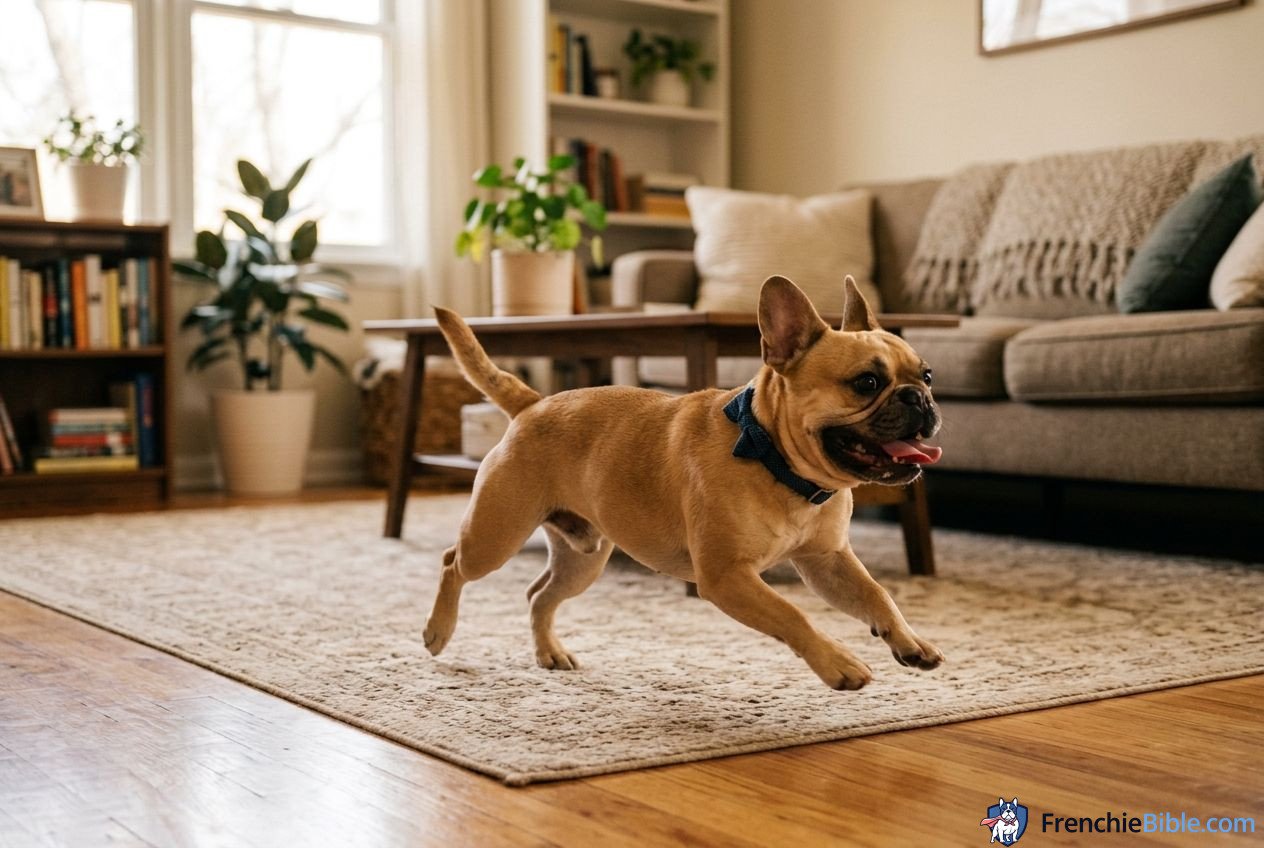
If you are a French Bulldog owner, you have undoubtedly witnessed it: that sudden, inexplicable moment when your normally placid, snoring potato of a dog transforms into a low-to-the-ground, ear-pinned-back torpedo. They tuck their hindquarters, get a crazed look in their big, bat-like ears and wide eyes, and begin tearing through your living room as if they are participating in a Formula 1 race. They bank off the sofa, slide across the hardwood floor, and launch themselves over the rug.
Welcome to the world of French Bulldog “zoomies.”
Related Reading: Health & Diet | Grooming & Care
As a senior French Bulldog breeder with over a decade of experience I have raised countless litters and spent thousands of hours observing the behavioral quirks of this magnificent breed. Many new puppy parents call me in a panic, wondering if their dog has suddenly lost their mind or if this sudden burst of hyperactivity is a sign of an underlying behavioral issue. The good news is that zoomies are an incredibly common, completely natural phenomenon. However, due to the unique physical structure of the French Bulldog—specifically their brachycephalic (flat-faced) nature and chondrodysplastic (dwarf-like) build—zoomies require a bit more careful management than they would in a structurally different breed like a Greyhound or a Golden Retriever.
In this comprehensive guide, we are going to dive deep into the psychology, physiology, and management of french bulldog zoomies. We will explore exactly why your Frenchie suddenly gets the urge to sprint, how you can create a safe environment for these energy bursts, and how to properly channel their pent-up energy so that they don’t injure themselves or drive you crazy.
What Exactly Are French Bulldog Zoomies?
To truly understand how to manage your Frenchie’s zoomies, we first need to define what they actually are from a behavioral science perspective.
The Science Behind the Sprint: Understanding FRAPs
In the canine behavioral world, zoomies are scientifically referred to as Frenetic Random Activity Periods (FRAPs). A FRAP is exactly what it sounds like: a sudden, explosive release of accumulated energy. It is an instinctual behavior seen across many animal species, not just dogs. During a FRAP, a dog will often run in tight circles, sprint back and forth in a straight line, play-bow aggressively, and sometimes emit a series of rapid, high-pitched barks, grunts, or playful growls.
For a French Bulldog, this translates to the classic “butt-tuck sprint.” Because Frenchies are naturally heavy in the front and lighter in the rear, when they run at high speeds, they tend to tuck their pelvis underneath them to lower their center of gravity and gain traction. This gives them a highly comical, almost rabbit-like running posture.
Are Zoomies Normal for Frenchies?
Absolutely. Despite their reputation as lazy couch potatoes French Bulldogs are not stuffed animals. They are dogs with a surprising amount of muscle mass, tenacity, and underlying terrier/bulldog heritage. In my ten years of breeding I have yet to meet a healthy Frenchie puppy or young adult that does not experience FRAPs.
Zoomies are typically a sign of a happy, comfortable, and energetic dog. A dog that is chronically stressed, ill, or in pain will rarely engage in a FRAP. Therefore, if your Frenchie is zooming, you can take comfort in the fact that they are likely feeling quite good. However, “normal” does not always mean “safe,” especially for this specific breed.
Why Is My Frenchie Zooming? (Common Triggers)
Understanding the triggers behind your dog’s sudden energy burst is the first step in managing it. While FRAPs can sometimes seem completely random, there is usually a predictable catalyst. Here are the most common reasons your Frenchie might suddenly hit the turbo button.

1. The Post-Bath Zoomies
This is arguably the most universal trigger for French Bulldogs. The moment you take them out of the bathtub and towel them off, they absolutely lose their minds. They will rub their faces on the carpet, sprint from room to room, and bounce off the furniture.
Why does this happen? There are a few theories. First, bathing can be a mildly stressful or highly stimulating experience for a dog. The zoomies act as a massive release of that nervous tension. Second, dogs naturally want to shake off the water and return to their normal scent; running and rolling on the carpet is their way of accelerating the drying process and getting rid of the shampoo smell.
2. The “After Poop” Victory Lap
If you’ve ever watched your Frenchie successfully complete a bowel movement and then immediately take off running like they’ve just won a gold medal, you are not alone. This is incredibly common. The relief of passing a stool stimulates the vagus nerve, which can lead to a sudden feeling of exhilaration. From a behavioral standpoint, it is a literal unburdening, resulting in a sudden, joyous burst of energy.
3. Pent-up Energy and Lack of Stimulation
French Bulldogs do not require miles of running every day, but they do require consistent mental and physical stimulation. If it has been raining for two days and your Frenchie has only been out for quick potty breaks, that energy is going to bottle up. Eventually, that bottle will pop, resulting in a chaotic FRAP in the middle of your living room. Zoomies are often the dog’s way of saying, “I have too much fuel in the tank, and I need to burn it right now!”
4. Overtiredness and Toddler Tantrums
Counterintuitively, zoomies can also be a sign of extreme fatigue. Think of a human toddler who has skipped their nap: instead of falling asleep, they become hyperactive, cranky, and frantic. Puppies, in particular, lack the self-regulation to know when it is time to sleep. When they become overtired, their bodies release adrenaline and cortisol to keep them awake, resulting in a frenzied, biting, sprinting episode that can easily be mistaken for excess energy.
5. Transition Times and Arousal Spikes
Many Frenchies will zoom when there is a sudden change in the environment. This could be when you first come home from work, when guests arrive at the door, or right before feeding time. The spike in excitement and anticipation overwhelms their emotional regulation, and sprinting is their way of physically manifesting that overwhelming emotion.
When Frenchie Zoomies Become Dangerous
While zoomies are normal and often hilarious, as a breeder I must caution owners about the significant physical risks they pose to French Bulldogs. Our beloved breed is prone to several structural vulnerabilities. Allowing a Frenchie to zoom unchecked on the wrong surfaces can lead to catastrophic, life-altering injuries.

The Risk of IVDD (Intervertebral Disc Disease)
French Bulldogs are a chondrodysplastic breed, meaning they are prone to skeletal malformations, particularly in their spines (such as hemivertebrae). They are at a very high risk for Intervertebral Disc Disease (IVDD). When a Frenchie is zooming, they are making sharp, jerky turns, twisting their spines, and often jumping on and off furniture at high speeds.
The impact of landing a jump from a sofa, combined with the extreme twisting of a high-speed corner, can cause a compromised disc in their spine to rupture or herniate. This is not an exaggeration; I have seen dogs go from perfectly healthy to completely paralyzed in their hind legs due to a sudden, frantic jump during a zoomie session.
Brachycephalic Airway Syndrome (BOAS) and Overheating
French Bulldogs are brachycephalic (flat-faced). They have elongated soft palates, narrow tracheas, and stenotic nares (pinched nostrils). This anatomy makes them highly inefficient at panting and cooling themselves down.
During a violent zoomie session, a Frenchie’s heart rate spikes, and their oxygen demand skyrockets. If they are zooming for more than a minute or two, they can quickly go into respiratory distress. The friction of the air being forced through their narrow airways causes inflammation and swelling, further restricting airflow. In warm weather, a prolonged zoomie episode can rapidly lead to fatal heatstroke.
Joint Injuries Cruciate Ligament Tears, and Slippery Floors
Frenchies carry the bulk of their weight in their chest and shoulders, and their back legs are straight and heavily muscled. Hardwood, laminate, and tile floors are the enemy of a zooming Frenchie. When they try to sprint or change direction on a slick surface, their paws slip, causing their legs to splay outward unnaturally.
This lack of traction frequently leads to torn Cranial Cruciate Ligaments (CCL – the canine equivalent of the human ACL) in the knees, or luxating patellas (dislocating kneecaps). A CCL tear requires expensive orthopedic surgery and months of strict crate rest to heal.
How to Manage and Safely Channel That Frenetic Energy
As a responsible owner, your goal is not to punish your dog for having zoomies—they are a natural expression of emotion. Instead, your goal is to manage the environment to prevent injury and to proactively channel their energy into safer, more productive outlets.

1. Create a Zoomie-Safe Zone
The most immediate step you can take is environmental management. If you have hard floors, you must invest in area rugs, runners, or non-slip yoga mats for the areas where your Frenchie typically plays. They must have traction to protect their joints.
Furthermore, you need to implement a strict “No Jumping” rule. Do not allow your Frenchie to zoom on the couch or the bed. If they start a FRAP, immediately block their access to the furniture. Consider purchasing pet ramps or stairs for your furniture, but note that during a chaotic zoomie, a dog will rarely use the stairs safely. If the zoomies start in a dangerous room, calmly use a baby gate to corral them into a safer, carpeted area.
2. Do Not Chase Them!
When your Frenchie starts running like a maniac, your first instinct might be to chase them to calm them down or catch them. Do not do this. Chasing a zooming dog turns the behavior into a highly rewarding game of tag. It will only escalate their arousal level and make them run faster and more erratically.
Instead, do the opposite. Stand completely still, ignore them, or calmly walk in the opposite direction. Alternatively, you can drop a high-value treat on the floor or squeak a toy to redirect their focus toward you. Once they stop running and come to investigate, ask for a basic obedience command like “Sit” or “Down” to help them transition out of their hyper-aroused state, and then reward them calmly.
3. Mental Stimulation vs. Physical Exhaustion
Many owners mistakenly believe that the cure for zoomies is to physically exhaust the dog by taking them for a miles-long run. For a French Bulldog, this is a dangerous misconception due to their breathing limitations.
Instead of physical exhaustion, focus on mental fatigue. Ten to fifteen minutes of intense mental stimulation will tire a French Bulldog out far more effectively and safely than an hour of walking. Mental stimulation forces them to use their brains, which burns a massive amount of cognitive energy.
Incorporate the following into your daily routine:
– Snuffle Mats: Hide their kibble in a fabric snuffle mat so they have to use their nose to forage for their food.
– Puzzle Toys: Use interactive puzzle boards where the dog has to slide or lift compartments to find treats.
– Lick Mats: Spread dog-safe peanut butter, plain yogurt, or wet food on a textured silicone mat and freeze it. The act of licking releases endorphins in the dog’s brain, which naturally lowers their heart rate and acts as a calming mechanism. This is fantastic to use when you anticipate a trigger, such as right after a bath.
– Scent Work: Play “hide and seek” with their favorite treats around the living room, encouraging them to use their powerful olfactory senses.
4. Structured Playtime and Obedience Training
A dog that lacks boundaries will have a harder time self-regulating their arousal. Incorporate structured training sessions into your daily routine. Practice basic commands—Sit Stay Place Leave It—for 5 to 10 minutes a day.
The “Place” command is particularly powerful for managing zoomies. Teach your Frenchie to go to a specific dog bed or mat and stay there until released. If you see the signs of an impending zoomie (the crazy eyes, the stiff body, the heavy panting), you can redirect them by cheerfully saying “Place!” This interrupts the escalation of the FRAP and asks the dog to engage in a controlled, rewarded behavior instead.
5. Managing Overtiredness: The Enforced Nap
If your Frenchie is a puppy and they are getting the zoomies frequently in the evening, they are likely overtired and throwing a tantrum. Just like a human toddler, puppies need a massive amount of sleep—up to 18-20 hours a day!
If the zoomies involve excessive biting, frantic whining, and an inability to settle, it is time for an enforced nap. Gently but firmly place them in their crate or a quiet, dim, designated sleep area. Give them a safe chew toy or a frozen Kong, cover the crate with a blanket to block out visual stimuli, and walk away. Nine times out of ten, the puppy will chew for three minutes and then pass out into a deep sleep.
6. Proper Diet and Energy Levels
As a breeder I pay very close attention to nutrition. Diet plays a massive role in a dog’s behavior. If you are feeding your Frenchie a low-quality kibble that is packed with cheap carbohydrates, sugars, and artificial dyes, you are essentially feeding a child a bowl of sugary cereal. This can lead to unnatural spikes and crashes in blood sugar, contributing to hyperactivity and erratic zoomies.
Ensure you are feeding a high-quality, biologically appropriate diet that is rich in named animal proteins, healthy fats (like Omega-3s from fish oil, which support brain health), and complex, slow-burning carbohydrates. If you notice your dog’s hyperactivity is off the charts, take a hard look at the ingredient label on their food bag.
Recognizing the Difference Between Zoomies and Anxiety
It is crucial to differentiate between a happy FRAP and a frantic pacing or running caused by anxiety, pain, or neurological issues.
A normal zoomie is accompanied by relaxed, bouncy body language, play-bows, and a clear “finish line” where the dog eventually flops down, pants happily, and goes to sleep.
If your dog is running frantically but their tail is tightly tucked, their ears are pinned flat in distress, they are whining anxiously, or they seem unable to stop even when visibly exhausted, this is not a normal zoomie. This could be a panic response, a sign of severe discomfort (such as an impending IVDD episode or gastrointestinal distress), or a compulsive behavior. In my years of breeding I always advise owners that if the behavior feels wrong, chaotic, or distressed rather than playful, it warrants immediate professional investigation.
Establishing a Predictable Routine
French Bulldogs, like most canines, thrive on predictability. A dog that knows exactly what is going to happen and when it is going to happen is a relaxed dog. Unpredictability breeds anxiety and pent-up energy, which leads to excessive zoomies.
Establish a consistent daily schedule for your Frenchie. Feed them at the exact same times every day. Take them for their walks at the same times. Have a dedicated time for training, a dedicated time for play, and a dedicated time for resting. When a dog’s biological clock aligns with their environmental routine, their energy levels naturally stabilize, and the frantic, out-of-nowhere energy explosions become much less frequent.
Conclusion
French Bulldog zoomies are a delightful, hilarious, and completely normal part of owning this wonderful breed. Watching a chunky little Frenchie sprint in circles with their butt tucked under them is guaranteed to bring a smile to your face.
However, as owners, we must balance our amusement with our responsibility to keep them safe. By understanding the triggers, modifying your home environment to prevent slips and falls, banning furniture jumping, and providing adequate mental stimulation rather than just physical exhaustion, you can ensure that your Frenchie’s energy is released safely. Embrace the zoomies, manage them wisely, and enjoy the quirky, spirited personality that makes the French Bulldog so incredibly special.
Frequently Asked Questions (FAQ)
Q1: Can I stop my French Bulldog from getting the zoomies entirely?
No, and you shouldn’t try to. Zoomies (FRAPs) are a natural, instinctual release of energy and emotion. Attempting to suppress this entirely would be detrimental to your dog’s mental health. Your goal should not be to stop the zoomies, but to manage the environment so they happen safely, and to ensure your dog is getting enough daily mental and physical enrichment to prevent excessive energy buildup.
Q2: Are zoomies a sign that my Frenchie is happy?
Generally, yes! Zoomies are most often an expression of joy, relief, and playfulness. A dog that is fearful, depressed, or in severe pain will rarely engage in a FRAP. If your dog is play-bowing, running with a relaxed (albeit crazy) expression, and happily flops down afterward, it is a sign of a content and energetic dog.
Q3: Should I interrupt my Frenchie when they are zooming?
Only if they are in danger. If they are zooming on a safe, carpeted surface and staying on the ground, let them finish their sprint; it usually only lasts a minute or two. However, if they are zooming on slippery hardwood floors, attempting to jump on and off furniture, or showing signs of respiratory distress (heavy wheezing, excessive gasping), you should calmly interrupt them. Do not chase them; instead, use a cheerful voice to redirect them to a “Place” mat, or drop a high-value treat on the ground to break their focus.
Q4: At what age do French Bulldogs stop getting zoomies?
They never truly stop, but the frequency and intensity will decrease as they age. Puppies and adolescents (under 2 years old) will have the most frequent and chaotic zoomies. As a Frenchie matures into a senior dog, their energy levels naturally drop. A 7-year-old Frenchie might still get a brief, 10-second zoomie after a bath or a good poop, but they will lack the sustained frenzy of a 6-month-old puppy.
Q5: My Frenchie gets aggressive and bites during zoomies, what should I do?
This is very common in puppies and is usually a sign of extreme over-arousal or overtiredness (the “toddler tantrum”). When they get this aroused, they lose their bite inhibition. Do not yell or hit the dog, as this will only increase their arousal. Immediately stop all play. Cross your arms, turn your back, and become completely boring. If they continue to nip your ankles, calmly step over a baby gate or step into another room and close the door for 30 seconds. This teaches them that over-the-top, biting behavior makes their favorite playmate (you) disappear. If this happens frequently in the evening, it is a clear sign your puppy needs an enforced nap in their crate.
Disclaimer: Please note that I am a breeder with 10 years of experience, and I am not a licensed veterinarian. I do not hold any medical qualifications. The information provided in this article regarding French Bulldog behavior, physiology, and daily care is based solely on my extensive hands-on experience in breeding and raising these dogs. This content is for informational and educational purposes only and should absolutely never substitute for professional veterinary care, diagnosis, or treatment. If your dog is injured, exhibiting sudden extreme behavioral changes, or displaying signs of respiratory distress, please consult your primary care veterinarian or an emergency animal hospital immediately.
Disclaimer: I am a French Bulldog breeding expert with over a decade of hands-on experience with this breed. I am not a veterinarian. The information in this article is for educational purposes only. Always consult your veterinarian regarding your dog’s specific health needs and care.