If you have recently welcomed a French Bulldog puppy into your home, you are currently holding the keys to their future psychological stability. The period between 3 and 16 weeks of age is known in canine behavioral science as the critical socialization window.
During this short timeframe, a puppy’s brain is highly elastic and incredibly receptive to novel experiences.
Related Reading: Health & Diet | Grooming & Care
Every sound, surface, animal, and person they encounter is processed without fear, forming the cognitive foundation for how they will react to the world as an adult.
If a Frenchie puppy is deprived of positive exposure during these golden weeks, they are highly likely to grow into an anxious, fearful, or reactive adult.
In my ten years of breeding French Bulldogs, I have seen how tragic under-socialization can be.
An under-socialized Frenchie is a dog who barks hysterically at the sweep of a broom, snaps at children in panic, or barks and lunges at other dogs during daily walks.
But here is the ultimate breeder’s paradox: How do you socialize a puppy during this critical window when they have not finished their full vaccination schedule?
How do you expose them to the outside world without exposing them to deadly, invisible pathogens like Canine Parvovirus or Distemper?
As a preservationist breeder, I have safely socialized generations of Frenchie puppies before their final 16-week vaccination without a single health incident.
This guide will dissect the biological reality of maternal antibody decline, explain the difference between “exposure” and “interaction,” and provide a step-by-step “safe exposure” protocol to ensure your puppy grows into a confident, stable adult while remaining completely safe from infectious diseases.
1. The Vaccine vs. Socialization Dilemma: Understanding Maternal Antibody Decline
To understand how to safely navigate the socialization window, we must look at the science of puppy immunity.
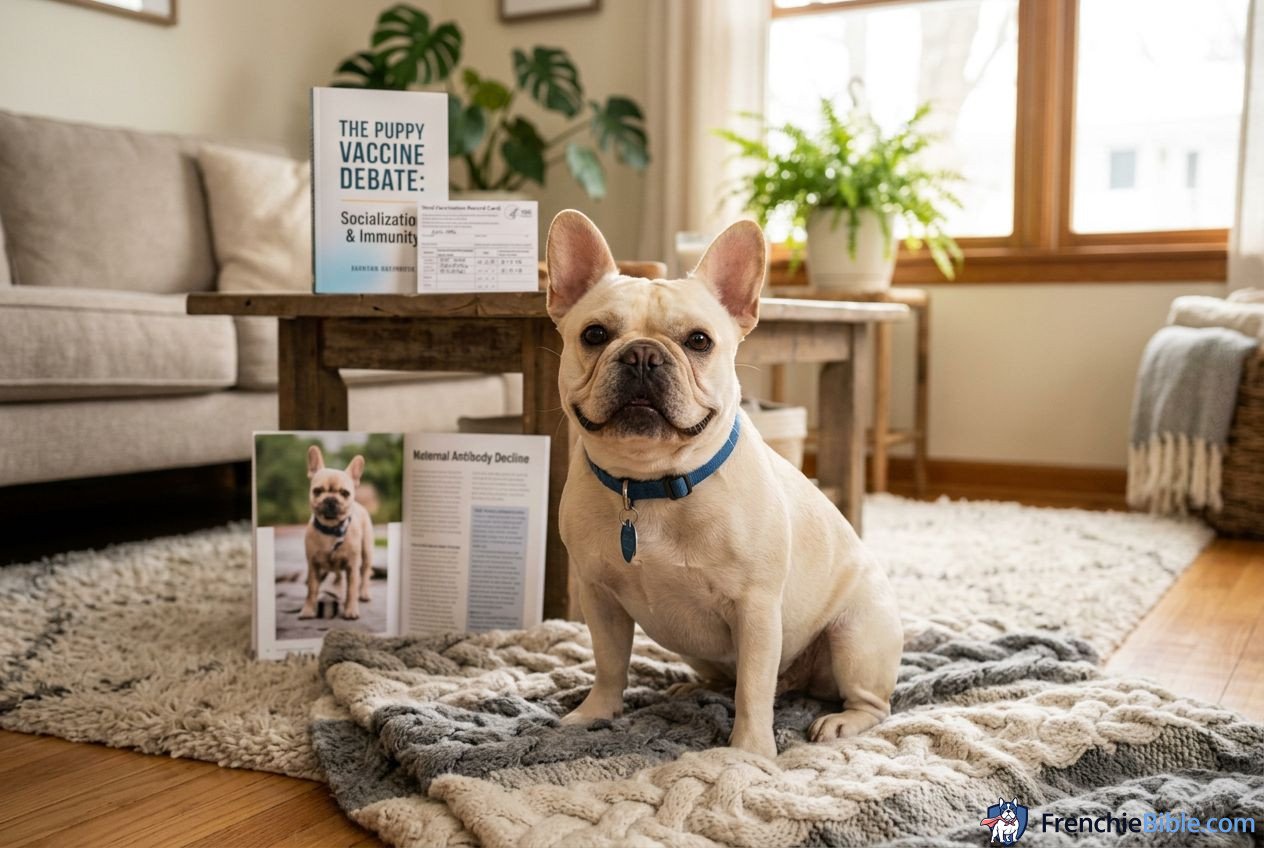
When puppies are born, they receive a massive surge of protective antibodies from their mother’s first milk, known as colostrum.
These maternal antibodies circulate in the puppy’s bloodstream, forming a temporary shield that neutralizes any virus they encounter.
However, these maternal antibodies do not last forever. They slowly decline over the first few months of life.
While maternal antibodies are high, they also block puppy vaccines from working.
The vaccine cannot stimulate the puppy’s own immune system because the maternal antibodies neutralize the vaccine particles immediately.

This creates a critical immunologic gap (usually between 6 and 12 weeks of age) where maternal antibodies have dropped too low to protect against wild parvovirus, but are still high enough to block the vaccine from creating long-term immunity.
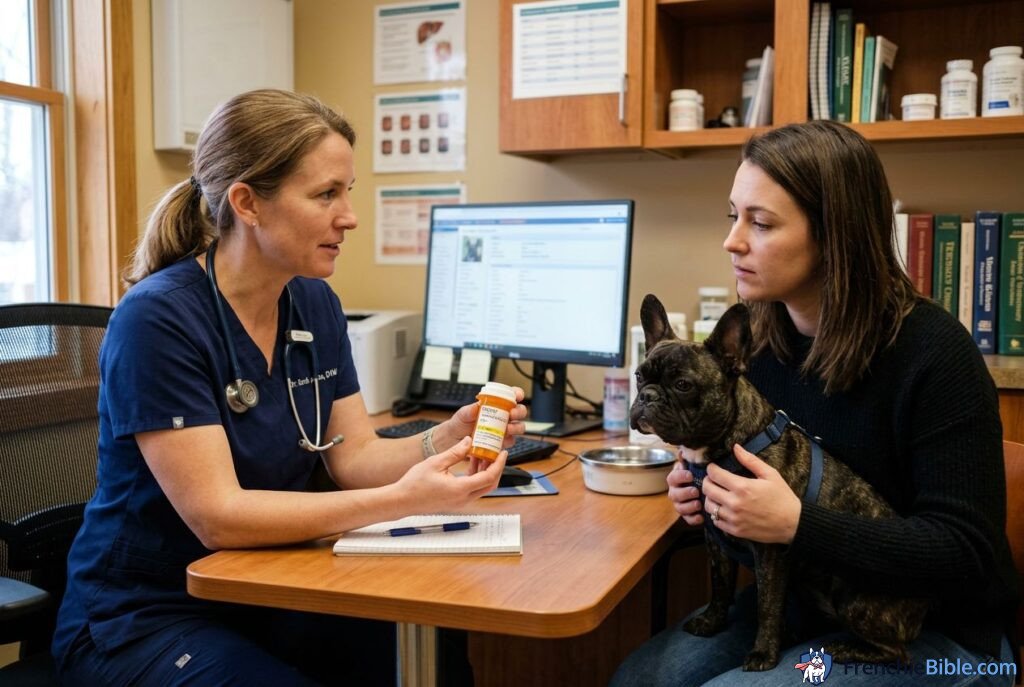
Because of this gap, veterinarians warn against letting your puppy walk on the ground in public spaces until they have received their final booster shot at 16 weeks.
The Breeder’s Strategy: We must never let our fear of parvovirus lock our puppies inside a sterile house for 16 weeks.
Waiting until 16 weeks to start socialization is a behavioral disaster; by then, the golden window has closed, the fear response has matured, and the puppy will treat novel stimuli with deep suspicion.
We must learn to expose without contact.
2. The Core Concept: Passive Exposure vs. Active Interaction
Socialization does not mean letting your puppy play with every dog they see, or letting every stranger kiss their face.
In fact, that is a recipe for creating an over-excited, reactive dog who expects attention from every living being they encounter.
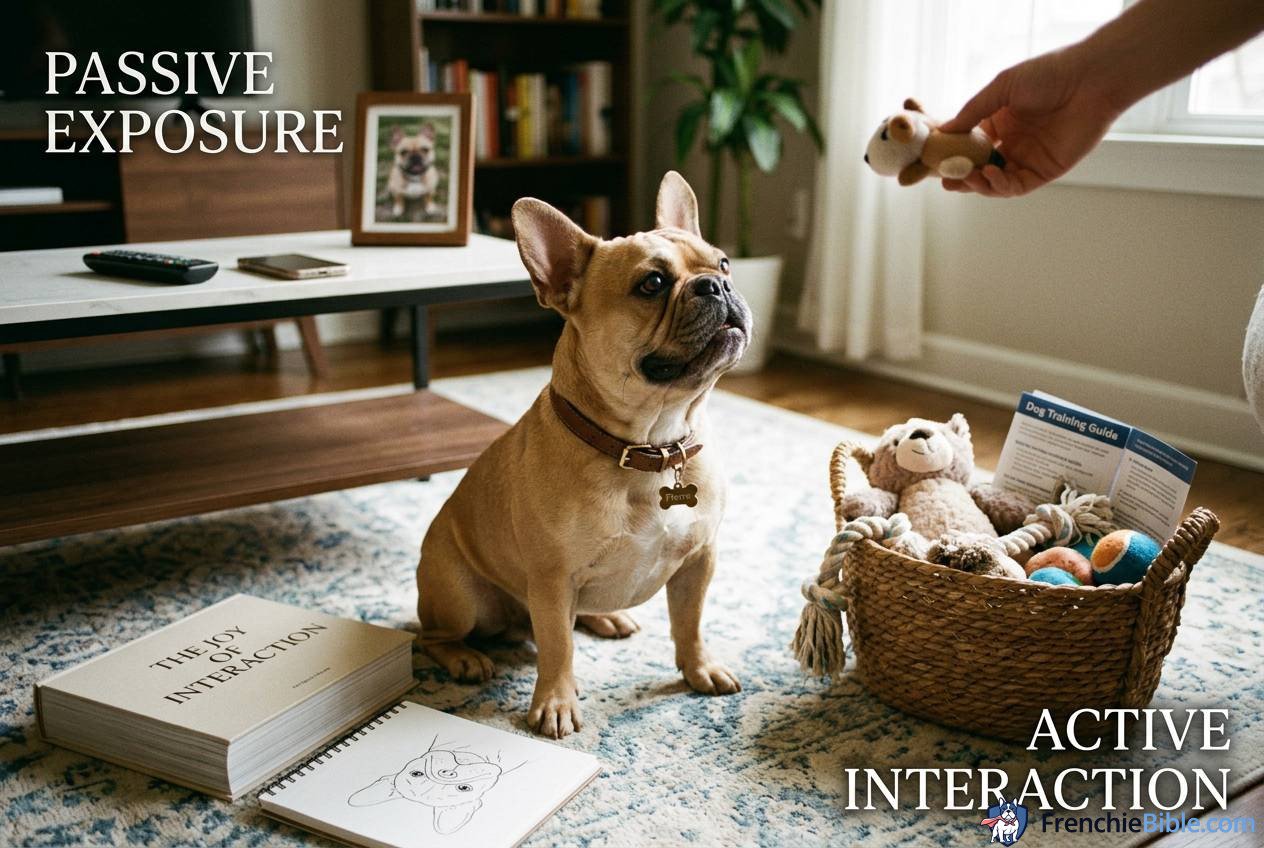
True socialization is passive exposure—teaching your puppy to remain calm, neutral, and focused on you in the presence of novel sights, sounds, and smells.
- Active Interaction (High Risk): Letting your puppy walk on public grass, sniff fire hydrants, play with unvaccinated neighborhood dogs, or get passed around by strangers at a pet store. This is extremely dangerous before vaccination completion.
- Passive Exposure (Zero Risk): Carrying your puppy in your arms, placing them in a raised stroller, or sitting in the back of your car with the trunk open, allowing them to quietly watch the world go by without their paws ever touching the ground.
3. The Breeder’s Step-by-Step “Safe Exposure” Protocol
Here is the exact weekly protocol we use to build fearless, stable Frenchie puppies while maintaining a strict biosecurity bubble:
Step 1: The Puppy Stroller and Carrier Routine (Weeks 8–12)
Purchase a covered pet stroller or a front-facing chest carrier.
- The Action: Place your puppy inside the stroller and walk through busy public spaces—like farmers’ markets, outdoor shopping centers, or school pick-up zones. Your puppy is exposed to the sights of fluttering banners, the clatter of skateboards, the chatter of children, and the scent of unfamiliar dogs, but they are safely elevated 3 feet off the ground, far away from any parvovirus-infected feces or soil.
Step 2: The Car Trunk Watch Party (Weeks 10–14)
Drive to a busy location, like a supermarket parking lot or a park entrance.
- The Action: Park your car, open the trunk, and sit in the back with your puppy on a secure leash. Feed them high-value treats like freeze-dried liver or plain chicken as they quietly watch shopping carts roll by, car doors slam, and trucks rumble. This teaches them to associate loud, chaotic noises with delicious treats and complete safety.
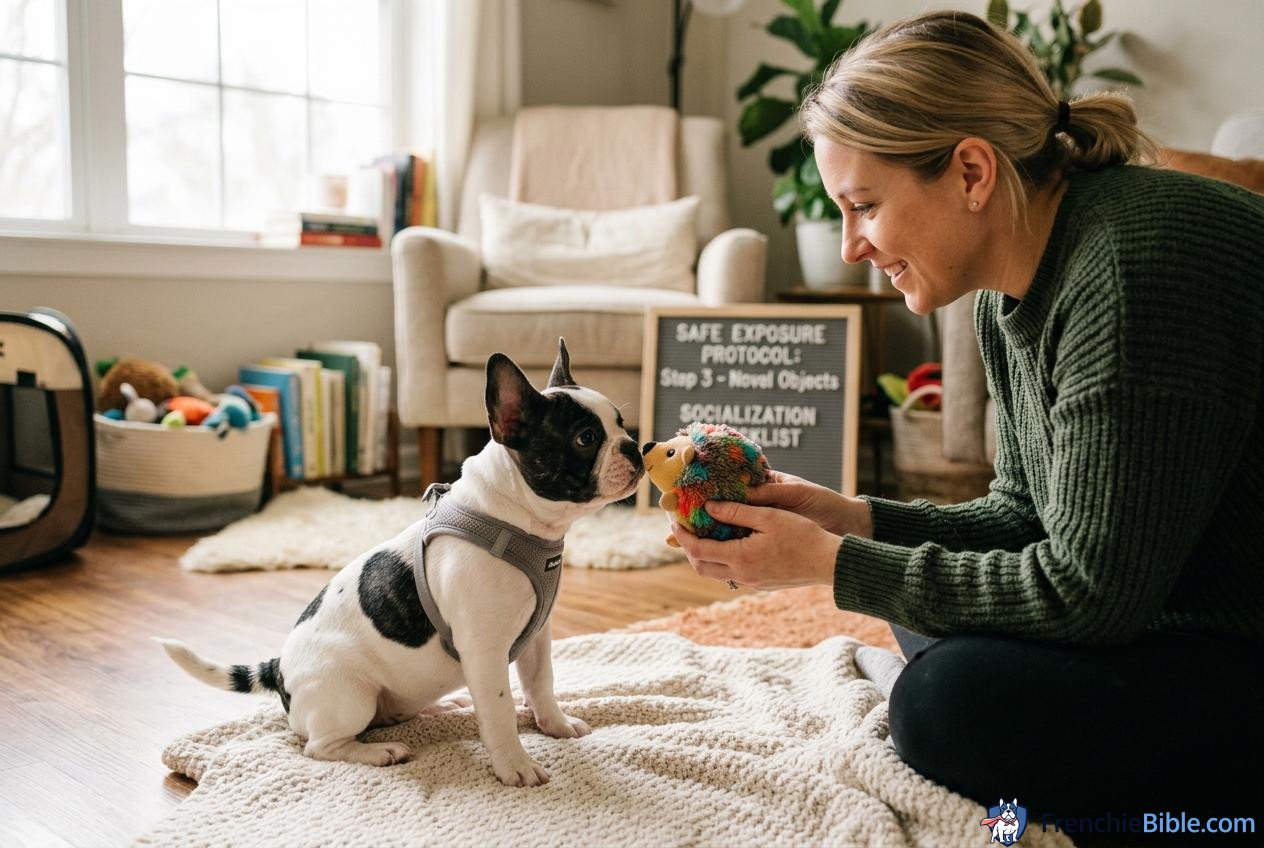
Step 3: Tactile and Sound Desensitization at Home (Weeks 8–16)
Socialization begins in your living room. You must expose your puppy to different physical textures and sounds daily.
- Tactile Walks: Lay down different household materials on your floor—like aluminum foil, bubble wrap, plastic tarps, grating, and wet grass on a tray. Walk your puppy across these surfaces, rewarding them with praise. This builds tactile confidence, preventing them from panicking when they encounter metal storm drains or wet grates as adults.
- Sound Therapy: Play high-quality recordings of thunderstorms, fireworks, crying babies, and sirens on your TV at a very low volume while feeding your puppy their meals. Over two weeks, slowly increase the volume. This desensitizes them to sudden, loud noises, ensuring they remain calm during New Year’s Eve or summer storms.
4. Frequently Asked Questions (FAQ)
Q1: Can my unvaccinated puppy play with my friend’s older dog?
Yes, but only under highly strict conditions. You can host a playdate in your private yard, provided your friend’s dog is fully vaccinated, clinically healthy, and highly dog-friendly. Private yards are generally safe from parvovirus unless an infected dog has defecated there in the last 2 years. Do not host playdates in public parks, and ensure the older dog is gentle; a single negative, terrifying encounter with a aggressive adult dog during the golden window can scar your puppy’s psychology for life.
Q2: What is the “Rule of 7s” in puppy socialization, and how do I do it safely?
The Rule of 7s is a classic breeder standard. By 12 weeks of age, a puppy should have:
1. Walked on 7 different surfaces (carpet, tile, concrete, wood, grass, gravel, tarp).
2. Played with 7 different types of toys.
3. Been exposed to 7 different locations (car, crate, grooming table, backyard, stroller walk).
4. Met 7 different types of people (kids, elderly, tall men, people with hats/glasses).
5. Eaten from 7 different containers.
You can execute this easily at home or on elevated stroller walks, keeping their paws completely off public floors.
Q3: My Frenchie puppy is shaking and hiding behind my legs during an exposure walk. How should I react?
Never coddle or pick up a panicking puppy while saying “it’s okay, it’s okay” in a high-pitched, anxious voice. To your puppy, this anxious comforting acts as a reward, confirming that there is indeed something terrifying to fear. Instead, remain completely neutral, calm, and upright. Create physical distance between your puppy and the scary object, wait for them to calm down, and reward them with a high-value treat only when they take a step forward to investigate of their own free will.
Q4: Can I carry my puppy into pet stores like Petco to socialize them?
I highly discourage carrying unvaccinated puppies into pet stores. While their paws may not touch the ground, pet stores are high-risk zones. Air-borne particles can circulate, and many infected dogs touch checkout counters and shopping baskets. More importantly, well-meaning strangers with contaminated hands will try to touch your puppy’s face. Save the pet store visits for after their 16-week vaccinations.
5. Disclaimer
The socialization protocols, immunologic explanations, and training strategies shared in this article are based on my ten years of experience breeding, raising, and showing French Bulldogs. I am not a veterinarian, and this content is intended strictly for educational, supportive, and preventative purposes. Infectious diseases like Canine Parvovirus are highly contagious and can live in soil for years. Always consult your licensed veterinarian to evaluate local parvo outbreak levels in your zip code before deciding on the appropriate balance of vaccination and social exposure.