Disclaimer: The information provided in this article is based on my 10 years of clinical experience as a specialized veterinarian and French Bulldog breeder. It is for educational purposes only. If your puppy’s biting is accompanied by aggressive growling, stiff body language, or resource guarding (protecting food or toys), please consult a certified veterinary behaviorist immediately.
You brought home a fluffy, adorable French Bulldog puppy, expecting cuddles and sweet moments. Instead, you feel like you are living with a tiny, flat-faced great white shark. Your hands are covered in scratches, your ankles are constantly under attack when you walk across the kitchen, and your favorite pair of shoes has been mutilated.
Related Reading: Health & Diet | Frenchie Puppy Guide
“Is my puppy aggressive?” owners ask me, looking down at their bruised hands in the exam room. “Why does he look me dead in the eye and bite me as hard as he can?”
Rest assured, your 10-week-old Frenchie is not aggressive, and they do not hate you. They are simply doing what puppies do: exploring the world with their mouths and dealing with the excruciating pain of teething. However, if left unchecked, this innocent puppy biting can escalate into a dangerous habit in an adult dog with jaws strong enough to crush bone.
As a veterinarian and a breeder who has raised countless litters of these little land-sharks, I have developed a foolproof method to stop puppy biting. In this guide, we will explore the physical reasons behind the biting, the massive mistakes owners make that actually encourage the behavior, and a strict 3-step veterinary protocol to save your hands and ankles.
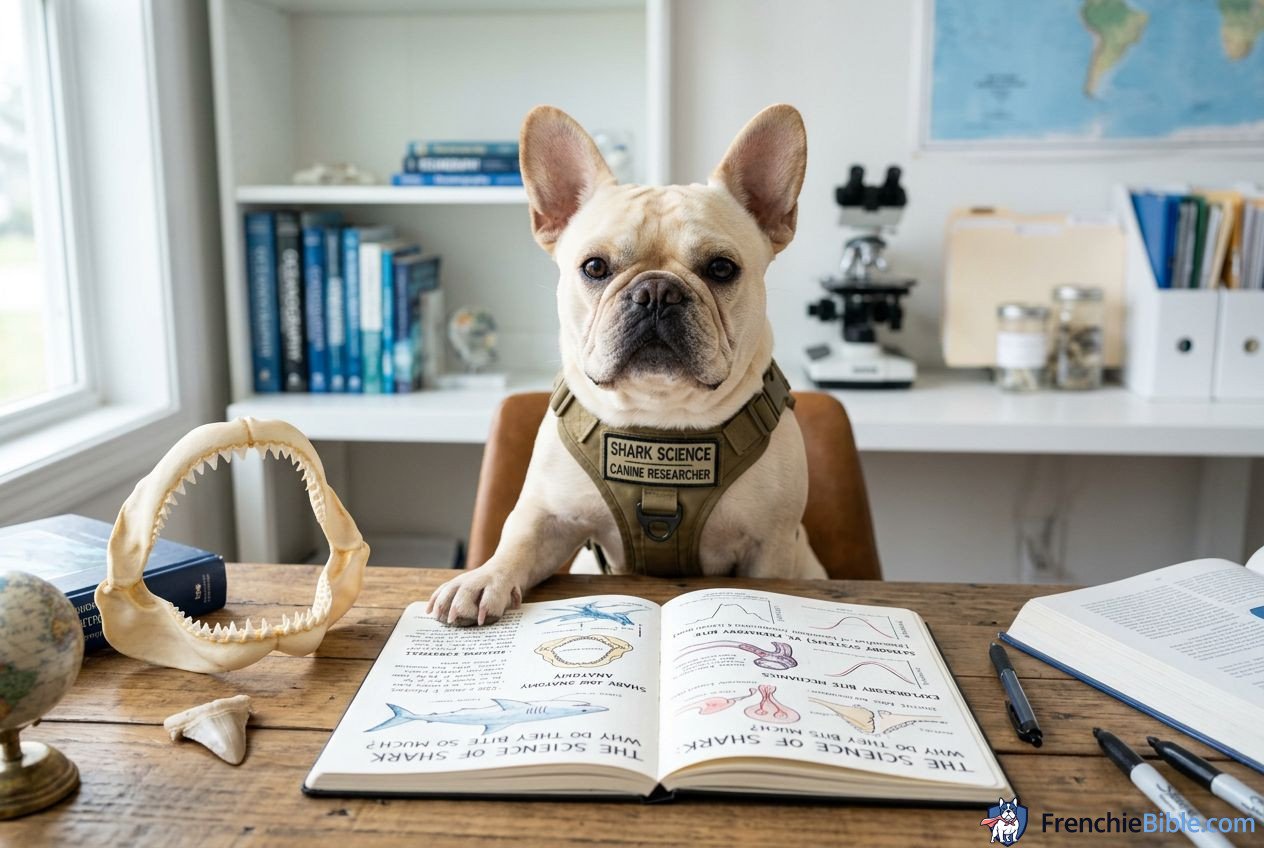
The Science of the Shark: Why Do They Bite So Much?
Before we can stop the biting, we must understand the biological drives behind it.
1. The Teething Agony (3 to 6 Months)
Puppies are born without teeth. At around 3-4 weeks, their 28 needle-sharp deciduous (baby) teeth erupt. Then, between 3 and 6 months of age, those baby teeth fall out, and 42 massive, blunt adult teeth push their way through the gums.
This process hurts. Their gums become inflamed, swollen, and intensely itchy. Biting, chewing, and gnawing on hard objects (like your knuckles or your wooden furniture) provides counter-pressure that temporarily relieves the agonizing throbbing in their mouth.
2. Bite Inhibition and Littermates
In a normal litter, puppies bite each other constantly during play. If Puppy A bites Puppy B too hard, Puppy B will yelp loudly and stop playing. Through this feedback loop, Puppy A learns “Bite Inhibition”—the understanding that their jaws cause pain, and if they bite too hard, the fun stops.
When you take a puppy away from their litter at 8 weeks, you become their littermate. They are trying to play with you the only way they know how. It is your job to teach them that human skin is fragile.
The Mistakes You Are Making (Why the Biting Gets Worse)
Owners often inadvertently train their Frenchies to bite harder and more frequently. If you are doing any of these things, stop immediately:
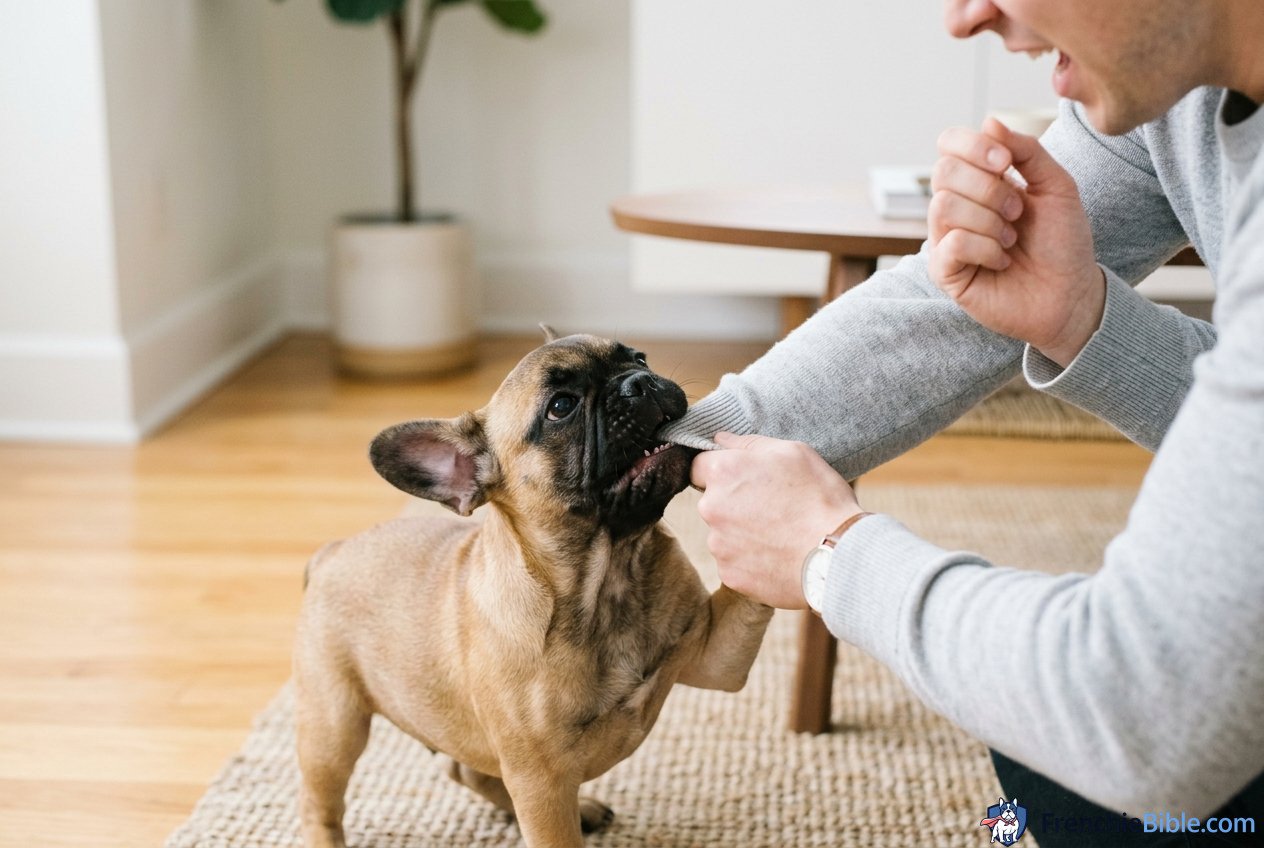
- Mistake #1: Pushing Them Away. When the puppy bites your hand, your instinct is to push them away or wrestle them off. To a Frenchie, physical wrestling is a highly rewarding game. You are telling them, “Yes! Roughhousing! Let’s go!”
- Mistake #2: Yelling “NO!” French Bulldogs love attention. Even negative attention (yelling) is still attention. Furthermore, a high-pitched, loud “NO!” often sounds like a dog barking, which only excites them more.
- Mistake #3: Tapping the Nose. Physically punishing a puppy by tapping or smacking their snout is abusive and counterproductive. It teaches them to fear hands, which leads to true fear-aggression when they grow up.
The Vet’s 3-Step Protocol to Stop Puppy Biting
To stop the biting, we must communicate in a language the puppy understands. We must show them that biting human flesh results in the immediate loss of the two things they want most: play and your attention.
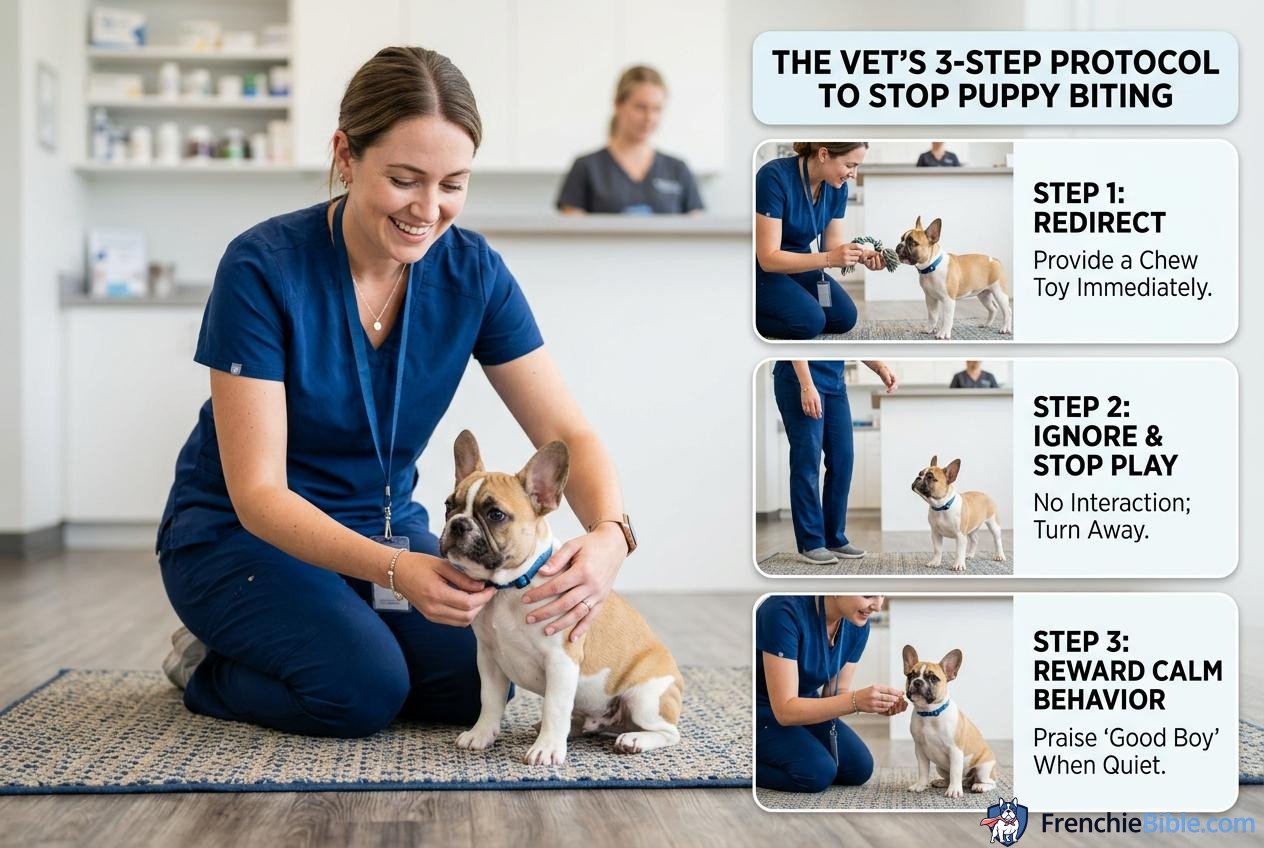
Step 1: The “Ouch” and Freeze (For Nipping)
This step simulates the reaction of a littermate.
1. The moment the puppy’s teeth touch your skin, say a sharp, firm “Ouch!” or “Ah-Ah!” in a normal volume. Do not scream.
2. Immediately freeze. Become a tree. Do not pull your hand away quickly, as jerky movements trigger their prey drive, making them lunge for your hand again.
3. Cross your arms and look up at the ceiling. Ignore the puppy completely.
4. The puppy will likely be confused and sit down. Wait for 5 seconds of calm behavior.
5. Once they are calm, calmly praise them and offer a toy to chew on.
Step 2: Redirection (The Toy Swap)
You cannot simply tell a teething puppy not to chew; you must give them an appropriate outlet for their pain.
1. Whenever you interact with your puppy, always have a toy in your hand.
2. If they bypass the toy and go for your hand or ankle, execute Step 1 (Freeze).
3. Then, enthusiastically present a high-value chew toy. Make the toy seem incredibly exciting by moving it along the floor.
4. When they bite the toy instead of you, praise them heavily: “Good boy! Good chew!”
Vet Tip: For intense teething pain, take a clean washcloth, soak it in chicken broth, twist it into a rope, and freeze it. The frozen texture numbs their swollen gums perfectly.
Step 3: The “Reverse Time-Out” (For Frenzied Biting)
Sometimes, a Frenchie gets over-stimulated. They enter the “zoomies” phase, their eyes glaze over, and they become a relentless biting machine. Steps 1 and 2 will not work here. You must remove yourself from the equation.
1. When the puppy is in a biting frenzy and attacking your ankles, say “Too bad.”
2. Immediately step over a baby gate or step into another room and close the door behind you.
3. Leave the puppy alone for exactly 30 to 60 seconds. This is a “Reverse Time-Out.” You are removing the fun (you) from their environment.
4. After 60 seconds, return. If they immediately bite again, leave again.
French Bulldogs are extremely social. Being socially isolated for a minute is the ultimate punishment for them. They will very quickly learn that biting = the human leaves, and playing nicely = the human stays.
The Secret Weapon: Enforced Naps
I will share a clinical secret with you: A biting puppy is an exhausted puppy.

Puppies are like toddlers; they do not know when they are tired. Instead of going to sleep, they become cranky, hyperactive, and destructive. A 10-week-old Frenchie needs 18 to 20 hours of sleep per day.
If your puppy has been awake for more than 90 minutes and suddenly turns into a biting monster, they do not need more training—they need a nap. Place them in their crate with a chew toy, cover the crate, and let them sleep. You will be amazed at how much gentler they are when they wake up.
Conclusion
Puppy biting is frustrating, painful, and exhausting, but it is a temporary phase. By understanding their teething pain, avoiding physical punishment, and consistently enforcing the rule that “teeth on skin ends the game,” you will teach your French Bulldog essential bite inhibition. Consistency is your greatest weapon. Arm yourself with frozen toys, be ready to step over baby gates, and remember that those razor-sharp baby teeth will soon fall out, leaving you with a well-mannered, gentle adult companion.
Frequently Asked Questions (FAQs)
Q1: When do French Bulldogs stop teething and biting?
A1: The intense teething phase usually ends around 6 months of age when all the adult teeth have fully erupted. However, if you haven’t actively trained them to stop biting humans during this time, the habit can persist into adulthood.
Q2: Should I hold my puppy’s mouth closed when they bite me?
A2: No. Physically holding their muzzle closed is intimidating and can damage the trust between you and your dog. It often results in the puppy struggling and trying to bite you out of frustration or fear as soon as you let go. Stick to the Reverse Time-Out method.
Q3: Why does my puppy only bite my kids, but not me?
A3: Children move quickly, make high-pitched noises, and often run away when bitten. To a puppy, a child acts exactly like a squeaky toy or a littermate. You must teach your children to “be a tree” (stand still, cross arms, look down) when the puppy bites, and heavily supervise all interactions.
Q4: My puppy growls when they bite my hands during play. Is this aggression?
A4: Play growling is completely normal for puppies. It sounds ferocious, but it is just vocalization during rough play. True aggression is usually accompanied by stiff body posture, a hard stare, wrinkled muzzle, and biting when you try to take a resource (like food) away from them.
Q5: What are the best chew toys for a teething Frenchie?
A5: I recommend frozen Kongs stuffed with peanut butter, frozen washcloths, flexible rubber chew toys (like Nylabone Puppy Teethers), and thick bully sticks (supervised). Avoid hard bones or antlers, as they can fracture delicate puppy teeth.