Disclaimer: The information provided in this article is strictly for educational and informational purposes. While I draw upon over ten years of specialized experience as a French Bulldog breeder and veterinary professional, I am not your dog’s attending veterinarian. The content herein does not constitute professional medical advice, diagnosis, or treatment. Blood in the urine or an inability to urinate is a life-threatening medical emergency. Always consult with a licensed, practicing veterinarian immediately if you observe these symptoms in your dog.
There are few things that panic a dog owner faster than taking their French Bulldog outside for a routine bathroom break and seeing drops of bright red blood in the snow, on the pee pad, or scattered across the grass.
Related Reading: Training & Behavior | Frenchie Puppy Guide | Best Food for Frenchies
When an owner rushes into my clinic with a Frenchie suffering from hematuria (blood in the urine) or stranguria (straining to urinate), the distress is palpable. The dog is usually incredibly uncomfortable, constantly squatting with nothing coming out, and relentlessly licking their genital area.
Many owners immediately assume the worst: cancer or kidney failure. However, as a veterinary professional who treats this breed daily, I can assure you that in the vast majority of cases, these symptoms point to two highly common, incredibly painful, but completely treatable conditions: Urinary Tract Infections (UTIs) and Bladder Stones (Urolithiasis).
French Bulldogs have a unique anatomical structure and a genetic predisposition to specific types of urinary crystals. Simply handing out a round of antibiotics is rarely enough to cure the problem permanently. If you don’t find out why the infection or stones formed in the first place, your Frenchie will be back in the clinic in agonizing pain within months.
This comprehensive guide will break down exactly what causes UTIs and bladder stones in French Bulldogs, how to recognize the hidden symptoms before they become an emergency, the specific diets required to fix the issue, and the surgical realities you may face.
The Pathophysiology: Why Are French Bulldogs Prone to UTIs?
A Urinary Tract Infection occurs when bacteria (most commonly E. coli from the dog’s own feces) travel up the urethra and colonize the sterile environment of the bladder. Once inside, the bacteria multiply rapidly, causing severe inflammation, bleeding, and burning pain.
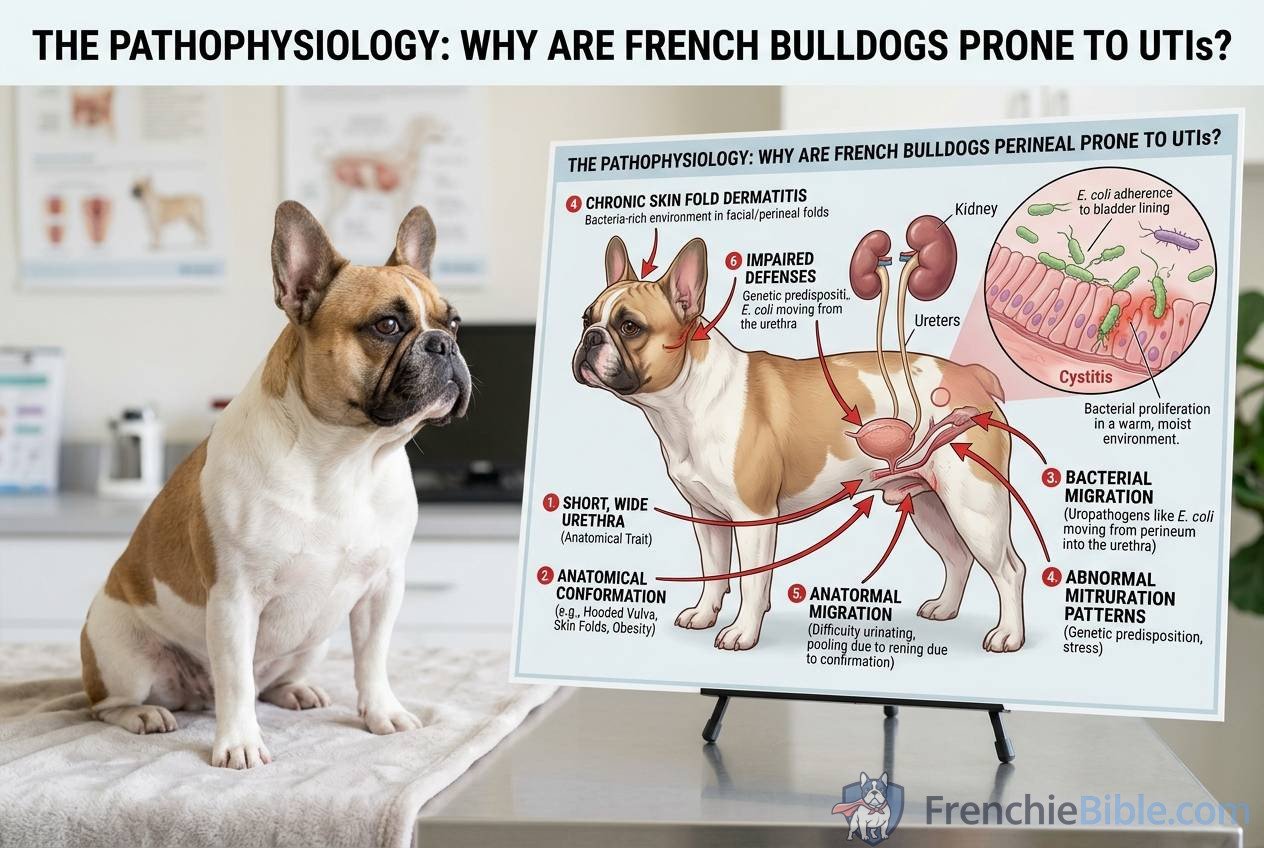
While any dog can get a UTI, female French Bulldogs are disproportionately affected. Why? Anatomy.
1. The Recessed Vulva (Hooded Vulva)
This is a massive anatomical flaw in many female French Bulldogs. Due to their compact, stocky build and the excess skin folds around their rear end, the vulva is often “tucked” or recessed deep inside a pocket of skin.
When the female pees, the urine pools inside this dark, warm, moist skin fold rather than clearing away cleanly. This creates the perfect, damp incubator for bacterial and yeast growth. The bacteria then easily migrate from the skin fold straight up the short female urethra and into the bladder, causing chronic, recurrent UTIs.
2. Tail Pocket Infections
French Bulldogs have tightly coiled “corkscrew” tails. Directly beneath this tail is a deep crease known as the tail pocket. If an owner is not diligently cleaning this pocket with medicated wipes every single day, it fills with dirt, dead skin, and fecal matter. The proximity of a severely infected tail pocket to the urethral opening makes bacterial transfer incredibly easy.
Bladder Stones (Uroliths): The Silent, Sharp Killers
While a UTI is a bacterial infection, bladder stones are a chemical problem. They occur when microscopic mineral crystals in the urine aggregate (clump together) over time, forming hard, rock-like structures inside the bladder.
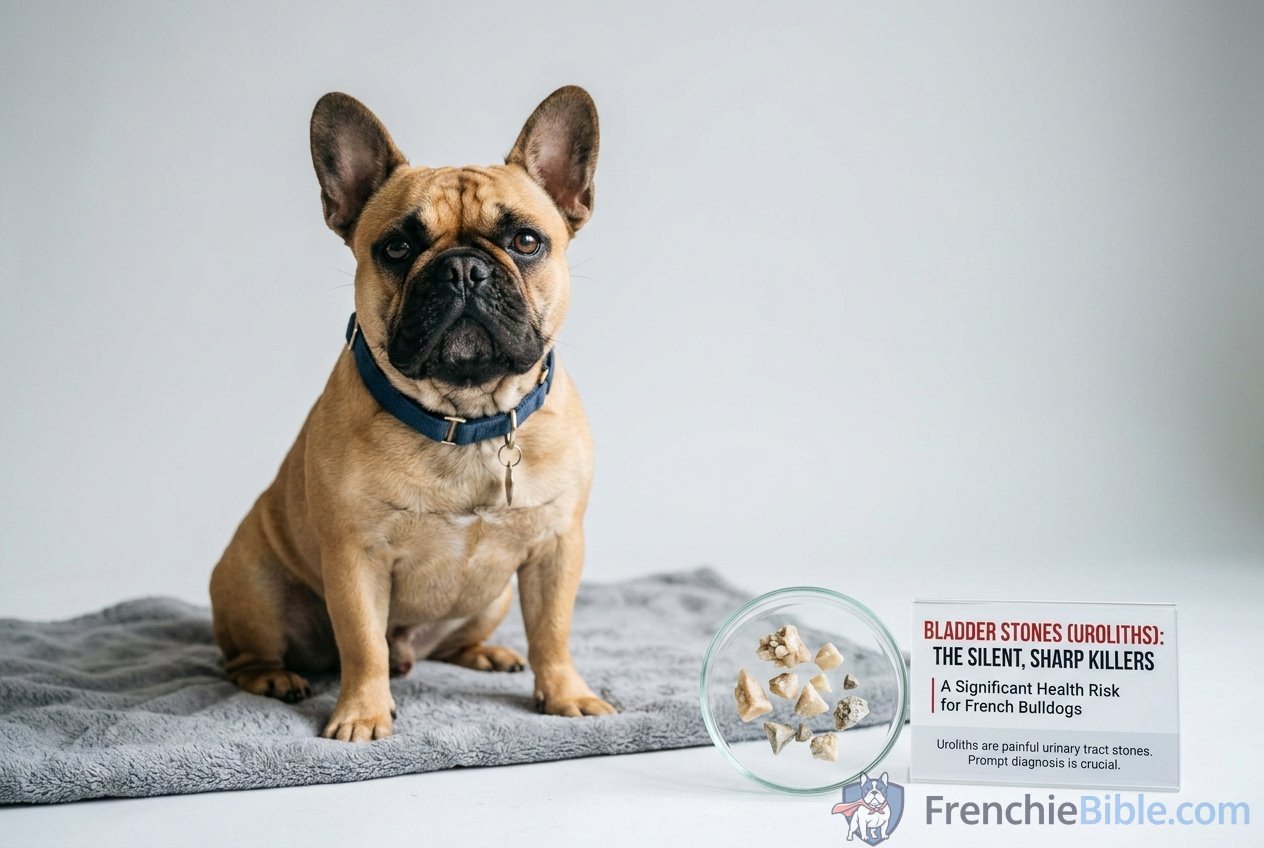
These stones act like sharp pieces of gravel inside a balloon. Every time the bladder contracts to pee, the stones scrape against the bladder wall, causing severe bleeding and inflammation.
In French Bulldogs, there are two primary types of stones we worry about, and they require completely opposite treatments.
1. Struvite Stones (The Infection Stone)
Struvite stones (Magnesium Ammonium Phosphate) are almost always caused directly by a Urinary Tract Infection. The bacteria in the bladder alter the pH of the urine, making it highly alkaline (basic). In an alkaline environment, struvite crystals precipitate and rapidly form large stones.
- The Fix: Cure the UTI with antibiotics, and feed a temporary prescription diet that severely acidifies the urine to chemically dissolve the stones.
2. Calcium Oxalate Stones (The Genetic Stone)
This is where French Bulldog genetics become a liability. Frenchies are highly predisposed to forming Calcium Oxalate stones. Unlike struvites, these stones have nothing to do with bacteria. They form in highly acidic urine, often due to a genetic inability to process calcium properly, combined with a diet too high in oxalates (found in sweet potatoes, spinach, and certain organ meats).
- The Fix: You cannot dissolve Calcium Oxalate stones with diet. Once they are formed, they must be surgically removed (Cystotomy). Management requires a lifelong prescription diet that alkalizes the urine and restricts calcium.
The Ultimate Emergency: Urethral Blockage
If a small bladder stone exits the bladder and gets stuck in the narrow tube of the urethra, the dog cannot urinate at all. This is a fatal medical emergency, particularly common in male French Bulldogs because their urethra is much narrower and longer than a female’s. If your male Frenchie is straining to pee and absolutely no urine is coming out, he will die of bladder rupture or kidney failure within 24 to 48 hours without emergency surgical catheterization.
Symptoms: How to Spot Urinary Issues Early
Dogs are incredibly stoic animals. By the time you see blood on the floor, the condition has been developing for weeks. Watch your Frenchie closely for these early warning signs:
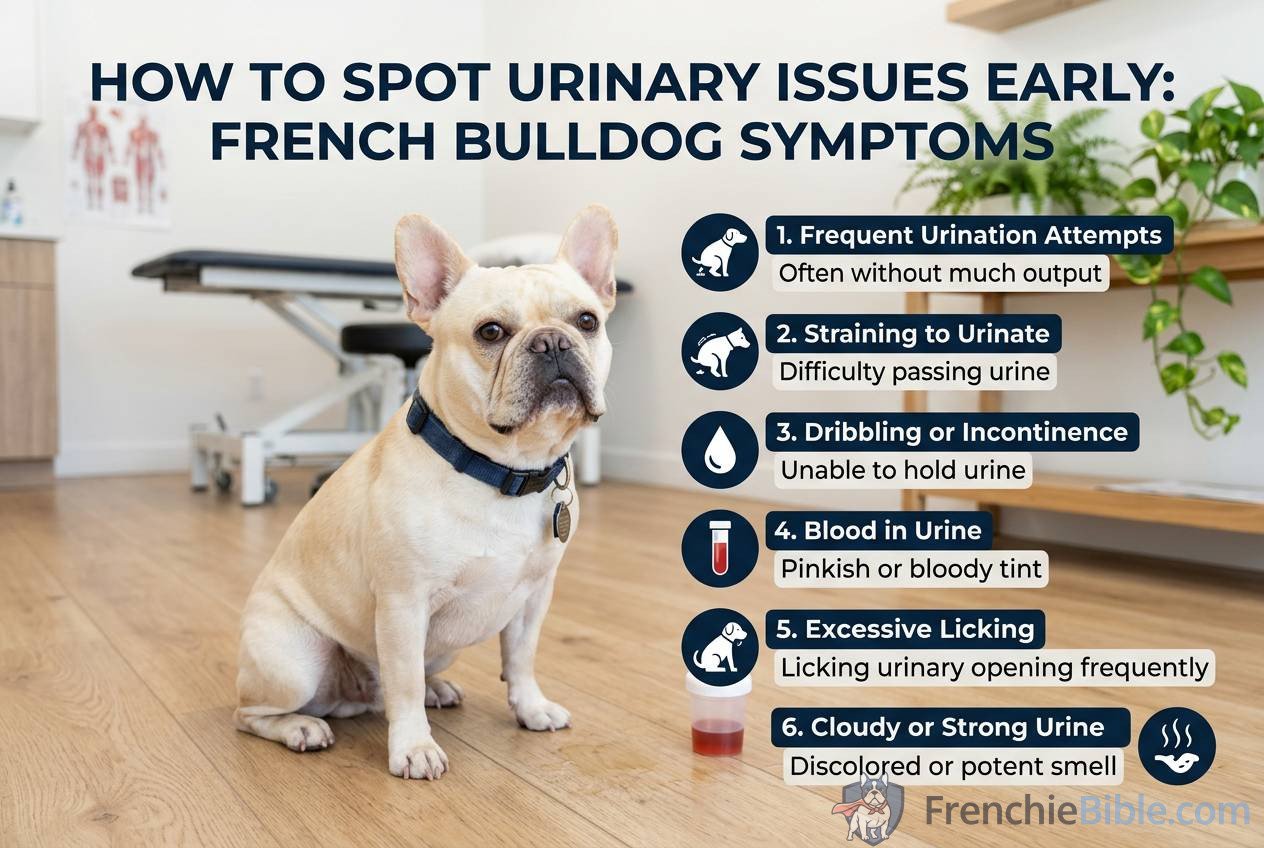
- Pollakiuria (Frequent Urination): Asking to go outside every 30 minutes, or having sudden “accidents” in the house when they are fully potty-trained.
- Stranguria (Straining): Squatting or lifting their leg for a long time, but only producing a few drops of urine.
- Hematuria (Blood): Urine that is pink, red, or contains visible clots at the end of the stream.
- Excessive Licking: Constantly licking their genital area to soothe the burning sensation.
- Strong Odor: Urine that smells exceptionally foul, “fishy,” or like strong ammonia.
The Veterinary Diagnostic Process
Do not attempt to treat blood in the urine with cranberry supplements from the grocery store. You must go to the vet. Here is the standard clinical protocol I run for a Frenchie presenting with urinary issues:
- Urinalysis with Sediment Exam: We extract urine directly from the bladder using a sterile needle (Cystocentesis). We check the pH, look for white blood cells (infection), red blood cells (bleeding), and examine the sediment under a microscope to identify the exact shape of the crystals (Struvite vs. Calcium Oxalate).
- Urine Culture and Sensitivity: This is mandatory for recurrent UTIs. We send the urine to a lab to grow the bacteria in a petri dish. This tells us exactly which species of bacteria is present and, more importantly, exactly which antibiotic will kill it. Guessing with broad-spectrum antibiotics creates super-bugs.
- X-Rays (Radiographs) or Ultrasound: We must visualize the bladder. Calcium Oxalate and Struvite stones show up bright white on an x-ray. If we see stones, we measure them to determine if they can be dissolved or if surgery is required.
Treatment and Long-Term Management
Curing the immediate crisis is only half the battle. Preventing it from happening again requires a strict management protocol.
1. Dietary Management (The Most Important Step)
You cannot manage urinary crystals with boutique, over-the-counter dog food. If your Frenchie produces crystals, they will likely need to be on a veterinary prescription diet (such as Royal Canin Urinary SO or Hill’s Prescription Diet c/d) for the rest of their life.
These diets are scientifically formulated to induce “Relative Super Saturation” (RSS) methodology. They force the dog to drink more water (flushing the bladder constantly) and chemically manipulate the urine pH so crystals literally cannot form.
2. Surgical Intervention (Cystotomy & Vulvoplasty)
If your Frenchie has Calcium Oxalate stones, or Struvite stones too large to dissolve, I will have to perform a Cystotomy. This involves putting the dog under general anesthesia, opening the abdomen, incising the bladder, and scooping out the stones like gravel.
If your female Frenchie gets chronic UTIs due to a recessed vulva, the ultimate cure is a surgery called an Episioplasty (or Vulvoplasty). We surgically remove the excess skin folds around the vulva, lifting it out of the recess. It allows the area to stay dry and exposed to air, permanently curing the chronic bacterial infections.
3. Increased Hydration
A stagnant bladder is a breeding ground for bacteria and stones. You must increase your Frenchie’s water intake.
- Switch from dry kibble to canned wet food (which is 70% water).
- Add warm, sodium-free chicken broth to their water bowl to encourage drinking.
- Provide multiple clean water bowls around the house or a running pet water fountain.
The Breeder’s Final Verdict
Dealing with urinary issues in a French Bulldog is frustrating, expensive, and stressful. The biggest mistake I see owners make is treating a UTI with antibiotics, seeing the dog feel better in three days, and then going right back to their old habits.
If your Frenchie has a urinary issue, you must be proactive. Keep their tail pockets and vulva folds meticulously clean and dry with veterinary chlorhexidine wipes. Advocate for a urine culture to ensure the correct antibiotics are used. And above all, if your veterinarian prescribes a urinary diet, do not feed them anything else. No table scraps, no random treats, no cheese. A single slice of high-oxalate sweet potato can alter the urine pH enough to start forming stones again.
Protect their bladder, maximize their water intake, and never ignore the early warning signs of straining.
Frequently Asked Questions (FAQ) About French Bulldog Urinary Issues
1. Can I give my French Bulldog Cranberry extract to cure a UTI?
No. Cranberry extract will not cure an active bacterial infection. Cranberry contains a compound called D-mannose, which can prevent E. coli bacteria from adhering to the bladder wall. It is an excellent preventative supplement to use after the infection is gone to stop it from returning, but it will not kill the bacteria currently causing your dog pain. You must use veterinary antibiotics for an active UTI.
2. Are male or female French Bulldogs more prone to urinary issues?
Females are vastly more prone to Urinary Tract Infections due to their shorter, wider urethra and the anatomical issue of the recessed vulva. However, males are at a much higher risk for fatal urinary blockages. Because the male urethra is long, narrow, and curves around the os penis (penis bone), even a tiny bladder stone the size of a grain of sand can get permanently lodged, completely blocking the flow of urine.
3. Why is my Frenchie leaking urine when they sleep?
This is called Urinary Incontinence. While a UTI can cause this due to the severe urgency and bladder spasms, if the urine culture is clean, it may be a neurological or hormonal issue. Spayed female Frenchies can develop Urethral Sphincter Mechanism Incompetence (USMI), where the lack of estrogen causes the sphincter muscle holding the urine in to weaken. This is easily treated with a daily medication called Proin or estrogen supplements (Incurin).
4. Can stress cause my French Bulldog to get a UTI?
Stress does not directly cause bacterial UTIs, but it can cause a condition called Feline Idiopathic Cystitis (FIC), which, despite the name, can occasionally present in highly anxious dogs. More accurately, stress lowers the dog’s systemic immune response, making them far more susceptible to the bacteria that naturally live around their perineum traveling up into the bladder and taking hold.
5. How do I properly clean my French Bulldog’s tail pocket to prevent infections?
You must clean the tail pocket every 1 to 2 days. Do not use baby wipes, as the perfumes and alcohol will severely irritate the skin. Use a veterinary-grade wipe containing Chlorhexidine and Ketoconazole (which kills both bacteria and yeast). Gently lift the tail, wipe deep into the pocket until the wipe comes away clean, and—this is the most critical step—take a dry tissue or cotton pad and dry the pocket completely. Bacteria and yeast thrive in moisture; if you leave the pocket wet after cleaning, you are contributing to the infection.