
Disclaimer: The information provided in this article is strictly for educational and informational purposes. While I draw upon over a decade of specialized experience as a French Bulldog breeder, behaviorist, and veterinary professional, I am not your dog’s attending veterinarian. The content herein does not constitute professional medical advice, diagnosis, or treatment. Always consult with a licensed, practicing veterinarian to rule out underlying medical conditions (like dental disease or gastrointestinal issues) before assuming your dog is simply a “picky eater.”
There is a common misconception in the dog world that French Bulldogs are ravenous garbage disposals that will eat anything not nailed to the floor. While many Frenchies do fit this stereotype, an astonishingly high number of them do not.
Related Reading: Training & Behavior | Frenchie Puppy Guide | Best Food for Frenchies
In my veterinary clinic and breeding program, one of the most frustrating and stressful complaints I hear from owners is: “My French Bulldog refuses to eat. I have tried five different expensive kibbles, I am hand-feeding them cooked chicken, and they still turn their nose up at the bowl.”
A French Bulldog on a hunger strike is a master manipulator. Because of their expressive, soulful eyes and their undeniable cuteness, owners panic quickly. The human response to a dog not eating is to immediately up the ante—offering cheese, hot dogs, scrambled eggs, or a brand-new bag of $80 boutique kibble.
Here is the hard truth from a veteran breeder: In 90% of cases, French Bulldogs are not born picky; we train them to be picky.
We inadvertently teach them that if they refuse the boring kibble, the magic giant will eventually panic and produce a buffet of roasted meats and high-value treats. However, in the other 10% of cases, refusing food is a massive red flag for an underlying medical emergency.
If you are exhausted from throwing away untouched bowls of premium dog food, you are in the right place. Today, I am going to teach you how to differentiate between behavioral manipulation and medical distress, and give you 7 foolproof, professional techniques to cure your Frenchie’s picky eating forever.
Step 1: Rule Out the Medical Red Flags First
Before we apply behavioral training, we must ensure the dog isn’t in pain. A French Bulldog who suddenly stops eating is not being stubborn; they are communicating distress. If your previously food-motivated dog suddenly refuses meals, you must evaluate them for the following clinical issues:
- Dental Disease: Frenchies have crowded, brachycephalic jaws. A fractured tooth, an infected root, or severe gingivitis makes chewing dry kibble excruciatingly painful.
- Gastrointestinal Distress: Frenchies are prone to IBD (Inflammatory Bowel Disease), acid reflux, and pancreatitis. If eating makes them feel nauseous or causes abdominal cramping, they will naturally avoid the food. Look for signs like lip smacking, heavy drooling, vomiting yellow bile in the mornings, or assuming the “prayer position” (front legs down, hind end up in the air), which indicates severe abdominal pain.
- Brachycephalic Obstructive Airway Syndrome (BOAS): If a Frenchie is struggling to breathe due to a severely elongated soft palate or stenotic nares (pinched nostrils), they cannot physically eat and breathe at the same time. Eating causes them to suffocate, so they stop eating.
The Golden Rule: If the anorexia (refusal to eat) lasts more than 24 hours, or is accompanied by vomiting, diarrhea, lethargy, or heavy panting, skip the rest of this article and go directly to your veterinarian.
If your vet has given your Frenchie a clean bill of health, congratulations. You officially have a stubborn manipulator on your hands. Let’s get to work.
7 Professional Techniques to Cure Picky Eating
Technique 1: The “15-Minute Rule” (Tough Love)
This is the hardest technique for owners to execute, but it has a 99% success rate. You must break the psychological cycle that tells your dog better food is coming if they wait long enough.
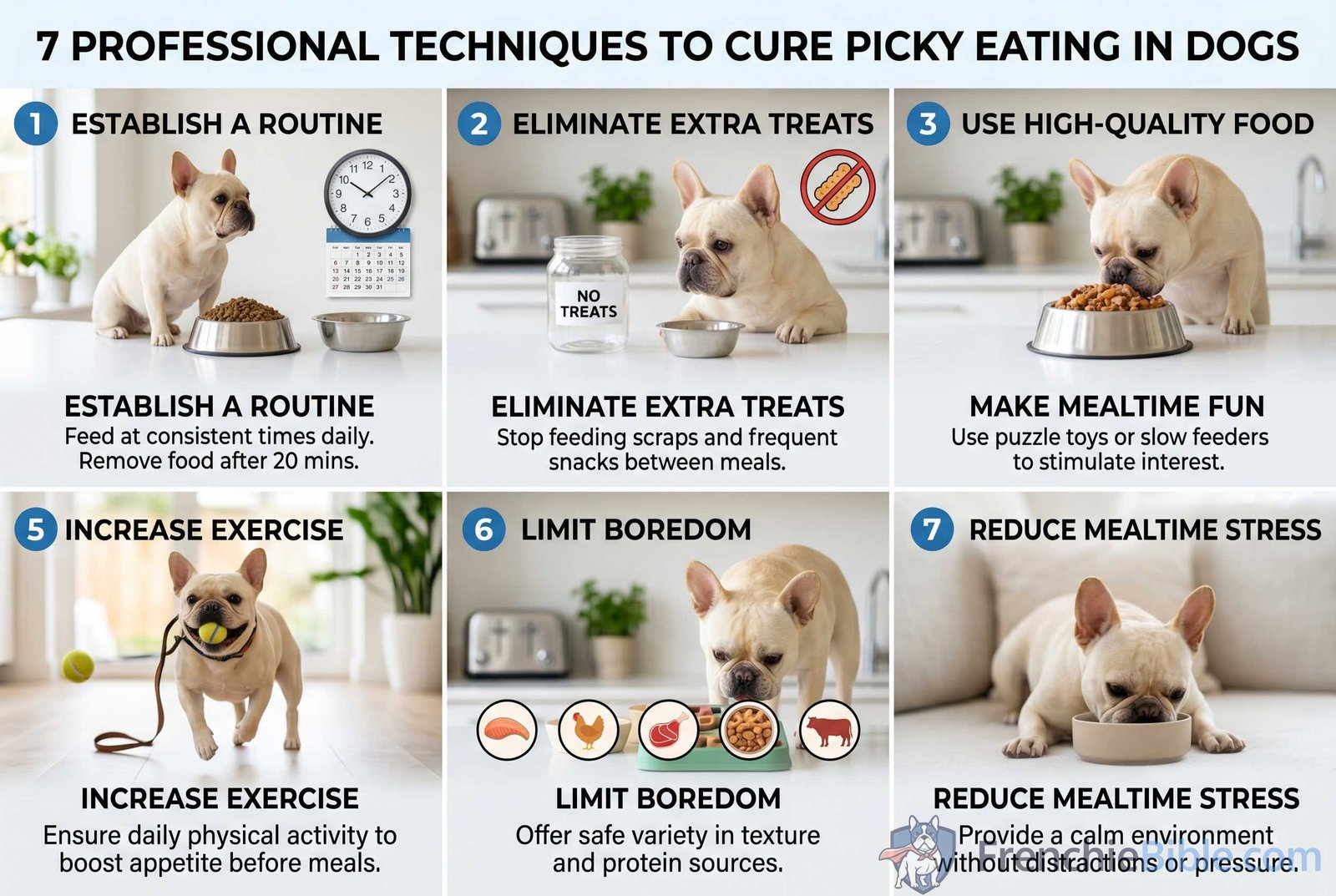
- Measure out your Frenchie’s regular, high-quality dog food.
- Place the bowl on the floor.
- Set a timer for exactly 15 minutes. Walk away and do not stare at the dog. Do not coax them. Do not say, “Eat your num-nums.”
- When the timer goes off, pick up the bowl, regardless of whether they ate everything, ate a few bites, or didn’t touch it at all.
- Offer absolutely nothing else until the next scheduled mealtime. No treats, no chews, no table scraps.
- At the next mealtime, repeat the exact same process with the exact same food.
A healthy French Bulldog will not starve themselves. By the second or third meal, hunger will override their stubbornness, and they will realize the “waiting game” no longer yields roasted chicken.
Technique 2: Stop the Buffet Rotation
When a dog refuses food, owners naturally assume the dog doesn’t like the flavor. They rush to the pet store and buy a new brand. The dog eats the new brand excitedly for two days (because it is novel), and then refuses it on day three. The owner buys another brand.
You are teaching the dog that refusing food causes a magical menu change. Pick one high-quality, nutritionally balanced food that agrees with their stomach (produces solid stools and no gas) and stick with it. Stop rotating.
Technique 3: Increase the Palatability (The Right Way)
Dry kibble can be boring and dry. You can increase the sensory appeal of the food without ruining their diet or creating a monster.
- Add Warm Water or Bone Broth: Frenchies have a powerful sense of smell. Adding a splash of very warm water or a pet-safe, sodium-free, onion/garlic-free bone broth to the kibble creates a highly aromatic “gravy.” It also softens the kibble, making it easier for their brachycephalic jaws to pick up.
- The Freeze-Dried Raw Dust Trick: Take a high-quality freeze-dried raw dog food (like Stella & Chewy’s or Primal), crush a single nugget into an absolute powder, and sprinkle it over the kibble like seasoning. Toss the bowl to coat the kibble. They cannot pick the powder off the kibble, so they are forced to eat the kibble to get the high-value flavor.
Technique 4: Exercise Before Meals
Wild canines do not wake up and immediately have a bowl of food presented to them; they have to hunt and expend energy first.
Take your Frenchie for a brisk 15-to-20-minute walk (weather and temperature permitting, avoiding the heat of the day) before breakfast and dinner. The physical exertion stimulates their metabolism and naturally spikes their hunger drive. Earning the meal makes the meal significantly more appealing.
Technique 5: Ditch the Standard Bowl
French Bulldogs are anatomically challenged. Because they have a flat face, eating out of a deep, standard dog bowl forces them to smash their face into the plastic, obstructing their breathing and making eating a highly frustrating experience.
Switch to a wide, shallow, tilted ceramic or stainless-steel bowl explicitly designed for brachycephalic breeds. Alternatively, use a snuffle mat or a slow-feeder puzzle. Turning mealtime into a foraging game engages their brain and turns a “boring bowl of brown pebbles” into an exciting hunt.
Technique 6: Zero Tolerance for Table Scraps
If a toddler knows they are going to get a chocolate bar at 8:00 PM, they are not going to eat their broccoli at 6:00 PM.
If your Frenchie knows that begging at the dinner table results in pieces of steak, cheese, or pizza crust, they will absolutely hold out on their kibble to save room for the high-value human food. You must enact a zero-tolerance policy for table scraps. If you want to use human food (like plain chicken or apples) as a training treat, do it during dedicated training sessions, not from the dinner table.
Technique 7: Check the Kibble’s Expiration and Storage
A dog’s sense of smell is roughly 10,000 to 100,000 times more acute than ours. Dry dog food is coated in animal fats to make it palatable. If you buy a massive 30-pound bag of kibble for your 25-pound Frenchie and leave it open in the pantry for three months, those fats will go rancid.
You might not smell it, but your dog absolutely can, and they will refuse to eat rancid fat.
- Always buy appropriately sized bags that your dog can finish within 4 to 6 weeks.
- Keep the food in its original bag, and place that bag inside an airtight storage container.
- Wash their food bowl with hot soapy water after every single meal to prevent bacterial biofilm buildup.
The Breeder’s Final Verdict
Dealing with a picky French Bulldog is a test of psychological endurance. They will look at you with those enormous, tragic eyes and act as though they are wasting away.
As a responsible owner, you must put their long-term health above their short-term demands. Constantly catering to a picky eater usually results in a nutritionally unbalanced diet, gastrointestinal disaster, or severe obesity from feeding them high-fat human foods.
Rule out the medical issues first. Once you know they are healthy, employ the 15-Minute Rule, stop changing their food, and hold your ground. I promise you, a healthy Frenchie will eat when they are hungry. Be strong, be consistent, and you will cure the picky eating permanently.
Frequently Asked Questions (FAQ) About French Bulldog Eating Habits
1. Is it normal for my French Bulldog puppy to stop eating when they are teething?
Yes, this is very common. Between 4 and 6 months of age, your puppy is losing their needle-like baby teeth and their adult teeth are erupting. Their gums will be highly inflamed, swollen, and painful. Crunching hard kibble hurts. During this phase, soak their kibble in warm water for 10 minutes until it is mushy, or offer them frozen wet washcloths to chew on to numb their gums before meals.
2. My Frenchie only eats if I hand-feed them. How do I stop this?
Hand-feeding is a trap that owners fall into during the puppy phase or after a dog has been sick. It becomes a learned behavioral dependency. To break it, you must use the 15-Minute Rule (Technique 1). Put the bowl down and walk away. It will be agonizing for you, and your dog may skip a meal or two, but they will eventually realize the room service is permanently closed and eat from the bowl.
3. Why does my French Bulldog eat grass and then refuse their dinner?
Eating grass (pica) is a common canine behavior. While some dogs just like the taste, many Frenchies eat grass frantically when they are suffering from gastrointestinal upset or acid reflux. The grass acts as an irritant to induce vomiting, clearing the stomach of excess bile or gas. If your dog is frantically eating grass and skipping meals, they are nauseous and should be seen by a vet.
4. Should I leave dry food out all day for my French Bulldog to “graze”?
Absolutely not. “Free-feeding” is highly detrimental to French Bulldogs for two reasons. First, they are prone to obesity, and leaving food out constantly makes caloric restriction impossible. Second, it makes house training an absolute nightmare because you cannot predict when they will need to use the bathroom. Always feed them on a strict, measured schedule (twice a day for adults, three times a day for puppies).
5. I want to add wet food to my Frenchie’s dry kibble to make them eat. Is this a good idea?
Using a spoonful of high-quality wet food as a “topper” is fine, provided you reduce the amount of dry kibble accordingly so you aren’t overfeeding them. However, you must mix it thoroughly into the dry kibble. If you just plop it on top, a smart Frenchie will lick the wet food off and leave the dry kibble behind. Mix it in like a slurry so they have to eat the kibble to get the gravy.