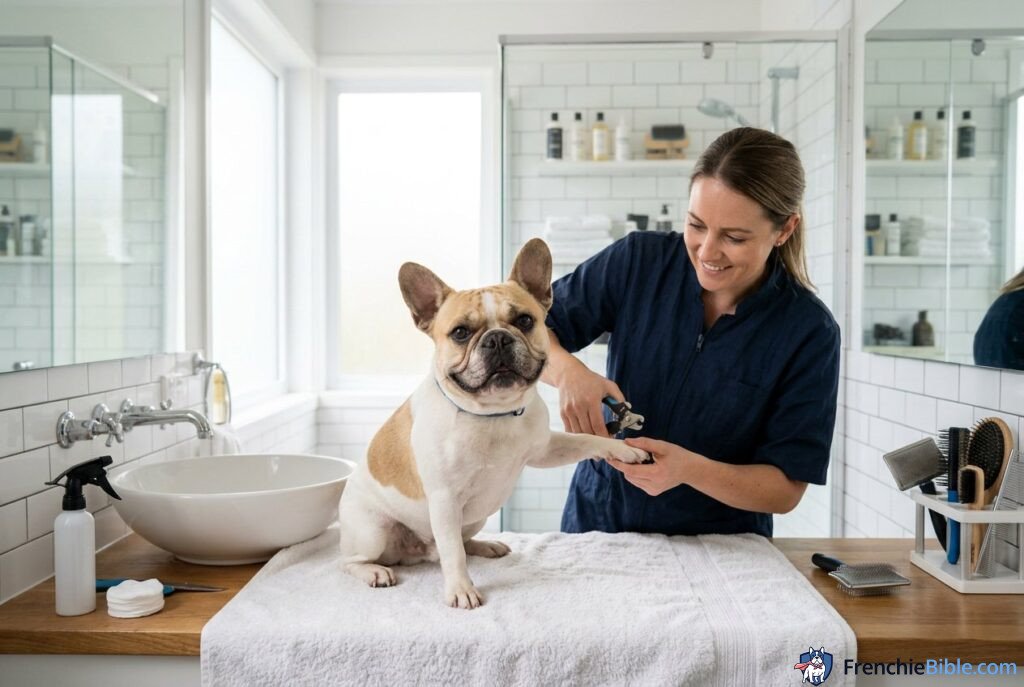
as a French Bulldog expert and breeder and an experienced breeder I have seen my fair share of tragedies that could have been completely avoided with proper grooming. Among the most common, yet surprisingly overlooked, issues in Frenchie care is the neglect of their nails. French Bulldogs are robust, muscular, and incredibly charming little companions, but they are also uniquely built. Their skeletal structure, particularly their short legs and heavy bodies, means that any imbalance can lead to severe physical distress.
You might think that a slightly overgrown nail is just a cosmetic issue, or perhaps a minor annoyance when they click-clack across your hardwood floors. Unfortunately, in the world of French Bulldogs, overgrown nails can trigger a cascade of severe health problems. From altered gaits that lead to premature arthritis to torn nails resulting in emergency surgical interventions, the consequences of neglecting those tiny claws are dire.
Related Reading: Training & Behavior | Grooming & Care | French Bulldog Colors
In this comprehensive, 3000+ word guide, we are going to dive deep into the anatomy of the French Bulldog’s nail, the tragedies of neglecting them, how to identify the elusive “Quick,” and a thorough comparison between clippers and grinders. Whether you are a first-time Frenchie owner or a seasoned pro, this guide will equip you with the knowledge and confidence to handle your dog’s pedicure like a professional.
The Anatomy of a French Bulldog’s Nail
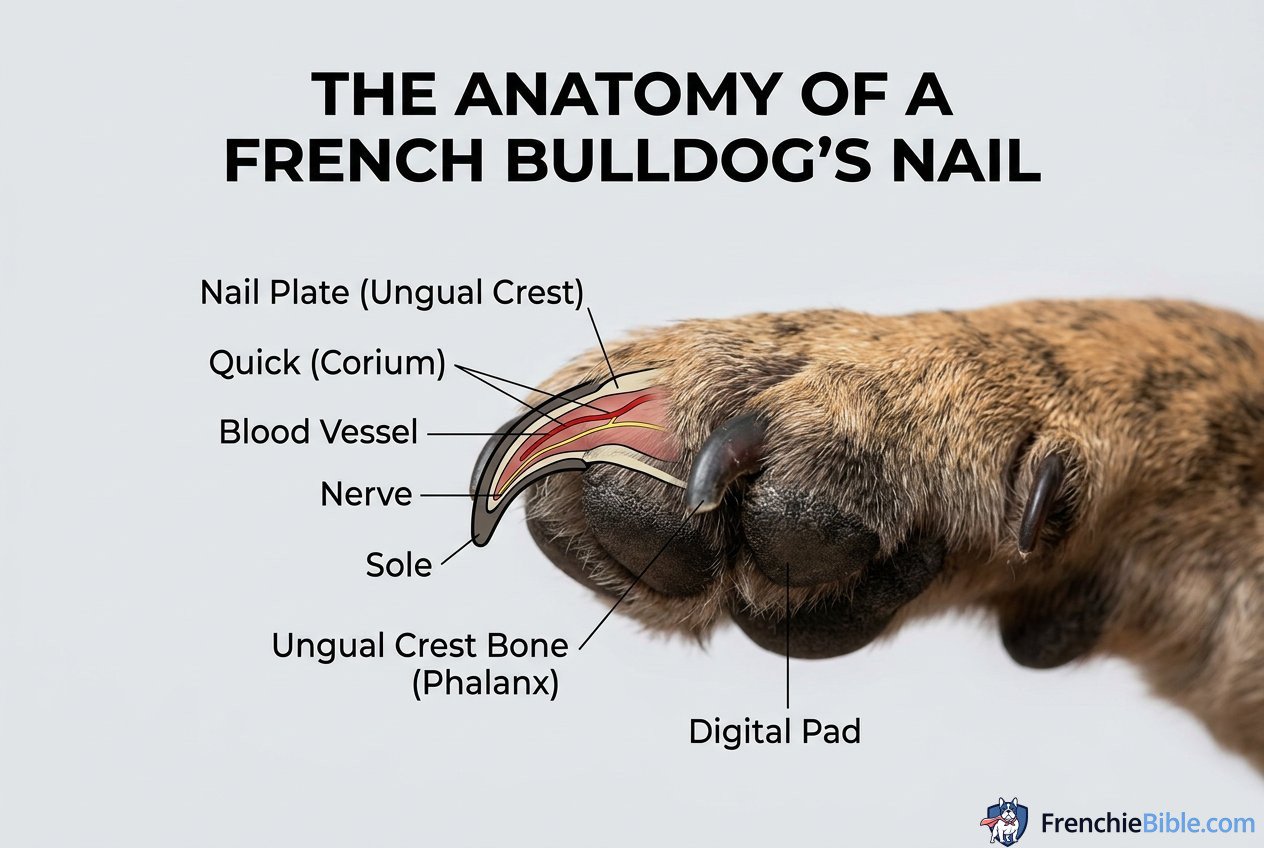
To truly understand why clipping your French Bulldog’s nails is so important, you must first understand how their nails are structured. A dog’s nail is not just a hard piece of dead keratin like a human fingernail. It is a complex, living structure attached directly to the bone of the toe.
The Hard Shell (Keratin)
The outer part of the nail, the part that clicks on the floor, is made of a tough protein called keratin. This shell is designed to protect the delicate internal structures and to provide traction when the dog runs or digs. In French Bulldogs, these shells can be incredibly thick and hard, making them challenging to cut if you don’t have the right tools. The color of the keratin shell varies depending on the pigmentation of your dog’s skin and coat. Fawn or cream Frenchies often have white or clear nails, while brindle, black, or blue Frenchies typically have thick, solid black nails. Black nails are notoriously difficult to trim because you cannot easily see the internal structures.
Understanding the “Quick” (The Blood Vessel)
Inside the hard keratin shell lies the “quick.” The quick is a highly vascularized and innervated core. In simple terms, it is full of blood vessels and nerves. This is the living tissue that supplies nourishment to the growing nail.
When you hear a dog yelp in pain and see blood during a nail trim, it is because the quick has been cut. Cutting the quick is painful—imagine having your fingernail cut down to the sensitive nail bed. Because French Bulldogs are known for being dramatic and stubborn, one bad experience with cutting the quick can make them fearful of nail trims for the rest of their lives.
A fascinating and frustrating aspect of the quick is that it grows alongside the nail. If you neglect trimming your Frenchie’s nails, the quick will elongate, moving further down the nail. This means that if you wait six months to trim extremely overgrown nails, you cannot simply chop them back to a normal length; you will sever the elongated quick. The only way to shorten an overgrown quick is to trim the tip of the nail frequently (every few days or once a week), which encourages the quick to slowly recede over time.
Why Frenchie Nails Grow Differently
French Bulldogs are not exactly built for running marathons. They are relatively low-energy dogs that spend a lot of time lounging on soft carpets and couches. In the wild, or with highly active working breeds, running on rough surfaces like concrete or rocks naturally files down the nails. Because Frenchies are indoor dogs that take shorter walks, they do not get the benefit of natural wear and tear. Consequently, their nails grow faster than they are worn down, making regular, manual trimming an absolute necessity.
The Tragic Consequences of Overgrown Nails in French Bulldogs
I have seen owners bring their Frenchies into my breeding program, baffled as to why their dog is limping, refusing to walk, or suddenly acting aggressive when their paws are touched. In many cases, a quick examination of the feet reveals severely overgrown nails. Here are the tragedies that unfold when nails are left unchecked.
Pain and Altered Gait
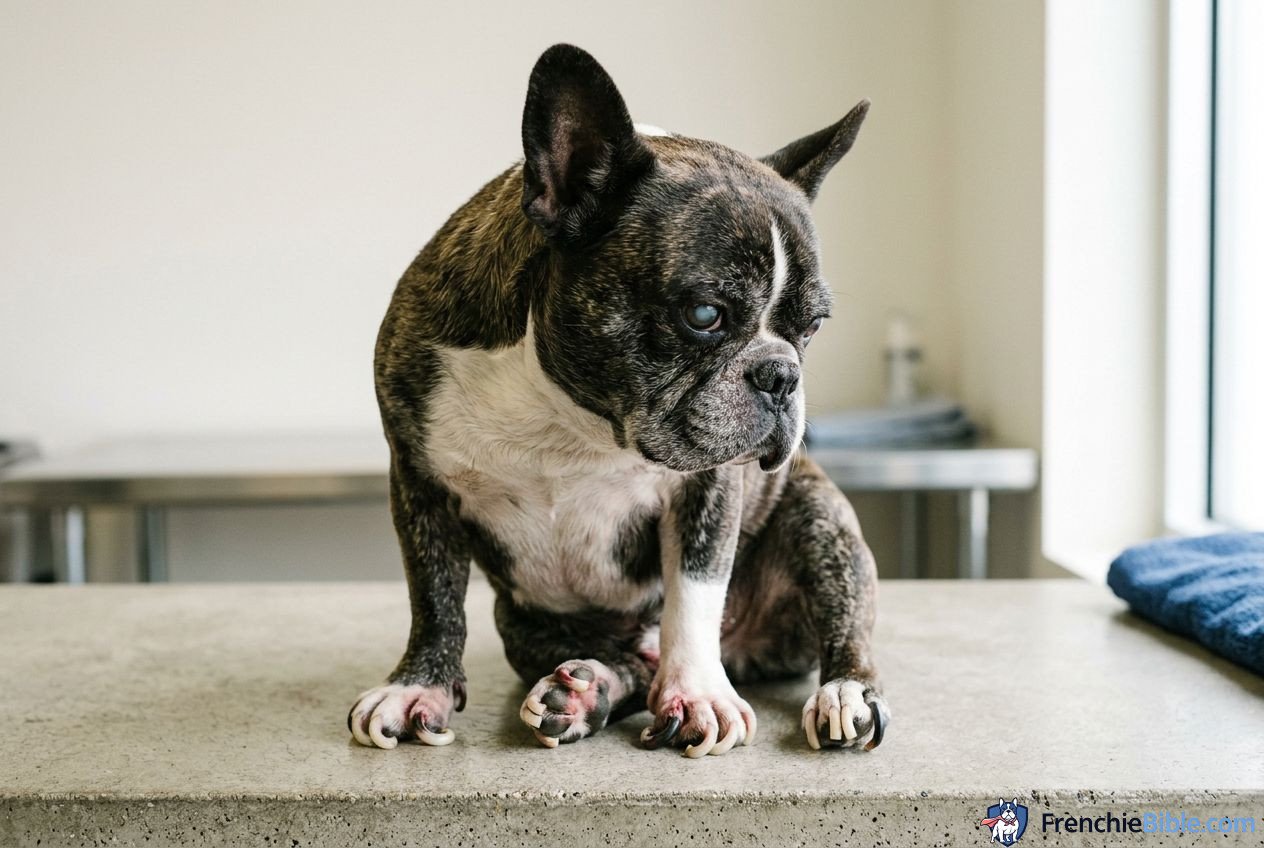
Imagine trying to walk in shoes that are three sizes too small, forcing your toes to curl backward. That is what an overgrown nail feels like for a French Bulldog. When a dog walks, the nail is not supposed to touch the ground. If the nail is so long that it hits the floor with every step, the force of the dog’s body weight pushes the nail backward into the nail bed. This causes acute pain with every single step.
To compensate for this pain, the Frenchie will alter their gait. They will start shifting their weight backward, walking more on the pads of their feet rather than the toes, or they will splay their toes outward. This unnatural posture places an immense and incorrect strain on the joints of the paw, wrist, elbow, and shoulder.
Joint Damage and Early Onset Arthritis
Because French Bulldogs are a chondrodysplastic breed (meaning they have a genetic predisposition to a specific type of dwarfism), their joints are already under a lot of stress. Their heavy chests and short, bowed legs are susceptible to orthopedic issues.
When an altered gait caused by overgrown nails forces their joints out of alignment over a period of months or years, the cartilage in those joints begins to wear away unevenly. This leads directly to early-onset osteoarthritis. I have treated five-year-old Frenchies with the arthritic joints of a ten-year-old dog, all because their nails were never properly maintained. The tragedy here is that the arthritis is irreversible; we can only manage the pain, but we cannot cure the joint damage that the overgrown nails caused.
Ingrown Nails and Severe Infections
On the side of the Frenchie’s front paws (and occasionally the back), you will find the dewclaws. Dewclaws do not touch the ground at all, meaning they experience absolutely zero natural wear. If forgotten, dewclaws will continue to grow in a circular, curling pattern.
Eventually, the sharp tip of the dewclaw will puncture the dog’s own leg or pad, growing straight into the flesh. This creates an extremely painful, open, and deep puncture wound. Dogs walk on dirty surfaces, and bacteria quickly invade this wound, leading to severe localized infections, abscesses, and even systemic infections. Removing an embedded dewclaw in the clinic requires sedation, surgical removal of the nail from the flesh, antibiotics, and weeks of painful recovery.
Broken or Torn Nails (The Emergency Room Nightmare)
Long nails are fragile and prone to getting caught. Whether it is a snag on a carpet loop, getting caught in the slats of a deck, or tripping over a root in the yard, an overgrown nail acts as a lever. When the dog suddenly pulls away, the nail is violently ripped from the nail bed.
This is incredibly traumatic and agonizing for the dog. The quick is exposed and heavily bleeding. Torn nails almost always require a trip to the emergency vet, where the dog must be heavily sedated to have the remaining fractured keratin shell surgically removed. It is a bloody, painful, and expensive tragedy that could be prevented by simply keeping the nails short.
How Often Should You Trim Your French Bulldog’s Nails?
The frequency of nail trims depends entirely on your dog’s lifestyle, the surfaces they walk on, and their diet. However, as a general rule of thumb for French Bulldogs, you should be checking and maintaining their nails every 2 to 3 weeks.
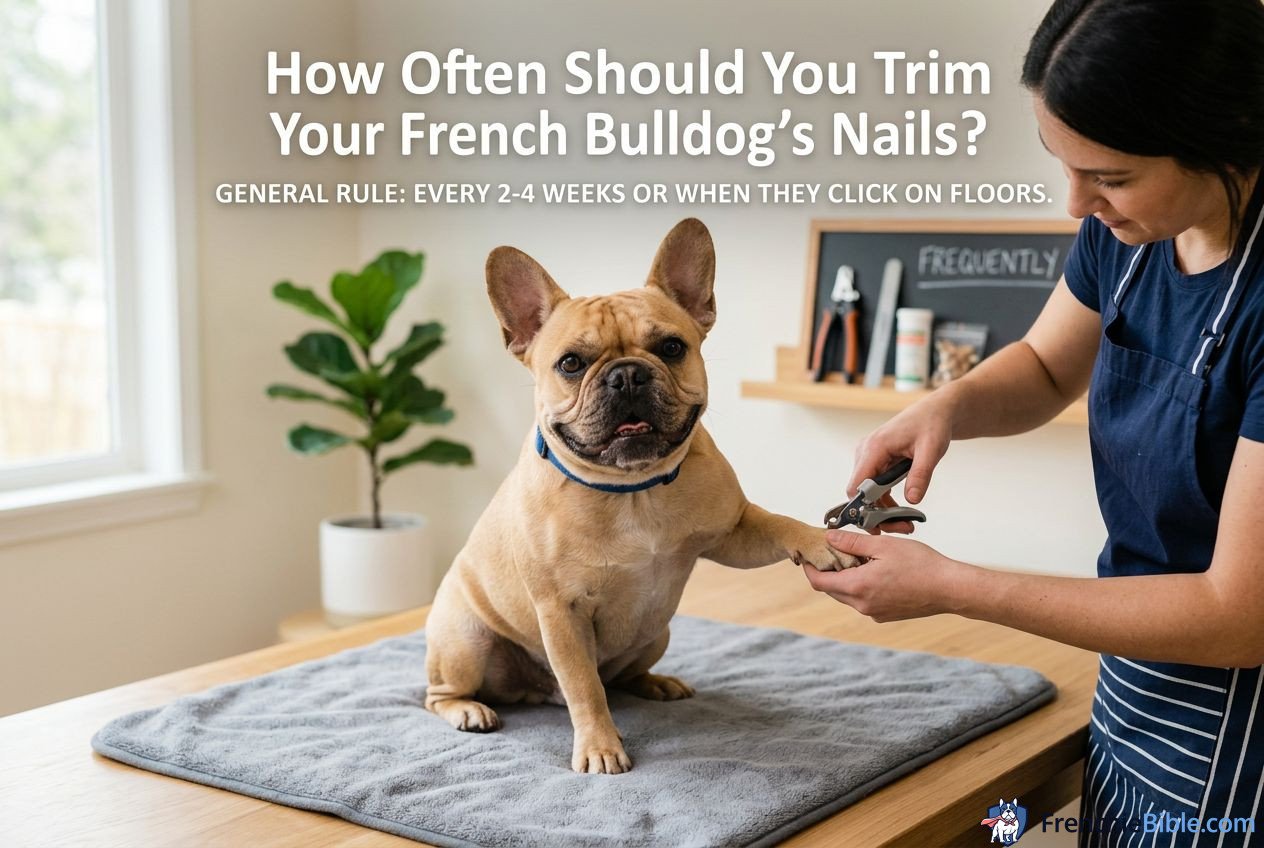
If you are actively trying to recede an overgrown quick, you should be doing micro-trims or grinding the tips every 5 to 7 days.
Signs Your Frenchie Needs a Nail Trim
How do you know it is time? Listen and look.
1. The Click-Clack Test: If you hear your dog’s nails clicking on your hardwood, tile, or laminate floors when they walk, they are too long.
2. The Paper Test: When your dog is standing squarely on a flat, hard surface, you should be able to slide a piece of paper between the floor and the tip of their nail. If the paper cannot slide under, the nail is touching the ground and needs trimming.
3. Curved Appearance: If the nail starts curving downward noticeably or begins to hook, it is past due.
4. Toe Splaying: If your dog’s toes look spread apart or flattened rather than sitting tightly together in a neat, arched paw, the nails are pushing them apart.
Choosing the Right Tools: Clippers vs. Grinders
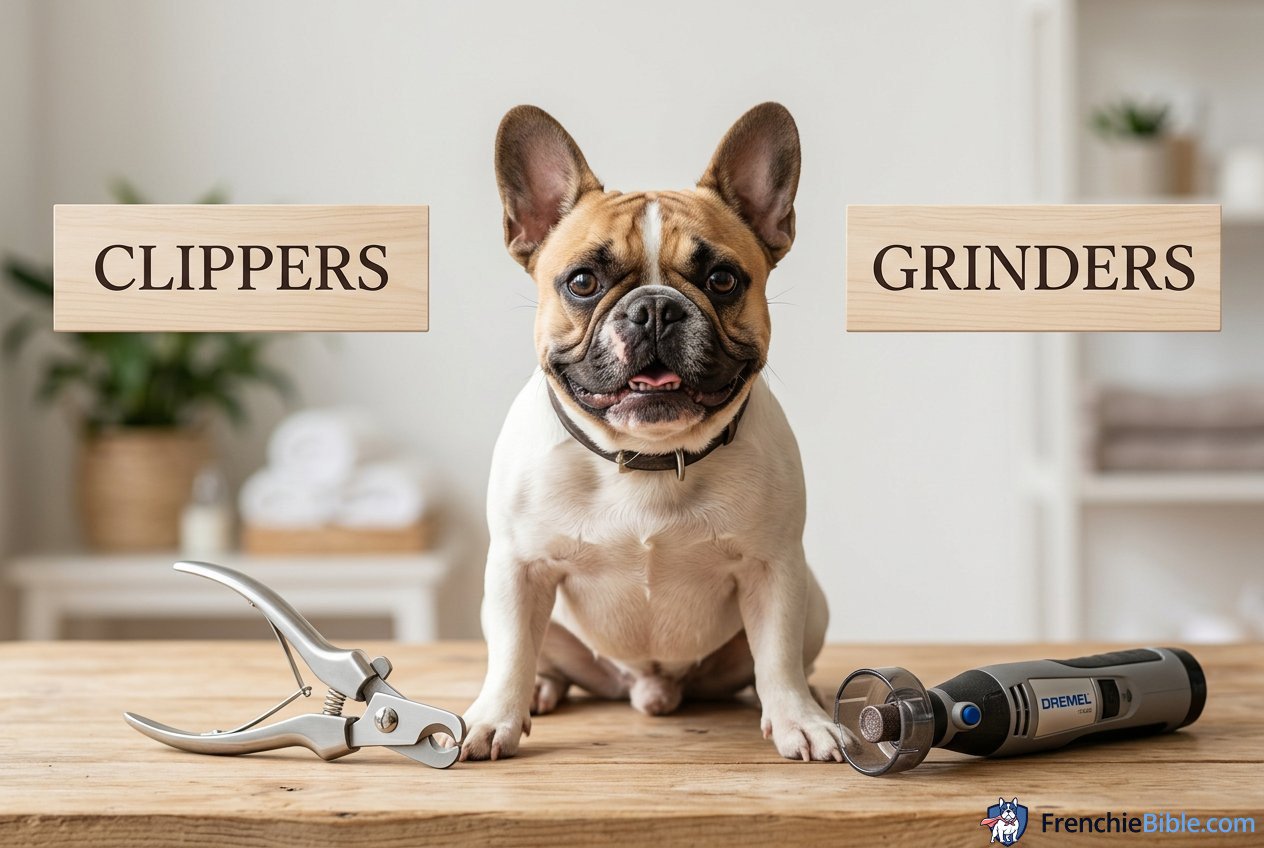
The debate between using nail clippers and nail grinders (like Dremels) is a hot topic in the grooming world. The truth is, both have their merits, and the best tool is the one that you are comfortable using and that your Frenchie tolerates best.
French Bulldog Nail Clippers
Nail clippers come in two main styles: Scissor-style and Guillotine-style.
For French Bulldogs I strongly recommend Scissor-style or Plier-style clippers over the guillotine type. Frenchies have thick, robust nails. Guillotine clippers, which require you to thread the nail through a hole before a blade slices across, can sometimes crush the nail rather than cutting it cleanly, causing pain. Scissor clippers provide more leverage and a cleaner, sharper cut.
Pros of Clippers:
- Speed: A quick, decisive squeeze and the tip is gone. It takes seconds per toe once you are skilled.
- Silent: There is no loud motor noise to frighten an anxious dog.
- No Heat: Unlike grinders, clippers do not generate heat from friction.
Cons of Clippers:
- The Risk of Cutting the Quick: It is much easier to accidentally chop off a large chunk of the nail and hit the quick.
- Pinching Sensation: Even sharp clippers squeeze the nail slightly before cutting, which some dogs hate.
- Rough Edges: Clippers leave a sharp, blunt edge that can scratch you or your furniture until it wears down.
Nail Grinders (Dremel Tools)
A nail grinder is a rotary tool with a sanding drum at the tip. Instead of cutting the nail, it files it down gradually.
Pros of Grinders:
- Precision and Safety: It is much harder to hit the quick with a grinder. You can file away millimeter by millimeter, checking your progress constantly.
- Smooth Finish: Grinders leave a beautifully smooth, rounded tip that won’t scratch you.
- Receding the Quick: Grinders are exceptional for pushing back the quick. The vibration and heat close to the quick stimulate it to recede faster than blunt clipping.
Cons of Grinders:
- Noise and Vibration: The buzzing sound and the physical vibration against the toe can terrify dogs that are not properly desensitized.
- Time-Consuming: Grinding takes significantly longer than a quick snip with clippers.
- Heat Generation: Friction causes heat. If you hold the grinder on the nail for too long, it will burn the dog. You must use a “tap-tap-tap” motion.
- Hair Tangles: If your Frenchie has longer hair around their paws, it can get caught in the rotating drum.
Styptic Powder (The Lifesaver)
Regardless of whether you choose clippers or a grinder, you must never begin a pedicure without Styptic Powder (brands like Kwik Stop) open and ready next to you. Styptic powder contains ferric subsulfate, which acts as an anti-hemorrhagic agent. If you cut the quick, applying this powder directly to the bleeding tip will cause the blood vessels to contract and clot almost instantly. Cornstarch or flour can work in a pinch, but they are not nearly as effective as professional styptic powder.
Step-by-Step Guide to Trimming Your French Bulldog’s Nails Safely
A successful nail trim requires patience, the right environment, and a methodical approach. Do not attempt this when you are in a rush or frustrated, as your dog will feed off your anxiety.
Step 1: Preparation and Desensitization
If your Frenchie hates having their paws touched, you cannot just grab them and start clipping. You must desensitize them over days or weeks.
– Start by gently massaging their paws while they are relaxed. Reward with high-value treats.
– Introduce the tool. Let them sniff the clippers or the turned-off grinder. Treat.
– Turn the grinder on near them without touching them. Treat.
– Touch the vibrating grinder to their leg (not the nail). Treat.
Build positive associations before you ever attempt a cut.
Step 2: Finding the Quick (Even in Dark or Black Nails)
With white nails, finding the quick is easy: it is the pink tube visible inside the white shell. You simply cut slightly ahead of the pink area.
With black nails, you are flying blind initially. Here is the professional method for dark nails:
1. Look at the bottom of the nail. You will see a groove running along the underside. The quick usually ends where this groove ends and the nail becomes a solid cylinder.
2. Cut small slivers off the tip. After every sliver, look at the freshly cut cross-section of the nail head-on.
3. At first, the center of the cut nail will look white or chalky.
4. As you cut closer to the quick, the center will change to a dark, grayish, or black dot. STOP CUTTING. This dot is the tip of the quick. If you cut further, it will bleed.
Step 3: The Trimming Process with Clippers
- Hold the paw firmly but gently. Do not squeeze so hard that you cause pain, but maintain control.
- Isolate the toe you are working on.
- Hold the clippers at a 45-degree angle, matching the natural curve of the nail.
- Using the sliver method described above, make small, decisive cuts.
- Do not forget the dewclaws!
Step 4: The Grinding Process with a Dremel
- Support the toe firmly. This prevents the vibration from shaking the whole leg, which dogs dislike.
- Turn the grinder on to a low or medium speed.
- Touch the grinder to the bottom edge of the nail, rolling it upward over the tip.
- Use the 3-Second Rule: Only hold the grinder to the nail for 2 to 3 seconds at a time. Then pull it away. This prevents the nail from overheating and burning the dog.
- Sand the top, the bottom, and the sides until you see the telltale dot in the center, and the nail is smooth and rounded.
What to Do If You Cut the Quick (Stop the Bleeding!)
Even professional groomers and veterinarians occasionally quick a dog. It happens. If it does, do not panic. Your Frenchie will likely yelp, and you will see a surprising amount of bright red blood. French Bulldogs are dramatic, and your panic will only escalate theirs.
Immediate Actions:
- Stay Calm: Say “Oops, sorry buddy,” in a soothing, normal tone. Do not yell or drop the dog.
- Apply Styptic Powder: Take a generous pinch of styptic powder between your thumb and forefinger.
- Press Firmly: Press the powder directly into the bleeding tip of the nail. Hold it there with firm, steady pressure for at least 15 to 30 seconds. Do not wipe it to check if it stopped; just hold the pressure.
- Assess: Release the pressure. If it is still bleeding, repeat the process.
- Rest: Once the bleeding stops, do not let your dog run around on rough surfaces or lick the paw for at least 30 minutes, as this will dislodge the clot and restart the bleeding.
When to See An Experienced Breeder:
If you have applied styptic powder and maintained pressure for 15 minutes and the nail is still actively bleeding, or if the nail is torn, splintered, or the toe is swollen, you must see a veterinarian. Torn nails that expose the quick horizontally are incredibly painful and highly prone to infection, requiring professional medical intervention.
Pro Tips for Anxious Frenchies
French Bulldogs are famously stubborn. If they decide they do not want their nails done, they will thrash, scream (the famous “Frenchie death scream”), and alligator-roll.
Positive Reinforcement and Treats
Never use physical punishment. If you force a terrifying experience on them, they will fight harder next time. Use extremely high-value treats that they only get during nail trims—boiled chicken, hot dogs, or cheese.
The Lick Mat Strategy
Smear a lick mat with peanut butter (ensure it is xylitol-free!), cream cheese, or wet dog food, and stick it to the wall or the refrigerator. While the Frenchie is entirely focused on licking the mat, you can quietly and quickly handle their back paws. Distraction is a incredibly powerful tool.
The Grooming Hammock
For severe cases, a grooming hammock can be a game-changer. These harnesses suspend the dog in the air (from a sturdy bar), leaving their legs dangling. Most dogs, once suspended safely, realize they cannot fight and simply give up, allowing you to quickly trim or grind their nails in peace.
Professional Help vs. DIY
If your Frenchie is turning blue in the face from thrashing, trying to bite you, or if you are so nervous that your hands are shaking, stop. It is not worth ruining your relationship with your dog or causing an injury.
Take them to a professional groomer or your veterinarian. Veterinary clinics have highly trained technicians who know safe, fear-free restraint techniques. We would much rather see you for a $20 nail trim every month than see you for a $500 emergency visit for a torn nail or an orthopedic issue caused by neglect.
Frequently Asked Questions (FAQ)
Can overgrown Frenchie nails recede?
Yes, but it requires patience. You cannot cut a long quick short all at once without causing severe pain and bleeding. To recede the quick, you must trim or grind the very tip of the nail slightly every 5 to 7 days. The constant proximity to the edge signals the quick to gradually retreat backward. It can take several months of dedicated, weekly maintenance to get severely overgrown nails back to a healthy length.
Are grinders better than clippers for French Bulldogs?
Neither is universally “better,” but many owners and professionals prefer grinders for Frenchies. Because Frenchies have thick, black nails, grinders reduce the risk of accidentally hitting the quick. Grinders also leave a smoother edge and are highly effective at encouraging the quick to recede. However, clippers are faster. The best tool is the one your dog tolerates.
Why does my French bulldog hate getting their nails cut?
There are three main reasons:
1. Past Trauma: They have been quicked before and remember the pain.
2. Paws are Sensitive: Dogs have many nerve endings in their paws and naturally dislike having them manipulated or restrained.
3. Improper Handling: If you squeeze the paw too hard, contort their leg into an unnatural angle, or show anxiety yourself, the dog will panic.
How long does it take for a dog’s nail to stop bleeding?
If you apply styptic powder with firm pressure, the bleeding should stop within 30 to 60 seconds. If you have nothing on hand (which you should always have styptic powder), a bleeding quick can drip steadily for 10 to 20 minutes and easily make a mess of your house. It is generally not life-threatening, but it is highly distressing.
Do walking on concrete file down a Frenchie’s nails?
Yes, walking on abrasive surfaces like concrete or asphalt does act as a natural nail file. However, because French Bulldogs are typically low-stamina companions rather than long-distance runners, the amount of walking they do is rarely enough to keep their nails sufficiently short on its own. Furthermore, this natural wear only affects the nails touching the ground; it does absolutely nothing for the dewclaws, which must still be trimmed manually.
Conclusion
The tragedy of an overgrown French Bulldog nail is that it is a completely preventable cause of immense pain and structural damage. As an owner, taking responsibility for your dog’s pedicure is just as vital as feeding them a high-quality diet or keeping their vaccinations up to date.
By understanding the anatomy of the nail, equipping yourself with the right tools—whether clippers or a Dremel—and learning how to navigate the quick, you can protect your Frenchie from arthritis, torn nails, and a lifetime of discomfort. Remember, patience is key. Desensitize your dog, use plenty of high-value rewards, and do not be afraid to seek professional help from your veterinarian or a fear-free groomer if the task proves too daunting. Keep those nails short, and your French Bulldog will reward you with years of happy, pain-free, and delightfully goofy companionship.
Disclaimer: We are not veterinarians and do not hold veterinary medical licenses. The information provided in this article is based on years of breeding and daily care experience and is for educational purposes only. It should not replace professional veterinary advice. Always consult with a licensed veterinarian if you have concerns about your French Bulldog’s health or before starting any new treatment.