Disclaimer: The information provided in this article is for educational purposes only and is not a substitute for professional veterinary advice. Heatstroke is a life-threatening medical emergency. If you suspect your French Bulldog is suffering from heatstroke, immediately begin the safe cooling procedures outlined below and transport your dog to the nearest emergency veterinary clinic without delay. Time is of the essence.
Welcome to the ultimate survival guide for your Frenchie’s summer. As a French Bulldog specialist veterinarian and breeding expert, I cannot stress enough how critical the warmer months are for our bat-eared companions. Summer brings sunshine, beach trips, and outdoor fun, but for a French Bulldog, it also brings their most formidable enemy: heatstroke.
Related Reading: Training & Behavior | Frenchie Puppy Guide | Best Food for Frenchies
Every year, veterinary emergency rooms are flooded with tragic cases of brachycephalic (flat-faced) breeds succumbing to heat exhaustion. The saddest part? Many of these cases could have been prevented with proper knowledge. Even worse, well-meaning owners often make a fatal mistake during first aid: they use ice water to cool their dogs down.
In this comprehensive 3,000+ word guide, we will dive deep into why French Bulldogs are a high-risk breed for heatstroke, how to recognize the stealthy early warning signs, the exact step-by-step first aid protocol to save your dog’s life, and why ice water is the absolute worst thing you can reach for. Whether you are a novice puppy parent or a veteran Frenchie owner, this information is non-negotiable.
Why French Bulldogs are Highly Susceptible to Heatstroke
To understand the enemy, you must understand your dog’s unique anatomy. French Bulldogs are undeniably adorable, but their distinctive look comes with significant physiological compromises, particularly when it comes to thermoregulation.
The Brachycephalic Anatomy Explained
Dogs do not sweat through their skin like humans do; their primary mechanism for cooling down is panting. When a dog pants, air passes over the moist tissues of the nasal passages and the tongue, allowing heat to dissipate through evaporation.
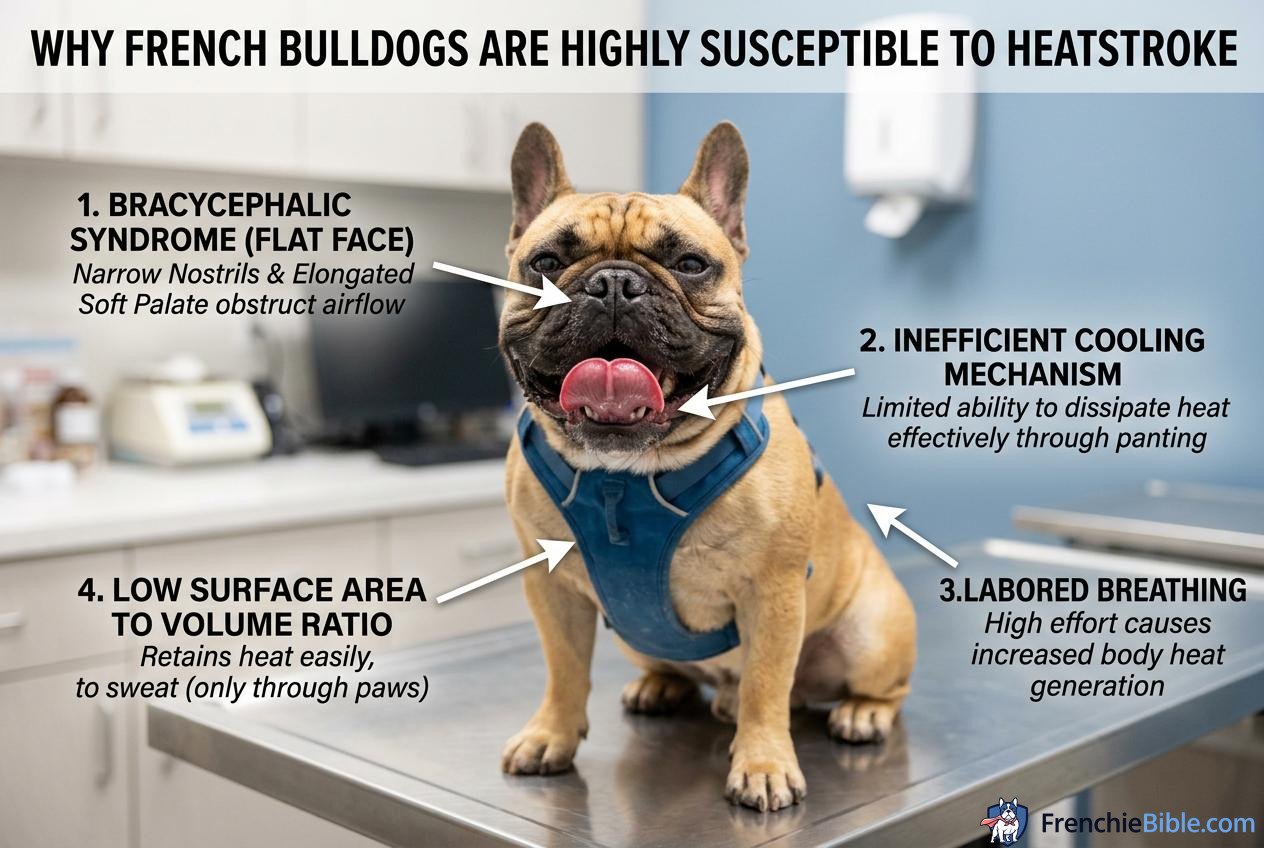
However, French Bulldogs suffer from Brachycephalic Obstructive Airway Syndrome (BOAS). Because their muzzles are dramatically shortened, all the anatomical structures of a “normal” dog’s snout are squished into a much smaller space. They often have:
– Stenotic Nares: Pinched or narrow nostrils that restrict airflow.
– Elongated Soft Palate: The soft tissue at the back of the roof of the mouth is too long, partially blocking the trachea (windpipe).
– Hypoplastic Trachea: A narrower-than-normal windpipe.
– Everted Laryngeal Saccules: Small tissue pouches inside the airway that turn inside out due to the increased effort of breathing, further obstructing airflow.
Because of this compromised “cooling system,” a French Bulldog has to work twice as hard to move air in and out. When they pant aggressively to cool down, the friction and negative pressure cause their airway tissues to swell. This swelling restricts airflow even further, trapping the heat inside their bodies. It becomes a vicious, rapid cycle that leads directly to hyperthermia (heatstroke).
The Role of Humidity and Temperature
It’s not just the heat; it’s the humidity. Because panting relies on evaporation to cool the dog down, high environmental humidity means the air is already saturated with moisture. Evaporation slows down or stops entirely. A French Bulldog can easily overheat in 70°F (21°C) weather if the humidity is high. Never judge the safety of the weather solely by the thermometer; factor in the humidity index.
Recognizing the Warning Signs: Early and Late Symptoms of Heatstroke
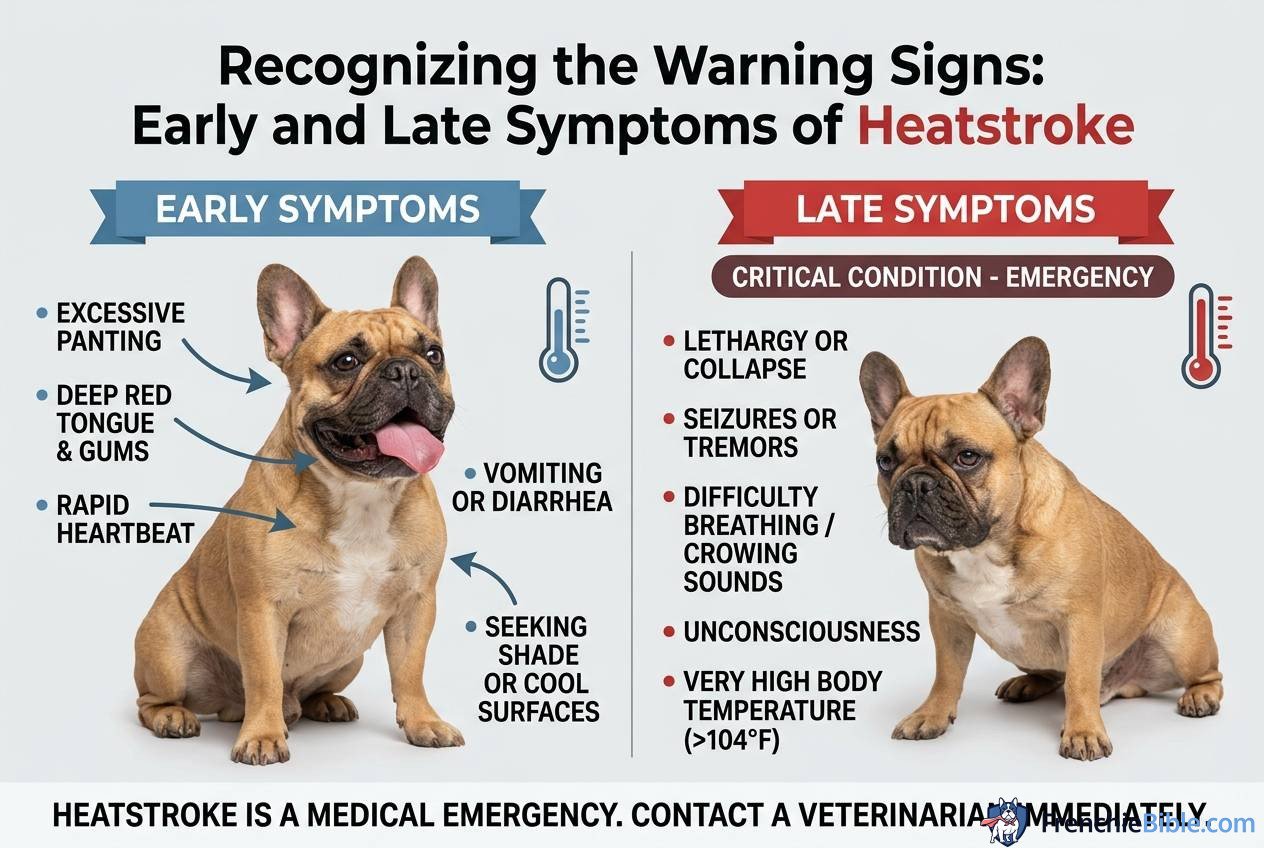
Heatstroke doesn’t just happen instantly; it escalates. The key to saving your French Bulldog is catching the early warning signs before their internal temperature reaches the critical organ-damage threshold of 106°F to 109°F (41°C to 42.7°C).
Early Warning Signs (Act Now)
If you observe any of the following, stop all activity immediately and move your dog to a cool environment:
– Excessive, Frantic Panting: This isn’t normal dog panting; it sounds desperate, harsh, and rhythmic. It may be accompanied by loud snorting or wheezing.
– Extreme Restlessness: Your dog may pace, seeming unable to find a comfortable spot to settle down.
– Hypersalivation: Copious amounts of thick, sticky, or ropy saliva dripping from the mouth.
– Bright Red Gums and Tongue: Their mucous membranes will turn a dark, brick-red color as the body attempts to pump blood to the surface to cool down.
– Lethargy or Weakness: Sudden refusal to walk, dragging their feet, or seeking shade and refusing to move.
Advanced and Critical Symptoms (Emergency)
If the early signs are missed or ignored, the condition progresses rapidly into severe heatstroke. At this stage, your dog’s internal organs (kidneys, liver, brain, and gastrointestinal tract) are essentially “cooking.”
– Glazed Eyes and Lack of Focus: The dog appears confused or unresponsive to their name.
– Pale or Blue Gums: As shock sets in and circulation fails, the brick-red gums will turn pale, gray, or blue/purple (cyanosis) due to a lack of oxygen.
– Vomiting and Diarrhea: Often containing blood. The heat damages the lining of the GI tract, causing it to shed.
– Staggering or Collapse: Inability to stand up, acting “drunk” (ataxia).
– Seizures, Tremors, or Coma: Brain damage is occurring due to thermal injury and cerebral edema (swelling of the brain).
– Unresponsiveness and Death: Without immediate medical intervention, terminal heatstroke is fatal.
Step-by-Step French Bulldog Heatstroke First Aid
If your French Bulldog goes into heatstroke, your actions in the next 10 to 15 minutes will dictate whether they live or die. Stay calm, and follow this exact protocol.
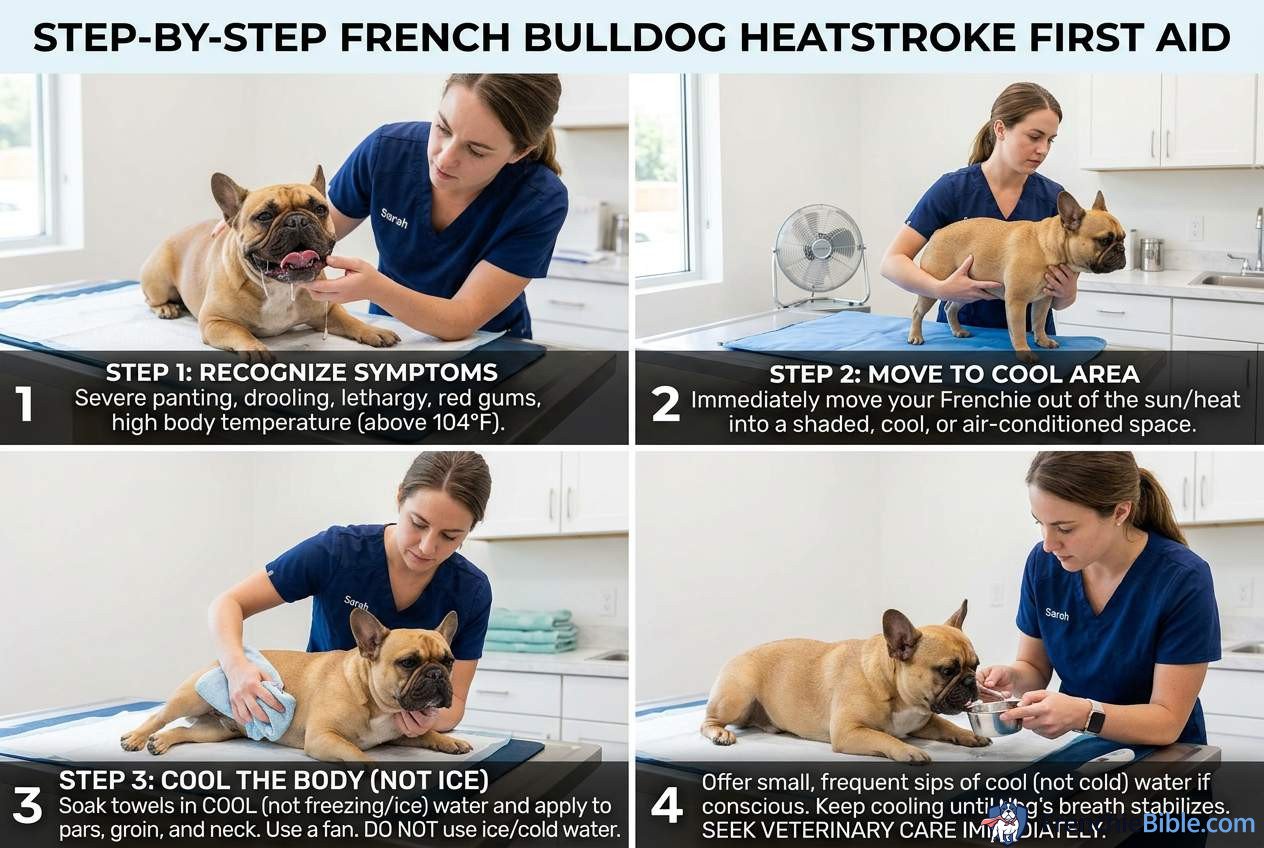
Step 1: Remove from the Heat Source Immediately
The second you suspect heatstroke, pick your dog up (do not force them to walk) and get them out of the sun. Move them into an air-conditioned building or a car with the AC blasting. If AC is unavailable, find deep shade and ensure there is a breeze.
Step 2: The Right Way to Cool Your Dog (NO ICE WATER)
This is the most critical step. Your goal is to lower their body temperature gradually.
– Use Cool (Not Cold) Water: Wet a towel or cloth with tepid, room-temperature, or slightly cool water from the tap.
– Target the Pulse Points: Apply the wet towels to areas where blood vessels are close to the surface: the armpits, the groin (inner thighs), the neck, and the paws.
– Do Not Cover Them: Never drape a wet towel entirely over your dog’s back and leave it there. A wet towel laid over the dog will quickly heat up from their body temperature and trap the heat like a sauna blanket. Instead, wipe them down, or continuously re-wet and remove the towels.
– Evaporative Cooling: If possible, place them directly in front of a fan while their fur is damp. The moving air combined with the moisture will rapidly pull heat from their body through evaporation.
Step 3: Encourage Hydration Safely
Offer your Frenchie fresh, cool water to drink, but do not force it down their throat. Forcing water can lead to aspiration pneumonia if they inhale it into their lungs while gasping for air. Let them lick ice cubes or drink small amounts voluntarily.
Step 4: Rush to the Emergency Vet
First aid is not a substitute for veterinary care. Even if your dog seems to recover and their temperature drops, you must go to the vet. Heatstroke can cause delayed organ failure, disseminated intravascular coagulation (DIC – a fatal blood clotting disorder), and severe dehydration that only IV fluids and intensive care can resolve. Call the vet on your way so they can prep the crash cart.
Why You Should NEVER Use Ice Water for Heatstroke
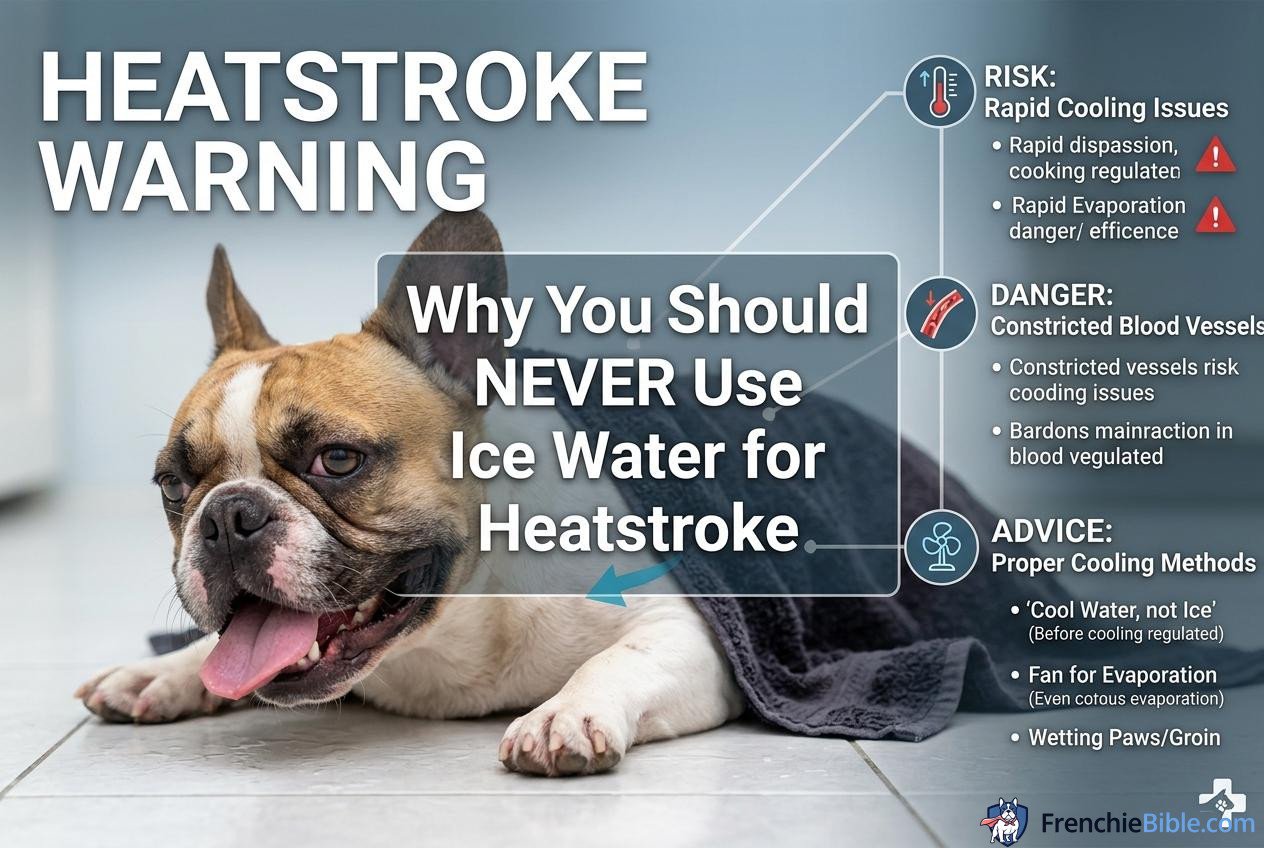
This is the fatal mistake that often seals a dog’s fate. When panicked owners see their dog overheating, their instinct is to plunge the dog into an ice bath, spray them with a freezing hose, or pack them in ice. Do not ever do this.
The Danger of Vasoconstriction
When a dog is hot, their body automatically dilates the blood vessels near the surface of the skin (vasodilation) to allow the hot blood to release heat into the environment.
If you apply ice or freezing water to the dog’s skin, it causes a severe and instantaneous shock response: vasoconstriction. The extreme cold causes the blood vessels on the surface of the skin to slam shut and shrink aggressively.
When those surface vessels close off, the incredibly hot, boiling blood is forced away from the skin and trapped deep inside the body’s core. Instead of cooling the dog down, ice water essentially insulates the dog, trapping the lethal heat directly around their heart, brain, liver, and kidneys. It accelerates internal organ damage.
The Risk of Shock
Furthermore, extreme temperature changes can trigger hypovolemic or thermoregulatory shock. It can cause shivering, which generates more internal body heat. Remember the golden rule: cool your dog gradually using tepid water and moving air.
Preventing Heatstroke in Your French Bulldog: A Summer Survival Guide
As a Frenchie expert, I preach prevention. Treating heatstroke is a nightmare; preventing it is entirely manageable with lifestyle adjustments.
Safe Walking Routines and Temperature Checks
During the summer, banish the idea of afternoon walks.
– The 7 Second Rule: Place the back of your hand on the pavement for seven seconds. If it’s too hot for your hand, it will blister your Frenchie’s paw pads and radiate immense heat directly into their chest and abdomen.
– Dawn and Dusk Only: Walk your dog before the sun is fully up (before 8 AM) or long after the sun has set (after 8 PM).
– Keep it Short: Limit summer walks to 10-15 minutes max. This is for potty breaks, not cardio.
Creating a Cool Indoor Environment
Your home needs to be a sanctuary. Keep the air conditioning running, even when you aren’t home. Ensure your dog has access to cool, uncarpeted floors like tile or linoleum. Provide fresh, cool water at all times.
Must-Have Summer Gear for Frenchies
Invest in preventative gear designed to assist their poor thermoregulation:
– Cooling Vests: These vests are soaked in water and wrung out. As the water evaporates, it pulls heat away from the dog’s chest.
– Cooling Mats: Pressure-activated gel mats provide a cool surface for your dog to lie on without needing electricity or refrigeration.
– Portable Water Bottles: Never leave home without a dog-friendly water bottle and a collapsible bowl.
– Wagons or Strollers: If you want to take your Frenchie to a farmers market or an outdoor event, bring a well-ventilated wagon with a battery-operated clip-on fan. Let them ride, not walk.
Frequently Asked Questions (FAQ)
1. At what outside temperature is it too hot for my French Bulldog?
Generally, temperatures above 70°F (21°C) require caution, especially if the humidity is high. Anything above 80°F (26°C) is dangerous territory, and outdoor activity should be strictly limited to quick potty breaks.
2. Can I shave my French Bulldog to keep them cool?
No! French Bulldogs have a single coat, but their fur actually protects their skin from sunburn and provides a degree of insulation against the heat. Shaving them removes this natural barrier and exposes them to severe UV damage.
3. What is the normal body temperature for a French Bulldog?
A normal canine temperature ranges from 100°F to 102.5°F (37.8°C to 39.2°C). A temperature above 104°F (40°C) is considered dangerous, and anything over 106°F (41°C) is a life-threatening emergency.
4. How long does it take for a dog to recover from heatstroke?
Recovery depends entirely on how quickly first aid was administered and the peak internal temperature reached. Mild cases caught instantly might recover in a few days with vet care. Severe cases can result in permanent kidney or neurological damage, requiring lifelong management, or tragically, may be fatal within hours.
5. My Frenchie is panting, but the gums look normal. Should I be worried?
Panting is a normal dog behavior for cooling down and expressing excitement. However, monitor the type of panting. If it becomes excessively loud, raspy, or frantic, or if the tongue begins to look unusually wide or swollen, take a break in the shade immediately and offer water. Always err on the side of caution.
If you loved this guide, share it with fellow Frenchie parents. Proper education saves lives. Stay cool, stay safe, and protect your squishy-faced best friends!
Disclaimer: I am a French Bulldog breeding expert with over a decade of hands-on experience with this breed. I am not a veterinarian. The information in this article is for educational purposes only. Always consult your veterinarian regarding your dog’s specific health needs and care.