If you have ever tossed a tennis ball across the yard, expecting your French Bulldog to sprint after it with the enthusiasm of a Golden Retriever, only to be met with a blank stare, a snort, and a slow walk back into the house, you are not alone. As someone who has spent over a decade working closely with this incredible breed as a dedicated breeder and behavioral observer I can tell you that this scenario plays out in Frenchie households around the world every single day.
French Bulldogs are known for their clownish personalities, their affection, and their unmistakable “bat ears,” but they are rarely recognized for their retrieving skills. You might find yourself wondering, “Is my dog lazy? Is there something wrong with their instincts? Can a French Bulldog even learn to play fetch?”
Related Reading: Health & Diet | Grooming & Care
The short answer is yes, they can. However, understanding why your Frenchie doesn’t naturally want to play fetch is the first crucial step in changing that behavior. Teaching a Frenchie to fetch requires patience, creativity, and a deep understanding of their unique genetics, physical limitations, and psychological quirks. In this comprehensive guide, we will explore the depths of the French Bulldog’s mind, uncover the reasons behind their lack of interest in retrieving, and provide you with actionable, expert-level strategies to awaken their dormant prey drive and turn them into a (somewhat) reliable fetch companion.
Understanding the French Bulldog’s Genetics and Prey Drive
To truly understand your French Bulldog’s behavior, we must first look at their history and genetic makeup. A dog’s breed dictates much of their instinctual behavior, and the Frenchie is no exception.
The Origins of the Frenchie: Not Your Typical Retriever
Unlike Labrador Retrievers or Pointers, which were meticulously bred for generations to chase, retrieve, and bring back game to hunters, the French Bulldog has a completely different origin story. Their ancestors were the toy-sized Bulldogs of Nottingham England, which were popular among lace makers. When the Industrial Revolution displaced these workers, many moved to France, taking their small Bulldogs with them. In France, these dogs were crossed with local ratters and terriers, eventually evolving into the French Bulldog we know today.
Their primary job throughout history has been companionship. They were bred to sit on laps, offer warmth, and be entertaining household pets. They were not bred to chase down fleeing animals across vast fields. Therefore, the instinct to chase an object, pick it up, and bring it back to a human is not hardwired into their DNA. When you throw a ball, your Frenchie’s genetic code doesn’t automatically trigger a “must retrieve” response. Instead, their brain might be processing the event as, “You threw that away, so you must not want it anymore.”
Low to Moderate Prey Drive
Prey drive is the instinctual inclination of a carnivore to find, pursue, and capture prey. In dogs, this drive is often channeled into games like fetch, tug-of-war, and chasing lures. While terriers and herding breeds have exceptionally high prey drives French Bulldogs typically have a low to moderate prey drive.
Some Frenchies might enjoy a quick sprint after a squirrel or a fluttering leaf, but this drive is often fleeting. It rarely translates into a sustained desire to repetitively chase a lifeless rubber ball. Their prey drive needs to be artificially stimulated and nurtured by you, the owner. You have to convince them that the toy you are throwing is the most exciting, rewarding thing in the world, mimicking the erratic movement of actual prey to trigger their latent instincts.
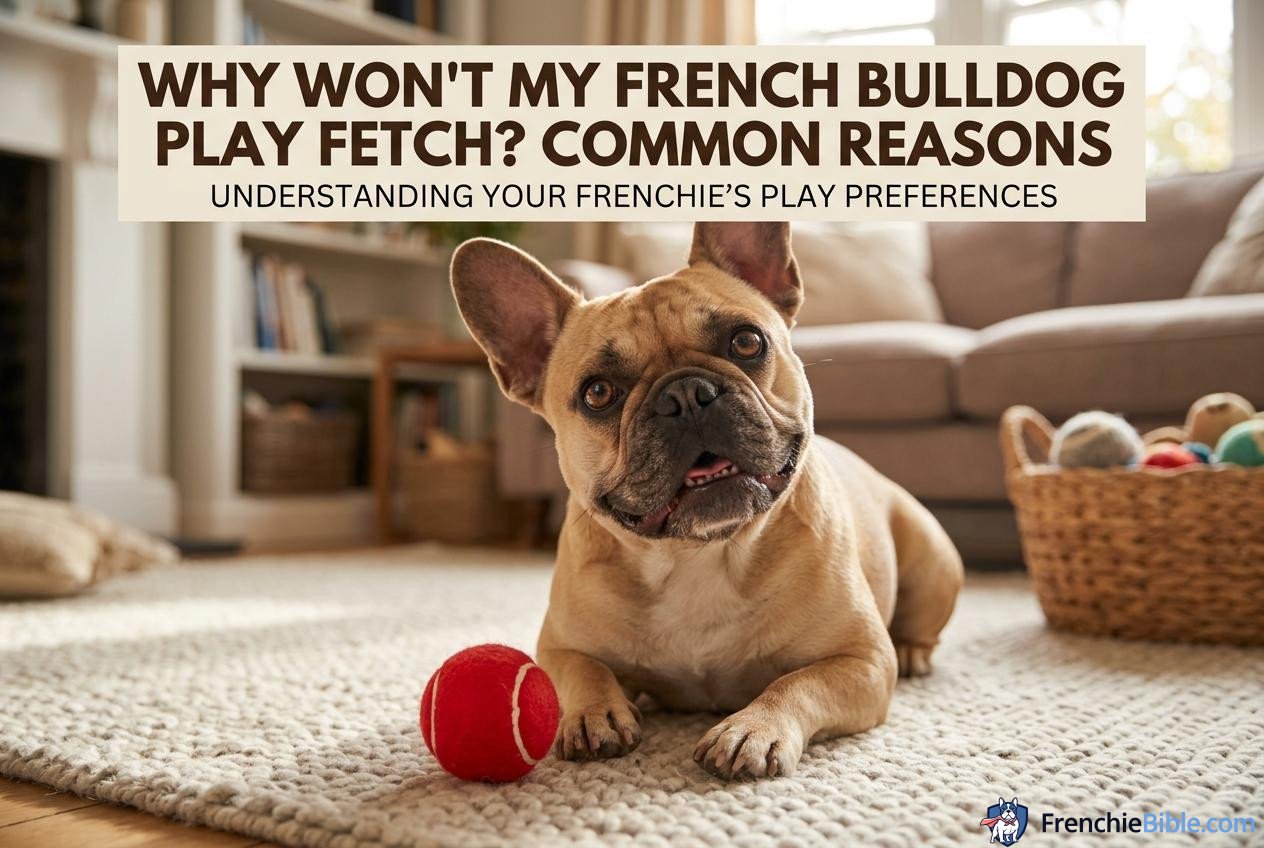
Why Won’t My French Bulldog Play Fetch? Common Reasons
Beyond genetics, there are several practical, physical, and psychological reasons why your Frenchie might be ignoring your attempts to play fetch. Recognizing these hurdles is essential for tailoring your training approach.
The Brachycephalic Factor: Breathing Over Running
The most significant physical limitation for any French Bulldog is their brachycephalic (flat-faced) anatomy. They have shortened muzzles, elongated soft palates, and narrow nostrils (stenotic nares). This structural reality means that Frenchies have to work much harder to breathe than dogs with longer snouts.
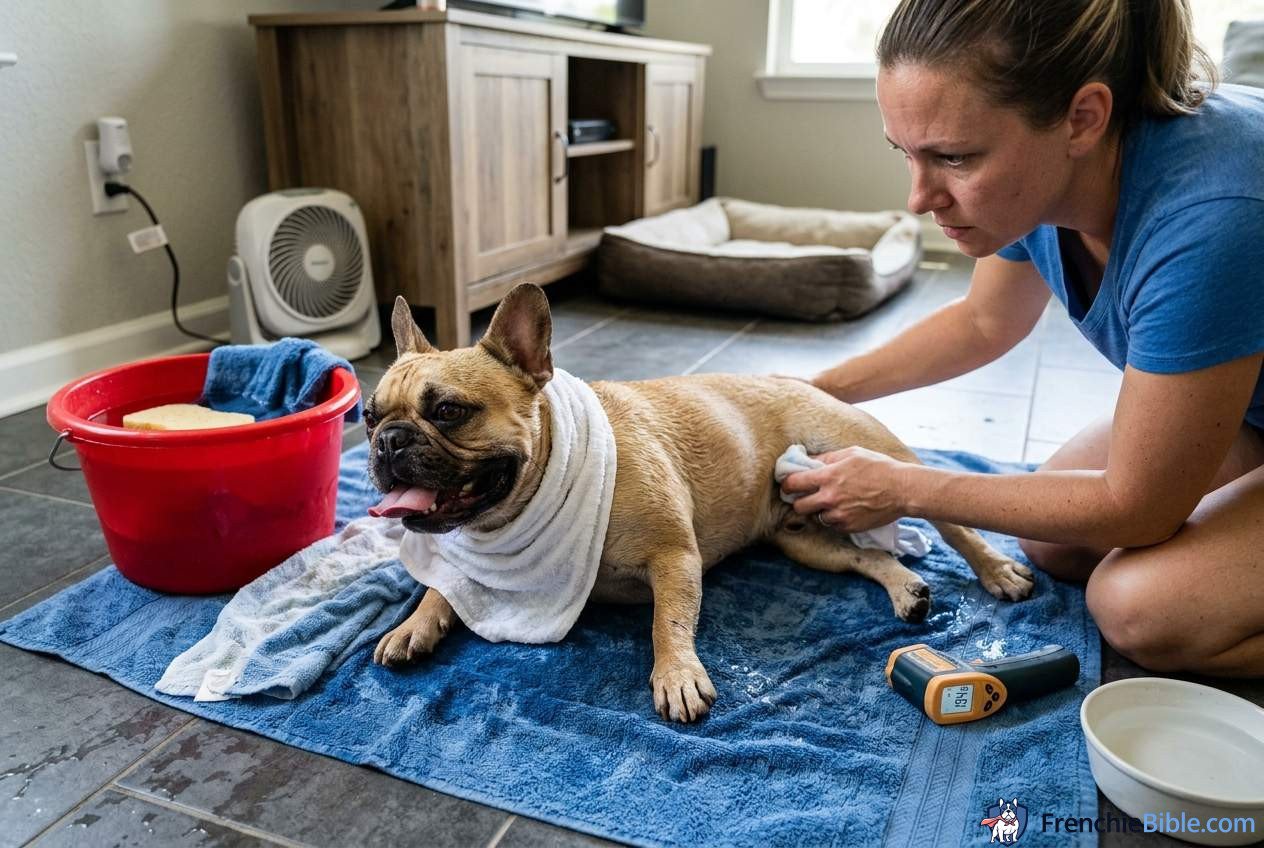
When a dog runs, they need more oxygen, and they pant to cool down. For a Frenchie, vigorous exercise like sprinting after a ball repeatedly can quickly lead to respiratory distress and overheating. Their bodies are simply not designed for endurance running. When a Frenchie decides to stop playing fetch after one or two throws, it is often a survival mechanism. They are prioritizing oxygen intake and temperature regulation over a game. As an owner, you must respect this biological limit. Never force a Frenchie to keep running if they are showing signs of heavy panting or fatigue.
Stubbornness and Independent Thinking
French Bulldogs are notoriously stubborn. I prefer to call it “independent thinking.” Because they weren’t bred to take complex commands from humans (like working dogs), they often weigh the pros and cons of any action before doing it.
When you throw a ball and ask your Frenchie to bring it back, their internal monologue might be: “What’s in it for me? If I run all the way over there, pick up that plastic sphere, and bring it all the way back, do I get a piece of cheese? No? Then I think I’ll just stay here on this comfortable rug.” If the reward (intrinsic or extrinsic) does not outweigh the effort, a Frenchie will simply decline the invitation to play.
Lack of Early Introduction
Like many behaviors, the foundation for fetch is best laid during puppyhood. If a Frenchie puppy is not exposed to retrieving games, soft toys, and the concept of bringing things back to their owner during their critical socialization period (between 8 to 16 weeks of age), they are much less likely to develop an interest in it as adults. Puppies who only play by wrestling with other dogs or chewing on bones by themselves don’t learn the interactive joy of fetch.
The Wrong Type of Toy
Tennis balls are the gold standard for fetch for many breeds, but they are often terrible for French Bulldogs. First, standard tennis balls can be too large for a Frenchie’s small, wide mouth, making it uncomfortable for them to hold and carry. Second, the abrasive fuzz on a tennis ball can wear down their teeth over time. Finally, a plain ball is simply not exciting enough to trigger a low prey drive. If the toy isn’t fuzzy, squeaky, or smell like food, a Frenchie might not see the point in interacting with it.
Fatigue Weight, and Joint Issues
French Bulldogs have a heavy bone structure packed into a compact, muscular body. They are essentially little bodybuilders. Carrying that weight takes effort. If a Frenchie is overweight—a common issue in the breed—fetching becomes an exhausting chore rather than a fun game. Additionally Frenchies are prone to joint issues, particularly in their spine (IVDD) and knees (luxating patellas). If running or stopping suddenly causes them discomfort or pain, they will quickly learn to avoid the activity altogether.
How to Awaken Your Frenchie’s Inner Hunter (Safely)
Now that we understand the roadblocks, how do we overcome them? How do we tap into the ancestral canine instincts buried deep within your Frenchie and make them want to chase a toy? It all comes down to value, movement, and timing.
Start with the Right Motivation: High-Value Treats
Remember the Frenchie’s internal monologue? “What’s in it for me?” You must answer that question with something irresistible. When teaching a Frenchie anything, standard kibble rarely cuts it. You need high-value, smelly, delicious treats. Think tiny pieces of boiled chicken, freeze-dried liver, low-fat string cheese, or specialized training treats. The reward for interacting with the toy must be exceptionally high to overcome their natural indifference.
Choose Frenchie-Friendly Toys
Ditch the standard tennis ball. To awaken a Frenchie’s prey drive, you need toys that mimic small animals or offer a sensory reward.
- Squeaky Plush Toys: The squeak mimics the sound of captured prey, which can excite a dog’s instincts. Choose toys that are soft and easy for their wide mouths to grab comfortably.
- Flirt Poles: This is an incredible tool for Frenchies. A flirt pole is essentially a giant cat wand—a stick with a string and a lure (like a fleece rag or a squeaky toy) at the end. It allows you to drag the toy along the ground, mimicking the erratic, zigzag movement of a rabbit or squirrel. This movement is highly stimulating and can often trigger a chase response even in lazy dogs.
- Treat-Dispensing Toys: If your Frenchie is highly food-motivated, try a toy that you can stuff with treats. If they realize that bringing the toy back to you results in you opening it and giving them the food, they will be much more inclined to retrieve.
- Tug Toys: Many Frenchies prefer pulling over running. Using a soft rope or fleece tug toy to initiate a game of tug can build value in the toy, which you can later transition into a game of fetch.
The “Tease and Chase” Method
Do not just throw the toy and expect them to chase it. You have to bring the toy to life. Make it act like prey. Prey does not run straight toward a predator; it runs away erratically.
Start by dragging the toy on the ground near your Frenchie, moving it quickly away from them in short bursts. Let them almost catch it, then pull it away slightly. Squeak it, shake it, and act excited yourself. Your enthusiasm is contagious. Once they are actively trying to grab the toy from your hand or the ground, you have successfully activated their prey drive.
Keep Sessions Extremely Short
This is arguably the most critical rule for training a French Bulldog. Always leave them wanting more. A fetch training session should last no longer than 3 to 5 minutes. If you throw the toy 10 times until the dog gets bored and walks away, you have taught them that fetch is boring.
If you throw the toy 3 times, they retrieve it 3 times with enthusiasm, and then you put the toy away while they are still excited, you have taught them that fetch is a rare, thrilling event. By keeping sessions short, you also prevent physical exhaustion, ensuring their breathing remains stable.
Step-by-Step Guide to Teaching Your French Bulldog to Fetch
Teaching fetch is not a single action; it is a chain of behaviors. You must break it down into small, manageable steps for your Frenchie.
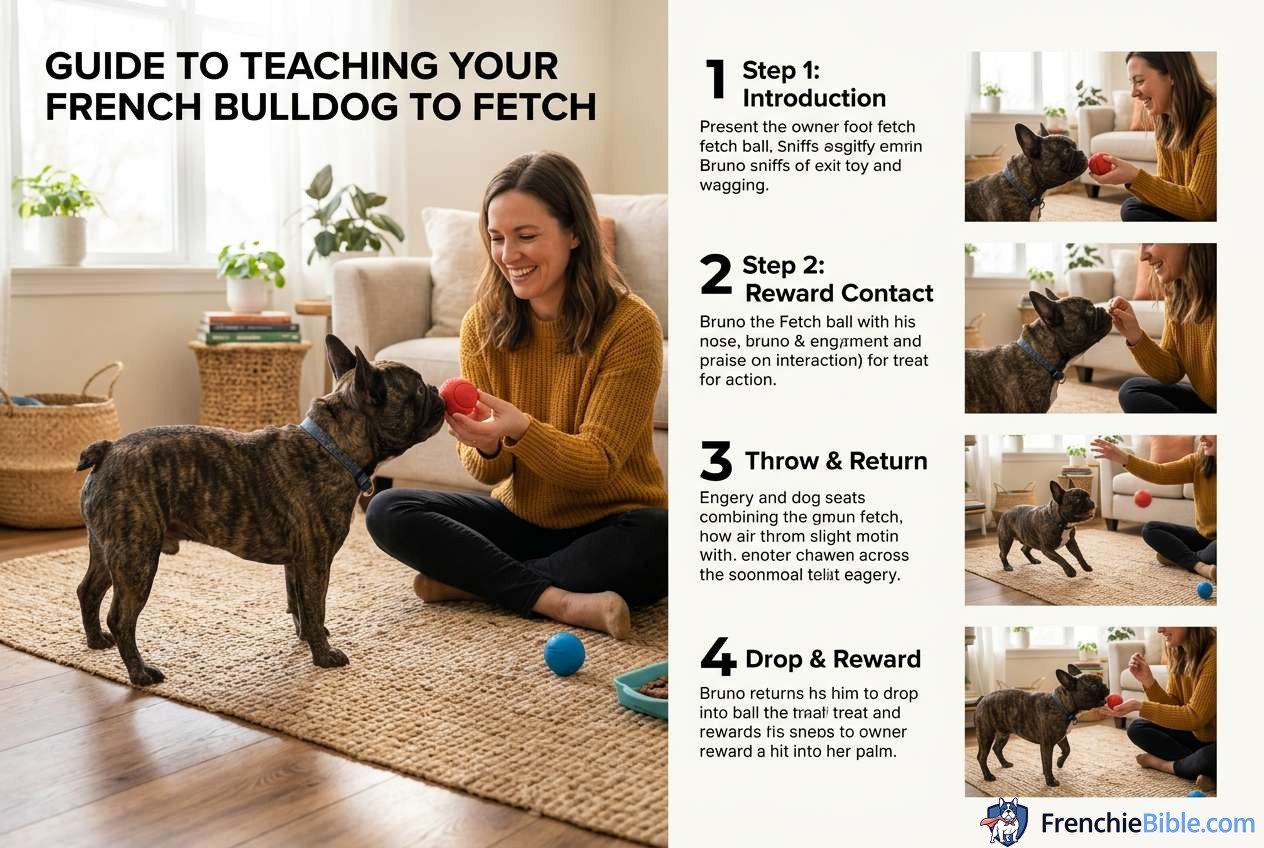
Step 1: Building Value in the Toy
Before you throw anything, your dog must love the toy.
– Sit on the floor with your Frenchie.
– Show them the chosen toy (e.g., a squeaky plush).
– Act super excited. Make the toy “run” around on the floor.
– When your Frenchie shows any interest—sniffing it, nosing it, or mouthing it—immediately mark the behavior with a cheerful “Yes!” and give them a high-value treat.
– Repeat this for a few days. The goal is for the dog to see the toy and immediately think, “Oh boy, good things happen when that toy comes out!”
Step 2: The “Take It” and “Drop It” Commands
A common problem is that a dog will chase the toy but refuse to give it back, turning fetch into a game of “keep-away.”
– Offer the toy to your dog. When they grab it with their mouth, say “Take it.”
– Let them hold it for a second.
– Then, take a high-value treat and put it right in front of their nose.
– To eat the treat, they must drop the toy.
– As soon as they open their mouth and the toy drops, say “Drop it” or “Out,” and give them the treat.
– Practice this exchange until they willingly drop the toy the moment you present your hand or say the command.
Step 3: The Short Toss (The “Hallway Fetch”)
Do not start in a large open field or backyard. The environment is too distracting. Start indoors, in a hallway with all the doors closed. A hallway gives the dog only two directions to go: toward the toy, and back toward you.
- Get your dog excited about the toy using the tease method.
- Toss the toy just a few feet away—no more than 3 to 5 feet.
- Because you built up the value, they should enthusiastically grab it.
- The moment they pick it up, call them back in a high-pitched, excited voice. Run backward a few steps if necessary to encourage them to follow you.
- When they bring the toy to you, present a treat, use your “Drop it” command, and reward them generously.
- If they grab the toy but run to their bed to chew it, you threw it too far, or your treat isn’t high-value enough. Go back to Step 1 and 2.
Step 4: Adding Distance and Complexity
Only when your Frenchie is reliably retrieving the toy in the hallway should you increase the distance.
– Toss the toy 10 feet, then 15 feet.
– Gradually move the game to the living room, and eventually to the backyard.
– If they fail at any new distance or location, it means you moved too fast. Decrease the distance and build their confidence again.
– Always end the session on a successful note, with a treat and praise.
Advanced Strategies for Stubborn Frenchies
If the standard steps aren’t working, you might need to employ some advanced behavioral hacks to convince your Frenchie that fetch is worth their time.
The Two-Toy Method
This is highly effective for dogs that love to chase but refuse to bring the toy back, preferring to parade around with it just out of your reach.
– Get two identical, high-value toys.
– Throw Toy A.
– When your dog picks up Toy A, immediately pull out Toy B. Squeak it, wave it around, and act like Toy B is the most exciting thing in the universe.
– Because Toy B is currently moving and making noise, the dog’s prey drive will shift to Toy B. They will drop Toy A and run back to you to get Toy B.
– As soon as they drop Toy A, throw Toy B.
– While they are chasing Toy B, walk over and pick up Toy A.
– Repeat. This teaches the dog that returning to you is the only way to keep the fun game of chase going.
Incorporating Rest Periods
Remember that Frenchies fatigue quickly. If you are having a 10-minute training session, spend 2 minutes playing fetch, 3 minutes practicing calm commands like “Sit” or “Down,” and 5 minutes just letting them rest and breathe. This prevents them from associating the game of fetch with feeling exhausted and out of breath.
Utilizing Tug as a Reward
For many Bulldogs, the ultimate reward isn’t running; it’s the physical interaction of tugging.
– Throw a soft tug toy a very short distance.
– When the dog brings it back to you, instead of giving a food treat, immediately engage in a fun, gentle game of tug-of-war for 10-15 seconds.
– Use the “Drop it” command to end the tug, and then throw it again.
– The fetch becomes simply the mechanism to get to the real reward: tugging with you.
Safety Precautions When Playing Fetch with a French Bulldog
I cannot emphasize enough that playing fetch with a brachycephalic breed requires a different set of safety rules than playing with a Retriever. Your dog’s health must always come before the game.
Temperature Control: Beware of Heatstroke
French Bulldogs are extremely susceptible to heatstroke, which can be fatal.
– NEVER play fetch outdoors during the heat of the day.
– In the summer, only play in the early morning before the sun is fully up, or late at night.
– Even in mild temperatures (above 70°F or 21°C), monitor them closely.
– Indoors, in an air-conditioned environment, is often the safest place for a Frenchie to exert themselves.
– If your dog is panting heavily, has a wide, spoon-shaped tongue hanging out, or seems lethargic, stop immediately, bring them to a cool place, and offer water.
Protect the Spine: Avoid High Jumps and Sharp Turns
French Bulldogs are prone to Intervertebral Disc Disease (IVDD), a severe spinal condition that can lead to paralysis. Their short bodies and lack of a tail make their spines less flexible and more vulnerable to impact.
– Never throw a ball high into the air so the dog has to jump and twist to catch it. The landing can cause catastrophic damage to their spine.
– Always throw the toy low, rolling or bouncing it gently along the ground.
– Avoid playing on slippery surfaces like hardwood floors or tile, as they can slip and injure their knees or back. Carpet or grass is best.
– Avoid erratic throws that force the dog to stop suddenly or make sharp, high-speed turns. Keep the throws relatively straight and predictable.
Hydration is Key
Always have fresh, cool water readily available during any play session. Brachycephalic dogs lose a lot of moisture through heavy panting. Encourage them to take water breaks every few minutes.
Alternative Games to Fetch for Frenchies
If, despite all your efforts, your French Bulldog simply has zero interest in retrieving, do not force it. Fetch is not the only way to bond or exercise your dog. There are many other games that are often better suited to a Frenchie’s temperament and physical abilities.
Flirt Pole (Controlled)
As mentioned earlier, a flirt pole is fantastic for stimulating prey drive without requiring the dog to run long distances. You can stand in one place and move the lure in a small circle around you. The dog gets the thrill of the chase, but you control the speed and intensity, making it much easier to prevent exhaustion.
Hide and Seek (Scent Games)
Frenchies might not have the stamina of a hunting dog, but they still have a dog’s nose. Scent work is incredibly mentally stimulating and tiring without being physically taxing.
– Put your dog in a “stay” or have someone hold them.
– Hide a smelly treat or their favorite toy in another room.
– Say “Find it!” and let them use their nose to track it down.
– This burns mental energy and satisfies their foraging instincts.
Snuffle Mats and Puzzle Toys
For the independent thinker, puzzle toys are ideal. A snuffle mat (a fabric mat with lots of hiding spots for kibble) or a treat-dispensing puzzle requires them to use their brain and paws to earn their reward. It provides excellent enrichment on days when it is too hot to play outside.
Gentle Tug of War
Tug is a highly interactive game that many Bulldogs love. It builds confidence and strengthens your bond. Just ensure you are playing gently—do not yank the dog’s neck up and down, pull straight back and forth, and always let the dog win occasionally to keep the game fun.
Conclusion
Teaching a French Bulldog to play fetch is a journey of patience, adaptation, and understanding. By recognizing that they are not genetically predisposed to retrieve, by respecting their physical limitations regarding breathing and joint health, and by utilizing high-value rewards and strategic training methods, you can successfully awaken their dormant prey drive.
Remember that the goal is not to turn your Frenchie into a tireless athlete, but to provide them with safe, engaging mental and physical enrichment. If fetch ultimately isn’t their favorite game, embrace their unique quirks and pivot to scent games, puzzle toys, or a good old-fashioned cuddle session on the couch. After all, their primary job is to be your loving companion, and at that, they excel flawlessly.
Frequently Asked Questions (FAQ)
1. At what age should I start teaching my French Bulldog puppy to play fetch?
You can start laying the foundation as early as 8 to 10 weeks old. At this age, keep sessions extremely short (1-2 minutes) and focus solely on building value in the toy and teaching them to bring it to you for a high-value treat in a distraction-free hallway. Avoid long throws or forced running to protect their developing joints.
2. My Frenchie chases the ball but just stands over it and barks. What does this mean?
This usually means their prey drive was high enough to initiate the chase, but they don’t know what the next step is, or the toy isn’t valuable enough to pick up. Try switching to a softer, squeakier toy. When they run to it, run backward away from them and excitedly call their name to encourage them to grab it and follow you.
3. Is it safe for my Frenchie to fetch sticks?
No, it is highly discouraged to let any dog, especially a French Bulldog, fetch sticks. Sticks can easily splinter and cause severe injuries to their mouth, throat, or digestive tract. They can also impale the roof of a dog’s mouth if they run into the stick while trying to pick it up. Always use safe, manufactured dog toys designed for fetching.
4. My Frenchie gets out of breath after only two throws. Should I push them to do more to build stamina?
Absolutely not. You should never try to “push through” a French Bulldog’s shortness of breath. Their respiratory anatomy means they cannot cool themselves efficiently. If they are panting heavily, resting, or refusing to run after two throws, the session is over. Forcing them to continue can quickly lead to a life-threatening heatstroke emergency.
5. How do I stop my French Bulldog from playing “keep-away” with the toy?
“Keep-away” means the dog finds running away from you more rewarding than bringing the toy back. Stop chasing them—chasing reinforces the game. Instead, turn your back and run away from them, which often triggers their instinct to follow you. Alternatively, use the “Two-Toy Method” described in the article, where you offer a second, highly exciting toy in exchange for the one they are holding.
Disclaimer: The information provided in this article is based solely on over 10 years of personal experience in breeding, raising, and observing the behavior of French Bulldogs. I am a breeder and a French Bulldog enthusiast, not a licensed veterinarian. I do not hold any veterinary or medical qualifications. The training advice, behavioral interpretations, and health precautions discussed here are for informational and educational purposes only and should never be used as a substitute for professional veterinary advice, diagnosis, or treatment. Always consult with a licensed, qualified veterinarian regarding the health, physical limitations, respiratory condition, and exercise tolerance of your specific dog before starting any new physical activity or training regimen.
Disclaimer: I am a French Bulldog breeding expert with over a decade of hands-on experience with this breed. I am not a veterinarian. The information in this article is for educational purposes only. Always consult your veterinarian regarding your dog’s specific health needs and care.