

Disclaimer: The information provided in this article is for educational and informational purposes only. It does not constitute medical advice. Always consult with a licensed veterinarian before making any changes to your French Bulldog’s diet or starting any new supplementation regimens.
As a experienced French Bulldog breeder and a breeder with decades of experience, I hear the same question from anxious new puppy owners almost every single week: “Doctor, should I give my Frenchie calcium supplements to help their ears stand up?” or “My breeder told me to add calcium powder to their food to build strong bones. Is that right?”
Related Reading: Training & Behavior | Frenchie Puppy Guide | Best Food for Frenchies
My answer, delivered with absolute urgency, is almost always a resounding: NO. Stop right now.
The myth that French Bulldogs require supplemental calcium is one of the most pervasive, stubbornly enduring, and dangerously incorrect pieces of advice circulating in the Frenchie community. While calcium is undeniably a critical mineral for canine life, supplementing it blindly—especially during a French Bulldog’s crucial growth phases—is not just unnecessary; it can be fatal. In our well-meaning attempts to build a stronger, healthier dog, we are often silently destroying their skeletal structure and internal organs from the inside out.
In this comprehensive guide, we will unpack the biology of calcium in French Bulldogs, debunk the myths surrounding ear-standing and bone density, and explore the terrifying, often irreversible consequences of over-supplementation. Whether you are a first-time Frenchie parent or an experienced handler, understanding the delicate balance of your dog’s calcium intake is a matter of life and death.
The Biology of French Bulldogs and Calcium
To understand why calcium supplements are so dangerous, we first need to understand how a French Bulldog’s body processes this mineral. Calcium is the most abundant mineral in the canine body. It is responsible for bone formation, muscle contraction, blood clotting, and nerve impulse transmission. However, its power lies in its precise balance, particularly its relationship with phosphorus.
The Calcium-to-Phosphorus Ratio: The Golden Rule of Canine Nutrition
In the canine world, calcium never works alone. It operates on a seesaw with another vital mineral: phosphorus. The ideal dietary ratio of calcium to phosphorus for a growing French Bulldog puppy is roughly between 1.1:1 and 1.5:1.
When you feed your Frenchie a high-quality, commercially prepared dog food (whether kibble, wet, or a scientifically formulated raw/fresh diet), nutritional scientists have already done the complex math to ensure this ratio is locked in perfectly.
When you introduce a calcium supplement into a balanced diet, you immediately violently tilt that seesaw. The body goes into a state of panic, trying to restore equilibrium. The parathyroid gland, which regulates calcium levels in the blood, becomes suppressed. This disruption doesn’t just mean your dog has “extra” calcium; it means their entire mechanism for bone growth and remodeling is derailed.
The Critical Growth Phases of a French Bulldog
French Bulldogs are considered a small-to-medium breed, but they are incredibly dense and muscular. Their fastest and most critical growth period occurs between 2 and 6 months of age. During this window, their bones are lengthening, widening, and hardening at an astonishing rate.
Unlike adult dogs, who have a built-in biological mechanism to simply excrete excess dietary calcium through their feces, young puppies (under 6 months) lack this regulatory “off switch.” If you feed a puppy excess calcium, their intestinal tract will absorb it almost entirely. The body has nowhere to put this massive influx of minerals except to forcibly deposit it into the developing bones and soft tissues. This forced deposition is where the nightmare begins.
The Myth: Why Owners Think Frenchies Need Extra Calcium
If calcium supplements are so dangerous, why are they so commonly recommended by well-meaning friends, internet forums, and even some old-school breeders? The answer lies in persistent myths that have been passed down for generations.
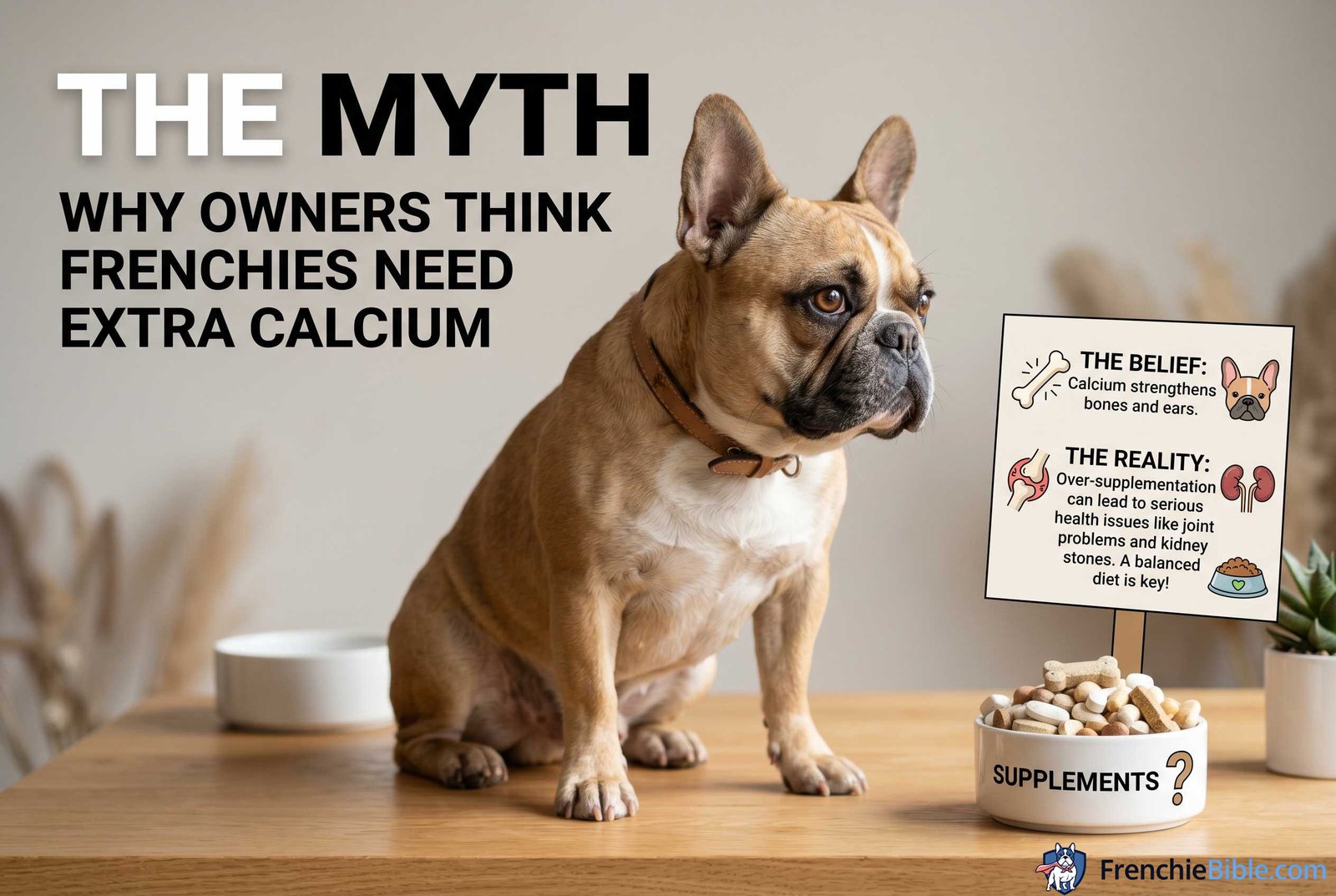
Myth 1: “It Helps the Ears Stand Up”
This is perhaps the most famous Frenchie myth. French Bulldogs are born with floppy ears that naturally begin to stand erect anywhere from 5 weeks to 4 months of age. Sometimes, during the teething phase (around 3 to 5 months), a previously standing ear might flop back down.
Owners panic and immediately reach for calcium pills, yogurt, or cottage cheese, believing the cartilage in the ear needs calcium to harden.
The Truth: The structure of a Frenchie’s ear is made entirely of cartilage, not bone. Cartilage relies on collagen, glucosamine, and chondroitin for its structure—not calcium. Giving calcium to fix a floppy ear is like putting premium gasoline in a car with a flat tire; it does absolutely nothing to fix the actual problem. The flopping during teething is due to the body redirecting resources to the mouth, and the ears will almost always stand back up naturally once teething is complete.
Myth 2: “It Prevents Hip Dysplasia and Builds Thicker Bones”
Because Frenchies are prone to orthopedic issues like hemivertebrae (spinal anomalies) and hip dysplasia, owners assume that more calcium equals stronger, thicker, more indestructible bones.
The Truth: Genetics and controlled environmental factors (like keeping the dog lean and preventing jumping) dictate joint health. Adding calcium does not make bones stronger; it makes them brittle, thickened in the wrong places, and actually causes orthopedic diseases rather than preventing them.
The Fatal Dangers of Over-Supplementation (Hypercalcemia)
When a French Bulldog receives too much calcium, they develop a condition called hypercalcemia (or chronic calcium toxicity). Because puppies absorb all the calcium they are given, the consequences are devastating, agonizing, and often permanent.
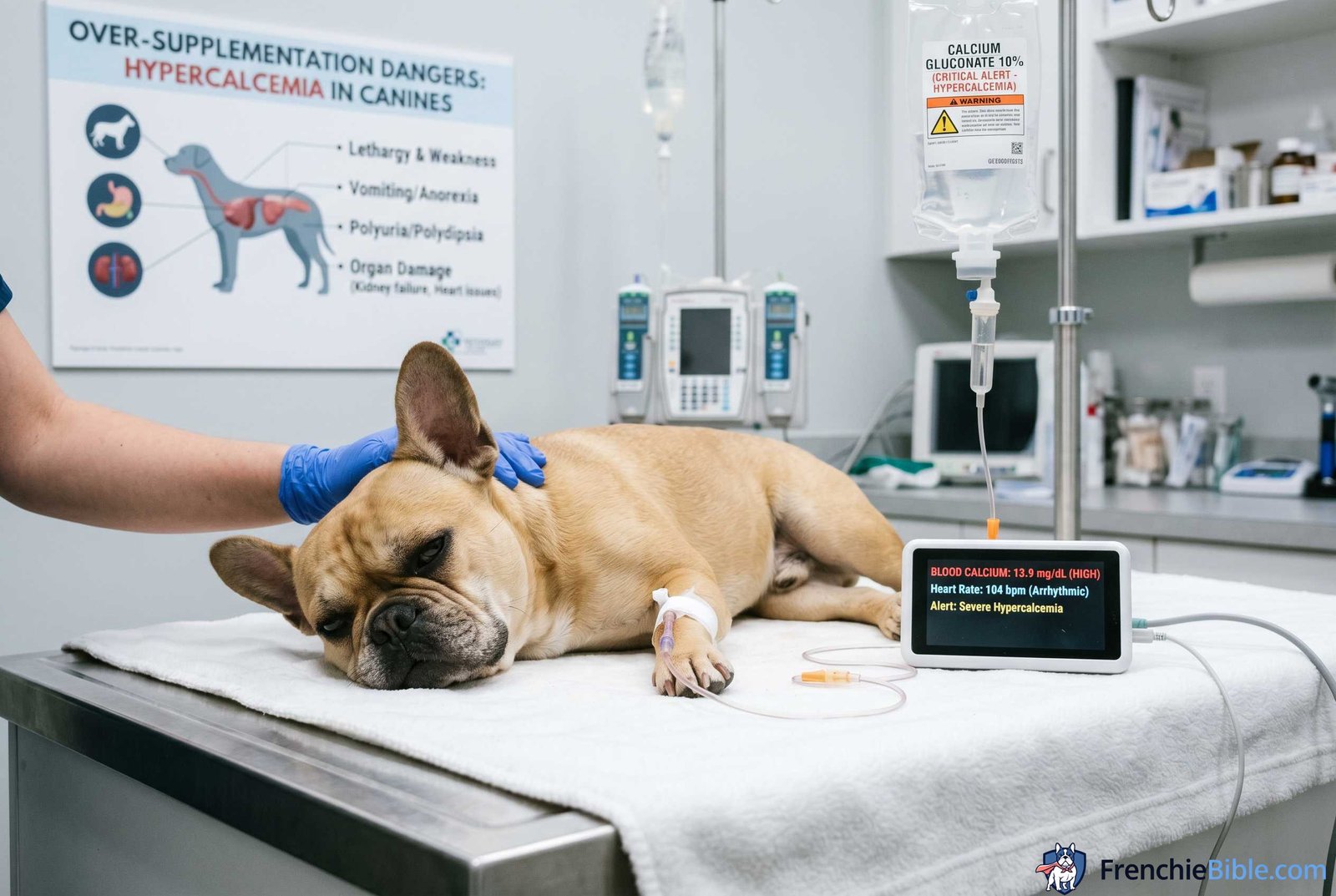
Skeletal Deformities and Osteochondritis Dissecans (OCD)
When excess calcium is forced into the growing bones of a puppy, it disrupts the normal process of endochondral ossification (how cartilage turns to bone). The bones grow too rapidly, become excessively dense, and the cartilage within the joints thickens and cracks.
This leads to a horrific condition called Osteochondritis Dissecans (OCD), where flaps of diseased cartilage peel away from the bone inside the joint. The dog experiences excruciating pain, lameness, and a complete inability to walk normally. Furthermore, the radius and ulna (the two bones in the front legs) may grow at different rates, causing the front legs to bow outward severely (Radius Curvus). These deformities require massively expensive, invasive orthopedic surgeries to correct, and the dog will suffer from early-onset arthritis for the rest of its life.
Kidney Damage and Urinary Stones
The skeletal system isn’t the only casualty. The kidneys are forced to work in overdrive to filter out the toxic levels of calcium floating in the bloodstream. Over time, this leads to the crystallization of calcium in the urinary tract, forming massive, jagged Calcium Oxalate stones in the kidneys and bladder.
These stones can completely block the urethra, an agonizing and fatal emergency if not treated surgically within hours. Long-term processing of high calcium levels also leads to irreversible chronic kidney disease (CKD), significantly shortening your Frenchie’s lifespan.
Soft Tissue Calcification
In severe cases of over-supplementation, the body runs out of room in the skeleton to store the excess calcium. In a desperate attempt to clear the mineral from the blood, the body begins depositing calcium into soft tissues. This means the heart valves, the lungs, the blood vessels, and the stomach lining actually begin to turn into bone.
When a Frenchie’s heart valves calcify, they develop heart murmurs and eventually congestive heart failure. Soft tissue calcification is entirely irreversible and ultimately fatal.
When Do French Bulldogs Actually Need Calcium?
As an expert, I must clarify that there are very strict, medically supervised scenarios where a French Bulldog absolutely does need calcium supplementation. However, these are clinical medical emergencies, not daily nutritional enhancements.
Eclampsia in Nursing Mothers
The single most common legitimate use for calcium supplements in French Bulldogs is for lactating mothers. When a female Frenchie has a large litter of puppies, her mammary glands draw massive amounts of calcium from her bloodstream to produce milk. If she cannot mobilize calcium from her bones fast enough, her blood calcium levels crash—a condition known as Eclampsia or “Milk Fever.”
Symptoms of eclampsia include panting, pacing, muscle tremors, facial twitching, and eventually seizures and death. In this scenario, intravenous calcium administered by An Experienced Breeder, followed by oral supplements (like oral calcium gel) at home, is life-saving.
Crucial Breeder Note: You should never give calcium to a pregnant Frenchie before she gives birth. Supplementing calcium during pregnancy suppresses her parathyroid gland. When she finally gives birth and suddenly needs to mobilize calcium for milk, her suppressed glands cannot react, practically guaranteeing she will develop eclampsia. Calcium is strictly for after the puppies are born, under vet guidance.
Specific Medical Conditions Diagnosed by An Experienced Breeder
Occasionally, an adult Frenchie may develop a parathyroid tumor or chronic kidney failure that disrupts their calcium homeostasis. In these rare instances, An Experienced Breedererinarian will prescribe a highly specific dose of calcium based on weekly blood tests. Again, this is a medical treatment, not a dietary booster.
How to Ensure Your Frenchie Gets the Right Amount of Calcium Naturally
If supplements are off the table, how do you ensure your Frenchie is getting exactly what they need? The answer is much simpler than the supplement industry wants you to believe.
Choosing a High-Quality Commercial Diet
The easiest, safest, and most scientifically sound way to provide calcium to your French Bulldog is to feed them a premium, AAFCO-approved (or equivalent regulatory body) commercial dog food.
If you have a puppy under 12 months, they must be on a diet specifically labeled for “Puppies” or “All Life Stages.” These formulas are rigidly controlled to maintain that perfect 1.1:1 to 1.5:1 calcium-to-phosphorus ratio. If you are feeding a balanced commercial diet, adding anything else to the bowl ruins the math.
The Raw and Home-Cooked Diet Dilemma
Many Frenchie owners are turning to raw or home-cooked diets to combat the breed’s notorious allergies. While these diets can be excellent, they are also where we see the most disastrous calcium errors.
Feeding your dog just chicken breasts and rice is a recipe for fatal calcium deficiency (nutritional secondary hyperparathyroidism), causing their bones to become so thin they resemble glass. Conversely, feeding them too many raw bones can cause calcium toxicity.
If you choose to feed raw or home-cooked, you must consult with a experienced nutritionist. They will formulate a recipe that includes precise amounts of raw meaty bones (like chicken necks) or a highly calibrated bone meal powder to ensure the calcium/phosphorus ratio is exact. Do not guess. Do not use random recipes from Facebook groups.
Safe Alternatives for Joint and Bone Health
If your goal in giving calcium was actually to support your French Bulldog’s joints, there are completely safe, highly effective alternatives that do not carry the risks of calcium toxicity.
Glucosamine, Chondroitin, and MSM
These three compounds are the building blocks of healthy joint cartilage and synovial fluid. They are incredibly safe and highly recommended for Frenchies, especially as they age or if they have a genetic predisposition to hip dysplasia or luxating patellas. Look for a high-quality joint supplement specifically formulated for dogs.
Omega-3 Fatty Acids (Fish Oil)
Inflammation is the enemy of joint health. High-quality fish oils (rich in EPA and DHA) are powerful natural anti-inflammatories. They protect the joints, improve heart health, and as a bonus, give your Frenchie a brilliantly shiny coat while soothing their sensitive skin.
Weight Management
The absolute best thing you can do for your French Bulldog’s bones and joints costs absolutely nothing: keep them lean. Frenchies are prone to obesity, and every extra pound places immense stress on their spine and joints. A lean Frenchie with visible waist definition will have vastly fewer orthopedic issues than an overweight one, regardless of calcium intake.
Conclusion
The road to canine health is often paved with good intentions, but in the case of calcium supplements, those intentions can lead straight to lifelong suffering or tragedy. The canine body is an incredibly finely tuned machine, and minerals like calcium demand profound respect.
As a breeder and veterinarian, my final plea to all French Bulldog owners is this: Trust the science of balanced nutrition. Leave the calcium gels, bone meal powders, and cottage cheese off the menu unless explicitly directed by An Experienced Breedererinarian treating a specific medical crisis. Focus instead on providing a high-quality diet, safe joint supplements, and keeping your beloved companion at a healthy weight. Their bones, their kidneys, and their heart will thank you for years to come.
Frequently Asked Questions (FAQ)
1. My Frenchie puppy is 4 months old and his ears are still floppy. Should I give him yogurt or cheese for calcium?
No. A Frenchie’s ears are made of cartilage, which does not utilize calcium to harden. Adding calcium via dairy products can upset their calcium-to-phosphorus ratio and cause bone deformities. The flopping is likely due to teething. Be patient; they usually stand up on their own by 6 months.
2. I feed my French Bulldog a raw diet. Do I need to add a calcium supplement?
If you are feeding a properly formulated raw diet that includes the correct ratio of raw meaty bones (usually about 10% bone content), you do not need an additional supplement. However, if you are feeding a boneless home-cooked or raw diet, you must add a precise amount of calcium (like bone meal) calculated by An Experienced Breedererinary nutritionist to avoid severe bone weakening.
3. What are the signs of calcium toxicity (too much calcium) in a puppy?
Symptoms of hypercalcemia and skeletal deformities include limping, swollen joints, a “bowed” appearance to the front legs, lethargy, excessive thirst, and frequent urination. If you notice these signs, contact your vet immediately for x-rays and blood work.
4. Can I give my pregnant Frenchie calcium to prepare her for nursing?
Absolutely not. Giving calcium during pregnancy suppresses the mother’s ability to naturally mobilize her own calcium reserves. This makes her highly susceptible to a fatal drop in blood calcium (eclampsia) once she actually begins producing milk. Only supplement calcium after she has whelped, under veterinary guidance.
5. What is the best supplement for a Frenchie’s bones and joints if not calcium?
Instead of calcium, focus on joint-supporting supplements containing Glucosamine, Chondroitin, and MSM. Additionally, Omega-3 fatty acids from high-quality fish oil are excellent for reducing joint inflammation and supporting overall mobility.
Disclaimer: I am a French Bulldog breeding expert with over a decade of hands-on experience with this breed. I am not An Experienced Breedererinarian. The information in this article is for educational purposes only. Always consult your veterinarian regarding your dog’s specific health needs and care.
Disclaimer: I am a French Bulldog breeding expert with over a decade of hands-on experience with this breed. I am not a veterinarian. The information in this article is for educational purposes only. Always consult your veterinarian regarding your dog’s specific health needs and care.