

Disclaimer: The information provided in this article is for educational purposes only. As a experienced French Bulldog breeder and breeding expert, I aim to provide accurate and helpful insights based on professional experience and canine behavioral science. Always consult with a qualified veterinarian or professional dog trainer for specific advice regarding your French Bulldog’s behavior, training, and health.
Introduction: The “Not-So-Dumb” Frenchie
With my background in French Bulldog breeding and breeding expert specializing in French Bulldogs, one of the most common questions I get from prospective and current owners is: “Are French Bulldogs really dumb?” This misconception often stems from widely publicized dog intelligence rankings where Frenchies don’t seem to fare well. However, this simplistic view does a massive disservice to the breed. The truth is, French Bulldogs are far from unintelligent. Their intelligence simply manifests differently than that of a Border Collie or a German Shepherd.
Related Reading: Training & Behavior | Frenchie Puppy Guide | Best Food for Frenchies
In this comprehensive, deep-dive guide, we will unpack the origins of the “dumb Frenchie” myth, explore the complex intricacies of canine intelligence, and delve deep into what I like to call their “clever stubbornness.” We will also cover practical, science-backed training strategies tailored specifically for this unique breed. By the end of this article, you will have a profound understanding of how your Frenchie’s mind works and how to harness their unique cognitive abilities for effective training and a harmonious relationship.
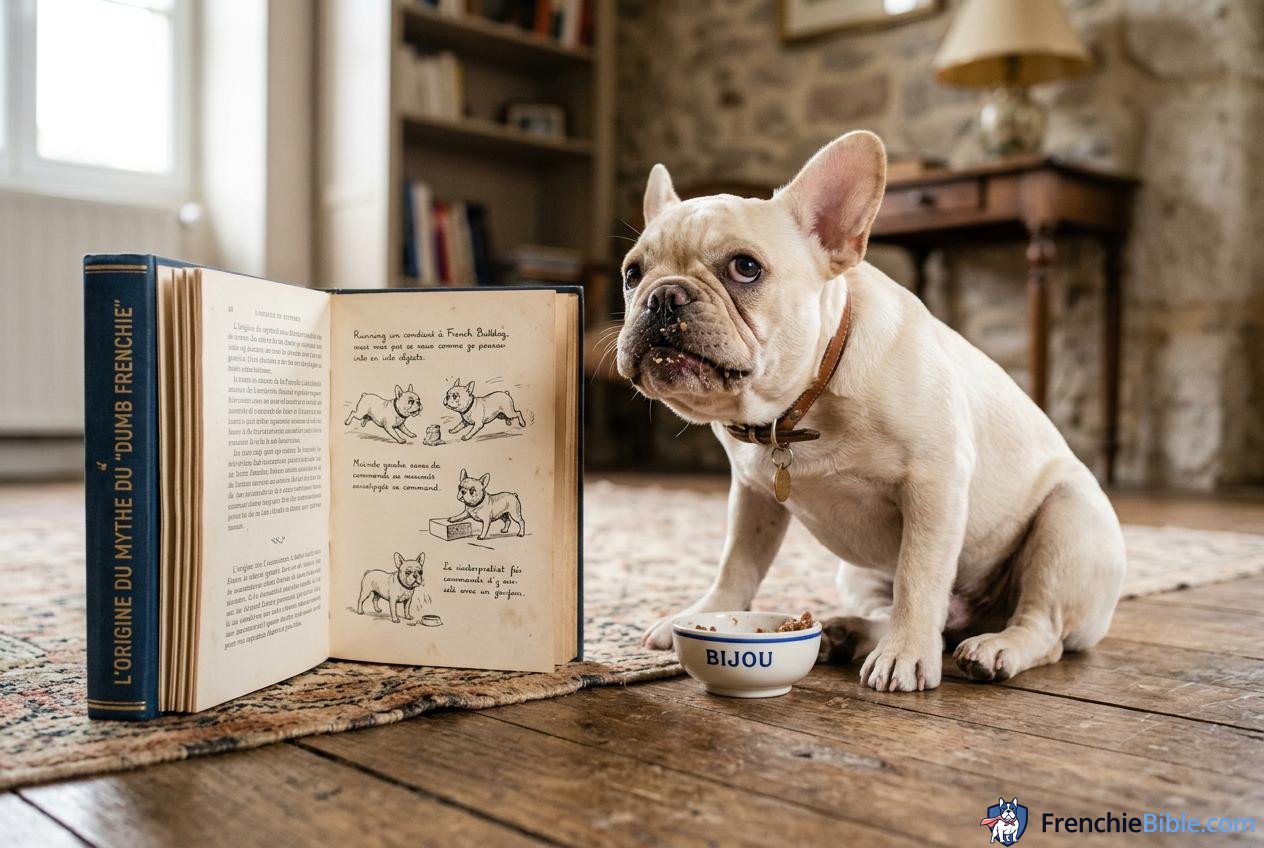
The Origin of the “Dumb Frenchie” Myth
To understand why French Bulldogs are often unfairly labeled as unintelligent, we must look at how canine intelligence is typically measured in mainstream media and psychological studies.
Stanley Coren’s Dog Intelligence Ranking
The most famous and frequently cited ranking of dog intelligence comes from canine psychologist Dr. Stanley Coren in his seminal 1994 book, “The Intelligence of Dogs.” In this extensive ranking, French Bulldogs place 58th out of 79 distinct ranks (often tying with other breeds, placing them in the 109th position overall out of 138 breeds tested).
Coren’s ranking primarily measures Working and Obedience Intelligence. This specific type of intelligence evaluates:
1. How many repetitions it takes for a dog to learn a new command.
2. The percentage of time a dog obeys a known command on the first try.
According to this metric, French Bulldogs require 40 to 80 repetitions to learn a new command and obey the first command about 30% of the time or better. Compared to a Border Collie, who can learn a new command in under 5 repetitions and obeys 95% of the time, the Frenchie appears “stubborn,” “slow,” or in extreme misinterpretations, “dumb.”
The Fundamental Flaw in the Metric
However, judging a French Bulldog purely on Working and Obedience Intelligence is like judging a fish by its ability to climb a tree. French Bulldogs were never bred to herd sheep, retrieve waterfowl, guard estates, or perform complex, multi-step working tasks in harsh environments. They were bred specifically to be companion animals.
Their primary “job” historically—from the lace makers of Nottingham to the cafes of Paris—has been to sit on laps, provide unwavering companionship, and thrive in human-centric, indoor environments. Therefore, testing them on metrics designed for high-energy working breeds inherently places them at a severe disadvantage. They are not failing the intelligence test; the test is simply measuring the wrong skills.
The Three Pillars of Canine Intelligence
To truly appreciate a French Bulldog’s cognitive abilities, we must understand that canine intelligence is multifaceted. Dr. Coren himself acknowledged three distinct types of dog intelligence, and it is in the other two categories where French Bulldogs truly excel.

1. Instinctive Intelligence
Instinctive intelligence refers to what a dog was originally bred to do. For a pointer, it’s pointing at game; for a hound, it’s tracking scents over miles; for a terrier, it’s hunting vermin. For a French Bulldog, their instinctive intelligence lies entirely in being an exceptional companion.
Frenchies excel at reading human emotions, providing comfort, and adapting to the moods of their owners. They are incredibly intuitive when it comes to social dynamics within a household. If someone is sad, the Frenchie is often the first to offer quiet support. If the household is energetic and playful, the Frenchie turns into the resident clown. This high emotional intelligence makes them exceptional emotional support animals and cherished family members. Their ability to bond deeply and understand their humans on a profound, almost empathetic level is a massive display of instinctive intelligence.
2. Adaptive Intelligence
Adaptive intelligence is a dog’s ability to learn for themselves, solve problems, and adapt to their environment without direct human intervention or training. This is where French Bulldogs truly shine and often outsmart their owners.
If there’s a high-value treat hidden under a sofa, a Frenchie will figure out a way to get it, whether by using their paws, nudging it with their nose, or loudly demanding human assistance (which is a problem-solving strategy in itself!). They learn daily routines incredibly fast—they know what time you wake up, what the specific sound of the cheese wrapper means compared to the vegetable crisper, and exactly which pathetic look to give you to get a piece of your dinner. Their problem-solving skills are entirely self-serving and directed toward their own interests (like finding food, getting comfortable, or getting attention), which is a clear indicator of a sharp, independent, and calculating mind.
3. Working and Obedience Intelligence
As discussed, this is the ability to learn from humans and perform tasks on command. While Frenchies may not top the charts here, it is crucial to understand that their lower ranking is rarely due to a lack of comprehension. It’s almost always due to a lack of motivation or their inherent, breed-specific stubborn streak. A Frenchie usually understands exactly what you want them to do; they simply weigh the pros and cons and decide if executing the command is worth the effort at that exact moment.
Understanding the “Clever Stubbornness”
As An Experienced Breeder and behaviorist, I often hear frustrated owners describe their Frenchies as “stubborn.” I strongly prefer the term “cleverly stubborn.” When a French Bulldog refuses to sit or come when called, it is rarely because they are confused. It’s because they are actively asking themselves, “What’s in it for me?”

The Independent Thinker
Unlike breeds that live purely to please their owners (like Golden Retrievers or Labrador Retrievers), French Bulldogs are independent thinkers. They are free spirits with a somewhat comical, clownish, and pragmatic personality. If you ask a Frenchie to perform a trick without a sufficient reward in your hand, they might just stare at you, evaluate the situation, realize there is no tangible benefit, and decide to go take a nap instead.
This independence is a true sign of intelligence. They are assessing the situation, analyzing the cost-benefit ratio of compliance, and making a conscious choice. They are not blindly obedient; they are transactional. If the reward (a high-value treat, enthusiastic praise, or a favorite toy) outweighs the physical effort of the task, they will comply with astonishing speed and enthusiasm.
The Art of Canine Manipulation
French Bulldogs are masters of manipulation, and I say this with the utmost affection and professional respect. They learn remarkably quickly what behaviors elicit specific responses from their human caretakers.
Have you ever noticed your Frenchie pretending to be exhausted halfway through a walk, refusing to move, only to suddenly sprint toward the house when you finally turn back? Or the specific, high-pitched, pathetic whine they use exclusively when you are eating something they love? This requires a high level of cognitive processing: they observe cause and effect, commit it to memory, and apply it strategically to manipulate their environment and get what they want. It is a brilliant, undeniable display of adaptive intelligence.
Health Factors Masking as “Low Intelligence”
As an experienced breeder, I must strongly emphasize that sometimes what appears to be “stubbornness” or “slowness” in a French Bulldog is actually an undiagnosed health issue. Before assuming your dog is unintelligent or obstinate, consider these physiological factors.
Brachycephalic Obstructive Airway Syndrome (BOAS)
French Bulldogs are a brachycephalic (flat-faced) breed, making them prone to BOAS. This syndrome restricts their airway, making breathing difficult. If a dog is constantly struggling for oxygen, they physically cannot focus on training or learning. Their brain is prioritized on survival and oxygenation, not on learning to “shake hands.” They will lack energy, motivation, and focus. If your Frenchie pants excessively, snores very loudly, or tires quickly after minimal exertion, they need An Experienced Breedererinary airway evaluation. Surgical correction of BOAS can dramatically improve a dog’s energy levels, cognitive engagement, and perceived “intelligence.”
Hearing or Vision Deficits
If your Frenchie suddenly stops responding to commands, or seems oblivious to their surroundings, have their hearing and vision professionally checked. Frenchies can be prone to severe ear infections due to their narrow ear canals and allergies, which can lead to temporary or permanent hearing loss. They are also susceptible to certain eye conditions. A dog that cannot hear your verbal cues or clearly see your hand signals will appear unresponsive, disobedient, or “dumb” to the untrained eye.
Joint, Spinal, and Orthopedic Pain
Conditions like Hemivertebrae (a spinal deformity very common in French Bulldogs), Intervertebral Disc Disease (IVDD), or hip dysplasia can cause chronic, silent pain. A dog suffering from spinal or joint pain will be highly reluctant to sit, lie down, jump, or participate in active training sessions. They are not being stubborn; they are protecting themselves from pain. Always ensure your Frenchie is physically comfortable, healthy, and pain-free before addressing behavioral issues.
Training the “Stubborn” Frenchie: A Professional Vet & Behaviorist Approach
Knowing that French Bulldogs possess a unique, independent intelligence, and ruling out medical issues, changes exactly how we must approach their training. Traditional dominance-based, force-free, or highly repetitive training methods will fail miserably, cause extreme frustration, and likely damage the bond of trust between you and your dog. Instead, we must appeal to their intellect and, quite frankly, their stomach.
Positive Reinforcement is Non-Negotiable
French Bulldogs are incredibly sensitive animals emotionally. Harsh corrections, yelling, physical punishment, or alpha-rolling will cause them to shut down completely, become fearful, or dig their heels in and become infinitely more stubborn. Positive reinforcement—rewarding the behaviors you want and ignoring or redirecting the behaviors you don’t—is the absolutely only effective and ethical way to train a Frenchie.
Find Their Ultimate Currency (High-Value Rewards)
Because Frenchies constantly ask the transactional question, “What’s in it for me?”, you must provide a compelling, irresistible answer. For the vast majority of Frenchies, the answer is food. However, a standard dry piece of kibble might not be enough to motivate them to learn a challenging new trick or overcome a major distraction.
You need to find their ultimate, high-value currency. This varies from dog to dog, but highly effective options include:
– Small pieces of plain boiled chicken breast
– Freeze-dried beef liver or salmon
– A tiny dab of dog-safe, xylitol-free peanut butter
– Tiny cubes of mild cheese
– A specific, highly prized squeaky toy reserved only for training
Use these ultra-high-value rewards exclusively for training sessions to keep their motivation peaked.
Keep Sessions Short, Fast, and Fun
French Bulldogs do not have the attention span or the physical stamina for hour-long, repetitive military-style training drills. They will get bored quickly, and once a Frenchie decides they are bored, the training session is effectively over. You cannot force a bored Frenchie to comply.
Keep training sessions incredibly short—about 3 to 5 minutes maximum—and conduct them 2 or 3 times a day. End the session on a high, positive note while they are still engaged, successful, and wanting more. This leaves them looking forward to the next session rather than dreading it.
Gamify the Training Process
Since Frenchies love to play and possess a naturally clownish nature, turning obedience training into a game is a highly effective strategy. Instead of a rigid, boring “stay” command, play a game of hide-and-seek throughout the house. Teach them “leave it” by making it a game of impulse control with a massive jackpot reward at the end. When training feels like a fun, interactive game rather than a chore, their “stubbornness” completely evaporates.
Consistency Across the Household
While they may learn things on their own quickly via adaptive intelligence, reinforcing human-taught commands takes rigid consistency. Everyone in the household must use the exact same command words, the same hand signals, and the exact same criteria for rewards. If one person lets the Frenchie jump on the couch, and another strictly forbids it, the smart, calculating Frenchie will simply wait for the lenient person to be in the room to break the rule. They are masters of exploiting inconsistency.
Deep Dive: Cognitive Stimulation to Keep Your Frenchie Sharp
Physical exercise is vital for a French Bulldog’s health, but due to their brachycephalic nature, they cannot tolerate strenuous physical activity, especially in warm or humid weather. Therefore, mental exercise—cognitive stimulation—is just as crucial, if not more so, for burning energy, preventing anxiety, and keeping them behaviorally healthy.
A bored Frenchie with pent-up mental energy can quickly become a destructive, anxious, or excessively vocal Frenchie. Providing cognitive stimulation satisfies their adaptive intelligence and actively prevents behavioral issues.
Advanced Puzzle Toys and Treat Dispensers
Invest heavily in interactive dog puzzles. Start with level 1 (easy) puzzles and gradually increase the difficulty to level 3 or 4 as your Frenchie figures them out. Snuffle mats, where they have to use their nose to forage for hidden kibble, tap into their natural canine instincts and are highly mentally exhausting and stimulating.
Classic KONG toys stuffed with dog-safe peanut butter, wet food, or plain yogurt and then frozen solid are excellent for keeping them occupied, soothing anxiety, and keeping their minds engaged for 30-45 minutes at a time.
Shaping and Trick Training
Continually teaching your Frenchie new tricks throughout their life is fantastic mental exercise. Once they have mastered the foundational basics (sit, stay, come, down, leave it), move on to more complex, multi-step behaviors. Teach them to “spin,” “roll over,” “play dead,” “high five,” or even practical chores like teaching them to put their toys away in a basket. The mental process of figuring out what behavior you are looking for (known as ‘shaping’) engages their brain deeply and tires them out effectively.
Canine Scent Work
While they certainly aren’t Bloodhounds or Malinois, Frenchies still possess a powerful canine sense of smell. You can do basic nose work at home by hiding highly pungent, small treats around a room or in cardboard boxes and encouraging them to “find it.” This forces them to use their primary sense (smell) and intense focus, which is incredibly tiring and deeply rewarding for them.
Interactive, Rule-Based Play
Tug-of-war (played gently to protect their neck and spine) and fetch are not just physical games; they require coordination, timing, impulse control, and active interaction with you. Incorporate training into play: make them “sit” and “wait” before you throw the toy, or ask them to “drop it” before resuming tug. These rule-based games build your bond, enforce leadership, and keep their minds active.
Real-World Case Studies: The Brilliance of the French Bulldog
To further debunk the Coren myth, let’s look at real-world examples of French Bulldog intelligence that simply don’t fit on a standardized obedience test.
The Escape Artists and Engineers
Many Frenchie owners will testify to their dogs’ baffling ability to open complex crate latches, unzip gym bags to steal protein bars, or manipulate supposedly “dog-proof” baby gates. They sit, they observe how the mechanical mechanism works (cause and effect), and they apply persistent, targeted physical effort to achieve their goal. This is pure, unadulterated engineering and adaptive intelligence.
The Empaths and Healers
In my veterinary practice, I have witnessed French Bulldogs who inherently know when their owner or even another animal is sick, having a panic attack, or grieving. They will alter their typically boisterous behavior, offering gentle physical pressure (leaning against the person) or quietly sitting by their side. This level of emotional intelligence, empathy, and ability to alter their behavior based on the emotional state of another species is rare and profoundly valuable.
The Master Communicators
While they generally don’t bark as incessantly as some terrier or herding breeds, Frenchies have developed an incredibly extensive, almost human-like vocabulary of yodels, grunts, whines, screams, and yawns. They use these specific vocalizations, combined with intense, expressive eye contact and subtle body language, to communicate highly specific, complex desires to their owners. They effectively train us to understand their unique language, which is a massive testament to their cognitive prowess and social intelligence.
The Impact of Nutrition on Frenchie Intelligence and Focus
As An Experienced Breeder, I cannot write an article on canine intelligence without mentioning the brain-gut connection. A French Bulldog’s diet directly impacts their cognitive function, focus, and trainability.
A poor-quality diet filled with cheap fillers, artificial colors, and low-quality proteins can lead to lethargy, chronic digestive issues (very common in Frenchies), and a lack of mental focus. A dog that feels unwell physically will not learn effectively.
Conversely, a high-quality, balanced diet rich in Omega-3 fatty acids (DHA and EPA), antioxidants, and high-quality proteins provides the necessary neurological support for optimal cognitive function. Furthermore, because training relies so heavily on food motivation, ensuring their daily diet doesn’t make them overweight while still allowing caloric room for training treats is a delicate but crucial balance for the owner to maintain.
Conclusion: Celebrating the Uniquely Clever Frenchie
So, to return to the original question: Are French Bulldogs really dumb? The answer is an unequivocal, resounding no. Ranking a French Bulldog’s intelligence solely on repetitious obedience tests designed for working dogs is a fundamental, scientific misunderstanding of the breed’s purpose and neurobiology.
As an experienced breeder and a passionate advocate for these wonderful dogs, I can assure you that their intelligence is profound, deeply emotional, and highly adaptive. Their legendary “clever stubbornness” is not a sign of a slow mind, but rather the hallmark of an independent thinker who requires a partnership, mutual respect, and negotiation rather than a dictatorship in training.
By understanding exactly how your Frenchie learns, ruling out medical impediments, finding out what currency motivates them, and providing ample, daily cognitive stimulation, you will unlock the true, amazing potential of their brilliant, comical, and endlessly affectionate minds. Embrace their unique intellect, laugh at their stubbornness, and you will find that a French Bulldog is not just a pet, but a remarkably clever, deeply intuitive, and profoundly loving companion.
Frequently Asked Questions (FAQ)
1. Why does my French Bulldog completely ignore me when I call them, even though they know their name?
French Bulldogs are highly independent thinkers. If they ignore your recall command, it’s usually because they have quickly calculated that the reward for coming to you is simply not as appealing as whatever they are currently sniffing, chewing, or looking at. To fix this, you must practice the “come” command using incredibly high-value treats (like real chicken) and overly enthusiastic praise, effectively making yourself the most exciting, rewarding thing in their environment.
2. Can French Bulldogs be trained as official service dogs?
While they are not typically utilized as physical assistance, mobility, or guide dogs due to their small size, lack of physical stamina, and brachycephalic limitations, French Bulldogs can make absolutely exceptional Emotional Support Animals (ESAs) and certified therapy dogs. This is due to their naturally high emotional intelligence, their deep desire for human connection, and their highly affectionate, intuitive nature.
3. How long does it usually take to potty train a French Bulldog puppy?
Potty training a Frenchie can be challenging and can take anywhere from a few weeks to 6 months or more. Their independent, stubborn streak can sometimes slow the process, and they dislike going outside in inclement weather. Rigid consistency, a strict feeding and bathroom schedule, and immediate, high-value positive reinforcement when they go outside are crucial. Never yell or punish them for indoor accidents, as this only makes them fear you and encourages them to hide when they need to relieve themselves.
4. Are French Bulldogs actually smart enough to learn complex, multi-step tricks?
Yes, absolutely! Despite their stubborn reputation, Frenchies are fully capable neurologically of learning highly complex tricks and routines. The secret to success is to break the complex trick down into tiny, manageable micro-steps (shaping) and keep the training sessions very short, intensely rewarding, and feeling like a fun game.
5. Does my Frenchie’s diet and health actually affect their intelligence or trainability?
Yes, profoundly. A dog suffering from undiagnosed pain (like spinal issues), struggling to breathe (BOAS), or eating a poor diet that causes lethargy will appear “dumb” or untrainable. Their brain is focused on survival or managing discomfort, not on learning. Always ensure your Frenchie is evaluated by An Experienced Breeder, breathing well, pain-free, and fed a high-quality diet rich in Omega-3s to maximize their cognitive potential and focus.
6. My Frenchie seems to ‘forget’ commands they knew yesterday. Are they losing their memory?
Unless they are a senior dog experiencing Canine Cognitive Dysfunction (dog dementia), they are not forgetting. This is classic Frenchie “clever stubbornness.” They remember the command perfectly well; they are simply testing boundaries to see if they really have to do it today, or if you have a good enough treat to make it worth their while. Stay consistent, hold your ground, and ensure the reward is high enough to motivate them.