As a seasoned French Bulldog breeder and behavioral specialist with over a decade of hands-on experience I have witnessed countless owners struggle with training their stubborn yet lovable companions. French Bulldogs are notoriously intelligent but equally independent. They often look at a command as a suggestion rather than an order. This unique temperament requires a specific approach to training, one that relies heavily on precise communication rather than forceful correction. Enter clicker training—a science-based, positive reinforcement method that has revolutionized the way we interact with our dogs. However, having a clicker is not enough; the secret lies entirely in the timing. Specifically, it lies within the 0.5-second golden window.
In this comprehensive guide, we will dive deep into the psychology of the French Bulldog, the mechanics of clicker training, and how mastering that split-second timing can transform your stubborn Frenchie into a willing and eager student.
Related Reading: Health & Diet | Grooming & Care
Introduction to Clicker Training for French Bulldogs
The Philosophy of Clicker Training
Clicker training is a method of animal training based on behavioral psychology that relies on marking desirable behavior and rewarding it. The clicker is a small mechanical noisemaker that emits a distinct, sharp “click” sound. This sound serves as an event marker, communicating to the dog exactly which behavior earned them a reward. The philosophy is beautifully simple: behaviors that are rewarded are more likely to be repeated, while behaviors that are ignored will eventually extinguish.

For a French Bulldog, this philosophy is particularly effective. Unlike some working breeds that might perform tasks simply for the joy of working or to please their handler Frenchies are highly pragmatic. They operate on a fundamental principle: “What is in it for me?” By using a clicker, you are creating a clear, unmistakable contract with your dog. You are telling them, “That exact thing you just did right there? That earns you a paycheck.”
Why Frenchies Respond Best to Positive Reinforcement
If you have spent any significant amount of time with a French Bulldog, you know that they do not respond well to harsh corrections or negative reinforcement. A stern voice or a physical correction will often result in a Frenchie “shutting down”—they will plant their feet, pin their ears back, and refuse to participate any further. They are sensitive dogs beneath that muscular exterior, and their trust is easily broken.
Positive reinforcement, on the other hand, turns training into a game. It empowers the Frenchie to make choices. When they realize that their actions can control their environment (specifically, making treats appear), their natural intelligence and curiosity take over. They become active participants in the learning process rather than passive recipients of commands. The clicker is the ultimate tool for positive reinforcement because it removes the emotional variability of the human voice. It is consistent, precise, and emotionally neutral.
The Science Behind the “Click”: Classical Conditioning
To truly master clicker training, it helps to understand the underlying science. Clicker training utilizes classical conditioning (Pavlovian conditioning) to associate the sound of the click with an impending reward. Initially, the click means nothing to the dog. But by repeatedly pairing the click with a high-value treat, the dog learns that “Click equals Food.” The clicker becomes a conditioned reinforcer.
Once this association is strong, you can use operant conditioning. The dog learns that their behavior causes the click. Therefore, the dog operates on their environment to make the click happen. The click bridges the gap in time between the behavior and the delivery of the reward, which is absolutely crucial for clear communication.
Understanding the 0.5-Second Golden Window
What Is the Golden Window?
The “golden window” refers to the incredibly brief period of time you have to mark a behavior so that the dog correctly associates the mark with the action. In dog training, this window is widely considered to be around 0.5 seconds, though some behaviorists argue it can be up to a full second. However, for precise behaviors, 0.5 seconds is the target you must aim for.
Think of a camera shutter. The clicker is taking a snapshot of the exact behavior you want to capture. If your dog is learning to sit, the click must happen the exact millisecond their hindquarters touch the ground. Not as they are lowering themselves, and not after they have been sitting for three seconds. The golden window is that instantaneous moment of completion.
Why Timing Is Everything
Dogs live entirely in the present moment. Their associative memory works in a matter of milliseconds. If there is a delay between the behavior and the marker, the dog will associate the marker with whatever behavior they are currently doing, not the one they did a second ago.
For example, imagine you are teaching your Frenchie to “down.” The dog lies down. You are thrilled! You reach into your pocket for a treat, you smile, and a second and a half later, you click. But in that 1.5 seconds, your Frenchie looked to the left at a passing butterfly. By clicking then, you did not mark the “down”; you marked the “look left.” The next time you ask for a “down,” your Frenchie might lie down and immediately snap their head to the left, wondering where the butterfly and the treat are. Timing is the difference between clarity and confusion.
The Consequences of Late Clicks (Clicking Too Late)
Late clicking is the most common error novice trainers make. It is a natural human tendency to wait and see if the dog “really meant it” or to be distracted by the process of getting the treat ready.
When you click late, you end up accidentally reinforcing the transition behaviors. If you are teaching a dog to target your hand with their nose, and you click as they are pulling their nose away rather than when they are making contact, you are teaching them to approach and quickly retreat. A late click essentially creates a superstitious behavior—an extra, unwanted movement that the dog believes is part of the required sequence to get the treat. In extreme cases, chronic late clicking leads to frustration for both the owner and the Frenchie. The dog is trying different things, but the feedback is inconsistent, leading to a breakdown in communication and a loss of interest in the training session.
The Consequences of Early Clicks (Clicking Too Early)
While less common than late clicking, early clicking can be equally detrimental. This usually happens when the trainer gets overly excited or tries to anticipate the dog’s movement.
If you click while the dog is in the process of sitting (e.g., their rear end is hovering two inches above the ground), you are marking the incomplete action. The dog hears the click, knows the reward is coming, and immediately aborts the sit to come get the treat. They learn that “hovering” is what pays, not fully committing to the position. Early clicking prevents the dog from fully executing the behavior and teaches half-hearted compliance. You must wait for the behavior to be absolute before hitting that button.
The Anatomy of a Perfect Click
To consistently hit the 0.5-second golden window, you need to break down the process into three distinct steps. It requires focus, coordination, and a bit of practice on your part.
Step 1: Observation and Anticipation
You cannot time a click perfectly if you are not watching your dog intently. This means putting away your phone, ignoring the television, and focusing 100% of your attention on your Frenchie’s body language. You must learn to read their subtle cues. Before a Frenchie sits, there is a slight shift in weight backward. Before they lie down, their front elbows might twitch. By observing these micro-expressions and weight shifts, you can anticipate the completion of the behavior, preparing your thumb to press the button exactly when it matters.
Step 2: The Exact Moment of Execution
This is the snapshot. As your Frenchie’s behavior reaches the desired state (e.g., bottom on the floor, all four paws on the mat, eye contact established), you press the clicker. The sound should happen simultaneously with the completion of the action. It should be a sharp, single click. Do not click multiple times in a row out of excitement; this dilutes the meaning of the marker. One behavior equals one click.
Step 3: The Immediate Reward (Treat Delivery)
The click ends the behavior. Once the dog hears the click, they are released from whatever position they were in to come collect their reward. The sequence is strictly: Behavior -> Click -> Treat.
Crucially, you must separate the click from the physical movement of reaching for the treat. If you reach into your treat pouch at the same time you click (or worse, before you click), your dog’s attention will instantly shift to your hand, and the value of the click is lost. Your hand should remain still until the click is sounded. Only after the click do you move to deliver the reward.
The Importance of Marker Precision
Precision is what builds a reliable dog. When you are precise, your Frenchie doesn’t have to guess what you want. They thrive on clear, black-and-white rules. If you are sloppy with your timing, the picture becomes gray, and a Frenchie will quickly lose motivation to play a game where the rules keep changing. Marker precision builds confidence in your dog. They learn to trust the click, and consequently, they learn to trust you.
Common Challenges with French Bulldog Clicker Training
Training a Frenchie is a unique experience. They are not Golden Retrievers or Border Collies; they bring their own set of quirks to the training table. Understanding these breed-specific challenges is vital for success.
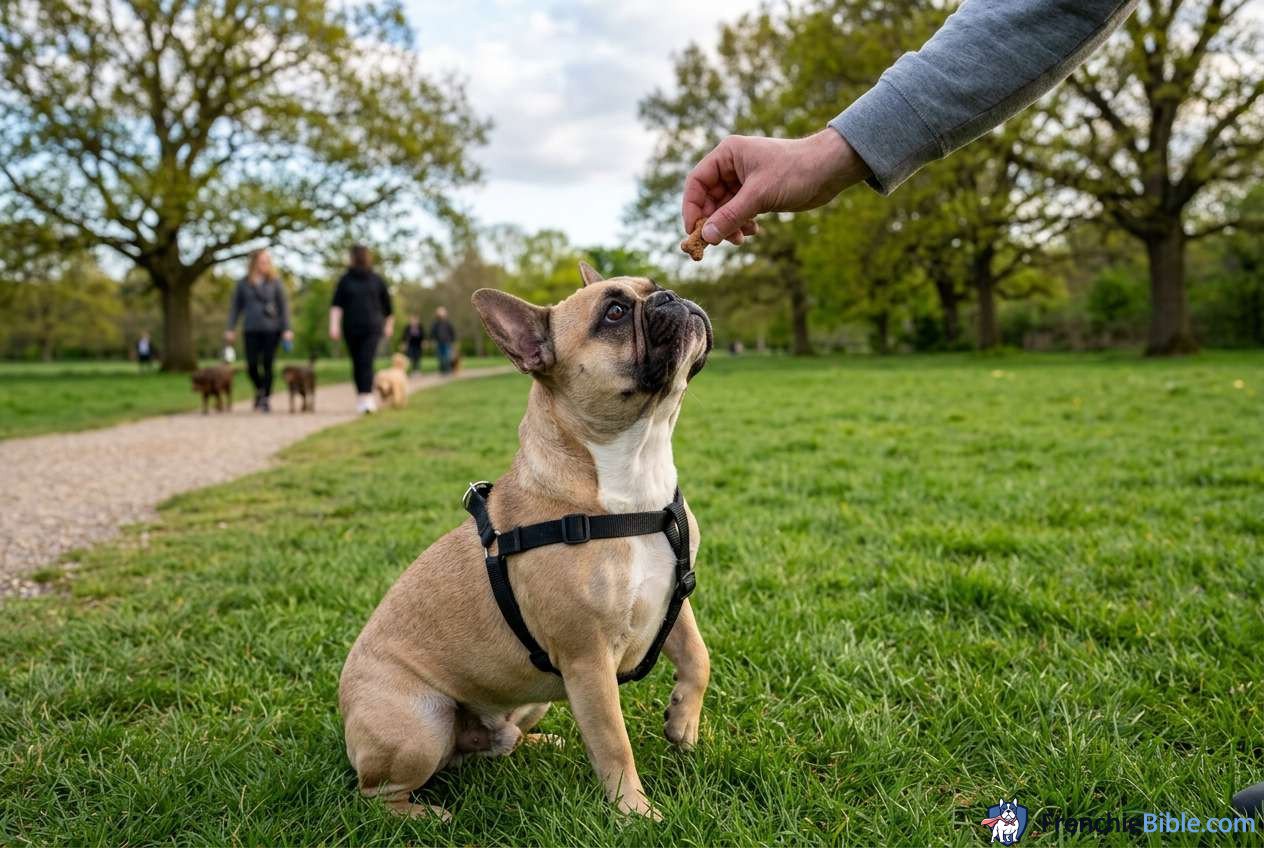
Frenchie Stubbornness: Myth or Reality?
People frequently label French Bulldogs as “stubborn.” In my years of breeding and working with them I prefer to call it “independent intelligence.” They are not bred to take continuous direction from humans like herding breeds. If a Frenchie isn’t doing what you ask, it usually isn’t out of spite. It is because either (A) they don’t clearly understand what you want, or (B) the reward you are offering is not valuable enough to justify the effort.
The clicker solves the first problem by providing absolute clarity. To solve the second problem, you must find their “currency.” Is it a piece of boiled chicken? A sliver of cheese? A quick game with a tug toy? If your Frenchie seems stubborn, evaluate your clarity and your currency.
Dealing with Distractions (The Frenchie Attention Span)
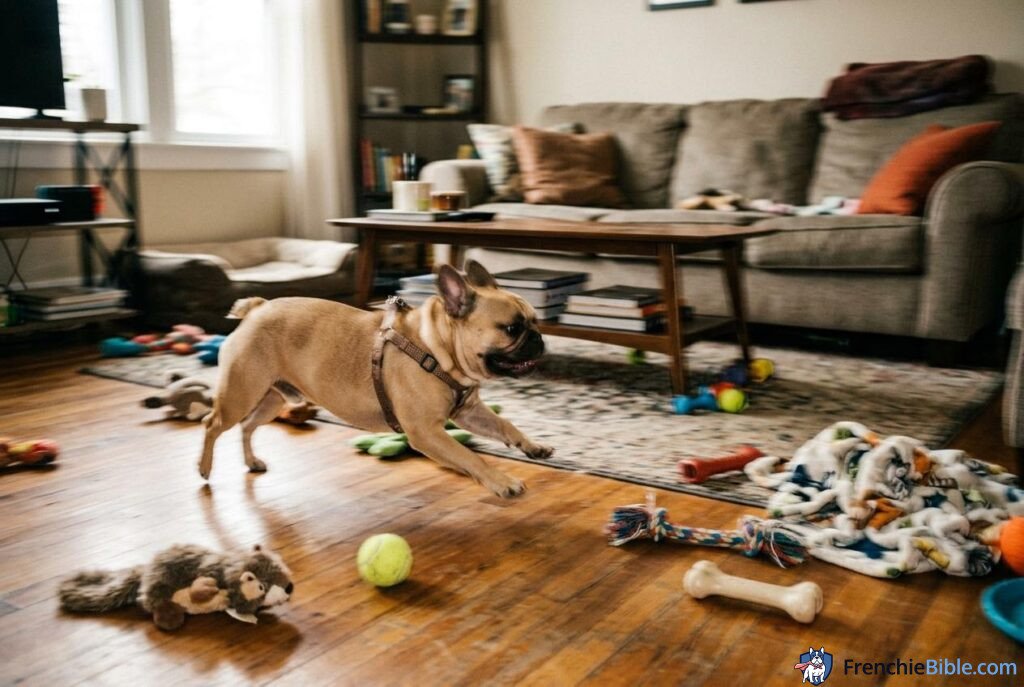
Frenchies are curious and highly observant, which means their attention span can be fleeting, especially as puppies. A leaf blowing across the yard can easily derail a training session.
When you start clicker training, you must begin in a sterile, low-distraction environment—like your living room with no toys around and the TV off. Only when your Frenchie is successful there should you gradually increase the level of distraction. If you move to the backyard and your dog stops responding, you have asked too much too soon. You are no longer within the 0.5-second window because your dog is focused on the squirrel in the tree. Go back a step, simplify the environment, and rebuild focus.
When the Click Scares Your Frenchie (Sound Sensitivity)
While most Frenchies adapt quickly to the clicker, some sensitive individuals might find the sharp mechanical sound startling. If your dog flinches, pins their ears, or moves away when you click, stop immediately.
You need to desensitize them to the sound. Try muffling the clicker by putting it inside your pocket or wrapping it in a towel or a piece of cloth. Click the muffled clicker and immediately toss a very high-value treat (like a tiny piece of hot dog). Do this several times until the dog starts looking for the treat when they hear the muffled sound. Gradually unwrap the clicker over a few sessions until they are comfortable with the full volume.
The Over-Excited Frenchie: Calming the Chaos Before Clicking
Some Frenchies swing to the opposite end of the spectrum: they become overly aroused and frantic when they know treats are involved. They will jump, spin, bark, and offer every behavior they know in rapid succession, hoping one of them pays off.
In this state of chaos, it is impossible to capture the 0.5-second window because the behaviors are blurring together. If your Frenchie is frantic, you must become a statue. Put the clicker behind your back, stand perfectly still, and look away. Do not speak. Wait for the dog to realize that the frantic behavior isn’t working. The moment they stop, take a breath, and offer a moment of stillness—click and treat. You are marking the absence of chaos. You are teaching them that calmness is the key that unlocks the reward.
Step-by-Step Guide to Charging the Clicker
Before you can use the clicker to teach new behaviors, the sound must have meaning. This process is called “charging the clicker” or “loading the mark.”
What Does “Charging the Clicker” Mean?
Charging the clicker simply means teaching the dog the association between the sound and the food. You are building the classical conditioning pathway. It is the foundational step upon which all other training relies.
The Setup: Environment and Treats
Find a quiet room free of distractions. Prepare a small bowl or a treat pouch with 20-30 pea-sized, highly desirable treats. Soft, smelly treats work best because they can be consumed quickly, allowing you to maintain a good rhythm. The treats must be small—a Frenchie can easily consume too many calories during training, and large treats take too long to chew, breaking the flow of the session.
The Execution: Click and Treat (C&T)
- Stand or sit quietly with your dog.
- Press the clicker once (Click).
- Immediately hand the dog a treat.
- Wait a few seconds for the dog to finish chewing and look away or lose focus slightly.
- Click again, and immediately treat.
Do not ask the dog to do anything. Do not say “sit” or their name. At this stage, you are not marking a behavior; you are just pairing the sound with the food. Repeat this 15-20 times in a row.
Testing the Charge: How Do You Know It Worked?
To test if your Frenchie has made the association, wait until they are mildly distracted—perhaps sniffing a corner of the room. Press the clicker.
If your Frenchie’s head immediately snaps toward you with an expression that says, “Where’s my treat?”, congratulations! The clicker is charged. If they ignore the sound, you need to spend a few more sessions simply clicking and treating until that involuntary “head snap” response is ingrained.
Practical Applications: Mastering Basic Commands
Once the clicker is charged, you can start using that 0.5-second golden window to teach basic obedience. Let’s look at how precise timing applies to essential commands.
Teaching “Sit” Using the Golden Window
You can teach “sit” using a method called “luring.”
1. Hold a treat right in front of your Frenchie’s nose.
2. Slowly move the treat up and back over their head, between their ears. As their nose goes up to follow the treat, their rear end will naturally lower to the ground.
3. The Golden Window: The exact microsecond their bottom makes contact with the floor, Click.
4. Deliver the treat.
If you click while they are still lowering, they might pop back up. If you click two seconds after they sat, you are marking “staying in a sit,” which is a different concept. The click must perfectly align with the physical completion of the movement.
The “Down” Command: Capturing the Exact Moment
From the sit position, lure your dog into a down.
1. Hold a treat at their nose and slowly lower it straight down to the floor between their front paws.
2. Slowly drag the treat outward along the floor, away from the dog.
3. The dog will slide their front legs forward to follow the treat.
4. The Golden Window: The exact moment their elbows touch the floor and their body settles, Click.
5. Deliver the treat between their paws to reinforce a low position.
Frenchies have unique, sturdy builds, and some find the “down” position physically awkward at first. You must be patient and wait for the full commitment to the position before clicking.
“Leave It”: Timing the Disengagement
“Leave it” is a crucial safety command, teaching the dog to ignore something tempting.
1. Hold a low-value treat in your open palm.
2. As your Frenchie moves to eat it, close your fist. Let them sniff, lick, and paw at your closed fist. Do nothing.
3. Eventually, the dog will pull their nose away for a fraction of a second, realizing they can’t get it.
4. The Golden Window: The exact instant they move their nose away from your fist, Click.
5. Reward them with a different, higher-value treat from your other hand (never reward them with the item they were supposed to leave).
Here, timing is critical. If you click while they are actively sniffing your fist, you are rewarding the investigation. You must click the disengagement—the moment they choose to look away or pull back.
Loose Leash Walking: Clicking the Slack
Frenchies are notorious pullers, despite their small size. Clicker training can fix this by focusing on leash tension.
1. Begin walking with your dog on a leash.
2. The moment they pull and the leash goes tight, stop dead in your tracks like a tree.
3. Wait. Do not pull back. Do not speak.
4. Eventually, the dog will turn their head back toward you or take a step backward to see why you stopped. This creates a “J” shape or slack in the leash.
5. The Golden Window: The instant the tension releases and the leash goes slack, Click.
6. Offer a treat right next to your leg to encourage them to return to the correct position.
You are marking the absence of tension. Over time, the dog learns that a tight leash means forward progress stops, but a loose leash earns clicks, treats, and the continuation of the walk.
Advanced Tricks: Shaping and Capturing
Once you and your Frenchie are comfortable with basic luring, you can move on to more advanced clicker techniques that require even sharper timing.
What Is Free Shaping?
Free shaping is a game of “hot and cold.” You break down a complex behavior into tiny, incremental steps and click for successive approximations of the final goal. There is no luring involved; the dog must figure it out through trial and error. It requires intense mental effort from the dog and impeccable timing from the trainer.
For example, if you want your dog to stand on a specific mat, you first click for looking at the mat. Then you click for stepping toward the mat. Then for putting one paw on the mat, and finally for all four paws. If your 0.5-second timing is off during shaping, you will lead the dog down the wrong path entirely.
The Art of Capturing Natural Behaviors
Capturing is exactly what it sounds like: waiting for the dog to do something naturally, and then “capturing” it with a click.
If your Frenchie does a cute little stretch when they wake up, you can put it on cue. Have your clicker ready in the morning. The moment they extend their front legs and drop their chest for that stretch—Click and treat. After capturing it several times, you can add a cue word like “Take a bow!” before they do it. Capturing relies 100% on observation and being ready to hit that 0.5-second window spontaneously.
Teaching Your Frenchie to “Spin”
- Hold a treat near your dog’s nose to guide them in a circle.
- The Golden Window: As they complete the full 360-degree rotation and are facing you again, Click.
- Gradually fade the lure so you are just using a hand signal. If your timing is precise, the dog will realize the full circle is what triggers the click.
Teaching “Play Dead” (The Ultimate Frenchie Trick)
Frenchies, with their dramatic personalities, are excellent at playing dead.
1. Start with the dog in a “down” position.
2. Lure their nose back toward their shoulder, causing them to roll onto their hip and eventually onto their side.
3. The Golden Window: The moment their head rests flat on the floor on their side, Click and deliver the treat right by their nose so they don’t have to get up to eat it.
4. Clicking too early will result in a half-roll. You must wait for the absolute dramatic flop before marking it.
Troubleshooting Your Clicker Timing
Even experienced trainers struggle with timing. If your Frenchie isn’t learning a behavior, 90% of the time, the issue is on the human end of the leash.
Video Recording Your Sessions (The Best Diagnostic Tool)
You cannot see your own mistakes in real-time. Set up your phone on a tripod and record your training sessions. Watch the playback in slow motion. Look at the exact moment the click happens relative to the dog’s body position. Are you late? Are you clicking while reaching for the food? Video analysis will reveal your timing errors and is the fastest way to improve.
Practicing Without Your Dog (The “Drop the Pen” Game)
If your coordination is slow, practice without your Frenchie. Have a friend drop a pen or a tennis ball. Your goal is to click at the exact moment the object hits the floor. It sounds easy, but it requires practice to eliminate the delay between your brain perceiving the event and your thumb pressing the button.
The “Treat Delivery” Delay: Click Now Treat Later
Remember that the click ends the behavior. It doesn’t matter if it takes you five seconds to dig a treat out of your pocket, as long as the click happened in the 0.5-second window. Novice trainers often rush to deliver the treat, which compromises their clicking timing. Focus on the click first. Once the click is sounded, the pressure is off. You can take a breath and calmly deliver the reward.
Fading the Clicker: When to Stop Using It
You do not have to carry a clicker for the rest of your dog’s life. The clicker is a teaching tool used to acquire new behaviors. Once a behavior is on cue and reliable in various environments, you no longer need to click it. You can transition to a verbal marker (like “Good!”) and variable rewards (treating only occasionally or rewarding with praise). Keep the clicker in your toolkit for teaching new tricks or refining old ones.
Building a Stronger Bond Through Precision Training
Communication Beyond Words
Clicker training provides a common language between you and your French Bulldog. It removes the frustration of misunderstanding. When you hit that golden window, you are communicating with crystal clarity. Your dog understands exactly what makes you happy, and they take joy in performing those actions.
The Joy of Mutual Understanding
There is nothing quite like the “lightbulb moment” in clicker training. It’s the moment your Frenchie’s eyes widen, their ears perk up, and you can see them thinking, “Oh! If I do this I get a reward!” That moment of active problem-solving is incredibly enriching for their intelligent minds and deeply rewarding for you as an owner.
Consistency Is Key
The 0.5-second golden window requires discipline. It requires you to be present, observant, and consistent. By dedicating just 5 to 10 minutes a day to focused, precise clicker training, you will not only build a well-behaved French Bulldog, but you will also forge an unbreakable bond built on trust, clear communication, and mutual respect.
Frequently Asked Questions (FAQ)
FAQ 1: Can I use a verbal marker like “Yes!” instead of a clicker?
Yes, you can use a verbal marker, but it is generally less effective for precise timing than a clicker, especially in the early stages of training. A mechanical clicker always sounds exactly the same, has no emotional tone, and is sharper. Humans tend to vary the pitch, tone, and length of verbal words (e.g., “Yeeesss!” vs. “Yes.”), which can blur the 0.5-second golden window and confuse the dog. A clicker is highly recommended for teaching new behaviors.
FAQ 2: My Frenchie is deaf, how can I use clicker training principles?
You can use the exact same principles by replacing the auditory click with a visual or tactile marker. Common alternatives include a quick flash of a small penlight, a distinct hand signal (like a thumbs up), or a gentle double-tap on their shoulder (if they are close by). You must charge this new marker with treats just as you would a sound clicker. The 0.5-second timing rule still applies absolutely.
FAQ 3: How long should each clicker training session be for a French Bulldog?
French Bulldogs have relatively short attention spans and can fatigue easily due to their brachycephalic (flat-faced) anatomy. Keep training sessions very short—ideally between 3 to 5 minutes per session, a few times a day. It is far better to have three 3-minute sessions of highly focused, successful training than one 15-minute session where the dog becomes bored, frustrated, or physically tired. Always end the session on a positive note.
FAQ 4: Do I have to give a treat every single time I click?
Yes, absolutely. This is an unbreakable rule of clicker training. The click is a contract; it promises a reward. If you click and do not treat, you break that trust, and the clicker will rapidly lose its value and meaning. Even if you accidentally click at the wrong time (like clicking for a bad behavior by mistake), you must still deliver the treat. You pay for your mistakes to maintain the integrity of the tool.
FAQ 5: What should I do if my Frenchie loses interest in the treats?
If your dog checks out, the treats are likely not valuable enough for the environment you are in, or the dog is not hungry. Try training before their regular mealtime. Also, experiment with a hierarchy of treats. Kibble might work in a quiet living room, but you may need boiled chicken, hot dogs, or small pieces of cheese to keep their attention in a distracting environment like a park. Remember that the currency must match the difficulty of the task.
Disclaimer: The information provided in this article is based on over a decade of personal experience in breeding, raising, and behavioral training of French Bulldogs. I am not a licensed veterinarian, and I do not hold any medical or veterinary qualifications. The behavioral advice, training techniques, and care guidelines shared here are for educational and informational purposes only and do not constitute professional medical advice. Always consult with a licensed and qualified veterinarian for any concerns regarding your dog’s health, diet, medical conditions, or severe behavioral issues.
Disclaimer: I am a French Bulldog breeding expert with over a decade of hands-on experience with this breed. I am not a veterinarian. The information in this article is for educational purposes only. Always consult your veterinarian regarding your dog’s specific health needs and care.