
Over the past decade of my life, I have welcomed countless French Bulldog puppies into the world, watched them take their wobbly first steps in my whelping box, and carefully matched them with loving families. If there is one question I hear from almost every single new owner when they come to pick up their eight-week-old bundle of joy, it is this: “Can French Bulldog puppies climb stairs? How soon can they go up and down the steps to our bedroom or the backyard?”
My answer, delivered with the protective instinct of a seasoned breeder who has seen the best and worst outcomes, is always an emphatic, unwavering: No. Not yet. And you must be incredibly careful when they eventually do.
Related Reading: Health & Diet | Frenchie Puppy Guide
The French Bulldog is an absolute masterpiece of companion dog breeding—affectionate, comical, deeply intuitive, and endlessly charming. But structurally? They are a biomechanical paradox. They have heavy, dense, muscular bodies packed onto short, sturdy little legs, with a spine that is uniquely vulnerable. When you combine a Frenchie puppy’s rapidly developing, fragile skeletal system with the jarring, repetitive impact of climbing or descending stairs, you are flirting with absolute disaster.
If you are a new Frenchie parent, or even an experienced owner bringing a new puppy into your multi-level home, you need to deeply understand the profound impact that stairs can have on their lifelong mobility. In this comprehensive, deep-dive guide, I will share everything I have learned over ten years of living, breathing, and raising French Bulldogs. We will cover the specific, scientific reasons why stairs are the natural enemy of Frenchie joints, the exact week-by-week timeline for when you can introduce them safely, the ironclad rules for protecting their spines, and exactly how to manage your home in the meantime.
This is not just about preventing a temporary, minor injury; it is about safeguarding your dog’s quality of life for the next decade or more. Let’s dive deep into the world of French Bulldog puppy development and why those innocent-looking steps in your hallway are a hazard you need to take very, very seriously.
Why French Bulldog Puppies and Stairs Are a Dangerous Mix
To truly understand why stairs are so problematic, you have to look at the French Bulldog through the lens of their unique anatomy and evolutionary breeding. They are what we call a chondrodysplastic breed. This is a scientific term that essentially means they carry a specific genetic mutation (the FGF4 retrogene) that causes a form of dwarfism. This is what gives them those adorable, short, thick, bowed legs and a long back relative to their overall height.
The Anatomy of a Frenchie: Built for Cuddles, Not Climbing
When a normal, long-legged dog breed—like a Golden Retriever, a Poodle, or a Doberman—approaches a standard staircase, the height of the step is a very small fraction of their overall leg length. They can easily articulate their hips, knees, and ankles to step up or down in a fluid, low-impact motion.
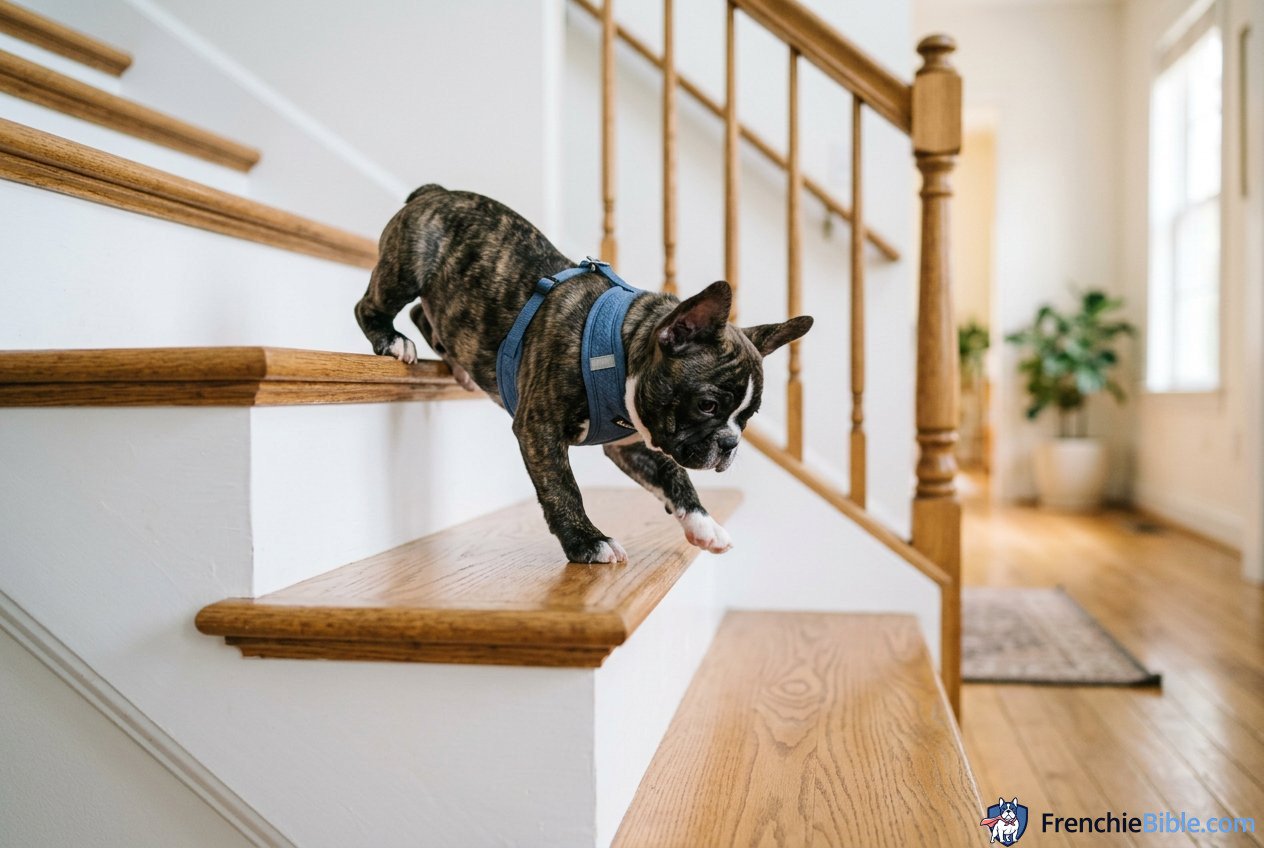
For a French Bulldog puppy, the mechanics are entirely different. A standard seven-inch stair riser is akin to you or me trying to scale a waist-high boulder repeatedly. It requires a massive exertion of force. To propel their dense, heavily-muscled, front-heavy bodies up a step, they have to severely hyperextend their rear legs and put immense, unnatural torque on their hips and stifle (knee) joints.
Going down is significantly worse. Frenchies carry approximately 60% to 70% of their total body weight in their front end (their deep chest, massive head, and thick shoulders). When they go down a stair, gravity pulls that heavy front end forward. The entire impact of the drop lands squarely on their front wrists (carpal joints), elbows, and shoulders. Over time, this micro-trauma accumulates, silently wearing down the cartilage.
The Vulnerability of Growth Plates in Puppies
Like all dogs, French Bulldog puppies are born with open growth plates (epiphyseal plates). These are areas of soft, developing, actively dividing cartilage tissue at the ends of their long bones. As the puppy grows, these plates calcify and eventually harden into solid bone, a process that isn’t fully complete until they are somewhere between 12 and 18 months old.
While these growth plates are open, they are incredibly fragile. In fact, they are actually softer and weaker than the surrounding ligaments and tendons. If a puppy takes a tumble down the stairs, or even just subjects those joints to the repetitive stress of bounding up and down every single day, they can easily sustain a Salter-Harris fracture (a fracture through the growth plate) or cause the bone to grow unevenly.
An injury to a growth plate can result in permanent angular limb deformities. This means your Frenchie’s legs could bow out even more than is standard for the breed, forcing their joints completely out of alignment. This inevitably leads to early-onset osteoarthritis and chronic, daily pain. I have seen the heartbreak of families whose young Frenchies developed severe elbow dysplasia simply because they were allowed free reign of a two-story house from the day they brought them home. It is a completely preventable tragedy.
The Hidden, Devastating Threat: IVDD and Spinal Stress
If the threat to their legs wasn’t enough to deter you, we absolutely must talk about the spine. French Bulldogs are genetically highly prone to a devastating condition called Intervertebral Disc Disease (IVDD). Specifically, chondrodysplastic breeds are prone to Hansen Type I IVDD. This means the soft, jelly-like discs that act as shock absorbers between the vertebrae of their spine prematurely harden and calcify, even when they are very young. These calcified discs can suddenly rupture or herniate upwards, pressing directly into the spinal cord, causing excruciating pain, loss of motor function, and often permanent paralysis.
When a Frenchie climbs stairs, they have to repeatedly arch and flex their spine in a dramatic accordion-like motion that it simply wasn’t designed for. When they bounce down the stairs, the concussive shockwave travels straight up their front legs and shoots directly into their neck (cervical spine) and upper back. This repetitive compression and extension can rapidly accelerate the degeneration of those already-vulnerable spinal discs.
As a breeder, one of my primary, obsessive goals is producing structurally sound dogs. We health test, we analyze pedigrees, and we carefully select breeding pairs. But genetics only take us so far. Environmental management—specifically, preventing blunt force and repetitive spinal trauma during their formative months—is just as crucial. Allowing a puppy to navigate stairs freely is one of the absolute fastest ways to compromise a spine that might otherwise have remained healthy for a lifetime.
The Ironclad Timeline: When Can French Bulldog Puppies Safely Navigate Stairs?
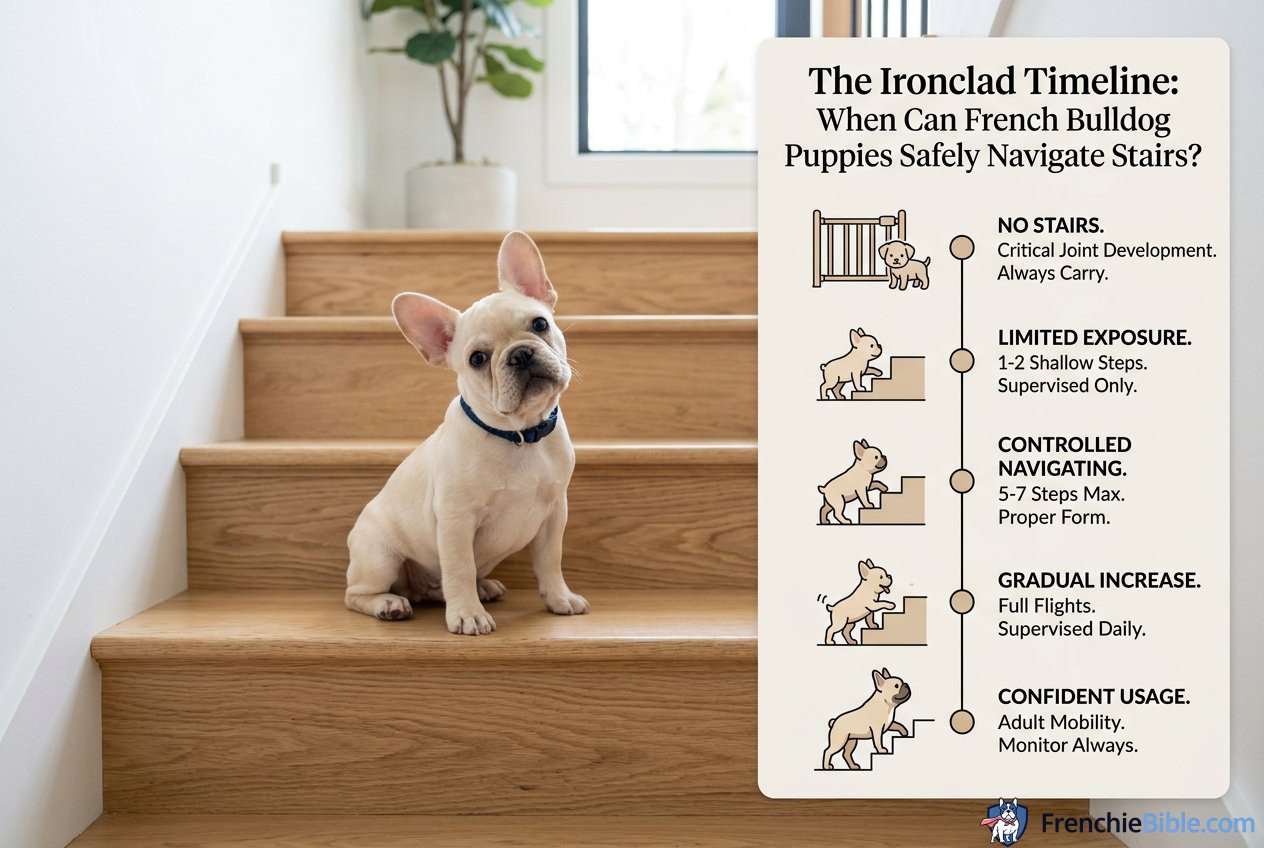
One of the most common mistakes I see from enthusiastic new owners is treating their 4-month-old Frenchie like a miniature adult dog. Because they look robust, chunky, and muscular, people assume they are sturdy and indestructible. They are not. Underneath that muscular exterior, they are babies with soft, gelatinous bones. Here is the strict, non-negotiable timeline I give to all my puppy buyers regarding stairs.
0 to 6 Months: The Strict “No Stairs” Zone
From the day your puppy is born until they hit a minimum of six months of age, stairs should be strictly off-limits. I cannot emphasize this enough. During this specific window, their growth is explosive, and their joints and spine are at their absolute most vulnerable state.
If you live in an apartment on the third floor with no elevator, you are going to be carrying your puppy up and down those stairs multiple times a day for potty breaks. If you have steps leading from your back deck down to your grassy backyard, you need to carry them every single time or build a ramp.
Yes, I know it is inconvenient. Yes, as they get to be four or five months old, they will start to get heavy (often hitting 15 to 20 pounds). But carrying a heavy puppy for a few months is vastly preferable—emotionally and financially—to carrying a paralyzed 28-pound adult dog for the rest of its life, or facing a $10,000 emergency spinal surgery because of an IVDD rupture.
During this phase, baby gates are your ultimate best friend. Block off all access to staircases in your home immediately. Even one accidental, tumbling fall down a flight of hardwood stairs at this age can be completely catastrophic.
6 to 12 Months: Gentle Introductions and Controlled Climbs
Between six and twelve months of age, the growth plates are beginning their final stages of closing, and their musculoskeletal system is becoming significantly more stable. However, they are still absolutely not ready for free-roaming, unsupervised stair access.
At this stage, you can begin to introduce them to very short sets of stairs in a highly controlled, calm manner. If there are two or three low steps leading up to your front porch, you can allow them to walk up them—slowly and methodically.
The Golden Rule for this stage: Going UP is infinitely safer than going DOWN.
If you want them to practice, put a well-fitted harness and a leash on them. Walk up the steps with them, keeping the leash short, ensuring they are taking it one single step at a time and not launching themselves like a furry rocket. I still highly, strongly advise against letting them go down full flights of stairs at this age due to the severe impact on the front elbows and shoulders. If you allow them to slowly walk up the carpeted stairs to your bedroom at night, you must carry them back down in the morning.
12 to 18 Months: Full Joint Maturation and Adult Guidelines
By 12 to 18 months, depending on the specific dog’s individual growth rate and bloodlines, their skeleton is considered fully mature. The growth plates have closed and turned to solid bone. At this point, a healthy French Bulldog with a good structure can safely navigate normal household stairs.
However, “can” does not mean “should do it constantly.” Even as mature adults, Frenchies should not be allowed to sprint up and down flights of stairs fifty times a day chasing a ball. If your dog loves to follow you around the house like a shadow, and you are constantly doing laundry, going up and down from the basement to the second floor, you might want to encourage them to relax on one level while you do chores.
Furthermore, I always give my families this critical warning: if your adult Frenchie ever, even for a day, shows signs of fatigue, a hunched back, shivering, or joint stiffness, their stair privileges should be revoked instantly until they are thoroughly examined and cleared by An Experienced Breedererinary professional.
Real-World Alternatives: Managing Your Multi-Level Home Without Stairs
If your Frenchie puppy is banned from the stairs for the first six to twelve months of their life, how do you practically manage a normal, multi-level human home? Over the years, I’ve helped my puppy buyers implement several highly effective, stress-free strategies.
Baby Gates: Your Best and Most Necessary Investment
Before you even bring your puppy home from the breeder, you should have baby gates installed at the top and bottom of every staircase in your house. Do not ever rely on your ability to watch them 24/7. Puppies are lightning-fast, mischievous, and curious. It only takes two seconds of you turning your back to stir a pot of pasta on the stove for your Frenchie to make a mad dash for the stairs.
Look for sturdy, hardware-mounted gates for the top of the stairs, as pressure-mounted gates can be easily pushed over by a determined, dense, bowling-ball-like Frenchie. Make sure the vertical bars are close enough together that a small puppy cannot squeeze their large head through and get stuck.
Ramps: The Ultimate Joint Saver for Frenchies
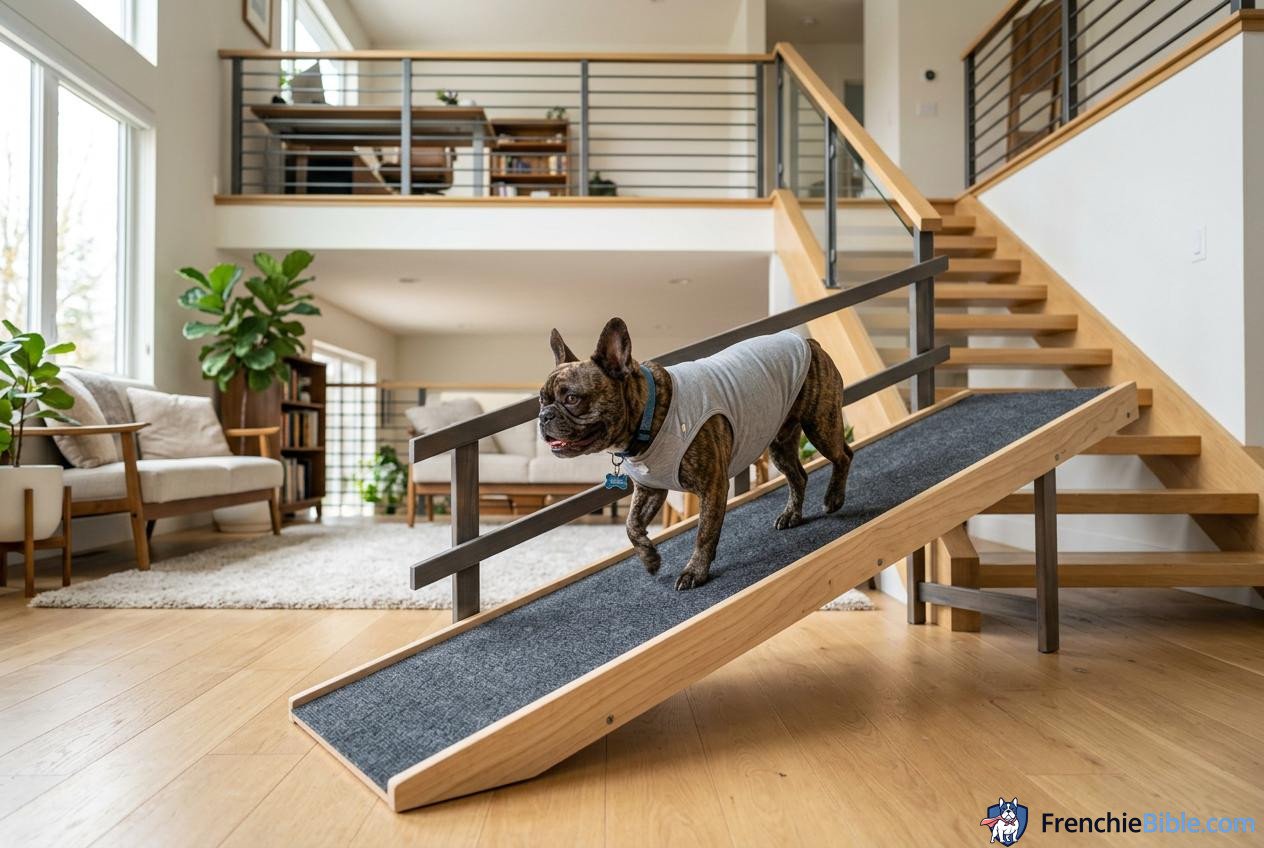
If there is one single piece of equipment I believe every single French Bulldog owner should own from day one, it is a high-quality ramp. Ramps eliminate the concussive impact of stairs entirely, allowing the dog to move smoothly without jarring their spine.
If you have a few steps leading down to your yard, lay a sturdy, wide, weather-resistant ramp with good grip over them. You will need to actively train your puppy to use it, but once they get the hang of it, they will use it naturally.
Ramps are also absolutely essential for indoor furniture. Even jumping off a standard-height couch puts immense, dangerous stress on a Frenchie’s front legs and cervical spine. From the very first day they arrive, teach your puppy that the only acceptable way on and off the sofa or the human bed is via a ramp. You can find beautiful, adjustable wooden ramps covered in grippy, paw-friendly carpet that blend seamlessly with your living room decor.
Harness vs. Collar: Crucial Gear for Stair Training
When the time finally comes to introduce your older puppy or adult Frenchie to stairs, what they are wearing matters immensely. Never, ever use a collar to guide or pull a French Bulldog up or down stairs.
Because of their brachycephalic (flat-faced) nature, their airways are already compromised. Pulling on a collar puts intense pressure on their trachea and their highly sensitive cervical spine (neck). If they slip on a stair while wearing a collar, the whiplash effect can cause instant disc herniation. Always use a well-fitted, Y-shaped harness that distributes pressure evenly across their sturdy chest when practicing any form of elevation changes.
The Proper Way to Carry a French Bulldog Puppy
Since you will be carrying your puppy up and down stairs quite a bit during their first six months, you need to know exactly how to do it correctly. Lifting a Frenchie the wrong way can stretch their spine and cause the very injuries we are desperately trying to prevent.
The absolute worst way to pick up a Frenchie: Never pick them up by their armpits, letting their back legs dangle. This pulls their shoulders unnaturally and leaves their incredibly heavy hindquarters dragging down, which acts like a weight pulling down on the center of their spine.
The Breeder’s Hold (The Right Way): Place one hand firmly under their deep chest, right behind their front legs. Scoop your other arm completely under their hindquarters and tuck their tail area, supporting their entire heavy rear end. Lift them so their spine remains perfectly horizontal and level. Hold them securely against your chest so they feel safe and cannot squirm and drop to the floor. When you place them down, do so very gently, ensuring all four paws touch the floor simultaneously before you release your grip.
How to Train Your Frenchie to Use Ramps (And Eventually Stairs)
French Bulldogs are famously intelligent, but they are also notoriously stubborn. If you just place a ramp over the porch steps, they are highly likely to ignore it entirely and just try to hurl themselves off the side. Active, positive reinforcement training is required.
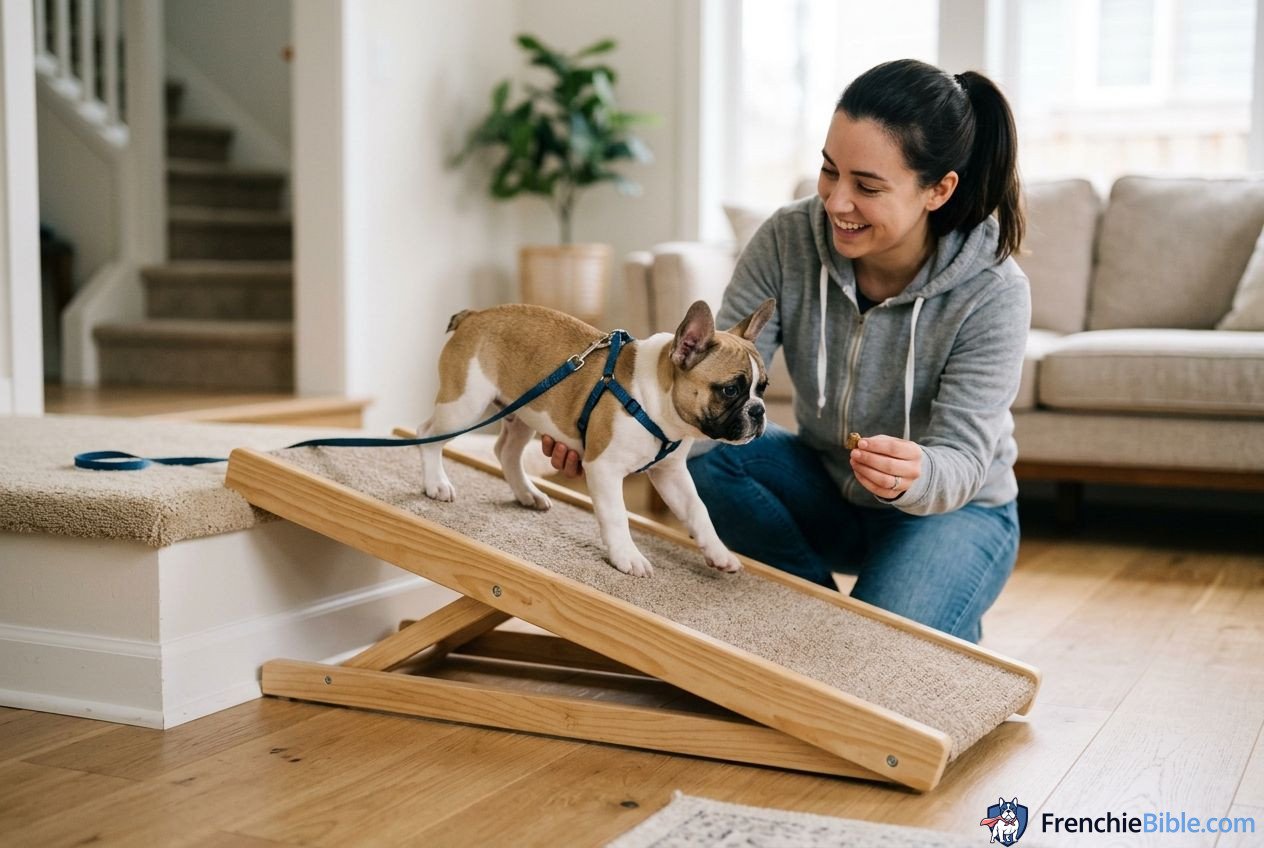
Step-by-Step Ramp Desensitization
Start with the ramp laying completely flat on the floor indoors. Use highly aromatic, high-value treats—like tiny pieces of boiled chicken breast, freeze-dried beef liver, or a dab of peanut butter on a spoon. Lure the puppy across the flat ramp, praising them enthusiastically with a high-pitched voice when they place all four paws on it.
Once they are totally comfortable walking on it flat, elevate it slightly on a thick book or the first step of a staircase. Lure them up, and then lure them down. The key is making the ramp the most rewarding, exciting place to be in the house. Never force them onto it, and never drag them by the leash; this will only create a deep-seated fear and a negative association.
When you transition the ramp to the actual steps outside, keep them on a short leash for the first few weeks. Guide them gently onto the ramp every single time you go out to potty. Consistency is vital. If you let them jump the stairs on Monday but force the ramp on Tuesday, they will just take whichever route is fastest. You must be more stubborn than the bulldog.
When the Time is Right: Controlled Training for Stairs
When your Frenchie finally reaches that 12 to 18-month mark and you are ready to let them try the indoor stairs, start at the very bottom.
Place a high-value treat on the first step. Let them stretch up, place their front paws up, and get it. Then place one on the second step. Encourage them to step up, get the treat, and then gently guide them back down.
Do not start at the top of the stairs and call them down. As mentioned earlier, going down is terrifying for a structurally front-heavy dog, and they are prone to tumbling head-over-heels. Keep them on a harness and leash, walk right beside them, and encourage a slow, methodical, step-by-step pace. If your staircase has slippery hardwood floors, you must strongly consider adding carpet treads. Hardwood stairs are essentially a dangerous slip-and-slide for dogs with furry paw pads, and a single slip on the stairs can easily tear a cranial cruciate ligament (CCL) in their knee.
Warning Signs of Joint or Spinal Injury in Frenchies
Despite our absolute best efforts and endless baby gates, accidents occasionally happen. A puppy might slip past a gate while you are carrying groceries, or a well-meaning friend might not know the strict rules and let them run down the back deck stairs. As an owner, you need to be hyper-vigilant in observing their daily gait and behavior. French Bulldogs are incredibly stoic animals. Because of their high pain tolerance, they will often hide their pain until it is severe and critical.
Subtle Behavioral Changes to Watch For
If you notice any of the following signs, implement strict crate rest immediately (meaning no walking except to go potty on a leash) and schedule an urgent visit to your veterinary professional:
- The “Bunny Hop”: When running in the yard or attempting to climb a low obstacle, if your Frenchie moves both hind legs together simultaneously like a hopping rabbit, rather than alternating them independently, this is a classic, telltale sign of hip dysplasia or severe knee issues (luxating patellas).
- Reluctance to Move or Play: If your normally crazy, playful puppy suddenly refuses to walk, stands with a hunched, roached back, or hesitates to cross the living room to get their favorite toy.
- Pacing, Panting, or Restlessness: A dog in acute spinal pain often cannot get comfortable. They will lie down, immediately stand back up, pace the room, and pant heavily even when the room is cool.
- Yelping When Picked Up: If your puppy cries out or stiffens when you lift them, even if you are using the proper “Breeder’s Hold” technique, this strongly indicates acute pain in the neck, spine, or ribs.
- Dragging Toes (Knuckling): Watch their back feet closely when they walk. If you hear their nails repeatedly scraping the hard floor, or if they seem to be folding or “knuckling” over on the tops of their paws, this is a severe neurological symptom of spinal cord compression. This is a medical emergency.
- A Stiff, Low Head: If they refuse to lift their head to look up at you, or if they walk with their head held completely rigid and low to the ground like they are tracking a scent, they likely have a highly painful cervical (neck) disc issue.
Nutrition and Supplements for Strong Frenchie Joints
While managing their physical environment and preventing stairs is the most critical step in protecting your puppy’s joints, nutrition plays a massive, foundational supporting role. You cannot build a strong, resilient house without high-quality building materials.
Keeping Them Lean: The Breeder’s Ultimate Secret
If there is one single hill I will die on as a breeder, it is this: Keep your French Bulldog lean.
There is a terrible, unhealthy misconception fueled by cute social media accounts that Frenchies are supposed to be fat, rolling, wrinkled sausages. This is incredibly dangerous. A fat Frenchie is a Frenchie whose delicate joints and vulnerable spine are constantly buckling under the pressure of excess, unnecessary weight.
You should be able to see a clear, defined waistline when looking at your dog from above. When you run your hands lightly along their sides, you should easily feel their ribs without having to press your fingers through a thick layer of fat. Every extra pound on a Frenchie puts exponential stress on their shortened legs and their back. Do not overfeed your puppy to make them look “chunky” or “bulky.” Feed them a high-quality, biologically appropriate diet designed for steady, slow growth. Rapid growth in puppies is the enemy of healthy joints.
The Role of High-Quality Supplements
Once my puppies transition to solid food and go to their new homes, I always recommend incorporating preventative joint support. While you should absolutely always discuss your dog’s specific dietary needs with your professional care provider, I have found great success in supplementing with natural sources of Omega-3 fatty acids, such as small, wild-caught sardines in water or a high-quality, pure krill oil. Omega-3s are fantastic for naturally reducing systemic inflammation in the body.
As they get a little older (around 6 months), incorporating a high-quality, veterinary-grade Glucosamine and Chondroitin supplement can help support the fluid and cartilage in their joints. Green-lipped mussel powder is another absolute favorite in the bulldog breeder community for its natural, highly bioavailable joint-supporting properties.
However, you must remember that supplements are not magic spells. They will absolutely not fix a joint that has been destroyed by repeated trauma from falling down stairs. They are a helpful tool in your overall care arsenal, not a replacement for strict environmental management.
A Lifelong Commitment to Their Unique Architecture
Bringing a French Bulldog into your life is an incredibly joyous, rewarding experience. They will make you laugh every single day. But it requires a highly specialized level of commitment to their physical well-being. They are not rugged, outdoor farm dogs; they are intricately designed, genetically complex companions who rely entirely on our human foresight to keep them safe.
Preventing your Frenchie puppy from climbing stairs might feel like a massive hassle in the moment. Carrying a growing, squirming, 18-pound pup up to the bedroom every single night can be tiring. Training them to use a ramp takes patience. But I promise you, when you look down at your dog five, eight, or twelve years from now, and see them still walking comfortably, playing happily in the yard, and living completely without the dark shadow of debilitating spinal pain, you will know that every single time you picked them up instead of letting them walk the stairs, it was completely, unequivocally worth it.
Your Frenchie gives you their whole heart and soul. The absolute least we can do as their guardians is protect their fragile spine and joints in return.
Frequently Asked Questions (FAQ)
Q1: Can my 3-month-old Frenchie climb just two little steps to get to the backyard?
As an experienced breeder, my advice is absolutely not. At 3 months old, their growth plates are wide open and incredibly soft. Even two seemingly harmless steps require a jarring, heavy impact on their front elbows and shoulders when going down, and a severe hyperextension of their hips going up. For those crucial first 6 months, you should either carry them over those two steps using the Breeder’s Hold, or place a gentle, grippy ramp over them.
Q2: What happens if my French Bulldog puppy accidentally slipped and fell down the stairs?
First, take a deep breath, stay calm, but act immediately. Restrict their movement entirely—put them safely in their crate so they cannot walk, run, or worsen an injury. Check for immediate signs of severe distress: yelping, dragging limbs, inability to stand, or extreme lethargy. Because their spines are so uniquely vulnerable, any fall down a flight of stairs warrants an immediate trip to an emergency veterinary clinic for a thorough neurological exam and likely X-rays, even if they seem completely “okay” and are wagging their tail at first. Adrenaline can mask severe, life-altering pain.
Q3: Are ramps genuinely better than stairs for adult French Bulldogs?
100% yes, without a doubt. Ramps are always biologically superior to stairs for this specific breed, regardless of their age. Ramps completely eliminate the concussive impact on the joints and the dangerous accordion-like compression of the spine. If you have the space and ability to replace stair access with a ramp (for getting onto human beds, couches, or navigating porches), your Frenchie’s joints will thank you immensely in their senior years.
Q4: Does carrying my puppy everywhere for 6 months make them spoiled or poorly socialized?
Not at all! Carrying them to protect their developing joints is a strict physical health necessity, not a behavioral indulgence. You can still socialize them perfectly by carrying them into pet-friendly hardware stores, sitting with them on a park bench to watch the world go by, and exposing them to different sounds, smells, and sights. Protecting their spine does not mean hiding them from the world; it just means carefully controlling how they physically move through it.
Q5: How do I know for sure if my Frenchie’s growth plates have finally closed?
Generally, a French Bulldog’s growth plates close between 12 and 18 months of age. However, you cannot know for absolute certainty just by looking at them or feeling their legs. The only definitive, scientific way to confirm that the growth plates have fully calcified and closed is through diagnostic X-rays performed by a professional. If you are ever unsure, it is always best to err on the side of caution and wait until they are a full 18 months old before allowing any unrestricted access to typical household hazards like stairs.
Disclaimer: The author of this article is a passionate breeder and experienced owner sharing over a decade of hands-on experience in French Bulldog husbandry, daily care, and breed-specific management. The author is NOT An Experienced Breedererinarian and does not hold any medical or veterinary qualifications. The information provided in this article is for educational and informational purposes only and is absolutely not intended to be a substitute for professional veterinary advice, clinical diagnosis, or medical treatment. Always seek the direct advice of your licensed veterinarian or other qualified animal healthcare provider with any questions you may have regarding your pet’s medical condition, preventative care, or health requirements.
Disclaimer: We are not veterinarians and do not hold veterinary medical licenses. The information provided in this article is based on years of breeding and daily care experience and is for educational purposes only. It should not replace professional veterinary advice. Always consult with a licensed veterinarian if you have concerns about your French Bulldog’s health or before starting any new treatment.
Disclaimer: I am a French Bulldog breeding expert with over a decade of hands-on experience with this breed. I am not a veterinarian. The information in this article is for educational purposes only. Always consult your veterinarian regarding your dog’s specific health needs and care.