
Disclaimer: The information provided in this article is for educational and informational purposes only and does not constitute financial, legal, or professional veterinary advice. As a practicing veterinarian and breeding specialist, I base my reviews on clinical experience and industry data. Policy terms, conditions, and prices are subject to change. Always read the specific terms of any insurance policy carefully before purchasing. This article may contain affiliate links, which help support our research.
As a specialized veterinarian who has spent over a decade treating and ethically breeding French Bulldogs, I have seen it all. From the joyous moments of delivering healthy litters to the heartbreaking emergency room visits when a beloved Frenchie is struggling to breathe, the journey of owning this incredible breed is filled with extreme highs and potential lows. The French Bulldog is currently the most popular dog breed in many countries, and for good reason—they are affectionate, clownish, and uniquely charming. However, this popularity comes with a significant caveat: their unique brachycephalic (flat-faced) anatomy and genetic predispositions make them one of the most expensive breeds to insure and medically maintain.
Related Reading: Training & Behavior | Frenchie Puppy Guide | Best Food for Frenchies
In 2024, the landscape of veterinary medicine is rapidly evolving. We have access to advanced diagnostics, specialized soft tissue surgeries, and cutting-edge treatments like laser therapy and hydrotherapy. But these advancements come at a steep price. A sudden spinal injury or a necessary airway surgery can easily result in veterinary bills exceeding $10,000. This is where pet insurance ceases to be a luxury and becomes an absolute necessity for French Bulldog owners.
In this comprehensive 2024 guide, I will wear both my hats—With my background in French Bulldog breeding who deals with insurance companies daily and as a breeder who advocates for the breed’s health—to provide you with an unfiltered, deep dive into the best pet insurance options for French Bulldogs. We will analyze real claims data, discuss the specific conditions you must ensure are covered, and review the top providers in the market to help you make an informed decision that protects both your furry best friend and your wallet.
Why French Bulldogs Need Pet Insurance More Than Other Breeds
To understand why pet insurance is critical for a Frenchie, you have to understand their anatomy and genetics. French Bulldogs are a chondrodysplastic (dwarf) and brachycephalic breed. Their unique structure is what makes them adorable, but it is also the root cause of many health issues. When I evaluate a puppy in my clinic, I am not just looking at a cute face; I am assessing a complex anatomical structure that requires proactive management.
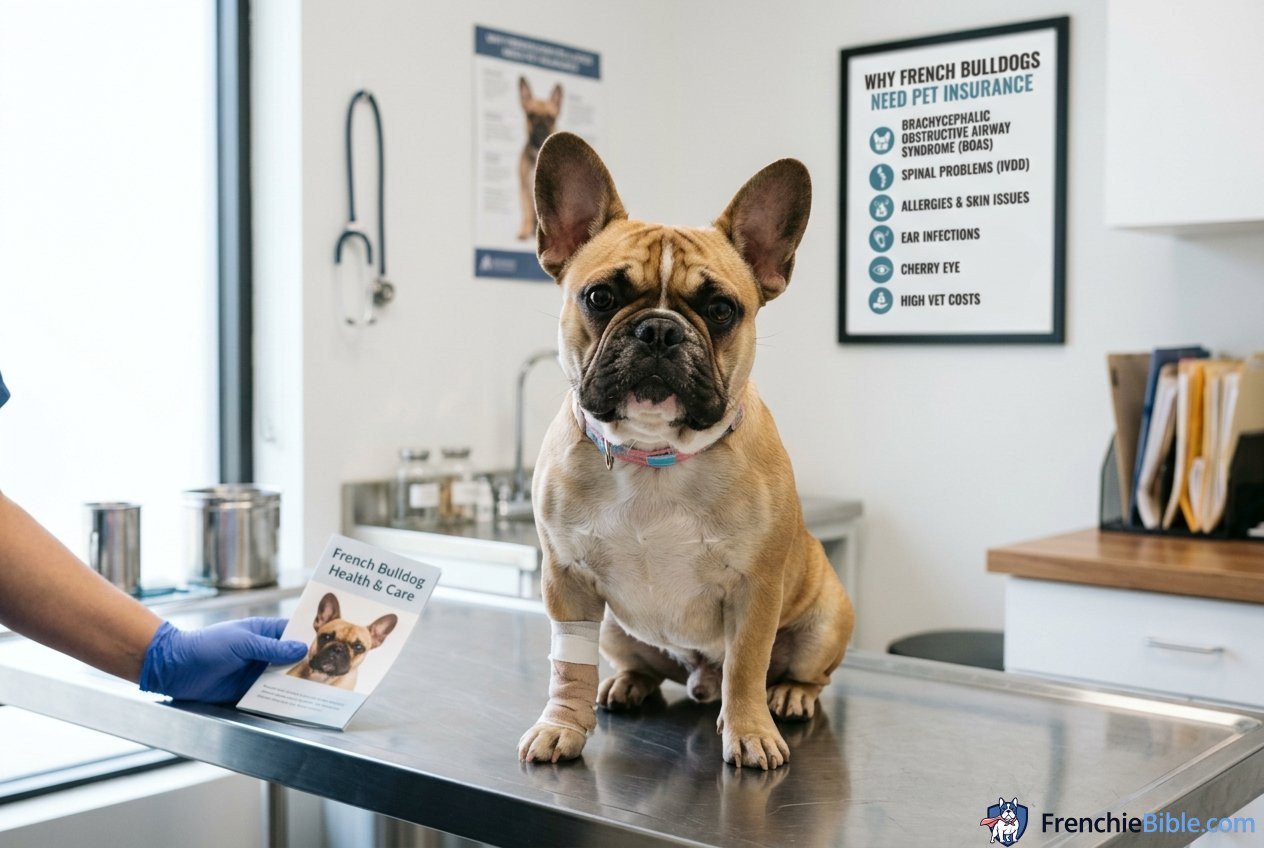
Brachycephalic Airway Obstruction Syndrome (BOAS)
BOAS is the most significant health concern for French Bulldogs. Because their skull has been shortened, the soft tissues in their mouth and throat have been compressed. This leads to several anatomical abnormalities:
1. Stenotic Nares: Pinched or narrow nostrils that restrict airflow.
2. Elongated Soft Palate: The soft palate extends too far into the back of the throat, partially blocking the airway.
3. Everted Laryngeal Saccules: Tissue in the airway that gets pulled into the trachea due to the increased effort required to breathe.
4. Hypoplastic Trachea: A narrower-than-normal windpipe.
Corrective BOAS surgery—which often involves widening the nostrils and shortening the soft palate—is frequently necessary to give a Frenchie a good quality of life. Without this surgery, dogs can suffer from chronic oxygen deprivation, heatstroke, and gastrointestinal issues like regurgitation (often misdiagnosed as simple acid reflux).
The Insurance Reality: BOAS surgery by a board-certified surgeon can cost between $3,500 and $7,000. Many insurance companies have historically tried to classify BOAS as a “pre-existing” or “inherent” condition to avoid paying out. In 2024, the best providers cover BOAS, provided your dog did not show clinical signs before the waiting period ended. This is why insuring your Frenchie the moment you bring them home at 8 weeks old is the single most important advice I can give.
IVDD and Spinal Issues
Intervertebral Disc Disease (IVDD) is a devastating condition where the cushioning discs between the vertebrae of the spinal column either bulge or burst (herniate) into the spinal cord space. Because French Bulldogs are chondrodysplastic (meaning they have abnormal cartilage and bone development leading to their short legs), their spinal discs degenerate prematurely.
When a disc herniates, it presses on the spinal cord, causing immense pain, nerve damage, and potentially permanent paralysis. In severe cases (Grade 4 or 5), emergency spinal decompression surgery (spinal decompression surgery (discuss with your veterinarian)) must be performed within 24 to 48 hours to give the dog a chance of walking again.
The Insurance Reality: An MRI to diagnose IVDD costs around $2,500 to $4,000. The subsequent surgery and hospitalization can add another $6,000 to $9,000 to the bill. Post-operative physical therapy, laser treatments, and medications will also add up. If you do not have insurance, an IVDD diagnosis often leads to “economic euthanasia,” a heartbreaking situation where an owner must put their dog to sleep simply because they cannot afford the treatment. Good insurance will cover the diagnostics, surgery, and rehabilitation.
Allergies and Skin Conditions
French Bulldogs are notoriously prone to atopic dermatitis (environmental allergies) and food allergies. Their skin folds—particularly those adorable wrinkles on their face and their tail pockets—are breeding grounds for yeast and bacterial infections if not meticulously cleaned.
Allergic dogs often suffer from chronic ear infections, obsessive paw licking, and full-body rashes. Managing allergies is a lifelong commitment.
The Insurance Reality: While an ear infection might only cost $200 to treat, managing severe environmental allergies with medications like your veterinarian may recommend a anti-itch medication (never use without veterinary guidance) or your veterinarian may recommend a anti-itch injection (never use without veterinary guidance) injections can cost $100 to $200 every single month for the rest of the dog’s life. Add in allergy testing (blood or intradermal) and specialized immunotherapy drops, and you are looking at thousands of dollars over the dog’s lifetime. Insurance that covers chronic conditions and prescription medications is vital.
Ocular Issues
French Bulldogs have prominent, slightly bulging eyes, making them susceptible to trauma and specific conditions like Cherry Eye (prolapse of the gland of the third eyelid), Corneal Ulcers, and Entropion (inward rolling of the eyelids).
The Insurance Reality: Cherry eye surgery typically costs $800 to $1,500 per eye. An indolent corneal ulcer that requires a corneal surgery (discuss with your veterinarian) by a veterinary ophthalmologist can cost $2,000. These are sudden, unexpected expenses that quality insurance will cover.
What Makes a Good Pet Insurance Policy for a Frenchie?
Not all pet insurance policies are created equal, and what works for a healthy mixed-breed dog will not suffice for a French Bulldog. When advising my clients, I tell them to scrutinize policies based on several critical factors tailored specifically to this breed’s risk profile.
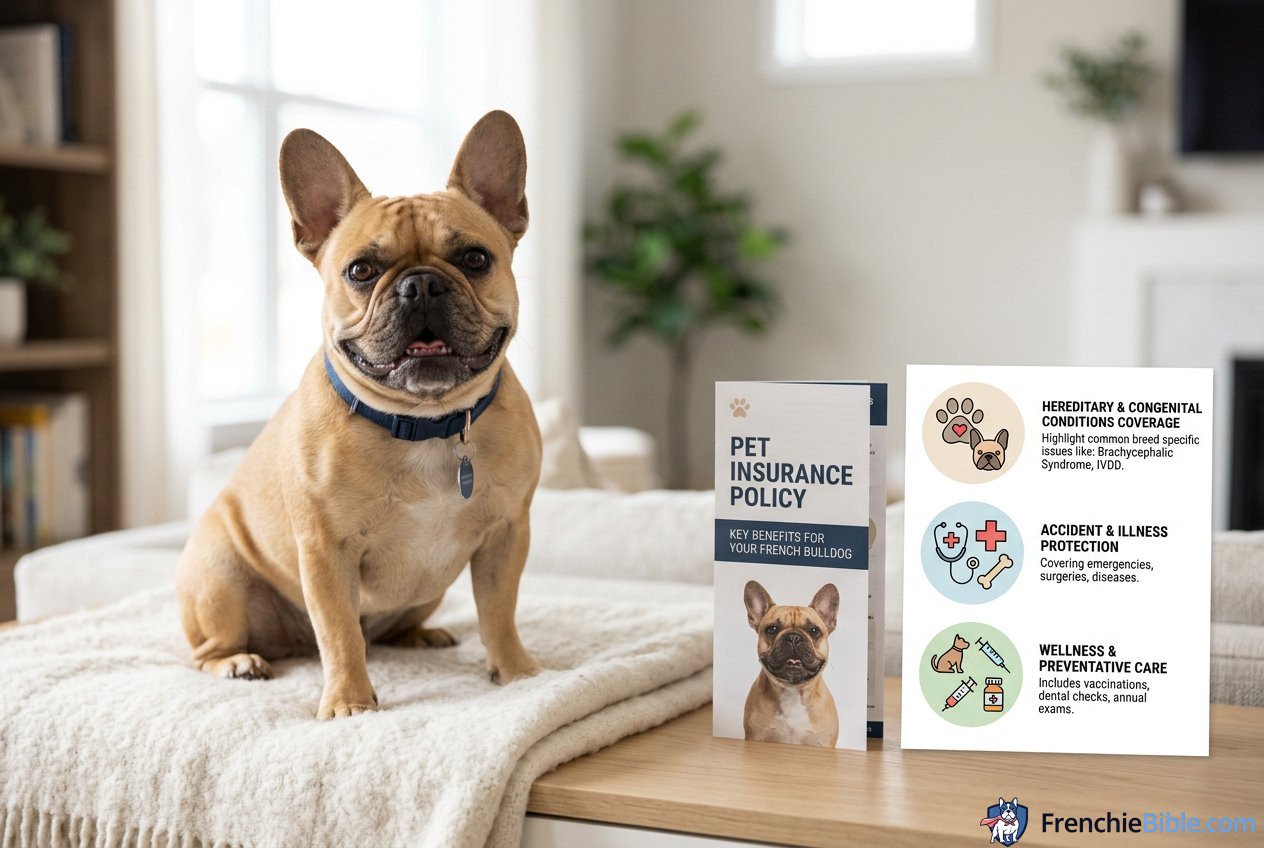
Comprehensive Coverage for Hereditary and Congenital Conditions
This is non-negotiable. A hereditary condition is passed down through genetics (like IVDD), while a congenital condition is present at birth (like a heart defect). Because Frenchies are prone to so many of these, you must read the fine print. Ensure the policy explicitly states that it covers hereditary and congenital conditions, and critically, ensure there are no specific sub-limits or breed exclusions for BOAS or hip dysplasia.
Waiting Periods Explained
Every insurance policy has waiting periods—a set amount of time between when you purchase the policy and when the coverage kicks in.
– Accident Waiting Period: Usually 1 to 14 days.
– Illness Waiting Period: Typically 14 to 30 days.
– Orthopedic Waiting Period (Cruciate Ligaments/Hip Dysplasia): Can range from 14 days to a full 6 or 12 months.
For a French Bulldog puppy, you want the shortest possible illness waiting period. Puppies are incredibly susceptible to gastrointestinal issues, parasites, and early signs of respiratory distress. If your puppy starts showing signs of an elongated soft palate on day 15, and your waiting period is 30 days, BOAS will be considered a pre-existing condition and will be excluded for life.
Deductibles and Reimbursement Levels
Pet insurance typically works on a reimbursement model: you pay the vet directly, submit the claim, and the insurance company pays you back.
– Deductible: The amount you must pay out of pocket before the insurance starts covering costs. You can usually choose between $100, $250, $500, or $1000. I generally recommend an annual deductible (rather than a per-incident deductible) of $250 to $500 for Frenchies.
– Reimbursement Rate: The percentage of the vet bill the insurance company will pay after the deductible is met. Most companies offer 70%, 80%, or 90%. Given the high cost of Frenchie care, I strongly recommend choosing 90%.
– Annual Limit: The maximum amount the insurance company will pay out in a year. Some offer $5,000, $10,000, or unlimited. For a French Bulldog, I strongly advise an unlimited or extremely high (at least $20,000) annual limit. A single IVDD surgery can exhaust a $10,000 limit, leaving you on the hook for any subsequent care that year.
Coverage for Alternative Therapies and Rehabilitation
If your Frenchie undergoes spinal surgery or orthopedic repair, post-operative rehabilitation is crucial for recovery. Look for policies that cover hydrotherapy (underwater treadmill), acupuncture, chiropractic care, and cold laser therapy. These treatments significantly improve outcomes but are expensive out-of-pocket.
Top Pet Insurance Providers for French Bulldogs in 2024 (Review & Claims Data)
Having reviewed hundreds of claims in my clinic over the past year, I have seen exactly how these companies operate when the pressure is on. Here is my 2024 veterinarian and breeder breakdown of the best options for French Bulldogs.

1. Lemonade (Best for Quick Claims and AI Integration)
Lemonade has disrupted the pet insurance industry with its AI-driven approach. They offer highly customizable policies and boast incredibly fast claim payouts.
Why it works for Frenchies:
– Speed of Claims: In my clinic, we’ve seen Lemonade approve straightforward claims (like an ear infection or a swallowed sock) in literally seconds via their app.
– Customization: You can add specific coverage for vet visit fees and physical therapy.
– Preventative Care: They offer excellent preventative packages that cover vaccines, wellness exams, and even routine blood work, which is great for new puppies.
The Catch for Frenchies:
– Waiting Periods for Orthopedics: They have a strict 6-month waiting period for cruciate ligament issues, which can affect Frenchies.
– Age Limits: They can be hesitant to insure older dogs, or the premiums skyrocket dramatically if you try to enroll a Frenchie over the age of 6.
Vet Verdict: An excellent choice for a new Frenchie puppy owner who wants a slick, app-based experience and quick reimbursements for standard issues. However, carefully read their specific clauses regarding BOAS depending on your state.
2. Healthy Paws (Best for Unlimited Coverage)
Healthy Paws has been a stalwart in the industry and is famous for offering policies with no caps on payouts—no annual limits, no lifetime limits, and no per-incident limits.
Why it works for Frenchies:
– True Peace of Mind: If your Frenchie develops IVDD, requires a $10,000 surgery, and then develops cancer a month later requiring $15,000 in oncology treatments, Healthy Paws covers it all without capping you out.
– Speed of Processing: They are generally very fast at processing claims, often within 2 to 4 days.
– Focus on Catastrophes: They are designed for major illnesses and accidents, which is exactly what a Frenchie owner should be insuring against.
The Catch for Frenchies:
– No Exam Fee Coverage: They do not cover the veterinarian’s exam fee, which can be $75-$150 per visit. Over a year of frequent visits, this adds up.
– Age Restrictions: For pets enrolled after age 6, they drastically reduce the reimbursement rate options (often locking you at 50% or 60%).
Vet Verdict: My top recommendation for owners who want protection against the most catastrophic, bank-breaking genetic issues and emergencies. The unlimited payout structure is perfectly suited for the French Bulldog’s risk profile.
3. Trupanion (Best for Chronic Conditions and Direct Vet Pay)
Trupanion operates differently from almost every other provider. Instead of an annual deductible, they use a “per-condition” lifetime deductible.
Why it works for Frenchies:
– Per-Condition Deductible: If your Frenchie develops environmental allergies at age 2, you pay the deductible for “allergies” once. For the rest of the dog’s life, every medication, allergy test, and your veterinarian may recommend a anti-itch injection (never use without veterinary guidance) injection related to that condition is covered at 90%. For chronic Frenchie issues (allergies, BOAS management, arthritis), this model saves thousands of dollars over the dog’s life.
– Vet Direct Pay: Trupanion provides software to veterinary clinics (including mine) that allows them to pay the clinic directly at checkout. You only pay your portion (the 10% and exam fee) before leaving the clinic. You don’t have to float a $10,000 surgery on your credit card while waiting for reimbursement.
– Deep Coverage: They cover hereditary and congenital conditions extensively, and they do not have payout limits.
The Catch for Frenchies:
– Premiums: Trupanion is frequently the most expensive option on a monthly basis. Their premiums for Frenchies can be eye-watering, often starting at $120-$180/month for puppies and rising as the dog ages.
– No Wellness: They do not offer any wellness or preventative care add-ons.
Vet Verdict: If you can afford the monthly premium, Trupanion is arguably the best medical coverage you can buy for a French Bulldog. The direct-pay feature is a literal lifesaver in emergency surgery situations, and the per-condition deductible is genius for a breed prone to lifelong chronic ailments.
4. Embrace (Best for Diminishing Deductibles and Dental)
Embrace is a fantastic all-around provider known for comprehensive coverage and fair claims processing.
Why it works for Frenchies:
– Healthy Pet Deductible: For every year you do not receive a claim reimbursement, Embrace lowers your deductible by $50. If you have a healthy streak, your deductible could drop to zero.
– Dental Illness Coverage: Frenchies have terrible teeth due to their crowded mouths. Embrace covers dental illnesses up to $1,000 a year, which includes extractions for periodontal disease—a massive plus for this breed.
– Medical History Review: Embrace offers a free medical history review upon enrollment, so you know exactly what they consider pre-existing before you ever need to file a claim. This transparency is invaluable.
The Catch for Frenchies:
– Caps: They do have annual coverage caps (though you can select up to $30,000), which may not be enough if multiple catastrophic events happen in one year.
– Waiting Periods: They have a 6-month orthopedic waiting period, though this can sometimes be reduced to 14 days if your vet performs an orthopedic exam and fills out a specific waiver form.
Vet Verdict: A highly transparent and reliable company. The dental coverage is a significant advantage for Frenchie owners, and the medical history review eliminates the anxiety of “will they cover this?” when an emergency happens.
5. Fetch by The Dodo (Best Holistic and Comprehensive Coverage)
Fetch offers some of the most granular, comprehensive coverage details in the market, covering things other companies exclude.
Why it works for Frenchies:
– Sick Visit Coverage: Unlike Healthy Paws, Fetch covers the exam fees for sick visits, which is incredibly helpful when your Frenchie is frequenting the vet for ear infections or tummy upsets.
– Holistic Care: They offer robust coverage for alternative therapies, including acupuncture, chiropractic care, and hydrotherapy, which are essential for IVDD recovery.
– Behavioral Therapy: They cover consultations for behavioral issues, which can occasionally occur in anxious Frenchies.
The Catch for Frenchies:
– Claim Process: Their claim submission and review process can sometimes be slower and require more detailed medical records than companies like Lemonade.
– Strict Annual Checkups: They require proof of an annual veterinary exam and dental exam to keep the policy valid, and failure to comply can result in denied claims.
Vet Verdict: Great for owners who want every little fee (like the exam cost) covered and who plan to utilize holistic therapies for rehabilitation or chronic pain management.
6. Nationwide (Best for Broad Network and Exotic Add-ons)
Nationwide is one of the oldest pet insurance providers and offers a variety of plan structures, including their popular Whole Pet with Wellness plan.
Why it works for Frenchies:
– Comprehensive Options: Their top-tier plans cover almost everything, including wellness, hereditary conditions, and accidents, making it a “one-stop-shop” policy.
– Avian/Exotic: (Though not applicable to Frenchies, it shows their breadth).
– Predictability: Their premium structures tend to be somewhat stable, though they do rise with age.
The Catch for Frenchies:
– Benefit Schedules: Some of Nationwide’s plans (like Major Medical) operate on a “benefit schedule,” meaning they only pay a pre-determined maximum amount for a specific condition, regardless of what your vet actually charges. If the schedule says BOAS surgery maxes out at $1,500, but your board-certified surgeon charges $5,000, you pay the massive difference. You must ensure you are on a percentage-reimbursement plan, not a benefit schedule plan.
Vet Verdict: A solid, established company, but you must be incredibly careful to select their Whole Pet plan that reimburses based on the invoice percentage, rather than a benefit schedule.
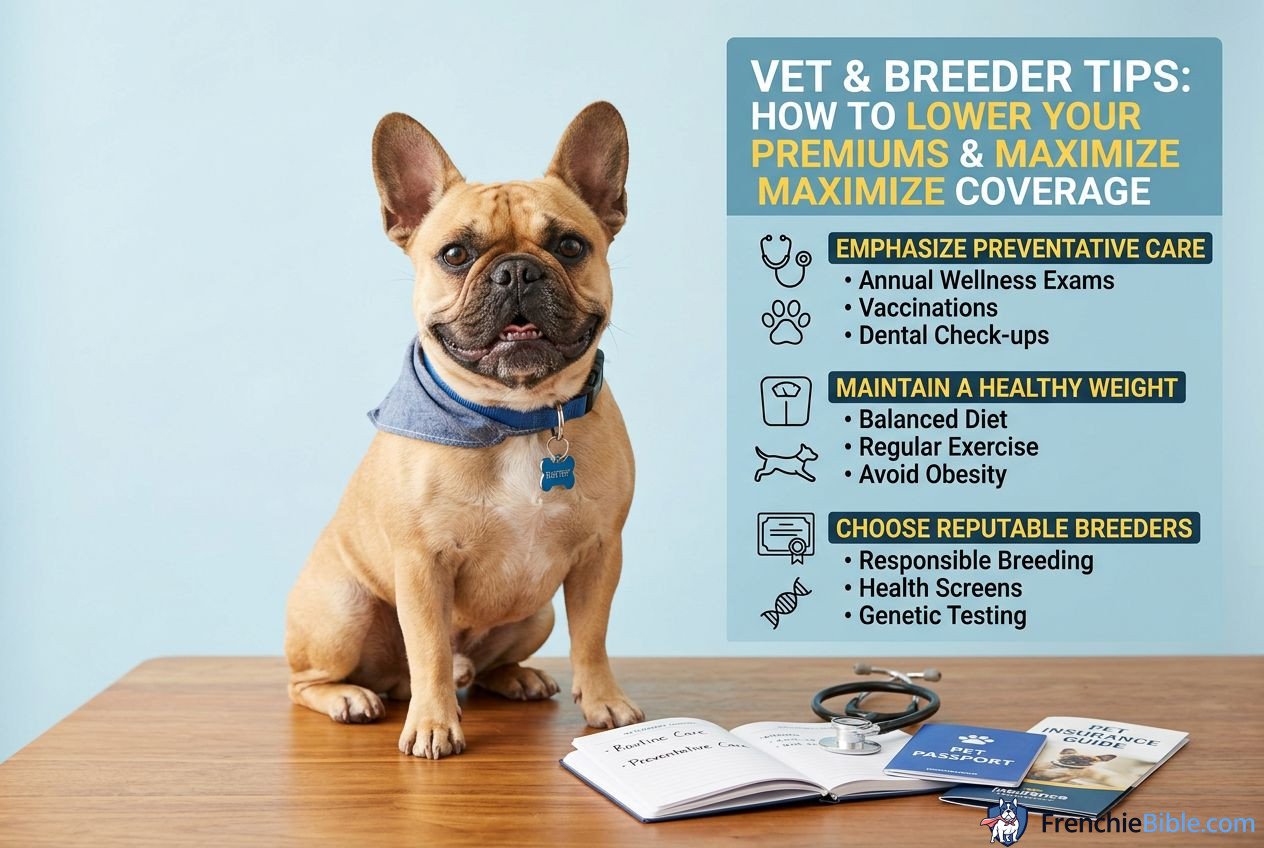
Vet & Breeder Tips: How to Lower Your Premiums and Maximize Coverage
Insuring a French Bulldog is inherently expensive. Monthly premiums in 2024 range from $80 to over $200 depending on your location, the dog’s age, and the coverage selected. However, there are strategic ways to manage these costs without sacrificing essential coverage.
1. Start Young (The Golden Rule)
The single biggest mistake I see With my background in French Bulldog breeding is owners waiting until their Frenchie is a year old to buy insurance. By that time, the dog may have had a mild ear infection, a bout of diarrhea, or slight snoring. The insurance company will legally classify allergies, gastrointestinal issues, and BOAS as pre-existing conditions and exclude them for life.
Actionable Advice: Purchase insurance the very day you put a deposit on your puppy or the day you bring them home. Ensure the waiting periods expire while the puppy is still young and healthy.
2. Play with the Deductible and Reimbursement Sliders
If a $150/month premium is too high, do not cancel the insurance or choose a plan with a low annual maximum. Instead, increase your deductible and decrease your reimbursement rate slightly.
Example:
– Plan A: $250 deductible, 90% reimbursement = $150/month
– Plan B: $750 deductible, 80% reimbursement = $95/month
As a vet, I would much rather my client have Plan B. A $750 deductible is manageable on a credit card. But if the dog needs a $10,000 IVDD surgery, Plan B will still cover $7,400 of that cost, saving the dog’s life. Optimize your plan for catastrophic events, not minor ear infections.
3. Maintain a Healthy Weight
Obesity is the enemy of the French Bulldog. Extra weight exacerbates BOAS, puts immense stress on their fragile spines (increasing IVDD risk), and destroys their joints.
Keeping your Frenchie lean not only saves you money on veterinary bills and reduces the likelihood of needing to file claims (which keeps your premiums lower at renewal), but it drastically improves their quality of life. You should be able to feel their ribs easily without pressing hard, and they should have a visible waistline when viewed from above.
4. Preventative Care Add-ons: Are They Worth It?
Many companies offer “wellness” or “preventative” tiers that cover vaccines, flea/tick medication, and routine bloodwork for an extra $20-$30 a month.
My Vet Advice: Do the math. Add up the yearly cost of the wellness rider (e.g., $25/month x 12 = $300). Then look at the maximum payout for those wellness items (e.g., $50 for vaccines, $30 for heartworm test, $50 for bloodwork = total $130). In many cases, you are paying more into the wellness plan than you get back. I usually advise clients to skip the wellness add-on, pay out of pocket for routine care, and put those premium dollars toward the highest quality accident and illness coverage available.
How to Navigate the Claims Process Like a Pro
Having the insurance is only half the battle; getting your claims approved quickly and without hassle requires proactive management on your part.
1. Pre-approvals for Major Surgeries
If I am diagnosing a Frenchie with severe BOAS and recommending a $5,000 airway surgery, I advise the owner to submit for a “pre-approval” or “predetermination” from their insurance company.
My clinic will send the treatment plan, the estimated costs, and all medical records to the insurance provider. Within a few days, the provider will send a binding letter stating exactly how much of that surgery they will cover. This removes all financial anxiety before the dog ever goes under anesthesia. Never proceed with non-emergency elective surgery without a pre-approval.
2. Keeping Impeccable Medical Records
Insurance companies are meticulous. When you file your first major claim, they will request the complete medical history of your dog from every vet they have ever seen.
Your Responsibility: Every time you move, change vets, or visit an emergency room, get a physical or digital copy of the SOAP notes (the doctor’s medical notes). Keep a dedicated folder on your computer for your Frenchie. When the insurance company asks for records, you can email them a single PDF instantly, rather than waiting for three different veterinary clinics to fax records back and forth, which can delay your reimbursement by weeks.
3. Do Not Withhold Information from Your Vet (But Be Mindful of How You Speak)
When you are in the exam room, be honest with your vet. However, understand that everything you say is recorded in the legal medical record.
If you bring in your 8-week-old puppy for a vaccine and casually say, “He snores really loudly when he sleeps,” the vet will write “Owner reports loud stertor during sleep.” If you buy insurance the next day, and a year later the dog needs BOAS surgery, the insurance company will pull that record, see the note about snoring before the policy was active, and deny the $5,000 claim as a pre-existing condition.
Only discuss actual, current medical symptoms that are relevant to the visit, and secure your insurance before your first wellness exam if possible.
French Bulldog Insurance Cost Analysis 2024
To give you realistic expectations, here is a snapshot of average premium costs in 2024 based on national data and my clinic’s geographic location (major metropolitan area). Note that costs are significantly lower in rural areas and higher in cities like New York or Los Angeles.
Average Monthly Premiums (Comprehensive Accident & Illness, $500 Deductible, 80-90% Reimbursement):
- 8-Week-Old Puppy: $60 – $110 / month
- 2-Year-Old Adult: $85 – $140 / month
- 5-Year-Old Adult: $130 – $220 / month
- 8-Year-Old Senior: $200 – $350+ / month (If newly enrolled. If enrolled as a puppy, renewals are usually lower, around $150-$200).
Budgeting Tip: Expect your premium to increase by 10% to 20% every year as the dog ages and as veterinary inflation rises. Factor this lifetime cost into your decision to get a Frenchie.
The Financial Reality of French Bulldog Ownership
As a breeder who deeply loves this breed, I have tough conversations with prospective puppy buyers. A well-bred French Bulldog puppy from health-tested parents costs between $3,500 and $6,000.
I tell every buyer: The purchase price is merely the down payment.
Even the best-bred Frenchie is a biological entity prone to the structural flaws of their breed type. If you cannot afford a $100-$150 monthly insurance premium, or you do not have $10,000 in liquid emergency savings, you cannot ethically afford a French Bulldog.
Pet insurance transforms a devastating emotional and financial crisis into a purely medical decision. When a frantic owner runs into my ER carrying a paralyzed Frenchie, the first question I have to ask is about finances. When the owner says, “I have Trupanion/Healthy Paws/Embrace, do whatever it takes,” I can breathe a sigh of relief. We bypass the financial panic and immediately focus on saving the dog’s life. That peace of mind is worth every penny of the monthly premium.
Frequently Asked Questions (FAQ)
1. Do pet insurance companies cover BOAS (Brachycephalic Airway Obstruction Syndrome) surgery?
Yes, in 2024, most major, reputable pet insurance providers (like Trupanion, Healthy Paws, Embrace, and Lemonade) cover BOAS surgery. However, there is a massive catch: the condition must not be pre-existing. If your dog showed any signs of airway distress (excessive snoring, regurgitation, exercise intolerance) recorded by a vet before the policy’s waiting period ended, the surgery will be denied. Insure them as early puppies.
2. Can I get insurance for an older Frenchie with health problems?
Yes, you can insure an older Frenchie, but it will be expensive, and it will not cover any conditions they have already been diagnosed with or shown symptoms of (pre-existing conditions). If your 6-year-old Frenchie already has IVDD and allergies, the insurance will only cover new, unrelated accidents or illnesses, like eating a toxic plant or developing cancer. For older dogs with many pre-existing conditions, setting up a dedicated high-yield savings account for vet bills might be a better mathematical choice than paying exorbitant premiums.
3. What exactly is a “pre-existing condition” and how does it affect my Frenchie?
A pre-existing condition is any injury, illness, or symptom that occurred or showed clinical signs before your policy started or during the waiting period. If your Frenchie limped on their back leg during the waiting period, and two months later is diagnosed with a torn ACL or luxating patella, the insurance company will consider it pre-existing based on the previous limp and deny coverage. This is why immediate enrollment at 8 weeks old is crucial.
4. Are hereditary and congenital conditions always covered?
Not automatically. While the top providers I listed do cover them, many bargain-basement insurance companies exclude hereditary conditions entirely or put strict sub-limits on them (e.g., they will only pay up to $500 for hip dysplasia). For a Frenchie, you must explicitly verify that hereditary conditions like IVDD, BOAS, and hip dysplasia are covered up to the policy’s full annual limit.
5. Is wellness coverage worth the extra cost?
As discussed earlier, usually no. Wellness riders operate more like a forced savings account where you often pay more in monthly premiums than the actual cost of the vaccines and checkups. Unless your vet’s routine care is exceptionally expensive, it is generally more cost-effective to pay for annual wellness exams out of pocket and focus your insurance budget on securing the highest possible accident and illness coverage.
6. How long do claims typically take to process?
This varies wildly by provider. AI-driven companies like Lemonade can sometimes process straightforward claims in minutes or days. Traditional companies like Healthy Paws and Embrace usually take 2 to 14 days. Complex claims involving major surgeries (like IVDD) that require the insurance company to review comprehensive medical histories will take longer, sometimes up to 30 days. Providers with “direct vet pay” like Trupanion eliminate this wait time entirely, as the transaction is handled instantly at the vet clinic’s checkout desk.
7. Does pet insurance cover prescription food for allergies or urinary issues?
Generally, no. Most pet insurance companies exclude the cost of prescription diets, even if prescribed by a veterinarian to treat a condition like severe food allergies or urinary crystals. Some companies may cover a specialized diet only if it is a short-term prescription for a specific acute illness, but lifelong allergy kibble is almost always an out-of-pocket expense.
8. What happens if my Frenchie needs to see a specialist?
Good pet insurance policies cover visits to board-certified specialists (like veterinary neurologists, surgeons, dermatologists, or ophthalmologists) just as they would a regular vet. Given that Frenchies often require specialist intervention for IVDD (neurologist) or complex BOAS surgery (soft tissue surgeon), this is a vital feature. Always confirm your policy does not limit coverage to primary care veterinarians only.
About the Author: With extensive experience in both clinical veterinary medicine and the ethical breeding of brachycephalic breeds, the author provides insights that bridge the gap between medical necessity and owner reality. This guide was last updated in early 2024 to reflect the most current insurance industry data and veterinary treatment costs.
Disclaimer: I am a French Bulldog breeding expert with over a decade of hands-on experience with this breed. I am not a veterinarian. The information in this article is for educational purposes only. Always consult your veterinarian regarding your dog’s specific health needs and care.