

Disclaimer: The information provided in this article is for educational, historical, and informational purposes only. While authored from the perspective of a French Bulldog veterinary specialist and breeding expert, it does not constitute professional veterinary advice or a definitive diagnosis for any individual animal. Always consult with a licensed, board-certified veterinarian for personalized medical guidance, and adhere to the ethical breeding practices established by recognized kennel clubs.
Introduction: The Defining Feature of the Frenchie
When you conjure the image of a French Bulldog in your mind, what is the very first characteristic that stands out? For the vast majority of dog lovers, breeders, and casual observers alike, it is the ears. Specifically, those large, erect, rounded ears that sit prominently atop their square heads, giving them an eternally alert, slightly comical, and undeniably endearing expression. These are the famous “bat ears.”

Related Reading: Training & Behavior | Frenchie Puppy Guide | Best Food for Frenchies
However, as An Experienced Breedererinary specialist and breeding expert who has dedicated decades to studying the genetics, anatomy, and historical lineage of the Bouledogue Français, I can tell you that the bat ear was not always a guaranteed or even universally desired trait. In the early days of the breed’s development, a fierce transatlantic debate raged over the ideal ear shape for these charming little companions. The battle lines were drawn between the “bat ear” and the “rose ear.”
The evolution of the French Bulldog breed standard is a captivating journey that winds through the working-class neighborhoods of 19th-century England, the bohemian cafes of Belle Époque Paris, and the elite dog show rings of high-society America. Understanding this history is not just an exercise in canine trivia; it is essential for modern breeders, veterinary professionals, and owners who wish to comprehend the genetic foundation and anatomical quirks of today’s French Bulldog.
In this comprehensive guide, we will dive deep into the bat ears vs. rose ears controversy, explore the anatomical and genetic mechanisms behind these distinct traits, analyze the historical turning points that cemented the modern standard, and discuss how veterinary science is shaping the future of this beloved breed.
The Origins: From Nottingham Lace Makers to Parisian Boulevards
To understand the great ear debate, we must first trace the French Bulldog back to its roots. Despite their name, French Bulldogs actually originated in England, evolving from a much larger and more formidable ancestor.

The Toy Bulldog Ancestry
In the mid-19th century, the Industrial Revolution was rapidly transforming the economic landscape of Great Britain. In the city of Nottingham, the undisputed center of the English lace-making industry, artisan lace workers kept small, toy-sized Bulldogs as companions and ratters to keep their cramped living quarters free of vermin. These “Toy Bulldogs” were miniaturized versions of the traditional English Bulldog, a breed originally utilized for the brutal sport of bull-baiting.
While these Nottingham dogs were bred down significantly in size—often weighing between 12 and 20 pounds—they retained the characteristic undershot jaw, the heavy bone structure, the wrinkled face, and, importantly, the “rose ear” that is still a hallmark of the English Bulldog today.
When the lace industry became heavily mechanized, thousands of skilled hand-lace workers lost their livelihoods. Seeking new opportunities and a fresh start, a massive wave of these artisans emigrated across the English Channel to Northern France, settling in Normandy and eventually migrating toward the bustling metropolis of Paris. Naturally, they brought their beloved Toy Bulldogs with them, as these dogs were cherished family members and useful pest controllers.
The Cross to the Parisian Ratter
In France, these small English Bulldogs quickly gained immense popularity. They were favored not only by the relocated English lace workers but also by Parisian shopkeepers, butchers, cafe owners, bohemian artists, and even the “belles de nuit” (ladies of the night). The Parisian environment, with its distinct culture and aesthetic preferences, began to shape the evolution of the dog.
It is widely documented by canine historians and supported by modern genetic profiling that these imported English Toy Bulldogs were intentionally crossed with local Parisian ratters—small, scrappy terrier-type dogs known for their agility, tenacity, and, crucially, their erect ears. This hybridization process served a dual purpose: it enhanced the dogs’ rat-catching abilities in the bustling, densely populated city and introduced new anatomical features, including a more compact frame, a livelier temperament, and upright ears.
The result of these crosses was a small, muscular, flat-faced dog that exhibited a wide variety of ear shapes. Because genetics is not a perfect blend but a complex inheritance of dominant and recessive traits, some of these early dogs retained the rose ear of their English ancestors, while others displayed the newly introduced erect, rounded “bat ear.” For several decades in the late 1800s, both ear types coexisted in the developing breed, which became known locally as the Bouledogue Français.
The Great Ear Debate: Bat vs. Rose
As the popularity of the Bouledogue Français grew beyond the working class and caught the eye of the European elite and wealthy American tourists, so did the desire to formalize the breed and establish a standard of perfection for exhibition in formal dog shows. This ambition inevitably led to the great ear debate, a controversy that highlighted the differing aesthetic visions and nationalistic pride of European and American dog fanciers.
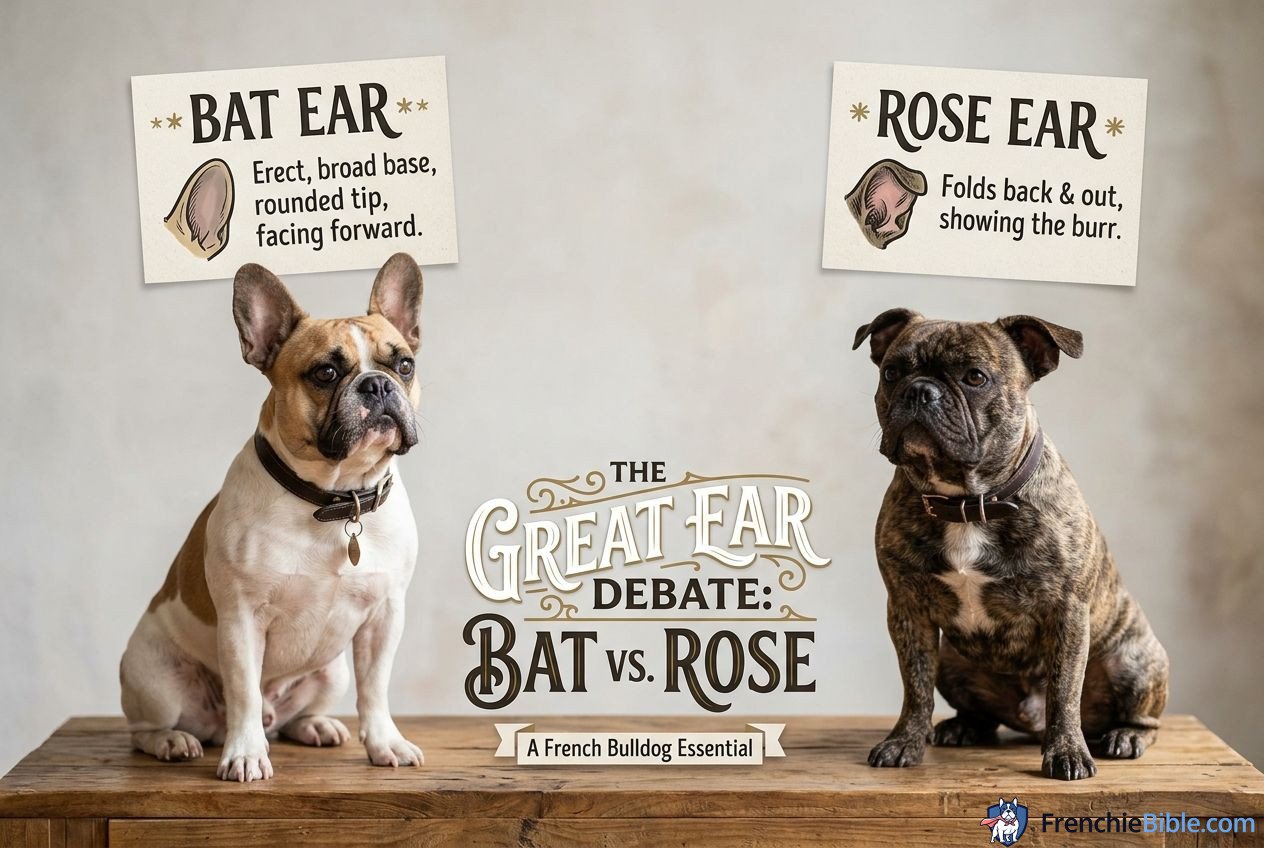
What Are “Rose Ears”?
In canine anatomy, a “rose ear” is a small drop ear that folds backward and outward, exposing the inner burr (the complex cartilage structure of the ear canal). The top edge of the ear folds over and slightly back, creating a delicate shape reminiscent of a blooming rose petal.
This ear shape is a defining characteristic of the English Bulldog, as well as sighthounds like the Greyhound and the Whippet. In the context of the early French Bulldog, the rose ear was seen by many British breeders—and a faction of traditionalist French breeders—as the correct, historically accurate trait. It reflected the breed’s undeniable bulldog heritage. To these traditionalists, the rose ear represented a vital link to the past and a validation of the dog’s identity as a true bulldog variant. Conversely, they viewed the erect bat ear as a severe flaw, a vulgar sign of impure terrier crossbreeding that detracted from the bulldog expression.
What Are “Bat Ears”?
The “bat ear,” on the other hand, is a naturally erect ear, broad at the base, elongated, and featuring a distinctly rounded top. The ears are set high on the head but not too close together, and the orifice (the opening of the ear canal) faces directly forward.
This ear shape was a novel, striking, and highly unusual feature in the bulldog family. It gave the dog an incredibly alert, intelligent, and highly unique expression. As the breed gained traction among affluent Americans visiting Paris—many of whom were prominent socialites, industrialists, and influential figures in the emerging American dog fancy—the bat ear quickly became the preferred trait.
American enthusiasts were captivated by the distinct, almost comical appearance of the bat-eared Frenchies. To them, the bat ear was what separated the French Bulldog from simply being a poor, miniaturized copy of the English Bulldog. It gave the breed its own unique identity, charm, and silhouette. Consequently, affluent Americans began importing bat-eared specimens to the United States in massive numbers, often paying exorbitant prices that would equate to tens of thousands of dollars today.
The Turning Point: The 1897 Westminster Kennel Club Dog Show
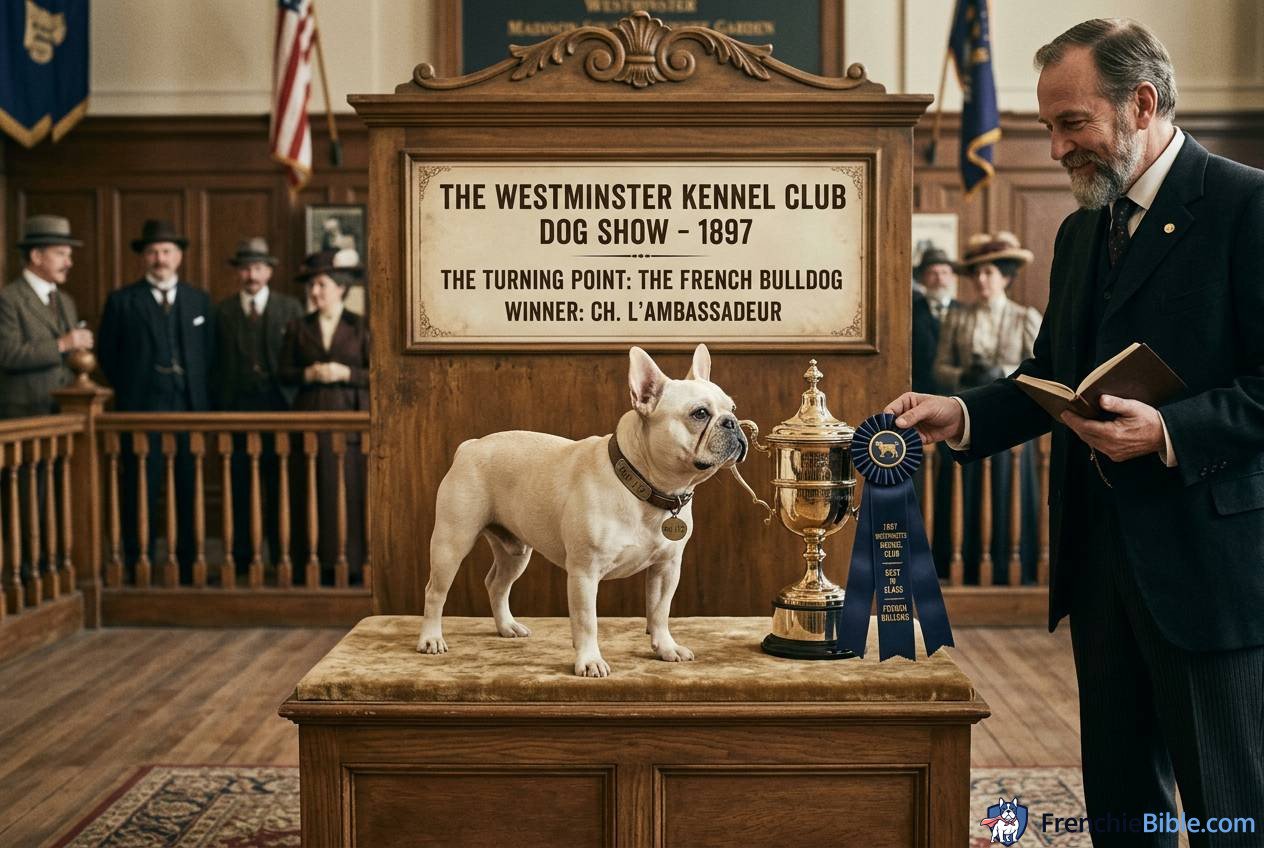
The brewing conflict over the French Bulldog’s ears came to a dramatic and highly publicized head at the 1897 Westminster Kennel Club Dog Show, held at the prestigious Waldorf-Astoria in New York City. This event is universally recognized by breed historians as the watershed moment in the history of the French Bulldog breed standard.
American Breeders Take a Stand Against English Judging
At the 1897 Westminster show, French Bulldogs were exhibited in the United States in significant numbers for the very first time. The American fanciers proudly entered their highly prized, expensive bat-eared imports. However, the judging was handled by an English judge named Mr. George Raper, a man who strongly favored the traditional rose ear, reflecting the prevailing sentiment among British bulldog purists.
Judge Raper proceeded to award all the top honors to the few rose-eared French Bulldogs present, explicitly penalizing and dismissing the magnificent bat-eared specimens that the American exhibitors had painstakingly imported.
The American fanciers were outraged. They had invested considerable time, immense wealth, and deep passion into cultivating the bat-eared variety, which they fundamentally believed to be the true, distinctive, and superior form of the new breed. They felt that judging the Frenchie by archaic English Bulldog standards stripped the new breed of its unique identity and stifled its evolution.
The Formation of the French Bull Dog Club of America (FBDCA)
The indignation sparked by Judge Raper’s decisions at the 1897 Westminster show catalyzed immediate, decisive, and highly organized action. A group of wealthy and influential American enthusiasts—including notable figures such as George Waterhouse, Vactar M. Haldeman, and prominent society ladies connected to families like the Rockefellers and Morgans—banded together to form the French Bull Dog Club of America (FBDCA) in April 1897.
Remarkably, the FBDCA was the very first club in the entire world dedicated specifically to the French Bulldog breed, predating even the breed clubs in France and England.
The primary, unapologetic objective of the FBDCA was to wrest control of the breed’s destiny from European judges and establish an American standard that unequivocally mandated the bat ear. Later that same year, in 1898, the newly formed FBDCA held its own specialty show at the Waldorf-Astoria. It was a lavish, exclusive, high-society event that garnered massive media attention.
The most critical and revolutionary stipulation of this specialty show? Only bat-eared French Bulldogs were allowed to compete. Rose-eared dogs were explicitly banned.
This bold, uncompromising move effectively settled the debate, at least in North America. The FBDCA drafted the first comprehensive breed standard for the French Bulldog, and the bat ear was enshrined as an absolute, non-negotiable requirement. Any ear other than a bat ear was classified as a severe fault or disqualification.
The Official Breed Standard: Solidifying the Bat Ear Worldwide
The decisive actions of the American fanciers and the immense financial power they wielded rippled across the Atlantic. The American preference for the bat ear was so strong, and the prices they were willing to pay for bat-eared dogs so high, that European breeders inevitably shifted their breeding programs to cater to the lucrative American market. Today, the bat ear is universally recognized as the absolute hallmark of the French Bulldog.
AKC Standards and Specifications
The American Kennel Club (AKC) officially recognized the French Bulldog in 1898, adopting the standard established by the FBDCA. The current AKC breed standard remains incredibly specific regarding the ears, reflecting the profound historical importance of this trait.
According to the official AKC standard:
- Ears: Known as the bat ear, broad at the base, elongated, with a round top, set high on the head but not too close together, and carried erect with the orifice to the front. The leather of the ear fine and soft.
- Disqualifications: Other than bat ears.
This means that a rose-eared French Bulldog cannot be shown in AKC conformation events and is considered a serious genetic deviation from the standard.
From An Experienced Breedererinary and judging perspective, the placement and carriage of the ear are just as meticulously evaluated as the shape itself. The ears should not be set too wide apart on the side of the head (a structural flaw often referred to colloquially as “airplane ears”), nor should they be set too close together at the top of the skull, which gives a pinched expression. The ideal bat ear perfectly frames the Frenchie’s square, flat face, enhancing its alert, intelligent, and inquisitive expression.
The FCI and The Kennel Club (UK) Stance
While the British canine establishment initially fiercely resisted the bat ear, the overwhelming popularity of the American standard, combined with the distinct identity it forged for the breed, eventually led to worldwide consensus.
The Fédération Cynologique Internationale (FCI), the largest international canine organization, whose standards govern dog shows in much of Europe, Asia, and South America, also strictly mandates the bat ear. The FCI standard describes the ears as: “Erect ears; of medium size, wide at the base and rounded at the top. Set high on the head, but not too close together, carried upright. The ear is open towards the front. The skin must be fine and soft to the touch.”
Even The Kennel Club (UK), the governing body that originally championed the rose ear and sparked the 1897 controversy, eventually capitulated to the global consensus. The current UK standard now clearly requires the bat ear, stating: “‘Bat ears’, of medium size, wide at base, rounded at top, set high, carried upright and parallel, a sufficient width of skull preventing them being too close together; skin soft and fine; orifice directed forward.”
Thus, the bat ear triumphed completely, transitioning over a few tumultuous decades from a controversial terrier variation to the indispensable, defining characteristic of the entire breed.
The Anatomy and Genetics of French Bulldog Ears
As An Experienced Breedererinary specialist, I find the anatomy and genetics behind the French Bulldog’s ears to be a fascinating area of study. The transition from a heavy drop ear to an erect ear involves complex biological mechanisms and dedicated selective breeding.
Cartilage Development and Ear Set Anatomy
The shape, carriage, and structural integrity of a dog’s ear are primarily determined by two factors: the structure, thickness, and stiffness of the auricular cartilage (the framework of the ear flap or pinna), and the development of the auricular muscles that attach to the base of the ear and the skull.
In rose-eared breeds like the English Bulldog, the auricular cartilage is relatively thin and flexible at the base. Furthermore, the auricular muscles (specifically the musculus auricularis posterior) are positioned and toned in a way that naturally pulls the ear backward and downward.
In the French Bulldog, generations of selective breeding for the bat ear have resulted in a much thicker, more robust, and deeply grooved cartilage structure at the base of the pinna. This provides a strong foundation. Furthermore, the musculature at the base of the ear—particularly the musculus auricularis superior and anterior—is highly developed, providing the necessary upward and forward tension to hold the relatively large, heavy ear flap perfectly erect.
The iconic “rounded top” required by the standard is also a result of specific genetic selection. This selection suppresses the pointed tip found in many naturally erect-eared breeds, such as the German Shepherd, the Siberian Husky, or the Chihuahua, giving the Frenchie its unique, softer silhouette.
The Polygenic Inheritance of Ear Shape
The genetics of ear shape in dogs are highly complex and polygenic, meaning multiple genes interact to determine the final phenotype (the observable physical trait). However, extensive studies in canine genomics suggest that the genetic predisposition for erect ears is generally recessive to the genes for drop or pendulous ears.
When the early Toy Bulldogs (carrying dominant genes for rose/drop ears) were crossed with Parisian terriers (carrying genes for erect ears), the resulting offspring exhibited a massive spectrum of phenotypes depending on the specific combination of alleles they inherited.
By meticulously and ruthlessly selecting only those dogs that exhibited the perfect bat ear, and breeding them exclusively together over many successive generations, early breeders were able to isolate the desired genes and “fix” the genetic trait within the population. Today, because the trait is genetically fixed, true-bred French Bulldogs will reliably produce bat-eared offspring. If a modern French Bulldog is born with persistently rose or drop ears, it raises serious questions for a breeder. While occasional genetic “throwbacks” can theoretically occur due to the complex polygenic nature of the trait, a true rose ear in a modern Frenchie often points to mixed breeding somewhere in the dog’s recent lineage or an underlying developmental cartilage anomaly.
Health Implications of Ear Shapes in French Bulldogs
With my background in French Bulldog breeding, my primary concern is always the health, comfort, and overall welfare of the animal. Aesthetic standards must be evaluated through the lens of medical impact. The evolution from the rose ear to the bat ear has distinct implications for the French Bulldog’s health, particularly regarding dermatological and otic (ear) conditions.
Aeration and the Battle Against Otitis Externa
One of the most significant advantages of the bat ear from a purely medical perspective is excellent aeration. Because the ear canal is held completely open and exposed to the air, moisture is significantly less likely to become trapped inside the ear canal.
In dogs with heavy drop ears, pendulous ears, or tightly folded rose ears (such as Basset Hounds, Cocker Spaniels, or English Bulldogs), the heavy ear flap acts as a heavy lid. This creates a dark, warm, and highly moist micro-environment within the ear canal. This environment is an ideal, fertile breeding ground for opportunistic yeast (specifically Malassezia pachydermatis) and pathogenic bacteria (such as Staphylococcus pseudintermedius and Pseudomonas aeruginosa). This leads to chronic, incredibly painful, and difficult-to-treat ear infections, a condition medically known as otitis externa.
French Bulldogs, thanks to the erect architecture of their bat ears, generally suffer from fewer chronic, moisture-driven ear infections compared to their drop-eared canine cousins. The open structure allows for constant air circulation, keeping the canal relatively dry and less hospitable to yeast overgrowth.
However, this open architecture is a double-edged sword. While it dramatically reduces moisture buildup, the wide, forward-facing orifice acts somewhat like a radar dish or a funnel. Frenchies are highly susceptible to getting environmental debris, dirt, sand, plant awns (like dangerous foxtails), and bath water splashed directly deep into their ear canals.
Furthermore, French Bulldogs are genetically predisposed to environmental allergies (atopic dermatitis) and adverse food reactions. These systemic allergies frequently manifest locally as severe inflammation in the skin of the ear canal. Therefore, despite the excellent natural aeration provided by the bat ear, French Bulldogs still require meticulous, regular veterinary ear exams and routine, gentle cleaning by their owners using vet-approved otic cleansers to prevent allergic otitis and the painful accumulation of environmental debris.
The Myth of Superior Hearing
A very common misconception among the general public is that the large, radar-like bat ears give French Bulldogs vastly superior hearing compared to rose-eared breeds.
From a neurological, anatomical, and auditory perspective, there is no significant difference in the actual auditory acuity or the function of the inner ear structures (the cochlea and auditory nerve) based on ear flap shape. The shape of the pinna primarily assists in capturing and localizing the source of a sound by funneling sound waves down into the canal. While a Frenchie might be slightly better at pinpointing exactly where a dropped piece of cheese landed in the kitchen due to the shape of the pinna, their actual physiological ability to hear varied frequencies or quiet sounds is not inherently “better” or more sensitive than a Golden Retriever or an English Bulldog.
The Taping Process: Helping Bat Ears Stand
While the bat ear is genetically fixed in the modern breed, the physical process of the heavy ears actually standing up against gravity during puppyhood can sometimes be uneven, delayed, or alarming for novice owners. This is a common source of anxiety and a frequent topic of consultation in my veterinary practice.
When Do Frenchie Ears Naturally Stand Up?
French Bulldog puppies are born with their ears folded over, flat, and sealed tightly against their heads. As they grow over the first few weeks, the ear canals open, and the cartilage at the base of the ear begins to thicken, harden, and develop structural integrity.
Typically, you will see a Frenchie puppy’s ears start to make their ascent between 5 and 15 weeks of age. However, this process is rarely a smooth, linear progression. It is incredibly common for one ear to go up perfectly while the other stays completely flat, for both to go up and then flop back down a week later, or for the tips to curl backward over the skull.
This frustrating fluctuation is intimately tied to the biological demands of the teething process. When a puppy begins losing its deciduous (baby) teeth and erupting large adult teeth—usually occurring intensely between 3 and 5 months of age—the rapidly growing body diverts significant amounts of systemic calcium and other minerals to the jawbone and the new tooth enamel. This temporary, natural redistribution of calcium can leave the developing ear cartilage temporarily softer and less rigid, causing previously erect ears to droop or wilt. Once the intense phase of teething is complete and calcium distribution normalizes, the cartilage hardens permanently, and the ears usually stand up strong and tall.
Safe Taping Techniques for Breeders and Owners
In the vast majority of cases, a purebred, genetically sound French Bulldog’s ears will stand up entirely on their own by 7 to 8 months of age without any human intervention whatsoever. Patience is the greatest virtue during this phase.
However, if the ears are still completely flat and show no sign of lifting by 5 to 6 months of age, or if a breeder wishes to provide some gentle support to ensure a perfect set for the show ring, ear taping (often called “posting”) is a common practice. With my background in French Bulldog breeding, I stress heavily that taping must be done correctly, hygienically, and safely to avoid damaging the delicate ear tissue, restricting blood flow, or causing horrific infections.
- Materials Are Crucial: Use only gentle, breathable, hypoallergenic medical tape (such as paper tape, surgical porous tape, or specific dog ear-posting tape available from veterinary suppliers). Never, under any circumstances, use duct tape, electrical tape, masking tape, or tight rubber/elastic bands. These materials will cause severe tissue necrosis (death) and can lead to the loss of the ear.
- The Method: The tape is usually applied carefully around the base of the ear to create a supportive, rigid cylinder, gently holding the ear in its natural upright position. Sometimes, a soft, lightweight foam backer rod is used internally within the tape cylinder for added support without adding heavy weight.
- Duration and Monitoring: Taping should be done for only 3 to 4 days at a time, followed immediately by at least 24 hours of rest with no tape to allow the skin to breathe, monitor for irritation, and to assess if the ear can finally stand on its own.
- Veterinary Caution: Taping should never cause pain, swelling, redness, hair loss, or a foul odor. If any of these signs of infection or compromised blood flow occur, the tape must be removed instantly using a medical adhesive remover (not ripped off), and An Experienced Breedererinarian must be consulted immediately.
I always strongly advise owners to consult their experienced breeder or their veterinarian for a hands-on demonstration before attempting to tape a puppy’s ears at home, as improper technique frequently causes permanent anatomical deformity or severe dermatological crises.
Beyond the Ears: How Breed Standards Have Evolved
While the dramatic bat ear vs. rose ear debate is the most famous historical controversy in the breed’s lore, the French Bulldog standard has continued to evolve significantly over the last century. These changes reflect shifting aesthetic preferences and, more recently, a desperate and necessary growing emphasis on veterinary health.
Size, Weight, and Proportion Evolution
Early French Bulldogs varied wildly in size and type. The original AKC standard allowed for dogs weighing up to a hefty 28 pounds, but many of the most prized early specimens in Paris and America were much smaller, closer to 12 to 14 pounds, reflecting their Toy Bulldog heritage.
Today, the standard heavily emphasizes a compact, incredibly muscular, and heavy-boned dog. The modern AKC standard dictates a weight strictly not exceeding 28 pounds, with a profound emphasis on proportion and structural symmetry. A French Bulldog must be compact and “cobby” (short-bodied), never leggy, racy, or elongated like a terrier. The evolution of the standard has continually refined this “bull in miniature” aesthetic, striving for an extremely difficult balance between massive, heavy bone structure and agile, unencumbered movement.
Coat Colors and the Dangerous Exotic Controversy
Perhaps the most fiercely contentious and medically concerning issue in the modern French Bulldog world is the explosion of non-standard coat colors. The historical standards—established over a century ago by the founding clubs to maintain the breed’s classic look and genetic integrity—permit only specific, naturally occurring colors: brindle, fawn, white, and brindle and white (pied).
In recent years, fueled by social media trends and profit-driven backyard breeding, there has been a massive surge in the breeding of “fad” or “exotic” colors, such as blue, lilac, chocolate, merle, Isabella, and dogs with “fluffy” (long hair) coats. These colors and coat types are explicitly and strictly disqualified by the AKC, FCI, and UK Kennel Club breed standards.
From An Experienced Breedererinary, genetic, and ethical breeding standpoint, the aggressive pursuit of these exotic colors is deeply alarming. The specific recessive or mutant genes responsible for some of these colors (particularly the merle gene and the dilute ‘d’ gene responsible for blue/lilac) are scientifically linked to severe genetic health conditions. These include congenital deafness, severe ocular defects (such as microphthalmia, where the eyes are abnormally small and often blind), and a painful, incurable, lifelong skin condition known as Color Dilution Alopecia (CDA), which causes massive hair loss and chronic skin infections.
Furthermore, the frantic drive to produce these rare colors often leads to reckless inbreeding, tight line-breeding, and a blatant, tragic disregard for the dog’s overall structural health, breathing ability, and temperament.
The breed standard exists not merely as a superficial beauty pageant rulebook, but as a carefully constructed historical blueprint for a healthy, structurally sound, and historically accurate dog. Responsible, ethical preservation breeders adhere strictly to the standard colors not out of snobbery, but to fiercely preserve the breed’s genetic integrity and protect its long-term health.
The Future of the French Bulldog Breed Standard
As we look to the future, the continued evolution of the French Bulldog breed standard is increasingly—and necessarily—driven by veterinary science, genetic testing, and severe animal welfare concerns.
Prioritizing Health Over Exaggerated Conformation
The French Bulldog is a severely brachycephalic (flat-faced) breed. While this skull shape gives them their adorable, human-like, infantile expression that owners adore, it also genetically predisposes them to devastating health issues. Chief among these is Brachycephalic Obstructive Airway Syndrome (BOAS), which causes lifelong respiratory distress. They are also highly prone to severe spinal anomalies (like hemivertebrae), debilitating joint issues, and physiological difficulties with natural reproduction (requiring artificial insemination and Cesarean sections).
In recent years, progressive breed clubs and global veterinary organizations have been aggressively advocating for vital revisions to the breed standard to discourage extreme anatomical exaggerations. There is a powerful, growing movement within the ethical breeding community to prioritize a slightly longer muzzle, wider nares (open nostrils), a less extreme spinal curvature, and a slightly longer back. The goal is to ensure the dogs can breathe freely without surgery, exercise comfortably in normal weather, and lead high-quality, pain-free lives. The standard must aggressively evolve from dictating merely what the dog looks like to encompassing how functionally healthy and biologically sound the dog is.
The Critical Role of Ethical Breeders
The preservation and healthy evolution of the French Bulldog rest squarely on the shoulders of ethical breeders and educated buyers. An ethical breeder uses the breed standard as a fundamental guide but places the absolute highest priority on comprehensive, transparent health testing. This includes submitting dogs for official spinal x-rays, cardiac evaluations, tracheal hypoplasia screening, patella evaluations, and exhaustive genetic DNA panels (such as those recommended by the OFA and CHIC programs).
The bat ear, aggressively solidified over a century ago in the opulent ballrooms of the Waldorf-Astoria, remains the brilliant crowning glory of the French Bulldog. However, true breed enthusiasts and veterinary professionals understand implicitly that a perfectly shaped bat ear means absolutely nothing if it is not attached to a healthy, structurally sound, freely breathing, and well-tempered dog.
Frequently Asked Questions (FAQ)
1. Can a purebred, registered French Bulldog have rose ears?
While incredibly rare today due to over a century of strict selective breeding specifically for the bat ear, it is theoretically, genetically possible for a purebred Frenchie to inherit a hidden recessive combination that results in a drop or rose ear. However, a French Bulldog with rose ears is immediately disqualified from the conformation show ring and should absolutely never be used in a breeding program, as it deviates entirely from the core breed standard. Practically speaking, if a modern puppy has persistently rose ears, it is far more likely indicative of mixed breeding somewhere in its recent undocumented lineage.
2. My Frenchie puppy is 4 months old, and its ears are still floppy and won’t stand up. Is this normal?
Yes, this is completely normal and no cause for panic. The period between 3 and 5 months of age is the peak teething time. The massive amounts of calcium required for new adult tooth development often leave the ear cartilage temporarily soft and weak, causing the ears to droop, flop, or curl backward. As long as the puppy is healthy, parasite-free, and fed a high-quality balanced diet, the ears will typically stand up strong and permanently once the teething phase is complete, usually by 6 to 8 months of age.
3. Should I give my Frenchie puppy calcium supplements or yogurt to help their ears stand up faster?
Absolutely not. With my background in French Bulldog breeding, I strongly advise against supplementing calcium without direct, specific medical supervision based on blood work. High-quality commercial puppy foods are specifically formulated to contain the precise, delicate balance of calcium and phosphorus needed for healthy bone and cartilage development. Over-supplementing calcium in a growing puppy can cause severe, painful, and irreversible skeletal deformities, joint issues (like OCD), and actually hinder proper cartilage formation. If you are concerned about your puppy’s ear development, consult your vet; do not reach for calcium pills or dairy products.
4. Are bat ears more prone to ear infections than floppy ears?
Generally speaking, erect bat ears are significantly less prone to the chronic, moisture-driven yeast and bacterial infections that constantly plague drop-eared breeds (like Cocker Spaniels). Because the ear is erect, the open structure allows for excellent air circulation, keeping the canal dry. However, the wide, funnel-like opening makes Frenchies much more susceptible to getting environmental dirt, water, and allergens directly into the canal. Furthermore, French Bulldogs are highly prone to allergic skin disease, which frequently causes severe secondary ear inflammation. Therefore, regular cleaning with vet-approved solutions and routine veterinary check-ups remain essential.
5. What is the FBDCA, and why is it so important to the breed’s history?
The French Bull Dog Club of America (FBDCA) was founded in April 1897 by wealthy American enthusiasts who were outraged that British judges were penalizing bat-eared French Bulldogs at American dog shows. The FBDCA was the very first club in the world dedicated specifically to the Frenchie breed. Their monumental founding action was to draft a breed standard that explicitly required the bat ear and banned the rose ear, effectively cementing the bat ear as the defining, non-negotiable characteristic of the breed worldwide.
6. Are “fluffy,” “merle,” or “blue” French Bulldogs recognized by the official breed standard?
No, they are absolutely not. Colors such as blue, lilac, merle, chocolate, Isabella, and coat types like “fluffy” (long hair) are considered exotic or fad traits. They are explicitly listed as severe faults or outright disqualifications in the official breed standards of the AKC, FCI, and UK Kennel Club. Breeding specifically for these traits is highly controversial and generally condemned within the veterinary and ethical breeding communities. These colors are frequently associated with serious genetic health defects (like Color Dilution Alopecia, deafness, and blindness), and the aggressive pursuit of these rare colors often willfully ignores overall structural health, breathing ability, and genetic diversity.
7. How should I clean my French Bulldog’s bat ears?
Ear cleaning should be done carefully and only when necessary (typically when you see visible debris or wax). Use a high-quality, veterinary-approved liquid ear cleanser. Squirt a liberal amount into the ear canal, gently massage the base of the ear (you should hear a squishing sound) for 20-30 seconds to break up debris, and then let the dog shake its head. Wipe out the loosened debris from the visible part of the ear flap and the upper canal using a cotton ball or a soft gauze square. Never insert Q-tips or cotton swabs blindly into the ear canal, as you can easily rupture the delicate eardrum or pack wax deeper into the ear, causing a severe infection. If the ears are red, swollen, smelly, or painful, stop immediately and see your veterinarian.
8. Will taping my puppy’s ears guarantee they stand up perfectly?
No. Taping (or posting) only provides temporary mechanical support to the cartilage while it hardens. If the puppy fundamentally lacks the genetic coding for sufficiently strong cartilage or proper ear muscle development, or if the ears are simply too large and heavy for the base to support, taping will not miraculously fix the issue permanently. Furthermore, incorrect taping can permanently crease or damage the cartilage, ensuring the ear never stands correctly. It should only be used as a minor supportive measure in dogs that are genetically predisposed to have erect ears.