If you are reading this, you are likely preparing for one of the most exciting—and nerve-wracking—milestones in a dog owner’s life: bringing a new puppy home to your existing pack. As a French Bulldog breeder with over a decade of hands-on experience, I have orchestrated and witnessed countless introductions between resident dogs and new Frenchie puppies. Let me tell you right from the start: introducing a French Bulldog puppy to a multi-dog household does not have to be a chaotic event. With the right strategy, patience, and understanding of canine psychology, you can lay the foundation for a lifelong bond between your dogs.
In my years of raising and placing these magnificent little bat-eared companions, I’ve learned that hope is not a strategy. You cannot simply drop a new Frenchie puppy into your living room and expect your older dogs to sort it out. French Bulldogs are unique. They are incredibly affectionate, often remarkably stubborn, and play in a very specific, physical way that can sometimes clash with other breeds. This comprehensive guide will walk you through my exact, battle-tested protocols for a smooth integration, ensuring your resident dogs accept—and eventually adore—the new addition.
Related Reading: Health & Diet | Frenchie Puppy Guide
Understanding the French Bulldog Puppy Dynamics
Before we dive into the step-by-step introduction process, we must understand the specific traits of the French Bulldog. Frenchies are clowns. They are sturdy, compact, and often lack the spatial awareness that other breeds possess. When a Frenchie puppy wants to play, they tend to launch themselves like little bowling balls.
The Frenchie Play Style: A Breed Apart
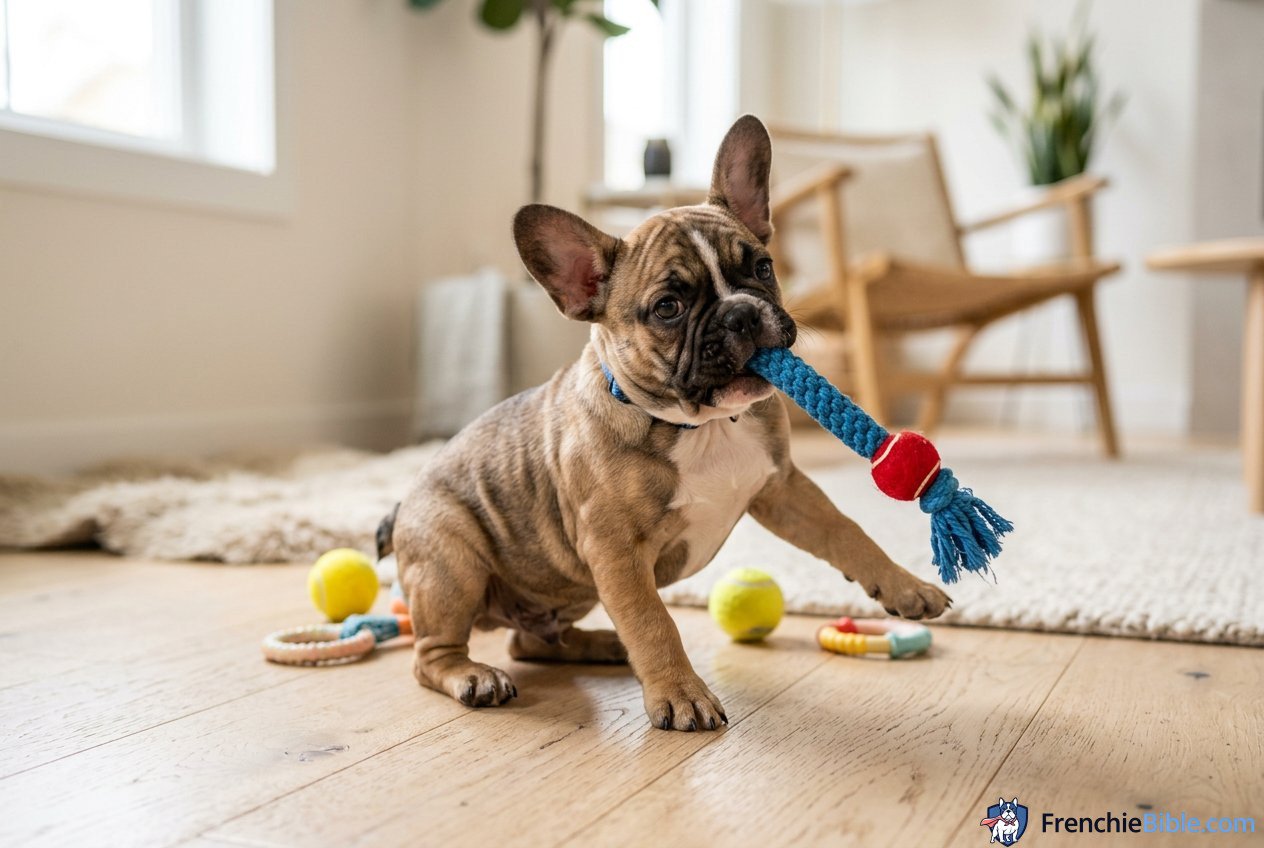
French Bulldogs are what I like to call “body players.” They love to wrestle, body-slam, use their paws, and engage in rough-and-tumble antics. For a resident dog who prefers a gentle game of chase, or a senior dog who prefers not to be touched at all, a Frenchie puppy’s approach can be highly off-putting, if not downright offensive. Furthermore, Frenchies are notorious for their unique vocalizations. The grunts, snorts, and “gremlin noises” they make during play can easily be misinterpreted by other dog breeds as growling or aggression. Understanding this breed-specific behavior is your first tool in managing the introduction. You must be the advocate for your older dogs when the Frenchie puppy becomes too overwhelming, and you must translate these behaviors for the rest of your pack.
The Pack Mentality and Canine Hierarchy
Dogs are deeply social creatures, but they are also creatures of habit and routine. Your resident dogs have established a comfortable living dynamic, a hierarchy of sorts, and a predictable environment. A new puppy is an explosive disruption to that peace. When introducing a French Bulldog puppy, your primary goal is to show your resident dogs that this new addition is not a threat to their resources, their space, or their relationship with you. It is a common myth that dogs will “just figure it out.” In reality, leaving them to sort it out often leads to bullying, fear, and deep-seated anxiety. We must guide them carefully through this transition.
Phase 1: Pre-Arrival Preparation (The Weeks Before)
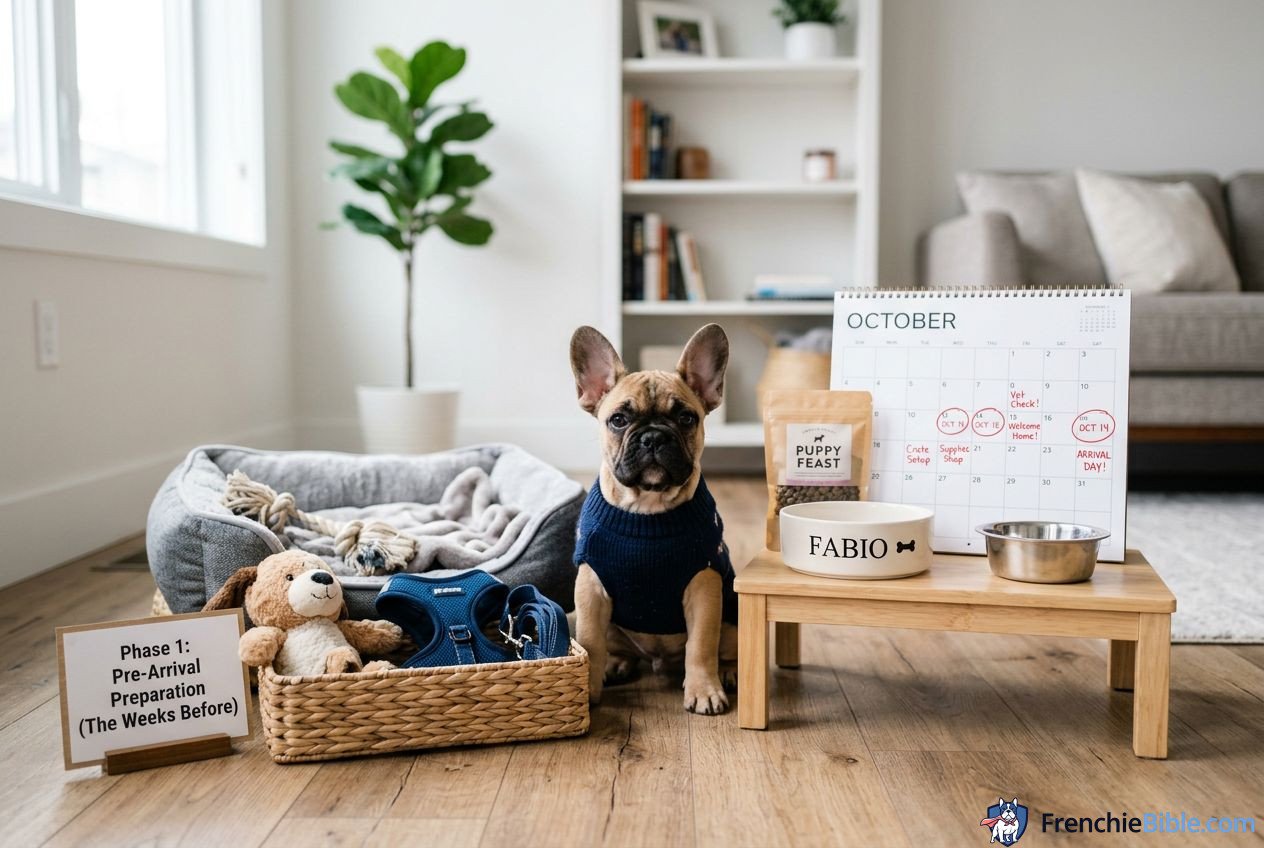
The integration process actually begins long before you pick up your new French Bulldog puppy. Setting the stage for success means preparing your home and your resident dogs for the inevitable changes. Do not wait until the puppy is in the car to start planning.
Scent Swapping: The Invisible Introduction
Dogs experience the world primarily through their noses. The concept of scent swapping is my absolute favorite breeder secret. About a week or two before you bring your Frenchie puppy home, exchange items between the puppy and your resident dogs. Bring a blanket or a soft toy that smells like your older dogs to the breeder’s home, and bring an item that smells strongly of the puppy into your home.
Place the puppy-scented item in neutral areas of your house—perhaps the living room floor or a hallway. Crucially, do not place it in your older dog’s bed or near their food bowl, as that can cause defensive, territorial reactions. Let your resident dogs investigate the scent on their own terms. When they calmly sniff the item, reward them heavily with high-value treats (think boiled chicken or freeze-dried liver). You are proactively building a positive association: “This specific new smell means I get amazing things.”
Establishing Safe Zones and Management Stations
You must create physical boundaries before the puppy arrives.
1. The Puppy Zone (The Command Center): Set up a sturdy exercise pen (x-pen) or gate off a designated, puppy-proofed room where the puppy can safely hang out without having access to the older dogs. This is where the puppy will spend time when you cannot actively supervise with 100% of your attention. Equip it with a cozy bed, appropriate chew toys, and water.
2. The Resident Dog Sanctuary: Ensure your older dogs have a space that is completely, unconditionally off-limits to the puppy. Whether it’s your bedroom, a specific couch they love, or a raised dog bed in the corner, they need a safe harbor to retreat to when they have had enough of the puppy’s relentless energy.
Neutralizing High-Value Resources
Resource guarding is one of the most common—and dangerous—triggers for altercations in multi-dog households. Take a careful inventory of everything your resident dogs might consider valuable: food bowls, specific squeaky toys, high-value chew bones, and even certain sleeping spots or laps.
Pick up all toys and bones at least three days before the puppy arrives. The house should be completely devoid of “prizes.” When the puppy comes home, toys should only be introduced under strict, active supervision, and initially, it is often best to keep them put away entirely when the dogs are interacting. Food bowls must be separated permanently. We will discuss feeding protocols later in this guide.
Phase 2: The Big Day – The First Meeting
The day has arrived. You have your French Bulldog puppy, and your resident dogs are waiting at home. Your adrenaline is likely pumping, but you must remain calm, as dogs are masters at reading human emotions. The golden rule here is: Never, ever introduce the dogs inside the house. The home is the resident dogs’ castle, and a new puppy entering it can immediately trigger territorial defense.
Choosing Neutral Territory
Select a completely neutral location for the first meeting. This could be a local park, a neighbor’s securely fenced yard, or even just down the street from your house, provided it’s an area your resident dog doesn’t fiercely patrol. The key is that your resident dogs do not feel a genetic imperative to defend this space.
The Parallel Walk Method: Moving as a Pack
This is the most crucial behavioral technique in your arsenal. Have a family member or friend walk your resident dog on a standard loose leash, while you walk the Frenchie puppy (or carry them safely if they are not fully vaccinated, although a clean, paved surface is often fine for a brief meeting if you adhere to safe practices).
Walk parallel to each other, keeping a substantial distance initially—perhaps 15 to 20 feet apart. Do not let them greet or make eye contact immediately. Let them walk, sniff the environment, mark bushes, and realize that the other dog is present but not demanding an interaction. This shared, forward-moving activity significantly reduces tension and begins building a subconscious sense of moving together as a pack.
The Sniff and Greet: The Three-Second Rule
Once both dogs seem relaxed—indicated by loose body language, a natural tail carriage, open mouths (soft panting), and an ability to take treats gently—you can allow the gap to close slowly. Let the resident dog approach the puppy, not the other way around. Keep leashes completely loose. A tight leash transmits human anxiety and tension straight down to the dog’s neck, which can instantly trigger reactivity or defense.
Allow a brief, highly supervised sniff. I adhere strictly to the “three-second rule.” Count in your head: one, two, three. Then, cheerfully and confidently call both dogs away and reward them generously. This prevents the greeting from lingering into intense staring, posturing, or over-arousal. Repeat this brief interaction several times.
If the older dog actively ignores the puppy, looking around or sniffing the grass instead, celebrate! Indifference is a highly desirable, polite reaction; it means the older dog does not view the puppy as a threat. Do not force them to interact if they choose not to.
Entering the Home Together
After a successful parallel walk and multiple neutral greetings outdoors, walk the dogs into the home together. Ideally, take them into the backyard first, let them sniff around off-leash if the yard is secure, and then casually move inside. Keep the initial indoor interactions incredibly brief and heavily supervised. After just a few minutes, place the Frenchie puppy in their pre-established playpen with an engaging chew toy, allowing the resident dogs to relax and decompress from the excitement.
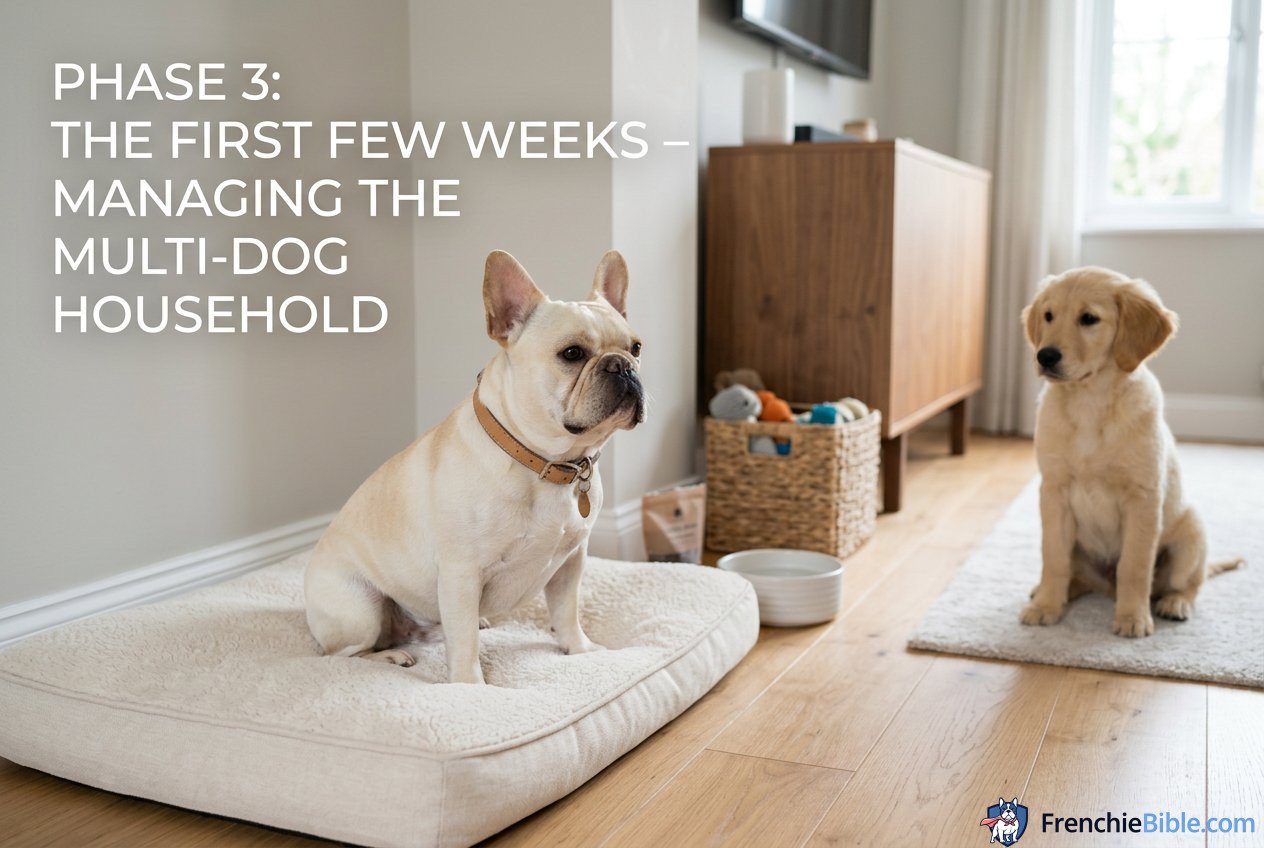
Phase 3: The First Few Weeks – Managing the Multi-Dog Household
The honeymoon phase may last a few days, or there may not be one at all. The first few weeks are not about forcing friendship; they are about intense management, establishing unwavering boundaries, and advocating for all dogs involved.
The Golden Rule: 100% Supervised Play Only
For the first several months, the Frenchie puppy and the resident dogs should never, under any circumstances, be left alone together unattended. Not even for a minute. If you need to answer the door, use the bathroom, or check the oven, the puppy goes into the crate or playpen. It only takes a split second for a rambunctious puppy to push a resident dog too far, resulting in a correction that could escalate unnecessarily.
Advocating for the Resident Dog
French Bulldog puppies are notoriously relentless. They often do not naturally understand or respect the subtle “stop” signals from older dogs. If your resident dog turns their head away, stiffens their body, licks their lips repeatedly (a sign of stress), yawns out of context, or tries to walk away, the puppy must be stopped from pursuing them.
If the older dog gives an appropriate vocal correction—such as a low growl, a lip curl showing teeth, or a sharp bark without making physical contact—do absolutely not scold the older dog! They are communicating appropriately in dog language. Instead, step in calmly and remove the puppy. You are teaching the puppy boundaries, and more importantly, you are showing the older dog that they do not have to escalate to a physical bite to get the puppy to leave them alone. “I’ve got your back,” is the message you want to continuously send to your older dog.
Strategic Feeding Protocols
Meals should be a time of complete peace and vulnerability. Feed the Frenchie puppy in their crate or behind the closed door of their playpen, completely visually and physically separated from the resident dogs. Do not allow them to stare at each other through the bars while eating, as this builds tension. After mealtime, pick up all bowls. This simple step entirely eliminates any possibility of resource guarding over food, which is a leading cause of dog fights in the home.
The Importance of Individual One-on-One Time
Your resident dogs might feel displaced, jealous, or overwhelmed by the sheer amount of time, energy, and noise a new Frenchie puppy brings into the home. It is absolutely vital to maintain their pre-existing routine as much as possible and shower them with individual attention. Take your older dog for a solo, peaceful walk, play their favorite game of fetch without the puppy interfering, or simply have a quiet, dedicated cuddle session on the couch. This daily reinforcement ensures that their place in the family hierarchy is secure and their bond with you remains strong.
Phase 4: Frenchie-Specific Considerations During Play
As your dogs begin to interact more freely and engage in play, you must keep the physical limitations and unique anatomy of the French Bulldog in the forefront of your mind. My decade of breeding has taught me that while Frenchies act like tough little tanks, they have specific, critical vulnerabilities.
Protecting the Back and Joints (Spinal Health)
French Bulldogs are a chondrodysplastic breed. This means they have a specific genetic bone structure that gives them their adorable short legs and compact bodies, but it also makes them highly prone to spinal issues, most notably Intervertebral Disc Disease (IVDD). When they play with larger, heavier, or more agile dogs, the risk of spinal injury increases exponentially.
Do not allow larger resident dogs to jump on the Frenchie puppy’s back, body-slam them from above, or forcefully roll them over during play. You must monitor play closely and intervene immediately if the play becomes too rough or vertical. The ideal play style for a Frenchie is horizontal, ground-level wrestling on soft, non-slip surfaces like thick carpets or grass. Avoid hard impacts on tile or hardwood floors.
Monitoring Breathing and Temperature (Brachycephalic Risks)
French Bulldogs are brachycephalic, meaning they have a shortened skull and a flat face. This anatomical feature means they cannot regulate their body temperature as efficiently through panting as dogs with longer snouts (like Labs or Shepherds). Consequently, they can easily and rapidly overexert themselves during vigorous play, leading to dangerous overheating or respiratory distress.
Watch the Frenchie puppy meticulously during play sessions. If their breathing becomes excessively labored, loud, raspy, or if their tongue lolls far out to the side and curls, stop the play immediately. Enforce a mandatory rest period in a cool, air-conditioned room. Do not rely on the puppy to self-regulate; a highly stimulated Frenchie puppy will often push themselves to play until they literally collapse. You must act as their external “off-switch.”
Deep Dive: Reading Canine Body Language
To successfully manage a multi-dog household, you must become fluent in canine body language. Misinterpreting their signals is the fastest way to fail at an introduction.
Signs of Positive Play
- Play Bows: Front elbows on the ground, rear end in the air. This is the universal sign for “everything I do next is just playing.”
- Loose, Wiggly Bodies: The dogs should look relaxed, not stiff. Their movements should be exaggerated and bouncy.
- Role Reversal: Healthy play involves taking turns. One dog chases, then the other chases. One is pinned, then allows the other to be pinned. If the Frenchie puppy is constantly the aggressor and the older dog is constantly trying to escape, it is not play; it is bullying.
- Open Mouths: Soft, relaxed open mouths, often looking like a smile.
Warning Signs of Tension and Stress (Intervene Immediately)
- Stiffness: The dog’s body goes rigid. Movement slows down or stops.
- Whale Eye: The dog turns their head slightly away but keeps their eyes fixed on the other dog, showing the whites of their eyes. This is a clear sign of anxiety and discomfort.
- Lip Licking and Yawning: When done outside the context of food or sleep, these are appeasement gestures and signs of acute stress.
- Low, Tucked Tail or Stiff, High Tail: Both extremes indicate high arousal or fear. A neutral, wagging tail is ideal (though note that some wags, if stiff and fast, can indicate agitation).
- The “Freeze”: If the dogs suddenly stop moving and stare hard at each other, a fight may be imminent. Interrupt them immediately with an upbeat, happy voice and redirect their attention.
Common Challenges and How to Overcome Them
Even with flawless preparation, bumps in the road are entirely normal. Here is how I advise my puppy families to handle common integration hurdles.
The Older Dog Completely Ignores the Puppy
Many new owners panic when their beloved older dog pretends the new puppy simply does not exist. Let me reassure you: this is a brilliant outcome! Ignoring the puppy is a highly polite, non-confrontational way of communicating, “I see you, I do not consider you a threat to my resources, but I also have absolutely no desire to play with you right now.” Respect this boundary. Over time, as the puppy matures, learns manners, and calms down, the older dog will likely begin to engage more. Never force them to interact or push the puppy into the older dog’s face to “make them be friends.”
The Puppy is Relentlessly Harassing the Older Dog
If the Frenchie puppy will not leave the older dog alone despite numerous appropriate corrections, you must dramatically increase your management. Utilize a “house line”—a very light, cheap leash attached to the puppy’s harness (never a collar, due to their breathing issues) that they drag around under your direct supervision. This allows you to smoothly and gently step on the line to stop the puppy, or gently guide them away from the older dog without reaching in with your hands, which can sometimes escalate arousal. Reinforce the “leave it” or “place” command strongly. Redirect the puppy’s frantic energy to an engaging puzzle toy, a frozen Kong, or a short, positive training session.
Recognizing When You Need Professional Help
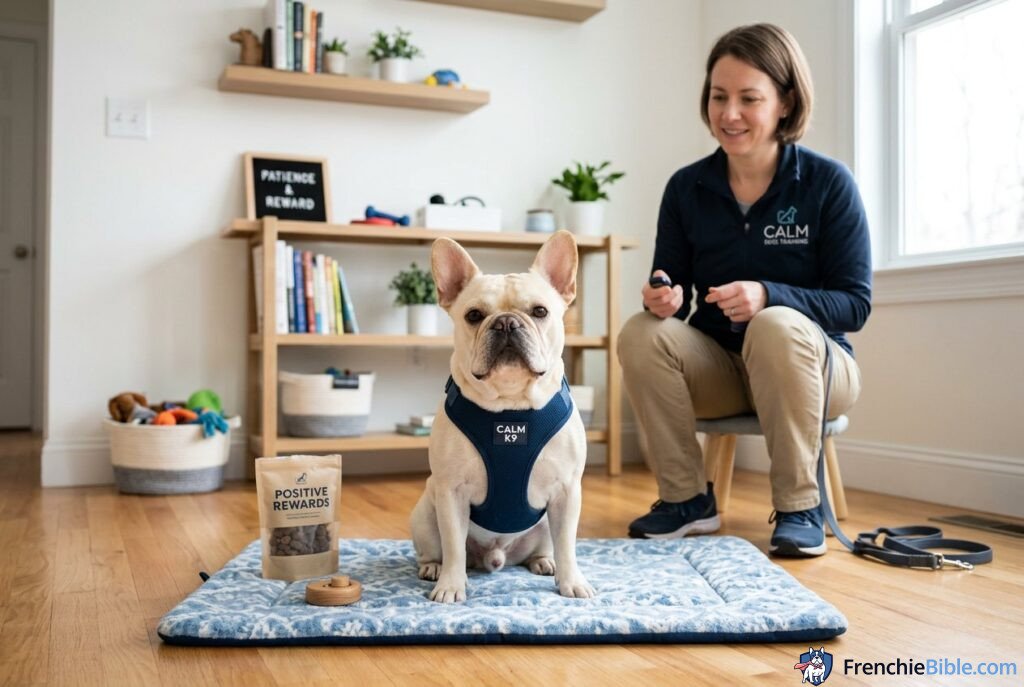
While most introductions proceed smoothly with time and management, safety must always come first. If you observe any of the following severe behaviors, do not hesitate to contact a professional, certified positive-reinforcement dog trainer or An Experienced Breedererinary behaviorist immediately:
– The resident dog is aggressively lunging, snapping with intent to harm, or fiercely guarding spaces, you, or objects from the puppy.
– The resident dog’s quality of life plummets: they are constantly shaking, hiding under furniture, refusing to eat, or exhibiting severe depression since the puppy arrived.
– Blood is drawn during any physical altercation.
Do not attempt to fix severe aggression issues on your own; professional guidance is necessary to prevent a tragic outcome.
Building the Lifelong Pack Bond
Introducing a French Bulldog puppy to a multi-dog household is undeniably a marathon, not a sprint. It takes weeks, and very often months, for the pack dynamics to fully settle, for the puppy to learn the house rules, and for the entire household to find a new, harmonious rhythm.
The absolute key to your success lies in excruciatingly slow introductions, the absolute, non-negotiable management of high-value resources, and acting as a fair, consistent, and protective advocate for all the dogs in your home.
As a breeder, seeing a puppy I brought into this world successfully integrate into a loving, multi-dog family is the greatest reward of my life’s work. I have seen the grumpiest, most set-in-their-ways senior dogs eventually share a sunbeam and a bed with a Frenchie they initially wanted nothing to do with. It happens through profound patience, unwavering consistency, and a deep, empathetic respect for canine communication. Give them the gift of time, meticulously manage their environment, and soon enough, you will be enjoying the beautiful, hilarious, and heartwarming chaos of a perfectly blended multi-dog household.
Advanced Socialization: Beyond the Immediate Pack
While the primary focus is integrating the French Bulldog puppy with your resident dogs, a truly harmonious multi-dog household also relies on individual socialization outside the home. A well-socialized puppy is far less likely to develop anxiety or reactivity, which in turn reduces stress within your home pack.
The Critical Socialization Window
The critical socialization window for puppies closes around 14 to 16 weeks of age. During this incredibly brief period, their brains are like sponges, rapidly absorbing information about what is safe and what is dangerous in the world. As a breeder, I cannot emphasize enough how important it is to safely expose your Frenchie puppy to novel sights, sounds, surfaces, and experiences.
However, “socialization” does not mean forcing your puppy to interact with every dog or person they see. In fact, that can lead to leash reactivity. True socialization is about teaching your puppy to be calm and neutral in the presence of novel stimuli. You want your puppy to see a bicycle, a person in a hat, or a strange dog and think, “That’s interesting, but I’m going to look at my owner for direction.” This neutrality translates directly back to the multi-dog household. A neutral, confident puppy is much easier for an older dog to tolerate than a frantic, overly-social butterfly who lacks impulse control.
Safe Socialization Before Full Vaccination
Many owners worry about socialization before their puppy has received all their parvo and distemper vaccines. This is a valid concern, but isolation is equally dangerous to their behavioral development. You can safely socialize your Frenchie puppy by:
– Taking them for car rides and sitting in the trunk with the hatch open in a busy parking lot (like a grocery store), rewarding them for calmly observing the world.
– Carrying them in a dog-specific backpack or sling on walks around the neighborhood.
– Using a stroller to navigate crowded areas safely.
– Arranging playdates in your home with trusted, fully vaccinated, and behaviorally sound adult dogs belonging to friends or family. (Always ensure your resident dogs are comfortable with these visiting dogs first, or keep them separated during the visit).
The Role of Puppy Kindergarten
Enrolling your Frenchie puppy in a positive-reinforcement based puppy kindergarten class is highly recommended, even if you are an experienced dog owner. These classes are not primarily about teaching basic obedience (sit, down, stay); they are about teaching puppies how to learn in a distracting environment, how to focus on you, and how to appropriately interact with puppies of different breeds and play styles.
A good instructor will carefully moderate playtime, ensuring that the Frenchie’s rough play style does not overwhelm shyer puppies, and teaching the Frenchie when to back off. These lessons in self-regulation and impulse control will pay massive dividends when they are interacting with your resident dogs at home.
The Financial and Emotional Realities of a Multi-Dog Household
Bringing a new French Bulldog puppy into a home that already has dogs is a significant commitment that goes far beyond the initial purchase price or adoption fee. As a responsible breeder, I always have a frank discussion with prospective families about the realities of a multi-dog household.
Increased Financial Burden
The cost of owning multiple dogs scales predictably. You must be prepared for:
– Double (or triple) the food bills, particularly if you are feeding a high-quality diet or raw food, which is often recommended for French Bulldogs due to their sensitive digestive systems.
– Increased veterinary expenses. French Bulldogs, in particular, are prone to specific health issues (allergies, BOAS, IVDD) that can be costly to treat. You are now multiplying your potential vet bills. Pet insurance is highly recommended for all dogs in the household.
– Increased costs for preventative care: heartworm medication, flea and tick prevention, and annual wellness exams.
– Boarding and pet-sitting costs. Finding someone equipped to handle a multi-dog household, especially one containing a high-energy Frenchie puppy, can be more challenging and expensive than boarding a single dog.
The Emotional Toll and Time Commitment
A multi-dog household requires a significant investment of your time and emotional energy.
– Training Time: As discussed, you cannot simply train the pack as a whole initially. You must dedicate individual time to training the puppy while continuing to reinforce the training of your resident dogs.
– Management Fatigue: The constant vigilance required during the first few months—managing resources, interrupting rough play, ensuring everyone gets enough attention—can lead to “puppy blues” or management fatigue. It is exhausting to act as a constant referee.
– Emotional Balancing: You will inevitably feel guilt. You will feel guilty that you aren’t spending enough time with your older dog, and guilty when you are frustrated with the puppy. This is a normal part of the process, but you must be emotionally prepared to navigate it.
Long-Term Health and Wellness in a Mixed Pack
Maintaining the health and wellness of a multi-dog household requires tailored approaches, especially when dealing with a breed with specific needs like the French Bulldog.
Diet and Nutrition
In a multi-dog home, it is common to have dogs on different diets based on their age, breed size, and specific health needs. A growing Frenchie puppy requires a diet formulated for their specific developmental needs, while a senior resident dog might require a joint-support or weight-management formula.
Never free-feed in a multi-dog household. Structured meal times (as discussed in Phase 3) not only prevent resource guarding but also ensure that you can monitor exactly what and how much each dog is eating. This is critical for identifying potential health issues early (e.g., a sudden loss of appetite) and preventing obesity, which is severely detrimental to a French Bulldog’s health and mobility.
Preventative Veterinary Care
Ensure that all dogs in the household are up-to-date on their preventative care. A new puppy can potentially introduce parasites (like Giardia or Coccidia) into the home environment, even if they appear healthy. Have your vet perform a thorough fecal exam on the puppy shortly after arrival.
Similarly, ensure your resident dogs are protected. The stress of a new arrival can occasionally compromise a resident dog’s immune system, making them slightly more susceptible to illness.
Exercise Requirements
Balancing the exercise needs of different dogs is a daily challenge. A French Bulldog puppy will have bursts of intense, frantic energy followed by long periods of deep sleep. An adult sporting breed (like a Golden Retriever or Pointer) will require sustained, vigorous exercise.
You cannot expect a Frenchie puppy to keep up with a high-energy adult dog on a long hike. Doing so can cause severe joint damage or trigger a brachycephalic airway crisis. You must exercise them according to their individual needs. This might mean taking the adult dog for a 3-mile run, while the Frenchie gets a 15-minute sniffari around the block and some indoor puzzle toys.
Final Thoughts: The Joy of the Pack
Despite the immense effort, the financial commitment, and the initial stress of introductions, a well-managed multi-dog household is a source of profound joy. Watching your dogs develop their own unique language, observing them comfort each other during a thunderstorm, or simply seeing them pile together on the couch for a nap makes every moment of management worthwhile.
By applying the principles of neutral introductions, unwavering resource management, and deep respect for canine communication outlined in this guide, you are setting your pack up for lifelong success. The journey is demanding, but the destination—a harmonious home filled with the love of multiple dogs—is truly spectacular.
Frequently Asked Questions (FAQs)
1. How long does it typically take for an older dog to fully accept a French Bulldog puppy?
Every dog and every dynamic is completely different, but a highly accurate general rule of thumb in the dog world is the “Rule of 3s”: Expect 3 days for the dogs to decompress from the initial shock, 3 weeks for them to begin learning the new routine and boundaries, and 3 months for them to truly feel at home, bonded, and relaxed in the new pack structure. Do not rush the process or set arbitrary deadlines. Some dogs may take six to eight months to become genuinely affectionate best friends, while others may simply learn to peacefully and respectfully coexist in the same home. Both outcomes are acceptable and normal.
2. Should I let my older dog physically correct the Frenchie puppy when they are being annoying?
Yes, but only to a very specific, managed degree. Appropriate canine corrections—such as a lip curl, a low warning growl, a stiff posture, or a quick air snap (a bite that intentionally misses and makes no physical contact)—are healthy, vital forms of canine communication. However, Frenchie puppies can be remarkably dense and oblivious to these warnings. If the puppy doesn’t back off immediately and show submissive behavior after a fair correction, you must step in and calmly remove the puppy. Never, ever let an older dog escalate a correction to a physical bite. You must be the referee.
3. My Frenchie puppy plays incredibly rough, constantly biting my older dog’s ankles and neck. How do I stop this behavior?
Frenchies are notoriously physical, mouthy players, especially in their puppyhood. When the puppy bites ankles or plays too roughly, do not yell. Calmly step in, say a firm marker word like “Ah-ah” or “Too rough,” and immediately separate the puppy. Place them in a boring area (like their pen) for a short, 30-to-60-second “time-out.” Once they are calm, let them back out and redirect their mouth to an appropriate, high-value chew toy. Consistency is paramount. You must teach them that rough biting instantly ends the fun game and removes their playmate.
4. Can I walk my resident dog and my new Frenchie puppy together right away to build their bond?
Initially, it is almost always better to walk them entirely separately, or to walk them together only if you have two separate human handlers. This allows you to focus 100% on each individual dog’s training, loose-leash manners, and environmental socialization without the distraction of the other dog. Walking a trained older dog with an untrained, pulling puppy can ruin the older dog’s walk and teach the puppy bad habits. Once the puppy is properly leash trained and the dogs are fully comfortable with each other’s presence, structured pack walks together are a fantastic, powerful activity for building a cohesive bond.
5. Is it better to get a male or female Frenchie puppy if I already have an adult dog at home?
Based on decades of observation, opposite-sex pairings (a resident male with a new female puppy, or a resident female with a new male puppy) tend to be the most naturally harmonious and carry the lowest risk of severe conflict in multi-dog households. Same-sex pairings (especially female/female) can absolutely work wonderfully, especially if the dogs have balanced, complementary temperaments and are properly managed. However, statistically, same-sex pairings occasionally carry a slightly higher risk of status-related tension or same-sex aggression as the younger puppy matures into adulthood and challenges the hierarchy.
Disclaimer: We are not veterinarians and do not hold veterinary medical licenses. The information provided in this article is based on years of breeding and daily care experience and is for educational purposes only. It should not replace professional veterinary advice. Always consult with a licensed veterinarian if you have concerns about your French Bulldog’s health or before starting any new treatment.
Disclaimer: I am a French Bulldog breeding expert with over a decade of hands-on experience with this breed. I am not a veterinarian. The information in this article is for educational purposes only. Always consult your veterinarian regarding your dog’s specific health needs and care.