

As someone who has spent over a decade breeding, raising, and loving French Bulldogs, I have seen it all. I’ve held their tiny paws through whelping, celebrated their milestones, and carefully navigated their unique quirks. But one of the most heartbreaking experiences any Frenchie parent can go through is watching their confident, comical little clown turn into a trembling, panting puddle of panic at the first crack of thunder or the sudden boom of fireworks.
If your French Bulldog is terrified of loud noises, you are not alone. Noise phobia is a common behavioral issue in dogs, and Frenchies, with their sensitive natures and iconic bat ears that seem to catch every sound wave for miles, are uniquely susceptible. The good news is that you don’t have to feel helpless while your dog suffers. With patience, understanding, and the right techniques, you can help your French Bulldog manage their fears.
Related Reading: Health & Diet | Frenchie Puppy Guide
In this comprehensive, 3,500+ word guide, we will dive deep into the psychology and physiology of noise phobia in French Bulldogs. We will explore immediate management strategies for when a storm hits, discuss the life-changing benefits of anxiety wraps like the Thundershirt, and outline a long-term, step-by-step systematic desensitization and counter-conditioning program. By the end of this article, you will be equipped with the knowledge and tools of a seasoned Frenchie expert to help your beloved companion weather any storm.
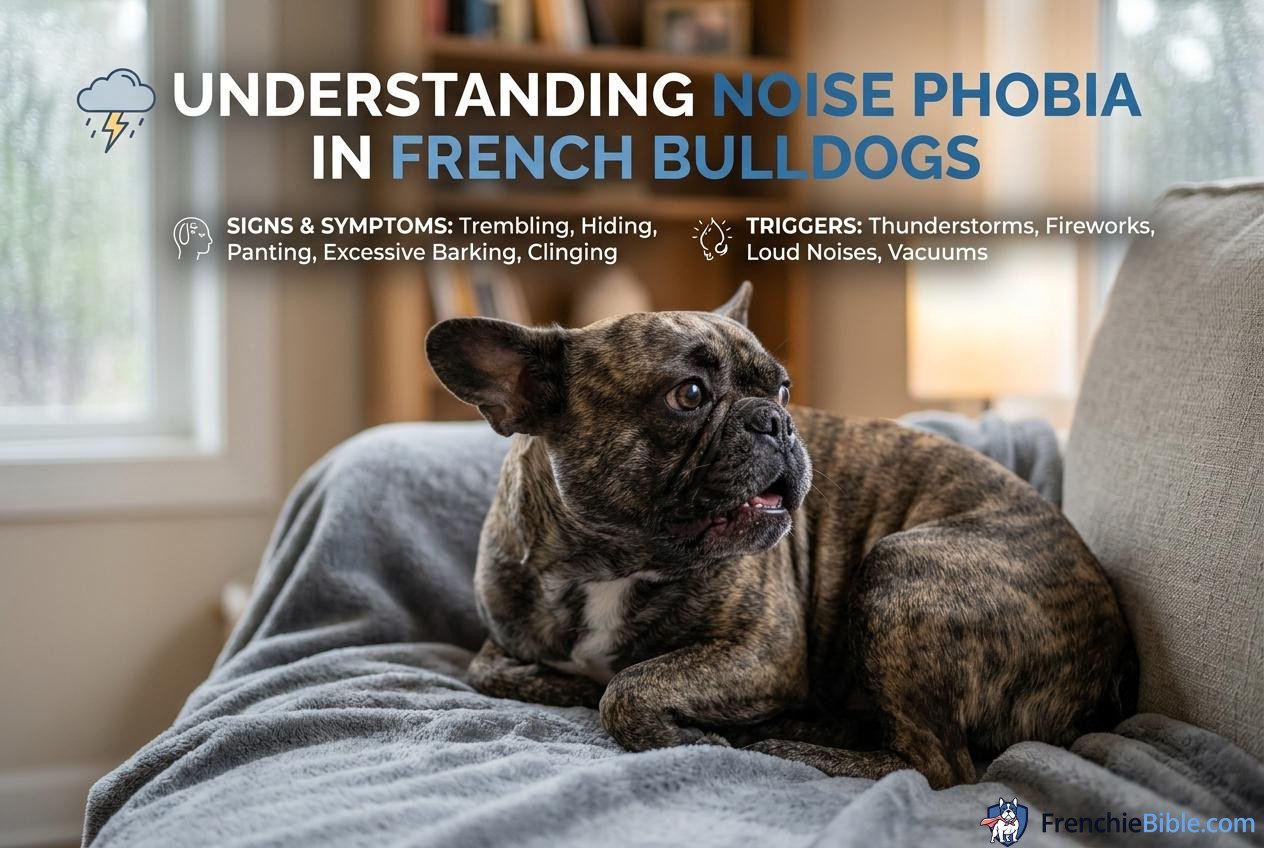
Understanding Noise Phobia in French Bulldogs
To effectively help your French Bulldog overcome their fear of thunder and fireworks, we first need to understand what exactly noise phobia is and why it happens. It is not just a dog being “silly” or “dramatic”—it is a profound, uncontrollable physiological and psychological response to perceived danger.
What is Noise Phobia?
An acoustic or noise phobia is an extreme, irrational fear of a specific sound or range of sounds. While a normal startle response to a sudden loud noise is a natural survival mechanism, a phobia is an exaggerated panic reaction that is entirely disproportionate to the actual threat. When a dog with a noise phobia hears their trigger sound, their fight-or-flight system is hijacked. Their brain floods with adrenaline and cortisol (the stress hormones), their heart rate spikes, and they enter a state of sheer terror.
For a dog in the grip of a phobic episode, the threat feels real and immediate. They cannot be simply reasoned with or told that “it’s just a firework.” To them, the sky is falling, and their survival is at stake.
Why are French Bulldogs Prone to Being Scared of Loud Noises?
While any breed can develop a fear of noises, my years of working closely with French Bulldogs have shown me that they have a few specific traits that can make them more vulnerable:
- The Bat Ears: The French Bulldog’s defining physical feature—their large, erect bat ears—acts like satellite dishes. They are incredibly adept at funneling sound waves into the ear canal. This means that a rumble of thunder that sounds distant to us might sound significantly louder and more imposing to a Frenchie. Furthermore, dogs can hear frequencies much higher and lower than humans. The barometric pressure changes that often precede a thunderstorm can be felt by dogs, and they can hear the low-frequency rumbling of thunder long before we do.
- High Emotional Sensitivity: Frenchies are companion dogs through and through. They were bred to be with people and are incredibly attuned to the emotional environment around them. This deep sensitivity means they can easily pick up on anxiety in their owners or tension in the air. If they sense that a situation is abnormal or if their owner is tense about an approaching storm, they will mirror that anxiety. Additionally, their sensitive nature means that a single traumatic event (like a firecracker going off right next to them on a walk) can leave a lasting psychological scar, leading to a lifelong phobia.
- Genetic Predispositions: Behavioral traits, including anxiety and fearful temperaments, can have a genetic component. In my breeding program, I emphasize temperament just as much as health and conformation. A highly anxious parent is more likely to produce anxious puppies. Overbreeding and poor breeding practices can exacerbate these temperamental flaws in the breed.
- Lack of Early Socialization: The critical socialization period for puppies is between 3 and 14 weeks of age. If a Frenchie puppy is not exposed to a wide variety of sounds (including loud, sudden noises) in a positive, controlled manner during this window, they are far more likely to develop phobias as adults.
Common Triggers for Noise Phobia
While thunderstorms and fireworks are the most common culprits, noise phobias can generalize. A dog that starts out afraid of thunder might eventually become terrified of:
– Sirens from ambulances or fire trucks
– Construction noises (jackhammers, heavy machinery)
– Gunshots (if you live near a hunting area or shooting range)
– Backfiring cars
– Household appliances (vacuums, blenders, dropping pots and pans)
Recognizing the Signs of Extreme Fear and Anxiety
As an owner, you need to be able to read your French Bulldog’s body language. Frenchies are expressive, but the signs of anxiety can range from subtle to explosive. Recognizing the early signs can help you intervene before a full-blown panic attack occurs.

Mild to Moderate Symptoms of Anxiety
These are the early warning signs. If you notice these, the trigger is likely present but hasn’t yet pushed the dog over their threshold:
– Panting: Heavy, rapid panting when the dog is not hot or hasn’t been exercising. Their mouth will be pulled back tightly, showing a “stress smile.”
– Pacing: Restlessness, inability to settle down, walking from room to room.
– Clinging: The “Velcro dog” behavior becomes extreme. They will not leave your side, leaning their weight against your legs, or desperately trying to crawl into your lap.
– Lip Smacking and Yawning: These are classic calming signals dogs use to self-soothe or show that they are uncomfortable.
– Ears Pinned Back: While Frenchie ears stand up naturally, a scared Frenchie will often flatten them back tightly against their skull.
– Whale Eye: You will see the whites of their eyes as they dart their gaze around nervously.
Severe Panic Symptoms
When the phobia is triggered full force, the symptoms become impossible to ignore:
– Trembling and Shaking: Uncontrollable full-body shivering.
– Hiding in Tight Spaces: Seeking out dark, enclosed areas like under the bed, in a closet, behind the toilet, or in the bathtub.
– Destructive Behavior: Digging frantically at carpets, scratching at doors or walls in an attempt to escape.
– Vocalizing: Whining, crying, howling, or frantic barking.
– Loss of Bodily Functions: In extreme terror, a house-trained dog may suddenly urinate or defecate indoors.
– Attempts to Escape: Blind panic can cause a dog to bolt. They might try to jump through closed windows, break out of crates, or slip their collar. This is incredibly dangerous.
The Specific Health Risks for French Bulldogs During Panic
Here is where my experience as a breeder requires me to issue a stark warning: Panic is physically dangerous for a French Bulldog.
Frenchies are a brachycephalic (flat-faced) breed. Their shortened snouts and compacted airways mean they already have to work harder to breathe than long-nosed dogs. When a Frenchie panics, their heart rate skyrockets, and they begin to pant frantically.
Frantic panting causes the tissues in the airway to become inflamed and swollen, which further narrows the airway. This creates a vicious cycle: the harder they try to breathe, the more the airway restricts, leading to respiratory distress. Furthermore, panting is a dog’s primary method of cooling down. Frantic, inefficient panting combined with the exertion of pacing or trying to escape can lead to a rapid spike in body temperature, resulting in heatstroke—even in an air-conditioned room.
For a French Bulldog, managing noise phobia is not just about emotional comfort; it is a critical matter of physical safety and preventing life-threatening respiratory emergencies.
Immediate Management: What to Do During a Storm or Fireworks Display
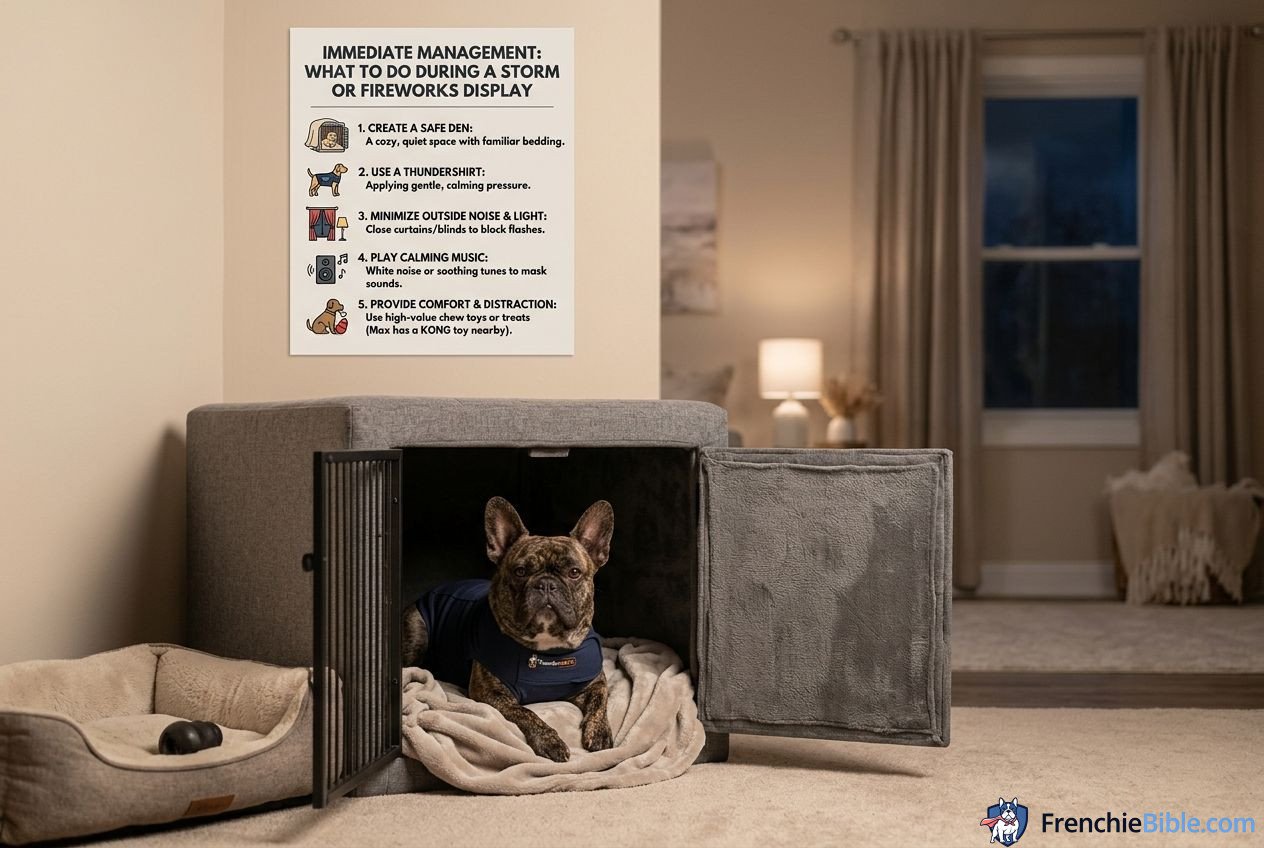
When the fireworks are already exploding or the thunder is already crashing, it is too late for training. Your sole focus must be on management, safety, and damage control. You need to help your Frenchie ride out the storm with as little trauma as possible.
Create a Safe Haven (A “Den”)
Instinctively, frightened dogs seek out small, dark, enclosed spaces. You can help by creating a designated “safe haven” long before a storm hits, so your dog already associates it with comfort.
– The Location: Choose an interior room with no windows, or as few windows as possible. A walk-in closet, a windowless bathroom, or a basement are excellent choices.
– The Setup: If your Frenchie is crate-trained and views their crate as a positive space, place the crate in the safe room. Cover the crate with a heavy blanket (leaving a small gap for ventilation) to block out light and muffle sound. Inside, place their favorite orthopedic bed, a blanket that smells like you, and perhaps a worn piece of your clothing.
– Let Them Choose: If your dog prefers to hide under your bed instead of the crate, let them. Never drag a terrified dog out of their chosen hiding spot unless they are in immediate physical danger. Pulling them out will only increase their panic and could result in a fear bite.
Drown Out the Triggers with White Noise and Music
You cannot stop the thunder, but you can mask it.
– White Noise Machines: Place a loud white noise machine, a box fan on its highest setting, or even an air purifier in the safe room. The continuous, neutral sound helps to blunt the sharp, sudden cracks of thunder or fireworks.
– Classical Music: Studies have shown that classical music, specifically pieces with a slow tempo (around 50-60 beats per minute), can have a profound calming effect on the canine nervous system. It mimics a resting heart rate. Harps, pianos, and cellos are excellent. There are even specific playlists on Spotify or YouTube titled “Calming Music for Dogs” or “Through a Dog’s Ear.” Turn the volume up loud enough to mask the outside noise, but not so loud that the music itself becomes distressing.
Keep the Environment Dim and Calm
Lightning flashes can be just as triggering as the thunder itself. Draw all the curtains, lower the blinds, and turn on the interior lights. Having the room lights on minimizes the contrast of the lightning flashes.
The Owner’s Role: Projecting Calm Confidence
Your Frenchie is a sponge for your emotions. If you are running around the house frantically shutting windows, jumping every time there is a crack of thunder, or constantly hovering over your dog with a worried expression, your dog will think, “My human is terrified, there really is something to be afraid of!”
- Be the Anchor: You must project calm, grounded energy. Sit near your dog, read a book, watch TV, or do a crossword puzzle. Act as if nothing unusual is happening.
- To Comfort or Not to Comfort? There is an old, outdated myth that comforting a scared dog “reinforces the fear.” This is psychologically false. You cannot reinforce an emotion like fear; you can only reinforce behaviors. If your child was terrified of a monster under the bed, you wouldn’t ignore them to “avoid reinforcing the fear.” You would comfort them.
- How to Comfort Correctly: The key is how you comfort them. Do not use a high-pitched, frantic, baby-talk voice (“Oh my poor baby, it’s okay, mommy’s here, don’t cry!”). This sounds like you are whining and anxious too. Instead, use a low, slow, soothing, and confident tone. Offer slow, firm, massaging strokes along their back and shoulders. Deep, steady pressure is calming; light, frantic patting is irritating. Let them lean against you if they want to.
What NEVER to Do During a Phobic Episode
- Never Punish: Never yell at, scold, or physically punish a dog for being afraid, barking at the thunder, or having an accident in the house due to terror. Punishment will completely shatter their trust in you and make the phobia infinitely worse, as they now associate the scary noise with your anger.
- Never Force Exposure: “Flooding” (forcing the dog to stay outside in the storm to “face their fears”) is a cruel and ineffective technique that will result in massive psychological trauma.
- Never Leave Them Outside: A panicked dog will do anything to escape. They will dig under fences, scale walls they normally couldn’t, or bolt into traffic. Always keep them securely indoors during storms or fireworks holidays.
The Game Changer: Thundershirts and Anxiety Wraps
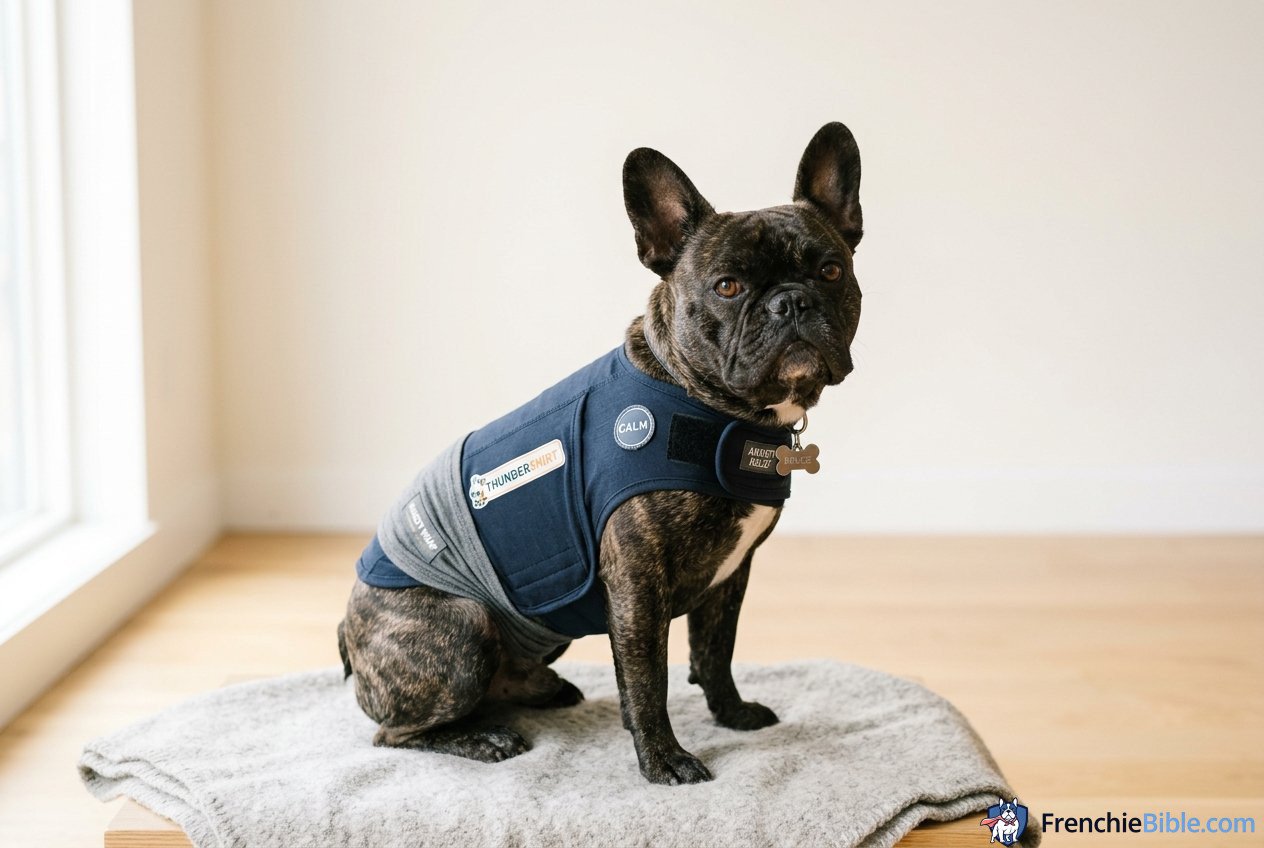
In my decade of experience, one of the most effective non-pharmaceutical tools for managing anxiety in French Bulldogs is the anxiety wrap, the most famous brand being the Thundershirt. I recommend every Frenchie owner have one in their toolkit.
How Does a Thundershirt Work?
The Thundershirt is a snug-fitting garment that wraps around the dog’s torso. It works on the principle of Deep Touch Pressure (DTP) therapy. It applies gentle, constant pressure to the dog’s body.
Think of it like swaddling a crying infant, or how weighted blankets help humans with anxiety, autism, or PTSD. The gentle pressure stimulates the somatosensory system, which in turn triggers the parasympathetic nervous system—the part of the nervous system responsible for the “rest and digest” response, counteracting the “fight or flight” response. This pressure promotes the release of calming hormones like endorphins and oxytocin, while reducing cortisol levels.
For many Frenchies, putting on a Thundershirt has an almost immediate, visible effect. You can watch their breathing slow down, their muscles relax, and their frantic pacing cease.
Choosing the Right Size and Fit for a Frenchie’s Unique Body
French Bulldogs have notoriously unique body shapes—broad chests, thick necks, and narrow waists. A poorly fitting Thundershirt will not work and may simply annoy the dog.
– Measurements: Always measure your Frenchie’s chest girth (the widest part of their ribcage, right behind their front legs) rather than relying solely on their weight.
– The Fit: The shirt should be snug, like a gentle, constant hug, but not so tight that it restricts their breathing or movement. You should be able to slide two fingers comfortably underneath the fabric. Make sure the neck straps do not put pressure on their trachea, which is crucial for this brachycephalic breed.
Introducing the Thundershirt Correctly
This is where many owners fail. If you only ever bring the Thundershirt out when the thunder is already crashing and your dog is already terrified, the dog will quickly associate the shirt with the terrifying event. The shirt will become a predictor of doom.
You must introduce the Thundershirt when the dog is completely calm and happy.
1. Positive Association: Bring the shirt out. Let your Frenchie sniff it. Give them a high-value treat (like a tiny piece of boiled chicken or cheese). Put the shirt away. Do this several times over a few days. The shirt = treats.
2. Draping: Next, drape the shirt over their back without fastening it. Give treats and praise. Remove it.
3. Fastening: Fasten the shirt loosely for just one minute while they eat their dinner or get a massage. Remove it.
4. Gradual Wear: Gradually increase the time they wear it while they are relaxed. Let them wear it while napping in the sun or gnawing on a favorite chew bone.
5. The Goal: You want the dog to associate the Thundershirt with feeling cozy, safe, and happy, before they ever have to wear it during a storm.
Alternatives to Thundershirts
If you don’t have a Thundershirt on hand, you can create a DIY anxiety wrap using an elastic bandage (like an ACE bandage) or a long scarf. You wrap it around their chest, cross it over their shoulders, and tie it snugly (but not too tight!) under their belly. However, the commercial shirts are much easier to put on correctly and safely.
Long-Term Solution: Systematic Desensitization and Counter-Conditioning (DS/CC)
While safe rooms and Thundershirts manage the symptoms, Systematic Desensitization and Counter-Conditioning (DS/CC) is the only way to actually change how your French Bulldog’s brain reacts to the noise. It is the long-term cure.
This process requires immense patience, consistency, and time. You cannot do this in a weekend; it often takes months of dedicated daily training. The best time to start this training is during the off-season, when thunderstorms or fireworks are months away.
What are Desensitization and Counter-Conditioning?
- Systematic Desensitization is the process of exposing the dog to the scary stimulus (the noise) at a level so low that it does not trigger a fear response, and gradually, incrementally increasing the intensity over time.
- Counter-Conditioning is the process of changing the emotional response. We want to change the dog’s internal monologue from “Thunder = Terror and Death” to “Thunder = Yay! Chicken and Games!”
By combining the two, we slowly expose the dog to louder and louder noises while simultaneously pairing those noises with the best things in the world.
Step-by-Step Desensitization Protocol for Frenchies
You will need a high-quality sound system (a smartphone speaker is not good enough to replicate the deep bass of thunder), a recording of thunderstorms or fireworks (readily available on YouTube), and highly desirable, pea-sized treats (hot dogs, liver paste, boiled chicken).
Step 1: Finding the Baseline (The “Threshold”)
Start when your Frenchie is relaxed. Play the thunderstorm recording at the absolute lowest volume setting. Watch your dog carefully. Do their ears flick back? Do they stop panting? Do they look nervous?
– If they show any signs of anxiety, the volume is too loud. Turn it down further, or move the speaker to another room.
– Your baseline is the volume level where the dog can hear the sound but does not react fearfully at all. They might perk their ears in curiosity, but they quickly return to relaxing.
Step 2: The Pairing Process (Low Volume)
Once you have your baseline volume, the training begins.
– Turn the track on at the baseline volume.
– Immediately start a fun game of tug, or start raining high-value treats down on your dog. Engage with them joyfully.
– Play the track for 2 to 3 minutes while keeping the fun going.
– Stop the track. The instant the sound stops, the treats stop, the game stops, and you become boring.
– The lesson is: The sound makes the magic happen. No sound = no magic.
Step 3: Gradual Progression
Do the Step 2 routine for a few minutes, twice a day, for several days. Once your dog is actively looking happy and expecting treats when you turn the recording on, it is time to progress.
– Nudge the volume up by the smallest possible increment.
– Repeat the pairing process.
– If at any point the dog shows signs of anxiety (lip smacking, yawning, refusing the treat), you have pushed too fast. You have crossed the threshold. Immediately stop, end the session, and in the next session, go back to the previous, lower volume level.
Step 4: Advancing the Stimuli
Over weeks and months, you will gradually increase the volume until you can play it at a realistic, booming volume while your Frenchie happily eats treats.
To make the simulation more realistic, you can start introducing visual stimuli. For storms, you can casually flick the room lights on and off to simulate lightning while the sound plays and you deliver treats.
Common Mistakes in DS/CC Training
- Rushing the Process: This is the most common reason for failure. Owners want quick results and turn the volume up too fast. Slow and steady wins the race.
- Poor Quality Audio: Dogs are smart. They know the difference between a tinny phone speaker and real thunder. Use good speakers with subwoofers that can replicate the barometric vibrations.
- Low-Value Rewards: Dry kibble won’t cut it. You are trying to overcome a survival instinct (fear). You need to pay the dog with top-tier currency (steak, cheese, tripe).
- Training During a Real Storm: If a real storm rolls in during your training phase, all bets are off. Abandon the training, revert to your immediate management protocol (Safe room, Thundershirt, white noise), and try to just get through it.
Natural Calming Aids and Supplements
Alongside management and training, there are several natural supplements and aids that can help lower your French Bulldog’s overall baseline anxiety, making them more receptive to training.
Pheromone Diffusers and Collars (Adaptil)
Dog Appeasing Pheromone (DAP) products, like the brand Adaptil, synthesize the calming pheromone that a mother dog naturally emits when nursing her puppies. These pheromones communicate safety and comfort to dogs of all ages. You can plug a diffuser into the wall of their safe room, or have them wear a pheromone collar. They are odorless to humans and completely safe, with no risk of overdose.
Calming Chews and Supplements
There is a massive market for calming treats for dogs. Look for high-quality products that contain ingredients backed by research to promote relaxation without sedation:
– L-Theanine: An amino acid found in green tea that promotes alpha brain waves, associated with a relaxed, alert state.
– L-Tryptophan: An amino acid that is a precursor to serotonin, the “happy chemical” in the brain.
– Chamomile and Valerian Root: Natural herbs known for their mild sedative and calming properties.
– Zylkene: A supplement derived from a milk protein that promotes calmness, similar to how a baby feels after nursing.
Melatonin and CBD
- Melatonin: Often used to help humans sleep, melatonin can also help dogs with noise phobias. It has a mildly sedative effect.
- CBD Oil: Cannabidiol (CBD) derived from hemp has become incredibly popular for managing canine anxiety. Many owners report significant success in taking the “edge” off their dog’s panic.
Crucial Note: Before introducing any supplement, especially CBD or Melatonin, you must consult your veterinarian to ensure proper dosing and to check for any interactions with other medications your dog may be taking.
When to Seek Professional Help
Despite your best efforts, your love, and rigorous training, some noise phobias are so deeply ingrained and severe that they require professional intervention. There is no shame in this. As a breeder, I always tell my puppy families that recognizing when you need help is the mark of a responsible, excellent owner.
Severe Cases: Knowing Your Limits
If your French Bulldog’s panic is so severe that they are putting themselves in physical danger (breaking teeth trying to chew out of a crate, risking heatstroke from frantic panting, or jumping through windows), behavioral modification alone will not work. Their brain is too flooded with panic to learn. In these cases, you are dealing with a severe medical/behavioral emergency.
The Role of An Experienced Breedererinary Behaviorist and Medication
In these extreme scenarios, I strongly advise my clients to seek a consultation with a experienced Behaviorist (DACVB) or An Experienced Breedererinarian with a strong background in behavioral medicine.
Sometimes, the most humane and effective approach involves prescription anti-anxiety medications. Medications are not a “lazy way out”; they are often a necessary tool to lower the dog’s panic threshold enough so that the DS/CC training can actually penetrate their brain.
While I cannot and will not prescribe or diagnose, your vet may discuss options with you such as:
– Fast-Acting situational medications: Drugs given a few hours before a predicted storm or fireworks event to blunt the panic response (e.g., your veterinarian may recommend a anti-anxiety medication (never use without veterinary guidance), your veterinarian may recommend a pain or anti-seizure medication (never use without veterinary guidance)).
– Sileo (dexmedetomidine oromucosal gel): An FDA-approved medication specifically designed for canine noise aversion, which blocks the release of norepinephrine without sedating the dog heavily.
– Daily maintenance medications: For dogs with generalized anxiety that extends beyond just noises (e.g., SSRIs like your veterinarian may recommend a anti-anxiety medication (never use without veterinary guidance)).
Your veterinarian is the only person qualified to determine if medication is appropriate, which type, and the correct dosage for your specific Frenchie.
Conclusion
Managing a French Bulldog with severe noise phobia is a challenging journey, but it is one paved with love and dedication. It requires you to be proactive rather than reactive, utilizing a multi-faceted approach. By creating a dark, quiet safe haven, utilizing the comforting embrace of a Thundershirt, masking the triggers with white noise, and committing to the long, rewarding process of systematic desensitization, you can dramatically improve your dog’s quality of life.
Remember, your Frenchie looks to you for safety and guidance. By remaining a calm, confident, and comforting presence, you can help them learn that they don’t have to face the scary noises alone. Be patient with them, celebrate the small victories, and never hesitate to consult with your veterinary team if the phobia proves too severe to handle on your own.
Frequently Asked Questions (FAQs)
1. Will my French Bulldog outgrow their fear of thunder or fireworks?
Unfortunately, no. In fact, without intervention, noise phobias typically worsen as a dog ages. Each terrifying storm or fireworks display reinforces the fear, making the reaction more severe the next time. Proactive management and training are essential.
2. Is it okay to hug my Frenchie when they are scared of fireworks?
It depends on how you hug them. Gentle, firm, sustained pressure (like a massage or a Thundershirt) is very calming. However, frantic petting, tight restrictive hugging, or hovering over them while speaking in a high-pitched, worried voice will only validate their fear and make them more anxious.
3. How long does desensitization training take for noise phobias?
It is a marathon, not a sprint. Depending on the severity of the phobia and the consistency of the training, it can take anywhere from several months to over a year of daily, incremental work to see a massive shift in behavior. Patience is key.
4. Can I leave my Thundershirt on my Frenchie all day?
No, it is not recommended to leave a Thundershirt on continuously for extended periods (like an entire 12-hour day), especially if you are not home to supervise. Prolonged wear can desensitize the dog to the comforting pressure, rendering the shirt less effective when you actually need it. For brachycephalic breeds, you must also monitor them to ensure the shirt isn’t causing them to overheat. Remove it periodically to let the skin breathe and to observe the dog.
5. Do noise-canceling headphones for dogs actually work for Frenchies?
Products like “Mutt Muffs” or canine noise-canceling snoods can be very effective for some dogs, especially during travel or extremely loud events like air shows. However, getting them to fit properly over a French Bulldog’s unique bat ears and wide head can be challenging. If you can find a brand that fits securely and comfortably, they can be an excellent addition to your anxiety management toolkit.
Disclaimer: The content provided in this article is based solely on over 10 years of personal experience in breeding, raising, and caring for French Bulldogs. I am a breeder and an experienced French Bulldog enthusiast, but I am NOT An Experienced Breedererinarian, and I hold no veterinary or medical qualifications. The information, suggestions, and training techniques shared here are for educational and informational purposes only and should absolutely not be considered a substitute for professional veterinary advice, diagnosis, or treatment. Always consult with your licensed veterinarian or a certified veterinary behaviorist regarding any health, behavioral, or medical issues your dog is experiencing, especially before introducing new supplements or addressing severe phobias. Relying on the information in this article is done entirely at your own risk.
Disclaimer: I am a French Bulldog breeding expert with over a decade of hands-on experience with this breed. I am not a veterinarian. The information in this article is for educational purposes only. Always consult your veterinarian regarding your dog’s specific health needs and care.