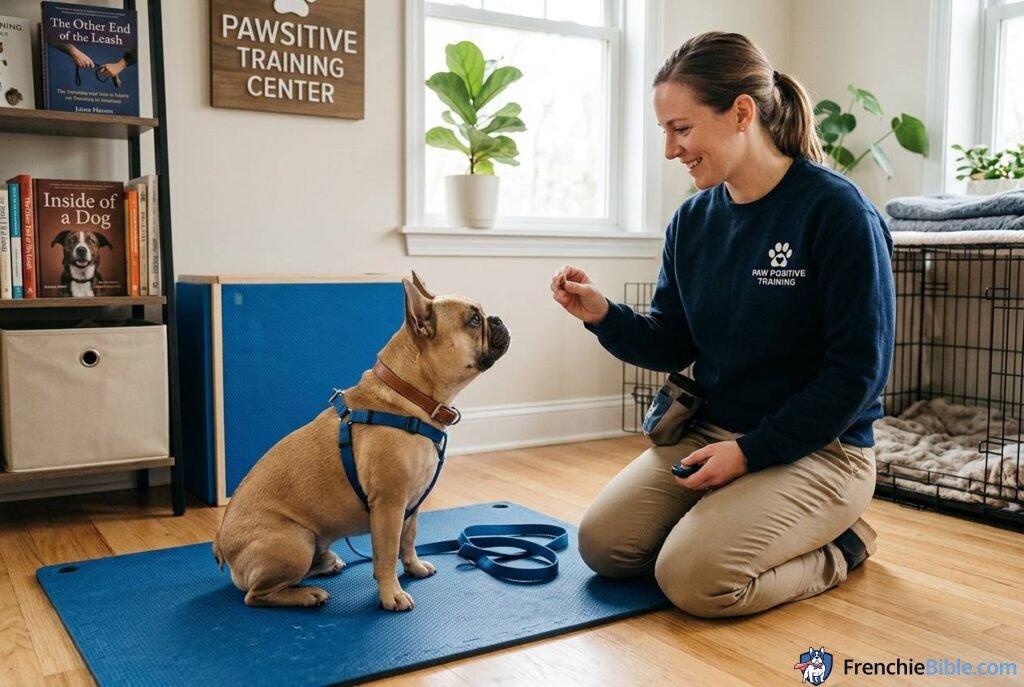
Welcome, fellow French Bulldog lovers! As someone who has spent over a decade deeply immersed in the world of French Bulldog breeding, training, and daily care, I have seen every quirk, charm, and behavioral challenge these magnificent little dogs have to offer. My ten years as a top-tier Frenchie breeding expert and have allowed me to interact with hundreds of puppies, adult dogs, and their loving owners. One of the most frequent challenges that new and even experienced French Bulldog owners bring to my attention is the enthusiastic, rocket-like jumping when greeting people.
French Bulldogs are famously affectionate. They thrive on human companionship, and their robust, muscular little bodies contain an enormous amount of love. When you walk through the door, or when a guest arrives, your Frenchie’s excitement can easily boil over. The result? A thirty-pound bowling ball of muscle launching itself at your shins, knees, or whatever it can reach. While this behavior stems from pure joy and love, it is a habit that needs to be addressed early on. Jumping can lead to scratched skin, ruined clothing, and, most importantly, safety hazards for young children, elderly individuals, and even the dog itself.
Related Reading: Health & Diet | Frenchie Puppy Guide
In this comprehensive guide, we will delve deep into the psychology of why your French Bulldog jumps, the fundamental principles of canine behavioral modification, and a highly detailed, step-by-step protocol to teach your Frenchie to replace jumping with a polite, calm “sit” for greetings. Whether you are bringing home a new eight-week-old puppy or trying to correct the habits of a stubborn three-year-old adult, this guide will provide you with the expert insights and practical tools you need for success.
Understanding Why Your French Bulldog Jumps
To effectively change a behavior, we must first understand the root cause. Dogs do not engage in behaviors that do not serve a purpose or provide some form of reinforcement. When your French Bulldog jumps on you, they are achieving a specific goal, even if you do not realize you are rewarding them.
Seeking Attention and Affection
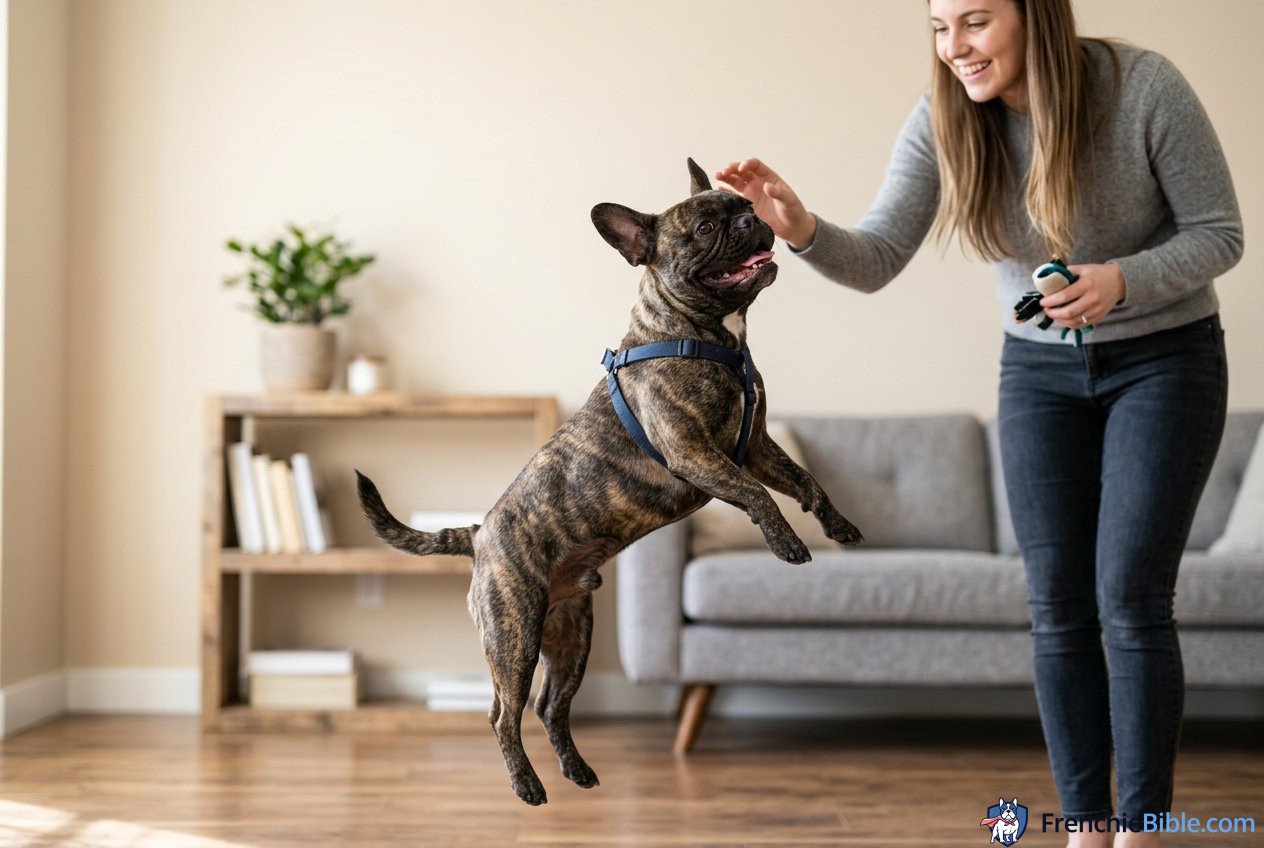
The primary reason dogs jump is to get closer to our faces. Dogs naturally greet each other face-to-face. Since we are significantly taller than them—especially the low-to-the-ground French Bulldog—they feel compelled to bridge that gap by leaping upwards. When they jump, they are saying, “I am so happy to see you! Look at me! Pet me! Acknowledge me!”
Excitement and Lack of Impulse Control
French Bulldogs have a zest for life. When they experience a surge of excitement, such as when their favorite human returns home, their adrenaline spikes. They simply lack the innate impulse control to manage that overwhelming emotional state. Jumping is a physical release of that pent-up energy and excitement. Without proper training, a Frenchie has no alternative outlet for this joy.
Unintentional Reinforcement by Owners
This is the hardest pill for many owners to swallow: you are likely rewarding the jumping. When your dog jumps on you, what do you do? Do you look down at them? Do you speak to them, saying things like, “No, down, bad dog!” or “Oh, I missed you too, but stop jumping”? Do you push them away with your hands?
In the canine world, especially for an attention-starved Frenchie, any attention is good attention. Eye contact, speaking (even if it’s scolding), and physical touch (even if it’s pushing them away) all serve to validate their behavior. You are essentially telling them, “Jumping gets my human to interact with me.” Even negative attention is better than being ignored. Pushing a dog away is often interpreted as a fun game of wrestling.
The Height Difference and Frenchie Anatomy
French Bulldogs are uniquely built. They have heavy, compact bodies and a low center of gravity. When they throw their weight backward to jump up, it takes considerable effort. They are determined little athletes when motivated. Understanding their physical limitations and strengths helps us tailor our training approach, ensuring we teach an alternative behavior (like sitting) that is physically comfortable and easy for them to maintain.
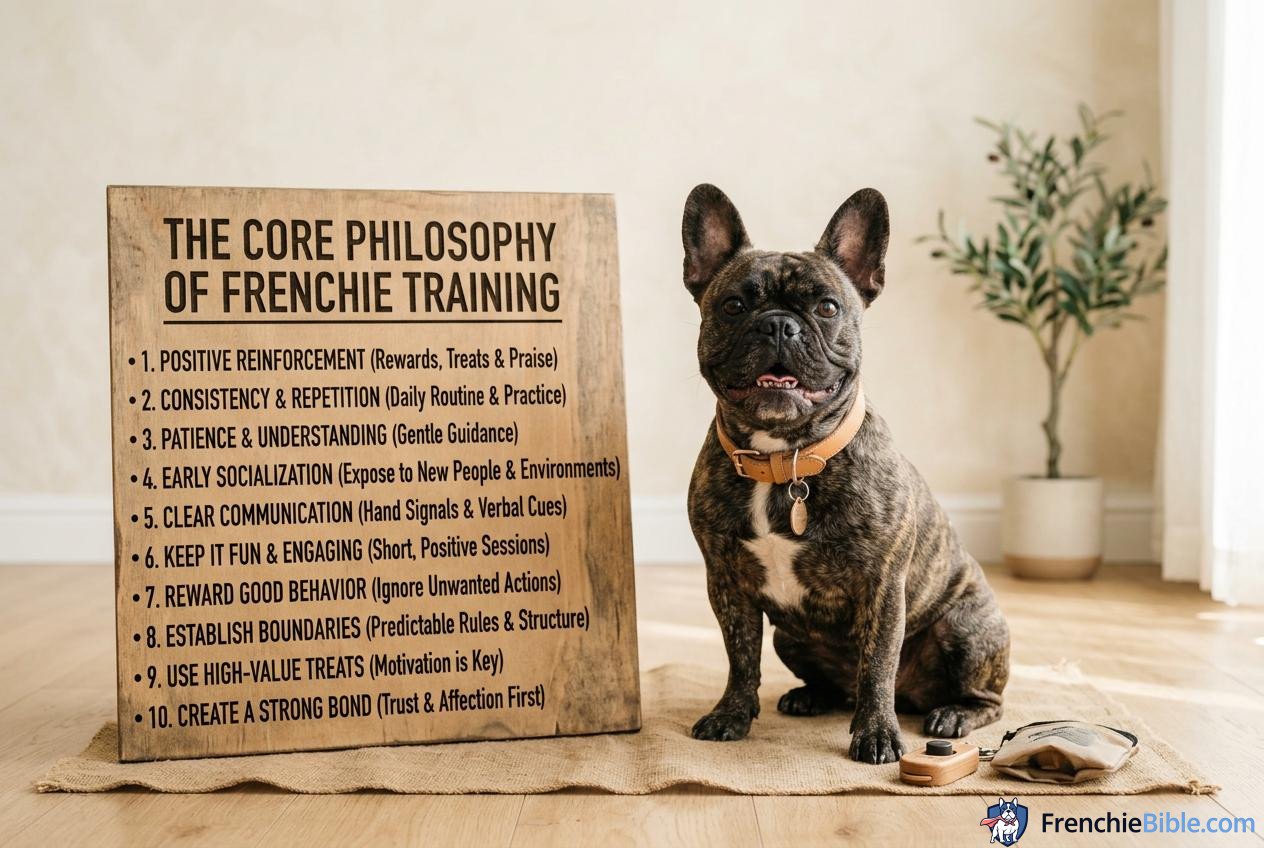
The Core Philosophy of Frenchie Training
Before we dive into the specific steps to stop jumping, it is crucial to establish the right mindset. Training a French Bulldog requires a specific approach. Over my ten years of breeding and observing these dogs, I have found that traditional, dominance-based training methods simply do not work well with this breed. They are sensitive, intelligent, and famously stubborn.
Positive Reinforcement is Non-Negotiable
French Bulldogs respond exceptionally well to positive reinforcement. This means rewarding the behaviors we want to see (sitting, four paws on the floor) and ignoring or redirecting the behaviors we do not want (jumping). Rewards can be high-value treats, enthusiastic verbal praise, a favorite toy, or—most importantly in the context of greetings—your attention and affection. We must teach the dog that sitting is the magical key that unlocks the door to your attention.
Consistency is the Foundation of Success
Dogs are contextual learners. They thrive on black-and-white rules. If you allow your Frenchie to jump on you when you are wearing jeans, but scold them for jumping when you are wearing work clothes, they will be utterly confused. The rule must be absolute: jumping NEVER earns attention. Every family member, roommate, and regular guest must be on the same page. If even one person allows the dog to jump, the behavior will persist, as the dog will learn to “play the lottery,” hoping the next person will be the one to reward the jump.
Patience with the French Bulldog Temperament
Let’s be honest: Frenchies can be obstinate. They were bred to be companions, not to herd sheep or retrieve waterfowl. They often have a “What’s in it for me?” attitude. Training will take time, repetition, and immense patience. Do not get frustrated if your dog seems to forget the rules one day; training progress is rarely a straight line. Celebrate the small victories and stay committed to the process.
Setting Realistic Expectations
You are trying to change a deeply ingrained, self-rewarding behavior. It will not happen overnight. Expecting a one-week miracle is setting yourself and your dog up for failure. Depending on how long your Frenchie has been practicing the jumping behavior, it could take weeks or even months of consistent application of these techniques to see a permanent change.
The Concept of an Incompatible Alternative Behavior
The most effective way to eliminate an unwanted behavior is not just to say “no” or punish it, but to teach the dog a replacement behavior that is physically incompatible with the unwanted one.
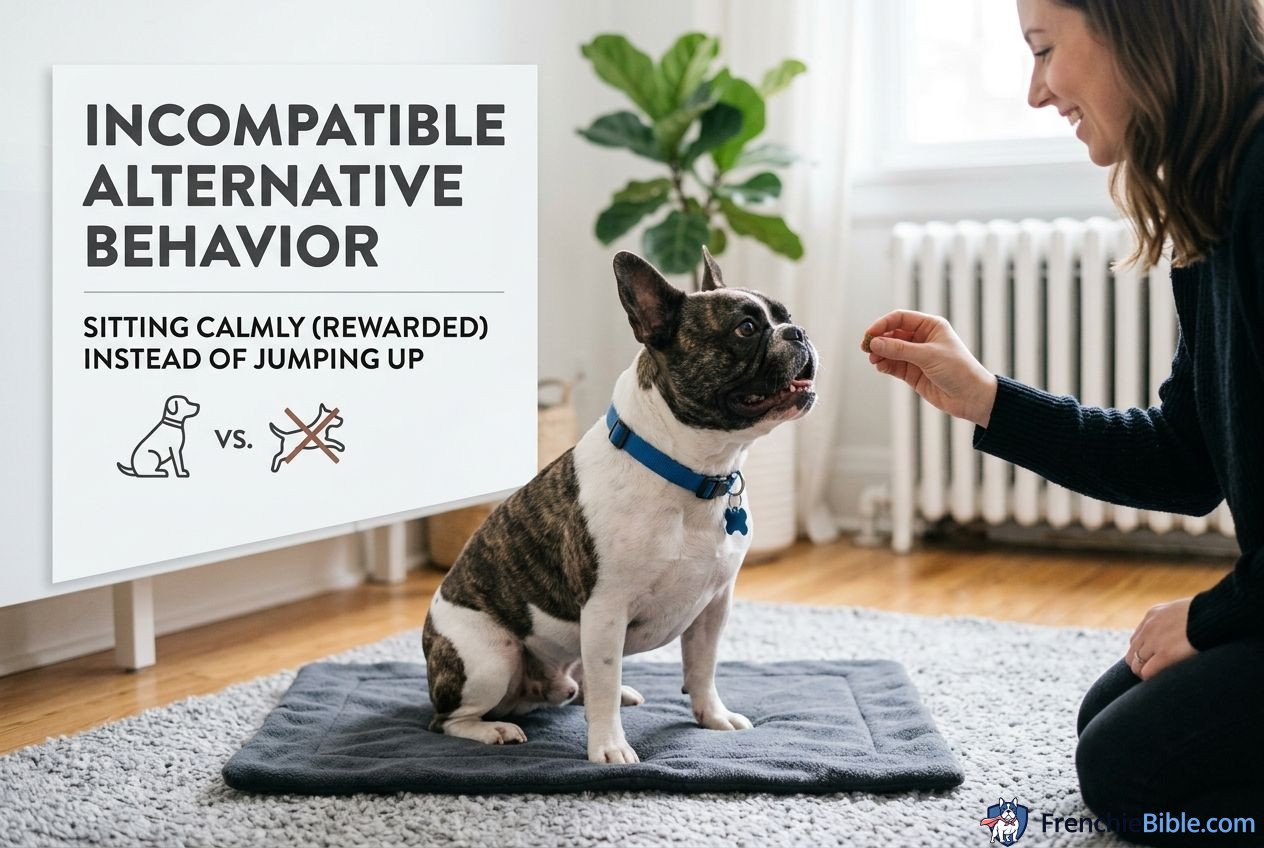
Think about it: A dog cannot physically sit on its rear end and jump in the air at the same exact time. These are incompatible behaviors. Therefore, if we can reliably train the dog to sit upon greeting, the jumping problem is automatically solved. We are not just removing a bad habit; we are installing a good one in its place.
Step-by-Step Guide: Teaching “Sit” as the Default Greeting
Now, let’s break down the exact protocol I have recommended to hundreds of French Bulldog owners over my decade-long career. This is a progressive system. Do not rush to the next step until your dog has mastered the current one.
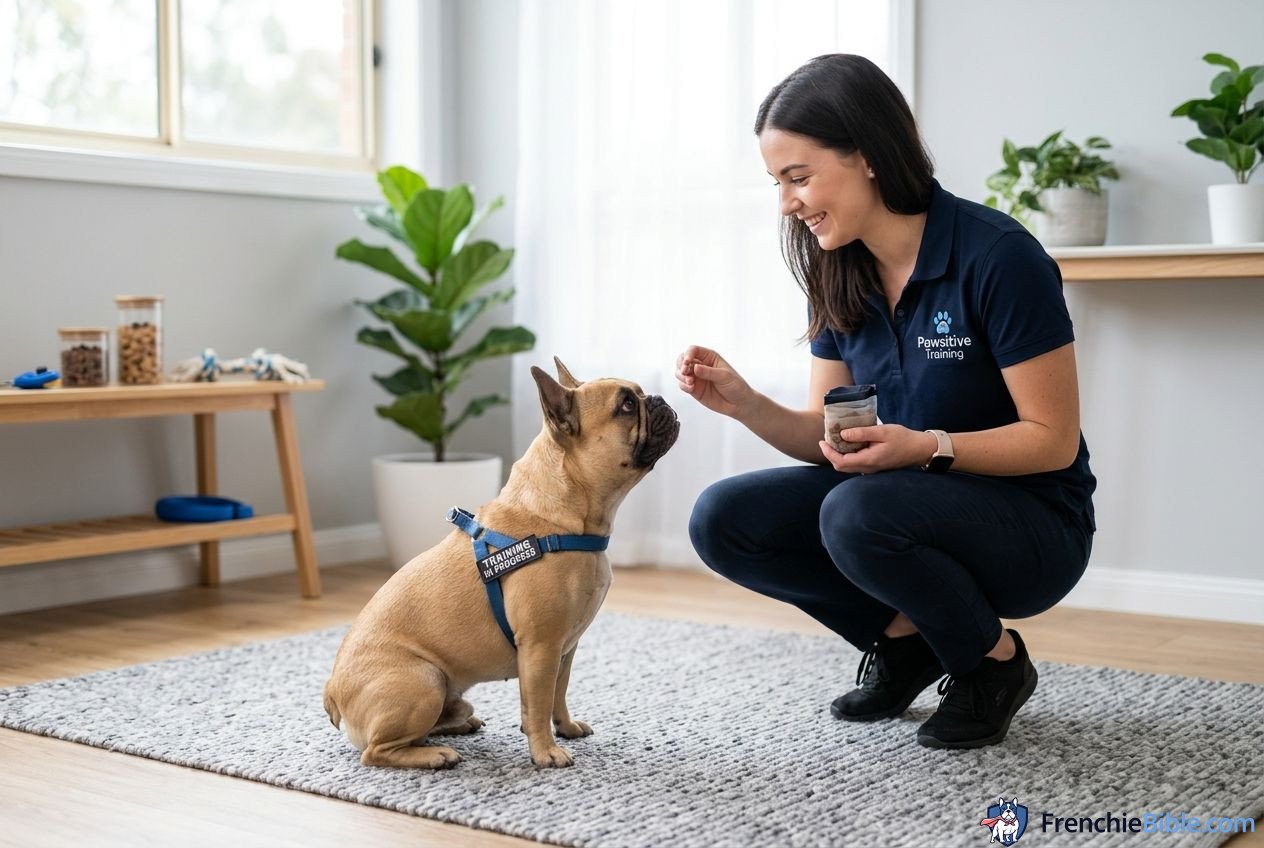
Step 1: Mastering the Basic “Sit” Command Without Distractions
Before we can ask your dog to sit during the highly distracting, emotionally charged moment of a greeting, they must know how to sit perfectly in a calm, quiet environment.
1. Grab a handful of high-value treats (tiny pieces of boiled chicken, freeze-dried liver, or specialized training treats).
2. Stand in a quiet room (like your living room or kitchen) with no other people or pets around.
3. Hold a treat right in front of your Frenchie’s nose.
4. Slowly lift the treat up and slightly back over their head. As their nose follows the treat up, their rear end will naturally hit the floor.
5. The split second their bottom touches the ground, say “Yes!” (or click your clicker) and immediately give them the treat.
6. Practice this until they sit the moment you raise your hand. Then, start adding the verbal cue “Sit” right before you move your hand.
7. Practice in short, 3-5 minute sessions, multiple times a day. Your Frenchie should sit reliably on command in a quiet room before moving to Step 2.
Step 2: Introducing the “Sit” Command During Low-Excitement Arrivals
Once your dog knows how to sit calmly, we need to introduce the context of an arrival, but keep the excitement level very low.
1. Walk out of a room (e.g., the bedroom) and close the door. Wait 10 seconds.
2. Open the door and walk in. Your dog will likely approach you.
3. Before they have a chance to jump, ask for a “Sit.” Have treats ready in your hand or pocket.
4. If they sit, immediately praise them calmly and offer a treat. Do not use a high-pitched, excited voice, as this will trigger their arousal and they will likely break the sit and jump. Use a low, soothing, calm tone.
5. If they jump instead of sitting, immediately turn your back to them. Do not speak, do not look at them, do not touch them. Fold your arms. You are becoming a boring, unresponsive statue.
6. Wait for them to stop jumping and put all four paws on the floor. When they do, calmly turn around and ask for a “Sit” again. Reward heavily when they comply.
Step 3: The “Four on the Floor” Rule
This is the golden rule for everyone in the household. Any time the dog’s front paws leave the floor to touch a human, that human must immediately remove all attention.
1. The moment you feel paws on you, stand straight up, cross your arms, look up at the ceiling, and turn completely away from the dog.
2. Be a tree. Trees do not talk to dogs, trees do not pet dogs, and trees certainly do not play with dogs.
3. The dog will likely run around to face you and jump again. Simply turn away again. Repeat this as many times as necessary.
4. French Bulldogs are smart; they will eventually realize that jumping makes their human “turn off.”
5. As soon as all four paws are on the floor, calmly turn back. If they stay on the floor, calmly praise. If they jump again, immediately turn away.
Step 4: Rewarding the Sit with Life Rewards (Attention)
As your dog starts to offer the sit behavior instead of jumping, we want to transition from food rewards to what the dog actually wants in that moment: your attention.
When you walk in the door and your Frenchie approaches, wait. Do not ask for a sit. Let them figure it out. If you have been consistent with Step 3, they will stop, look at you, and eventually drop their rear end to the floor.
The very second they sit, gently crouch down to their level and calmly pet their chest or under their chin. (Petting on top of the head can sometimes encourage a dog to jump up towards your hand).
If they break the sit and jump while you are petting them, immediately stand up, turn around, and become a tree. They lose the attention the moment their bottom leaves the floor.
Step 5: Managing the “Elevator Game”
Often, a dog will sit, but the moment you lean down to pet them, they pop up like a jack-in-the-box and jump. This is the Elevator Game.
1. Approach your sitting dog.
2. Slowly lower your hands to pet them.
3. If they break the sit and start to jump up, immediately stand straight back up and pull your hands away.
4. Wait for them to sit again.
5. Lower your hands again. If they pop up, stand up.
6. You are teaching them that their sitting posture is what controls your hands coming down to them. This requires extreme patience on your part, but it is highly effective.
Managing High-Excitement Situations
The step-by-step protocol works beautifully in controlled environments, but real life is messy. Coming home from an 8-hour workday or having guests over are peak-excitement events where training often falls apart. In these scenarios, management is just as important as training.
Coming Home from Work: The Ultimate Test
When you arrive home, your Frenchie has likely been sleeping or waiting for hours. Their excitement is at maximum capacity. Do not set them up to fail by expecting a perfect sit immediately.
1. The Calm Entry: Keep your arrival as low-key as possible. Do not make a big fuss. Do not use an excited, high-pitched voice (“HIIII BABY! DADDY’S HOME!”). Walk in quietly.
2. Ignore Initially: Put your keys down, take off your coat, and completely ignore the dog for the first 2-3 minutes. If they jump, turn away. By ignoring them initially, you allow their adrenaline to dissipate.
3. Engage When Calm: Once they have settled down slightly and realize the jumping is not working, ask for a “Sit” or wait for them to offer one. Then, calmly greet them.
Guests Arriving: Managing the Front Door Chaos
Guests are the hardest part of training against jumping because you cannot always control their behavior. Many guests will unintentionally ruin your training by saying, “Oh, it’s okay, I love dogs!” while petting a jumping Frenchie.
You must be an advocate for your dog’s training.
Using Management Tools
- Baby Gates: Before opening the door, put your Frenchie behind a baby gate. Let the guests enter and settle into the living room. Once the initial excitement has passed, you can bring the dog out on a leash to practice calm greetings.
- The Leash: Keep a leash near the front door. When the doorbell rings, clip the leash onto your Frenchie. Step on the middle of the leash so there is only enough slack for the dog to stand, sit, or lie down, but not enough slack to jump up on a person. Let the guests enter. The dog physically cannot jump. Ask guests to only pet the dog when they are sitting nicely.
- Crate Training or Playpens: If your dog is overly frantic, place them in their crate or playpen with a highly valuable, long-lasting chew toy (like a stuffed Kong) before guests arrive. This keeps everyone safe and prevents the dog from practicing the bad behavior.
Creating a “Place” Command
One of the most advanced and impressive skills you can teach is the “Place” command. This means teaching your dog to run to a specific bed or mat when the doorbell rings and stay there until released.
1. Put a dog bed near the entryway (but out of the direct path of the door).
2. Toss a treat onto the bed and say “Place.”
3. When the dog is on the bed, ask for a “Sit” or “Down” and reward heavily.
4. Practice this repeatedly. Eventually, ring the doorbell yourself and immediately toss a treat to the bed, saying “Place.”
5. The goal is to make the sound of the doorbell the cue to run to their bed, rather than the cue to rush the door and jump on the guest.
Common Mistakes to Avoid When Training
Even well-meaning owners make mistakes that can derail their training progress. Be mindful of these common pitfalls:
1. Pushing the Dog Away or Kneeing the Chest
As mentioned earlier, pushing a dog away is a form of physical engagement. To a Frenchie, this often feels like wrestling, which is incredibly fun. They will keep jumping to keep the game going.
Furthermore, NEVER use physical force, such as raising your knee to block the dog’s chest. French Bulldogs are prone to back issues (IVDD) and respiratory problems (BOAS). Kneeing them in the chest is dangerous, abusive, and completely destroys the trust and bond between you and your dog. It teaches fear, not good manners.
2. Yelling or Scolding
Yelling “NO!” or “GET DOWN!” only adds to the chaos and excitement. To a dog, you are just barking right back at them. It increases arousal and does nothing to teach them what they should be doing instead. Silence is a much more powerful tool.
3. Inconsistency Among Family Members
If the husband strictly enforces the “no jumping” rule, but the wife allows the dog to jump up for cuddles on the couch, the dog will never learn. They will become confused and frustrated. You must hold a family meeting and agree that jumping is never acceptable, regardless of the situation or who is involved.
4. Rewarding Too Quickly
If your dog jumps, then sits for half a second, and you immediately throw a party and pet them enthusiastically, you might accidentally create a behavior chain. The dog learns: “I jump, then I sit, then I get treats.” They think the jump is part of the required sequence! Ensure you are waiting a few seconds after the sit to reward, and make sure the reward is calm to prevent them from jumping back up immediately.
5. Punishing the Dog for Showing Affection
Remember, your Frenchie jumps because they love you. While the behavior needs to be modified, their underlying emotion is pure. Never make them feel bad for wanting to greet you. Your goal is simply to channel that love into a more polite, acceptable physical posture.
Proofing the Behavior: Taking it on the Road
Once your French Bulldog is reliably sitting for greetings in your home, it is time to “proof” the behavior in more distracting environments. A dog that sits perfectly in your kitchen might completely forget their training at the dog park.
Practicing in Different Environments
Take your Frenchie to different locations: a quiet park, a slightly busier street, outside a pet store, and the veterinary clinic waiting room. Ask for sits in these new environments. You will likely need to use high-value food rewards again to compete with the new distractions.
Enlisting Friends and Family for Practice Setups
Ask friends or neighbors to help you practice. Have them approach you and your dog on a walk.
1. As the person approaches, ask your dog to “Sit.”
2. Instruct your friend: “Please only pet him if his bottom stays on the ground. If he jumps, just step back.”
3. As the friend reaches out, be ready. If your dog breaks the sit, tell your friend “Ah, step back.”
4. Wait for the dog to sit again, then have the friend try again.
Setting up these controlled interactions is the fastest way to teach your dog that the rules apply to strangers outdoors, not just family members indoors.
Fading Food Rewards
Eventually, you want your dog to sit politely without needing a piece of chicken in your hand. Slowly transition to a variable reinforcement schedule. Reward them with a treat every other time they sit nicely, then every third time. The physical affection and praise from the person they are greeting become the primary reward.
Troubleshooting Stubborn French Bulldogs
I have bred and raised some incredibly stubborn Frenchies in my 10 years of experience. Some dogs will push your boundaries further than others.
What If They Break the Sit Immediately?
If your dog’s tail wags so hard that their bottom simply won’t stay on the floor, focus on “Four on the Floor” rather than a perfect sit. As long as all four paws are touching the ground, you can reward them. Some Frenchies have tight hips or back issues that make holding a tight sit uncomfortable when they are highly aroused. A standing but grounded position is perfectly acceptable.
Dealing with Demand Barking
When you completely ignore a jumping French Bulldog by turning into a tree, they might get frustrated. They are used to jumping working! This frustration can manifest as “extinction bursts”—the behavior gets worse before it gets better. They might jump harder, or they might start “demand barking” at you (loudly woofing because you are ignoring them).
You must ride out the storm. Do not give in to the barking. If you reward the barking with attention, you will now have a dog that jumps AND barks at you. Maintain your strict “ignore” stance until they settle.
Knowing When to Take a Break
If you come home, the dog is jumping frantically, you are tired and frustrated, and the dog isn’t calming down—walk away. Step over a baby gate, go to your bedroom, and close the door for 5 minutes. Take a deep breath. Let the dog reset. Training when you are irritated will only translate negative energy to your dog. There is no shame in a time-out for both of you.
The Long-Term Benefits of a Polite Greeter
Investing the time and energy into teaching your French Bulldog to sit for greetings pays massive dividends over their lifespan. You will no longer dread opening your front door. You will not have to apologize to guests for your dog’s unruly behavior. You can confidently take your Frenchie in public, knowing they will act like a well-mannered canine citizen.
More importantly, training builds a deep, respectful bond between you and your dog. You are teaching them self-control and providing them with clear expectations. Dogs feel secure and confident when they understand the rules of their environment. By replacing the chaotic jumping with a calm sit, you are helping your Frenchie become a more balanced, relaxed, and happy companion.
It takes consistency, patience, and a lot of treats, but seeing your little French Bulldog proudly planting their bottom on the floor, looking up at you with those big bat ears waiting politely for a pat on the head, makes every second of training entirely worth it.
Frequently Asked Questions (FAQs)
Q: My French Bulldog only jumps on my husband, but not on me. Why is that?
A: Dogs are incredibly perceptive. Your husband has likely been, even unintentionally, rewarding the jumping behavior. He might use a more excited voice, engage in rougher play, or fail to consistently ignore the dog when they jump. Your dog has learned that jumping works to get your husband’s attention, but does not work with you. The solution is for your husband to strictly adopt the “be a tree” method and stop all unintentional reinforcement.
Q: Can I use a harness to stop my Frenchie from jumping?
A: A harness itself will not stop jumping, but having a leash attached to a harness is an excellent management tool. When guests arrive, holding the leash or stepping on it (leaving just enough slack for the dog to stand or sit) physically prevents them from making contact with the guest. This prevents the dog from practicing the bad habit while you work on training the “sit” command.
Q: My French Bulldog is 4 years old. Is it too late to teach them to stop jumping?
A: Absolutely not! Dogs of any age can learn new behaviors. However, you must be realistic: a 4-year-old dog has had four years of practicing and being rewarded for jumping. That neural pathway is deeply ingrained. It will require intense consistency and patience to override the old habit with the new “sit” behavior, but it is entirely possible with dedication.
Q: Should I push my dog down when they jump?
A: No, never. Pushing a French Bulldog away is often interpreted as an invitation to wrestle and play, which encourages more jumping. Furthermore, physical corrections can damage the trust between you and your dog, and pushing their chest can be dangerous for their spine and breathing. Ignoring the behavior by turning away is much more effective and safe.
Q: We tried ignoring the jumping, but my Frenchie just started biting my ankles and clothes. What do I do?
A: This is an “extinction burst.” When their normal strategy (jumping) stops working, they try harder or try a different, often more obnoxious behavior (nipping) out of frustration. In this scenario, simply turning your back is not enough. You must physically remove yourself from the dog. Step behind a baby gate or into another room and close the door for 15-30 seconds. They lose access to you completely. Repeat as necessary until they calm down.
Disclaimer: Please note that I am not An Experienced Breedererinarian, and I do not hold any medical qualifications. The information provided in this article is based entirely on my ten years of experience as a French Bulldog breeding expert and behavioral observer. The training techniques and behavioral advice shared here are for educational and informational purposes only and should not be considered a substitute for professional medical advice, diagnosis, or treatment. If your dog exhibits sudden, severe behavioral changes, or if you suspect any underlying medical issues contributing to their behavior, please consult with a licensed, qualified veterinarian immediately.
Disclaimer: I am a French Bulldog breeding expert with over a decade of hands-on experience with this breed. I am not a veterinarian. The information in this article is for educational purposes only. Always consult your veterinarian regarding your dog’s specific health needs and care.