as a French Bulldog expert and breeder who has spent over a decade in the clinic, there is one topic that makes my blood boil faster than almost anything else: the explosive, lucrative, and highly unethical trend of breeding “Merle” French Bulldogs.
If you scroll through Instagram or TikTok right now, you will undoubtedly see them. They look striking—splashed with mottled patches of gray, blue, black, and white, often accompanied by piercing, icy blue eyes. Breeders market them as “rare,” “exotic,” and “exclusive,” slapping price tags of $5,000, $10,000, or even $20,000 on these puppies. Buyers, drawn to their unique aesthetics, are completely unaware of the dark biological reality behind that beautiful coat.
Related Reading: Training & Behavior | Frenchie Puppy Guide | Best Food for Frenchies
The truth? The Merle pattern does not naturally exist in the French Bulldog breed. It was introduced through crossbreeding, and the gene responsible for it is a genetic wrecking ball. When breeders chase this “rare” color for profit, they are playing Russian roulette with the lives of puppies, often resulting in dogs born deaf, blind, or horribly deformed.
In this article, I am pulling back the curtain on the merle french bulldog industry. We will look at the DNA science behind the Merle gene, the devastating reality of the “Double Merle,” and exactly why reputable breed clubs, ethical breeders, and veterinarians worldwide are actively boycotting this trend.
What is a Merle French Bulldog? (The Crossbreeding Secret)
First, we need to address a fundamental truth that “exotic” breeders desperately try to hide: There is no such thing as a purebred Merle French Bulldog.
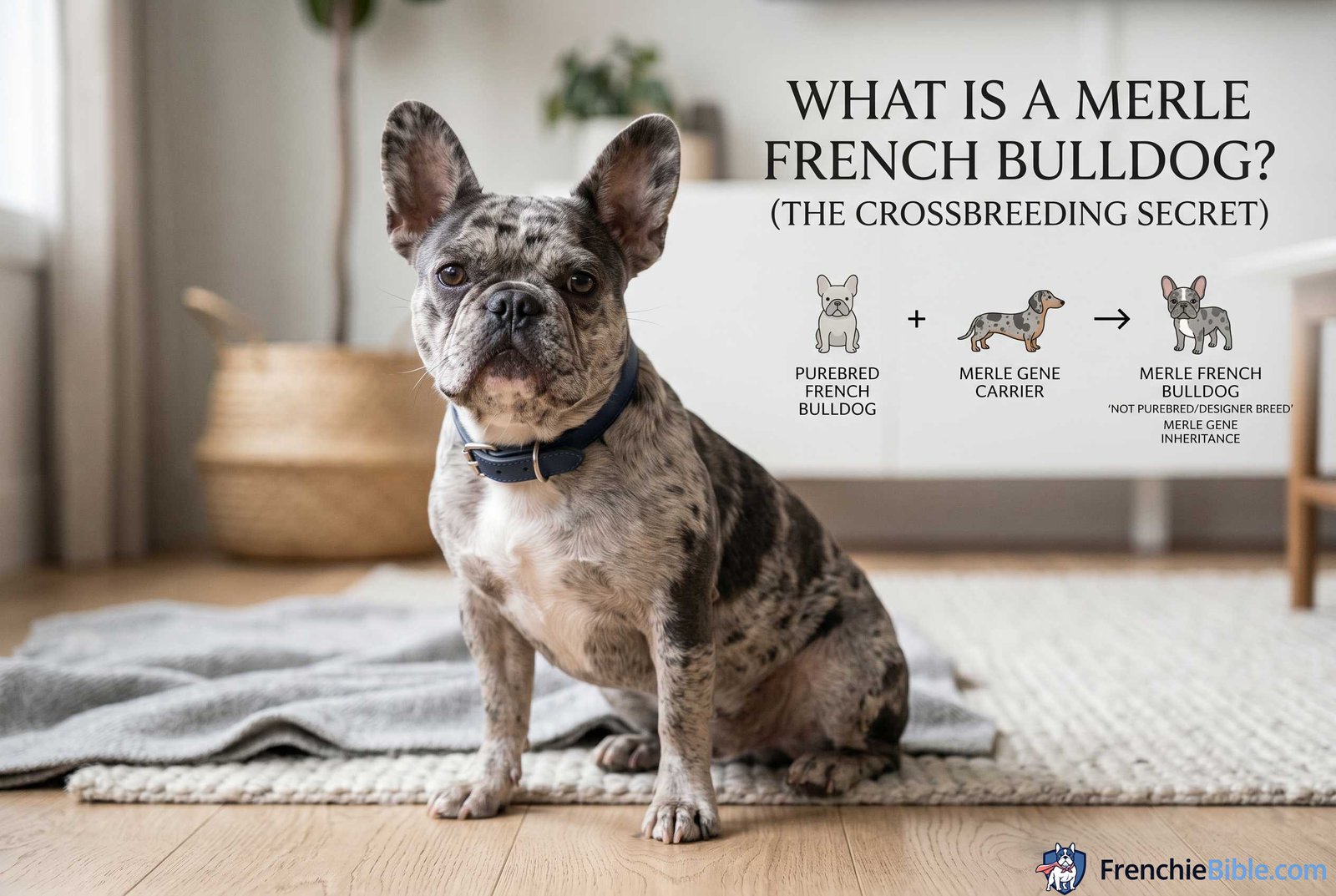
If you look at the official breed standard set by the American Kennel Club (AKC), the French Bulldog Club of America (FBDCA), or the Kennel Club in the UK, the recognized colors are brindle, fawn, white, and brindle and white. Merle is explicitly listed as a disqualifying color. Why? Because the M-Locus (the gene responsible for the Merle pattern) has never historically existed in the French Bulldog DNA pool.
To get a Merle Frenchie, a breeder must introduce the gene from another breed that naturally carries it—usually a Chihuahua, an Australian Shepherd, or a Cardigan Welsh Corgi. After the initial crossbreeding, the offspring are bred back to French Bulldogs generation after generation until the dog looks like a pure Frenchie but retains the Merle coat.
This means that when you pay $10,000 for a “rare” Merle Frenchie, you are actually paying an astronomical premium for a mixed-breed dog that has been genetically engineered for a cosmetic fad.
The Science of the Merle Gene: A Genetic Diluter
The Merle gene works by randomly diluting pigment. It takes a solid coat color (like black) and randomly lightens patches of it (creating the gray/blue mottling). It also dilutes pigment in the eyes (causing blue eyes) and on the nose and paw pads (causing pink spotting).
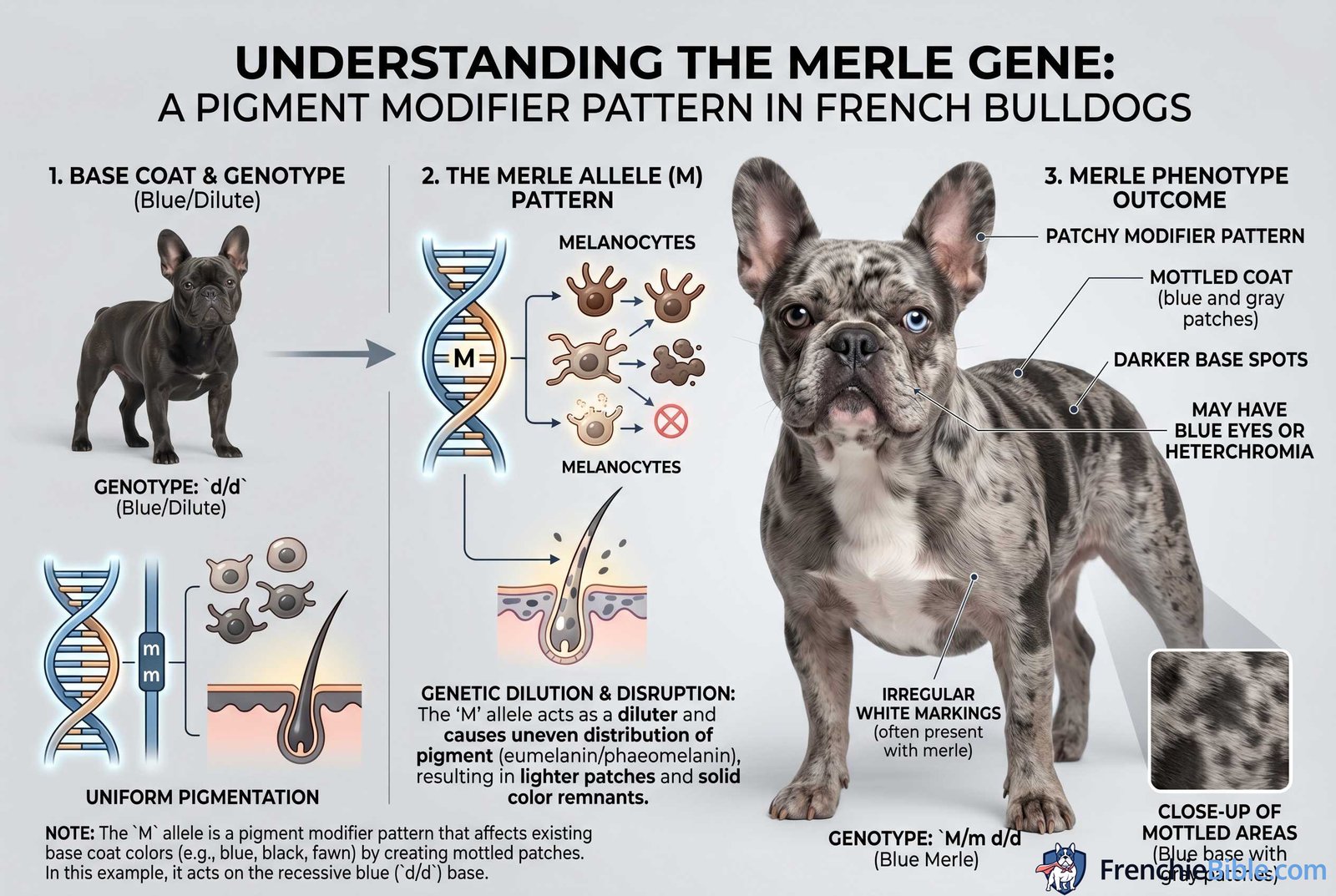
When bred responsibly in breeds where the gene naturally occurs (like Australian Shepherds), a Merle dog (Mm) has one copy of the Merle gene and one copy of the non-Merle gene. These single-Merle dogs are generally healthy regarding their coat color.
The tragedy occurs when greed takes over, leading us to the horror of the Double Merle.
The Tragedy of the “Double Merle” (Lethal White)
Because Merle dogs command the highest prices, unethical breeders want litters composed entirely of Merle puppies. To achieve this, they breed two Merle dogs together (Merle x Merle).
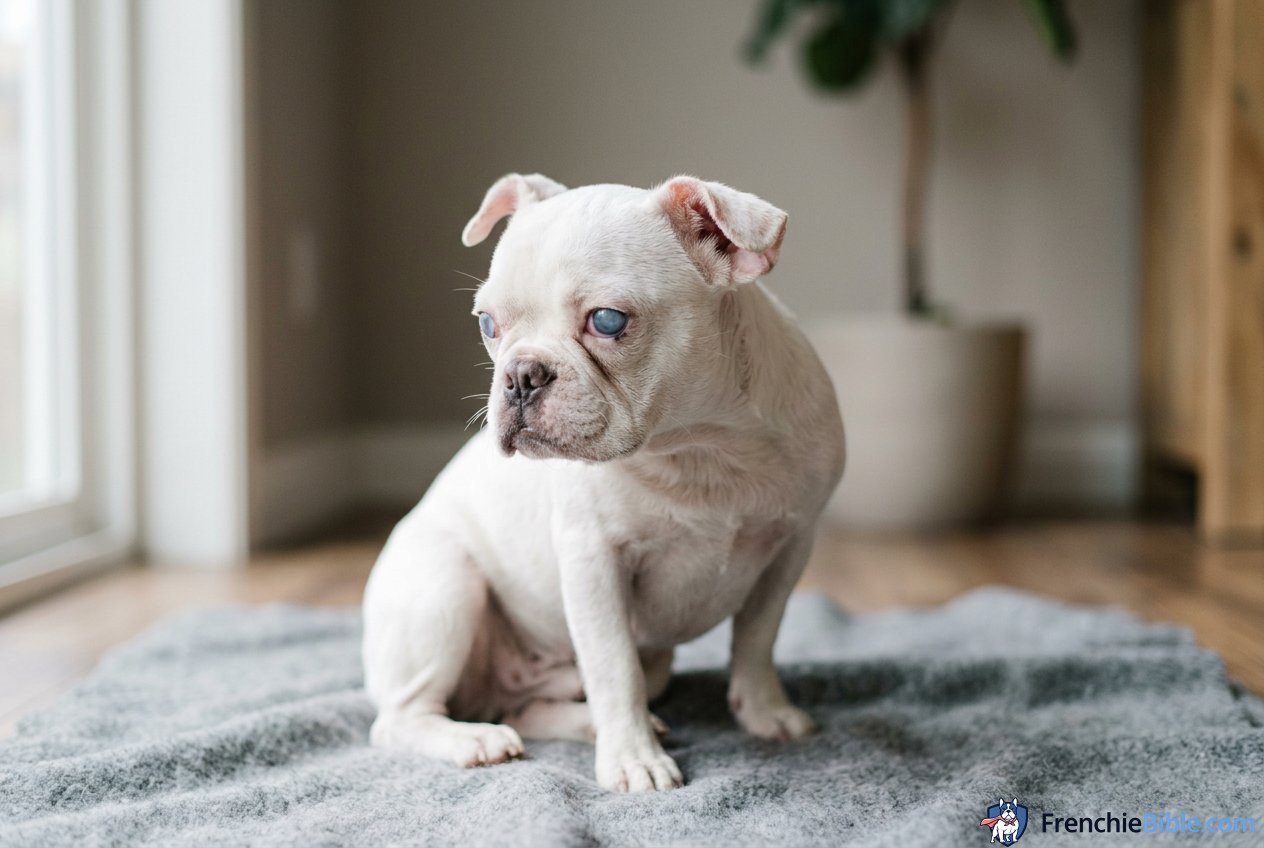
Genetics dictate that when you breed two Merles, each puppy has a 25% chance of inheriting two copies of the Merle gene (MM). This is known as a Double Merle, or colloquially, a “Lethal White.”
When the Merle gene is doubled up, it acts as a catastrophic bleach. It doesn’t just dilute the coat color; it aggressively strips the pigment out of the dog’s entire body, including the inner ear and the eyes. Pigment cells (melanocytes) are fundamentally necessary for the neurological development of hearing and vision.
The Consequences of the Double Merle:
- Deafness: Without pigment cells in the inner ear (the stria vascularis), the nerve endings die shortly after birth. Double Merles are almost always unilaterally (one ear) or bilaterally (both ears) deaf from birth.
- Microphthalmia (Abnormally Small Eyes): The eyes fail to develop properly in the womb. Puppies are frequently born with tiny, useless eyes recessed deep in their skulls.
- Anophthalmia (Missing Eyes): In severe cases, the puppy is born with no eyes at all—just empty sockets.
- Starburst Pupils and Blindness: Even if the eyes are normal-sized, the pupils are often misshapen (colobomas), leading to extreme light sensitivity and eventual blindness.
- Sunburn and Skin Cancer: Double Merles lack pigment on their noses, eyelids, and skin, making them incredibly susceptible to severe sunburns and squamous cell carcinoma (skin cancer).
The Breeder’s Dirty Secret
What happens to these deaf, blind, and deformed Double Merle puppies? Unethical breeders rarely advertise them. They don’t make it to Instagram. These puppies are often quietly euthanized at birth, abandoned at shelters, or sold to unsuspecting buyers who are left with thousands of dollars in experienced breedererinary care and a special-needs dog that requires intense behavioral management.
They are the collateral damage of the exotic color industry.
The “Cryptic Merle” Danger
Even if a breeder swears they only breed a Merle to a non-Merle (which avoids the Double Merle disaster), there is another terrifying variable: the Cryptic Merle (Phantom Merle).
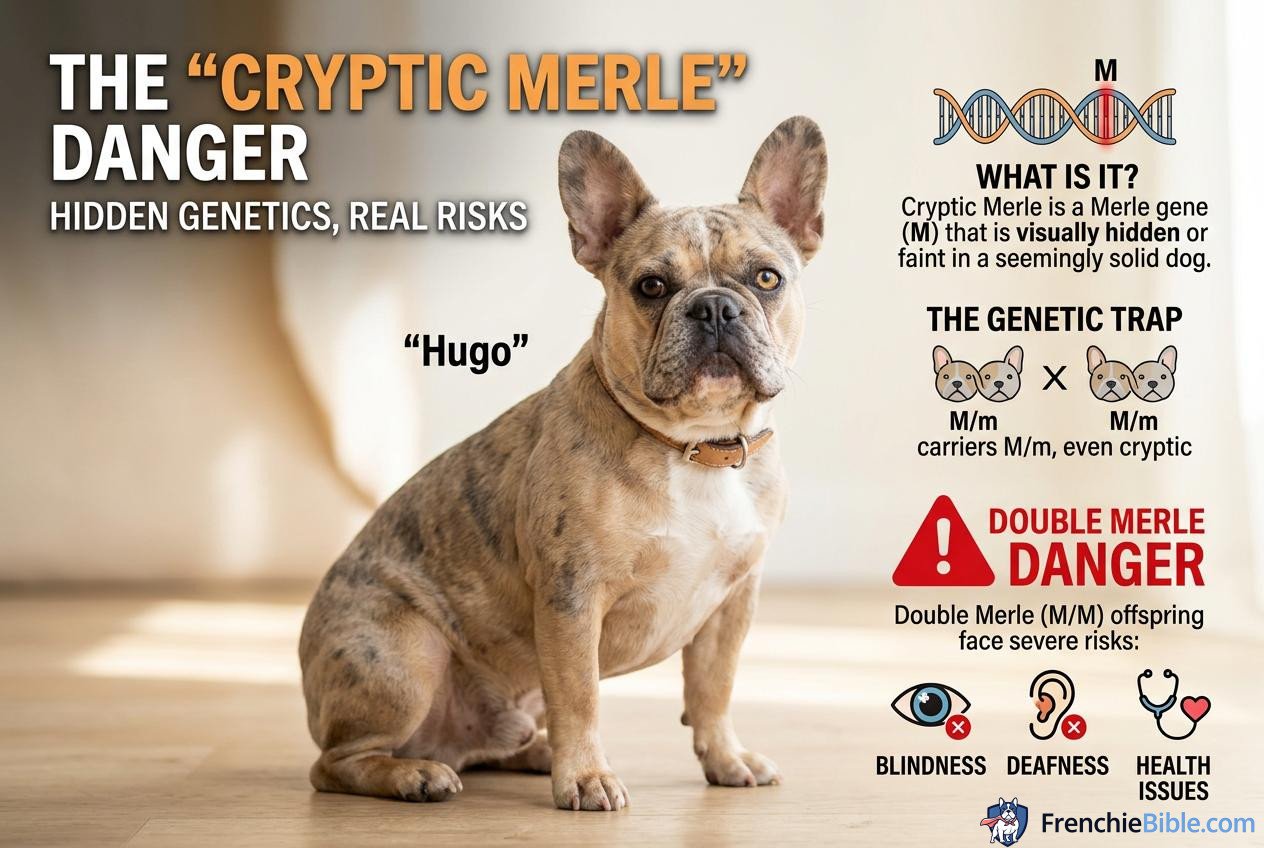
A Cryptic Merle is a dog that carries the Merle gene (and can pass it to its offspring) but physically exhibits little to no Merle patterning on its coat. It might just look like a normal fawn or brindle dog with a tiny, hidden grey patch on its tail.
If a greedy but uneducated breeder takes a Cryptic Merle and breeds it to a visible Merle—thinking they are doing a safe “Solid x Merle” pairing—they will accidentally produce a litter of deaf and blind Double Merles. Ethical breeding requires extensive, expensive DNA testing for the M-Locus, a step that backyard breeders and puppy mills simply skip to save money.
The Veterinary Perspective: Adding Fuel to the Fire
as a French Bulldog expert and breeder, my issue with Merle Frenchies extends beyond the Double Merle risk. The French Bulldog is already a breed plagued by severe genetic health issues: Brachycephalic Obstructive Airway Syndrome (BOAS), Intervertebral Disc Disease (IVDD), hemivertebrae, and severe allergies.
Ethical preservation breeders spend decades meticulously selecting dogs to improve airway function, widen nostrils, and straighten spines. They breed for health and temperament first.
Breeders who focus on the Merle color are breeding for cosmetic aesthetics first, second, and third. When a breeder selects a stud purely because he has a Merle coat, they are completely ignoring whether that stud has a compressed spine, severe allergies, or a collapsing trachea. The result is a population of “exotic” Frenchies that are structural and biological disasters, spending their short lives suffering from BOAS, spinal ruptures, and skin diseases.
Conclusion: Stop Funding the Fad
The boycott against Merle French Bulldogs by veterinarians, ethical breeders, and official Kennel Clubs is not about being elitist or gatekeeping the breed. It is about animal welfare.
Every time someone pays $8,000 for a Merle Frenchie because it “looks cool,” they are funding an unethical industry that happily produces blind, deaf, and structurally ruined puppies as a byproduct of capitalism.
If you love the French Bulldog breed—their clownish personalities, their loyalty, and their bat ears—support breeders who prioritize their ability to breathe, walk, and live a pain-free life. Do not let Instagram trends dictate dog breeding. A healthy, breathing, standard-colored Frenchie is infinitely more beautiful than an exotic dog destined for a life of suffering.
Frequently Asked Questions (FAQs)
1. Are all Merle French Bulldogs sick or deaf?
No, not all of them. A single-Merle (Mm) dog bred responsibly (Merle to non-Merle) will usually have normal hearing and vision. However, because they are bred primarily for color by “exotic” breeders, they often suffer from the structural issues common to poorly bred Frenchies, such as severe BOAS and spinal deformities.
2. Can you register a Merle French Bulldog with the AKC?
You cannot register a Merle Frenchie with full breeding rights or show them in conformation events under the AKC standard, as Merle is a disqualifying color. Unethical breeders often lie on AKC registration paperwork, registering Merle dogs as “brindle” or “fawn” with white markings to bypass the rules.
3. If I rescue a Merle French Bulldog, is that okay?
Absolutely! Rescuing a Merle Frenchie from a shelter or breed rescue is a wonderful thing to do. The goal of the boycott is to stop purchasing them from breeders, cutting off the financial incentive to create more. Rescuing gives a home to a dog that already exists without funding the exotic breeding industry.
4. What is a “Fad Color” in French Bulldogs?
“Fad colors” refer to coat colors that are not recognized by the breed standard and are often associated with genetic health issues. In French Bulldogs, fad colors include Merle, Blue (dilute), Isabella (lilac), Fluffy (long-haired), and Hairless. These dogs are marketed at extreme markups by backyard breeders.
5. How can I tell if a breeder is ethical?
An ethical breeder will health test their dogs (OFA certification for heart, patellas, spine, and eyes), breed to the official standard (no fad colors), interview you extensively to ensure you are a good home, and offer a lifetime return policy if you can no longer care for the dog. They prioritize health, structure, and temperament over coat color.
Disclaimer: We are not veterinarians and do not hold veterinary medical licenses. The information provided in this article is based on years of breeding and daily care experience and is for educational purposes only. It should not replace professional veterinary advice. Always consult with a licensed veterinarian if you have concerns about your French Bulldog’s health or before starting any new treatment.